Feeds:
Posts
Comments

Archive for the ‘Uncategorized’ Category

Photo: Imagine China via AP Images.
A solar-covered parking lot at the plant of Anhui Quanchai Engine Co., Ltd. in Chuzhou, China.

We have to keep a close watch on our innovations, even the ones we think are good. Take solar. Sometimes you read about aggressive solar companies decimating wooded lots to build an array. What? Trees are even better than solar at fighting global warming.

Let’s consider places where solar doesn’t harm anything. How about over a parking lot?

Richard Conniff writes at YaleEnvironment 360, “Fly into Orlando, Florida, and you may notice a 22-acre solar power array in the shape of Mickey Mouse’s head in a field just west of Disney World. Nearby, Disney also has a 270-acre solar farm of conventional design on former orchard and forest land. Park your car in any of Disney’s 32,000 parking spaces, on the other hand, and you won’t see a canopy overhead generating solar power (or providing shade) — not even if you snag one of the preferred spaces for which visitors pay up to $50 a day.

“This is how it typically goes with solar arrays: We build them on open space rather than in developed areas. That is, they overwhelmingly occupy croplands, arid lands, and grasslands, not rooftops or parking lots, according to a global inventory published last month in Nature. In the United States, for instance, roughly 51 percent of utility-scale solar facilities are in deserts; 33 percent are on croplands; and 10 percent are in grasslands and forests. Just 2.5 percent of U.S. solar power comes from urban areas.

“But that doesn’t necessarily make it smarter. Undeveloped land is a rapidly dwindling resource, and what’s left is under pressure to deliver a host of other services we require from the natural world — growing food, sheltering wildlife, storing and purifying water, preventing erosion, and sequestering carbon, among others. And that pressure is rapidly intensifying. By 2050, in one plausible scenario from the National Renewable Energy Laboratory (NREL), supplying solar power for all our electrical needs could require ground-based solar on 0.5 percent of the total land area of the United States … 10.3 million acres.

“Because it is more efficient to generate power close to customers, some states could end up with as much as five percent of their total land area — and 6.5 percent in tiny Rhode Island — under ground-based solar arrays, according to the NREL study. If we also ask solar power to run the nation’s entire automotive fleet, says Margolis, that adds another 5 million acres. It’s still less than half the 31 million acres of cropland eaten up in 2019 to grow corn for ethanol, a notoriously inefficient climate change remedy.

“The argument for doing it this way can seem compelling: It is cheaper to build on undeveloped land than on rooftops or in parking lots. And building alternative power sources fast and cheap is critical in the race to replace fossil fuels and avert catastrophic climate change. It’s also easier to manage a few big solar farms in an open landscape than a thousand small ones scattered across urban areas.

Despite the green image, putting solar facilities on undeveloped land is often not much better than putting subdivisions there.

“Developers tend to bulldoze sites, ‘removing all of the above-ground vegetation,’ says Rebecca Hernandez, an ecologist at the University of California at Davis. That’s bad for insects and the birds that feed on them. In the Southwest deserts where most U.S. solar farms now get built, the losses can also include ‘1,000-year-old creosote shrubs, and 100-year-old yuccas,’ or worse. The proposed 530-megawatt Aratina Solar Project around Boron, California, for instance, would destroy almost 4,300 western Joshua trees, a species imperiled, ironically, by development and climate change. … In California, endangered desert tortoises end up being translocated, with unknown results, says Hernandez. …

“The appeal of parking lots and rooftops, by contrast, is that they are abundant, close to customers, largely untapped for solar power generation, and on land that’s already been stripped of much of its biological value.

“A typical Walmart supercenter, for instance, has a five-acre parking lot, and it’s a wasteland, especially if you have to sweat your way across it under an asphalt-bubbling sun. Put a canopy over it, though, and it could support a three-megawatt solar array, according to a recent study co-authored by Joshua Pearce of Western University in Ontario.

“In addition to providing power to the store, the neighboring community, or the cars sheltered underneath, says Pearce, the canopy would shade customers — and keep them shopping longer, as their car batteries top up. If Walmart did that at all 3,571 of its U.S. super centers, the total capacity would be 11.1 gigawatts of solar power — roughly equivalent to a dozen large coal-fired power plants. Taking account of the part-time nature of solar power, Pearce figures that would be enough to permanently shut down four of those power plants.

“And yet solar canopies are barely beginning to show up in this country’s endless acreage of parking lots. The Washington, D.C., Metro transit system, for instance, has just contracted to build its first solar canopies at four of its rail station parking lots, with a projected capacity of 12.8 megawatts. 

“New York’s John F. Kennedy International Airport is now building its first, a 12.3 megawatt canopy costing $56 million. Evansville (Indiana) Regional Airport, however, already has two, covering 368 parking spaces, at a cost of $6.5 million. According to a spokesperson, the solar canopy earned a $310,000 profit in its first year of operation, based on premium pricing of those spaces and the sale of power at wholesale rates to the local utility.

“Rutgers University built one of the largest solar parking facilities in the country at its Piscataway, New Jersey campus, with a 32-acre footprint, an 8-megawatt output, and a business plan that the campus energy conservation manager called ‘pretty much cash-positive from the get-go.’ ”

Lots more info at YaleEnvironment360, here.
Read Full Post »

Photos: Suzanne and John’s Mom.
Commercial fishing is recognized as a high-stress job. Land & Sea Together offers a 24-hour help line and free counseling sessions with Coastline, a Rhode Island-based employee assistance program, for farming, fisheries, and forestry workers and their families.

Because I have never lived very far from the Atlantic, I have long known that the people who go out into deep water to catch the fish we buy are doing dangerous work. Fishermen may be injured handling boats in rough seas. Boats may be lost and the crew never seen again. The stress on families can be beyond belief.

That is why I was interested to read in this ecoRi News article that in Rhode Island, at least, help is available for workers in industries identified as especially stressful.

Bonnie Phillips writes, “Workers in Rhode Island’s farming, fisheries, and forestry [FFF] industries struggle with a number of stressors: the impacts of climate change; workforce issues; business and financial concerns; restrictive regulations, and more.

“Until recently, there were few ways workers in these industries — which have long working hours, often in isolation — could access support, whether financial, emotional, or physical. A new initiative, Land & Sea Together, is working to change that.

“ ‘Farmers and fishermen are among the professions most likely to commit suicide each year, and many more folks suffer silently as they tend their crops, equipment, and vessels,’ according to the organization’s website. Land & Sea aims to ‘reduce stress and build mental and financial resilience in the fisheries, forestry and farming communities’ by building a collaborative network of support services.

“The USDA-funded program, operated through the Rhode Island Department of Environmental Management and implemented by the Warwick-based Center for Collaboration and Mediation RI, was started in June 2022 with an initial $500,000 USDA grant. …

“To better understand the communities it wanted to help, Land & Sea put together a comprehensive needs assessment, released last December. For the 90-page report, L&ST studied existing data on the FFF industries in Rhode Island; surveyed individuals working in the industries about stressors; and convened a focus group of workers/owners in the industries. …

“Across the three industries, the main causes of stress were similar: financial management concerns; small-business operations; impacts of climate change; the inability to control the weather; labor shortages; succession planning; lack of access to resources; transportation barriers; housing challenges; longer working hours and increased workloads at peak times; and compliance with government regulations, according to the report. …

“Farmers, who often work where they live, said the lack of separation between work and home can blur the lines of family life, which often results in conflicts. And from spring to fall — the growing season — local farmers are under high amounts of stress, the report says, which can be exacerbated by the weather.

“Those in the fishing industry said heavy workloads, time pressure, lack of support due to isolated working conditions, and climate change were their main stressors. Employers in the fishing, aquaculture, and shellfishing industries reported difficulty hiring reliable workers, some of which they attributed to the lack of public transportation, especially in southern Rhode Island, and the difficulty of keeping employees during the winter. …

“A lack of mental health resources and a reluctance to seek help were identified as an issue across the FFF industries. Some employers, the report said, were unaware of available mental health resources they could offer their employees. Others said the nature of some of the jobs — lack of flexibility in the work schedule, uncompensated time off, and lack of insurance — prevented workers from seeking help. …

‘Most people in sea industries view themselves as a cross between Vikings and pirates, and they do not view themselves as people who need help,’ according to the report. …

“Employers interviewed for the report said they did not think their employees would seek help, and said they especially watch out for signs of concern in their younger employees. …

“Land & Sea offers a 24-hour help line and up to 12 free counseling sessions with Coastline EAP, a Rhode Island-based employee assistance program, for FFF workers and their families. Since the launch of the program in June 2022, [Laurel Witri, former director of the program] said, ’60 farming, fisheries, and forestry workers have called for assistance, receiving 286 hours of support with free outpatient services, financial counseling.’ …

The free, confidential help line with Coastline EAP is 1-800-445-1195, and support is available in English, Spanish, Portuguese, and Cape Verde Creole. The National Suicide and Crisis Hotline is 988, available by call or text.

More at ecoRI News, here. This nonprofit highlights environmental stories that often effect the whole country. It has no paywall, but please consider a donation.

Read Full Post »

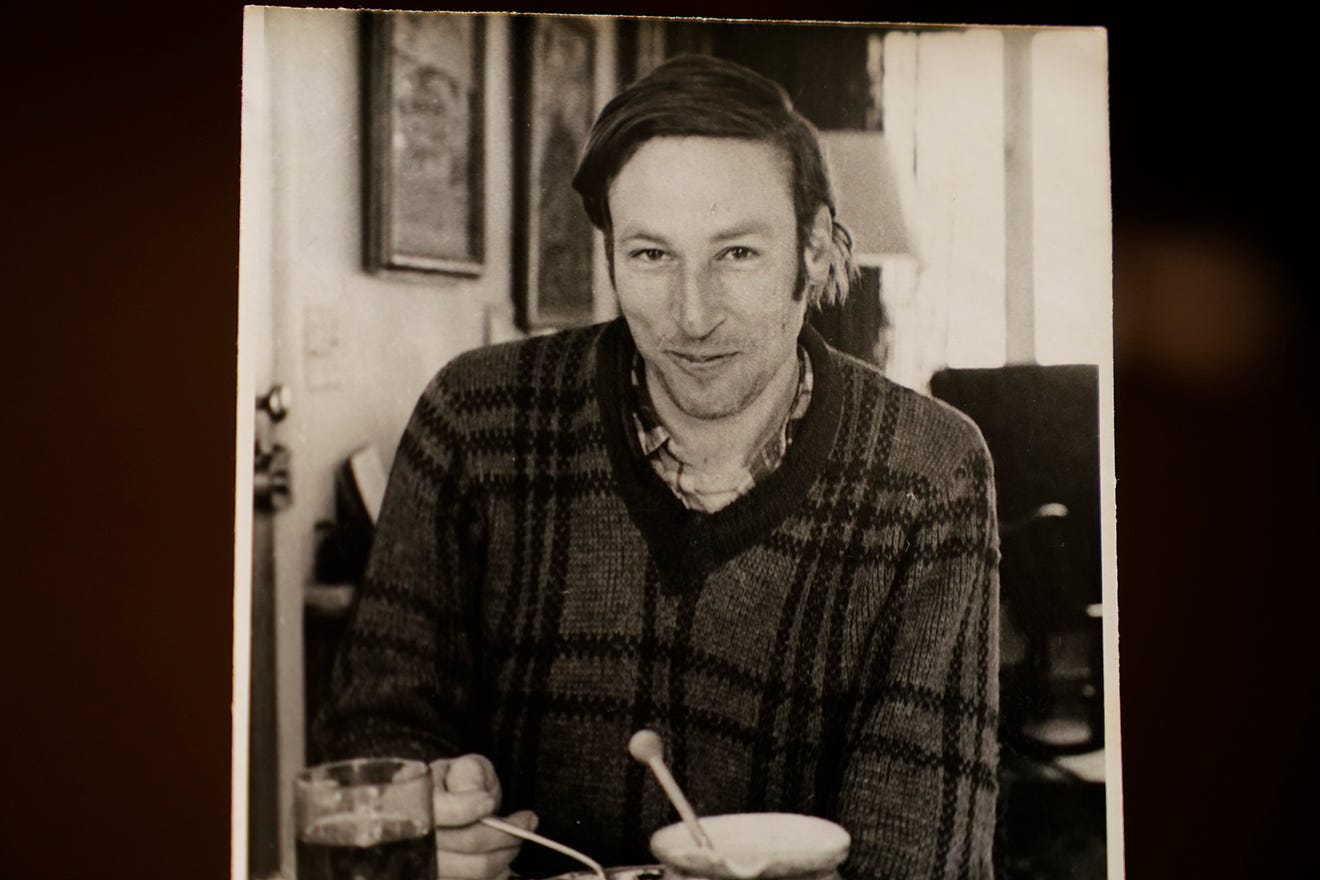
Photo: AP via Ed Smith and family of Geoffrey Holt.
Almost no one knew this unassuming man was investing — until his small New Hampshire town got a large bequest.

In today’s story, a quiet man, known locally as a groundskeeper for a trailer park, rises to prominence in a way that would have totally embarrassed him.

Saleen Martin has the story at USA Today. “Community members knew the late Geoffrey Holt to be a reserved man who liked simple things.  What most people didn’t know is that he was sitting on a $3.8 million fortune. Holt died on June 6, leaving millions to his beloved town of Hinsdale, New Hampshire. ..

“Hinsdale Town Administrator Kathryn Lynch said Edwin ‘Smokey’ Smith is Holt’s estate executor. He told town administrators about Holt’s generous donation a few months ago. …

“ ‘The town and other community committees can apply annually for a grant of $150,000 to be used for health, education, culture or recreation,’ she told USA TODAY in an email. … The town is considering using the money for electronic ballot machines since Holt was ‘an avid voter.’ …

“The main thing, she said, is that they want to honor how frugal Holt was and find ways to help people in Hinsdale save money through the town budget.

“Smokey Smith [and Holt] met when Smith ran an insurance company. … ‘He was very reserved,’ Smith said. ‘He liked to be at the back of a group rather than in the front. He got along well with people, but he didn’t want to be the one leading the conversation. If he knew what was going on today with this story … he would be all sorts of embarrassed.’ …

“Holt worked for Agway Corporation in the 1970s. According to his obituary, he was a production manager with the company. When they closed in the 1980s, he received a cash settlement that he chose to invest.

“He also did odd jobs around town when Agway closed. Smith eventually hired him to do some work on his land. … Smith said Holt eventually moved into an apartment he owned and then, a mobile home that he shared with a woman named Thelma Parker. … She died in 2017.

“ ‘She was good for him and he was good for her,’ Smith said. … ‘She helped him be a little more social. They were a good fit. She was the inspiration he needed to keep moving and she had somebody around to help her.’ …

“He had a car when he worked at Agway but sold it. … What Holt seemed to really love was his lawn mower. He’d ride around Smith’s property with his bad leg elevated on the hood of the vehicle, his friend recalled. … ‘He had several places where he trimmed back the brush so that he could sit down there and read magazines, newspapers, just put his foot up and enjoy the brook and nature.’ …

“Holt spent many years in preparatory school when he was younger. … ‘That’s where he learned that if you stay in the background, you stay out of trouble,’ Smith said. … In 1963, he graduated with a bachelor’s degree from Marlboro College in Vermont and then served in the United States Navy, his obituary reads. 

“He later earned a master’s degree from American International College in Massachusetts in 1968 and then taught social studies and drivers’ education at Thayer High School in Winchester, New Hampshire.

“Smith recalls the day Holt told him about his fortune. It was about 13 years ago. He said his investments had done better than he expected.”

More at USA Today, here.

Read Full Post »

Art: Stella Teller.
“Seated Storyteller with Four Children.”

For too long, the dominant culture has missed out on some great storytelling. Gradually that is changing, and indigenous playwrights are part of the change.

Mark Kennedy wrote at the Associated Press (AP), “The financial crisis of 2008 hit Mary Kathryn Nagle differently. As a playwright and a citizen of the Cherokee Nation, she saw parallels to events that negatively impacted Indigenous people centuries ago.

“Her play Manahatta juxtaposes the recent mortgage meltdown when thousands lost their homes to predatory lenders with the shady 17th-century Dutch who swindled and violently pushed Native Americans off their ancestral lands. …

“Nagle’s 2018 play has landed in New York City at the prestigious Public Theater this winter and it’s just the latest in a flowering of Native storytelling. From Reservation Dogs, Dark Winds and Rutherford Falls on TV to Prey on the big screen and Larissa FastHorse becoming the first Indigenous female playwright on Broadway, barriers are being broken.

“ ‘I hope it’s not a moment. I hope it’s the beginning of an era,’ says FastHorse, a member of the Sicangu Lakota Nation and a 2020 MacArthur Fellow. …

“ ‘[Most] film studios had never produced any content actually written or produced by Natives. It may have been about some Native people, but it was not written by Native people. And we’ve just seen that flipped on its head,’ Nagle said. …

“Nagle recalls moving to New York in 2010 and asking artistic directors of theaters why they weren’t producing Native work. They would answer that they didn’t know any Native playwrights or that there weren’t enough Native audiences to power ticket sales.

“ ‘Good storytelling is good storytelling, whether the protagonist is white, Black, Asian, LGBTQ — it doesn’t matter,’ said Nagle, who is on the board of IllumiNative, a nonprofit working to deal with the erasure of Native people.

” ‘There’s a lot of projects out there that are changing the narrative and that are proving that our stories are powerful and that non-Natives are really moved by them because they’re good stories.’

“Madeline Sayet, a playwright and professor at Arizona State University who also runs the Yale Indigenous Performing Arts Program, sees the contemporary Native theater movement flowing from the Civil Rights Movement of the ‘60s and ’70s and an increase in awareness of Indigenous issues ever since Native people won the right to legally practice their culture, art and religion.

“She connects the Wounded Knee occupation of 1973 to the Standing Rock standoff over the Dakota Access Pipeline in 2016 to Ned Blackhawk’s The Rediscovery of America: Native Peoples and the Unmaking of U.S History winning the National Book Award this year.

“Sayet, a member of the Mohegan Tribe who became the first Native playwright produced at the Public when her Where We Belong made it in 2020, said keeping Indigenous stories being produced depends on changing funding structures and getting long-term commitments from theaters and programs like Young Native Playwrights Contest.

“FastHorse, who made history on Broadway in 2023 with her satirical comedy The Thanksgiving Play, which follows white liberals trying to devise a culturally sensitive Thanksgiving play, has since turned her attention to helping rewrite some classic stage musicals to be more culturally sensitive. …

“She has recently reworked the book for an upcoming touring musical revival of the 1954 classic Peter Pan, which was adapted by Jerome Robbins and has a score by Moose Charlap-Carolyn Leigh and additional songs by Jule Styne, Betty Comden and Adolph Green.

“FastHorse found the character of Peter Pan complex, the pirates funny, the music enchanting but the depictions of Indigenous people and women appalling. There were references to ‘redskins’ throughout, a nonsense song called ‘Ugh-A-Wug’ and Tiger Lily fends off randy braves ‘with a hatchet.’ …

“FastHorse widened the concept of Native in the musical to encompass members of several under-pressure Indigenous cultures from all over the globe — Africa, Japan and Eastern Europe, among them — who have retreated to Neverland to preserve their culture until they can find a way back.

“The playwright said one of her guiding principles in the reworking was to make sure a little Native girl in South Dakota could see herself and celebrate. ‘Then we’ve done our job and she can join the magic instead of having to armor herself against the magic.’ …

“ ‘I think one thing I’m just hoping that people take away from this play is like, “Wow, Native stories are really compelling. Native people are incredible. They’re incredibly resilient. They’re incredibly brilliant. Yes, there’s tragedy, but they have such incredible senses of humor,” ‘ [Nagle] said.

“ ‘I want them to love my characters the way I love them. I want them to feel the heartache. I want them to feel the laughter. I want them to feel the love,’ she said. ‘And I want them to leave the theater just wanting to know more about our tribal nations and our Native people.’ ” More at AP, here.

Got ideas for a show that needs the red pencil of FastHorse? I’d start with Annie Get Your Gun. Come to think of it, that show also needs the red pencil of poor, white mountain people. Their presentation is painful, too.

Read Full Post »

Photo: Aardman/Netflix.
A still from Chicken Run: Dawn of the Nugget. The Wallace and Gromit studio reassures fans over rumors of a clay “shortage.”

Here’s a kind of antidote to all the serious things one worries about these days. I myself am an Olympic worrier. For example, when Suzanne went to live in New York after college, I made a little notebook for her, starting with “Things to Worry About in New York City.” (I don’t think it infected her much.)

These days, I worry about the health of people I care about, the war in the Middle East, climate change, the increase in authoritarian governments, Covid, the meanness of our political divide, plastic in the ocean, homelessness, Bangladesh, Burma, Sudan, Ukraine, hungry children, income inequality. And when I don’t know what is going on or why something is happening in my own life, I revert to a childhood way of coping by making up scenarios that are usually off base. Like my scratchy eye means I’m going blind.

So I was delighted to see that there are silly things to worry about. Couldn’t they become a kind of self-inoculation? I guess they would still have to be regarding something you actually cared about. A nice example today is the worry that Wallace and Gromit claymation fans indulged in when they thought there might be a shortage of clay.

Andrew Pulver has the story at the Guardian, the “Wallace and Gromit studio, Aardman Animations, has reassured its fans, and the film industry at large, that production of its popular films will not be grinding to a halt any time soon, saying ‘there is absolutely no need to worry.’

“After reports that the manufacturers of Aardman’s favored modeling clay had gone out of business, meaning the animators had enough supplies for only one more film, Aardman issued a statement on social media saying: ‘We are touched about recent concern over the future of our beloved clay creations, but wanted to reassure fans that there is absolutely no need to worry.’ …

” ‘We have been tinkering away behind the scenes for quite some time with plans in place to ensure a smooth transition to new stocks to continue to make our iconic productions.’

“Aardman is shortly to release Chicken Run: Dawn of the Nugget, a sequel to its hit poultry comedy from 2000, while it is still in production on a new Wallace and Gromit feature, due for release in 2024.” More at the Guardian, here. No paywall.

That’s one worry that can be put to bed. … But wait! The Guardian goes on to say, “In 2005 Aardman lost much of its archive material in a warehouse fire in Bristol.” What? Oh, no!

Read Full Post »

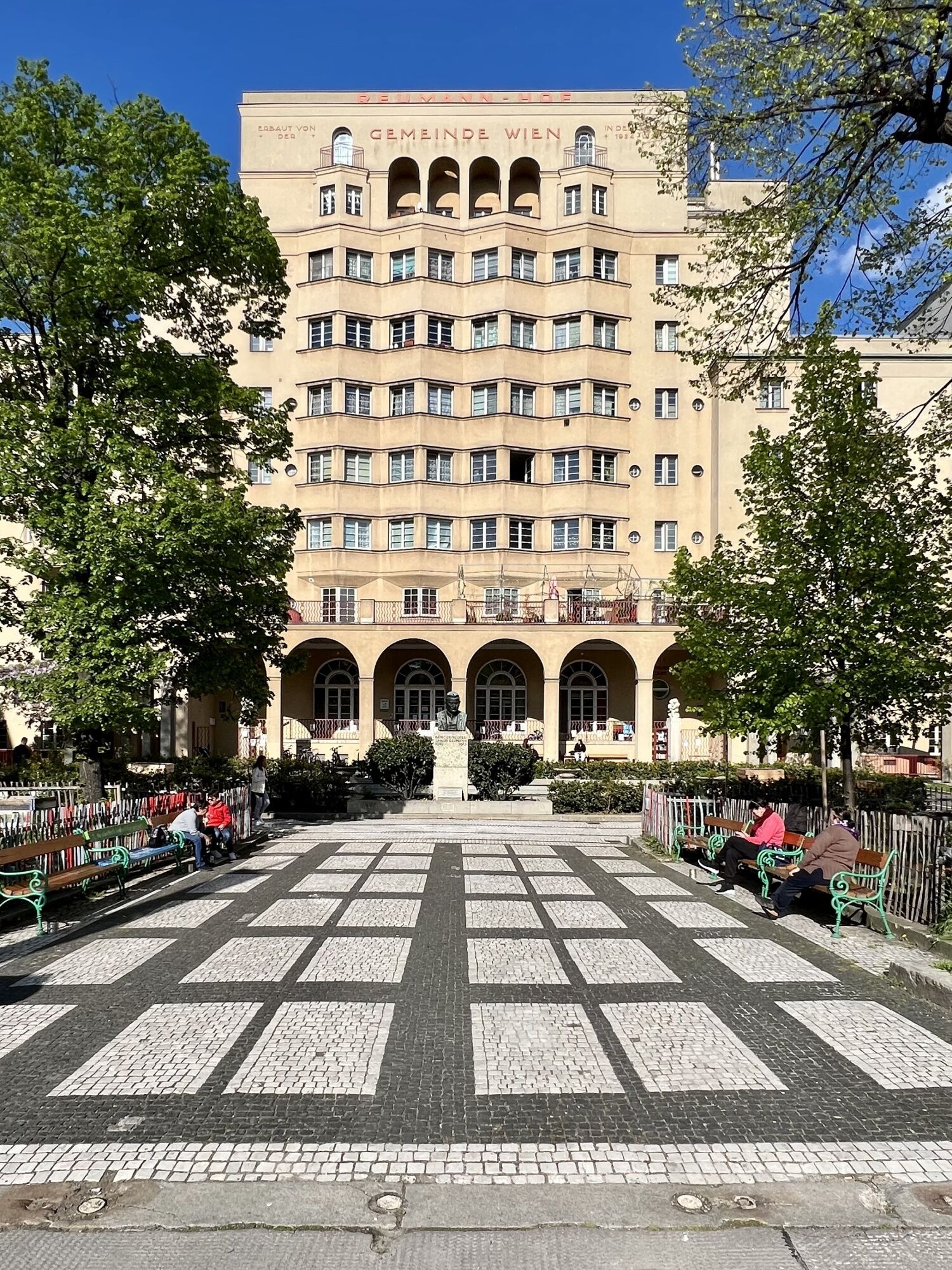
Photo: Richard Conway/Bloomberg CityLab.
The 478-unit Reumannhof, public housing completed in 1926, was named for Vienna’s first Social Democratic mayor, Jakob Reumann.

Making sure all residents have decent housing is a challenge for cities around the globe. Richard Conway at Bloomberg CityLab says Vienna pretty much figured it out in the 1920s. He maintains it’s the reason Vienna is such a livable city today.

“The housing crunch that the growing city of Vienna faced a century ago,” he writes, “might seem strikingly familiar today: Private developers in the Austrian capital were good at building elegant luxury residences and substandard tenements for the poor, but they’d failed to create enough units to allow average residents to live in decent comfort at an affordable price.

“In response, Vienna’s Social Democratic government pursued a solution that modern cities still struggle to emulate: a massive construction program for public housing.

“The municipal apartment complexes they built, known as Gemeindebau, provided new homes at a volume and level of quality never seen before, and rarely seen since. The long-term results not only saw conditions for the average Viennese skyrocket, they also provided a hugely influential example for cities from Moscow to Manhattan.

These cities-within-a-city included medical facilities, schools, libraries, post offices and theater spaces.

“The Viennese Gemeindebau — plural Gemeindebauten — emerged in a city already in flux. Following Austria’s defeat in World War I, the country’s empire had dissolved and its monarchy was replaced by a democracy, in which the Social Democratic Workers Party (SDAPÖ) had the largest number of seats, both nationally and in Vienna. Once in power, the Social Democrats started addressing an issue central to their base: the overcrowding plaguing the new republic’s capital.

“In the 40 years leading up to 1918 … working-class families often lived in tenements known as Bassena, so named after the communal sinks found in their hallways. While they could look grand from the street, six or seven people might pack into a single apartment; often, each household shared a toilet and a sink and lacked electricity or heating beyond coal and wood stoves. They weren’t cheap, either: About 25% of a tenant’s wages went toward monthly rent, according to a 2022 MIT study.

“Starting in 1919 and continuing through to 1934, the Social Democrats launched a series of wide-reaching urban reforms focused on improving living conditions, education and social services. This period of SDAPÖ rule, widely known as Red Vienna, was informed by non-Bolshevik Austro-Marxism, which emphasized democracy, parliamentary politics and public investment. The Gemeindebauten, or municipal housing projects, were born.

“In the early days of the administration, there were two competing types of Gemeindebau. The first was associated with the settler movement: a group of low-income Viennese and refugees displaced from Austria’s fragmenting empire who occupied squatter settlements on the city’s periphery in an era of postwar political and social disruption. Viennese authorities eventually took over these informal communities, formalizing and planning them using elements of the Garden City philosophy.

“It was a second, much more common type of Gemeindebau, however, that came to define Vienna — the superblock-scaled Volkswohnungspaläste (‘people’s apartment palaces’). …

“Neither elaborately decorative like Vienna’s prewar tenements nor strikingly spare like the glass-and-steel apartments of the later International Style, the Gemeindebau often straddled an intriguing line between late 19th historicism and 20th century modernism. …

“Like older tenements, the buildings were typically aligned with streets, accessorized with some decorative features such as fancy brickwork or statuary and grouped around shared common yards. But while Bassena courtyards tended to be narrow, treeless and drab, the huge courtyards of the Gemeindebauten were spacious enough to serve as as combined garden, sports facility and public square, all accessible and sheltered from street noise. …

“In general, the shared areas within the superblocks were in fact as important as the individual homes, reflecting the Viennese administration’s social philosophy. These cities-within-a-city included medical facilities, schools, libraries, post offices and theater spaces. Curved staircases connected large floors — often as many as seven — and spacious landings. …

“The individual apartments, while varying in layout, shared key features. They included a living room, a bedroom, a kitchen, and some had small entrance hallways inside the front door. Almost all units featured running water, while many had large windows and balconies. Each apartment usually housed an individual family.

“Vienna employed nearly 200 architects to build more than 380 Gemeindebau complexes between the wars, a construction boom that created 60,000 new municipal apartments. In her book The Architecture of Red Vienna 1919-1934, Harvard professor Eve Blau describes how the municipal government was able to do this through expropriation, the use of tax policies to reduce land values and zoning laws. By 1931, it owned a third of the city’s area.

“Working-class citizens might now expect to live in airy apartments and access shared facilities. Indeed, the urban philosophy of Gemeindebauten is neatly captured by a term carved by artist Mario Petrucci into a statue outside a housing project: … ‘Light in the home. Sun in the heart.’ This was more than just a slogan; it represented an entire worldview.”

More at CityLab, here. No paywall. Interesting pictures.

Read Full Post »

041217-shadows-stripe-forest-floor

Photo: Suzanne and John’s Mom.
Some living things benefit the planet more the older they get.

Those of us who were enthusiastic about planting zillions of trees to store carbon have been learning that the trees need to be part of a healthy ecosystem to do the most good. A collaboration among hundreds of forest ecologists offers keys to what works.

Patrick Greenfield writes at the Guardian, “Forest conservation and restoration could make a major contribution to tackling the climate crisis as long as greenhouse gas emissions are slashed, according to a study.

“By allowing existing trees to grow old in healthy ecosystems and restoring degraded areas, scientists say 226 gigatonnes of carbon could be sequestered, equivalent to nearly 50 years of US emissions for 2022.

But they caution that mass monoculture tree-planting and offsetting will not help forests realize their potential. …

“The research, published [in November] in the journal Nature as part of a collaboration between hundreds of leading forest ecologists, estimates that outside of urban agricultural areas in regions with low human footprints where forests naturally exist, they could draw down large amounts of carbon.

“About 61% of the potential could be realized by protecting standing forests, allowing them to mature into old growth ecosystems like Białowieża forest in Poland [check out the new Polish administration’s environmentalism] and Belarus or California’s sequoia groves, which survived for thousands of years. The remaining 39% could be achieved by restoring fragmented forests and areas that have already been cleared.

“Amid greenwashing concerns around nature’s role in climate crisis mitigation, the researchers underlined the importance of biodiversity helping forests reach their carbon drawdown potential, warning that planting huge numbers of single species would not help and urgent cuts to fossil fuel emissions were needed.

“Rising numbers of forest fires and higher temperatures due to the climate crisis would be likely to reduce the potential, they said. ‘Most of the world’s forests are highly degraded. In fact, many people have never been in one of the few old growth forests that remain on Earth,’ said Lidong Mo, a lead author of the study. ‘To restore global biodiversity, ending deforestation must be a top priority.’

“At Cop26 in 2021, world leaders pledged to halt and reverse deforestation by the end of this decade, although data shows that countries are currently off track. Brazil, Colombia and Indonesia are among nations making progress, however. The researchers said meeting this target, along with making good on UN climate and biodiversity agreements, was crucial to forests reaching their full potential.

“ ‘Conserving forests, ending deforestation and empowering people who live in association with those forests has the power to capture 61% of our potential. That’s huge. It’s potentially reframing forest conservation. It’s no longer avoided emissions, it’s massive carbon drawdown, too,’ said Tom Crowther, the head of the Crowther Lab at ETH Zurich. …

“ ‘It can be achieved by millions of local communities, Indigenous communities, farmers and foresters who promote biodiversity. It could be agroforestry for cacao, coffee or banana, natural regeneration, rewilding or creating habitat corridors. They’re successful when nature becomes the economic choice.’ …

“The research follows a controversial 2019 paper on the potential of forests to mitigate the climate crisis, which was also co-authored by Crowther, that provoked intense scientific debate among forest ecologists. … Several scientists felt that potential for nature to help meet climate goals had been overstated and the paper advocated for the creation of mass tree-planting, driving greenwashing concerns.

“Simon Lewis, a professor of Global Change Science at University College London who was a leading critic of the 2019 paper, said the new estimate was much more reasonable and conservative.

“There is a lot of spin and bluster about what trees can do for the environment. To cut through this always ask: what is the amount of carbon taken up by a hectare of land, and over what time period, he said. … ‘There is still only a finite amount of land to dedicate to forests, and ability of trees to sequester carbon is limited. The reality is that we need to slash fossil fuel emissions, end deforestation, and restore ecosystems to stabilize the climate in line with the Paris agreement.’

“Crowther acknowledged that he had been overzealous in the messaging around the 2019 paper. … ‘The fact that it was so much carbon I think gave people the idea that [the study] was suggesting that tree planting could be an alternative to cutting emissions, which categorically cannot be.’ ”

More at the Guardian, here.

Read Full Post »

Art: Janet Sobel.
Janet Sobel (1893–1968) was born Jennie Lechovsky in a Jewish settlement in Ukraine. Her contributions to abstract expressionist sensibilities is acknowledged in the book
Brushed Aside: The Untold Story of Women in Art.

Is Jackson Pollock famous because he made drip paintings or because what he made that way speaks to people? I’m inclined to say the results matter more than the technique. But Pollock apparently gets credit for a woman’s discovery that inspired him.

Noah Charney at Literary Hub writes, “We’re supposed to think that Jackson Pollock invented drip painting, and with it the American branch of Abstract Expressionism. … The first drip, or all-around painting — made by the revolutionary technique of splattering and dripping paint on the fly while approaching the canvas from all angles, as it lay on the floor — was Pollock’s 1947 Galaxy. Wasn’t it?

“It makes for a good story. Pollock was the macho, hard-drinking, Wyoming-raised cowboy of postwar American art — Hemingway with a paint bucket. … He remains one of the two most famous American painters, along with Andy Warhol. Americans, especially American men in the 1940s and 1950s, blazed trails and cast their shadows across the globe. …

“That’s [the narrative my book] Brushed Aside: The Untold Story of Women in Art seeks to correct. … Let’s begin by gently bumping Jackson Pollock off his pedestal. …

“Janet Sobel (1893–1968) was born as Jennie Lechovsky in a Jewish settlement in Ukraine. Her father was killed in a pogrom, the trauma of which prompted her to move to the United States, with her mother and three siblings, in 1908. A year later she married and went on to raise five children. It was decades later that she first picked up a paintbrush, when her then nineteen-year-old son passed his art supplies off to her. He’d won a scholarship to the Art Students League but didn’t plan to take it.

“She tried to convince him to do so, to which he replied, ‘If you’re so interested in art, why don’t you paint?’

“So paint she did. She was entirely untrained, and that has often been a good thing. In the sixteenth through the eighteenth centuries, it was considered a feather in one’s cap to be an ‘academic painter,’ as the best artists were emerging from the early days of the academy system. But from the nineteenth century onward, being called an ‘academic painter’ would be more of an insult. …

“Sobel experimented. She would squirt paint directly out of a tube, drip it with an eyedropper, even pull wet paint across the canvas using suction from a vacuum cleaner. She didn’t set her canvases on easels but laid them on the floor so she could attack them from all angles. As art historian Kelly Grovier wrote, ‘she assaulted the surface of canvases laid out on the floor, orchestrating a a liquid lyricism of spills, splashes and spits, the likes of which had never before been seen.’ Sobel’s first drip painting was one she’d call Milky Way and finish in 1945 — two years before Pollock ‘invented’ drip painting.

“One of Sobel’s sons, Sol [had written] to the leading tastemakers of the time, including Marc Chagall, who, like Sobel, had fled antisemitic pogroms of his youth and was among the world’s most famous painters.

“But he also wrote to Sidney Janis, a wealthy clothing manufacturer and art collector who had been an advisor to MoMA (the Museum of Modern Art) since 1934 and who would be described today as an art world influencer. Janis saw Sobel as one of the great Contemporary American artists (along with others who were immigrants to America, including Willem de Kooning and Marko Rothko). …

“Another hugely influential woman, Peggy Guggenheim, also included Sobel in a high-profile exhibition she promoted called ‘The Women.’ But these were all in 1944 and featured Sobel’s work prior to her innovation of the drip technique.

“Guggenheim was so impressed with Sobel that she also put on a solo show for her at her gallery, Art of the Century. That ran in 1946 and did include [drip painting] Milky Way. The leading art critic of the time, Clement Greenberg, wrote about visiting that exhibit with Jackson Pollock in 1946. Greenberg recalled the exhibit with a combination of dismissive misogynism toward Sobel and an admission that she had inspired Pollock.

“He wrote that he and Pollock had ‘noticed one or two curious paintings shown at Peggy Guggenheim’s by a primitive painter, Janet Sobel (who was, and still is, a housewife living in Brooklyn). … Pollock (and I myself) admired these pictures rather furtively. … The effect — and it was the first really “allover” one that I had ever seen — was strangely pleasing. Later on, Pollock admitted that these pictures had made an impression on him.’ “

You can read more at Literary Hub, here.

Read Full Post »

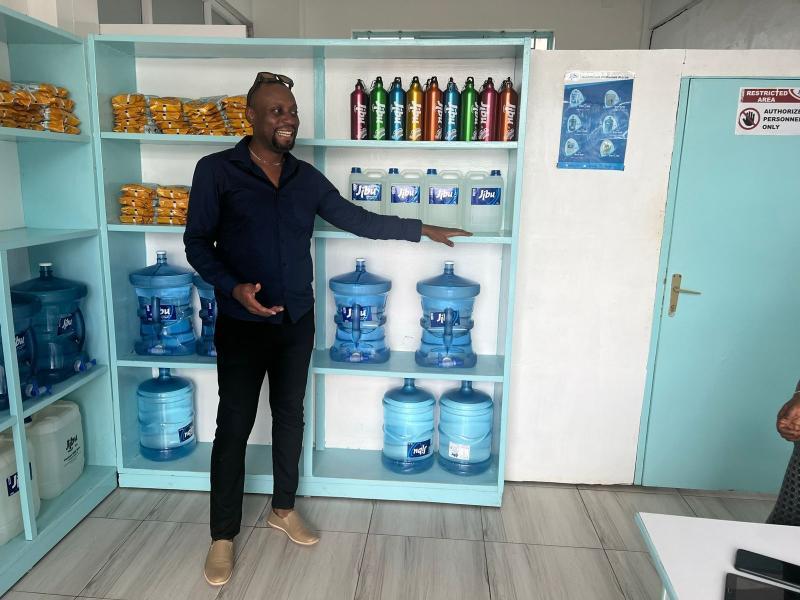
Photo: Kiva.org.
Ivan provides safe, affordable drinking water to people in Uganda, a country where, according to my grandson, 38 million people are without safe water. Ivan has applied for a loan from Kiva.org.

I was visiting Suzanne’s family yesterday and heard from my grandson about a worthy cause he’s donating some savings to. Actually, not donating. He is lending what he can to an entrepreneur called Ivan to help people in a country he has studied get access to safe drinking water.

How did this interest come about?

My grandson’s sixth-grade class’s research on the UN Global Goal of Eradicating Extreme Poverty involved choosing someone from a poor country who had applied to the lending nonprofit Kiva — and making a loan. After studying the poverty issue, screening a living-on-$1.98-cents-a-day experiment, and researching some of the Kiva offerings, the class voted.

My grandson was disappointed when the majority chose to support a grandmother in Thailand who was selling hammocks to help her care for a sick grandchild. He says that Uganda is a poorer country than Thailand — and he maintains that hammock accidents kill people. (He Googled it.) He also says that the annual income in Thailand is 8 times higher than in Uganda.

I asked him what the class majority’s reasoning was. He said (a) there was no way his favorite would get the extra $10,000 he still needed in the 8 days left in his application and (b) the grandmother still had 30 days left and was doing this for family. (He talks that way — “a and b.”)

He is not taking his defeat lying down, lending some of his own savings to Ivan’s cause, posting the link about Ivan in all the many chat rooms of his chess groups, sending Suzanne to twitter to promote Ivan’s application, and talking to me about a blog post.

Now here’s what Kiva says about Ivan: “Ivan is an experienced and seasoned entrepreneur in the safe water production and distribution sector. He has owned and run a Jibu water franchise for over five years and still counting. With the opportunity to open up a water production in the Munyonyo neighborhood, Ivan is excited at the opportunity to take safe and affordable drinking water to the residents of Munyonyo and also subsequently provide jobs for the youth who will be involved in the production and distribution value chain.

“Ivan is seeking a Kiva loan to open the Munyonyo operations. The loan will facilitate the launch of a water production and storefront facility, ensuring that every corner of Munyonyo has access to clean and affordable water. Please support Ivan so he can provide safe and affordable drinking water closer to the Munyonyo neighborhood.”

Interested? Please go to https://www.kiva.org/lend/2688341. Click on “technology.” Then click on the photo of Ivan and his water bottles. If you like the concept, maybe you or someone you know on social media will be up for helping. The Kiva rule is that Ivan has to get the total amount he applied for within the time allotted.

My grandson admits that this kind of lending is not a money-making proposition. He will get paid back in 39 months — in other words, when he is nearly 15 — without interest. (And I guess Kiva will reach him through Erik’s email, as Papa used a charge card when my grandson handed him the cash.)

But look, my grandson says, water is important — every 10 seconds someone in the world dies of water-borne disease, and 38 million Ugandans are without safe water.

Not a guy to argue with.

For more background on the nonprofit (“100% of every dollar you lend on Kiva goes to funding loans”) click here. It has a very good rating from Charity Navigator.

Read Full Post »

Photo: Marica S. Tacconi, CC BY-SA.
The musical score depicted in Jacopo Guarana’s fresco in a Venetian orphanage. 

I know there is a lot of drudgery in historical research and archaeology, but what fun to discover clues about the past that can be brought to life in the present!

That’s what Marica S. Tacconi, professor of musicology and art history at Penn State, does. At the Conversation, she writes about her determination to bring back music painted on the walls of a Venetian orphanage centuries ago.

She begins by asking the reader to imagine today’s rock stars “teaching at an orphanage or homeless shelter, offering daily music lessons” and says “that’s what took place at Venice’s four Ospedali Grandi, which were charitable institutions that took in the needy – including orphaned and foundling girls – from the 16th century to the turn of the 19th century.

“Remarkably, all four Ospedali hired some of the greatest musicians and composers of the time, such as Antonio Vivaldi and Nicola Porpora, to provide the young women – known as the ‘putte’ – with a superb music education.

“In the summer of 2019, while in Venice on a research trip, I had the opportunity to visit the Ospedale di Santa Maria dei Derelitti, more commonly known as the Ospedaletto, or ‘Little Hospital, because it was the smallest of the four Ospedali Grandi.

“As a musicologist specializing in the music of early modern Venice, I was especially excited to visit one of the hidden gems of the city: the Ospedaletto’s music room, which was built in the mid-1770s. …. Little did I know that I would encounter music that hasn’t been performed in nearly 250 years.

“As we entered the stunning music room, I was immediately struck by its elegance and relatively small size. In my mind, I had envisioned a large concert hall; instead, the space is intimate, ellipse-shaped and richly decorated.

“Overshadowed by the more prominent Ospedale della Pietà, not much is known about the music-making that took place for centuries behind the walls of the Ospedaletto. But one of the greatest clues to its venerable history as a music school is literally on one of its walls.

“A fresco on the far wall of the room, painted in 1776-77 by Jacopo Guarana, depicts a group of female musicians – likely portraits of some of the putte – at the feet of Apollo, the Greek god of music. Some of them play string instruments; one, gazing toward the viewer, holds a page of sheet music. …

“The music notation was quite legible, and the composer’s name was inscribed in the upper-right corner: ‘Sig. Anfossi.’

“I took several photos of the fresco. I wanted to learn as much as I could about that piece of music painted on the wall. …

“Armed with those clues on the wall, I continued my research in the days following the visit to the Ospedaletto. I learned that the music by ‘Signor Anfossi’ shown in the fresco was drawn from the opera Antigono, composed by Pasquale Anfossi (1727-97) on a libretto by Pietro Metastasio. The work premiered in Venice at the Teatro San Benedetto in 1773.

“The text of the [aria] is legible in the excerpt on the wall. It reads, ‘Contro il destin che freme, combatteremo insieme’ – ‘Against quivering destiny, we shall battle together.’

“Like many works from the 17th and 18th centuries, the entire opera is lost. I was determined to find out, however, if that particular aria had survived. … Luck was on my side: To my delight, I found a copy of the aria in a library in Montecassino, a small town southeast of Rome. Why was that particular excerpt chosen to be displayed so prominently on the wall?

“Like other institutions in Venice, the Ospedaletto faced financial hardship in the 1770s. Evidence suggests that the putte of the Ospedaletto were likely involved in raising the funds for the decoration of the music room. The new hall enabled them to give performances for special guests and benefactors, which brought in substantial donations. Together with Pasquale Anfossi, who was their music teacher from 1773 to 1777, they rallied behind their beloved institution, saving it – at least temporarily – from financial destitution. …

“Incidentally, the putte may also have wanted to honor their teacher, as Pasquale Anfossi, too, is portrayed in Guarana’s fresco, directly behind the young woman holding up his music.

“One of the aspects I find most rewarding about the study of older music is the process of discovering a work that has been neglected and unheard for hundreds of years and bringing it back to modern audiences.

“Inspired by the Ospedaletto’s music room, [my colleague] Liesl Odenweller and I have embarked on a collaborative project that brings back not only the aria on the wall but also other music from the institution that has gone unheard for centuries … thanks to a generous grant from the Gladys Krieble Delmas Foundation, the Venice Music Project. …

“Because the music of the past was written in a notation that’s different from that used today, it’s necessary to translate and input every mark of the original score – notes, dynamics and other expressive marks – into a music notation software to produce a modern score that can be easily read by today’s musicians.

“By performing on period instruments and using a historically informed approach, the musicians of the Venice Music Project and I are excited to revive this remarkably beautiful and meaningful music. Its neglect is certainly not a reflection of its artistic quality but rather likely the result of other composers, such as Vivaldi and Mozart, taking over the spotlight and overshadowing the works of other masters.”

More at the Conversation, here. The author has a nice description of her colleague testing the room’s exceptional acoustics.

Read Full Post »

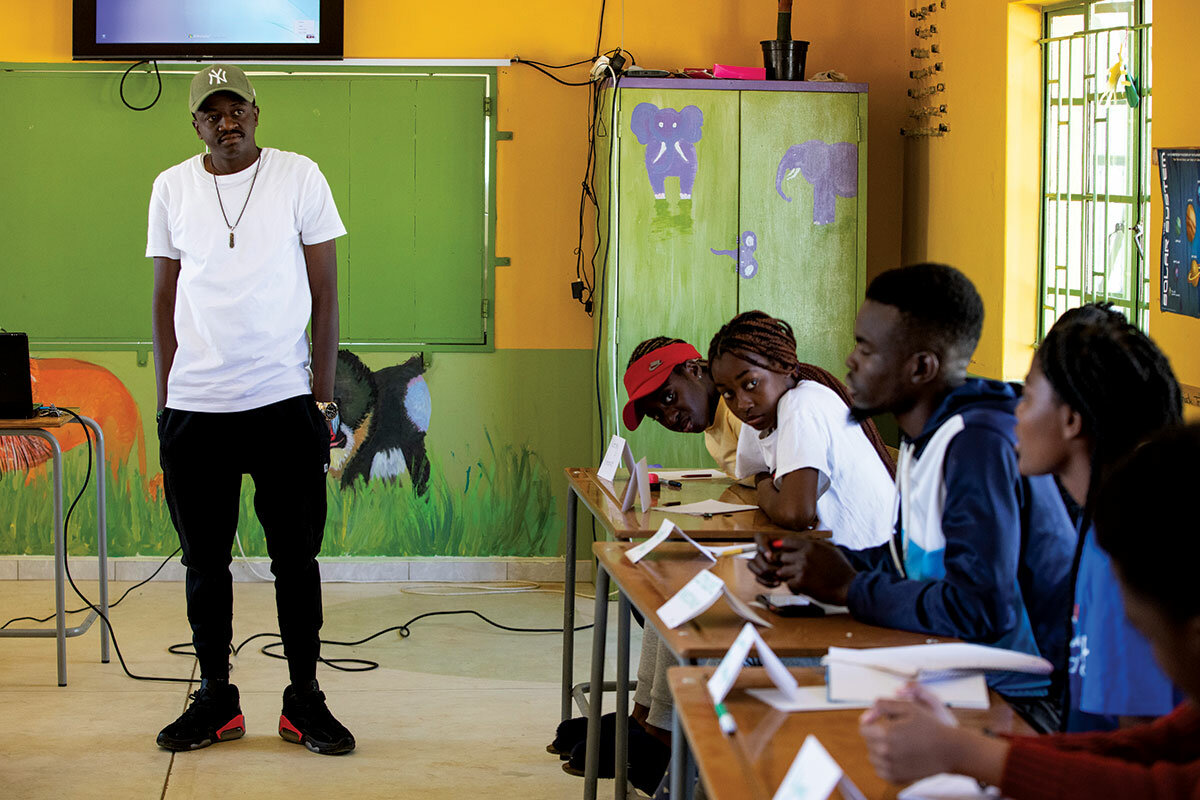
Photo: Melanie Stetson Freeman/CSM Staff.
The Christian Science Monitor says, “Deon Shekuza is a peripatetic presence at climate summits as well as at the grassroots – like the class on green hydrogen he taught to young teens in an informal settlement in Windhoek, Namibia, last July.”

Climate activism is no longer mainly the purview of the industrialized Northern Hemisphere or those with enough income and time to worry about it. Now people on the front lines are leading the way. For them it’s a matter of survival.

Sara Miller Llana writes at the Christian Science Monitor about Deon Shekuza, a climate influencer in Namibia, who is “as comfortable proselytizing green energy to youth on the hardscrabble roads and villages of this former German colony as he is in Namibia’s government ministries and the halls of United Nations conferences.

“Paid with respect if not a salary, he’s part of a rising breed of young climate activists across the Global South whose work, suggests one climate expert, may well determine the temperature of your world.

“Africa, which has contributed least to climate warming, is the continent most threatened by the droughts, floods, and heat intensified by climate change. In that extremity, the relentlessly positive Mr. Shekuza sees great opportunity for progress for Namibia.

“In the dusty chaos of an informal settlement on the edge of this capital city one recent morning, he faces his biggest challenge: capturing the imaginations of young teens on a complex topic. The kids have gathered in a bright community center classroom, not for school credit and certainly not for fun on their Saturday off, but to hear Mr. Shekuza teach green hydrogen 101. Namibia has staked its future on this next big solution for a global clean energy transition. …

(The process, simply put, would use solar or wind power to extract hydrogen molecules from desalinated seawater, producing green ammonium that would be used for regional and global fuel markets to power transportation and electricity production.)

“No one here knows what green hydrogen is, let alone how it might be the route to social justice that Namibia’s leaders proclaim.  Grasping for something understandable, Mr. Shekuza gestures out the window at the ancient and humble street scene of women laden with bushels of branches gathered from the forest for heating and cooking fuel. ‘This is exactly what we do not want for our people, right? Some energy sources keep you in the past, and some energy sources move you into the future. This is why we are here talking about green hydrogen.’

“After 90 minutes, Mr. Shekuza is satisfied. These kids might not exactly understand Namibia’s renewable energy policy, but they understand green hydrogen potential: jobs for them in a new economy that could turn Africa’s perpetual sunlight into clean fuel for electricity and transportation here and for export. …

“For activists across Namibia – like the Inuit in the Arctic, or youth from small island nations – caring and conserving is the easy part. These youth grew up living sustainable lives well before it was trendy. Many were born on the land, in the bush, on the coast, with no playgrounds except the natural environment around them. They conserved not for environmentalism, but for survival. …

“Mr. Shekuza and young African activists like him across the continent who are part of the Climate Generation, as we’re calling it, see a chance – the kind Mr. Shekuza tells the children in the informal settlement to seize, the kind he has seized for himself. …

“Mr. Shekuza can barely afford to do the work he has cut out for himself. For all his social confidence, he hesitates at the doorstep of his home before inviting visitors in for the first time ever. Descending from sunny daylight down a step at the side of a large old house, he enters the tiny basement space he shares with his mother.

“With a revealing flourish of humility, he pulls the worn blue curtain separating his mother’s bed from his floor space: ‘This,’ he says, ‘is climate activism in Africa.’

“In his windowless corner lies his bed. … On the chipped yellow paint of a cement wall are dozens of badges from U.N. conferences. A single business suit hangs from the curtain rope.

“This is the headquarters of his nongovernmental organization. With just the grants and fees he cobbles together from government and U.N. funding, the 33-year-old college dropout educates himself, hatches ideas for mentoring youth, and speaks via Zoom to august groups, all on the floor here. For an online speech on climate justice for a British Museum conference, he had no option but to give his speech right there, cross-legged on his sleeping pad, dressed in a traditional African tunic, surrounded by clothes, caps, shoes, and [policy] documents. …

“The environment, he says, was always a part of his interest: Nature was his escape from the noise and dilapidation of poverty in his rural hometown of Grootfontein. … ‘We are people who never look at the environment like something that is separate, because you grew up looking at it as part of you,’ he says. …

“He co-founded the NGO Namibian Youth on Renewable Energy (NAYoRE); gave himself the title ‘youth advocate for sustainable development’; worked with other organizations and networks on biodiversity, farming, and climate change; and started crisscrossing the globe on invitations to attend and address government, U.N., and private conferences. …

” ‘[Young people] may see me with a fancy English up here, but my lifestyle is no different from that kid in the shack. So when I speak for the youth, I’m coming from experience and I’m speaking something solid.’

“He pulls out a binder on agriculture in Namibia and how to use regenerative practices in one of the most water-stressed nations on the planet. It’s the latest document he’s read, and he’s read all of it: ‘I have dedicated hours and hours and hours … like trying to upgrade and up-skill myself. And I did that in and out of school, but I found the most benefit came out of it.’ …

“On a late Friday afternoon, Mr. Shekuza meets at a cafe with Micky Kaapama, whom he has been tutoring to be a climate activist, or, as they put it, a ‘biodiversity enthusiast.’ The glamorous fashion model studied biology and, crucially, has 12,000 Instagram followers. …

“As if trying to convince her of what she has to gain, he pulls out his phone to show an invitation from the Namibian president’s office that he’s just received. Addressed to Deon Shekuza, ‘Youth Advocate for Sustainable Development,’ it’s for a luncheon with Hyphen, a German- and British-financed Namibian company that signed a deal last May with Namibia to build the largest green hydrogen project in the country. It’s an $11 billion agreement.

“But there’s a hitch in the impressive invite. He has no idea how he can even afford to get to the event five hours away in Keetmanshoop.”

Find out what happens at the Monitor, here. No firewall.

Read Full Post »

Photo: James Lee Chiahan/Procedure Press.
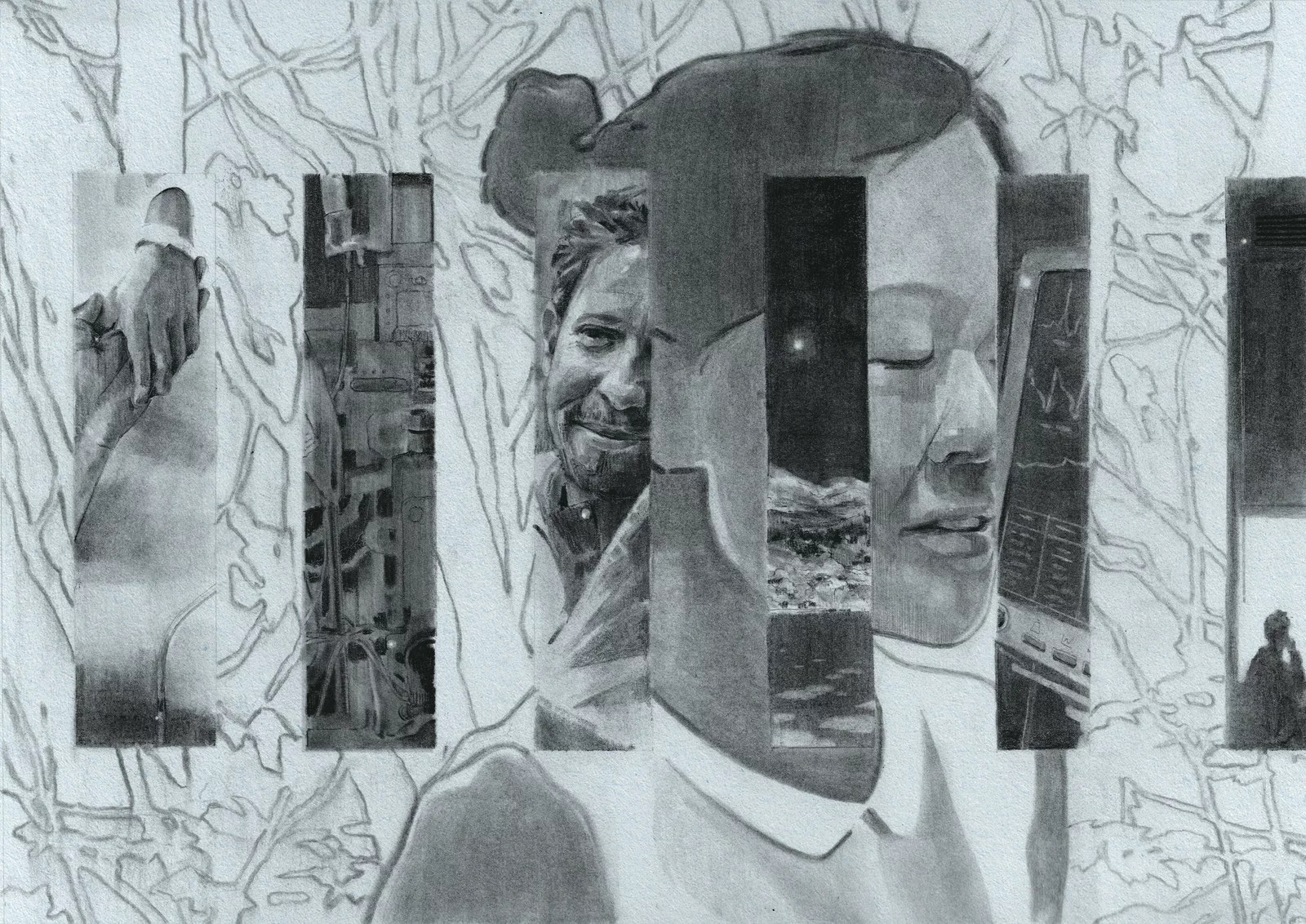
“Tone Shift,” by James Lee Chiahan. depicts musician Yoko Sen’s journey from being patient in the hospital to working to improve the sounds of ICU alarms around the world. Chiahan is a Taiwanese-Canadian artist currently working out of Montreal, Canada.

Those of us who have ever had a hospital stay know how difficult it is to get any sleep. Part of the reason is noise. Today’s article suggests that since artists started applying their creativity to the challenge, hospitals have new ways they could improve sounds and doctors have new ways to improve patient interactions.

Mara Gordon at NPR (National Public Radio) begins her story with Emily Peters, who had a rough time with the health care system when her daughter was born. “Peters, who works as a health care brand strategist, decided to work to fix some of what’s broken in the American health care system. Her approach is provocative: she believes art can be a tool to transform medicine.

“Medicine has a ‘creativity problem,’ she says, and too many people working in health care are resigned to the status quo, the dehumanizing bureaucracy. That’s why it’s time to call in the artists, she argues, the people with the skills to envision a radically better future.

“In her new book, Artists Remaking Medicine, Peters collaborated with artists, writers and musicians, including some doctors and public health professionals, to share [ideas] about how creativity might make health care more humane. …

“For example, the book profiles electronic musician and sound designer Yoko Sen, who has created new, gentler sounds for medical monitoring devices in the ICU, where patients are often subjected to endless, harsh beeping.

“It also features an avant-garde art collective called MSCHF (pronounced ‘mischief’). The group produced oil paintings made from medical bills, thousands and thousands of sheets of paper charging patients for things like blood draws and laxatives. They sold the paintings and raised over $73,000 to pay off three people’s medical bills.

“It’s similar to a recent performance art project not profiled in the book: A group of self-described ‘gutter-punk pagans, mostly queer dirt bags’ in Philadelphia burned a giant effigy of a medical billing statement and raised money to cancel $1.6 million in medical debt. …

“There’s very little in the way of policy prescription in this book, but that’s part of the point. The artists’ goal is to inject humanity and creativity into a field mired in apparently intractable systemic problems and plagued by financial toxicity. They turn to puppetry, painting, color theory, and music, seeking to start a much-needed dialogue that could spur deeper change.

Mara Gordon: What made you want to create this book?
Emily Peters: I think I’m always very curious why so many people – really the majority of everybody in any way involved in the health care system – feel so powerless. … And so the book came about as thinking about power and change. And then I realized that artists have this unique intersection where they are very powerful, they bring a lot of the things that were missing in health care, trying to build a better future.

MG: What is it about art that feels like a tool to challenge that feeling of powerlessness?
EP: The very first person I interviewed for the book was a photographer, Kathleen [Sheffer], who was a heart-lung transplant survivor. She used her camera in the hospital to try to be seen as more powerful, to be seen as a full person by these very fancy transplant surgeons who are whisking in and out of her room, viewing her as just a body. I saw that she had gained that power through being an artist.

“I had another conversation with a physician out of New York, Dr. [Stella] Safo. … She really highlighted that there’s this crisis of imagination. Everybody feels so demoralized that we can’t even imagine what we want to ask for to make it better.

“That’s a creativity problem. And the people who are creative are artists. They are really good at sitting in complexity and paradox, and not wanting everything to be perfect, but being able to imagine. And so that was the hypothesis: Oh, there’s something really interesting at this intersection between art and medicine. …

“MG: My favorite part of the book was the section where there’s a color palette, named for different medical phenomena: pill bottle orange, Viagra blue.… I think a lot of people in health care worry that too much color somehow distracts from the seriousness of medicine.
EP: So many of these things, somebody chose, and they didn’t do a huge amount of research on it. They just chose it, and we take it as gospel now.

“The white coat ceremony. [I had thought it must have started in] medieval Florence: they were putting white coats on medical students and welcoming them into the guild, it just feels like this ancient tradition. And it’s something that was invented in Chicago in 1989. A professor was complaining that the students weren’t dressing professionally enough. …

We surveyed a couple hundred people [and published the results online]: ‘What colors would you want to see in the hospital?’ I was expecting those soothing pastel tones. And it was totally different: it was neon purples and oranges and reds. Don’t assume what people want. We have the technology and the capability now to build in systems that give people some control and some agency over things like color. …

MG: Has anyone told you that they think that health care is too important for art?
EP: I’ve heard the criticism that this is just about wallpaper on a pig: ‘You’re talking about adding more sculpture gardens and increasing the cost of health care.’

“I did not want it to be a book about creating more luxurious hospitals. We have a crisis of financial toxicity, we have a crisis of outcomes. It’s specifically a book about fighting those things. …

“MG: Do you think medicine takes itself too seriously? Do we need more humor in health care?
“EP: You’re holding somebody’s heart in your hand – this is a very intense job. You’re trying to convince somebody to enter hospice – that is not easy. This is not an easy job. But that seriousness can feel almost like play acting and really inauthentic to people. …

“And that’s such a waste to me, because it is such a beautiful, incredible profession. We, as patients, also want you guys to be humans. We’re on your side.”

More at NPR, here. No paywall.

Read Full Post »

Photo: BBC.
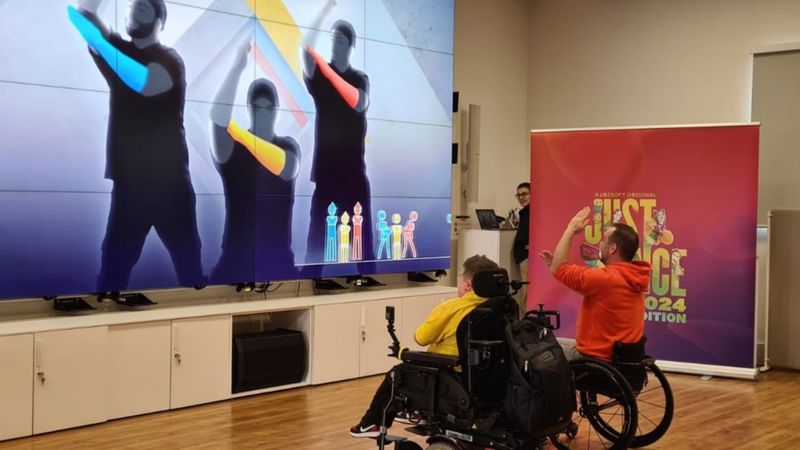
The 2023 version of the game Just Dance includes a routine suitable for people in wheelchairs. Gamer Seth Burke, who has Duchenne Muscular Dystrophy, learns the technique
.

When people talk about “gaming,” I don’t always know what they mean. That’s how far out of it I am. But when I saw a headline about gaming and wheelchairs, I wanted to learn more. It seems that some video-game companies are working to make their products accessible to all, especially games that ask the participants to move certain ways, even dance.

The BBC writes that more than 135 million people have played Just Dance. The network asked teenager Seth Burke to report on how accessible he thinks the game is for people who have a disability.

“Ubisoft’s video game has 500 unique choreographies that users from around the world follow. Seth, 14, from Vale of Glamorgan [in Wales], was invited to the company’s Paris studio to test out the latest version.

“He spoke to designers and choreographers and gave his input on a new routine for people in wheelchairs. This is his story.”

Seth: “Like most teenagers, I love gaming with my friends and brothers, but using a wheelchair means I’m not always able to join in with every video game. I have a disability that affects my muscles. If I play a game that involves me moving a lot, I’m not always very good at it and my arms ache easily.

“Gaming is important to me, so I wanted to know how tech companies are creating new games to suit people with disabilities. I was invited, with Children in Need, to meet the Paris-based team behind the hit game Just Dance.

“The latest version of the game features, for the first time, a routine performed by a dancer in a wheelchair. Players are invited to sit and follow the arm movements whilst holding their phone or console.

” ‘Everyone can get joy from dance,’ Stacey Jenkins, one of Ubisoft’s accessibility design specialists told me. ‘Game development is a really long process, but if you start to think about accessibility right at the beginning, we can make things accessible by design. …

“But is it possible to make all games accessible to all people?

” ‘I think it’s really difficult to make games completely 100% accessible to absolutely everybody at the same time,’ says Stacey. ‘Every game that we release, if it’s more accessible than the last, then we’re making good progress.’

“After chatting to Stacey, I tested Just Dance in the studio with Florent Devlesaver, a Belgian dancer in a wheelchair, who features in the game. He told me how he had to adapt the dance moves to work for him, as well as making sure they still worked in a video game.

“I loved meeting Florent and having a go at the dance routine in the studio. … It was nice to see that even though you have a disability, it doesn’t define you and you can do whatever you want with your life. I think people are making a huge effort to develop more accessible games, but it’s going to take some time. … I definitely think things are changing. I have confidence.”

More at the BBC, here. To learn more about the BBC Children in Need initiative, click here. According to the website, “BBC Children in Need is here to make sure that every child has the childhood they deserve – and the support they need to thrive.

“We are committed to funding the grassroots organizations and project workers across the UK that provide the vital positive relationships children need to help them navigate the challenges in their lives. Our project workers support, inspire and champion them to ensure they have opportunities and can reach their goals. And that will always be our approach.

“We fund thousands of charities and projects in every corner of the UK, that support children and young people to feel and be safer, have improved mental health and well-being, form better, more positive relationships and be given more equal opportunities to flourish.”

Read Full Post »

Photo: Erika Schultz / The Seattle Times.
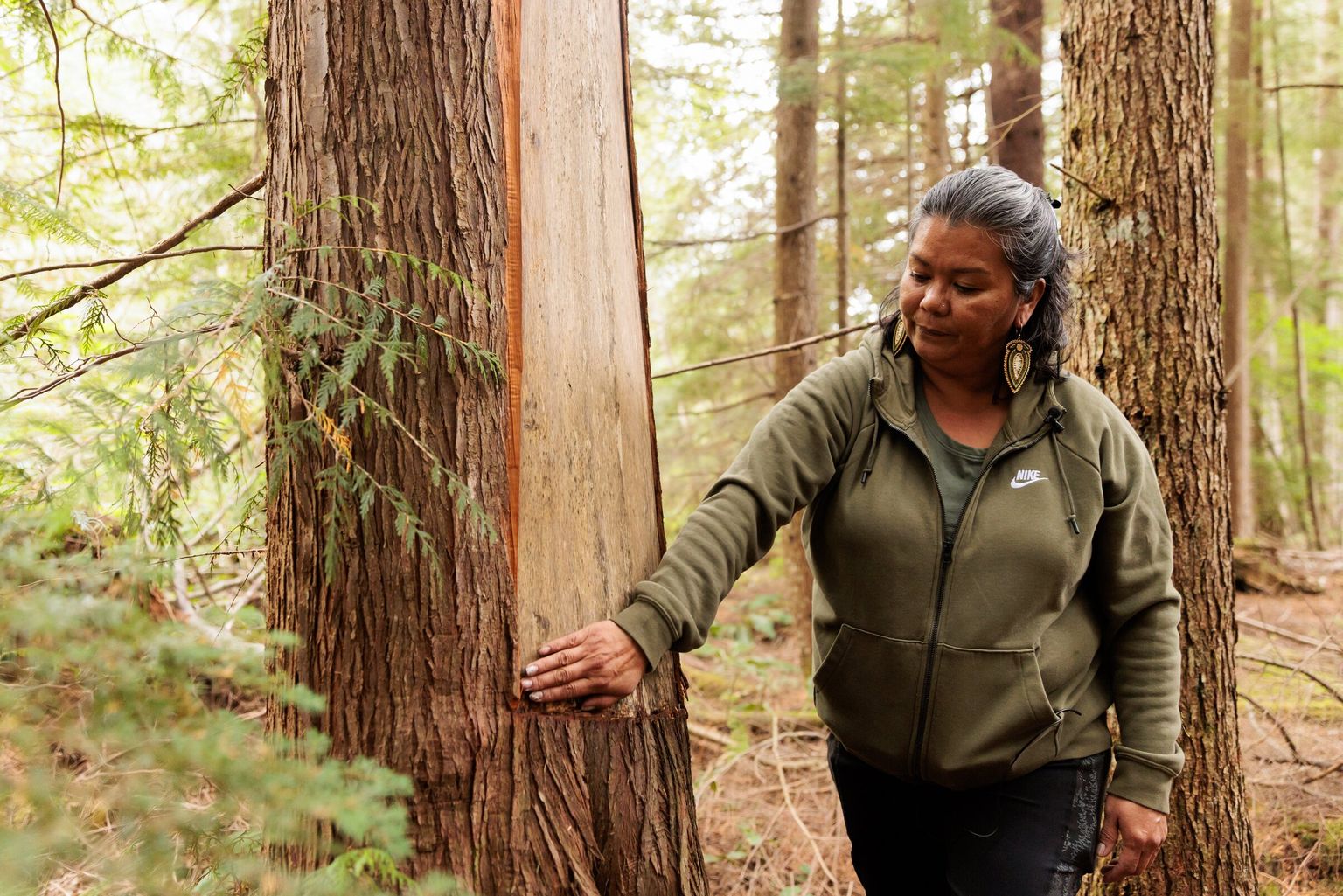
Gail White Eagle, a master cultural traditions specialist and master weaver at Muckleshoot, shows a cedar tree where she has traditionally stripped cedar bark for weaving baskets, hats, and more.

There’s always something more to learn about the generations that inhabited North America before European settlers came. Today’s article explains how indigenous people both used and managed forests, and how some continue to do so today.

Environmental reporter Lynda V. Mapes writes at the Seattle Times, “On a promontory above Puget Sound, a Douglas fir with arms bent at right angles stands above a quiet cove, where shellfish would have been gathered, long before this place was settled by newcomers. This tree was deliberately shaped by generations of hands into its current form, to mark what was here for countless years: rich clam beds, and a gathering site. … Modified trees are a connection interweaving generations of the region’s first people tightly as a cedar basket.

“ ‘It is the sacred fingerprint of the ancestors that shaped this place,’ said Sam Barr, a Samish tribal citizen and tribal historic preservation office supervisor for the Stillaguamish Tribe.

“Another tree, a cedar near the tree on the promontory over the cove, is elaborately trained to grow with branches at 90 degree angles low on its trunk that also were cut and recut so the branches would fork, and then fork again. The result is an elaborate candelabra. This is a marker tree, Barr said, that may have denoted the village that was here — today a housing development. It may also have indicated the direction toward the confluence of the deltas of the Skagit and Stillaguamish rivers that also fork and refork. …

” ‘People don’t think about it much, but we truly are living in an Indigenous garden, from which the gardeners have been forcibly removed,’ Barr said. ‘The entire landscape around the Pacific Northwest was carefully managed and stewarded by Indigenous hands. And there are traces of this everywhere.’

“Trees were stripped for bark for weaving, trees were planked for building materials, trees were made to serve as indicators of everything from trails, to a water source, a rich area for harvest, village or sacred place. …

“Trees are slow growing, and for a marker tree, it takes multiple generations of a family to curate it. … The presence of modified trees all over the landscape today, and continued traditional use of cedar in particular, binds tribes up and down the West Coast. … The Snoqualmie Tribe recently identified — and the state registered as an archaeological site — a modified tree in a lot being cleared for new homes in the Wedgwood neighborhood of Seattle. …

“Gail White Eagle, a Muckleshoot master weaver, said she always looks forward to this moment, as she paused the tribal van at a yellow gate that opens to a forest road in the foothills of Mount Rainier. She was about to enter Tomanamus Forest, 105,000 acres of forest land in King, Pierce and Lewis counties purchased by the Muckleshoot Indian Tribe in 2013. …

“The forest is in part of the territory ceded by the tribe in its treaty with the U.S. in 1855. Taking the forest back into tribal ownership was an act of healing, White Eagle said. Every tribal member can request a key to the gate, unlike at other forests that used to be theirs, now owned by other governments, corporations and individuals.

“A soft misty rain was falling as she walked into the forest, looking for trees from which she had harvested bark the previous spring. … She explained the harvesting process, which always begins with asking permission before taking anything.

She gives an explanation to the tree that its bark will be put to good use. And she often leaves a gift at the tree’s base, such as a bit of tobacco, sage or smoked fish.

“It’s a gesture of thanks and reciprocity in the relationship she holds with this tree, and this forest.

“White Eagle put her hand gently on the healing bark scar, and explained she is careful never to take a piece wider than two hands’ length. She chooses trees only big and robust enough for her to hug. And she pulls bark only in spring, when trees are full of sap, making the harvest easier on her and the tree. A tree can be harvested multiple times over many generations of users, if the harvest is done correctly.

“Tree wounds that penetrate bark damage the cambium layer, vascular tissue that is vital to movement of water and nutrients in a tree. The tree will seal and close the wound, compartmentalizing it with healing lobes to cover it and prevent rot. As long as a tree is not girdled — cut entirely around its circumference, severing all the vascular tissue — it will continue to live.

“Sometimes modified trees are recorded by tribes and government land managers as archaeological sites. But much more often, these trees are known only to the families that use them.

“Jacob Earnshaw is an independent archaeologist based in Victoria, B.C., who works to find and register modified trees as archaeological sites. His work has been entered as evidence in a right and title case in B.C. with the Nuchatlaht First Nation, who are working to prove their long presence on the northern half of Nootka Island on the northwest coast of Vancouver Island, to regain control of lands they never ceded. That case has not yet been resolved.

“Earnshaw has documented more than 1,000 years of cutting and pulling bark for harvest on Vancouver Island. The trees show management of these forests, Earnshaw said, by the island’s first people to protect what was an exhaustible resource. ‘What we are looking at is woodland management by these people who were thought of as hunter-gatherers,’ he said.

“That term is a myth, says Chelsey Geralda Armstrong, assistant professor in the Department of Indigenous Studies and School of Resource and Environmental Management Studies at Simon Fraser University in Burnaby, B.C. The first people didn’t just pick up what they needed here and there; they managed and cultivated their land and waters just as they do today — and evidence of their ancestors’ practices persists in the landscape.

“Armstrong teamed up with Earnshaw and other researchers to publish a 2022 paper that described forest gardens on Vancouver Island with still-evident remnants of cultivation, transplanting and all the other usual horticultural arts. The gardens were just part of the associated archaeological evidence of long prior use, including clam gardens, village sites, shell middens and trees in the nearby forest bearing scars of harvest for bark and other needs.

“Their work shows that far from an unpeopled wilderness, the Northwest Pacific Coast was a managed and stewarded place for thousands of years.” More at the Seattle Times, here.

Read Full Post »

Photo: Anna Olivella/The Jar via the Boston Globe.
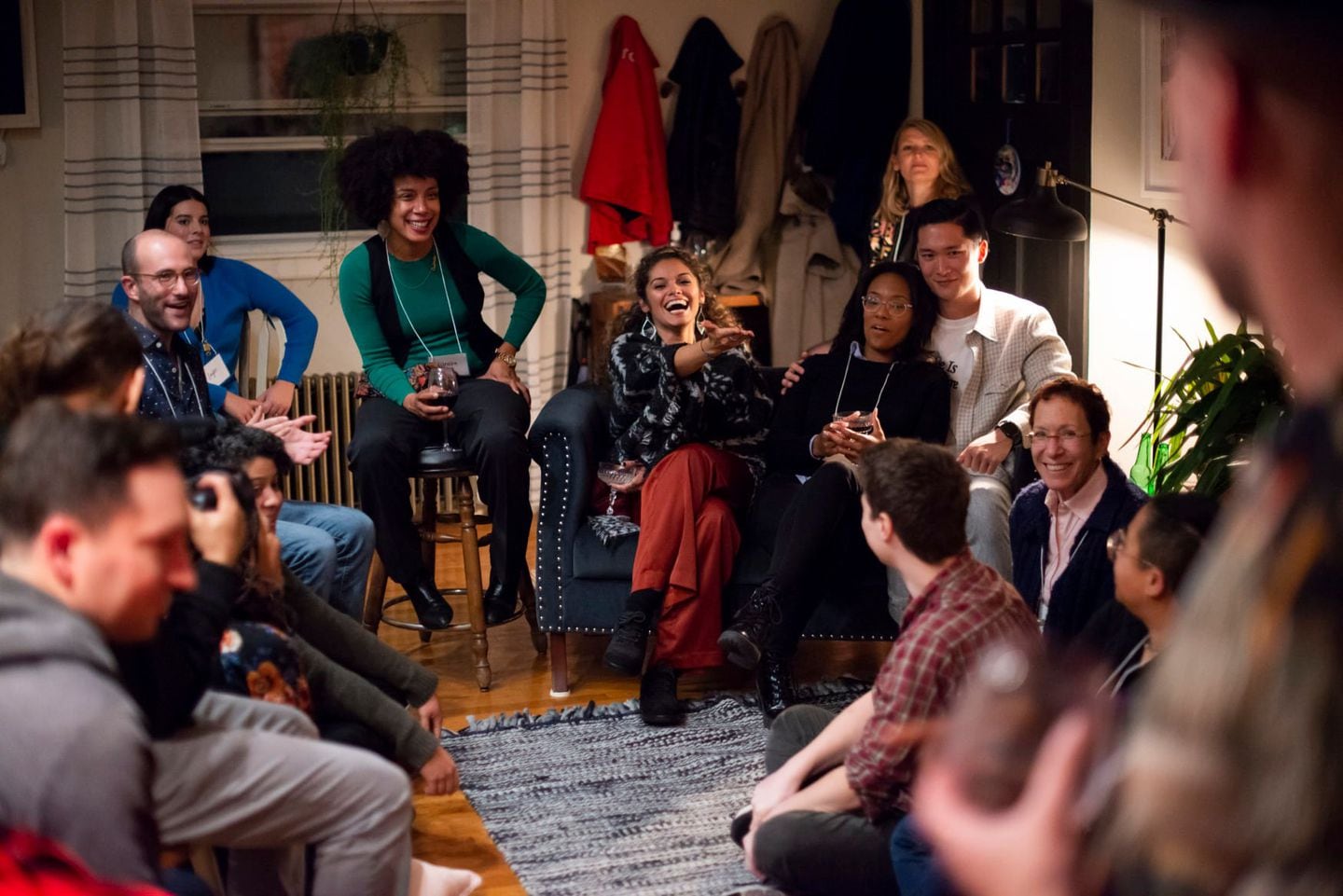
A dinner party “salon” hosted by The Jar, a Boston-based organization that uses works of art to create shared cultural experiences.

Many people who would like to reach across to people who are different from them just don’t know how to get started. It’s a challenge. Today’s story is about a group of artists who decided to tackle the challenge. And to have some fun along the way.

Peter Marks writes at the Washington Post, “On a chilly night in the Roxbury neighborhood, dozens of people — White, Black, Asian American, straight, gay, nonbinary, you name it — gathered for an invitation-only event that was equal parts about making art and making friends. Seated on the stage were Yo-Yo Ma, the celebrated cellist, and Liza Donnelly, the New Yorker cartoonist, who had been paired for the evening by the moderator, Guy Ben-Aharon, to explore how their creative lives might converge.

“As Ma played and Donnelly sketched him on a tablet projected onto a large screen, the audience was treated to a rare intersection — and another installment of The Jar, a pioneering nonprofit that aspires to knit a disparate citizenry together. Founded four years ago by Ben-Aharon, a 33-year-old stage director who previously ran his own Boston-based theater company, Israeli Stage, The Jar has developed a gentler model of social engineering. Its goal is forging comradeship via conversations about artistic experiences among groups that otherwise find few opportunities to commingle.

“ ‘There’s something so invigorating about making friends as an adult,’ said Rokeya Chowdhury, a Boston restaurateur and Jar proponent. …

“Bolstered by a $750,000, three-year grant from the Andrew W. Mellon Foundation, The Jar is in the vanguard of a movement seeking to capitalize on the communal powers of the visual and performing arts. … In a society that feels ever more tribal — even in cities that may have progressive cultures but checkered racial histories — inviting someone demographically unlike you to share a drink and an opinion is sometimes akin to a radical act.

“ ‘If you want to see a diverse and vibrant cultural community come to fruition, you have to build it,’ Ben-Aharon said over breakfast. ‘With The Jar, you’re actively invited to build the world you want to live in.’

“Invitation is the password unlocking the group’s mission. Here’s how The Jar works: Several people of divergent backgrounds agree to be ‘conveners’ for a Jar program or ‘happening,’ centered on a preselected reading, poem, playlet, painting or other work. Each convener agrees to bring five others to the event, at $10 a head, with the goal of an audience capped at 96. 

“One invitee in each ‘jar’ of six people is an intimate of the convener; two are ‘usuals’ — friends or colleagues. But two others must be ‘unusuals,’ people the convener barely or only incidentally knows. Or as Ben-Aharon put it, ‘people who you wouldn’t normally experience culture with.’ …

“ ‘The profoundness of it is that it invites people to do it themselves,’ he added about the process. … ‘They don’t really know what effect it will have on them,’ Ben-Aharon said. ‘Let’s say you go to church, and you’re a White gay man, and you go to this church with your husband, and your normal circle is White gay men. …

“ ‘But suddenly you’re invited to The Jar and you have to think of who are the two “unusuals,” and you invite a Black lesbian couple from that church. And suddenly you create a friendship with them. Suddenly you create a bond — and this actually happened, by the way.’ …

“Unlike, say, a religious community, where faith provides the link, Ben-Aharon and The Jar count on the creative soul as its spiritual source. …

“Ben-Aharon and his handful of staffers have had no trouble finding like-minded Bostonians; the catch is that the gatherings are small by design, and cracking the next challenge — how to grow the project, expand it perhaps to other cities — remains elusive. So does attracting additional capital.

“ ‘What we’re trying to do is scale intimacy,’ said Jeff Kubiatowicz, The Jar’s chief of staff. ‘On one hand, we need to use technology in order to make that happen. On the other hand, we have to keep it really, really personal. And we’re trying to balance those two things as we grow it.’

“The Jar’s participants seem to share a passionate belief in the outstretched hand. ‘The Jar’s model is very radical, very subversive,’ said Samantha Tan, an executive leadership consultant who chairs the board. ‘First of all is joy, right? Come here and enjoy yourself — enjoy meeting people who are not like you.’ …

“A few months ago in Roxbury, long a Black neighborhood that has, like so many enclaves in gentrifying cities, undergone changes in its class and ethnic makeup [a] renovated brick-walled space was donated for the happening by Chowdhury. …

“You could sense the audience’s pleasure, not only in meeting these artists up close, but also in having been asked, individually, to be there. ‘I like the people that I meet; it’s good to have places like this,’ said Cornell Coley, who came to the happening from Mattapan, another Boston neighborhood. ‘They created something that brings you out.’

“For artists, too, the invitation to be part of The Jar can elicit joy. Donnelly, who draws for the New Yorker and has also worked for CBS and had cartoons in publications such as Vanity Fair, said in an interview that she hadn’t been sure what to expect. What struck her was that she was able to make a connection herself. ‘Cartooning is communication, dialogue with other people. … I felt the warmth.’ ”

More at the Post, here. See also an earlier article in the Boston Globe, here.

Read Full Post »

« Newer Posts - Older Posts »