Feeds:
Posts
Comments

Archive for the ‘Uncategorized’ Category

Photo: Dea Andreea/Unsplash.
When a child is in a play, she can see what it’s like to be someone else for a while.

You don’t really need a reason to justify doing theater with children. It is just so much fun. But if you need a reason, think about what theater-engendered empathy and active listening can do for kids throughout their lives.

Alexandra Moe writes at the Washington Post, “It’s after school, and the tweens are rowdy with angst. Then two of them, Charlotte Williams, 13, and Tally Vogel, 11, face each other. Williams raises an arm, and Vogel raises her arm to follow. They’re practicing ‘the mirror,’ an improv exercise in a theater classroom, and the room suddenly hushes. It’s indistinguishable which girl is leading, and which is following. When the exercise stops, and the teacher asks how they were able to sync up so completely without speaking, Vogel says, ‘I used my eyes.’

“In other words, she used ‘active listening,’ a type of verbal and nonverbal communication skill that promotes mutual understanding.

“Several studies show communication skills are the most essential skills for navigating American adult life. … These skills are often taught through Social Emotional Learning programs, offered in K-12 schools in 27 states. But they are also a by-product of theater class, according to a recent study from George Mason University and the Commonwealth Theatre Center. The study follows children aged 5 to 18 over six years — the longest look at theater’s impact in kids to date — and finds increases in communication skills across age, gender and race.

“ ‘The longer the kids spent in the theater classes, the more they gained in 21st century skills, like communication, creativity, imagination, problem solving, and collaboration,’ says Thalia Goldstein, the study’s co-author and an associate professor of applied developmental psychology at George Mason University. …

“Parents of young children are familiar with pretend play — the couch is suddenly a frog castle, the floor a lake, and unbeknown to you, sharks are circling your ankles. It may seem like pure fantasy, but in fact, pretend play is the foundation for developing empathy, Goldstein says. It helps young children build emotional understanding, regulation and executive function, the foundational skills that later predict empathy levels. Parents can help foster empathy in children by introducing fiction books throughout childhood, with varied characters, settings and authors, which correlates directly to empathy scores in adulthood. They can let them be the drivers of pretend play, authors of their own stories.

“And theater class is yet another way. It’s the social dynamic of theater, the give and take, the volley of listening and responding, that expands kids’ capacity to read cues, think quickly and creatively, work as an ensemble and see things from another perspective. Theater provides an awareness of space, pausing, waiting for somebody else to talk.

“For children with autism, improv techniques increase eye attention and reciprocity of conversation, says Lisa Sherman, co-founder of Act As If, a communications program that specializes in working with autistic youths. And this is where the arts level the playing field for children of different abilities; they can participate in meaningful ways where language is not a requisite skill.

“A study among K-2 children in San Diego showed that participating in activities in drama and creative movement significantly improved English-speaking skills among children from primarily Spanish-speaking homes. Children with the most limited English benefited the most, says the study’s co-author, Christa Greenfader, an assistant professor of child and adolescent studies at California State University at Fullerton. …

“Connecting is ultimately the goal of communication, and it is the reason the actor Alan Alda began using improv exercises with scientists. Scientists are trained to speak methodically, defend their arguments and use niche jargon, a communication style that doesn’t always land with a general audience, says Laura Lindenfeld, executive director of the Alda Center for Communicating Science. Through improv, they are taught to make mistakes and laugh about it, to ‘give ourselves permission to fail and move on.’

“ ‘When scientists come into a room, they’re like, “Oh man, you’re going to put me through improv?” ‘ she says. But after exercises like ‘the mirror,’ looking intently into other people’s eyes, they realize they can’t succeed unless they’re in touch with the other person. Speaking becomes about making a human connection rather than pushing information — and that’s the point. You may have the most wonderful scientific finding, but if no one understands it, what’s the use?

“Sara Williams, mother to Charlotte, cites theater as the foundation for her daughter’s self-awareness. Charlotte began drama classes at age 5. At 13, she is not afraid to speak publicly or join the student council; she listens and has confidence. ‘They go to these classes and come home feeling energized, like they accomplished something,’ Williams says. And not just the outgoing kids — for the shy, theater opens them up. For children with anxiety, like so many children coming out of the pandemic, ‘the least judgmental place you can be is in a theater class.’ You can keep your personality, and unlike in sports, you’re not competing with anyone.

“In the end, theater is about telling stories. It is one of the best ways to help young people get to know themselves, Dawson says. Stories help us make sense of the world and understand another’s experience.”

More at the Post, here.
Read Full Post »

Photo: Munza Mushtaq.
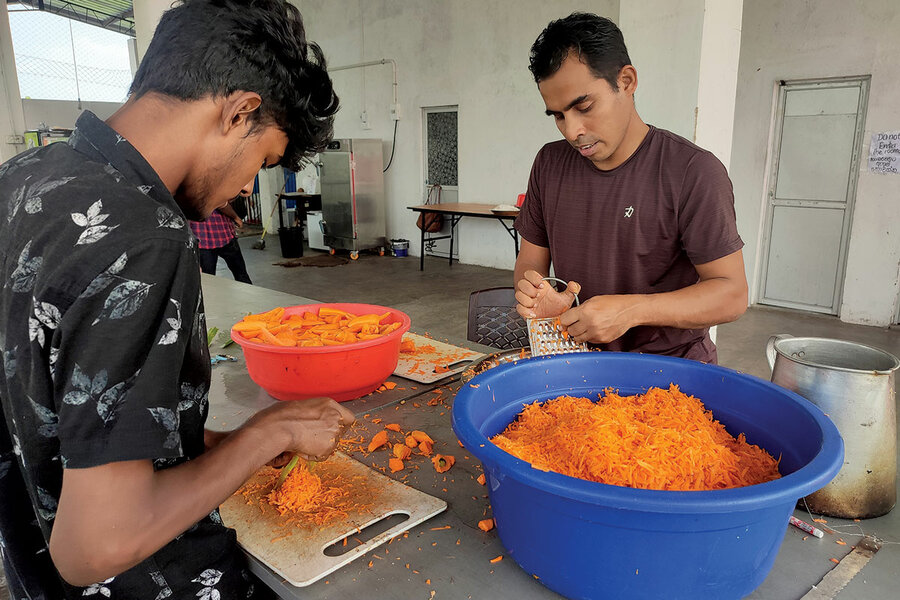
Pastor Moses Akash de Silva (right) helps prepare carrot sambol at Voice for the Voiceless Foundation’s flagship community kitchen in Sri Lanka.

Here’s a story from across the world about one way that food brings people together.

Munza Mushtaq reports at the Christian Science Monitor, “It’s just past noon, and on the sweltering rooftop of the Bethany Church in Rajagiriya, Sri Lanka, Pastor Moses Akash de Silva and a team of volunteers are grating piles of carrots while K.D. Iranie hovers over a large pan, stirring a spicy fish curry atop a makeshift firewood cooker.

“Ms. Iranie, who’s in her 60s, has served as the main cook for the church’s community kitchen since Pastor Moses started the project in June. ‘I come all five days a week,’ she says. ‘Seeing the people getting a delicious meal makes me so happy.’ …

“At 12:30 p.m. sharp, after trays of fresh food are carried down four flights of steps, Pastor Moses signals a volunteer to open the church’s grilled gates. At least a hundred men, women, and children eagerly file in, following the aromas of turmeric-infused fluffy yellow rice, fish and pumpkin curries, carrot sambol, and papadums. More will arrive with time. For many, this is their first proper meal in days.

“Sri Lanka’s worst-ever economic crisis has left nearly 30% of its 22 million people food insecure, according to the World Food Program, with food inflation soaring to 73% in November. The Voice Community Kitchen helps out by providing some 6,000 free lunches every week across roughly two dozen locations throughout Sri Lanka, while also bringing together different ethnoreligious communities that have historically struggled to find common ground. Pastor Moses says the initiative was born of pragmatism, compassion toward all Sri Lankans, and a desire to model the same generosity he experienced as a young person.

“ ‘I have gone for days without food, so I understand how these people feel,’ he says. ‘It does not matter to us what religion they are from, or if they have family, or what they do. If they are hungry, they are welcome to eat at our community kitchen.’

“Raised in an orphanage in the hill capital of Kandy, Pastor Moses moved to Colombo at age 17 seeking better opportunities. He lived at a bus stop for three days before finding work as a cleaner at a polyethylene factory. It’s there he met the senior pastor of Bethany Church, Dishan de Silva, who took him in.

“Pastor Moses explains with a bright smile how he lived with the senior pastor for seven years, eventually adopting his mentor’s surname. … The community kitchen idea came to [Senior Pastor de Silva] earlier this year when Voice Foundation volunteers were distributing dry rations to families on the outskirts of Colombo.

“ ‘In one house we met a mother with a 2-year-old child who had been surviving on ripened breadfruit and water spinach for three days due to the shortage of cooking gas in the market,’ he says. ‘That was when we thought, there was no point giving dry rations if people were unable to cook.’

“So they started cooking up meals themselves. Many of the current community kitchens are based in schools, while others, such as the flagship Bethany Church program in a Colombo suburb, serve lunch every day to a mix of children and adults. At least 60% of the people who come to the kitchen do not eat breakfast or dinner due to financial hardship, according to the Voice Foundation.

“There is only one rule at the Voice Foundation’s community kitchens: Guests can eat as much as they want, but they can’t take food outside the premises. 

“At the Bethany Church, there is not a single garbage bin. According to Pastor Moses, there’s no need – there are never leftovers.

“ ‘The community kitchen attracts different people from different walks of life, including beggars, street cleaners, security guards, and anyone else who needs a meal,’ Pastor Moses says.

“N.K. Karunawathie works at a bank nearby. Even as the cost of living skyrockets, her salary has remained stagnant, meaning her family can ‘no longer afford three meals a day,’ she says. To help make ends meet, she and her husband, both Buddhists, have been visiting the Voice Community Kitchen since it started this summer. …

“For a small country, Sri Lanka frequently faces religious-based conflict. Apart from a quarter-century-long war with the Liberation Tigers of Tamil Eelam, which strained the relationship between the majority Buddhists and minority Hindus, the country has also seen a rise in attacks against Muslims since 2013. The Easter Sunday bombings in 2019 further exacerbated tensions. 

“Mehdi Ghouse started volunteering at the kitchen months ago after learning about the project on social media.

‘It doesn’t matter that I am Muslim, or this project is run by the church. What matters is the satisfaction we all get when we see people eating and leaving happy,’ he says.

“Not only are all religions welcome at the Voice Community Kitchen, but experts also say such initiatives could be key to improving ethnoreligious engagement and lead to better conflict mediation in the future. …

“For Pastor Moses, the community kitchen’s mission is simple: Feed the hungry. But he does hope the work will have a ripple effect by inspiring generosity among all who engage with the project.

“ ‘I am who I am because of the upbringing I had in the orphanage and the help I got throughout the years since I came to Colombo,’ he says. ‘I hope others who volunteer here and those who I have taken under my wings will follow my footsteps by serving the people.’ “

More at the Monitor, here.

Read Full Post »

Photo: Amanda Barrows via Instagram | ccsf_p4p via Upworthy.
Amanda Barrows has placed a “poetry nightstand” in parks around San Francisco, including Alamo Square, left, and Golden Gate Park.

Here’s a good one for all my poet friends — actually, not just for poets, for everyone. Read about a park ranger in California who is getting all kinds of people involved in the art of poetry.

Sydney Page reports at the Washington Post, “In the middle of Golden Gate Park in San Francisco, a park ranger carefully placed a wooden nightstand on the ground. She attached a sign she made:

“ ‘Take a poem, leave a poem.’

“Since the nightstand’s debut there last month, amateur poets have filled it with more than 100 handwritten poems.

“ ‘The wind graces this park / Like a breezy whisper / as sounds of longing / echo from the nearby piano,’ one parkgoer scribbled on a piece of lined paper that they then left in the nightstand.

“Amanda Barrows, who came up with the idea, was surprised that it worked and people followed her instructions. …

“During the pandemic, Barrows — who said she has always considered herself a writer — decided to try her hand at poetry and signed up for a workshop.

“ ‘I had a really beautiful time,’ said Barrows, who then enrolled in another poetry class at City College of San Francisco ‘to keep the inspiration flowing, and keep myself writing.’

“The culminating assignment for the class — which is called Poetry for the People and has been taught at the school since 1975 — is a field project. Students are asked to find a way to ‘bring poetry into the community.’ …

“It dawned on her that she could perhaps fuse together her two worlds — parks and poetry. A colleague offered up a weathered nightstand, which Barrows thought would be the perfect vessel for her project, as she could fill the drawer at the top with fresh paper and pens and add a box at the bottom for poems. To get the ball rolling, she asked her close friends to help her stock the drawer with their favorite poems for people to take. …

“Since she only had a single nightstand to work with, Barrows decided she would leave it in one park for four days before moving it to a new location. …

“ ‘I’m in the parks all the time, and I see the many different ways people utilize them,’ she said, explaining that she wanted her project to reach as many people as possible.

‘Every resident of San Francisco is within a 10-minute walk to a park.’ …

“ ‘I love to see different people’s handwriting, and for them to be sharing their personal words,’ she said. “ ‘Every day that I check it and I have had submissions, it feels like Christmas.’ …

“The instructors of the Poetry for the People class — which is free for San Francisco residents — said Barrows’s nightstand has fulfilled the primary purpose of the project, which is to bring poetry to the community in a creative way.

“The success of Barrows’s project reinforces that ‘people need poetry now,’ said Lauren Muller, who started teaching the class at CCSF in 2000. ‘It fills me with optimism.’

“Other students have come up with various creative concepts, such as writing chalk poetry on neighborhood sidewalks and distributing poems disguised as parking tickets.

“ ‘It’s thrilling to see the work that students are doing,’ said Muller, adding that she hopes others will be inspired to establish similar initiatives in their own communities. ‘My hope is that this will happen across city parks, in D.C. and elsewhere.’

“Tanea Lunsford Lynx, a guest instructor for the class, agreed. ‘It’s really special to see that Poetry for the People is the catalyst but that it has a much, much bigger life; it’s one of the best things we could hope for,’ she said, adding that she believes San Franciscans are gravitating toward Barrows’s project in particular, as it has an old-fashioned feel ‘in the context of hyper-tech central.’ …

“ ‘It really is a community project,’ Barrows said. ‘It belongs to all of us.’ ”

More at the Post, here.

Read Full Post »

Does humanity sometimes do the right thing? Yes indeed. Hard to imagine but true: every country in the world signed on to combatting the danger of depleted ozone.

Scott Dance reports at the Washington Post that “a new assessment of Earth’s depleted ozone layer released [in January] shows that efforts to repair the vital atmospheric shield are working, according to a panel of U.N.-backed scientists, as global emissions of ozone-harming chemicals continue to decline.

“At this rate, the ozone layer could recover to 1980s levels across most of the globe by the 2040s, and by 2066 in Antarctica, the report concludes. Ozone loss is most dramatic above the South Pole, with an ozone ‘hole’ appearing there every spring.

“Those improvements will not be steady, scientists stressed, given natural fluctuations in ozone levels and the ozone-inhibiting influence of volcanic eruptions like the massive one from underwater Pacific Ocean volcano Hunga Tonga a year ago.

“But scientists said the latest ozone data and projections are nonetheless further proof of the success of the Montreal Protocol, the global 1987 agreement to phase out production and use of ozone-depleting substances. …

“A recent decline in observed levels of the chemical known as CFC-11, in particular — which as recently as 2018 had been observed at higher-than-expected levels and traced to China — is proof that societies can collaborate to address a confounding environmental problem, said Martyn Chipperfield, a professor at the University of Leeds who serves on the scientific panel. …

“Ozone is a molecule made of three oxygen atoms, and it proliferates in a layer of the stratosphere about 9 to 18 miles above the ground. It can exist at ground level, too, where it is a product of air pollution on hot summer days and considered a health hazard. But in the atmosphere, it serves as an essential shield protecting Earth’s life from harmful ultraviolet radiation.

“In the same way that UV lights eradicate pathogens like the virus responsible for covid-19, the sun’s radiation would make it impossible for life to thrive on Earth if not for the ozone layer’s protection.

UV-B, a high-energy form of solar radiation, damages DNA in plants and animals, disrupting a variety of biological processes and reducing the efficiency of photosynthesis.

“The Montreal Protocol, which has been approved by every country in the world, protects the ozone by outlawing the manufacturing and use of substances that destroy it when they come in contact with it in the atmosphere. That largely includes a class known as chlorofluorocarbons, or CFCs, which contain ozone-depleting chlorine and were used in refrigerators, air conditioners and aerosol cans.

“The treaty was expanded in 2016 through the Kigali Amendment to include hydrofluorocarbons or HFCs, a replacement for CFCs that do not harm the ozone but are a type of greenhouse gas that warms the planet more potently than carbon dioxide. The U.S. Senate ratified the amendment in September. …

“ ‘We can already see HFCs are not increasing as fast as we thought they would because countries are starting to implement their own controls,’ said Paul Newman, one of four co-chairs of the Scientific Assessment Panel of the Montreal Protocol.

“Still, it is possible forthcoming data on ozone levels will prompt some concerns that the ozone layer is not recovering as quickly as the report concludes, he said. Newman said he expects that will be because the Hunga Tonga eruption blasted so much material into the atmosphere. Volcanic eruptions are known to accelerate ozone depletion.

“Progress would likely also be slowed if humans pursue geoengineering to reverse global warming by injecting sunlight-reflecting particles into the upper atmosphere, Newman said. The panel, which considered the potential impact of that practice for the first time … found that, depending on the timing, frequency and amount of such injections, the particles could alter aspects of atmospheric chemistry that are important in ozone development.”

More at the Post, here.

Read Full Post »

Photo: Evan Qu/Unsplash.
Self-healing concrete at the Pantheon in Rome.

I grew up in a family that placed high value on the humanities — the arts, literature — and the people who practiced them. With the exception of our beloved Uncle Jim, who was a chemist, and Margaret Lawrence, who was a physician, we didn’t know how to admire people who didn’t fit our limited definition of “creative.”

But today, I’m bowled over by the imaginative pragmatism of people who invent solutions to real-world problems like those who reengineer gasoline engines to use electricity, for example, or who invent building materials that reduce the dangerous carbon dioxide we pump into the atmosphere.

I think even my parents would have loved that today’s scientists are finding inspiration in the ancients. After all, it was fine to admire archaeologists.

Adele Peters reports at Fast Company on research that suggests new possibilities for ancient wisdom.

“A road or bridge made from modern concrete might only last 50 years. But the massive Pantheon building in Rome, made from unreinforced concrete, has been standing for nearly two millennia. And nearby, some ancient concrete aqueducts still deliver water to the city. What made ancient Roman concrete so much more durable?

“A new study from researchers at MIT and Harvard University, along with labs in Italy and Switzerland, suggests that an ancient manufacturing technique can create self-healing concrete that naturally fills in cracks. Using a similar process now could help shrink concrete’s massive carbon footprint. ‘We’re looking to the ancient world as a source of inspiration,’ says chemist Admir Masic, an engineering professor at MIT who focuses on sustainable construction materials.

“Cement, the glue that binds concrete together, is responsible for up to 8% of global emissions when it’s made, both because of the energy it uses and the process of heating up limestone, a key ingredient in the material, which releases CO2 directly. Multiple startups are now working on alternatives: including companies that replace limestone with different rocks or add captured CO2 to the final product.

“The Roman-inspired approach is different. By making concrete last much longer, far less of it would need to be made in the first place. … The older production method also happens at a lower temperature, so it uses less energy.

“The researchers studied samples from a 2,000-year-old city wall in an Italian city. They focused on tiny white fragments of lime that aren’t found in modern concrete, but are ubiquitous in old ruins throughout the former Roman Empire. …

“In the past, some researchers thought that the fragments, called lime clasts, were the result of sloppy mixing. But it’s more likely that they were formed deliberately, and the study suggests that they are the reason the concrete lasts so long.

When tiny cracks form in the concrete, water travels to the lime clasts, which dissolve and then fill the cracks with calcium carbonate.

“The researchers attempted to duplicate the manufacturing process that created the lime clasts, and then tested the material against samples made with modern techniques. After cracking the samples and adding rainwater, they watched what happened: The old-school concrete healed itself within two weeks, while in the modern version, the cracks remained.

“Other approaches to ‘self-healing’ concrete also exist now. For example, it’s possible to embed bacteria in concrete that can fill cracks; but it’s costly to make. ‘Current self-healing concretes are very expensive because they are based on very complex chemistry, while our material is super cheap,’ Masic says. … The ancient process involves adding quicklime, a calcium oxide-based material (also known as lime), directly to other ingredients before adding water.

“A new startup is now spinning out from the research to bring the concrete to market. It may later add other features that the lab is studying, including making concrete that can absorb CO2 as it sits outside.” That would be amazing!

More at Fast Company, here.

Speaking of “creative,” check out the varied interests of that MIT chemistry professor: “Professor Masic’s research focuses on the science-enabled engineering of sustainable construction materials for large-scale infrastructure innovation. A chemist by training, with expertise in biomineralization, he specializes in the development of multifunctional cement-based materials, ranging from self-healing concrete materials to carbon absorbing concretes and electron conducting cement-based materials.

“He is a principal investigator in the Concrete Sustainability Hub at MIT, a faculty fellow in Archaeological Materials at MIT’s Center for Materials Research in Archaeology and Ethnology (CMRAE), and the faculty director of the Refugee ACTion Hub (ReACT) at MIT. MIT ReACT aims at providing new professional content development for displaced learners around the world.”

Read Full Post »

Art: Yun-Fei Ji via James Cohan Gallery.
Yun-Fei Ji, “Everything Moved Outside” (2022), acrylic on canvas.

The daughter of my mother’s college friend visited us in about 1980. Her family had been deeply traumatized by the anti-intellectual fervor of the Cultural Revolution in China. She couldn’t speak much English at the time, but I understood constant repetitions of “very painful, very painful.”

When I read today’s article about an artist who evolved from the Socialist Realism he was taught at the time, I thought of Ching and the way she grew, never completely shedding the deep hurt of totalitarian madness turned against friends and neighbors.

John Yau writes at Hyperallergic about Yun-Fei Ji, a Chinese painter who learned the state-sanctioned style of Socialist Realism “and then elected to unlearn it in order to reinvent himself.

“Yun-Fei Ji was born in Beijing in 1963, three years before the start of the Cultural Revolution (1966–76). Launched by the demagogue Mao Zedong, who distrusted intellectuals, the Cultural Revolution was an attempt to turn China into a utopian paradise run by and for workers. … 

“Ji belongs to the generation that studied at the Central Academy of Fine Art (CAFA) in Beijing in the first years after it reopened. Like the other painters in this group, he learned the state-sanctioned style of Socialist Realism and then elected to unlearn what he had absorbed in order to reinvent himself. … He secretly studied calligraphy — which was considered intellectual, bourgeois. …

“He opened it up and used it to respond to current events, such as post-revolutionary China’s massive Three Gorges Dam Project and the consequent displacement of more than 1.5 million people. …  

“As long as Ji continued to work in the tradition of Chinese landscape painting, Western audiences may have seen his views of displacement and protest, wayfarers carrying all their possessions, and melancholic ghosts as foreign to their experience. 

“This is why Ji’s change is radical. He decided to take on the Western tradition of painting in order to suggest that his subject matter is global, rather than local to China. … While the traumatic social upheaval caused by the Three Gorges Dam Project is still very much on Ji’s mind, as evidenced by painting titles such as ‘Migrant Worker’s Tent,’ ‘Satellite Dish on a Bed,’ and ‘Everything Moved Outside,’ new things are happening in his work.

“Three paintings signal a departure for Ji: two depictions of flowers (‘Sunflower Turned Its Back’ and ‘Early Spring Bloom 2020’) and a three-quarter-length view of a standing man — and my favorite work — ‘The Man with Glasses.’ … 

“Against a mottled brown, violet, and gray-blue abstract ground Ji has depicted an elderly man in blue pants and a long blue jacket over a pale blue shirt. The man is looking down, his hands in his pockets, and we cannot see his eyes. His head seems too large for his body, a deliberate choice by the artist. The shirt becomes a series of dry brushstrokes near the bottom and the gray-blue pants are largely unpainted. The jacket’s color reminds me of the blue surgical scrubs worn by doctors, which folds another level of feeling into the painting. The fact that the portrait resists a reductive reading is important to the change in Ji’s work and thinking. 

“The premier coup approach is in keeping with ink painting, which cannot be revised or layered, but in his use of paint he works differently, as seen in the mottled background and single dry brushstroke used to separate the front pockets of the shirt. The incompleteness of the man set against a dark, fully painted abstract ground seems both a formal and emotional decision. The man is ephemeral, while the dark, inanimate ground is permanent. The evocation of change and transience is also inherent to Ji’s paintings of sunflowers and blossoming branches. In these works, he meditates on the relationship between forced change and inescapable transformation.”

More paintings at Hyperallergic, here. No firewall. Subscriptions welcomed.

It was interesting to me that “Everything Moved Outside” (2022) makes this reviewer think of the migrant life. For me “everything moved outside” means Covid. Would love to hear more reactions to the paintings shown at Hyperallergic.

Read Full Post »

Photo: Pat Greenhouse/Boston Globe.
Samya prepares an evening meal. Back in Afghanistan, Samya and Noori’s fathers are out of work and their families struggle to find enough to eat. Noori sends them $200 to $400 a month.

In today’s story, an Afghan who worked as an interpreter for US troops builds a new life for his family in Lowell, Massachusetts, a longtime “gateway” city for new Americans.

Alexander Thompson reports at the Boston Globe, “Scarcely any of the 40 Afghans who trooped off planes at the Manchester, N.H., airport on an unseasonably warm day on Nov. 18, 2021, had ever heard of Lowell.

“Among the dazed and weary refugees at the airport was an irrepressibly optimistic former US military interpreter called Noori. His wife, Samya, and two young daughters, Taqwa and Zahra, were at his side. They were exhausted, but they were safe.

“Noori recalled that he didn’t know a single person in New England. He didn’t have a job. Or a car. Or an apartment. Or a winter coat. But he had his family. ,,,

“After a harrowing escape and a grueling journey halfway around the world, Noori and his fellow Afghans quickly found that life in Lowell is no Hollywood movie.

“ ‘We thought that in America all the facilities of life were going to be provided for you,’ he said. ‘It’s true that it has, if you work [for it].’

“Noori and several hundred other Afghan refugees who have been resettled in Lowell have set about doing what they could not in their own country. They’re building lives in peace while forging a united community that is, slowly, bridging the divides of language and creed that have riven Afghanistan for decades.

“ ‘The United States of America did not build a nation in Afghanistan, and now the Afghans who are here are trying to build a new nation here in the United States,’ said Jeff Thielman, president of the International Institute of New England, which resettled many of the Afghans.

“And in the past year, Noori has gone from being just another Afghan in the crowd to a community leader, always eager to help his compatriots even as he navigates his own obstacles in the new country he’s proud to now call home. …

“Getting his license at the end of March was a huge relief. It felt like a hard-earned victory after the family’s first few months in Lowell, which had been difficult at times.

“Noori was lucky that the Lowell Community Health Center hired him days after he arrived as a Dari and Pashto language interpreter for their influx of new Afghan patients. But rent, Wi-Fi, and heat were expensive. They also desperately missed their families back in Afghanistan.

“ ‘Whenever I’m talking to my mom, she was crying because we are away from her, so this is the hardest part,’ Samya said, with her husband interpreting from Pashto.

“[Samya’s] and Noori’s fathers are out of work and their families struggle to find enough to eat amid Afghanistan’s worsening humanitarian crisis. Noori sends back $200 to $400 a month.

“Worse still, as Noori would acknowledge many months later, the family was feeling trapped and helpless in a tiny apartment. Fortunately for Noori and the other 275 refugees who eventually settled in Lowell, there was a group of Afghans who had arrived in the area years earlier and who offered support and guidance. The group’s de facto leader, named Mohammad Bilal, is another former military interpreter, who arrived in 2014.

“Among the first things Bilal and the others did was establish a WhatsApp group for the new arrivals.

“ ‘We will just call to the community if there is someone available, just please help this family. … They were going to get [the refugees] food, they were there to get them to the hospital,’ Bilal said. ‘Whatever their need was, we were helping them.’

“Noori had an extra advantage: Major White [who helped him escape] was still looking out for him. White knew Noori needed a car, so he set up a GoFundMe page that raised $14,000 and bought Noori a used Ford Focus. …

“By May, doing checkups with every new Afghan, [Dr. Rob] Marlin and Noori were the clinic’s dynamic duo. Marlin brings the medical knowledge and Noori the linguistic and cultural savoir-faire. Each patient reveals aspects of Afghan life in Lowell. …

“Before one checkup, Noori pointed out to Marlin that a man’s name indicated he is a member of the persecuted Hazara ethnic group. That prompted Marlin to probe deeper about the man’s roommates and whether he feels safe.

“ ‘He will often find out something that I didn’t ask about, that I hadn’t thought about,’ Marlin said.”

Read more about the Marine who aided the family’s spine-tingling escape and about their new life, here.

Read Full Post »

Photo: Mariam Ehab.
View of Mandara Beach in Alexandria, Egypt, where floating ropes help the visually impaired enter and exit the Mediterranean Sea, Aug. 23, 2022.

You may have noticed that I love stories about Sweden and Egypt. That’s because two of my grandchildren are half Swedish and two are half Egyptian. How lucky is that!?

Today’s story comes from Alexandria in Egypt. Miriam Ehab covered it for the Christian Science Monitor.

“In a sunny spot along the bustling shores of Alexandria, Egypt’s second-largest city, a group of beachgoers splash and frolic in the sea. But this is no ordinary beach.

“Holding onto floating barriers and ropes, safe in the knowledge that attentive lifeguards are nearby, almost everyone here is blind or visually impaired. Mandara Beach is the first of its kind in the Arab world’s most populous country, specially fitted so it’s accessible to swimmers with physical disabilities. For many, it’s more than just a day of fun and relaxation – it’s a rare window of empowerment.

“Inaugurated in 2021 for people using wheelchairs, Mandara underwent another renovation last year. When the revamped beach opened again in June, at the height of Egypt’s summer season, thousands of citizens with visual impairments could also safely swim in the calm cerulean Mediterranean waters. …

“ ‘This is the first time I’ve been to the sea,’ Sarah, one beachgoer, says with a beaming smile. ‘I was very happy and did not feel afraid at all when I was swimming.’ … 

“Some 12 million Egyptians live with a disability, roughly 3.5 million of whom face visual challenges. In 2018, President Abdel Fattah al-Sisi declared the ‘year of persons with disabilities.’ … Parliament responded with a slew of laws, including the provision of state-subsidized health care to people with disabilities.

“Other benefits included tax exemptions on the purchase of cars, educational and medical materials, and imported assistive devices. Legal fees, whether for plaintiff or defendant, also were lifted for people with disabilities. And in 2021, Parliament approved tougher penalties for the bullying of people with disabilities.

“ ‘The laws from 2018 are excellent,’ says Hassan Abdel Qader, head of Alexandria’s Blind Association. ‘But the problem is in their implementation.’

“The fact is, say campaigners, that many public spaces and means of transport still lack accessibility, assistive technologies are hard to come by, services for people with disabilities are patchy, and discrimination is not uncommon. Still, change is coming, slowly. 

“Some months ago, Jihad Mohammed Naguib, an employee at the Department of Tourism and Resorts in Alexandria, was inspired by something she heard from the governor of Alexandria, Maj. Gen. Mohamed el-Sherif. He noted that there were never any blind people on the beaches, which are the pride of the coastal city. …

“ ‘The idea ​of ​allocating a part of the beach for the visually impaired … was put forward after we inaugurated the free Mandara Beach for people with motor disabilities and the success that it met,’ Major General Sherif says in an interview. And so, with funding from the Rotary Club of Alexandria Pharos, the work began. 

“Floating ropes with plastic balls were installed on a flat portion of the beach, so that swimmers with visual impairments could enter and leave the water holding these ropes. People in wheelchairs could use a modified ramp, the end of which was fitted with a metal box submerged in the water, ensuring their safety while in the sea. Lifeguards and a first-aid unit were also available – which isn’t always the case on Egypt’s public beaches.

“Those directly affected – and most likely to benefit – were consulted from the beginning. ‘We proposed some things that they have already implemented, and others that they promised would be implemented in the future,’ Mr. Qader says.

“Those suggestions included a whistle for children who feel endangered, and a rope that extends from the entrance of the beach to the water, so that even if a visually impaired person visits on their own they can reach the sea without assistance. …

“The beach is the latest in a recent string of hard-won successes for Egypt’s visually impaired people. The Egyptian Blind Sports Federation already runs several sports teams, including soccer, weightlifting, judo, and showdown – a type of air hockey for blind people.

“But gaps remain.  ‘Most services, and recreational and sports activities for the visually impaired, are concentrated in the Egyptian capital, Cairo, while other Egyptian cities have little capabilities,’ says Moamen Mostafa, the former head of public relations for the Blind Association of Egypt. …

“That makes Mandara Beach all the more poignant for a group who have difficulty accessing recreational and sports activities.  For 52-year-old Mohamed Attia and his 40-year-old wife, Sahar, both wheelchair users, this was the first time they could enjoy the beach together. 

“ ‘I am happy to go into the sea for the first time in my life, after I could only watch it from afar,’ says Ms. Attia. 

“The couple were delighted to find a group of people who helped them move their wheelchairs into the water. … 

“Mr. Attia says … ‘Those who had this idea have a compassionate heart. We really wish this project to continue and spread on all the beaches of Egypt,’ he adds. 

“That wish may come true. Buoyed by the success and widespread acceptance of Mandara Beach, Major General Sherif says there are plans to open a similar facility in Alexandria’s Anfushi Beach. From there, he hopes, the idea will spread through the country.”

More at the Monitor, here.

Read Full Post »

Photo: Heida Helgadottir for the Washington Post via the Independent.
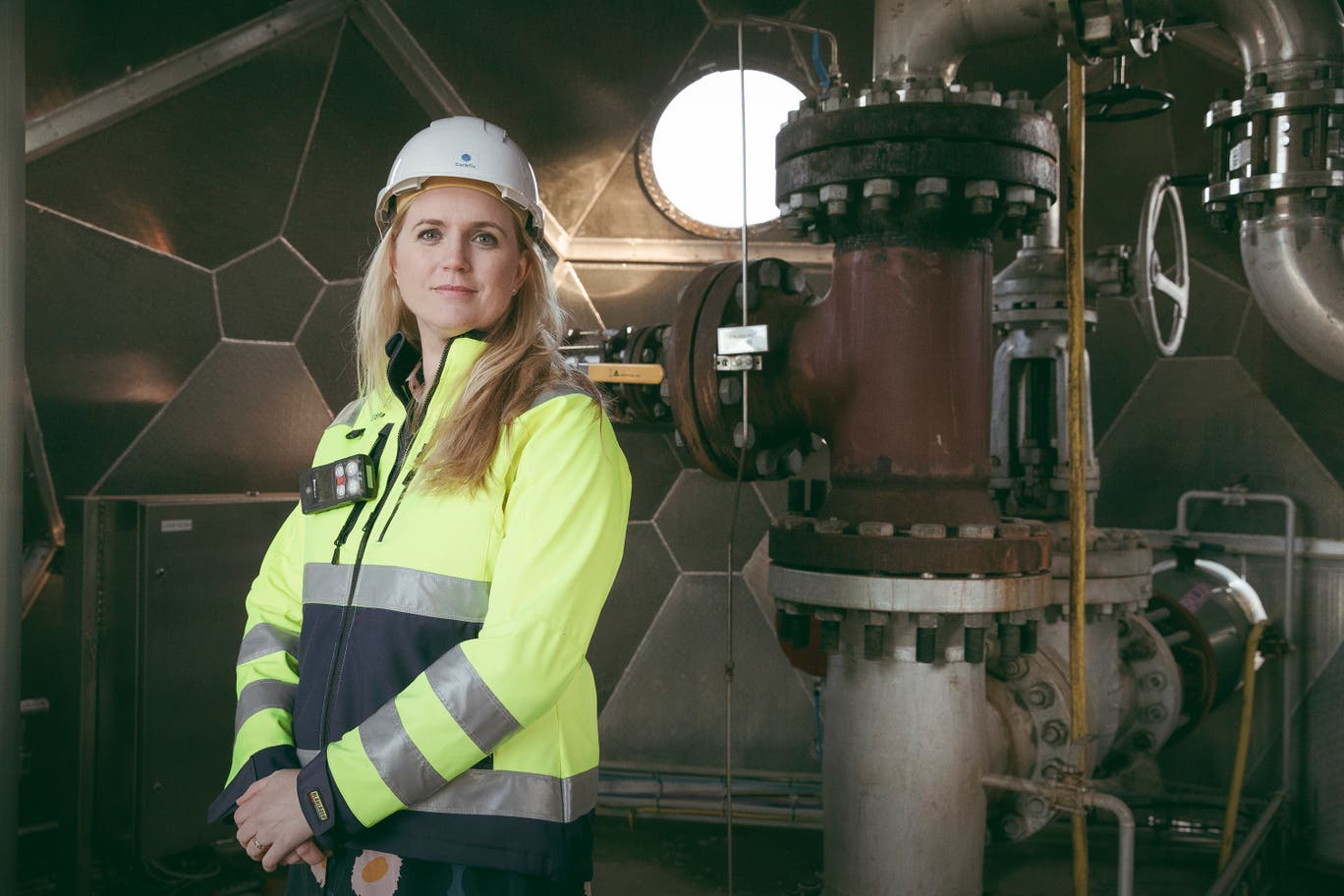
Edda Aradottir is the chief executive of Carbfix, a company that captures CO2 byproduct from the largest geothermal plant in Iceland. Many Icelandic start-ups are tackling climate change.

File this one under Hope. And maybe book a trip to the innovation hub called Iceland.

Hannah Hall has a report at the Washington Post on Icelandic companies that are taking on global environmental challenges.

“The electric red and green glow of the production facility resembles the Icelandic aurora borealis. Algae in their growth stage flow through hundreds of glass tubes that travel from floor to ceiling, all part of a multistep process yielding nutrients for health supplements. Soon, all parts of each alga will be used.

“The facility, operated by Icelandic manufacturer Algalif, is a space of inspiration for Julie Encausse, a 34-year-old bioplastic entrepreneur. During a July summer storm, Svavar Halldorsson, an Algalif executive, was guiding her through a tour of the company’s newest facility on the Reykjanes Peninsula.

“By the end of 2023, this new facility aims to triple its production. After Algalif dries the microalgae and extracts oleoresin, a third of this output then goes toward health supplements. Algalif has traditionally used the rest as a fertilizer. Now Encausse, founder and chief executive of the bioplastic start-up Marea, hopes to use that leftover biomass to create a microalgae spray that can reduce the world’s reliance on plastic packaging.

“Her newest partnership with Algalif is part of a start-up network in Iceland that focuses on inventive and creative technologies to address the climate and sustainability crisis. The Sjavarklasinn (‘Iceland Ocean Cluster’) network includes environmental entrepreneurs working across several industries.

“Thor Sigfusson founded the network in 2012 after conducting research on how partnerships between companies in Iceland’s technology sector helped expand that industry. At the time, he found that the fishing industry was not experiencing the same collaboration or growth.

“ ‘Even though companies were in the same building together, fishing from the same quotas and facing similar challenges, they were closed off,’ said Alexandra Leeper, the Iceland Ocean Cluster’s head of research and innovation.

“Three cod hanging on the wall of the second-floor entryway are the first thing to greet any visitor to the Iceland Ocean Cluster. Lightbulbs shine from their centers, and the dried scales filter the light to fill the space with an amber glow. The precise design is one that underlines the group’s belief that using 100 percent of a fish or natural resource can give rise to innovative technologies. …

“Encausse and Marea co-founder Edda Bjork Bolladottir have partnered with the cluster for 2½ years. Encausse says that involvement was core to their company’s inception.

“ ‘There is a collaborative mind-set when being on an island,’ she said. ‘We need to work together to survive, and this was passed from generation to generation.’

“In a country about the size of Kentucky, the people of Iceland have had to learn how to guard their resources. Encausse has discovered that often means using 100 percent of any material — a lesson she’s now implementing in her work with Algalif. She created a food coating from Algalif’s leftover biomass, a product she’s named Iceborea — in a nod to theaurora borealis.

“ ‘We are repurposing it and making something with value that gives it another life to avoid using more plastic,’ Encausse said. Once Algalif’s factory expands over the next year, it will have 66 tons of microalgae leftovers that Encausse’s company can tap each year.

“When sprayed onto fresh produce, Iceborea becomes a natural thin film and a semipermeable barrier that can protect against microorganisms. Iceborea can either be eaten with produce or washed off, reducing the need for plastic packaging.

“[Edda Aradottir] is the chief executive of Carbfix, a company capturing CO2 byproduct from the largest geothermal plant in Iceland, Hellisheidi, and injecting it into stone to be buried underground.

“Carbfix’s successful trials have marked a global milestone for carbon sequestration. It also has received international recognition — and Aradottir’s leadership has already served as a model for growing start-ups and other founders in the cluster trying to tackle extensive environmental concerns. …

“Another Icelandic company, GeoSilica, harvests silica buildup from the Hellisheidi waste stream to make health supplements.GeoSilica reaches the Icelandic and European markets, and its chief executive, Fida Abu Libdeh, is also working with the Philippines to pilot her silica-removal technology to create similar sustainable factory processes.

“A Palestinian from Jerusalem, Abu Libdeh moved to Iceland in 1995 at age 16, a transition she described as difficult because of the language barrier and the country’s small immigrant population. In 2012, she graduated from the University of Iceland after studying sustainable energy engineering and researching the health benefits of silica. That same year, she and Burkni Palsson co-founded GeoSilica.

“Ever since moving to Iceland, she was impressed with how the country produced electricity through geothermal sources. …

“GeoSilica is not formally part of the Iceland Ocean Cluster, but the network it has fostered reflects the same collaborative approach. Abu Libdeh has worked with cluster companies and held investor meetings at its headquarters. It’s a place that founders want to be, she said, where they want to learn from each other even if they are competitors in their fields.

“While there has been progress over the years, Abu Libdeh said, it’s still a challenge for women to enter this entrepreneurial space. In 2020, less than 1 percent of investment went to women-founded start-ups, according to a recent European Women in Venture Capital report. …

“What began as a dozen start-ups in 2012 has now grown to more than 70 members and associated firms connected to the Iceland Ocean Cluster. … There are now four sister clusters in the United States, as well as one in Denmark and one in the Faroe Islands.

“The Alaska Ocean Cluster, which was the first to follow the Icelandic model, has already accelerated policy change in the United States. Sen. Lisa Murkowski (R-Alaska) proposed legislation last year to create ‘Ocean Innovation Clusters in major U.S. port cities, which would provide grants along the U.S. coastline and the Great Lakes.

“ ‘I’ve learned a great deal from our friends in Iceland who created a roadmap of innovation and public/private partnership when they established the first Oceans Cluster in Reykjavik,’ Murkowski said in an email.”

More at the Post, here.

Read Full Post »

Photo: Jazeen Hollings via Wikimedia.

Working at maintaining your health through exercise? Here’s a form of exercise I bet you haven’t tried yet: Monty Python silly walks.

Gretchen Reynolds reports at the Washington Post that “a not-so-serious study discovered that a walking style made famous by the comedy troupe … works, according to an important — or, at least, actual — study published [in] the annual holiday edition of the BMJ, a British medical journal.

“Employing high-tech science and a tittering adolescent’s sensibility, the study’s researchers filmed volunteers perambulating like the ungainly bureaucrats in the Monty Python comedy troupe’s Ministry of Silly Walks sketch, while wearing metabolic monitors.

“Their aim was to determine the physiological effects of ambling around a track in the manner of the actor John Cleese, playing the apparently boneless Mr. Teabag, the head of the Ministry of Silly Walks, or Michael Palin’s Mr. Putey, a wannabe silly walker whose screwball stroll needs work.

“The scientists soberly wondered whether silly-fying people’s walking form would up the intensity and caloric expenditure of their exercise and make an otherwise simple stroll into a serious workout. …

“ ‘What we wanted to know was, how would deliberately inefficient walking affect energy costs?’ said Glenn Gaesser, a professor of exercise physiology at Arizona State University in Phoenix, who led the new study. …

“To find out, Gaesser and his colleagues gathered 13 healthy adults, ages 22 to 71, and had them watch the Ministry of Silly Walks sketch several times.

“For those unfamiliar with the skit, Mr. Teabag leads his ministry by example, moving like an unhinged heron, high-kicking, low-bobbing and randomly whisking up and jiggling his knees with abandon. The more-sedate Mr. Putey merely hitches his left leg out a bit with every other step, a motion the disapproving Mr. Teabag finds ‘not particularly silly.’

“After absorbing the basics of silly walking, the study volunteers donned a facial apparatus to measure their oxygen uptake and started walking around a short track in Gaesser’s lab. First, they walked as themselves, at their preferred pace, for five minutes. Then, they copied Mr. Putey, hooking out their left leg sometimes, for another five minutes. Finally, they went full-on silly, imitating Mr. Teabag’s demented eggbeater strides, for the concluding five minutes, generally giggling throughout, Gaesser said.

“Afterward, the scientists calculated the walkers’ speed and metabolic costs during each form.

“Silly walking like Mr. Teabag proved to be much harder than un-silly walking, requiring about 2.5 times as much energy. Putey-style strolling, meanwhile, was comparable to normal walking in terms of energy expenditure, but slower.

“In practical terms, these findings suggest super-silly walking can be strenuous enough to qualify as ‘vigorous exercise,’ Gaesser said.

If someone adopts a silly walk for at least 11 minutes a day, he continued, they will meet the standard recommendation of at least 75 minutes of vigorous exercise every week, which should meaningfully improve health and aerobic fitness. …

“Said David Raichlen, a professor of human and evolutionary biology at the University of Southern California in Los Angeles, [who] was not involved with this study, ‘Across human evolution, one of our key adaptive advantages was the development of a very economical, bipedal walking gait,’ [so] normal walking barely challenges our hearts and lungs or burns many calories. …

“But we can upset this walking ease ‘through biomechanical tweaks like those seen in the silly walks,’ Raichlen said, increasing the energy expenditure of getting from place to place.

“Gaesser, in fact, believes the utility of silly walking may lie in using it to replace our most quotidian strolls. Heading to the bus stop? Lift your knees, he said. Dip your rump. You’ll burn extra calories and improve your fitness.”

I was unfortunately not able to learn what John Cleese thinks of the study. More at the Post, here.

Note: “Gaesser said he understands walking is an enormous challenge for people with some disabilities, and the study was not meant, in any way, to exclude or mock them.”

Read Full Post »

Photo: Zoo Leipzig.
The endangered Arrau, a giant South American river turtle, has unusual conversational attributes.

I remember a fad (perhaps it wasn’t a fad, perhaps it’s still going strong) of expectant mothers exposing babies-in-the-womb to classical music, art museums, and breathtaking scenery. The idea was to inculcate certain interests before birth. Turns out, there’s a turtle mom that does something similar.

Dino Grandoni writes at the Washington Post about turtles that “talk” to their babies before they hatch.

“Camila Ferrara felt ‘stupid’ plunging a microphone near a nest of turtle eggs. The Brazilian biologist wasn’t sure if she would hear much. She was studying the giant South American river turtle, one of the world’s largest freshwater turtles.

“ ‘What am I doing?’ she recalled asking herself. ‘I’m recording the eggs?’

“Then Ferrara — who works for the Wildlife Conservation Society, a U.S.-based conservation group — heard it: a quick, barely audible pop within the shells.

“The hatchlings seemed to be saying to one another, she said, ‘ “Come on, come on, it’s time to wake up. Come on, come on.” And then all the hatchlings can leave the nest together.’

“Researchers for decades thought of aquatic turtles as hard of hearing and mostly mute. … But recent recordings of these turtles’ first ‘words’ — before they even hatch — challenge notions not just of the turtles’ capacity to communicate, but also of their instinct to care for young. Now the discovery has spurred an urgent count of this talkative turtle’s numbers, and may shape protections. …

“Known locally as the arrau or tartaruga da amazonia, the giant South American river turtle lives throughout the Amazon and its tributaries. During the dry season, thousands of females at once crawl onto beaches along the river to lay their eggs. For other kinds of turtles, the mothering usually ends at the beach. Many turtle hatchlings are left by their parents to fend for themselves.

“But that’s not the case with the arrau. After nesting, females often hover by the shore for up to two months waiting for their eggs to hatch.

“So Ferrara and her colleagues wondered: are mother turtle and child turtle communicating with one another? To test the idea, her team spent months taping the turtles — on land and underwater, in the wild and in a swimming pool. The team recorded a wide repertoire of whisper-quiet calls from arrau of all ages.

“Embryos appear to chirp together to coordinate hatching and digging up to the surface. With so many jaguars and other predators lurking, it is safer for baby turtles to move en masse toward the river.

“The mothers, meanwhile, approach and respond to the calls of their young. Once the hatchlings reach the water, the baby turtles migrate down the river with the adult females, Ferrara’s radio-tracking research shows.

“When her team published an early study on turtle vocalizations a decade ago, Ferrara said, academic journals resisted putting the phrase ‘parental care’ in the title of a study about turtles. …

“But Ferrara and her colleagues have gone on to record vocalizations from more turtle species, including the pig-nosed turtle in Australia, Blanding’s turtle in Minnesota and Kemp’s ridley sea turtle in Mexico, one of the world’s most endangered. …

“Other researchers may have missed turtle noises since they tend to be quiet, infrequent and low-pitched — just at the edge of human hearing. Leatherback sea turtles, for instance, appear to have ears tuned to the frequency of waves rolling ashore. Some species can take hours to reply to each other.

Some species can take hours to reply to each other.

“ ‘Had we had a bit more expansive imaginations, we might have caught this earlier,’ said Karen Bakker, a fellow at Harvard’s Radcliffe Institute for Advanced Study who wrote about turtle vocalization in her book, The Sounds of Life.

“ ‘We’re looking for sounds in the frequencies we can hear,’ she added. ‘We’re looking for sounds at a temporal rate that is as quick as we speak.’ …

“As a group, turtles are more ancient than dinosaurs, and are central to many cultures’ creation stories. Yet today they rank among the species at most risk of extinction. Nearly three in five species may vanish, according to a recent assessment, with climate change, habitat loss and hunting posing risks.

“The Amazon once teemed with so many turtles, it was difficult to navigate. While Indigenous people have long relied on turtles for meat, the arrival of Europeans accelerated their decline. …

“The species still faces serious threats. A boom in dam construction threatens to cull their numbers. And a continued appetite for turtle meat sustains a lucrative illegal trade, where middlemen can buy an arrau for $50 and sell it downriver for $450. …

“For [Ferrara], the real fight is not in the field, but in the cities, convincing regular Brazilians to refrain from eating turtle meat. For her, changing the minds of just a few folks would be a victory.

“ ‘What I want is to see two or three people stop.’ “

More at the Post, here.

Turtles that take a long time to answer another turtle are like Bob & Ray’s Slow Talkers of America.

Read Full Post »

Illustration by Cristiana Couceiro at the New York Times. Photo: Getty Images.

A black musician who composed sacred and secular vocal music more than 400 years ago is getting attention at last, thanks to the internet. Garrett Schumann recently wrote for the New York Times about composer Vicente Lusitano.

“On a day in June 2020, Alice Jones was in her Brooklyn apartment getting ready to attend a Black Lives Matter rally. Dr. Jones, a flutist and composer who serves as an assistant dean and faculty member at the Juilliard School, was adamant about expressing herself as a Black classical musician. …

“Dr. Jones designed a sign that listed Black composers throughout history. After adding Joseph Boulogne, Chevalier de Saint-Georges, the 18th-century subject of the upcoming film ‘Chevalier, she faintly remembered another, older name: Vicente Lusitano.

“Lusitano was an African-Portuguese composer and music theorist who was most likely born between 1520 and 1522, and who died sometime after 1562. Probably the child of an enslaved African woman and a Portuguese noble, Lusitano traversed Europe in a career that saw him depart the Iberian Peninsula for Rome as a Catholic priest in 1550 and, around a decade later, relocate from Italy to Germany as a married Protestant.

“He wrote sacred and secular vocal music, taught extensively and produced scholarship that includes a unique manuscript treatise on improvised vocal counterpoint. …

“It took until the late 19th century for new scholarship to revisit Lusitano’s printed works, beginning a 150-year-old reclamation project. Important strides were made in the 1960s and ’70s as new sources emerged, most notably a 17th-century manuscript that describes Lusitano as ‘homem pardo,’ a historical Portuguese term for certain mixed-race people of African descent. And since 2000, the internet has become increasingly important to Lusitano scholarship; the summer of 2020 saw the onset of a new and ongoing flurry of interest whose roots are entirely digital.

“Dr. Jones’s demonstration sign played a part in the current wave of activity: A picture of her placard went viral on social media and broadcast Lusitano’s name to a new audience. Joseph McHardy, a Scottish-Congolese conductor and early music specialist based in London, was stunned when he saw Dr. Jones’s post. ..

‘Learning about Lusitano reminded me of the feeling I got when I learned there were Black people in the Roman Empire.’

“After seeing the sign, McHardy quickly searched for scores of Lusitano’s music to perform with his church choir, but could only find scans of the 16th-century originals. So, he spent that summer making his own updated versions. He’s one of many experts and enthusiasts who produced the first modern editions of Lusitano’s compositions and shared them on free online databases. The result was a burst of new performances in the months that followed. Nearly five centuries after Lusitano’s death, dozens of choirs in the United States, Canada and Europe performed his music for the first time, largely because his scores were finally accessible.

“Britain has been the epicenter of Lusitano’s current musical resurgence. In June, McHardy partnered with the Chineke! Foundation to produce a tour highlighting Lusitano’s sacred works with an ensemble composed entirely of vocalists of color. The motets’ beauty astonished McHardy, who said, ‘We had no idea Lusitano’s pieces would be so enjoyable to sing.’

“His collaborators, too, were impressed. ‘I have fallen in love with Lusitano’s music,’ said Malcolm J. Merriweather, an American baritone and conductor who performed on the tour.

“The Marian Consort, another British choir, led by the conductor Rory McCleery, preceded McHardy’s tour with a 2021 concert series featuring one of Lusitano’s works, which they also performed at that year’s BBC Proms. …

“Today, Lusitano is not easy to study, even if you can find performances of his music on YouTube. Little correspondence and few records of his life are known to have survived, both because earlier scholars had no interest and because his sociopolitical disenfranchisement constrained the production of such documents. Contextual evidence is critical, especially with respect to his identity.

“We know other pardo people existed in 16th-century Portugal. At the time, thousands of African and African-descended people, most of whom were enslaved, lived in the country. … Lusitano’s experience as a historical figure illustrates the kind of collective activity that has traditionally excluded composers of African descent from classical music’s conventional performance and academic institutions. Melanie Zeck, a reference librarian at the Library of Congress’s American Folklife Center and former reference librarian at the Center for Black Music Research, emphasized that the first historians of Black classical music responded to these exclusionary tendencies by developing what she called a ‘totally separate practice from mainstream academic scholarship.’ …

“Now, the internet and social media can empower these principles of Black music scholarship, though, as Dr. Zeck said, ‘misinformation abounds.’ But for Lusitano, these technologies nevertheless have helped the truths of his life and music become more accessible than ever, 500 years after his birth.”

More at the Times, here.

Read Full Post »

Photo: Vesa Laitinen for the New York Times via the Jordan News.
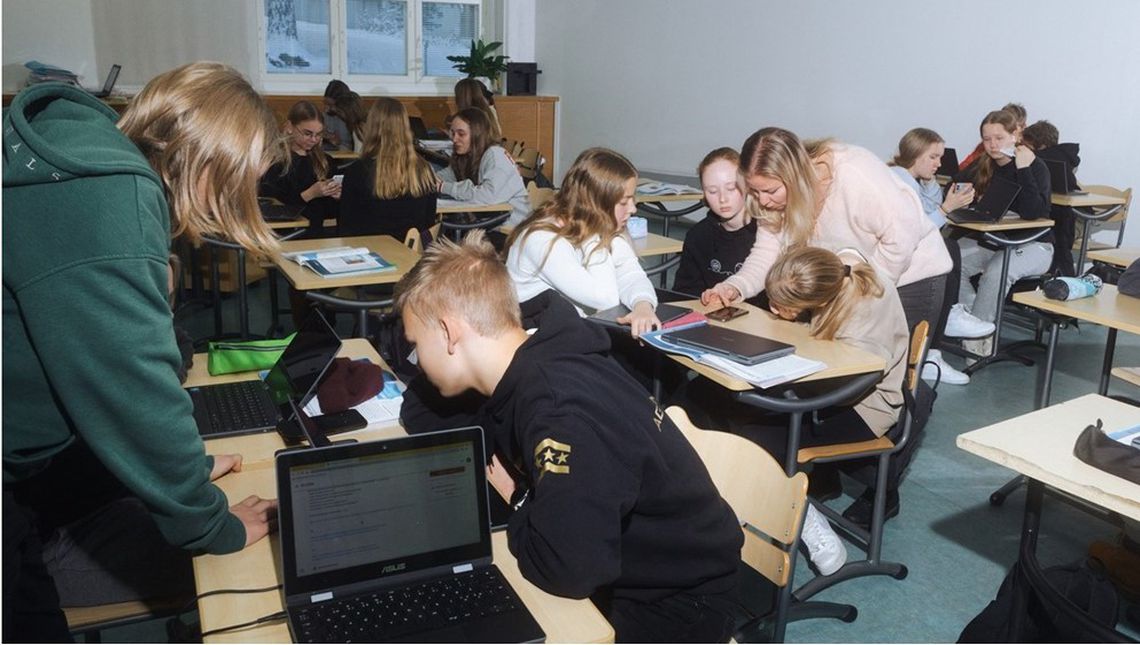
Teacher Saara Martikka (in pink sweater) works with students to identify misinformation. Media literacy is taught in Finland starting in preschool.

I have long admired Finland for its educational system, but this beats all. The country starts teaching children how to identify misinformation at a very young age. That’s why it “ranked No. 1 of 41 European countries on resilience against misinformation for the fifth time in a row in a survey published in October by the Open Society Institute in Sofia, Bulgaria.”

Jenny Gross has the story at the New York Times.

“A typical lesson that Saara Martikka, a teacher in Hameenlinna, Finland, gives her students goes like this: She presents her eighth graders with news articles. Together, they discuss: What’s the purpose of the article? How and when was it written? What are the author’s central claims?

“ ‘Just because it’s a good thing or it’s a nice thing doesn’t mean it’s true or it’s valid,’ she said. In a class last month, she showed students three TikTok videos, and they discussed the creators’ motivations and the effect that the videos had on them.

“Her goal, like that of teachers around Finland, is to help students learn to identify false information. … Officials say Finland’s success is not just the result of its strong education system, which is one of the best in the world, but also because of a concerted effort to teach students about fake news. Media literacy is part of the national core curriculum starting in preschool.

“ ‘No matter what the teacher is teaching, whether it’s physical education or mathematics or language, you have to think, “OK, how do I include these elements in my work with children and young people?” ‘ said Leo Pekkala, the director of Finland’s National Audiovisual Institute, which oversees media education. …

“The survey results were calculated based on scores for press freedom, the level of trust in society and scores in reading, science and math. The United States was not included in the survey, but other polls show that misinformation and disinformation have become more prevalent since 2016 and that Americans’ trust in the news media is near a record low. …

“Finland has advantages in countering misinformation. Its public school system is among the best in the world. College is free. There is high trust in the government, and Finland was one of the European countries least affected by the pandemic. Teachers are highly respected.

On top of that, Finnish is spoken by about 5.4 million people. Articles containing falsehoods that are written by nonnative speakers can sometimes be easily identified because of grammatical or syntax errors. …

“While teachers in Finland are required to teach media literacy, they have significant discretion over how to carry out lessons. Mrs. Martikka, the middle school teacher, said she tasked students with editing their own videos and photos to see how easy it was to manipulate information. A teacher in Helsinki, Anna Airas, said she and her students searched words like ‘vaccination’ and discussed how search algorithms worked and why the first results might not always be the most reliable. Other teachers also said that in recent months, during the war in Ukraine, they had used Russian news sites and memes as the basis for a discussion about the effects of state-sponsored propaganda.

“Finland, which shares an 833-mile border with Russia, developed its national goals for media education in 2013 and accelerated its campaign to teach students to spot misinformation in the following years. Paivi Leppanen, a project coordinator at the Finnish National Agency for Education, a government agency, said the threat of Russian misinformation on topics such as Finland’s bid to join the North Atlantic Treaty Organization ‘hasn’t changed the basics of what we do, but it has shown us that this is the time for what we have been preparing.’

“Even though today’s teenagers have grown up with social media, that does not mean that they know how to identify and guard against manipulated videos of politicians or news articles on TikTok. In fact, a study published last year in the British Journal of Developmental Psychology found that adolescence could be a peak time for conspiracy theorizing. …

“For teachers of any age group, coming up with effective lessons can be challenging. ‘It’s so much easier to talk about literature, which we have been studying for hundreds of years,’ said Mari Uusitalo, a middle and high school teacher in Helsinki.

“She starts with the basics — by teaching students about the difference between what they see on Instagram and TikTok versus what they read in Finnish newspapers. … During Ms. Uusitalo’s 16 years as a teacher, she has noticed a clear decline in reading comprehension skills, a trend she attributes to students’ spending less time with books and more time with games and watching videos. With poorer reading skills and shorter attention spans, students are more vulnerable to believing fake news or not having enough knowledge about topics to identify misleading or wrong information, she said.

“When her students were talking this summer about leaked videos that showed Finland’s prime minister, Sanna Marin, dancing and singing at a party, Ms. Uusitalo moderated a discussion about how news stories can originate from videos circulating on social media. Some of her students had believed Ms. Marin was using drugs at the party after watching videos on TikTok and Twitter that suggested that. Ms. Marin denied having taken drugs, and a test later came back negative.

“Ms. Uusitalo said her goal was to teach students methods they could use to distinguish between truth and fiction. ‘I can’t make them think just like me,’ she said. ‘I just have to give them the tools to make up their own opinions.’ ”

More at the Times, here.

Read Full Post »

Art: Norman Rockwell.
Study for “The Problem We All Live With” (1963), Wolff pencil and charcoal on paper, Norman Rockwell Museum Collection, from Lynda Gunn, Norman Rockwell model for “The Problem We All Live With,” a tribute to a brave little American, Ruby Bridges.

When I was growing up, Norman Rockwell art was everywhere, not just on the covers of the Saturday Evening Post. I think that, partly because it was so available, it was undervalued by art snobs. Abstract Expressionism was the only thing for serious artists, supposedly. But the public at large loved Rockwell’s storytelling, and in recent years the snobs have begun to notice the skill underlying those stories.

Lauren Moya Ford writes at Hyperallergic that the new Norman Rockwell: Drawings, 1911–1976 is the first book dedicated to the artist’s prolific but largely private drawing practice.

“Norman Rockwell produced nearly 3,000 images for publication over his six-decade-long career, but he made many more drawings and sketches that have never been seen,” she reports. “For the artist and illustrator known for depicting charming views of daily American life, putting pencil or charcoal to paper was more than just a quick, problem solving process.

‘Drawing is a complete expression of my idea in line and tone,’ he wrote in 1948, adding that ‘sometimes I feel that making this sketch is the most creative part of making a picture.’

Norman Rockwell: Drawings, 1911–1976 (Abbeville Press, 2022) by Stephanie Haboush Plunkett and Jesse M. Kowalski … sheds light on the artist’s personal and professional drawings, including his preparatory sketches for advertisements, books, and magazine covers, as well as his illustrated letters, travel sketchbooks, cartoons, and caricatures. Rockwell has long been celebrated for his technical expertise, light humor, and meticulous attention to detail, traits that come through perhaps most strongly in his drawings. …

“Born in New York City in 1894, Rockwell grew up watching his father and maternal grandfather draw and paint in their free time. At age 16, he left high school to study art, first at New York’s National Academy School, and later at the Art Students League, where he excelled in figure drawing. At only 19 years old, he was appointed Art Director at Boys Life magazine, and in 1916, he began his 47-year tenure at the Saturday Evening Post, where he produced more than 300 magazine covers that reached — and delighted — millions of Americans.

“Despite ongoing project deadlines, Rockwell remained a methodical craftsman. Each finished piece could take as many as 15 steps and countless sketches to complete, and his preparatory drawings are often so impressively executed that they could easily be finished works, though they were never shown publicly. The book explains that Rockwell’s fastidiousness owes itself at least in part to his love of the Old Master, and he referenced and sometimes imitated Raphael, Leonardo, Dürer, Vermeer, and others in his work. For example, Rockwell’s ‘Rosie the Riveter’ (1943) takes the same pose as Michelangelo’s ‘Prophet Isaiah’ (c. 1511) from the Sistine Chapel, and in ‘The Art Critic’ (1955), his son poses as a young gallery-goer admiring a Rubens-esque portrait, modeled by the artist’s wife.

“Rockwell used live models and real props to create his work during the first decades of his career. Later he incorporated photography, though this didn’t necessarily make his process any less elaborate. Ever the perfectionist, Rockwell sometimes took more than 100 shots of the individual models and elements he planned to draw at different angles and positions. But the rapid technology allowed Rockwell to use more animated poses and expressions, and to incorporate people, places, and things from outside of his studio. …

“One of Rockwell’s most famous pieces is ‘The Problem We All Live With’ (1963), his tribute to the bravery of Ruby Bridges. It was the artist’s first image for Look magazine, a publication that Rockwell began working for after being frustrated by the Post’s policy against depicting people of color, except in subservient roles. Rockwell was a life member of the NAACP. At Look, ‘his hands were no longer tied, and he felt free to create artwork that underscored his personal beliefs and called attention to the civil rights issues of the day,’ Louis Henry Mitchell writes in his foreword.

“The image was so timely and powerful that one Look reader wrote, ‘The truth is pretty hard to take until we get it from a Norman Rockwell.’ Although Rockwell has sometimes been criticized for his whimsical, even idealized portrayals of American life, this book reveals him to be a tireless worker whose drawings carried much more skill, substance, and conviction than previously recognized.”

More at Hyperallergic, here. No firewall. Terrific pictures.

For a treat, try to get to the Norman Rockwell Museum (“The Home for American Illustration”) in Stockbridge, Massachusetts. Right now they have a special exhibit on Hilary Knight, featuring Eloise, among other works. And of course, there are guided tours of the museum’s extensive Rockwell collection.

Read Full Post »

Photo: Sony.
A scene from the children’s film Stuart Little with artist Róbert Berény’s long-lost painting hanging in the background.

Wouldn’t you love to discover a missing artifact while watching an old children’s movie with a kid? That is what happened to a Hungarian art researcher who thought he was just relaxing and off work.

I saw this 2014 report from Agence France-Presse in Budapest at the Guardian.

“A long-lost avant garde painting has returned to Hungary after nine decades thanks to a sharp-eyed art historian, who spotted it being used as a prop in the Hollywood film Stuart Little.

“Gergely Barki, 43, a researcher at Hungary’s national gallery in Budapest, noticed ‘Sleeping Lady with Black Vase,’ by Róbert Berény as he watched television with his daughter Lola in 2009.

“ ‘I couldn’t believe my eyes when I saw Berény’s long-lost masterpiece on the wall behind Hugh Laurie. I nearly dropped Lola from my lap,’ said Barki.

‘A researcher can never take his eyes off the job, even when watching Christmas movies at home.’

“The painting disappeared in the 1920s, but Barki recognized it immediately even though he had only seen a faded black-and-white photo from an exhibition in 1928. He sent a flurry of emails to staff at the film’s makers, Sony Pictures and Columbia Pictures, and received a reply from a former set designer on the film – two years later.

“ ‘She said the picture had been hanging on her wall,’ Barki said. ‘She had snapped it up for next to nothing in an antiques shop in Pasadena, California, thinking its avant garde elegance was perfect for Stuart Little’s living room.’

“After leaving Sony, she sold the painting to a private collector who has now brought the picture to Budapest for sale by auction.

“Berény, the leader of a pre-first world war avant garde movement called the Group of Eights, fled to Berlin in 1920 after designing recruitment posters for Hungary’s short-lived communist revolution in 1919. … According to Barki, the buyer at the 1928 exhibition, who was possibly Jewish, is likely to have left Hungary before or during the second world war.”

So what else can we learn about artist Róbert Berény? Here’s what Wikipedia says: “Róbert Berény (18 March 1887 – 10 September 1953) was a Hungarian painter, one of the avant-garde group known as The Eight who introduced cubism and expressionism to Hungarian art in the early twentieth century before the First World War. He had studied and exhibited in Paris as a young man and was also considered one of the Hungarian Fauves.

“A Berény painting titled Sleeping Lady with Black Vase, whose whereabouts had been unknown since 1928, was rediscovered by chance in 2009 by art historian Gergely Barki upon watching the 1999 American film Stuart Little with his daughter, where the piece was used as a prop. An assistant set designer had bought the painting cheaply from a California antique store for use in the film, and had kept it in her home after production ended. The painting was sold at auction in Budapest on 13 December 2014 for €229,500 [about $249,524].”

More at the Guardian, here. No firewall. Donations welcomed. Nicole Waldner’s blog has a lot more detail, here.

Read Full Post »

« Newer Posts - Older Posts »