Feeds:
Posts
Comments

Archive for the ‘Uncategorized’ Category

In the interest of bringing you some of the latest ideas in sustainability, here is a story on reusing building materials, leasing instead of buying products, and other ideas to lighten the planet’s burden. And they are not just ideas.

Jessica Camille Aguirre reports at the New York Times, “When the Dutch National Bank moved into its Amsterdam headquarters in 1968, the new buildings were epic and stylish. A sprawling Modernist landmark that took up an entire city block off the banks of the Amstel Canal, it was distinguished by a towering high-rise of polished ochre tile. …

“A few decades into the new millennium, the entire complex began to show signs of wear. Tiles fell off the facade. Pipes began to leak. And, perhaps most troubling in a country that prized itself on environmental innovation, its overextended heating systems burned too much fuel.

“In 2020, an architecture firm completed a design plan that would update the original structures and transform the inner courtyard into a public garden. …

“Typically, the fate of a building that has outlasted its usefulness is demolition, leaving behind a huge pile of waste. The Netherlands and other European countries have tried to reduce that waste with regulations. Buildings there are often smashed to pieces and repurposed for asphalt. … A Dutch environmental engineer named Michel Baars thought he could do better than turn [a building] into material for a road.

Mr. Baars considers himself an urban miner, someone who extracts raw materials from discarded infrastructure and finds a market for them. …

“Lean and no-nonsense, Mr. Baars belongs to an emerging group of architects, engineers, contractors and designers who are determined to find a new way to build. This group shares a philosophy rooted in a set of ideas sometimes called the circular or regenerative economy, the cradle-to-cradle approach, or the doughnut economy.

“There are two main tenets to their thinking: First, on a planet with limited resources and a rapidly warming climate, it’s crazy to throw stuff away; second, products should be designed with reuse in mind. The first idea is a recognizable part of our everyday lives: Recycling has retrieved value from household trash for a long time. More recently, the approach has started to gain a toehold in industries like fashion, with secondhand retailers and clothing rental services, and in food production, with compostable packaging. The second takes more forethought and would require companies to rethink their businesses in the most basic ways. Translating either concept to the infrastructure of human settlements requires considering reuse in much longer time scales. …

“Buildings use a prodigious amount of raw materials and are responsible for nearly 40 percent of the world’s climate emissions, half of which is generated by their construction. The production of cement is alone responsible for eight percent of global emissions.

“In recent years, concern about waste and the climate has led cities like Portland, Ore., and Milwaukee to pass ordinances requiring certain houses to be deconstructed rather than demolished. Private companies in Japan have spearheaded new ways of taking high-rises down from the inside, floor by floor. China promised to repurpose 60 percent of construction waste in its recent five-year plan. But perhaps no country has committed itself as deeply to circular policies as the Netherlands.

“In 2016, the national government announced that it would have a waste-free economy by 2050. At the same time, the country held the rotating Council of the European Union presidency, and it made circularity one of the main concepts driving the industrial sector across the bloc. Amsterdam’s city government has set its own goals, announcing plans to start building a fifth of new housing with wood or bio-based material by 2025 and halve the use of raw materials by 2030. Cities like Brussels, Copenhagen and Barcelona, Spain, have followed suit.

“Even in the Netherlands, though, creating a truly circular economy is challenging. Nearly half of all waste in the country comes from construction and demolition, according to national statistics, and a stunning 97 percent of that waste was classified as ‘recovered’ in 2018. But most of the recovered waste is downcycled — that is, crushed into roads or incinerated to produce energy. A 2020 report by the European Environment Agency pointed out that only 3 to 4 percent of material in new Dutch construction was reused in its original form, which means that trees are still being cut for lumber and limestone still mined for cement. …

“Mr. Baars, who runs a circular demolition company called New Horizon, sent a crew of around 15 people to take down the office partitions [in the bank tower]. They packed off interior glass and plasterboard to companies that could make use of the materials. Then, starting at the top of the 86,000-square-foot tower, they began removing the glass facade. A crane lifted pieces to a quay, where they were loaded onto barges in the Amstel Canal for the seven-mile trip upriver to Mr. Baars’s warehouse.”

A 2012 McKinsey report presented at the Davos World Economic Forum suggested that companies were missing out on opportunities to create new business models. “What if, for example, manufacturers could make more money by leasing, rather than selling, their products?

“Thomas Rau, an architect in Amsterdam, is a leading proponent of this idea. In 2015, he appeared in a Dutch documentary called The End of Ownership, in which he didn’t argue for abolishing ownership so much as for shifting it from individuals to manufacturers.

“If manufacturers retain ownership of their products, he argued, they will want to make products that last longer and need fewer repairs. Just as significant, they will want to design stuff that can be easily taken apart and used again. Theoretically, this could help consumers, too. No one wants to own a computer or television or washing machine, Mr. Rau claimed; they just want the services those products offer: computing ability, visual entertainment, textile cleaning. … Think about the speed with which subscription music-streaming services replaced ownership of CDs.” More at the Times, here.
Read Full Post »

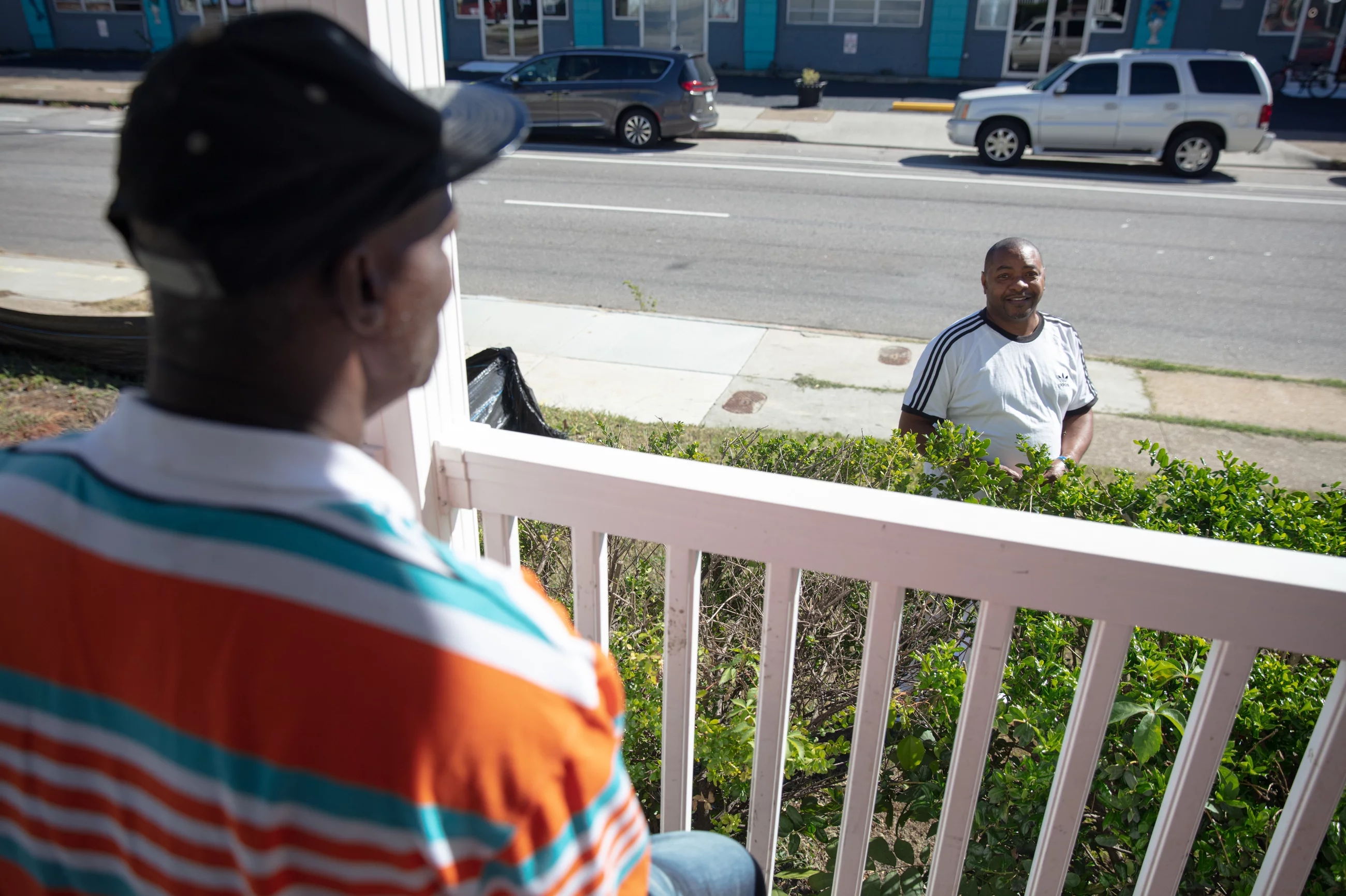
Photo: Parker Michels-Boyce for NPR.
Eric Perkins (right)
says lived on the beach, then a shelter and then in a hotel during the pandemic before moving into the Norfolk apartment,” NPR reports.”The median local rent for a one-bedroom apartment is over $1,000. Perkins’ rent is $600.

This is a story about an approach to housing that hasn’t always worked in the past but, when carefully managed, really can move people out of homelessness and into eventual independence. It’s called the roommate.

Jennifer Ludden has a report at National Public Radio (NPR).

“Even after three years of homelessness, Eric Perkins did not want to move into an apartment with another person who had been unhoused.

” ‘I was real skeptical because of the things I was seeing inside the shelter,’ he says. ‘A lot of drug use, lot of alcohol abuse, PTSD, there was a lot of veterans there. …

“But the arrangement suggested by a local housing provider has turned out better than he expected. On a recent afternoon, Perkins gave a tour of the two-story house where he has lived for more than two years. It’s divided into two apartments, and he shares the one on the first floor. The place came furnished, including with some homey knickknacks. Perkins has his own bedroom but shares a bathroom.

” ‘It’s small, but it’s enough for us,’ he says.

“Farther down the hall is what sold him on the place — a roomy kitchen with a window onto the small yard. ‘I like to cook,’ he says. ‘This is where I want to be.’

“Before he moved in, Perkins had lived on the beach in Virginia Beach, then a shelter and — during the pandemic — a hotel. He ended up without housing after a heart attack in 2017 and double-bypass surgery with no health insurance. He also has chronic lung disease that limits his ability to work. Perkins’ monthly disability payment is just under $800. The median local rent for a one-bedroom apartment is more than $1,000.

“After seeing the apartment and meeting the roommate he’d be paired with, Perkins decided to try it out. His rent is $600, and he gets a lot of help from housing aid. He says his roommate was also a good match with his personality, neat and quiet.

” ‘We got to know each other, we respected each other’s space, we shared everything,’ he says. ‘It was really nice.’

“That roommate ended up reuniting with his family and moved out, and in April 2021, Leon Corprew moved in. Corprew is 59 and Perkins is 56. They say they get along well, though they mostly keep to themselves and give each other space. Perkins used to cook for both of them, but Corprew makes his own meals now because, he says with a laugh, ‘I eat a lot!’

“Getting homeless people into their own apartment, without roommates, is considered the ‘gold standard’ for achieving independence, says Ann Oliva, CEO of the National Alliance to End Homelessness. But record high rents and a historic housing shortage are making it all but impossible in many places in the U.S. …

“Rents in many places around the country have gone up by double digits in the past couple of years, and in June, the median listed rent for an available apartment rose above $2,000 a month for the first time. Federal benefits like Supplemental Security Income — or disability — have been unable to keep up. …

“Oliva says she’s seeing more interest in offering roommate arrangements to homeless people out of necessity. When vacancy rates are as low as 1% or 2%, she says expanding the search to two- or three-bedroom apartments can make it easier to find a place.

“It may also lead to housing in nicer neighborhoods, says Todd Walker, executive director of the Judeo-Christian Outreach Center in Virginia Beach, which found the shared apartment for Eric Perkins.

“Walker started trying out this kind of shared housing eight years ago when one of his volunteers offered to rent out a four-bedroom family home. And he says he quickly learned some of the pitfalls.

” ‘We had clients that weren’t paying [rent], other clients giving that client their money to pay for the utility and it wasn’t getting paid,’ he says. ‘It was a catastrophe.’

“The first major lesson Walker learned was to have a separate lease for each roommate. That way, if one person is a problem they can be moved — or evicted — without everyone else being kicked out. Also, he says it’s important to keep utilities in the landlord’s name and include that cost in the rent.

“Another rule that Walker considers nonnegotiable: No doubling up in bedrooms, and there must be locks on the bedroom doors so that each renter is guaranteed a safe space. …

“The whole idea can also be a tough sell to landlords, who might worry about property damage. Walker talks it up to mom-and-pop landlords at every chance and offers incentives like a bonus or double deposit. He says these arrangements often let him house people who would otherwise be denied a lease, because of lack of income, a criminal record or past eviction. …

“Landlord Sophia Sills-Tailor owns the house where Perkins and Corprew live. When she heard about Walker’s program five years ago, she was desperate to rent out a couple of places. She’d been using Craigslist but found those tenants ‘fly-by-night.’ Working with a nonprofit seemed more stable, even if its clients were homeless.

” ‘When they come in, they don’t just say, “OK, here is the person, goodbye,” ‘ she says. They help them set up the household, donating things like blankets, pots and pans. ‘”‘And then they’re coming to see them.’ “

More at NPR, here. No firewall.

I love that when Perkins says the shared apartment is small, he adds that it’s “enough for us.” The roommates are not friends, but they are still an “us.”

Read Full Post »

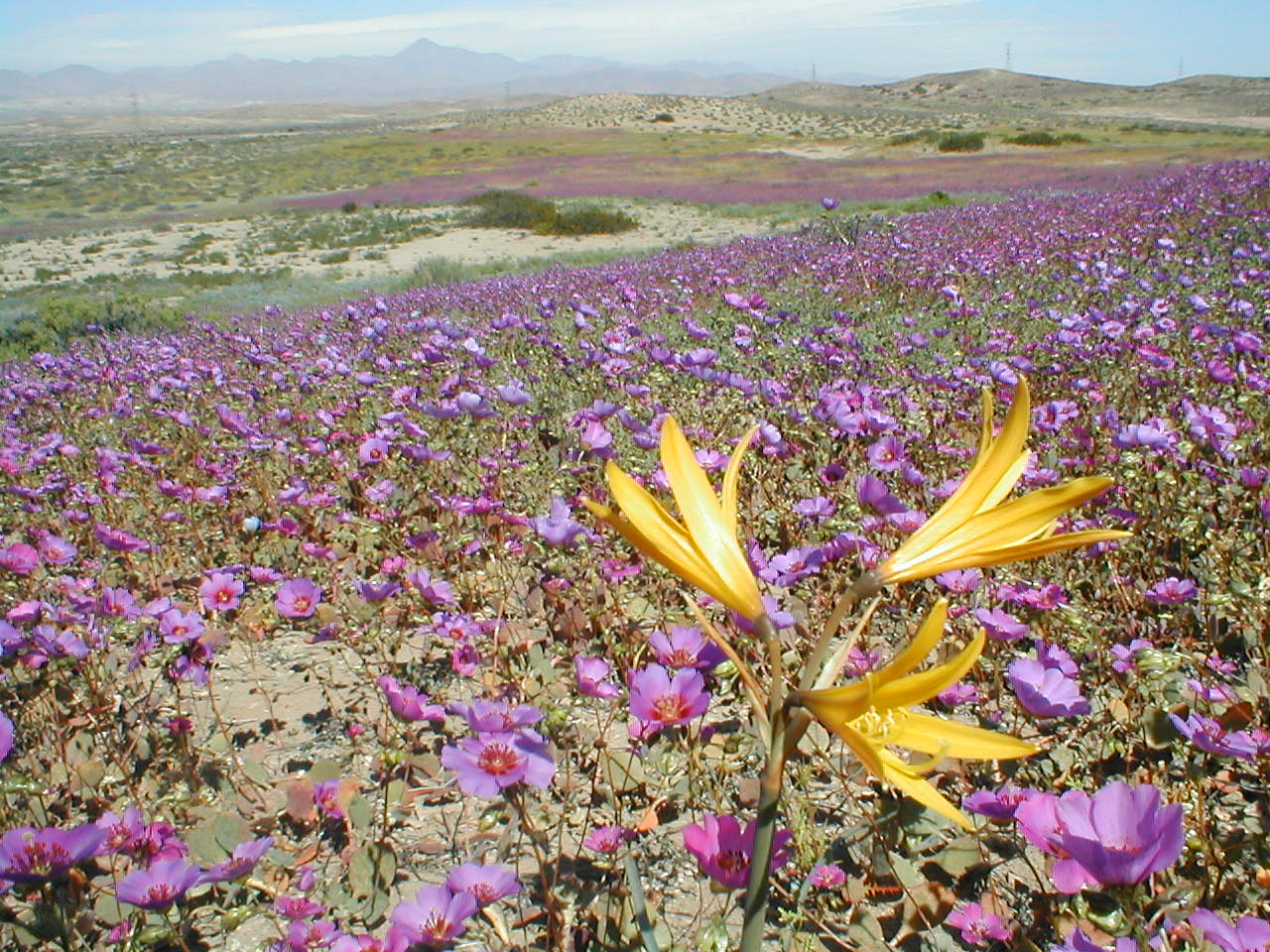
Photo: Javier Rubilar via Wikimedia.
Chile’s Atacama desert in flower.

I’m not much of a traveler, but when I see photos like the one above showing the desert in flower, I think it would be a treat to see that. Then I read that Chile’s flowering desert is in danger from tourism and I feel like I am actually doing my part by staying home. (Ha! I sound like the fox in the Aesop’s fable.)

Tibisay Zea reports at the radio show the World, “In Chile’s Atacama Desert, it almost never rains. The area is so dry that it even serves as a practice site for expeditions to Mars. But once or twice every decade, the skies open up and it rains, causing dormant seeds underground to grow.

“As a result, a spectacular ‘flowering desert’ of plants that are mostly endemic to the Atacama region attract tourists and botanists from around the world. But the great interest in the flowers is also the same thing that’s endangering them.

“This natural phenomenon of the blooming desert usually happens every 5 to 7 years, and it’s difficult to predict.

“ ‘There needs to be a perfect combination of precipitation and temperature for the flowers to bloom,’ said Monserrate Barrientos, a tour guide for the flowering desert in Copiapó.

“The most emblematic of the plants is a little pink flower — known as pata de guanaco, or ‘guanaco’s foot’ — that carpets large swaths of the desert during the bloom. Guanaco is a wild llama native to the area, whose feet look similar to the leaves of the flower.

“ ‘The leaves are thick, to [be able to] store water,’ Barrientos said. 

“For many scientists, the flowering desert is an exciting event, because it proves the resilience of certain types of flora, like the pata de guanaco, in the world’s driest desert.

“Benito Gomez Silva, a microbiologist at the University of Antofagasta, is studying microorganisms that are very resistant to extreme water scarcity. …

“But the flowering desert is facing several threats. One of them is climate change, according to Cesar Pizarro, a biologist with the Chilean Department of Conservation. ‘Longer droughts or heavier rains could affect the frequency of the desert bloom,’ he said.

Another threat is traffickers who collect the native plants, as well as visitors who pluck flowers to bring home with them.

“During his first visit to the Atacama region earlier this month, Chile’s President Gabriel Boric announced the creation of the Desierto Florido National Park for the first quarter of 2023 in an attempt to preserve the area.

“Environmental organizations have raised concerns in recent years about the possible negative effects of large numbers of tourists visiting the flowering desert, as well as the illegal trade of native flower species and the development of motorsport in the region. … An increased level of protection will ensure that tourists behave responsibly. 

“Chilean tourists Carlos Silva and Ana Maria Acuña drove 23 hours from across the country just to see the flowering desert. …

“Ana said that she’s been inspired by the visit. ‘Humans have a lot to learn from nature. It’s so resilient to scarcity, to difficulties.’

“Professor Benito Gomez-Silva agreed that there is a lot to learn. ‘It’s like translating the information that our little brothers, the microorganisms in the desert, provide for us,’ he said.”

More at the World, here. Nice photos. No firewall. Donations to the World welcome.

You might also be interested in my 2021 post “Returning Pilfered Cactuses,” here, about busting traffickers of Chile’s protected cactuses: “most likely the biggest international cactus seizure in nearly three decades.” 

Read Full Post »

Photo: Emmett FitzGerald.
Dean Wilson
, protector of Louisiana swampland.

Now that we know how important wetlands are for the environment and for protecting us from the worst effects of hurricanes, it doesn’t seem like a fringe occupation to be a protector of swamps. Among those who take Louisiana’s wetlands seriously is the scrappy nonprofit Louisiana Bucket Brigade. Another defender is Dean Wilson. Emmett FitzGerald at Living on Earth [LOE] interviewed him recently.

“LOE: Once, cypress swamps covered hundreds of thousands of acres across the American South. Logging, oil and gas extraction and swamp drainage transformed the landscape. But over recent years, Dean Wilson has worked to protect the remaining cypress swamps of Louisiana’s Atchafalaya Basin from illegal loggers and oil prospectors. Recently, the European biomass industry has set up shop in the state, and conservationists are concerned for the future. Living on Earth’s Emmett FitzGerald reports. …

“EMMETT FITZGERALD: Dean Wilson doesn’t sound like a Cajun, but he’s been living in the swamps of Southern Louisiana for 30 years now.

“DEAN WILSON: I remember the first time I saw the swamp I fell in love with it. You know you see the beautiful green trees, with the Spanish moss, over water, and those egrets flying around like angels. Uh, I just really fell in love with that.

“FITZGERALD: Dean grew up outside of Madrid, in Spain, but he came to Louisiana in his early twenties on his way to South America. He wanted to get used to the humidity and the mosquitoes before doing scientific research in the Amazon. But he never left the Bayou State.

“WILSON: When I realized I could actually make a living off the land, I decided to stay. I was a commercial fisherman for 16 years, full-time. So I made my living hunting and fishing the swamps in the Atchafalaya Basin for 16 years.

“FITZGERALD: Dean says people call all kinds of marshy wetlands swamps, but true swamps are actually pretty rare, and the Atchafalaya Basin is the largest in the United States.

“WILSON: And the difference between a swamp and a marsh is that a swamp is a flooded forest. So you actually go in the springtime when the waters high you go with a boat through the forest and you can see the birds and the animals the otters minks alligators all the things that live in the swamp. It’s a magnificent place. One of the most beautiful places on earth. The Cypress trees grows to different shapes; they can live to up to 4000 years old. So the Cypresses are incredibly beautiful.

The difference between a swamp and a marsh is that a swamp is a flooded forest.

“FITZGERALD: A few years ago, Dean gave up commercial fishing and turned his attention to protecting the ancient Cypress forest he calls home. Now, Dean patrols the swamp in his little motorboat as the head of the conservation organization Atchafalaya Basinkeeper. Today Dean and I are joined in his boat by his German Shepherd Shanka, and a fellow conservationist.

“PAUL ORR: I’m Paul Orr and I’m Lower Mississippi Riverkeeper. …

“FITZGERALD: Dean pulls the boat through the undergrowth into a clearing in the forest, and suddenly hundreds of giant cypress trees are all around us. Their trunks flare out at the bottom like grass skirts. Dean says this cypress forest is teeming with life.

“WILSON: The swamps of the Atchafalaya are considered by scientists the most productive in the entire world. You can go to the Amazon and you may have more biodiversity, but if you get an acre of the Atchafalaya Basin and you’re supposed to get more pounds of fish and crawfish than any other wetlands in the world.

“FITZGERALD: Full-grown cypress trees have nooks and cavities that birds love to nest in.

“WILSON: Nearly half of the waterfowl population in North America come at one time or another through the Atchafalaya basin. So it is a critically important ecosystem not only for North America but the whole western hemisphere.

“FITZGERALD: As we float between the trunks, Dean says swamps like this one once covered much of the American South.

“WILSON: Most people have seen the Amazon river flooding millions of acres of rainforest. The Mississippi used to do the same thing, used to flood 24 million acres of forest. For somebody to picture how big is 24 million acres, there was a time when you could get in a boat, right now this time of year and through this water, could go through this forest, and never leave the forest all the way to Missouri.

“FITZGERALD: But that five-hundred-mile waterway didn’t last. A lucrative timber industry developed in Louisiana around 1700. And then in the 19th century new steamship technology allowed companies to log southern cypress forests quickly and efficiently.

“WILSON: By the year 1900 it was the largest industry in coastal Louisiana, was the cypress logging industry. Uh, and people thought it would last forever. By 1920, it was all over. They logged every single forest in this state. Didn’t leave a single acre standing.

“FITZGERALD: In 1927, the Mississippi River spilled its banks, killing hundreds of people and displacing hundreds of thousands in the most destructive flood in US history. The Army Corps of Engineers responded to the crisis by building levees all up and down the Mississippi to control the flow of the river. The levees were designed to protect cities like New Orleans, but they straight-jacketed the river and prevented the natural flooding of Louisiana’s cypress swamps.

“WILSON: It drained all those forests. Farmers came in, they cut those trees down and today it’s mainly farmland. When people drive through Arkansas, Northern Louisiana, Mississippi through what is called the Delta area, it’s all farmland but it used to be like the Atchafalaya Basin.

“FITZGERALD: Today although the Atchafalaya Basin is smaller than it once was, it’s still one of last great cypress swamps left in the United States. Like all swamps it’s protected under the federal Wetlands Protection Act, and Dean Wilson and Paul Orr want to do everything in their power to preserve it. In 2008, they noticed an uptick in illegal logging in the Atchafalaya. They followed the supply chain all the way to the garden mulch aisle.

“ORR: We realized pretty quickly from following the logs and then finding bags of cypress mulch and following those to Wal-Mart, Lowes and Home Depot that there was this tremendous push to try and build a cypress mulch industry.

“FITZGERALD: But Dean says the companies that supplied the mulch weren’t clear about where it came from.

“WILSON: Home Depot, Lowes and Wal-Mart were selling the mulch as environmentally harvested. The bags would say ‘Made with environmentally-harvested cypress, from Florida’ – you have a Florida address, so they were actually deceiving the public into buying their mulch.

“ORR: And deceiving the retailers — I think that some of the retailers were not very happy that that was not what they said it was.

“FITZGERALD: So when Paul and Dean brought this issue to the attention of the retailers in 2008, the stores agreed to stop selling Louisiana Cypress mulch. But Dean’s still worried about illegal logging. He says the problem is enforcement.

“WILSON: We have laws to protect wetlands, the problem is those laws are not being enforced, and the government isn’t even putting in the resources to enforce them, they don’t even have a boat, so they can’t be enforced.

“FITZGERALD: And Paul Orr believes that problem starts with the cozy relationship between big business and the state government.

“ORR: I guess it was like the late 90s, early 2000s, the Louisiana Department of Economic Development put an ad in a lot of national publications and it was like a guy in a suit doing a back bend and it said, ‘Louisiana bends over backwards for business.’ And that’s really been the culture in Louisiana — the wealthy business people just give away all of our natural resources and our tax monies and everything for business.”

Oh, Homeowners, here’s a simple thing you can do: don’t buy mulch.

More at Living on Earth, here. There is no firewall, but donations are encouraged.

Read Full Post »

Photo: Moira Donovan.
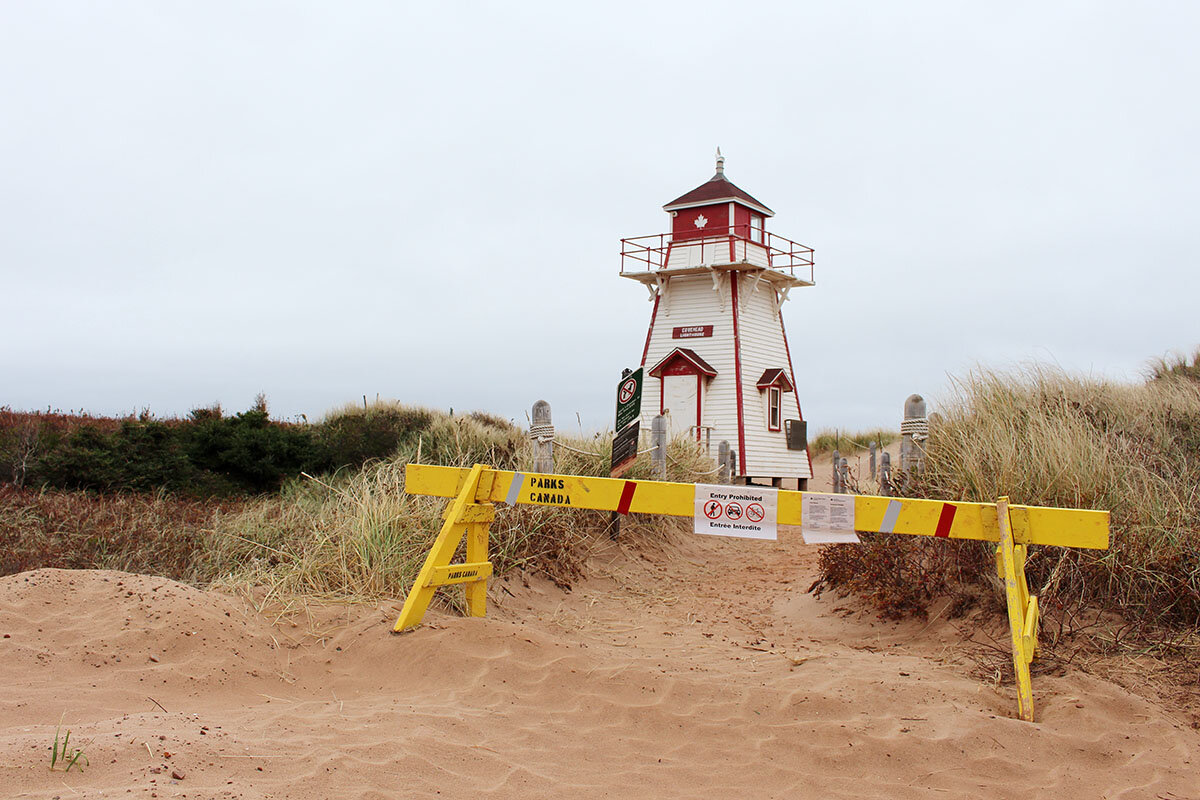
“Hurricane Fiona carved out sections of coastline,” says the
Monitor, “and caused dunes to disappear on Prince Edward Island, where beaches like this one remained closed weeks later.”

There’s nothing like a new experience to make you see things differently. At the Christian Science Monitor, Moira Donovan reports that the severity of a recent hurricane on Canada’s Prince Edward Island is forcing people “to grapple with how climate change is rewriting people’s relationship with the sea.”

She writes, “Robbie Moore spent a week preparing his oyster farm as Hurricane Fiona barreled toward Prince Edward Island in late September. But that didn’t spare it from the impact.

“On Sept. 24, Fiona roared across Atlantic Canada, leaving catastrophe in its wake, including two deaths. Prince Edward Island recorded 92 mph winds, and on the North Shore, where Mr. Moore’s farm is located, the storm ripped up trees, reduced wharves to splinters, and flooded structures. By the time he could get to his farm to assess the damage several days later, he found some sections had vanished, and this year’s oyster crop had been tossed into the treeline, 30 feet from the high-water mark.

“Still, he counts himself relatively fortunate. Some people lost everything, and as much as people had prepared, there was no way to prepare for the damage Fiona caused. ‘There’s a lot of people very discouraged right now,’ he says.

“The recovery is expected to take years. But given what Fiona has shown about the growing threat posed by hurricanes, the more transformative effect could be still to come. As hurricanes become a more regular, immediate danger up and down North America’s Eastern Seaboard, Atlantic Canada – like regions from the Gulf Coast to Florida to New England – is beginning to grapple with how climate change is rewriting people’s relationship with the sea.

“While Atlantic Canada is no stranger to volatile weather, Fiona marked a departure.

Past storms, such as Hurricane Dorian in 2019, had weakened before they made landfall. But Fiona retained much of its strength, making it the most powerful storm to ever hit Canada.

“University of Prince Edward Island climatologist Adam Fenech says that while Fiona was unprecedented, the storm was not unanticipated, given projections of stronger storms in the Atlantic hurricane season. ‘All the things that we’ve been talking about for 30 years are all coming true,’ he says.

“Despite that consensus, Dr. Fenech has spent years playing Cassandra to an at-times skeptical public. Half a dozen years ago, when Dr. Fenech was invited to give a talk about coastal erosion at a cottage development on Prince Edward Island’s North Shore, he warned that many of the properties could disappear in a big storm. Residents were unconvinced. …

“When Fiona hit, 12 cottages in that development were swept off their footings; several were swallowed wholesale by the ocean. In other places, people’s year-round homes were destroyed.

“But in a region where communities have deep ties to the coast, housing isn’t the only concern. Atlantic Canada is the site of Canada’s most lucrative fisheries, operating out of nearly 200 small harbors dotting the coastline – nearly three-quarters of which were affected by Fiona in some way.

“For many harbors, the destruction caused by Fiona will mean an expensive rebuild. But some people are saying the reconstruction should look different.

“When Fiona hit Newfoundland’s southwest coast, Shawn Bath was a day’s drive away; as the scale of the damage came to light, he loaded his truck, hitched his boat, and headed across the province.

“There, he found … shorelines littered with debris. In many places, wharves and fishing stages had been smashed like toothpicks, scattering fishing gear into the water. Mr. Bath and his crew – who run a marine debris cleanup project called the Clean Harbours Initiative – made their way to a small community called Burnt Islands, and got to work. …

” ‘It’s overwhelming,’ says Mr. Bath. ‘Pictures don’t do it justice.’ And he’s worried that there are more than a thousand fishing nets drifting along the bottom of affected harbors. … In the long term, Mr. Bath says the way harbors are laid out needs to be rethought. Fishing infrastructure has traditionally been placed close to the water because that’s where it made the most sense to be. But that calculus has changed.

“ ‘There’s no point in rebuilding and filling all these stages with nets again, if two years down the road the same thing happens,’ he says. ‘Keeping fishing gear on the water’s edge is no longer a reasonable thing to do.’ …

“For Prince Edward Island musician Tara MacLean, who grew up playing in the dunes, the shock of seeing a beloved landscape suddenly vanish was indescribable. …

“Ms. MacLean says the sorrow for what’s been lost should serve as a wake-up call on the risk that climate change poses to the region. But it’s that emotional connection to the water that could also make changing the relationship to it difficult, and when things return to normal, the allure of living close to the water may return, too.”

More at the Monitor, here. No firewall.

Read Full Post »

Photo: Tony Luong.
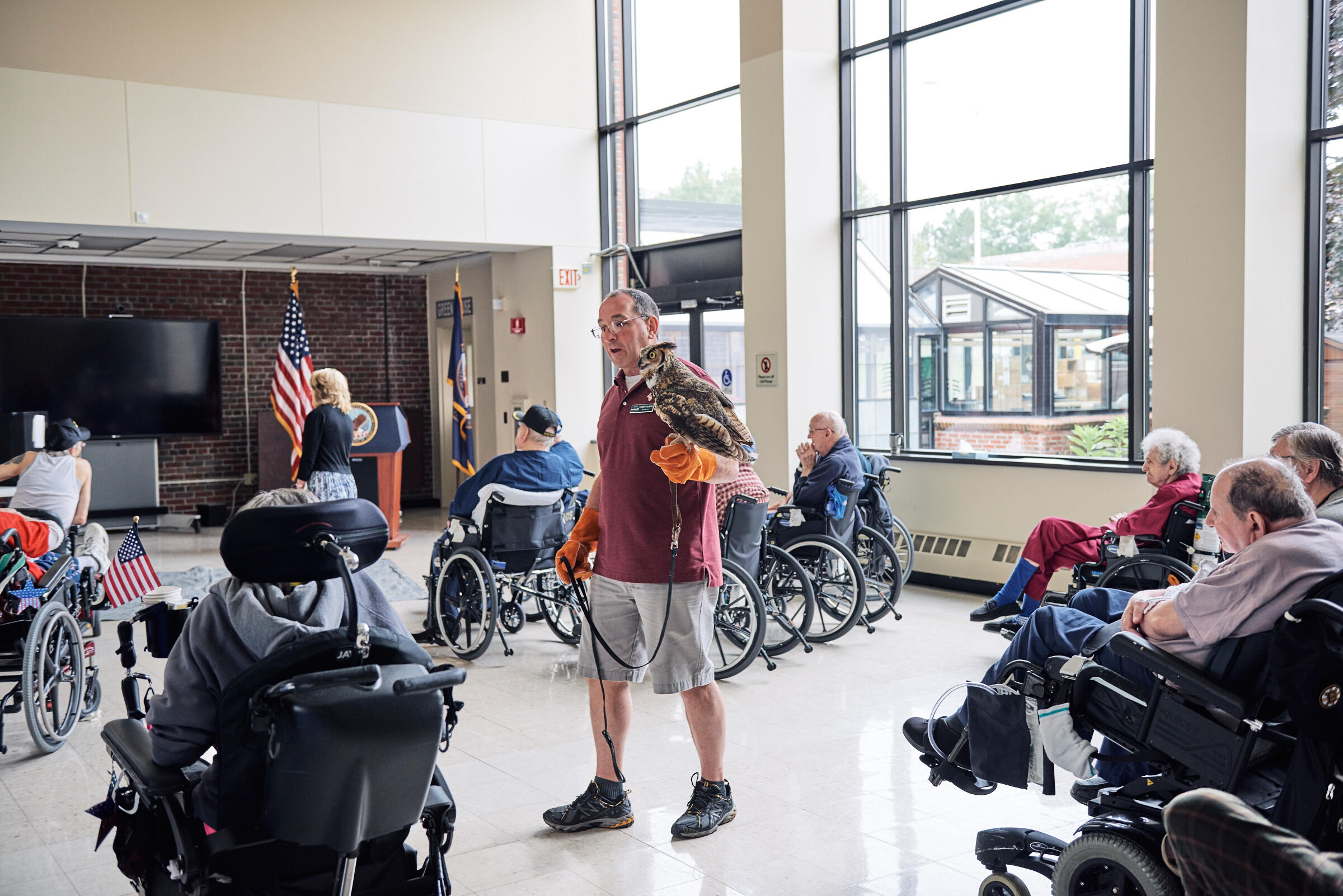
Robert Vallières brings a raptor when he speaks to veterans about how birds helped his recovery, like here at the Manchester VA Medical Center in New Hampshire. When asked the worth of this Great Horned Owl, he told the vet: “I can’t put a value on it.” 

Tomorrow, November 11, is Veterans Day, one of only two federal holidays that hasn’t been switched to a Monday. The other is July 4. I saw today’s story around this time last year and decided to save it for you.

Purbita Saha and Tony Luong wrote at Audubon magazine in 2017 about a former soldier who found solace in Nature and then used his insights to help other veterans.

“The first bird that saved Robert Vallières,” they report, “was a Black Hawk helicopter. It was October 1990, and the then 28-year-old Army soldier was serving in the Persian Gulf War. While riding in the back of a truck on a mission to fortify a foxhole in the remote Arabian Desert, a heavy beam slammed into him, sending him flying and causing severe head injuries and swelling in the brain. The chopper sped Vallières to a field hospital for emergency care. …

“After being honorably discharged, Vallières returned to Concord, New Hampshire. While he appeared to be on the mend, he continued to grapple with chest spasms and Gulf War Syndrome—the mysterious mix of symptoms, including headaches, exhaustion, and memory problems, that plagued up to a third of returning veterans. On top of that, he had lingering effects from a pre-deployment aneurysm, and was diagnosed with post-traumatic stress disorder. … The PTSD led to serious depression and horrific anger, he says. He was overwhelmed with trying to readapt to civilian life when he saw a newspaper ad for a birding trip in the White Mountains. Remembering his hikes with his nature-loving father, also a veteran, Vallières signed up immediately. Up on the slopes, as he scanned the leafy ledges for passerines, a Peregrine Falcon hurtled into view, seizing a Northern Flicker mid-air in a puff of feathers. He followed it back to a snag, where it tore the woodpecker apart, yellow shaft after yellow shaft. ‘I was glued,’ Vallières says. …

“Vallières credits that Peregrine with saving him from despair. The encounter sparked a full-fledged birding obsession that ultimately helped shape his philosophy on healing. He quickly signed on to monitor raptor nests with New Hampshire Audubon. The first site he claimed was Joe English Hill, near Concord, where he and his son Andrew would watch American Kestrels speed rodents to their begging chicks’ mouths. As his identification and observational skills deepened, his responsibilities multiplied. He began tracking breeding Peregrine Falcons and Bald Eagles, aiding in the recognition of an uptick in chicks that confirms the birds’ nationwide resurgence since the pesticide DDT was banned.

“Vallières finds strength and hope in their comeback. ‘They keep my defeats in perspective,’ he says. And, he discovered, while painkillers reduced his chronic pain, his ailments often temporarily vanished in the presence of birds. Besides taking his mind off the hurt, tracking wild birds also allowed Vallières to beat back depression and regain much of his physical strength. …

“He began rehabilitating raptors, first with Audubon, then with the local wildlife hospital Wings of Dawn, where he learned to train unreleasable birds as educational ambassadors.

Working with the feathered charges allowed him to pay forward the care and kindness he’d received from doctors, nurses, and therapists, he says. It also made him feel like less of a burden.

“Given the profoundly soothing effect raptors had on Vallières, he was motivated to share the experience. He brought other vets to the New Hampshire Audubon hawkwatch platform to take in thousands of Broad-wingeds during fall migration. He cowrote a memoir, Wounded Warriors, about his experiences in battle and birding. And he started bringing rehab birds to the New Hampshire Veterans Home and Manchester VA Medical Center. (Vallières is a patient at the latter, receiving therapy for his chronic pain, taking drawing lessons to relieve stress, and learning cognitive exercises to combat memory loss from a second aneurysm in 2012.)

“On the Friday before Memorial Day, Vallières made his rounds at both facilities. In the solarium of the medical center that morning he saluted each of the 15 seniors, many in wheelchairs and Vietnam and Korean War caps. Then he introduced a male Great Horned Owl that is permanently grounded due to a wing injury. Vallières walked around with the raptor on his arm, lifting it above the veterans’ heads so they could feel the rush of its beating feathers. The room buzzed with questions and anecdotes of pet cockatoos; placid faces broke into grins. With his audience transfixed, Vallières related his story. He showed them sketches he has drawn of being airlifted out of Kuwait, shared dark reflections of his struggle with PTSD, and explained the important role that birds have played in his recovery.”

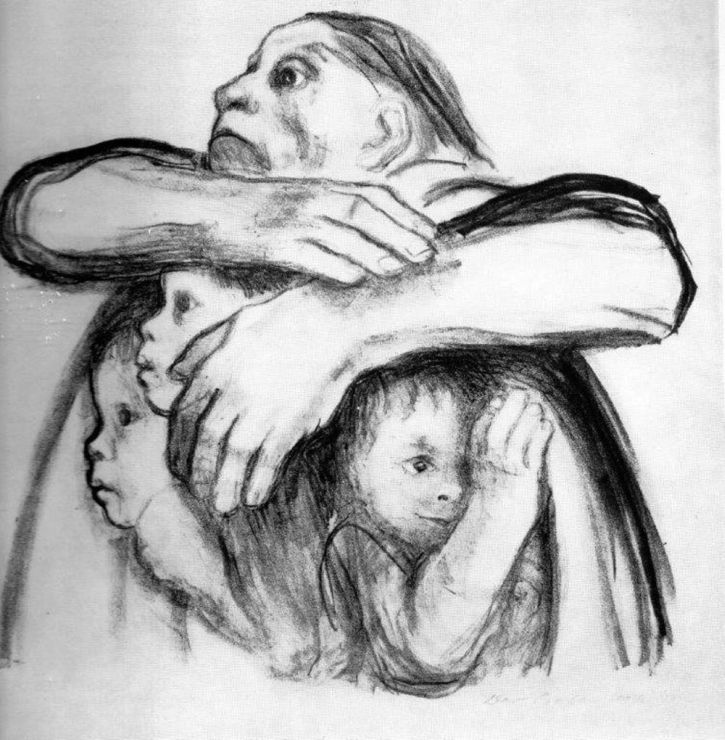
We owe so much to veterans, but you know as soon as a war starts that many, if not most, will be physically or mentally wounded or never come home. And the services to help them will be limited. All by itself, that’s a good reason not to go to war. Sometimes it’s necessary, of course, as the Ukrainians who take up arms today already know. Below is art that shows why they do it.

More at Audubon, here. No firewall. A description of the art is at WordPress, here.

Protecting the children: Kathe Kollwitz’s ‘Grieving Parents’ at Vladslo: ‘Seed Corn Must Not Be Ground.’

Read Full Post »

Photo: Corinne Staley, Flickr, CC BY-NC 2.0.
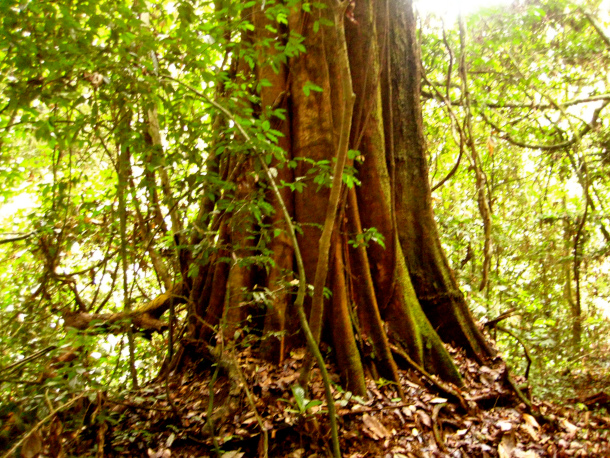
The Congo basin is home to numerous endemic plant and tree species, but today there are serious threats to the health of the ecosystem.

Peat bogs are the last thing I picture when thinking about the Congo. Shows how ignorant I am. Apparently, I am not alone. As the radio show Living on Earth reports, “Western scientists only learned about the Congo Basin peatlands in 2017. But indigenous communities have avoided disturbing the peatland while sustainably hunting and fishing in the area for generations. Raoul Monsembula grew up in the area and now works with Greenpeace Africa. He spoke with host Bobby Bascomb for a local perspective on the region.

BOBBY BASCOMB: “This area is new to the western world but, of course, local people have known about it for generations. Can you tell me a bit about your relationship with the peatlands and how the communities surrounding it used the area?

“RAOUL MONSEMBULA: The elders said to us it was a productive area for the fish and animals, and we could only do seasonal fishing and hunting, and collect some firewood because it’s a fragile area, where the fish and animals reproduce. We only use it during the dry season. We don’t go there during the wet season when the animals are reproducing.

We were advised by our elders to never start a fire in these areas, because these areas were essential for food. It’s also an area where we practiced traditional ceremonies.

“And you don’t see a lot of hospitals here but you don’t see people dying a lot because they’re using medicinal trees from the peatland and eating forest fruit.

“BASCOMB: So as a scientist from the DRC who grew up there, you spent your life in this region, how surprised were you to learn about the enormous amount of carbon locked up in the soil there?

“MONSEMBULA: When the scientists came here and we learned about the peatland, that night it was one of the biggest celebrations I’ve ever had in my life, we danced and we drank with the villagers because even if we didn’t know about the peatlands for a long time we knew that they were special. Even as we now begin to scientifically understand what this area means, the elders knew for a long time that this area would benefit humanity. This discovery made us very happy even if we were unsure if carbon would have any financial significance or not! It’s as though we are helping the world fight against climate change. …

“The problem is in Indonesia they are growing a lot of rice and palm oil crops in the peatlands, so the youth think why not grow them here too because it’s easy money. Most of the young people, the ones who are less than 25 years old, some of whom are unemployed or not well educated, want to do things like that.

“BASCOMB: Well you know the Congo Basin, the rain forest there, is second only to the Amazon of course in terms of being the largest rainforest in the world but unlike Brazil the Congo basin hasn’t really seen a whole lot of development but what are you seeing on the horizon in terms of possible development and threats to the integrity of the peatlands?

“MONSEMBULA: Logging is nearing the peatlands and agribusiness is growing. And the growing population can be problematic because it will encourage the development of more rice crops or palm oil crops in the peatland.

“That can be a problem because with a larger population if people can’t make a living, send their kids to school or go to the hospital they will damage the peatland by logging ecologically valuable trees to sell the wood and once they do that the peatland can dry. …

“BASCOMB: How can the Western world, do you think, support people living in the Congo Basin to preserve this thing that’s so important for all of us but at the same time support the people that need development?

“MONSEMBULA: The problem is that we need donors. We need western countries who are creating a lot of pollution to give some money for peatland protection. But another thing is corruption. You know how bad governance is in Central Africa. Like right now in the DRC we are hearing about millions of dollars going to the Central Africa Forest Initiative, they are giving a lot of money but when you’re in the field you don’t see anything. There is now a very big forest community project which is funded by international NGOs like Greenpeace, not the DRC government. We don’t want people to donate through the government ministry. With the corruption and bad governance that money will not go to the field.”

Reading this story on the day after the US elections, I am struck but something. I may be overgeneralizing, but it seems to me that the elders in the Congo have the wisdom, but in the US, it’s the youth. Whoever shows wisdom, I hope we can give them all the support they need.

More at Living on Earth, here.

Read Full Post »

Photo: Suzanne and John’s Mom.
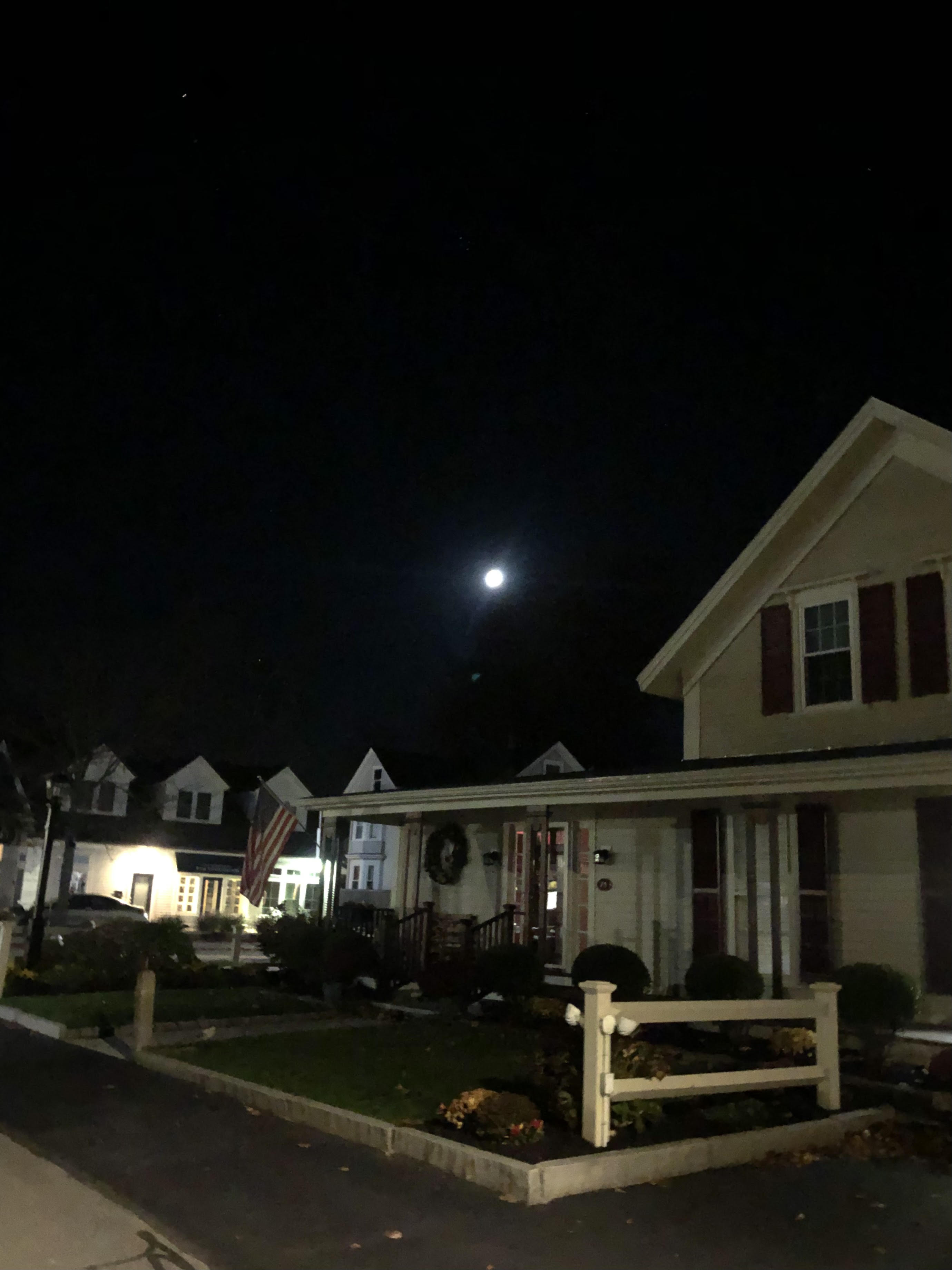
The total lunar eclipse begins in Massachusetts, November 8, 2022.

It was cold between 4 and 5 a.m., but I had my winter clothes over my bathrobe. Other than my husband, no one else was outside.

Today is special for two reasons. It’s election day, which is the reason that matters most to me. But there was also a total lunar eclipse, an event that can put all human anxieties in perspective.

I am always up early anyway, and I enjoyed watching the earth’s shadow pass gradually over the moon. I watched until the eclipse was total but couldn’t watch the shadow move away because the moon had descended too low.

I loved how you could still see the moon faintly glowing even in the total eclipse. And I thought about how a total lunar eclipse will not occur again for another three years. Where will I be then?

Shannon Hall reported for the New York Times about what to expect when watching the eclipse.

“During the early hours on Tuesday, darkness will slip across the face of the moon before it turns a deep blood red. … Anyone awake in the United States will have a front-row seat as the sun, the Earth and the moon line up, causing the moon to pass through Earth’s shadow in the last total lunar eclipse until 2025.

“ ‘To me, the most significant thing about a lunar eclipse is that it gives you a sense of three-dimensional geometry that you rarely get in space — one orb passing through the shadow of another,’ said Bruce Betts, the chief scientist at the Planetary Society. …

“In North America, observers on the West Coast will get the best view. At 12:02 a.m. Pacific time, the moon will enter the outer part of Earth’s shadow and dim ever so slightly. But the total phase of the eclipse — the true star of the show — won’t begin until 2:16 a.m. That phase is called totality, when the moon enters the darkest part of Earth’s shadow and shines a deep blood-red hue. Totality will last for roughly 90 minutes until 3:41 a.m., and by 5:56 a.m. the moon will have returned to its well-known silvery hue. …

“Viewers on the East Coast, on the other hand, will have to set their alarms early. Although they won’t be able to watch the entire eclipse, they can catch totality, which will run from 5:16 a.m. …

“No matter where you are and which phase of the eclipse is happening, it is safe to watch with your unaided eyes.

“It may come as a surprise that the moon doesn’t simply darken as it enters Earth’s shadow. That’s because moonlight is usually just reflected sunlight. And while most of that sunlight is blocked during a lunar eclipse, some of it wraps around the edges of our planet — the edges that are experiencing sunrise and sunset at that moment. That filters out the shorter, bluer wavelengths and allows only redder, longer wavelengths to hit the moon. …

“ ‘For many cultures, the disappearance of the moon was seen as a time of danger, chaos,’ said Shanil Virani, an astronomer at George Washington University. The Inca, for example, believed that a jaguar attacked the moon during an eclipse. The Mesopotamians saw it as an assault on their king. In ancient Hindu mythology, a demon swallowed the moon.

“But not all lunar eclipses result in the deep red that led to the ‘blood moon’ nickname. Just as the intensity of a sunrise or a sunset can vary from day to day, so can the colors of an eclipse. It’s mostly dependent on particles in our planet’s atmosphere. Wildfire smoke or volcanic dust can deepen the red hues of a sunset, and they can also affect the eclipsed moon’s hue. …

“The color of the moon can therefore reveal signatures from our own atmosphere — a trick that could be used for future observations of planets around distant stars.

“Astronomers don’t typically observe exoplanets directly. Instead, they look for transits, or telltale blips when a planet crosses in front of its parent star. During such a time, starlight is filtered through the exoplanet’s atmosphere in the same way that, during a lunar eclipse, sunlight passes through Earth’s atmosphere before it hits the moon. …

“Manisha Shrestha, an astronomer at the University of Arizona, has another idea in mind. She plans to observe the lunar eclipse on Tuesday from the Bok Telescope at Kitt Peak National Observatory in Arizona with the hope of spotting not only certain chemicals within our atmosphere, but also their distribution.

“This technique has never been performed on exoplanets before and could mean that future detections won’t simply reveal whether an exoplanet has clouds, but whether those clouds smother the world in a thick layer or whether they are slightly uneven, as clouds on Earth are. If those clouds were both uneven and composed of water vapor, that exoplanet just might be Earth 2.0. …

“ ‘From the cosmic perspective, our problems are temporary things — things that are passing fancies of the human species,’ [Andrew Fraknoi, an astronomer at the University of San Francisco] said. ‘The eclipse connects you to cycles and rhythms that are much older.’ ”

Yes. I could feel that.

More at the Times, here. For eclipse information without a firewall, see National Public Radio, here.

Read Full Post »

Photo: Christoph Vorburger.
European common frogs were among the beneficiaries of an initiative to dig ponds.

Where I grew up, there was a pond that was good for frogs. We hunted for tadpoles in the spring, and later I learned to catch the big bullfrogs in my hands and immobilize them briefly by running a finger down their spine. I still dream of doing that in front of my grandchildren one day, but the frogs around here have no interest in helping me look cool.

Rowenna Hoskin writes at the BBC about a recent effort in Europe to increase the numbers of vanishing frogs.

“Switzerland has reversed the decline of more than half of endangered frogs, toads and newts in one region, research finds,” she reports. “After conservationists dug hundreds of new ponds in the canton of Aargau, amphibian numbers significantly increased.

“The European tree frog population in particular ‘exploded,’ scientists say. …

“Globally, amphibian populations are in significant decline due to factors including habitat loss, urbanization, road infrastructure, disease and invasive species.

“In 1999 Aargau decided that a mass conservation effort was needed to combat the loss of amphibians. The collapse of the European tree frog was of particular concern.

State authorities, nonprofit organizations, private landowners and hundreds of volunteers worked for 20 years to build 422 ponds in five regions in Aargau.

‘Older ponds had become unsuitable for some amphibians due to lack of space, a high number of predators, and dense vegetation. By creating new ponds, the conservationists gave the species more space to thrive. Of the eight endangered species, 52% increased their regional populations and 32% were stabilized.

“Lead author of the study Dr Helen Moor told BBC News she was excited to see ‘such a clear increase’ in numbers considering the simplicity of the solution.

” ‘Species will come, they will settle and start using the space if you offer it to them,’ she said.

“One of the species that dramatically increased was the tiny European tree frog. This frog likes to jump from shrubs to trees, Dr Moor explains, and is one of the most mobile species, capable of traveling several kilometers.

“It needs a very specific habitat to thrive, preferring shallow ponds created by meandering rivers on floodplains. But this type of habitat has disappeared in many places in Switzerland, leading to the species’ decline. Switzerland, like the UK, has high population density with large road and railway networks, and much of the non-urban land is intensely farmed, Dr Moor explains. …

“Over 20 years the regional population of the European tree frog quadrupled in one area. It could only be found at 16 sites in Reusstal in 1999 but by 2019 the species was living in 77 places. …

‘The key message is that it pays to do something, even if it feels overwhelming,’ Dr Moor said. …

“Some ponds will need to be cleared of vegetation and drained to remove predator larvae that threaten tadpoles. Dr Moor hopes this conservation success will convince other landowners to create ponds and diversify habitats.

“The research is published in the Proceedings of the National Academy of Sciences.

This shows what can be accomplished when people identify a problem and make up their minds to do something about it.

More at the BBC, here. No firewall.

Read Full Post »

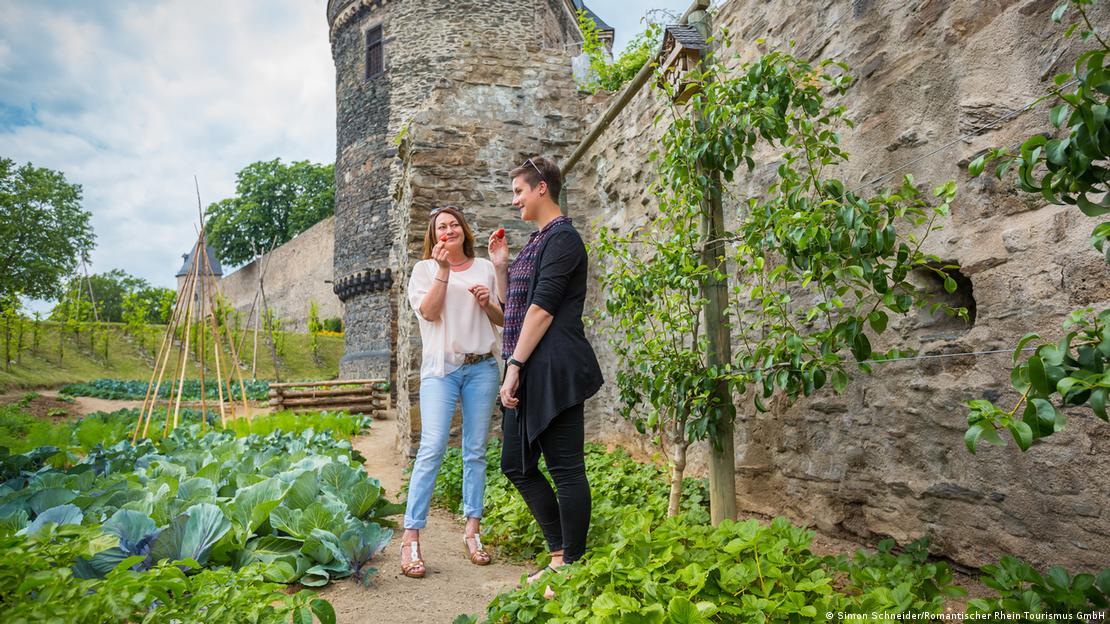
Photo: Simon Schneider/ Romantischer Rhein Tourismus GmbH via DW.
Residents and visitors alike are encouraged to pick whatever food they like from a public garden in Andernach, Germany.

An idea whose time has come may be growing food on public land and making it free for the picking. I wrote a 2011 post on scavenging, here, and a 2020 post on a homeless teen whose foraging helped her learn to cook, here. In those cases, the taking of food was done on the sly. But what if municipalities actively encouraged people to forage, as landscape director Paul did at my last job did?

Cathy Free writes at the Washington Post, “The city of Andernach, Germany, planted 101 varieties of tomatoes in the town center and told everyone to pluck and take whatever they wanted.

“It was such a hit, the following year the city did the same with beans. The next year, it was onions. After that, the city planted fruit trees, lettuce, zucchini, berries and herbs. All were free to anyone who lived or happened to be in the town of 30,000 people. …

“It’s one of a growing number of places across the globe known as edible cities. In the United States, there are public lands from Seattle to North Carolina where people are welcome to pick and take from fruiting trees and bushes.

“Organizers interviewed for this article said there has never been a problem with people taking more than they need, whether they grab a single pear or a bag full of potatoes and artichokes.

Every year, there is more than enough produce to go around.

“ ‘Many here are very proud when you talk to them about our edible city,’ said Bettina Schneider, 29, city team coordinator for the Edible Cities Network in Andernach.

“When word got out that Andernach’s public gardens and orchards — which started in 2010 — were free for the picking, other cities in Germany and throughout the European Union joined in, she said. Now the Edible Cities Network is funded by the European Commission, the executive body of the E.U.

“The areas that were converted into fruiting gardens and orchards in Andernach were previously overgrown and unkempt, so the gardens were well received, Schneider said, noting that a medieval moat is now covered with peach, almond and pear trees, and vacant spaces near schools have been transformed into community vegetable patches. …

“ ‘Every partner organization in the project receives funding from the E.U. budget to carry out their work,’ [Marisa Pettit, a coordinator for Edible Cities] said. Pettit said that several cities also receive funding for what Edible Cities calls ‘living labs’ — green spaces where residents can hold community events and develop their own plans to help their urban gardens to thrive and produce bountiful harvests.

“Edible Cities is now supporting a community garden in Cuba, while cities in China, Tunisia, Togo and Uruguay are also developing plans for urban food forests, said Ina Säumel, a principal investigator for the Edible Cities Network. …

“Many U.S. cities have similar projects. Detroit has an urban farming movement, Philadelphia has food forests, and there are edible community projects in Atlanta and Los Angeles. All rely on volunteers to do the weeding, pruning and planting.

“Smaller cities such as Bloomington, Ind., and Hyattsville, Md., also have fruit trees and vegetable gardens that can be accessed by anyone.

“At the Dr. George Washington Carver Edible Park in Asheville, N.C., founded more than 20 years ago, residents can harvest whatever they like from 40 varieties of fruit and nut trees, said Lynx Bergdahl, a community organizer at Bountiful Cities, the nonprofit that helps manage the food forest.

“ ‘Anyone can get whatever they want, when they want it,’ said Bergdahl, 33. ‘This is about taking away as many barriers as possible to create public food access, whether somebody wants a single apple or an entire basket.’

“In Seattle, the neighborhood of Beacon Hill turned a steep and empty slope next to a public park into a vibrant edible landscape in 2012 through a partnership with the city. The Beacon Food Forest recently celebrated its 10th anniversary as a diverse community garden that is open to anyone walking by, said Elise Evans, one of the project’s volunteers. …

“ ‘To create something from a blank hillside was a big deal,’ she said. ‘Our harvest truly offers something for everyone and it’s based on trust. People take what they need and are fed for free, and that’s an empowering feeling.’ “

Do you ever nibble from gardens around your town? Please let me know.

More at the Post, here.

Read Full Post »

Photo: Crispian Chan.
Margaret Leng Tan performing Dragon Ladies Don’t Weep on a toy piano. 

There is just no end to the variety of jobs people work at — or create for themselves — and no end to the variety of tools they use. Today’s story is about a toy-piano virtuoso called Margaret Leng Tan and the unusual career she built.

Sian Cain writes at the Guardian, “At her last count, Margaret Leng Tan owned 18 toy pianos – but these days she just settles for ‘lots and lots.’ The 76-year-old musician, once labelled ‘the world’s first toy piano virtuoso’ by the New York Times and ‘the formidable doyenne of the avant-garde’ by the Washington Post, finds her pianos everywhere from garage sales to garbage cans. ‘I picked up a beautiful one from the garbage – the legs were missing but it was vintage and had a beautiful sound,’ she says. Last year, a complete stranger even left a red one for her on her Brooklyn doorstep:

‘I have become a foundling hospital for orphan pianos.’

“Her personal favorite in her collection is a vintage Schoenhut, which she deems ‘the Steinway of the toy piano world.’

” ‘That one has been everywhere from Carnegie Hall to Beethoven’s house in Bonn. I played Beethoven in Beethoven’s house! Can you imagine? Eat that, Schroeder!’ she laughs. …

“Tan exudes a light playfulness that complements her chosen instrument: ‘I’ve always had aspirations to be a sit-down comic – not a stand-up one!’ she says. ‘The toy piano gives me that golden opportunity.’ She is not limited to the piano either: in one arrangement titled Old MacDonald’s Yellow Submarine, written for her by the composer Erik Griswold, she simultaneously plays toy piano, bicycle horn, bicycle bell and train whistle. ‘It was incredibly difficult,’ she says.

“In her latest show, Dragon Ladies Don’t Weep, she plays a simpler version involving a toy piano, a Fisher Price plastic phone and a toy mobile. …

“Have her audiences always understood what she’s doing? ‘They’ve come along for the ride. They’ve often been very enthusiastic and willing to go with me down that rabbit hole. I mean, the toy piano. [But] because I take it seriously, they take it seriously. And the toy piano is so seductive. How can you resist a toy piano? It is a marvelous way to introduce avant-garde music to audiences, who would never go to such a concert – they’ll go to a toy piano concert out of curiosity.’

Dragon Ladies is a step away from her usual concerts: it is a one-woman biographical theatre show in which Tan tells the story of her life through significant moments. ‘It started because I intended to sit down and write my memoir but I never could find the uninterrupted time to do that,’ she says. ‘I thought it’d be easier to make a sonic memoir than a written one. And I had the title – I read somewhere that if you have a good title, you must deliver.’

“A significant part of the show explores Tan’s lifelong struggle to manage her obsessive compulsive disorder. … Music and rhythm became outlets for her impulse to count everything. ‘Music is all about counting. OCD is all about counting. It is a marriage made in heaven,’ she says. “But I wouldn’t wish OCD on my worst enemy. It’s not fun.’ …

“Tan began playing piano when she was six. Her father was a famed lawyer and politician in Singapore, and her mother was a piano teacher – ‘though she had the good sense never to try to teach me,’ Tan says. When she was 16, Tan left Singapore to study at Juilliard; she became the first woman to graduate with a doctorate from the prestigious New York school. …

“At first, she was strictly a classical pianist. … ‘It was only after I met John Cage that I knew what I wanted to do,’ she says.

“Cage was arguably the world’s most influential avant-garde composer; his 1952 piece 4’33 is famously performed by musicians doing nothing, embodying his belief that any auditory experience, including silence, could be music. …

“Cage was her close friend and mentor until his death in 1992. ‘He believed, and I agree with him, that you can make music with essentially anything. Whether it is a tin can or a bucket, that is music,’ Tan says. ‘He was a genius. There won’t be anyone else like him for a very long time, if ever.’ “

More at the Guardian, here. No firewall.

Read Full Post »

Photo: Gorupdebesanez.
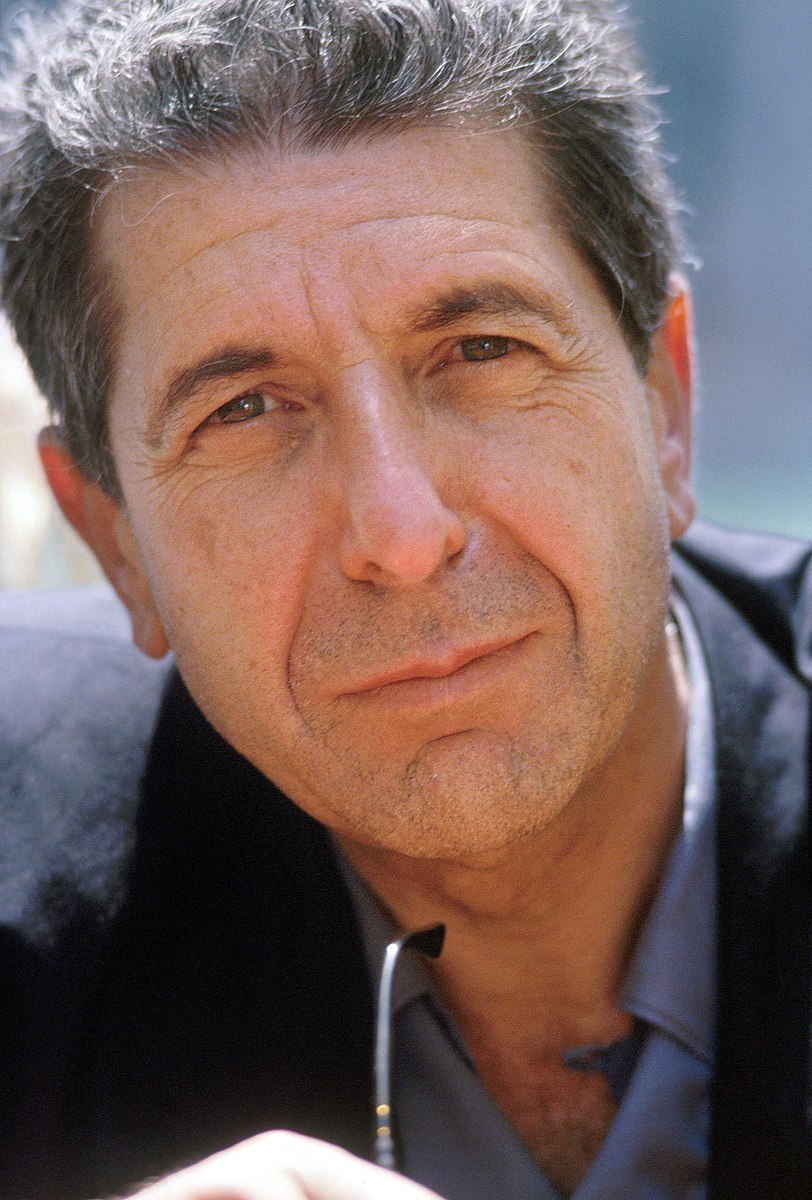
The singer-songwriter Leonard Cohen.  

I never knew much about poet/composer Leonard Cohen, but after hearing a radio interview with the producer of a new tribute album — and buying the album — I wanted to learn more.

First let me say a few words about an album in which an Iggy Pop version of a Leonard Cohen song is featured alongside songs sung by the likes of Norah Jones, James Taylor, and Mavis Staples. The way Sarah McLachlan’s voice cracks on “It’s a cold and it’s a broken Hallelujah” — oh, wow — gets me every time. There’s an uncharacteristically deep register for James Taylor on “Coming Back to You.” And who wouldn’t love the passionate, aging voice of Mavis Staples on “If it Be Your Will”?

“If it be your will
“That I speak no more
“And my voice be still
“As it was before
“I shall speak no more
“I shall abide until
“I am spoken for
“If it be your will”

I just can’t sing enough praise for this album. The instrumental accompaniments, usually led by guitarist Bill Frisell, are themselves worth the price of admission. I would love to know what instrument is making a sound like Bolivian panpipes. Haunting.

Longtime fans of Leonard Cohen may be as in the dark about the meaning of his lyrics as I am, but I’m sure they all know phrases that stun them without their knowing why. The album was produced by Larry Klein for Blue Note. I am still retro enough to have bought a CD, but if you stream any of the songs, please let me know your reactions.

Now for a bit of Wikipedia background on the artist. There’s even a Warhol connection. Who knew?

“Leonard Norman Cohen (September 21, 1934 – November 7, 2016) was a Canadian singer-songwriter, poet and novelist. His work explored religion, politics, isolation, depression, sexuality, loss, death, and romantic relationships. …

“Cohen pursued a career as a poet and novelist during the 1950s and early 1960s, and did not begin a music career until 1967. His first album, Songs of Leonard Cohen (1967), was followed by three more albums of folk musicSongs from a Room (1969), Songs of Love and Hate (1971) and New Skin for the Old Ceremony (1974). His 1977 record Death of a Ladies’ Man, co-written and produced by Phil Spector, was a move away from Cohen’s previous minimalist sound. …

“Leonard Norman Cohen was born into an Orthodox Jewish family in Westmount, Quebec, on September 21, 1934. His Lithuanian mother, Marsha (‘Masha’) Klonitsky (1905–1978), emigrated to Canada in 1927 and was the daughter of Talmudic writer and rabbi Solomon Klonitsky-Kline. His paternal grandfather, whose family had moved from Poland to Canada, was Canadian Jewish Congress founding president Lyon Cohen. His parents gave him the Jewish name Eliezer, which means ‘God helps.’ His father, clothing store owner Nathan Bernard Cohen (1891–1944), died when Cohen was nine years old. The family attended Congregation Shaar Hashomayim, to which Cohen retained connections for the rest of his life. On the topic of being a kohen, he said in 1967, ‘I had a very Messianic childhood. I was told I was a descendant of Aaron, the high priest.’ …

“In 1967, disappointed with his lack of success as a writer, Cohen moved to the United States to pursue a career as a folk music singer–songwriter. During the 1960s, he was a fringe figure in Andy Warhol‘s ‘Factory’ crowd. Warhol speculated that Cohen had spent time listening to Nico in clubs and that this had influenced his musical style.

“His song ‘Suzanne‘ became a hit for Judy Collins (who subsequently recorded a number of Cohen’s other songs), and was for many years his most recorded song. Collins recalls that when she first met him, he said he could not sing or play the guitar, nor did he think ‘Suzanne’ was even a song:

‘And then he played me “Suzanne”  … I said, “Leonard, you must come with me to this big fundraiser I’m doing” … Jimi Hendrix was on it. He’d never sung [in front of a large audience] before then. He got out on stage and started singing. Everybody was going crazy—they loved it. And he stopped about halfway through and walked off the stage. Everybody went nuts. … They demanded that he come back. And I demanded; I said, “I’ll go out with you.” So we went out, and we sang it. And of course, that was the beginning.’

Read Full Post »

I wanted to share something from the Christian Science Monitor editor about about a reporter who died recently.

“David Clark Scott traveled the world: He roamed throughout Latin America as the Mexico City bureau chief and reached into Southeast Asia as Australia bureau chief. He supported and counseled dozens of Monitor reporters as international editor.

“When he wrote columns, his favorite stories were of people taking the time to help one another. He even produced an entire podcast.

In these times, when everyone is fixated on what went wrong, it’s important to look for what is going right, and sometimes, frankly, it needs to be at the top of the page.

“Dave passed on this week. On his last day of work, he pitched three stories, any one of which would have made a lovely column. But, he told me, he’d already ‘put a call in to the principal at the Nansemond Parkway Elementary School cuz, well, that’s the intro that tugs at my heart.’

“It did mine, too, so I wanted to share it with you.

“The Nansemond students in Suffolk, Virginia, have been learning a new language: sign language, so they can communicate with food nutrition service associate Leisa Duckwall, who is deaf. It started with a fourth grade teacher, Kari Maskelony, who has deaf family members and started teaching her class. This month it spread when Principal Janet Wright-Davis decided the whole school would learn a new sign every week in honor of Disabilities Awareness Month.

” ‘I don’t think [the students] saw it as a disability,’ Dr. Wright-Davis told me over the phone. It was just a new way to communicate. Her biggest surprise? ‘How much they want to learn it.’ Their favorite sign: pizza.

“The difference in the cafeteria is palpable, she says. Instead of pointing, as they used to, the students sign their requests. ‘She’s smiling and they’re smiling, and it’s just a different environment,’ says Dr. Wright-Davis.

“Ms. Duckwall has come to morning announcements to teach everyone new signs and has signed that day’s menu. Dr. Wright-Davis gets stopped in the hall by students signing good morning and wanting to show her what they’ve learned. Instead of stopping at the end of this month, the students are going to keep learning all year.

“The school had its Trunk or Treat event Thursday evening, and the children were signing as they celebrated Halloween. ‘One gentleman came out, and he was signing,’ Dr. Wright-Davis says. It made her realize the lessons wouldn’t be confined to the lunchroom or even the school. ‘They’re going to encounter someone, even if it’s just to say good morning, or please, or thank you. … Now they know a little bit more to show some gratitude.’

“There’s plenty to learn from Nansemond: Show some gratitude, look for ways to make people feel welcome, and seek out kindness and celebrate it when you find it. Dave always did.”

See the Monitor, here, and more at WAVY television, here. No firewalls.

Read Full Post »

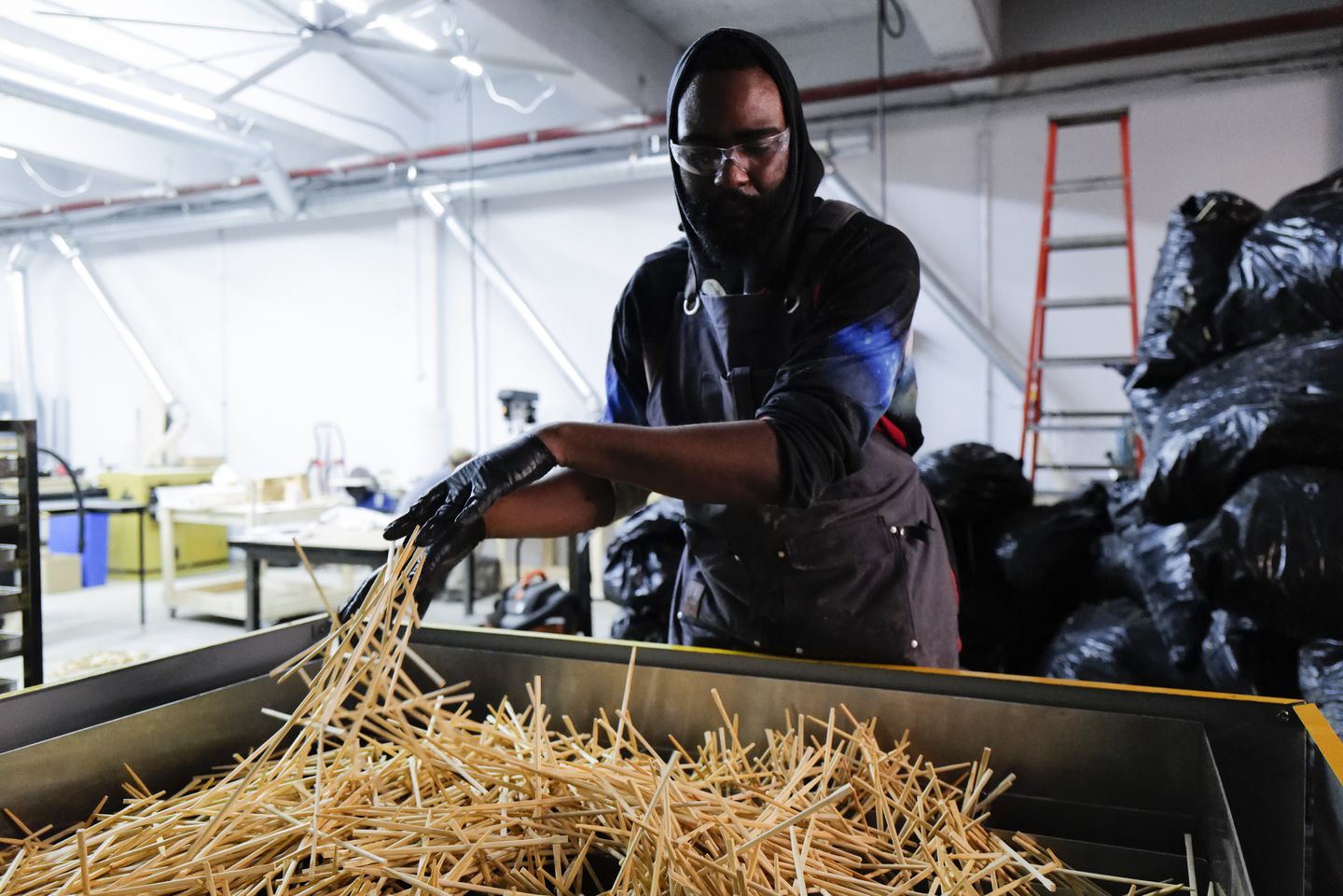
Photo: Carlin Stiehl/Boston Globe.
The Boston Globe reports that at ChopValue, bags of used chopsticks get “sorted — and made into everything from coasters to furniture.” ChopValue is a Canadian company that franchises factories.

Do you find yourself noticing more often just how many items we use and throw out? Many of us now seek out products that are reusable. We do this on our own because anytime a law is made, companies find a way to get around it.

Our town bans plastic take-home bags and plastic bottled water. Guess what? CVS merely made a heavier plastic bag and called it reusable. Bottled-water companies added a hint of flavoring, a loophole that allows them to sell plastic bottles here. So let’s do what we can on our own for sustainability.

Diti Kohli writes at the Boston Globe, “Elaine Chow believes your chopsticks can be more than utensils. In fact, she knows they can.

“The Savin Hill resident is giving ‘a mountain of chopsticks’ a second life at a new micro-factory that was launched in Charlestown in early September. … There, Chow melds the breakable wooden staples of Asian food into something more: cellphone stands ($11), charcuterie boards ($67), and even tables ($960).

“It’s all possible through ChopValue, a Canadian company that franchises factories that create chopstick-based homewares to people like Chow. … She leads the charge locally by collecting used utensils from more than 100 Greater Boston restaurants and running the machines that turn them into their final form. Chow eventually packs and delivers online orders of cribbage boards and workstation desks — all once used to eat sushi or stir-fry — all over New England.

“The draw for her is sustainability, and the ChopValue micro-factory already reigns as one of the only entirely cyclical businesses in Eastern Massachusetts, Chow said. …

‘People are realizing more and more that we can’t just continue to consume and build up piles of trash. We can do better.’

“Here’s how it works. Four days a week, a ChopValue truck visits restaurants around the region, picking up bags of used chopsticks. That itself is a win-win: Businesses are left with less waste to dispose of, and Chow has raw materials to work with. In six months, she has amassed 2.5 million chopsticks, weighing 15,000 pounds, and that number keeps growing.

“Back at the factory, Chow and three employees sort the sticks by color and separate them into mesh baskets. Then the utensils are dipped into resin and baked for 12 hours at 200 degrees, a process that allows them to harden and the resin to crystalize. Staffers then press a 3,000-pound machine on the sticks to flatten them, and what comes out on the other side is a durable tile — one of three sizes — that can be connected, sanded, and cut into the finished product.

“The process has proved to be labor-intensive, and Chow is on the hunt for two more employees, which is tough in the tight labor market. … After years of working in human relations, she has fallen in love with the factory’s green mission — and the chance to build on a love for woodworking that she picked up during the pandemic. Chow built a picnic table and shed to cover her trash bins during early COVID, before quitting her job and buying the franchise in September 2021.

“ ‘I have forever and ever been obsessive [with] recycling,’ she said. But she found ChopValue while scrolling through social media one day. ‘I actually have the computer algorithm to thank. It finally did a good thing.’ ”

More at the Globe, here.

Read Full Post »

Photo: Reuters/Albert Gea.
Reuters shows Colla Jove Xiquets de Tarragona starting “to form a human tower called ‘castell’ during a biannual human tower competition in Tarragona, Spain, October 2, 2022.

You don’t have to be a kid to play. Here’s a story on grown-ups having fun like kids. Of course, there are a few kids along with them, setting the proper tone for playtime.

Alan Ruiz Terol reports at Public Radio International’s The World, “A human tower rising higher than 26 feet swung perilously as 7-year-old Mar Mollà reached its top amid cheers from the crowd. 

“ ‘The views were great,’ she said later. ‘I could see all the colors and the arena vibrating.’

“[Recently] the town of Tarragona, in Spain’s northeastern region of Catalonia, hosted a massive tournament featuring the finest teams of human tower builders, or castellers. …

“One of the teams competing on Saturday was the Castellers de la Vila de Gràcia. Mar Mollà was one its youngest members. She also had one of the most difficult tasks. As she made her way up to the top of the castell on Saturday, her father, Daniel Mollà, watched nervously.

“ ‘I was worried,’ he explained, minutes later. ‘But it’s up to her; she’s the one who knows if [the castell] will fall or not.’

“To build a castell, dozens of people must stand at the base pressed against each other to provide stability, and, if things go wrong, a safety net. Others venture upward, climbing and being climbed over; forming one tier, and then another, and another. Finally, a kid crowns the human tower by raising a hand.

“Human towers are graded according to their height and difficulty. To get the full score, crowning the castell is not enough — it must be dismantled without collapsing. While falls are rare, they do occur, and kids wear helmets to avoid severe injuries. …

“Human towers are a centuries-old tradition in Catalonia, and are widely seen as a symbol of its own distinct culture and nationalist aspirations. …

“ ‘The oldest reference to castells dates back to 1791, to a local festival in the town of Valls,’ historian Àlex Cervelló said. 

“Human towers are thought to be a spin-off of a religious dance that featured acrobatic constructions known as Ball de Valencians. According to Cervelló, participants might have competed against each other, building higher and more complex structures, until castells became a separate tradition. …

“Following the Spanish Civil War in the 1930s, the Francisco Franco dictatorship tried to deprive castells of any hint of Catalan nationalism, Cervelló said, as part of its persecution of political dissidence.

“In the 1980s, shortly after Franco’s death, teams of castellers began incorporating women, making it possible to build towers of unprecedented height, and kickstarting a golden era.

“In 2010, the UNESCO recognized castells as Intangible Cultural Heritage of Humanity. …

“Júlia Pozo, who looks after the youngest members of the Castellers de la Vila de Gràcia, praised the bravery of Mollà and other kids climbing to the top of castells. Ultimately, she said, they’re the ones who decide whether a castell is crowned.

“ ‘If they are afraid and don’t want to climb, they let us know, and we either try to find someone else, or we dismantle it,’ Pozo said. 

“But some, she said, will venture upward even if they are afraid, pulled by their ‘casteller spirit.’ ” 

Be sure to click at the World, here, and enjoy the happy grins on faces old and young.

Read Full Post »

« Newer Posts - Older Posts »