Feeds:
Posts
Comments

Photo: Matthew Podolsky
Conservationist Alfred Larson, 96, has installed hundreds of bluebird next boxes in southern Idaho, allowing scientists to study Mountain Bluebirds as the species recovers from a decline.

In my area of New England, I don’t often see bluebirds. I see lots of bluebird houses people put up to entice them, but few bluebirds. You can imagine how excited I was one wintry day a few years back when a whole flock showed up in our deciduous holly. It was amazing. And never repeated.

A conservationist in his 90s who wanted to learn more about Western and Mountain Bluebirds has turned southern Idaho into a bluebird haven. Now, that’s something I’d like to see!

James Crugnale writes a the Audubon website, “In 1978, Alfred Larson was looking for a hobby that would keep him busy after he retired from his job at a sawmill plant near Boise, Idaho. He remembers reading an article in National Geographic that captured his imagination—about crafting wooden nests for bluebirds to save them from dizzying declines. Around this same time, he and his wife Hilda welcomed a new guest to their backyard: a Western Bluebird.

“ ‘We noticed a bluebird going in and out of a cavity of an old, dead snag,’ Larson says. … I had heard about bluebird trails out East that Lawrence Zeleny had set up. If I put up boxes on my ranch, I’d have a captive group of birds to take pictures of.’ …

“Four decades later, at the age of 96, Larson is monitoring almost 350 nest boxes on six different bluebird trails across Southwest Idaho. From the Owyhee Mountains to Lake Cascade, he and his fellow community scientists peek into the rustic abodes every nine days to band any residents and jot down notes on behavior and growth. Larson organizes the data and shares it with the Cornell Lab of Ornithology‘s Nestwatch program. …

“Prior to the big nest box craze, all three North American species—Western, Mountain, and Eastern—saw a major dip in population numbers, due to ‘the elimination of dead trees with the invention of gas-powered chainsaws in the 1930s . . . along with the widespread use of pesticides to kill insects,’ says bluebird photographer and expert Stan Tekiela. Studies in the 1970s tied DDT to the death of hundreds of Mountain Bluebird chicks in western Canada. …

“Many of Larson’s trail buddies are wary of the day he decides to retire again. Boyd Steele, a volunteer who regularly assists Larson with the nest boxes, says the nonagenarian has been steadily passing down his knowledge. But his devotion to bluebirds will be hard to replace. ‘I don’t think there’s anybody who is as dedicated as Al,’ Steele says.

“Filmmaker Matthew Podolsky echoes that sentiment. After being introduced to Larson through a graduate advisor at Boise State University, he and his peer Neil Paprocki tracked the local legend with a camera for weeks. The resulting 30-minute documentary, titled Bluebird Man, of course, went on to be nominated for an Emmy Award in 2015.”

More here, at the Audubon website.
Grumpy Grammarian

Recently Terry Gross of WHYY Philadelphia interviewed an experienced copy editor about his new book. I heard him tell her that all editors have certain things that make their skin crawl, things that are not necessarily wrong but that just bug the individual editor.

For example, the author of Dreyer’s English, “Random House copy chief Benjamin Dreyer, is not a fan of the word ‘very.’

” ‘It’s not a dreadful word,’ he allows, but ‘it’s one of my little pet words to do without if you can possibly do without it.’

” ‘Very’ and its cousins ‘rather’ and ‘really’ are ‘wan intensifiers,’ Dreyer explains. In their place, he advises that writers look for a strong adjective that ‘just sits very nicely by itself’ on the page. For example, ‘very smart’ people can be ‘brilliant’ and ‘very hungry’ people can be ‘ravenous.’ ” (Or caterpillars, I suppose.)

On twitter, freelance editor @morinotsuma mentioned another usage that isn’t wrong but confuses many copy editors, myself included.  “A phrase I always misunderstand,” she says, is “ ‘the date got moved up.’ I always think it should mean that the date was changed to something nearer to the present but really it means it got pushed further into the future.”

Here’s a lost cause of my own: “beg the question.” My writer father’s favorite usage book, known simply as “Fowler,” says the phrase beg the question means asking a question with an embedded assumption like, “When did you stop beating your wife?” It doesn’t mean, “That leads to the question XYZ,” which is how everyone uses it now.

And how about “too big to fail”? In my view, that should be should be “too big to be allowed to fail.” I know my wording is clunkier, but nothing is too big to fail, you know, not even the dinosaurs.

And then, there’s the way “loved ones” is used when someone dies and family members are mourning. The usage feels backward to me. The family of the deceased may indeed be his loved ones, the people he loved, but what we actually mean is “the people who loved him.” If a memorial could say, “Our thoughts are with all who loved him,” my brain would feel less itchy. But since the whole world knows what is meant when someone says, “my prayers are with her loved ones,” I probably should go off into a corner with my itchy brain and just be quiet.

Sunlight and Shadow


Diana-Clymer-painting-of-blogger-in-June-2018-RI-Statehouse

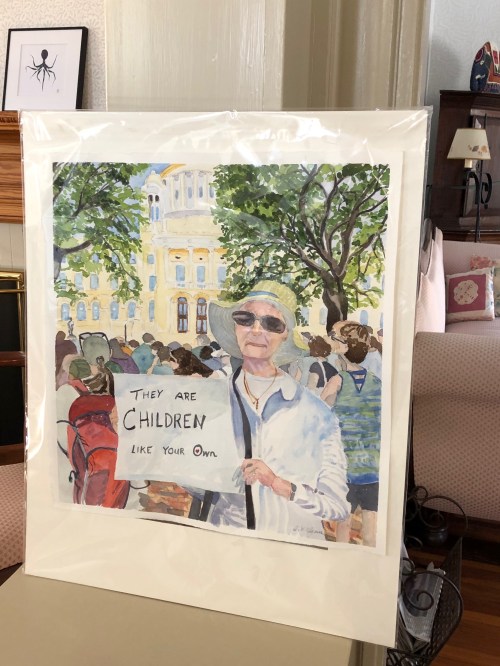
Something surprising happened the other day. Diana showed up with a portrait of me that I had no idea she was working on.

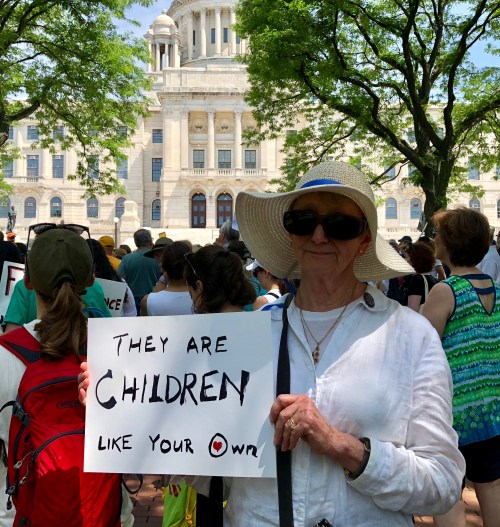
The teacher in her watercolor class had assigned the topic “umbrage.” Paint umbrage. My friend thought, How on earth? Then she remembered a photo I sent her in June after a #familiesbelongtogether protest. She decided to incorporate the “shade” meaning of umbrage with the “angry” meaning — the trees with the protest. I love the colors in this — and the light and shadow.

I’m including a couple other light and shadow themes today. My sister and I both took photos of frost on our windows. The main difference: her frost is on the inside! As much as she loves her New York apartment, the time has come for new windows. The landlord is finally interacting with the city as the historic building needs special permits for new windows.

Sandra M. Kelly caught the sunset at my favorite island. I love how the sun streams down through the clouds.

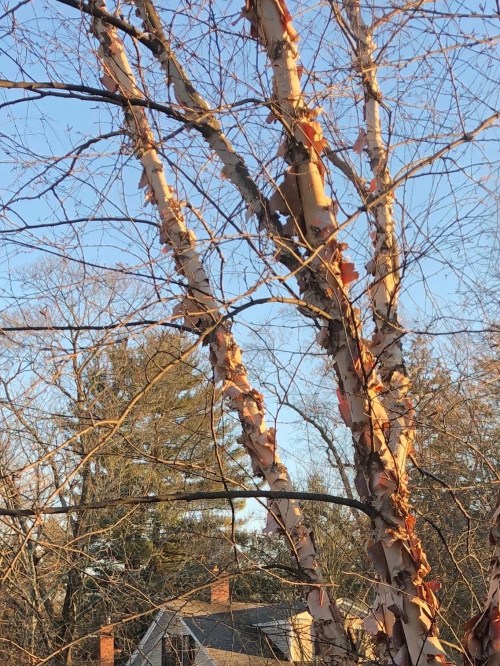
The next shot shows how the late afternoon light hits the river birches outside the library. That was the view behind the poets at the last poetry reading. It took me a few days to find the sun at that angle again so I could come back for a picture.

We had a lot of birds near our feeder during the recent polar vortex. Also squirrels. Maybe a rabbit. Can you read tracks? I would love to know if I had a rabbit.

My granddaughter (red shirt) chose an ice-skating theme for her birthday party this year, making good use of the backyard rink.

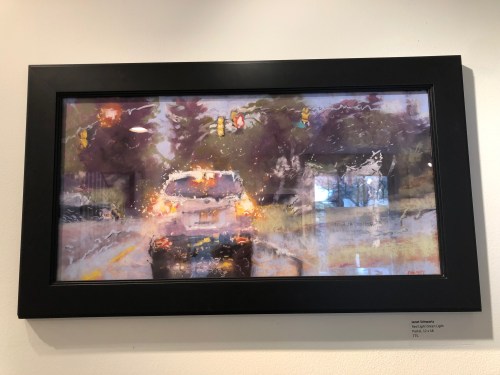
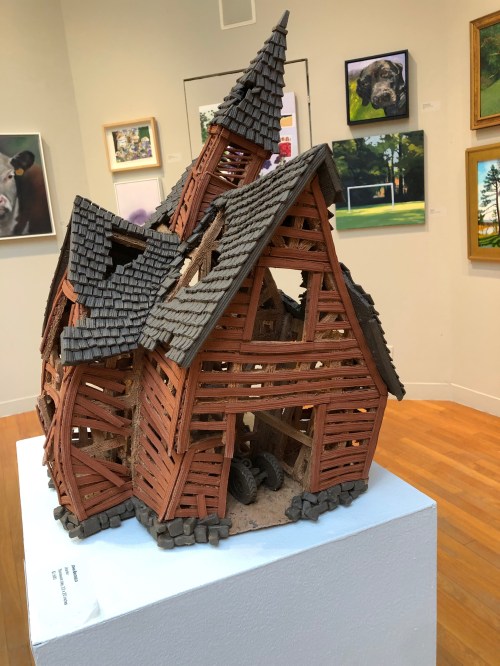
Janet Schwartz painted the lovely rainy traffic scene in a recent show at Concord Art. And John Brickels is the artist behind the collapsing house. Hmmm. Is that a metaphor for anything?

013119-indoor-frost-NYC

013119-frost-ivy-window-dawn

013019-Sandra-M-Kelly-sunset-from-heaven

020819-river-birch-library-window-2

020119-bird-tracks-in-snow

020319-birthday-girl-on-ice

012719-Concord-Art-Janet-SchwartzJPG

012719-Concord-Art-John-Brickels

063018-rally-for-separated-families


1 Million Women

This is Greta Thunberg, the 16-year-old climate activist from Sweden. She started the Friday school strikes that are spreading around the world and made a splash scolding power brokers at the World Economic Forum in Davos, Switzerland.

You have probably heard of the ubiquitous Greta Thunberg, the Swedish teen who is leading a youth movement to address global warming. But there are many other climate movements right now, as I learned when I read Mary Robinson’s inspiring book Climate Justice. One example she cites is an Australia-based organization called 1 Million Women, which was started by a woman who was able to cut way, way back on her family’s carbon footprint and wanted to share what she learned.

One Million Women’s website includes a pollution-cutting activity center that “has 50+ ways to cut pollution, covering energy, money, household, food, travel, shopping, sharing and a special girls section. Each activity has a pollution value attached. Choose the activities that work for you,” it suggests.

For those of you who really want to roll up your sleeves and tackle daily activities, 1 Million Women also has a handy feature called the Carbon Challenge, which provides sustainability tips and helps you track your progress in reducing pollution. See that here. I confess that I haven’t taken the challenge yet, but I’d love to hear from anyone who gives it a shot.

The blog for 1 Million Women features entries from many activists, each focusing on a different aspect of climate change activism. The toilet paper post was funny. In another post, Eve White, “mum of two and a freelance editor with a PhD in Ecology, … founding member of Australian Mums for a Safe Climate and Australian Parents for Climate Action,” asks, “Why are we leaving it up to our kids?”

She writes, “In November, 2018, 15,000 Australian kids went on strike from school to demand stronger action on climate change. Other actions will follow, with the next climate strike planned for March, 2019. Listening to these kids speak, it is clear that they are articulate and informed. They include school captains and future doctors, leaders and business people; not the kind of kids who’d routinely skip school. But without the power to vote they are worried about their future, frustrated with inaction on climate change and desperate to be heard.

“It is wrong that it has fallen on the kids to do this. As one young speaker said, ‘We are expected to tidy up after ourselves. Adults should tidy up their own mess, not leave it for us. This is not fair.’ ”

White goes on to list “ways that parents can support their kids in the fight for the future, and not all of them require a lot of effort,” like talking to more people about the issue, supporting the kids’ movement logistically and financially, writing to the local paper, and getting active in national environmental groups. Another “not a lot of effort” thing to do if you are on social media might be to follow people who are working on this issue and share information with your followers.

More.

Photo: Simon Buckley
Grandad, an artist who has experienced homelessness, is one of 33 people behind the “Doodle on Ducie Street” mural, part of the International Arts and Homelessness Festival and Summit in Manchester, UK. The event used art as part of a holistic approach to tackling homelessness.

So many initiatives to address the world’s problems feel like a drop in the bucket, but I have to believe that the bucket can be filled — even if it’s only one drop at a time, even if some drops spill out along the way and have to be replaced. Little things mean a lot if they hit a person just at the moment of receptivity.

In England, a homelessness summit last fall tested the potential of art to spark conversations between haves and have-nots and also to give homeless people a reason to get up in the morning. Helen Lock has the story at the Guardian.

“Two armchairs are facing each other in the Whitworth art gallery in Manchester. Denise Harrison, a mental health blogger with past experience of homelessness, is sitting in one of them, waiting for questions.

“A member of the public sits down opposite her, and tentatively asks if she thinks it’s OK to give money to people on the street, as charities discourage it. ‘It’s down to personal choice – you shouldn’t feel bad if you do or if don’t,’ replies Harrison. ‘Some worry it’s enabling addictions, but it’s also providing someone with the option to pay for shelter. On the street, someone can end up with several free McDonald’s burgers but nowhere to sleep that night.’ …

“Dialogues are part of a performance artwork called Are You Sitting Comfortably? by the artist Emma Turner, who felt the public were becoming inured to homelessness in Manchester. The official number of rough sleepers was 278 in 2017, a 41% increase on the previous year, but the true number of its homeless people – counting those in temporary accommodation – is likely to be much higher.

“As Harrison says of her time suffering with alcohol addiction and sofa surfing after the breakdown of her marriage: ‘It’s scary how quickly a situation that was so abnormal became normal, my new normal. It can happen to anyone.’

”The work was part of the inaugural International Arts and Homelessness Festival and Summit, running 12-18 November [2018], which explored a potentially contentious idea: the role of arts and culture in tackling homelessness.

“Manchester was chosen for the event because the city council’s homelessness strategy for the next five years explicitly includes a commitment to increasing access to arts, and because of how the city’s cultural sector has stepped forward to provide support for the council’s plan. …

“Third sector organisations began working together to approach the council, consulting businesses, universities, cultural organisations and the faith sector, as well as people with experience of homelessness. Their findings underpinned the new Manchester Homelessness Charter. … Officials will now work towards what is described as a jigsaw of homelessness support approaches, rather than focusing exclusively on immediate needs such as shelter and healthcare. This includes the chance to meet people, build skills and have fun. …

“But how would this approach work in practice when the crisis is so severe? Beth Knowles, an adviser on homelessness for the mayor’s office, reiterated that the call for a more holistic approach came from homelessness services themselves – even frontline providers such as the night shelters.

“ ‘I’ve spoken to some about trialling the jigsaw approach,’ she said, ‘and while it might not seem the most immediate thing when you’re trying to find beds, some see the value in maybe having some singing or photography sessions on site, because it’s worked well.

‘Of course, not every council officer is going to see this as a priority. But to do something, it doesn’t have to be a priority. It’s part of a whole package. It’s about what that individual needs and offering it.’

“[According to Amanda Croome, chief executive of the Booth Centre, a day facility for people who are homeless or at risk,] ‘We find that if you put someone into a flat and they have no support network, no interests and nothing to do, then very often in six months they’ll be back on the street. What the arts do is give people a new perspective.’

“Lawrence McGill has become an avid gardener since first becoming a regular visitor to the Booth Centre, filling salvaged containers with soil and seeds. He has also written poetry, and a song, ‘Spinning Plates,’ about juggling life’s hardships. ‘My life started the day I stepped into this place.’ ”

Read about other aspects of the festival, including a description of the “immersive opera” Man on a Bench, here.

Photo: Barbara Crossette/PassBlue
Fathiah Zakham studied tuberculosis in Yemen until a bomb destroyed the university where she was working. Through the Scholar Rescue Fund, she received safe haven in Helsinki, Finland, to study.

Scholars and scholarship are generally endangered in authoritarian countries and in war zones. Fortunately, there are activists determined to keep the search for truth alive among all nationalities. The Scholar Rescue Fund was established to place refugee scholars in safe institutions where they can continue their work. Even in today’s isolationist America, refugee scholars are getting a future.

Deborah Amos reported on international placement efforts at National Public Radio (NPR) last fall.

“Around the globe, more scholars are now threatened and displaced than since World War II began. In response, U.S. universities have sponsored endangered scholars and recently created a consortium that offers a broader academic community to refugee scholars threatened by war and authoritarian governments.

” ‘There is a moral obligation to do something,’ said Arien Mack, a psychology professor at New York City’s New School for Social Research, who launched Endangered Scholars Worldwide in 2007 to draw attention to the threats facing academics. She now oversees the New University in Exile Consortium, which will bring exiled scholars together over the next two years for seminars, workshops and conferences. The New School has recruited 10 other universities to the consortium, and is urging more to join. …

” ‘We are trying to nurture intellectual capital, we are saving brains,’ Mack said at a Sept. 6 event in New York City to launch the project. ‘Even when [refugee scholars] are safe, what is painfully absent is that they don’t get integrated, they are isolated, they suffer from estrangement.’ …

“Syrian academic Mohammad Alahmad, a specialist in Arabic literature, had to negotiate with Islamist radicals to continue teaching at Al-Furat University’s campus in Raqqa. In 2014, the militants declared Raqqa the capital of the Islamic State. …

“He escaped the city with his family, smuggling them across a dangerous border into Turkey after ISIS shut down his university. He was awarded a fellowship by the Institute of International Education’s Scholar Rescue Fund, an organization that helps arrange emergency placement and funds for academic figures at risk. He was matched with Georgetown University where he is now a lecturer at the Center for Contemporary Arab Studies. …

“The Scholar Rescue Fund, established in 2002, has helped more than 700 scholars find academic placements in 43 countries. About 40 percent have been placed in American educational institutions.

“Indian activist and academic Binalakshmi Nepram says her work advocating for gender rights and a women-led disarmament movement in her home state of Manipur, in northeast India, led to threats and intimidation. … Now she is a visiting scholar in residence at Connecticut College.

” ‘We have all left everything behind,’ she said. … Her placement in Connecticut is a lifeline. She has continued her activism, giving a recent lecture on how the women of Manipur state worked together to confront violence in a decades-old armed conflict between insurgents and the Indian military.

‘Before I got this job, [American] people told me I could be a bartender or a babysitter,’ she said. ‘Every job has its dignity, but we have our skills.’

More at NPR, here.

Photo: Mashable
Teen girls invent portable, solar-powered tent for people experiencing homelessness.

I worked at MIT in the early 2000s in the same building as a foundation that gave grants to inventors, both established inventors and young people. How the family made the money that funded the foundation is a complicated story, but this support for inventors is a big deal, so hats off for that!

Brittany Levine Beckman writes at Mashable about an invention by an inspiring group of teen girls.

“As Daniela Orozco picks off excess plastic bordering a 3D-printed box, she recalls how many homeless people she saw on her way to school when she was a high school freshman. Just one.

“Four years later, the number has multiplied. … In the San Fernando Valley, homelessness increased 36% to 7,094 people last year, according to the Los Angeles Homeless Services Agency’s annual count. Daniela and her friends wanted to help, but giving money wasn’t an option.

” ‘Because we come from low-income families ourselves, we can’t give them money,’ the high school senior says. …

“That was the starting point for their invention: a solar-powered tent that folds up into a rollaway backpack. The girls and 10 others from their high school had never done any hands-on engineering work before, but with the help of YouTube, Google, and trial-and-error, they got it done. They hope that one day, their tent will improve the lives of people experiencing homelessness in their community.

“The teen girls from San Fernando High School … none of whom had coded, soldered, sewn, or 3D-printed before they joined forces, won a $10,000 grant from the Lemelson-MIT Program to develop the invention.

“They were recruited by DIY Girls, a nonprofit that teaches girls from low-income communities about engineering, math, and science, to go after the grant.

” ‘I knew I wanted to apply for it, but I needed a team,’ says Evelyn Gomez, 29, the executive director of DIY Girls. ‘I went back to my calculus teacher at my high school and did a hands-on recruitment activity.’ …

“Hands-on STEM education at schools, especially for girls in low-income communities, is severely lacking, Evelyn says. Women make up just 29% of the science and engineering workforce, according to the National Science Board, a federal agency. Around 6% of female working scientists and engineers are Hispanic or Latina.

” ‘I studied aerospace engineering. When I was getting my master’s degree, I was often the only girl in the class and definitely the only Latina in the class. … You’re going to represent the Latina community in a bad light if you ask a stupid question or you’re going to represent women in a bad light if you ask a stupid question, and of course that’s not true. But I felt that.’ …

“In the beginning, the team depended on Evelyn for guidance, but they quickly started doing everything on their own. If they had an issue with a solar panel not functioning properly, they watched YouTube videos. If they couldn’t figure out a stitch pattern, they Googled it. The girls even developed their own inspirational hashtag: #wegetitdone.

” ‘You’re learning new things you’ve never even heard of or even thought of,’ says Chelly Chavez, who learned the programming language C++ to get the technical aspects of the tent to behave. The tent has button-powered lights, two USB ports, a micro-USB port, and the girls have even tested a sanitizing UVC light on a countdown timer. …

“They made two prototypes of the tent, but the first one is now in shreds. They put it through the ringer during quality control tests, tearing it with a knife, dousing it with water, and stomping on it. … They destroyed their finished product, just to start again. It was yet another tough engineering lesson the girls would learn. …

“The $10,000 grant from the Lemelson-MIT Program could only be used on the invention itself, not traveling to Cambridge, Massachusetts, to present the award. So DIY Girls fundraised an additional $15,000 to send the team to MIT.” More here.

Photo: Rebecca Kordas/UBC
Limpets are easy to overlook — so too is their effect on the environment. But careful consideration of how all the life forms in an area interact is key to understanding how ecosystems thrive.

I’ve been reading a small book called The Sound of a Wild Snail Eating. A friend offered to lend it to me, and much to my surprise, I’m finding it fascinating. It’s by a woman with a debilitating illness who describes her growing interest in a snail brought to her on a wild violet plant. As the author learns, there is more to snails than meets the eye. A lot more.

The same may be said of limpets. Christopher Pollon explains why at Hakai Magazine.

“As the ocean temperature rises, it may be the little things that make the biggest difference to the survival and resilience of living things.

“Take the limpet, a tiny snail-like gastropod with a hefty appetite for the minute plants that live in the intertidal — the space between low and high tide. In 2014, Becca Kordas, then a zoology doctoral candidate at the University of British Columbia, tested the effect these creatures have on the ecosystem when exposed to ocean warming. She found that their influence was huge.

“Kordas launched her project by sinking four sets of settlement plates in the intertidal zone of Saltspring Island, British Columbia, about 55 kilometers southwest of Vancouver. For 16 months, Kordas and her colleagues tracked which plants and animals established themselves on the four different types of plots. Kordas controlled the limpets’ access to half of the plates, while they were free to graze on the other half. She also simulated the effects of ocean warming by tinting some of the plates black to attract the sun’s heat.

“By the end of the study, the differences between the four sets of plates were stark. Kordas found that when limpets’ access is restricted, the artificially warmed intertidal ecosystem collapsed — the diversity of life largely replaced by a mat of microalgae. Limpets with access to the plates, however, maintained a healthier ecological community, even in a warming environment.

“What is it about limpets that helps maintain a diverse and complex community, even when their environment warms?

“Kordas says limpets eat huge amounts of microalgae, including microscopic diatoms and the spores of larger algal species. This clears the terrain for a variety of life.

“ ‘When limpets are allowed in, they make space for things like barnacles, and then those barnacles in turn create little condos for other animals to live in,’ she says.

“In a sense, limpets are tiny ecosystem engineers. … The study comes at a critical time for intertidal life in the northeast Pacific Ocean. In this area, the summer low tide typically occurs around noon, which exposes intertidal species to warm summer temperatures. The heat shakes up the intertidal community, but shakes it up more without limpets around.

“The lesson of Kordas’s study, however, is not about limpets per se. It’s about the need to better understand the role of every organism in an ecosystem.”

Hat tip: Pablo Rodas-Martini, @pablorodas, on Twitter.

More here.

Although black history is not a one-month-a-year-thing, having a dedicated month does seem to turn up stories that might not otherwise be heard. I got this one from the BBC television show Our Classical Century, “a celebration of the most memorable musical moments from 1918 – 2018,” which focused on broadening the audience for classical music.

In this episode, Sir Lenny Henry expressed admiration for forgotten black composer Samuel Coleridge-Taylor.

“I have been enthralled and captivated by the story of a man from Croydon in south London who died more than 100 years ago and who wrote one of the biggest musical hits of the 20th century. He was a total genius – a bit like Prince, but for late 19th-century London rather than 1980s California – and his name was Samuel Coleridge-Taylor. …

“Young Samuel was brought up by his mother and her extended family in Croydon. He never met his doctor father, Daniel Peter Hughes Taylor, who was originally from Sierra Leone and had come here to study medicine in London. …

“The family clubbed together to pay Samuel’s fees at the Royal College of Music, which he entered at 15 as a violin scholar. But the violin was set to one side and composition took centre stage and he was taken under the wing of the composer and conductor Charles Villiers Stanford. … For two years running, Coleridge-Taylor won the RCM’s Lesley Alexander composition prize and was championed by Edward Elgar, who recommended the talented young composer for a major commission – an orchestral work for the Three Choirs festival, his Ballade in A Minor, opus 33.

“The thing I like about Coleridge-Taylor is that he fought adversity to reach the top. He suffered racial abuse at school – apparently he even had his hair set on fire – but remained dignified. His compositions are dynamic, bold, incredibly melodic and immediately accessible. I was blown away. And I wasn’t the only one. He was known as the ‘African Mahler’ and his success stretched far and wide.

“In the US, he was a household name in his lifetime, and travelled there by invitation of the Samuel Coleridge-Taylor Choral Society of Washington DC in 1904, and again in 1906 and 1910. The US marines band were engaged for his first performance and 2,700 people were in the audience, two-thirds of whom were black. He went on to compose Twenty Four Negro Melodies and Five Choral Ballads after that visit. He became interested in interpreting African American melodies, writing: ‘What Brahms has done for the Hungarian folk music, Dvořák for the Bohemian, and Grieg for the Norwegian, I have tried to do for these Negro melodies.’ When success hit, he used it to tell stories about his racial origins in a musical way that might uplift others.

“His best known work, ‘Hiawatha’s Wedding Feast, part of the cantata trilogy ‘The Song of Hiawatha,’ premiered in 1898 to huge acclaim, and went on to play, with the other two parts in a semi-staged version, at the Royal Albert Hall for a fortnight in June every year for almost 30 years in the interwar years. …

“But Coleridge-Taylor never got to enjoy his success – he died tragically young, aged 37, of pneumonia in 1912 – illness said to have been brought on by overwork. Nor did his family enjoy the financial fruits of Hiawatha’s success – the composer had sold the publishing rights to it to Ivor Novello’s company for a low flat fee.

“[My family] never went to a concert hall, and I didn’t see any black musicians. When I finally heard a live orchestra as an adult, it hit me like lightning. … Perhaps it’s time for everyone to take a fresh look at classical music and put aside the stereotypes. … This is our music – it’s music for everyone.”

More here.

Photo: Hulton/Getty
The multitalented 19th-century British composer Samuel Coleridge-Taylor was best known for “Hiawatha’s Wedding Feast.”

Poetry readings are held every few months in the periodical room of the library. The tables are moved, and rows of folding chairs get set up.

I like going to poetry readings. The Friends of the Library present poets every couple months, and I go to as many readings as I can. The most recent featured work by poets Adam Scheffler, Carla Schwartz, and Alison Stone. The poems were remarkably accessible as well as profound, funny, and inspiring. The following is not meant to detract from my overall admiration.

When I got home after the reading, my husband asked me if any readers had used the Poet Voice, and I said I had heard it a little. He went straight to the web to see what others say about the phenomenon. Turns out, I’m not the only one who has noticed contemporary poets dropping into this odd, monotonous reading style.

Rich Smith, a poet himself, made a good effort to define the Poet Voice in a 2014 article at City Arts, here: ” ‘Poet Voice,’ is the pejorative, informal name given to this soft, airy reading style that many poets use for reasons that are unclear. The voice flattens the musicality and tonal drama inherent within the language of the poem and it also sounds overly stuffy and learned. In this way, Poet Voice does a disservice to the poem, the poet and poetry.”

Smith recommends that poets adopt a character suited to each poem as an actor might, or — if reading is not a strength — have someone else do it, or even refuse to give readings! He does come up with an example of the Poet Voice used appropriately: Yeats reading “Innisfree.”

Atlas Obscura describes the listener experience: “You walk into the bookstore. You sit in your folding chair, or on the floor, with your paper cup of wine. The poet approaches the microphone, affably introduces himself, and maybe cracks a joke. He shuffles his papers, launches into his first verse — and all of a sudden, his voice changes completely! Natural conversational rhythms are replaced by a slow, lilting delivery, like a very boring ocean. Long pauses — so long — hang in the air. Try and get comfortable. There’s no helping it. You’re in for a night of Poet Voice.

“Many performance-related professions and avocations,” says Atlas Obscura‘s Cara Giaimo, “have developed an associated ‘voice’: a set of specific vocal tics or decisions. Taken together, these mannerisms make up a kind of sonic uniform, immediately cluing a listener into who or what they’re listening to. There’s ‘Newscaster’s Voice,’ for example, characterized by a slow cadence and a refusal to drop letters. There is ‘NPR’ or ‘Podcast Voice,’ which the writer Teddy Wayne has diagnosed as a ‘plague of pregnant pauses and off-kilter pronunciations,’ and which radio host Ira Glass once said arose in direct response to those butter-smooth anchors. And then there’s Poet Voice, scourge of the open mic and the Pulitzer podium alike.”

So there you have it. It’s been puzzling me for years, and I still don’t know why poets use it. Below, you can hear Pulitzer Prize winner and former poet laureate Louise Glück reading from Faithful and Virtuous Night in the Poet Voice.

By the way, I know of several poets who read this blog, and I would love it if they would weigh in.

Photo: Terrence Antonio James/Chicago Tribune, via Associated Press
Candice Payne, “a regular person,” rented hotel rooms for more than 100 homeless people in Chicago — and strangers followed her lead — as temperatures headed way below freezing.

A Chicago real estate broker, a self-styled “little black girl from the South Side,” had a moment when she just couldn’t bear to see a particular bad thing happen.

The temperature in Chicago was about to go way below zero last week, and Candice Payne started thinking about the people in the city’s homeless camp. Here’s what can result when “a regular person” realizes that empathizing while doing nothing is not an option.

Sandra E. Garcia has the story at the New York Times.

“As temperatures plunged to life-threatening lows this week, more than 100 homeless people in Chicago unexpectedly found themselves with food, fresh clothes and a place to stay after a local real estate broker intervened.

“The broker, Candice Payne, 34, said it was a ‘spur-of-the-moment’ decision to help. ‘It was 50 below, and I knew they were going to be sleeping on ice and I had to do something,’ she said on Saturday.

“Ms. Payne contacted hotels and found 30 rooms available at the Amber Inn for Wednesday night at $70 per room. …

“After Ms. Payne paid for the rooms on a credit card, she asked on her Instagram account for anyone who could help transport the homeless people. Soon she had a caravan of cars, S.U.V.s and vans with volunteer drivers.

“ ‘We met at tent city, where all the homeless people set up tents and live on the side of the expressway,’ Ms. Payne said. … She asked as many people as she could to go with her to the Amber Inn as donations were pouring in to her Cash App account. …

“ ‘We had to accommodate everyone. It was really overwhelming,’ Ms. Payne said. ‘They were so appreciative. They couldn’t wait to get in a bath and lay in a bed.’

“Ms. Payne bought toiletries, food, prenatal vitamins, lotions, deodorants and snacks and made care packages to help make the people feel comfortable. Restaurants donated trays of food, and many people called the inn. …

“ ‘People from the community, they all piggyback off Candice,’ said Robyn Smith, the manager of the Amber Inn. ‘Other people started calling and anonymously paying for rooms,’ she added, and Ms. Smith lowered the price to accommodate more people. What started out as 30 rooms doubled to 60, Ms. Smith said. …

‘I am a regular person,’ Ms. Payne said. ‘It all sounded like a rich person did this, but I’m just a little black girl from the South Side. I thought it was unattainable, but after seeing this and seeing people from all around the world, that just tells me that it’s not that unattainable. We can all do this together. …

“ ‘This was a temporary fix, and it has inspired me to come up with more of a permanent solution.’ ”

Talk about the Power of One! Here’s hoping that the state’s wealthy governor, who called Payne to offer his praise, gets on board with a permanent solution.

More at the New York Times, here.

Photo: Monica LeRossignol
After a devastating wildfire, Bob Wilson, a Southern California real estate developer, gave $1,000 to each of Paradise High School’s 982 students and 105 employees. He is pictured here with student Trevor
LeRossignol.

Compassionate people pop up everywhere. I try to keep my attention focused on that as much as possible. In this example, a wealthy developer was moved to put money behind his compassion after the devastation of the 2018 wildfires in Paradise, California.

In November, Brianna Sacks wrote at BuzzFeed News, “Monica LeRossignol and her son are still stunned by the freshly printed $1,000 check, a gesture that’s brightened the difficult, surreal reality of rebuilding their lives after losing their home and most of their community in Paradise, California.

“On Tuesday night, her 17-year-old son, Trevor LeRossignol, and hundreds of other students, parents, and faculty members from Paradise High School gathered at Chico High School, as they have every week since the Camp fire leveled their town, to catch up, give hugs, rifle through donations, and eat some warm food. But this gathering had a major bonus.

“Bob Wilson, a Southern California real estate developer, was there giving out $1,000 to each of Paradise High School’s 982 students and 105 employees, totaling about $1.1 million in donations.

” ‘I gave him a hug,’ LeRossignol said. … Like thousands of others, the 46-year-old lost everything in the catastrophic wildfire, which has killed 88 people, torched more than 153,000 acres, and destroyed 14,000 homes. The mother, her son, fiancé, two nephews, and six other family members fled for their lives and are now crammed into two bedrooms at a friend’s house in the nearby city of Chico. …

“A few weeks earlier, as the Camp fire continued to burn around Paradise, Wilson came across a story in the Los Angeles Times about the students of Paradise, most of whom lost their homes. It delved into the uncertainty facing Paradise Unified School District and its class of seniors who were readying to graduate.

“The 89-year-old told BuzzFeed News that Paradise High School’s plight stuck with him, reminding him of his own ‘carefree’ days as a teenager. …

‘I made up my mind in five minutes,’ the businessman said Wednesday morning from Chico. ‘I had some of the most profound experiences in my life in high school because I was still able to be a kid, and it broke my heart to think of the experiences these kids were missing.’ …

“About two weeks later, Wilson was flitting between about 10 tables set up inside Chico High’s hallways, handing out envelopes containing a letter and personal check addressed to each student, teacher, and custodian, which he had personally stuffed from one of his offices in Los Angeles. …

” ‘It was a really unique, cool way to give,’ [Paradise High Principal Loren] Lighthall said of Wilson’s donation. ‘It’s been rough, especially for high schoolers who need their friends and there’s no way to get together.’ …

“Two days after the fire tore through their close-knit, rural California town, Lighthall, who has been principal for two years, started a GoFundMe for Paradise High, a ‘high-poverty”‘ school where 67% of students qualified for free lunch last year. Almost every one of the nearly 1,000 students lost their home and ‘everything they own,’ he said. …

“For now, Lighthall explained that their main goal is getting the kids their credits however they can. More at BuzzFeed, here.

By the way, it’s sad that BuzzFeed and other news outlets have had to lay off so many reporters lately, people who come up with good local stories like this one. The news model is changing nationwide and we need to pay for journalism in new ways. My husband and I pay to read the Boston Globe online, the New York Times, and the Guardian. I also have a membership in the investigative news site Talking Points Memo. Online ads are not enough to keep these vital services going.

Photo: Dani Hemmat
The elongated rocks seen above are called lithophones and are used to make xylophone-like music. Found in Colorado as well as other parts of the world, they are 6,000 years old.

Do you sometimes imagine being a person in a completely different period of history? What would it feel like? One thing I’m pretty sure of: you would behave has if your time period was the only one.

But today, let’s imagine living 6,000 years ago, before the European invasion, in what is now Colorado. Let’s imagine having an urge to make music.

Dani Hemmat writes at the Left Hand Valley Courier, “Colorado has rocks that, well, rock. They are called lithophones, and a local archaeologist who first came across these strangely shaped stones 40 years ago is finally sharing their musical story.

“Longmont archaeologist Marilyn Martorano first laid eyes on the long, baguette-shaped rocks almost four decades ago, as a volunteer at what is now Great Sand Dunes National Park and Preserve in southern Colorado.

“The clearly hand-shaped stones, which had been discovered in the area, were housed in the on-site museum when Martorano first saw them. They were a strange set of artifacts for which no one had yet determined a use. Martorano put them back into their drawer, assuming that someday someone would figure out their purpose.

“Thirty years later, Martorano borrowed the rocks from the museum to study. While many had postulated that the rocks were tools for grinding, the absence of typical marks led Martorano away from that theory. She studied for three years, without success.

“The day before she was to return the rocks to the museum, a friend sent her a video that showed a collection of stones from Paris — stones that looked exactly like those she’d been studying. The rocks, musical stones classified as lithophones, had been found all over the world, but never in Colorado. After watching the video, Martorano started tapping the mysterious stones, and their purpose was suddenly clear. …

“ ‘The rock is very dense, usually volcanic, granite or basalt. In order to be shaped, it can’t be hit too hard or too soft,’ Martorano said.

“She presented some of her findings and artifacts during her open-to-the-public presentation on Nov. 8 at Front Range Community College (FRCC). FRCC instructor and Niwot musician Michael DeLalla had heard about Martorano’s work on public radio, and reached out to her. …

“Martorano demonstrated the different tones achieved by hitting the lithophones with wood, antler and bone. The lithophones produce sounds ranging from the sound of tapping on a crystal glass, to a wooden marimba, to a xylophone.

“ ‘Out of the 22 artifacts we studied, we got a minimum of 57 notes out of them. That’s at least two different notes from each stone,’ Martorano said. …

“While most of the stones Martorano has studied have come from the San Luis Valley area, lithophones have been found in the eastern plains of Colorado and near Salida as well. One Colorado percussionist, Jeff Shook, has found several lithophones while digging post holes.”

More here.

Photo: Tom Goldman/NPR
Reporters at rural Oregon’s profitable
Malheur Enterprise keep the news flowing while other local papers nationwide are folding.

This morning I read that television is expanding like crazy, no end in sight. Wasn’t the internet supposed to kill off television? Wasn’t television supposed to kill off radio? It seems to me that new technologies don’t necessarily destroy everything that went before the way cars destroyed horse-drawn carriages. It all depends on whether the old technology finds a new way to meet needs that still exist.

Consider local newspapers. Many are folding — and it’s definitely scary because that’s where big stories often break. But there’s still a need for local news, and I think someone will fill it. In rural Oregon, a small newspaper survived and became profitable by hiring a salesman and improving quality.

Tom Goldman at National Public Radio (NPR) has the story.

“The Malheur Enterprise was founded in 1909, and, like many other newspapers, was languishing. But in the past few years, its circulation has surged and it has won several national awards. … [It] has boomed in the past three years.

” ‘Boomed’ is a relative term when it comes to a rural weekly. Paid subscriptions are at about 2,000. But during a recent week, more than a third of Malheur County’s roughly 30,000 residents read the paper’s online edition. And advertising dollars, the lifeblood of a small newspaper, are way up.

” ‘Our overall revenue is more than triple what it was three years ago,’ says Les Zaitz, the paper’s editor and publisher. ‘Circulation is probably double. We’re profitable, and there are not a lot of papers in the United States that can say they’re profitable.’ …

“Zaitz, 63, was a longtime, award-winning investigative reporter for the Oregonian, the state’s largest newspaper. He is a two-time Pulitzer Prize finalist. But he has always had a passion for small-town papers. Which is why, in 2015, he tabled his retirement plans and bought the Enterprise with family members. The paper, at the time, was almost out of business. It was filled with gossip and press releases.

” ‘It wasn’t delivering much in the way of real local news,’ Zaitz says, adding, ‘[it] had one reporter who primarily focused on high school sports. … It had not had an ad salesperson in 10 years. … There was just no doubt in my mind that if we turned around the news product, and got a salesperson in, we could make the thing profitable pretty quick.’

“Sure enough, the Enterprise now is a serious, award-winning newspaper.

“This spring, the paper won a prestigious national Investigative Reporters and Editors award for its coverage of a case that rocked Malheur County. A man released from the state hospital after claiming he faked his mental illness was accused of killing two people after being freed. The Enterprise was the first weekly paper to win the IRE Freedom of Information award. …

“Reporter Pat Caldwell, who has been a journalist for 22 years, says Zaitz has transformed the way he works. ‘It’s all about detail,’ Caldwell says, ‘detail, detail, detail. Y’know? And why, why, why, why? Why are you doing this? Why is this happening? Who pays for it?’ …

“Zaitz has earned his readers’ trust with his devotion to bedrock principles of journalism. He acknowledges it also helps that he is one of them. His hands are thick from bucking hay and fixing barbed wire fences on his ranch about 100 miles outside Vale. But being on the inside doesn’t mean he and the Enterprise pander. … Enterprise reporting has angered local politicians. Some still don’t talk to Zaitz or his reporters.

” ‘Public officials who’ve evaded scrutiny for decades here aren’t very fond of us in some quarters,’ Zaitz says. ‘But the good public officials, those who are trying to do a good job, they recognize that we are doing our job and we are holding them accountable and we’re making them better governing officials. And they don’t object to that. Because we try to be accurate; we try to be fair. While they may have to salve the sting of a particular story, that sting wears off and they appreciate what we’re doing. …

” ‘Rather than worrying about what’s going on in journalism at the national level,’ he says, ‘let’s turn the periscope around and let’s rebuild from the small guy up. And I think that’s going to have more influence in the long run.’ ”

More at NPR, here.

Photo: Parish of East Baton Rouge Recreation and Park Commission
Kids in Baton Rouge, Louisiana, compete in a sack race using equipment provided by the local parks and recreation commission. Mobile playgrounds designed to fight childhood obesity are catching on nationwide.

Did you always have some kind of gym class in elementary school? Something that kept kids running around and exercising even if it was only Dodge Ball? I did.

In recent decades, many schools have seen cutbacks in classes that are important for both intellectual growth and overall health — arts, music, gym, and more. Concerned communities are doing whatever they can to make up the difference.

Christine Vestal writes at the Washington Post, “In a state with the fourth-highest rate of youth obesity in the nation, the Baton Rouge parks and recreation agency wanted to lure Louisiana kids away from their screens and into the parks to get moving.

“But the low-income youths who needed exercise the most weren’t showing up at the parks. Officials learned that they didn’t have transportation, and their parents were too busy working to take them. So they decided to take the parks to the kids.

“With money donated in 2012 by corporate sponsors and a portion of their parish budget, the local parks and recreation agency, known as the Baton Rouge Recreation, or BREC, bought a box delivery truck, painted it with bright colors, and filled it with scooters, hula-hoops, balls, slack lines, trampolines, sidewalk chalk, and jump ropes.

” ‘The idea came to us one day while we were watching a bunch of kids turn flips on an old mattress someone had discarded near the office,’ said Diane Drake, who directs BREC’s playground on wheels. ‘We realized it wouldn’t take much to get kids moving if we put it right in front of them.’

“Naming the mobile playground BREC on the Geaux (a Cajun play on words for the word ‘go’), the agency in 2013 started what would become a daily program by holding community events at housing complexes, churches, parks, and schools in low-income neighborhoods.

“If peals of laughter and swarms of activity are any indicator, BREC on the Geaux was an immediate success, Drake said.

‘‘ ‘Once word spread, children would come running out of their apartments as soon as we pulled into the parking lot,’ Drake said. ‘It was all we could do to unload the equipment before they grabbed it and ran off.’

“A year after it began, BREC officials drove the mobile playground to a meeting of the National Recreation and Park Association in Charlotte.

“Since then, BREC has received dozens of e-mails and phone calls from other cities seeking advice on how to start a similar program, Drake said. …

“Transporting the joy and the health benefits of play to kids in underserved neighborhoods isn’t a new idea. A concept called ‘Play Streets,’ in which local volunteers work with police and health officials in urban neighborhoods to temporarily block traffic so kids can play, has been thriving for decades in places like London, Chicago, New York, and San Francisco.

“But the idea is now starting to take root in small- and medium-size cities — and in a handful of rural towns — where low-income children and adults are even more susceptible to obesity than in the nation’s urban centers, according to a June report from the Centers for Disease Control and Prevention. …

‘‘BREC started its mobile playground project with $110,000, half from the Blue Cross Blue Shield of Louisiana Foundation and half from the parish budget. A Play Streets project funded by the Robert Wood Johnson Foundation supported play events in four diverse low-income rural communities last summer — Warrenton, N.C.; Talihina, Okla.; Oakland, Md.; and Cameron, Texas — on a much smaller budget: $6,000 for a handful of community events. …

“In Baton Rouge, Louisiana State University’s Pennington Biomedical Research Center found that similar events sponsored by BREC resulted in children getting about 50 percent more physical activity, as measured in Fitbit steps, compared with weekdays and weekends without Play Street events.”

More here.

Photo: Our Home Louisiana
Baton Rouge Recreation celebrates a new mobile-playground truck with Pennington Biomedical Research Center’s Elizabeth Gollub, an evaluator of the anti-obesity initiative.