Feeds:
Posts
Comments

Photo: Melanie Stetson Freeman/CSM Staff.
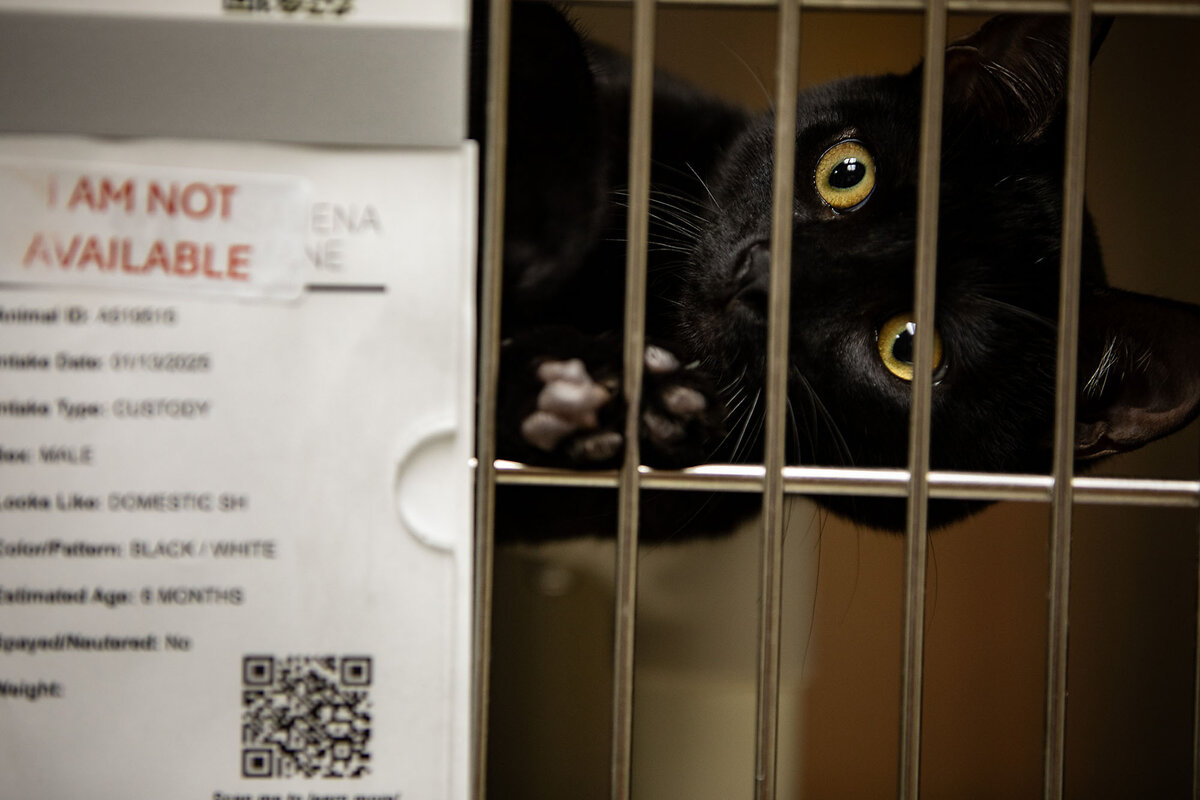
A sign on the cage of a young black cat boarded at Pasadena Humane indicates that it belongs to someone who lost their home in the Eaton Fire. The organization took in about 500 pets right after the fires. As of March 8, there were about 170 still boarding, free of charge.

Speaking of those pets and other animals in the Latvian animated film Flow, what actually does happen to them in a disaster?

Whether it’s a catastrophic flood as in Flow, or a massive wildfire as in California last January, humane societies and lots of volunteers rise to the challenge.

Ali Martin wrote at the Christian Science Monitor, “Six weeks after the Los Angeles wildfires erupted, Chris Briffett was sifting through 10,000 volunteer applications. The director of volunteer services for Pasadena Humane, a nonprofit, is expected to bring on about 2,000 – giving the organization an ‘unprecedented chance, he says, to respond to the community’s needs. …

“When communities are devastated, people step up to help, often in ways that align with their own skills or interests. But in the past decade, more trained volunteers have been integrated with official disaster response, says Tricia Wachtendorf, co-director of the University of Delaware’s Disaster Research Center. The inclusion of volunteers in the government process of planning for emergencies, she adds, improves coordination in the midst of disaster.

“Christine Quesada, director of volunteer programs for LA County’s Department of Animal Care and Control, says volunteers were vital during the wildfire evacuations at LA Pierce College, which took in horses and other livestock. LA County’s Equine Response Team — volunteers trained to work with large animals — provided food and care; worked with organizations for donations of food and supplies; and cultivated relationships with owners. …

“During the January wildfires, the small staff at Pierce’s equine science center worked around the clock with about 20 volunteers a day, plus officers from the county’s Department of Animal Care and Control. After the first day, Pierce was at capacity with over 200 animals.

“Some belonged to Sarah Kern. She arrived with six horses and two donkeys after watching the glow of flames spread across the oak-covered hills surrounding her home in Topanga. Ms. Kern knew the stakes; she and her family lost a home in the 2018 Woolsey Fire.

“Their animals are a way of life, central to their daily activity and rhythms. With the horses and donkeys safe, she says, she could focus on caring for her family and protecting her property.

“ ‘Yes, you’re supporting animals,’ she says, ‘but you’re really supporting the people. … They’re both important.’

“Back at Pasadena Humane, Skinny Minnie is recovering from severe burns. She is one of nearly 170 animals still boarding here because of the fires.

“Owners Mark Pastor and Lisa De Lange evacuated their home in Altadena and managed to grab their other two cats – Beauregard and Stella – but little else, with flames melting the back of Mr. Pastor’s car as he pulled out of the driveway.

“Someone found Skinny Minnie in the burnt remains of their home and took her to the shelter, which posted her photo on its website, where it was discovered by Mr. Pastor. Either he or Ms. De Lange visit Skinny Minnie nearly every day.

“Skinny Minnie’s care has been extensive, and it’s all covered by Pasadena Humane. When they told him, Mr. Pastor says, he ‘broke down.’

“ ‘It’s like they care as much about us and our feelings as they do about the animals that they’re treating,’ says Mr. Pastor.”

More at the Monitor, here.
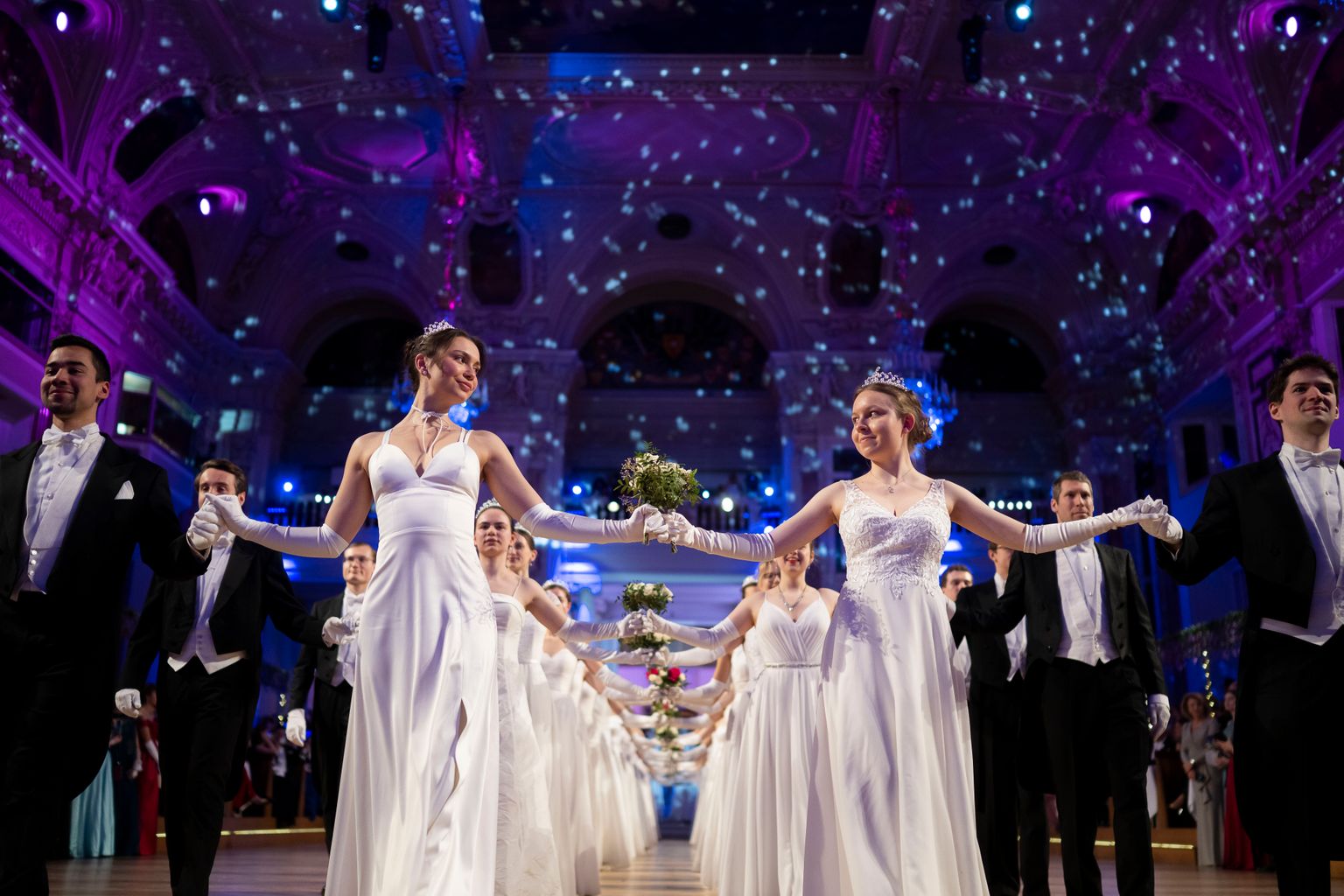
Photo: AP Photo/Denes Erdos.
Young people participate in the opening ceremony of the Lawyers’ Ball in Vienna, Austria, March 1, 2025.

Recently, we had Vienna on our minds because Erik and classmates from his high school in Wales were running a marathon there. Erik is a frequent marathoner and managed the course in under three hours, personal best.

Marathons are a longtime tradition in Vienna, but not as long as the activity in today’s story. It’s about the tradition of elegant balls.

Denes Erdos (along with AP journalist Stefanie Dazio in Berlin) submitted a report to the Associated Press.

“The aristocrats of the Habsburg royal court who danced in the first of Vienna’s famed balls in the 18th century could never have imagined how the hallmark of the Austrian capital’s social and cultural scene would evolve. Today, teenagers learn to waltz by watching YouTube videos while ladies shed their elbow-length gloves to better swipe on smartphones.

“More than 450 balls occur annually in Vienna, starting Nov. 11. … Professional guilds throughout the city host their own events, like the Ball of the Viennese Chimney Sweeps that marks the opening of the season.

“The sparkling balls are deeply rooted in Viennese culture, blending history with modern glamour, and the waltz remains an essential part. While the average ticket costs 395 euros ($427) — though VIP boxes at the Opera Ball can go for 25,500 euros ($27,539) — other events have lowered their prices to 40 euros ($43) to attract a wider audience.

“ ‘To be a part of this for me, as an Austrian person, is like taking part in Viennese culture,’ Leander Selmani, 19, said. ‘I was watching all these ball openings on YouTube and I said, “I want to be part of that.” ‘

“Besides YouTube, teens must learn the carefully choreographed dances for each ball’s opening ceremony from places like the Elmayer Dance School, which has been training dancers since 1919. In order to participate in an opening ceremony, dancers must first qualify through a strict regimen. Then they attend multiple lessons at a dance school and receive a stamped certificate of completion after each session. …

“Only once ‘Alles Walzer!’ (‘Let the waltz begin!’) has been declared can the rest of the crowd join in the dancing. This year, many balls honored the 200th anniversary of the birth of Viennese composer and violinist Johann Strauss II, known as the ‘waltz king.’

“While the waltz, the quadrille and other traditional dances are the heart of the Viennese balls, modern events now offer a diverse range of music and entertainment. Most venues feature multiple halls where guests can dance to various styles, including disco and contemporary beats. …

“Dress codes, however, have remained strictly enforced for centuries: gentlemen are required to wear tailcoats or tuxedos, and ladies must don evening gowns. Many attendees rent their attire from Lambert Hofer, a renowned costume workshop founded in 1862 that rents out hundreds of gowns each year.” More at AP via the Seattle Times, here.

Meanwhile in the US, you can take up ballroom dancing, but be prepared: the competition in the championships is fierce. My friend Ronnie’s sister wins them, but after years of work. About the latest competition, Ronnie tells Facebook, “I was in NY recently for the Fred Astaire Cross Country Dance Championships. My sister competed and is now 2025 Fred Astaire National Champion in American Smooth (tango, waltz, fox trot, Viennese waltz) Senior Division.” She is in her 80s.

Photo: Sideshow/JanusFilms.
The movie Flow is all about animals — no humans and no verbal conversation — and it seems that domestic pets are mesmerized.

I had been wanting to see the movie Flow, so at Easter, Suzanne set it up for the kids and me while she attended to Bunny work.

It was fun to figure out with the grandchildren exactly what was happening in the film and to add our own sound track. But in the end, I don’t think they liked it much. I myself have a problem with ambiguous endings, gorgeous as the animation was.

Now I am fascinated to learn what the movie has meant to a different audience: household pets. Esther Zuckerman has a report at the New York Times.

“Search on TikTok and you’ll find a number of videos of dogs and cats alike viewing Flow alongside their owners, appearing to recognize themselves in the gentle saga, which tells the tale of an adorable black kitty who must work with a motley crew of other industrious animals to survive rising sea levels in a surreal landscape. The trend is a particularly cute coda to what was already one of the feel-good stories of awards season in which the dialogue-free indie — made on open-source software and directed by Gints Zilbalodis — triumphed over studio fare like Inside Out 2 and The Wild Robot, to earn Latvia its first ever Oscar.

“Watching Flow in the theater is a wonderfully immersive experience where the spectacle of the movie’s visuals are on full display. … Watching Flow at home (it is streaming on Max) with an animal is an equally delightful experience, but a different one. You may find your attention pulled in two directions as you try to contemplate what this all means to your pet as well as what it means to you.

“I, for one, tried to decipher just what was going on with [my dog] Daisy. Surely, she wasn’t understanding the climate change allegory, but her huge ears stood up straight as she gazed upon the heroic cat, and I caught her running up to the TV for a sequence in which it and its capybara ally go tumbling off their boat. Seeing — or perhaps just hearing — the characters in peril stressed her out on some level.

“Matiss Kaza, who produced and co-wrote the film, said in an email that he suspects that it’s the real animal sounds used in production that attract the attention of our domesticated friends. …

“When I spoke to social media users who posted clips of their household beasts responding to Flow, they explained that their animals aren’t usually this entranced by the screen.

“Chayse Orion, 24, had seen other TikTok posts about the film before he decided to watch it. He thought it was cute but wasn’t paying super close attention. His cat Fishbone was. ‘Fishbone was so engrossed in the movie,’ Orion said. ‘He was just so into it, which was really weird because I’ve never seen him interact with a show like that.’ …

“Orion knew it would make great internet content. Not only did he start to film Fishbone, he moved the cat’s tower closer to the TV for a better view, one that put Fishbone at eye level with his animated brethren. ‘I actually put it on again yesterday for him to watch while I was working,’ he said. ‘It’s definitely his favorite movie now, for sure.’ …

“Celine Orosco, 29, found that her dog Samson, a golden retriever, was also invested in Flow. She said it was the first movie he ever watched all the way through. He was particularly excited, she noticed, whenever the Labrador that joins the cat’s group of travelers came onscreen. ‘He really loved that dog,’ she said.

“Of course, we don’t know what any of our animals are actually thinking when they watch Flow. Did Gao’s black cat actually recognize herself? Hard to say. My boyfriend at first inferred that Daisy liked the lemur who has a basket full of trinkets, then thought perhaps she was upset by it. I know that she didn’t follow the plot — I love her, but she’s not that intuitive. She did, however, hear the so-called voices of the characters, and reacted to whatever they were conveying. …

“We love to watch our pets watching Flow for the same reason we love to watch Flow. The film understands that delicately anthropomorphizing these animals is a powerful tool. Their movements are carefully calibrated to replicate the way the creatures would behave in real life, but their actions are just human enough to make the story feel relatable.

“Would a cat, a dog, a capybara, a large bird and a lemur all team up to save one another should massive floods happen? Hard to say. But it’s a good metaphor about how empathy can be salvation.”

More at the Times, here. If you’ve already seen the movie and can bear a negative review, check Asakiyume’s reservations, here. But be warned: there are spoilers.

Photo: Alexandra Corcode.
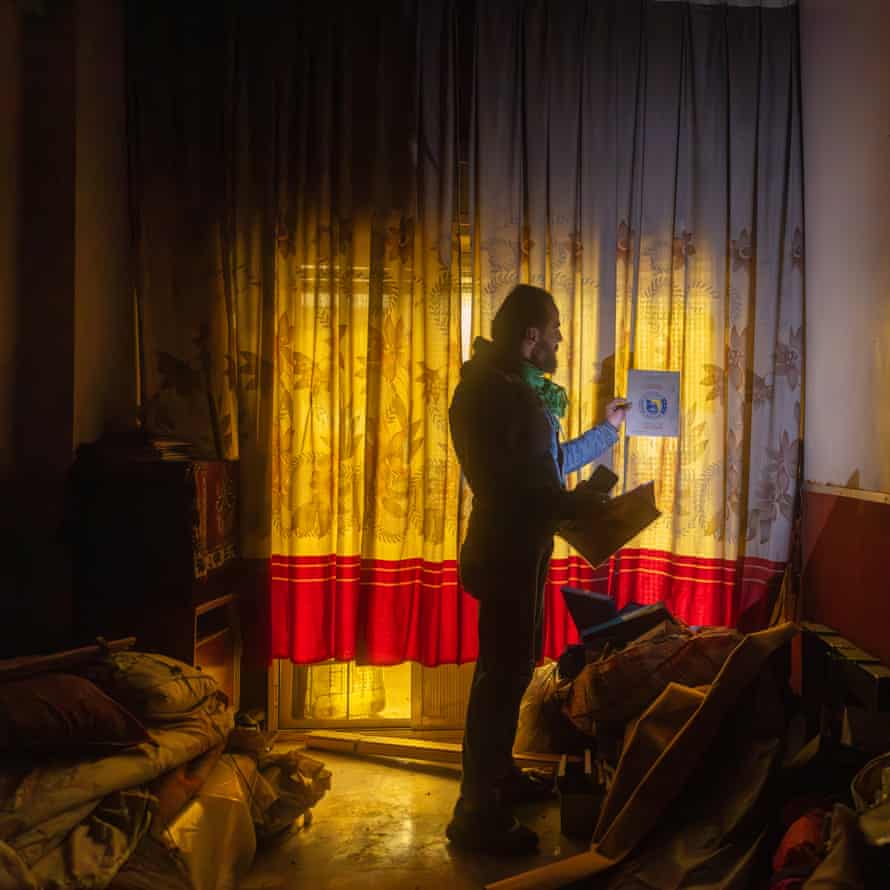
Mohamad searching for memories in a suitcase in Damascus. Their apartment was a stage — until the Assad government arrested them.

In today’s post, we learn more about how people living under repressive regimes keep culture and freedom going.

Andrei Popoviciu writes at the Guardian, “Thick layers of dust shimmer in sunlight as Mohamad and Ahmad Malas sift through old belongings in their Damascus apartment, abandoned for 14 years. …

“On one of the walls portraits of their father and one of their brothers, who have died, hang frozen in time. There’s no electricity so they use their phone torches to light their way as they collect personal artifacts they long forgot about.

“ ‘Looking around brings back so many memories,’ Mohamad says. ‘It’s painful.’

“For the 41-year-old brothers, returning to their flat is bittersweet. Their apartment was more than just a home. It was once a stage, a space where they performed original theatre plays away from the watchful eye of the Bashar al-Assad regime, which tightly controlled and censored artistic expression. In the two years before they left Syria, they performed more than 200 plays in their home.

“But their lives changed in 2011 when they were arrested for participating in the popular movement that started on the heels of the Arab spring and sought to remove Assad from power. Ahmad was wanted by the political police for sharing a revolutionary magazine with a friend, so the day security forces came knocking he fled immediately. Mohamad stayed behind to gather a few belongings before they escaped to Lebanon.

“Life there was uncertain, with Syrians facing the constant threat of deportation. Egypt offered brief stability, despite them feeling they could not continue their work as actors. Europe was where they felt they could freely perform with no censorship or threat. In 2013, they arrived in France as asylum seekers and speaking no French.

“Their first year in France was a struggle, spent moving from city to city, unable to work and battling to learn the language. Eventually, they were granted asylum and settled in Reims, in the country’s north-east. There, they rebuilt their acting careers, landing roles in theatre plays, films, and television.

“As they found their footing, they wrote and performed a play, The Two Refugees, chronicling the experience of refugees in France and inspired by their story. The production was a success and gained international recognition, taking them from Iraq to Japan and Jordan, often with the support of French cultural institutions.

“ ‘France gave us security and a chance to continue our art in a free world,’ said Ahmad. …

“They never imagined they would return to Syria. But as rebel forces were taking city by city, advancing toward Damascus in late 2024, they closely followed events from afar. Mohamad was at a film festival in Jordan; Ahmad was in France.

“On the morning of 8 December, Mohamad sent Ahmad a video. It showed people celebrating in a Damascus square, waving the revolution’s green flag and singing slogans against Assad. Ahmad could hardly believe his eyes. A deep longing stirred within them both. Soon after, Mohamad traveled from Jordan, and Ahmad followed from France.

“ ‘It felt like a dream come true,’ said Mohamad of the moment they entered Syria. ‘We felt like we could fly, it was surreal to walk through the streets and not see Assad’s photos everywhere.’ …

“The brothers knew they had to bring their play home, so they started performing it across the country, from Aleppo in the north to the coastal city of Tartus. They were unsure how an audience that had never left would react to a story of exile.

“ ‘Everyone understood it,’ Mohamad said. ‘I get it now – because even though they never left, they felt trapped in their own country.’ “

More at the Guardian, here. No paywall. Nice pictures.

Photo: Kevin Winter/Getty Images
After a bad year for wildfire, the Oscars gave the Los Angeles firefighters some well-deserved recognition.

After wildfires devastated the Los Angeles area last winter, Hollywood decided to give the firefighters some love. For men and women who are professionally calm in the face of extreme danger, being around celebrities felt a bit scary.

Jada Yuan reported the story for the Washington Post. “When 12 of greater Los Angeles’s firefighters took the stage at the Oscars … they got a standing ovation so big you could hear it the lobby bar. Screams filled the Dolby Theatre, which had been evacuated in early January when one wildfire ripped through the Hollywood Hills.

“Onstage, Los Angeles Fire Department Capt. Erik Scott earned his laughs, joking, ‘Our hearts go out to all of those who have lost their homes … and I’m talking about the producers of “Joker 2.” ‘ He and his fellow firefighters would take Monday off, but after that, it would be back to work — back to 5 a.m. wake-up calls, back to heartbreaking days, back to being on constant alert in a city that has barely recovered from the destruction wrought by the fires this winter. …

“Was Scott tearing up as the crowd cheered? ‘Maybe!’ he told the Washington Post … laughing sheepishly in the Dolby lobby after the bit. ‘I was not expecting for them to have that standing ovation for that long. I put my head down, and they got louder.’ … He kept emphasizing that they’re mere representatives of thousands of firefighters in the L.A. area. …

“This Hollywood awards season has been as Tinseltown-focused as ever, but for good reason. The devastating wildfires that swept through Pacific Palisades and Altadena, destroying tens of thousands of homes and businesses and killing 29, broke out two days after the Golden Globes. At first, it seemed like awards season might have to be put on hold. Every subsequent event was paused, rescheduled or reassessed as organizers tried to figure out how to honor the artistic achievements of an industry that is the lifeblood of this city without seeming indifferent to the struggles of so many.

“Inviting first responders to the awards shows and honoring their hard work and sacrifices — beginning with the Grammys and continuing through the Critics Choice and Screen Actors Guild awards, all the way through to the Oscars — has allowed the Los Angeles music and film communities to give thanks. …

“Many of the firefighters on the Oscars stage had been deployed for 28 days straight after the fires began, either actively fighting fires in the hardest-hit areas or getting information to the public. A month later, they were back out there, responding to life-threatening mudslides from heavy rains that even swept one firefighter’s car into the ocean.

“They’ve got a story to tell while the stage is theirs. Since the fires, Scott says he’s been dealing with a lingering cough and wheezing, as are others, because even a mask can’t protect you from breathing in toxic smoke for 28 days straight. … He has been put on breathing treatments, and researchers from the University of Arizona have given him and many others a full blood panel to test for heavy metals as part of a multiyear cancer study because of all the particles from vehicles with lithium batteries that were floating in the air.

“The immediate dangers are over, but the long-term ones will persist, and they are similar to those faced by first responders on and after 9/11 — something Scott is eager to explain to anyone who will listen, from the Hollywood A-list on down. … Scott said, ‘It’s part of the inherent dangers of our chosen profession.’ …

“ ‘Firefighters in general, we want to come to work, do our job, put the fire out, and we’re there to help people,’ Capt. Adam VanGerpen said. ‘We’re not looking for recognition. We don’t need praise. So we’re not used to that. It’s overwhelming for the amount of recognition that we’re getting, not just by these awards, but by just the general public coming by the fire station.’ They had so many supplies dropped off at various fire stations that they had to get flatbed trucks to spread the love around. …

“In the field, the LAFD had plenty of celebrity encounters, often with no fanfare and no cameras present. Jay Leno brought barbecue on his vintage fire truck to the Palisades base camp multiple times and would spend all night serving food. Gary Sinise did the same. Singer Steven Tyler invited the LAFD members to his Grammys after-party and then showed up at Station 69 in the Palisades and just hung out. VanGerpen’s favorite, though, was ‘J.T.’ — Justin Turner — the former Dodger who came out with his wife to serve firefighters food till 8 p.m. and then just chilled in the kitchen at the station, FaceTiming everyone’s kids. ‘He’s like a hero to these guys. That’s probably the No. 1 guy these guys want to see.’ “

More at the Washington Post via MSN, here.

Photo: SkoolGo.com.

We all use a lot of verbal pauses as we collect our wits to say whatever is on our mind. Lots of “ums” and “uhs.” And I remember that in teenage years, we couldn’t get through a sentence without several “ya knows.” It used to drive the grownups crazy.

Now at Knowable magazine, we learn that these interjections are actually valuable.

“Listen carefully to a spoken conversation,” Bob Holmes writes, “and you’ll notice that the speakers use a lot of little quasi-words — mm-hmmumhuh? and the like — that don’t convey any information about the topic of the conversation itself. For many decades, linguists regarded such utterances as largely irrelevant noise, the flotsam and jetsam that accumulate on the margins of language when speakers aren’t as articulate as they’d like to be.

“But these little words may be much more important than that. A few linguists now think that far from being detritus, they may be crucial traffic signals to regulate the flow of conversation as well as tools to negotiate mutual understanding. That puts them at the heart of language itself and …

… they may be the hardest part of language for artificial intelligence to master.

“ ‘Here is this phenomenon that lives right under our nose, that we barely noticed,’ says Mark Dingemanse, a linguist at Radboud University in the Netherlands, ‘that turns out to upend our ideas of what makes complex language even possible in the first place.’

“For most of the history of linguistics, scholars have tended to focus on written language, in large part because that’s what they had records of. But once recordings of conversation became available, they could begin to analyze spoken language the same way as writing.

“When they did, they observed that interjections — that is, short utterances of just a word or two that are not part of a larger sentence — were ubiquitous in everyday speech. ‘One in every seven utterances are one of these things,’ says Dingemanse, who explores the use of interjections in the 2024 Annual Review of Linguistics. ‘You’re going to find one of those little guys flying by every 12 seconds. Apparently, we need them.’

“Many of these interjections serve to regulate the flow of conversation. ‘Think of it as a tool kit for conducting interactions,’ says Dingemanse. ‘If you want to have streamlined conversations, these are the tools you need.’ An um or uh from the speaker, for example, signals that they’re about to pause, but aren’t finished speaking. A quick huh? or what? from the listener, on the other hand, can signal a failure of communication that the speaker needs to repair.

“That need seems to be universal: In a survey of 31 languages around the world, Dingemanse and his colleagues found that all of them used a short, neutral syllable similar to huh? as a repair signal, probably because it’s quick. …

“Other interjections serve as what some linguists call ‘continuers,’ such as mm-hmm — signals from the listener that they’re paying attention and the speaker should keep going. Once again, the form of the word is well suited to its function: Because mm-hmm is made with a closed mouth, it’s clear that the signaler does not intend to speak.

“Sign languages often handle continuers differently, but then again, two people signing at the same time can be less disruptive than two people speaking, says Carl Börstell, a linguist at the University of Bergen in Norway.

In Swedish Sign Language, for example, listeners often sign yes as a continuer for long stretches, but to keep this continuer unobtrusive, the sender tends to hold their hands lower than usual.

“Different interjections can send slightly different signals. Consider, for example, one person describing to another how to build a piece of IKEA furniture, says Allison Nguyen, a psycholinguist at Illinois State University. In such a conversation, mm-hmm might indicate that the speaker should continue explaining the current step, while yeah or OK would imply that the listener is done with that step and it’s time to move on to the next.

“Continuers aren’t merely for politeness — they really matter to a conversation, says Dingemanse. In one classic experiment from more than two decades ago, 34 undergraduate students listened as another volunteer told them a story. Some of the listeners gave the usual ‘I’m listening’ signals, while others — who had been instructed to count the number of words beginning with the letter t — were too distracted to do so. The lack of normal signals from the listeners led to stories that were less well crafted, the researchers found. …

“Nguyen [says] such words are far from meaningless. ‘They really do a lot for mutual understanding and mutual conversation,’ she says. She’s now working to see if emojis serve similar functions in text conversations.

“The role of interjections goes even deeper than regulating the flow of conversation. Interjections also help in negotiating the ground rules of a conversation. Every time two people converse, they need to establish an understanding of where each is coming from: what each participant knows to begin with, what they think the other person knows and how much detail they want to hear. Much of this work — what linguists call ‘grounding’ — is carried out by interjections.

“ ‘If I’m telling you a story and you say something like “Wow!” I might find that encouraging and add more detail,’ says Nguyen. ‘But if you do something like, “Uh-huh,” I’m going to assume you aren’t interested in more detail.’ “

We all know something about this, although we probably haven’t considered the science of it. Dinner conversations in our house used to have us stepping over each other’s speech, so we had a kind of rule: If you had “your ‘um’ in,” the floor was still yours.

More at Knowable, here. And, ya know, you can read the same article in Spanish at that site.

Photo: José Hevia.
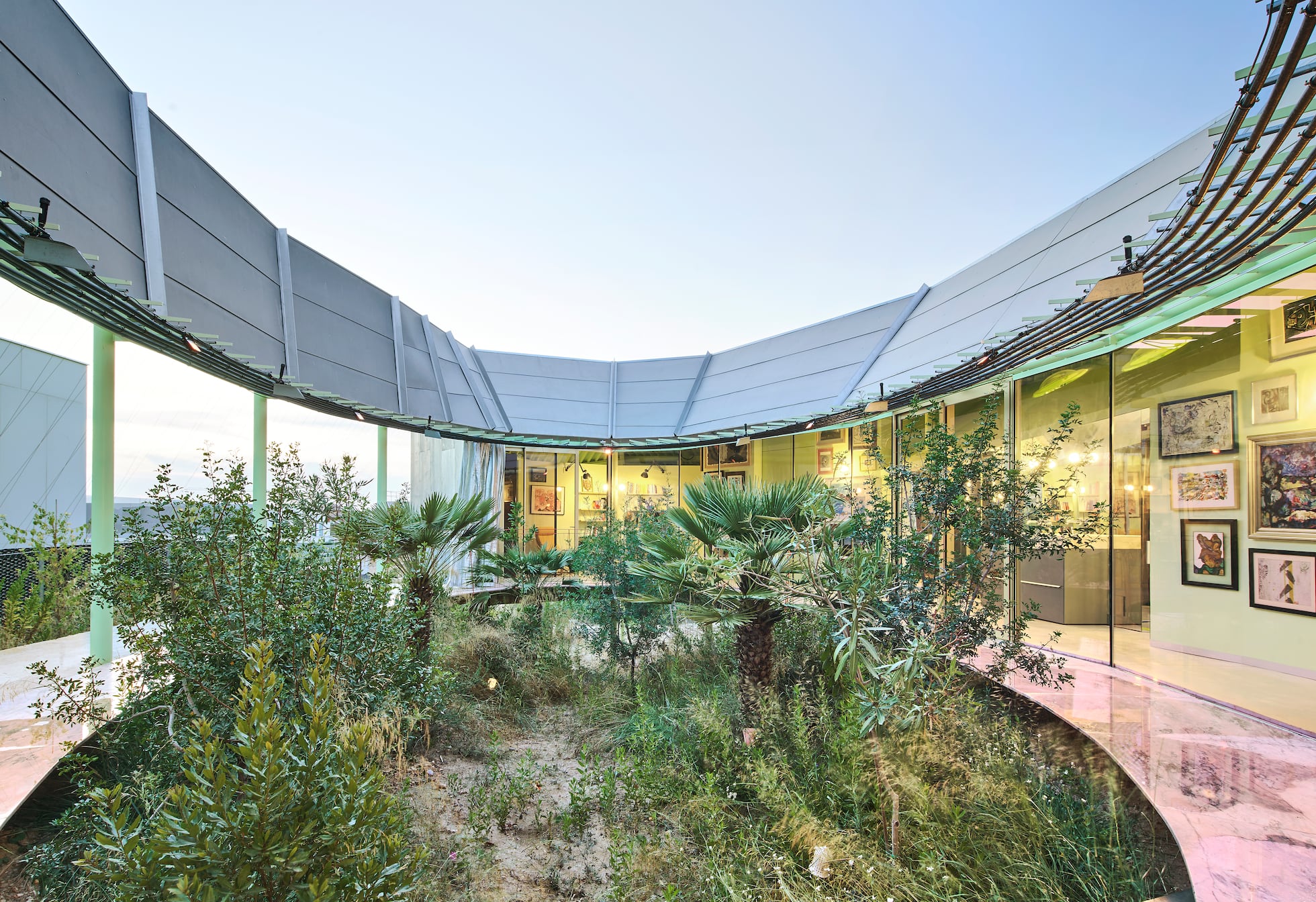
Rambla Climate-House by architect Andrés Jaque in Molina de Segura, Spain.

Today’s article addresses how architecture can and should repair our ecological system. How in cities, for example, a comprehensive vision would extend beyond beautifying downtown to embracing the understanding that we are not the only species on the planet.

At El País, Miguel Ángel Medina interviews architect Andrés Jaque about buildings that can be good for the environment.

“For three years,” he says, “Andrés Jaque, 53, has been dean of the Graduate School of Architecture at Columbia University, one of the most cutting-edge centers in architectural innovation. The Madrid-born architect is spending his time at the university rethinking how buildings and cities should face climate change. He believes that we must commit to an ‘interspecies alliance’ and that buildings, beyond just being sustainable, should also contribute to repairing our ecology.

“Jaque has proposed several projects with this concept in mind, such as the Reggio School in Madrid — designed to create life within its walls and attract insects and animals. …

Andrés Jaque
“Architecture is the discipline that has most clearly assumed the responsibility of responding to the climate crisis. In the last 15 years, there’s been a radical transformation [in the field]: materials have gone from being sustainable to [repairing the ecology]. And [the architectural field] has revised its own mission, which is no longer to just build new buildings, but to manage the built environment. Additionally, it has brought about an intersectional vision: understanding that the material, the social, the ecological and the political are inseparable and that climate action has to coordinate these fronts of transformation. This has placed architecture at the center of environmental action.

Miguel Ángel Medina
“Do architects share this interpretation?

Jaque
There’s a part [of the field] that’s anchored in a heroic vision of modernity and another that’s commercial… but there’s another that has a political commitment to the planet. And [those who adhere to this] understand that architecture must respond not only to the most immediate circumstances of a commission, but also to action for the planet. …

“There are two systems: a material world of extractivism — which is a mix of carbonization, colonialism, anthropocentrism, heteropatriarchy and racialization — that’s currently collapsing. And, in the cracks of this system, another kind of architecture is emerging, which seeks alliances between species based on symmetry, which pursues a global regime of solidarity and which advances along a line of decarbonization that marks the esthetics, the materialities [and] the types of relationships that constitute contemporary culture. This is gaining undeniable strength. In the future, we’ll see a change that’s as important as the one that modernity once represented.

Medina
“What do we do with urban planning, given so many extreme phenomena?

Jaque
“We’ve been pioneers in proposing a change of focus, from an emphasis on the city as a kind of stain on the territory, to a trans-scalar approach. This is a way of understanding [the physical structure that is] an urban block of apartments, the microbial relationships that occur in the bodies of those who live on that block, as well as the large networks of resource extraction that make life on that block possible.

“The city has lost the capacity to contain all realities, [which is necessary] in order to think in a climatic and ecosystemic way. And we need a new model that allows us to understand that what happens on a molecular scale has implications on the scale of bodies, buildings, streets, neighborhoods, the planet and the climate. Designing [cities] in a trans-scalar way requires changes in the methodologies of architecture, which we’re exploring. …

“Cities are going through a period of great transformation. A transformation in which the city has to be understood as something physically porous, which allows for the circularity of water, which contributes to multiplying life… a transformation of materiality that promotes a flow of materials that also contributes to the health of bodies. [We require] a very different way of urbanizing the air – in such a way that it’s understood that there’s a direct relationship between our lungs and the climate – and a commitment to the generation of diverse and empowered living environments. The main difficulty is how to do this quickly, so as to mitigate the impact of the climate and environmental crises.

Medina
“What’s this new ‘interspecies diplomacy’ that you advocate in favor of?

Jaque
“Humans are just one of many forms of life. And the idea that humans can decide to sacrifice the rest of the species to serve their own interests has been shown to be harmful. Understanding that we’re dependent on many other species — and that we’re actually inseparable from them — is more realistic. We depend on the quality of the soil, on the ecosystems. An interspecies alliance based on protecting the living conditions of diverse species is beneficial for all life on the planet.”

More at El País, here.

Photo: Ahmed Gaber for the New York Times.
The Hudson Park Library, one of more than 60 branches built in the city in the early 1900s with funding from the steel magnate Andrew Carnegie. These branches typically included an apartment for a live-in custodian.

A couple years ago, a guy was discovered living secretly in a mall in Providence, and now there’s even a movie about him.

I’m thinking of that as I read this New York Times story about the hidden apartments in Carnegie libraries. (And here’s your regular reminder that robber barons like Carnegie were once philanthropists, too.)

John Freeman Gill writes, “New York City is full of secret spaces. … But few such places so capture the imagination as the apartments hidden inside the mansion-like public branch libraries funded more than a century ago by the industrialist Andrew Carnegie. Is there a voracious reader anywhere, after all, who doesn’t relish the idea of living in a library?

“In 1901, Carnegie committed $5.2 million (the equivalent of well over $170 million today) for the construction of dozens of neighborhood libraries on land provided by the city. Designed by powerhouse firms like McKim, Mead & White, more than 60 branches were built across the five boroughs, bringing not only books but architectural grandeur to working-class neighborhoods largely deprived of both. Hidden from the public above the elegantly appointed reading rooms, each library typically contained a modest family apartment for a custodian, who performed the punishing work of stoking its coal-fired furnace around the clock.

“In the latter half of the century, these custodial apartments were gradually vacated, as the coal furnaces were replaced and the caretakers retired, the last one around 2005. Over the years, many of the units were converted for new library uses, while the remaining dwellings, left to molder for decades, took on a decrepit, ghostly appearance. Today only seven Carnegie apartments survive intact in the New York Public Library system, all uninhabited.

“ ‘The first time I saw a Carnegie apartment, I was just blown away,’ said Iris Weinshall, chief operating officer of the New York Public Library, which operates 30 Carnegie branches in Manhattan, the Bronx and Staten Island. ‘Many of them are almost like haunted houses. It’s a pretty eerie feeling.’

“Now, however, four of the abandoned apartments have been re-envisioned and renovated as part of a $176 million, city-funded modernization of five branches in under-resourced neighborhoods: the libraries at Fort Washington and 125th Street in Manhattan, Melrose and Hunts Point in the Bronx and Port Richmond on Staten Island.

“Overall, the Carnegie Branch Renovation Program preserved historic features like double-height ceilings and open-plan reading rooms, while upgrading the interiors to maximize public space and installing elevators in two libraries that lacked them. At the two Manhattan branches and Hunts Point, the custodial apartments were transformed into teen centers, while at Port Richmond, the unit became a mechanical room. The Melrose apartment, where a caretaker kept a chirping aviary of hundreds of birds in the 1950s, was lost to fire in 1959.

“Perhaps unsurprisingly, those who grew up in the city’s Carnegie libraries tend to be bookish sorts.

“ ‘I can hardly imagine what my life would’ve been like without the experience of living in that library,’ said Ronald Clark, 90, who moved into the third floor of the Georgian Revival-style Washington Heights branch as a teenager around 1949. ‘I was able to have all my questions answered as a young person growing up.’

“For example, he said, he was lying in bed one night at about age 15, ‘thinking about the things that the Bible says about the creation and the things that science, the archaeologists, have found. And I said, well, there seems to be a contradiction. So I got up and went downstairs, turned on one of the reading lights, and got out the Bible, laid it out, went to Reference, got an encyclopedia, and I read both of them and realized they were both saying exactly the same thing.’ That discovery, he added, ‘set me off on a search for all the scientific and spiritual connections that I could find.’

“Mr. Clark studied science at the City College of New York, becoming the first in his family to earn a degree. After performing classified work for the United States government in Nuremberg, Germany, he moved back to live with his custodian father, Raymond Clark, in the Washington Heights library. There he raised and home-schooled his daughter, Jamilah, for several years.

“In the evenings, Ms. Clark would accompany her grandfather downstairs to the children’s floor, where he had her sit on a table.

“ ‘He would be sweeping and mopping, and I would just sit up there and either read books, or they had a little television down there, so sometimes I would watch The Electric Company,’ she said. ‘Being that the library was closed, it was my own little paradise that I had all to myself.’ ”

More at the Times, here. Intriguing photos.

Photo: John and Suzanne’s Mom.
Fungi and algae receive less than 0.2% of conservation funding, according to a new study. Small speices never seem as cool as rhinos and elephants.

Is it human nature to pay more attention to the large and aggressive than to the small and quiet? As a female, I think so.

At the Guardian, Mariam Amini writes about how that tendency, when applied to the study of the natural world, can be harmful to the planet.

“Most global conservation funds go to larger, charismatic animals,” she says, “leaving critically important but less fashionable species deprived, a 25-year study has revealed.

“Scientists have found that of the $1.963bn allocated to projects worldwide, 82.9% was assigned to vertebrates. Plants and invertebrates each accounted for 6.6% of the funding, while fungi and algae were barely represented at less than 0.2%.

“Disparities persisted among vertebrates, with 85% of all resources going to birds and mammals, while amphibians received less than 2.8% of funding.

“Further funding bias was found within specific groups such as large-bodied mammals towards elephants and rhinoceros. Although they represent only a third of that group, they were the focus of 84% of such conservation projects and received 86% of the funding. Meanwhile mammals such as rodents, bats, kangaroos and wallabies remained severely underfunded, despite being considered endangered.

“ ‘Nearly 94% of species identified as threatened, and thus at direct risk of extinction, received no support,’ said Benoit Guénard, the lead author of the study. ‘Protecting this neglected majority, which plays a myriad of roles in ecosystems and represents unique evolutionary strategies, is fundamental if our common goal is to preserve biodiversity.’

“Alice Hughes, a coordinating lead author of the research, said: ‘The sad reality is that our perception of “what is threatened” is often limited, and so a few large mammal species may receive more funding than the near-12,000 species of reptile combined.

“ ‘Not only does this limit our ability to implement protective measures, but it closes opportunities to researchers. I have lost count of the number of times collaborators have switched taxa [organism populations] purely because theirs was difficult to fund. This leads to a chicken and egg situation – some of the groups with the highest rates of recent extinction, like freshwater snails, have the most outdated assessments.’

“The study, led by Guénard and colleagues at the University of Hong Kong, analyzed 14,566 conservation projects spanning a 25-year period between 1992 and 2016. …

“ ‘We are in the midst of a global species extinction crisis,’ said research author Bayden Russell. … ‘We need to change how we think about conservation funding. The community needs to be educated about the value of biodiversity and protecting species that are under threat.’ …

“ ‘Governments, in particular those which represent the main pool of funding, need to follow a more rigorous and scientifically driven approach in conservation funding,’ said Guénard.”

More at the Guardian, here.

And be sure to check Anna Kuchment’s Boston Globe interview with Mandë Holford, here, about a poisonous snail with lifesaving properties. It reads in part: “Some of the most powerful drugs in our medical arsenal come from animal venom. Ozempic was derived from Gila monsters, a lizard native to the southwestern US; Prialt, used to treat chronic pain in HIV and cancer patients, comes from deadly cone snails; and captopril, the first ACE inhibitor, a class of drugs used to treat high blood pressure, came from Brazilian pit vipers.”

Passover and Easter

Photos: Suzanne and John’s Mom.

People are celebrating Passover and Easter in my retirement community.

Spring Ephemerals

042118-trout-lily-brick-wal

Photos: Suzanne and John’s Mom.
Trout lilies in Massachusetts.

I always look eagerly for the early spring wildflowers to emerge. I even planted several kinds when we had a house. You are not supposed to transplant them, because most require very special woodland conditions, but there are vendors who grow them from scratch, like Grow Native Massachusetts and Garden in the Woods, and their flowers are safe.

It was only this year I learned that these beloved wildflowers are called spring ephemerals.

The Massachusetts government website says, “Early flowering plants that produce leaves, bloom, and set seed quickly after the snow melts in the spring are referred to as spring ephemerals. … They represent the seasons changing. Spring ephemeral flowers also provide the much-needed first nectar and pollen of the season for over-wintering pollinators, including bumblebee queens, mining bees, halictid or sweat bees, early butterflies, beetles, flies, and gnats. In return, these insects transfer pollen from one plant to another. 

“Spring ephemerals are found in deciduous forests dominated by sugar maple, ash, black cherry, and hop hornbeam trees. Before the trees have their leaves, these wildflowers show up early to take advantage of the unobscured access to sunlight. While the trees are still dormant, spring ephemerals are in a race against time. They take advantage of the above-average nutrient levels in the soil (from decomposing fall leaves) to photosynthesize quickly. This provides the energy they need for flowering, setting seed, and storing carbohydrates for the following year all before the tree canopy blocks sunlight from the forest floor. 

“The forest trees pull large amounts of water out of the soil when they start to grow leaves. The amount of water being absorbed by the trees is so great that it causes groundwater levels to drop. Before this happens, spring ephemerals use the higher moisture levels in the soil to carry out their life cycle. The dampness also helps them tolerate low temperatures they often face in early spring.

“Please keep in mind that the survival of a plant population depends on each plant’s ability to produce seed for the following year. If you find a location with these beautiful plants, enjoy them in place and do not pick them. Other people who follow in your path will appreciate what you have admired and left untouched, as will the many native pollinator insects that depend on spring ephemerals for their survival.”

If you are interested in more, Wikipedia gets wonky with scientific explanations of not just spring ephemerals but desert, mud flat, and weedy ephemerals. Here’s what is says about the spring ones.

“Spring ephemerals are woodland wildflowers which develop aerial parts (i.e. stemsleaves, and flowers) of the plant early each spring and then quickly bloom, and produce seed. The leaves often wither leaving only underground structures (i.e. rootsrhizomes, and bulbs) for the remainder of the year. This strategy is very common in herbaceous communities of deciduous forests as it allows small herbaceous plants to take advantage of the high levels of sunlight reaching the forest floor prior to the formation of a canopy by woody plants. Examples include: spring beautiestrilliumsharbinger of spring and the genus of Dicentra particularly D. cucullaria, Dutchman’s breeches and D. canadensis, squirrel corn.”

More at Wikipedia, here. Mass.gov, here, has some great photos.

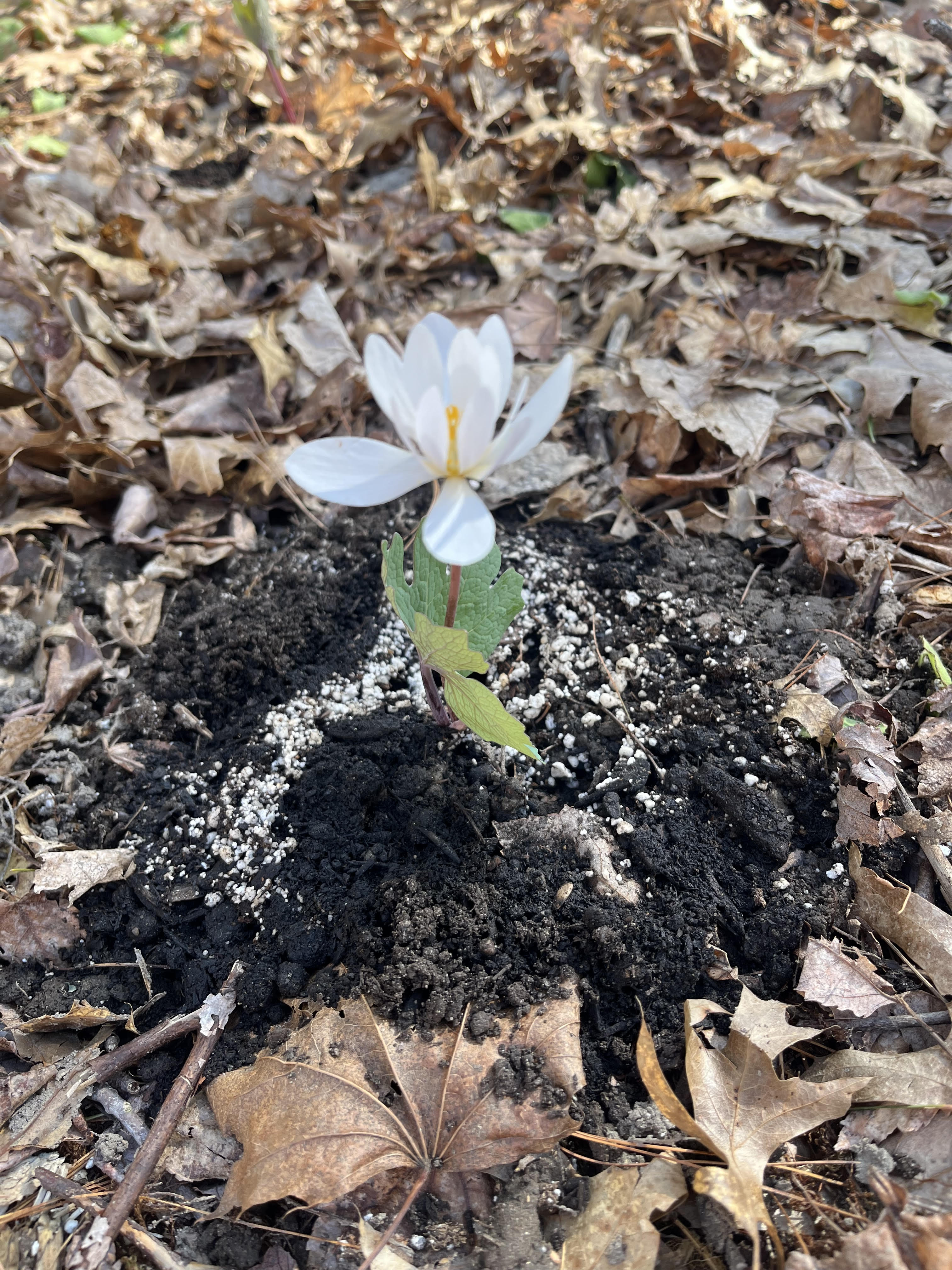
An early spring flower called bloodroot, planted by a committee at my retirement community.

250th

Pottery: Sue Brewster.
My retirement community has prepared for the country’s 250th anniversary — counting from April 19, 1775, when “the shot heard ’round the world” was fired at the North Bridge — in charateristic ways. In the pottery workshop, for example.

You will be pleased to know that the American experiment in democracy lasted nearly 250 years. It’s nothing like geologic time, but it’s pretty good depending on your frame of reference.

There will be celebrations all around New England to recognize the key events of 1775. In our town, the day will include an extra long parade and a visiting dignitary whose name the planners withheld until the last minute.

Back in 1975, the 200th anniversary of Patriots Day, the visiting dignitary was Gerald Ford. Protesters camped out on the hill above the North Bridge, by the Buttrick Mansion. They are said to have been rowdy, and Emerson Hospital had to treat several of them. This time, extensive preparations were made to handle rowdiness.

To give you a taste of the day’s activities at just one of many locales, here is what the museum posted:

“Celebrate the 250th Anniversary of April 19, 1775, with a free community celebration at the Concord Museum. … Free admission (9:00 am – 5:00 pm), including access to the immersive April 19, 1775 galleries to see the original lantern from Paul Revere’s famous midnight ride and the new special exhibition Whose Revolution.

A family-friendly encampment of Revolutionary Living History (10:00 am – 5:00 pm). Billerica Colonial Minutemen will drill with muskets, cook over an open firepit, and demonstrate colonial crafts.

Family drop-in activities (9:00 am – 4:00 pm) inspired by the American Revolution and the new Barefoot Books publication Rise Up!

A Forum with Doris Kearns Goodwin (6:00 – 7:00 pm) on the American Revolutionand its legacy. In-person attendance is at capacity. Join a stand-by line or register for virtual attendance.

An outdoor concert with the Goodwin Band (7:30 – 8:30 pm), finishing with a view of a town-wide drone show.

Food trucks, an ice cream truck, and a wine and beer truck all day and evening.”

Speaking of food trucks, you should know that they were a big bone of contention a few years ago at Town Meeting, when planning was getting underway. Not historically accurate, you know.

I have no idea where you can park, but if you can get here early, our tourist site notes, “church bells at 1st Parish toll at 5:45 a.m. to sound the alarm [and] Dr. Prescott arrives at the North Bridge after riding across the fields calling out the warning to towns and villages that the [British] Regulars were on the march and that their destination was Concord. The Concord Minutemen fire salutes and the Concord Independent Battery fire several volleys from the field at the Old Manse.”

I have heard the Independent Battery fire historically accurate volleys several times over the years, and my advice to you is to wear earplugs.

For other information, check the town website, here.

Photo: Nicholas J.R. White.
A night sky above a copse of trees on Guirdil Bay on the Isle of Rum in Scotland.

In the summer, when we are staying in New Shoreham, we can see the stars at night, including the Perseid meteor showers. But the rest of the year, newspaper alerts about cool things happening in the night sky are wasted on us. I would love to see, at least for a little while, what the residents of the Isle of Rum can see.

Kat Hill writes at the New York Times, “Rum, a diamond-shaped island off the western coast of Scotland, is home to 40 people. Most of the island — 40 square miles of mountains, peatland and heath — is a national nature reserve, with residents mainly nestled around Kinloch Bay to the east. What the Isle of Rum lacks is artificial illumination. There are no streetlights, light-flooded sports fields, neon signs, industrial sites or anything else casting a glow against the night sky.

“On a cold January day, the sun sets early and rises late, yielding to a blackness that envelopes the island, a blackness so deep that the light of stars manifests suddenly at dusk and the glow of the moon is bright enough to navigate by.

‘For this reason, Rum was recently named Europe’s newest dark-sky sanctuary, a status that DarkSky International, a nonprofit organization focused on reducing light pollution, has granted to only 22 other places in the world. With the ever-increasing use of artificial lighting at night, places where people can gaze at the deep, ancient light of the universe are increasingly rare.

“Rum’s designation is the result of a long, meticulous bid by the Isle of Rum Community Trust. The effort was led by Alex Mumford, the island’s former tourism manager, and Lesley Watt, Rum’s reserve officer, with the support of Steven Gray and James Green, two astronomers who started Cosmos Planetarium, a mobile theater offering immersive virtual tours of the night sky. Rum ‘stands for something greater,’ Mr. Mumford said, and aspires to be ‘a haven for others to experience the darkness and the Milky Way.’

“A seven-mile walk from Kinloch through the wild and empty heart of the island leads to a Greek-style mausoleum, built in the 19th century, above Harris Bay on the west side of Rum. Locals regard it as the best spot on the island to take in the night sky; on a cloudy night with no moon, one resident said, ‘you can’t even see your hand in front of your face.’ But this night was clear, and stars and meteors wheeled spectacularly overhead as the Milky Way drew a glistening smudge above the brooding mountains, Askival and Hallival. Venus, Saturn and Jupiter stood in a line above the mausoleum’s sandstone pillars.

“Plans are in motion to renovate an abandoned lodge nearby into a place where tourists could stay in their quest for celestial splendor. ‘What you are seeing is not just a 2-D map, but the four dimensions of space and time,’ Dr. Green said. ‘You are looking back into the past.’ …

“On Rum, human life is lived in the small pools of light that spill from windows or glow from headlamps. One key to attaining dark-sky sanctuary status has been to help residents adapt to and embrace the darkness. Porch lights are recessed into doorways and point down; the pier has LED lights, also pointing downward, that provide just enough illumination for marine safety; a shop’s outdoor motion-sensor lights come on only for a few minutes when needed. When the community trust started its sanctuary application in 2022, roughly 15 percent of homes and shops followed the lighting recommendations outlined by the initiative; compliance is now at 95 percent.

“The blackness of night provides more than a cosmic spectacle for humans to enjoy; it is also essential for the environment. ‘Low light levels are important for nocturnal species,’ Ms. Watt said. ‘And artificial lighting can influence the feeding, breeding and migration behavior of many wild animals.’ …

“Education — of adults and children, locals and tourists — is central to dark-sky awareness. Andy McCallum, a teacher on Rum, showed off the models and maps of stars and planets that his handful of students had designed.

“ ‘For our pupils, it’s a powerful reminder that although we live on a small island, we’re part of a vast and interconnected universe,’ he said. It made them proud, he added, to help preserve a unique environment for future generations.”

More at the Times, here. Wonderful photos.

Photo: Handout via the Guardian.
You can take hikes with goats. Why not enjoy time with lambs, too?

I’ve been saving an article from the Boston Globe for some future birthday, when I’ll talk my family into joining me in a hike with goats. It’s a service that a goatherd here in Massachusetts offers, and I think it might be fun.

But now I’m learning about spending a weekend with lambs. Maybe that would be even more fun. But I would have to fly to England, and I’m down on air travel.

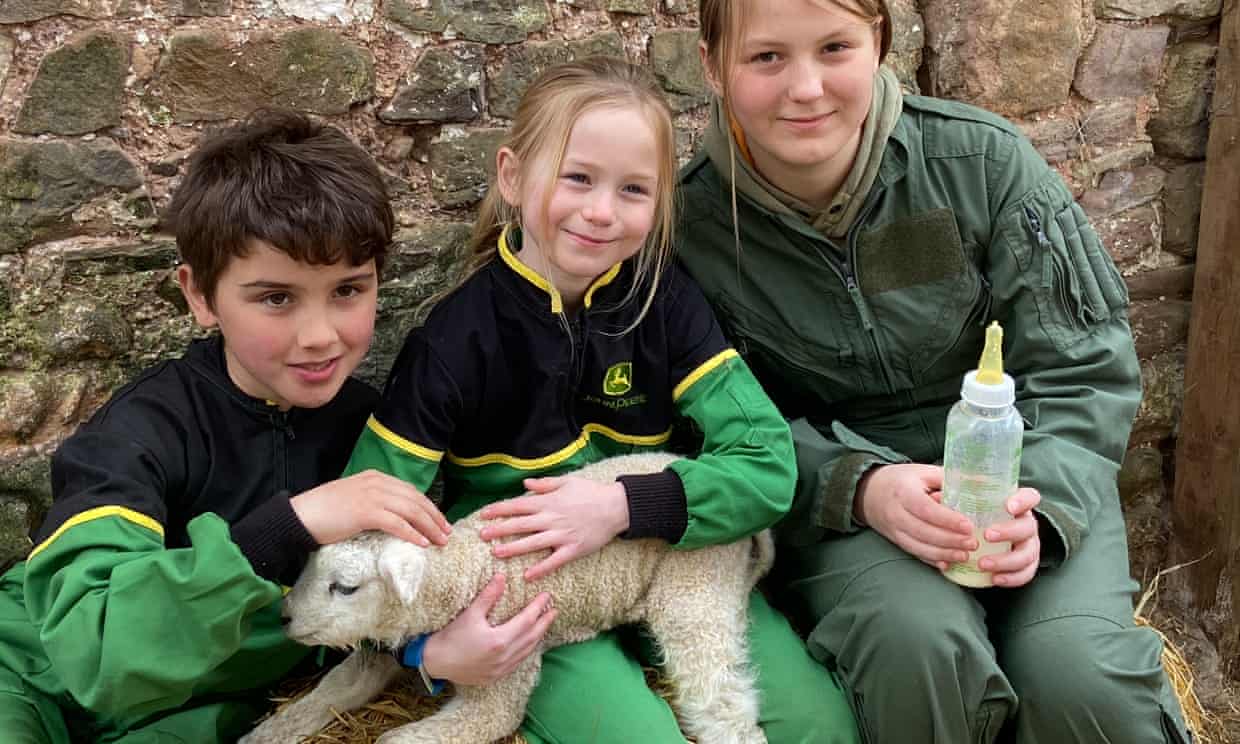
Sally Howard writes at the Guardian, “In a shed in the Malvern Hills, lambs struggle clumsily to their feet as holiday-making couples look on.

“Clare John, the third generation in her family to farm these 50 acres of Worcestershire pasture, began offering lambing-themed breaks two years ago in response to a surge of customer requests. Rowley Farm’s holiday cottages are block-booked for the 2025 spring lambing season, which traditionally peaks around Easter.

“ ‘For farmers like me it’s a bit strange to treat sheep like pets,’ John said. Self-catering guests arrive at Rowley Farm from February to May to feed hay to her pregnant ewes, and to bottle-feed orphan lambs who have been abandoned by their mothers or are the thirds in triplets (which ewes can struggle to feed).

“ ‘Mostly the guests want to touch and cuddle the lambs rather than do the mucking out,’ she said. …

“Farm Stay UK, a co-operative for farmers in hospitality, said that 90 of its 400 members now offer ‘lamb watch’ holidays. A number of farms are expanding their lambing offerings for 2025. … Church Farm in Lancing, West Sussex, offers evenings with the ‘shepherdess team’ where visitors can feed lambs and watch out for live births.

“Some put this popularity down to the effect of TV shows … or the growth of live-stream lambing cams such as lambwatch.co.uk and Walby Farm Park’s Lamb Cam Live.

“Farmer Helen Hearn introduced lambing-shed slots for visitors in 2023 after demand began to outstrip capacity at 450-acre Penhein Farm in Monmouthshire. Guests accompany Hearn – checking the sheds for births, ensuring lambs in the field are paired up with their mothers and bottle feeding the lambs – at a charge of £45 [~$60] for up to eight people a shed. ‘We charge for lambing as it takes four times as long to do our farming rounds when the public is involved.’ …

“She thinks lambing breaks answer a human need for connection to nature. ‘In previous generations most British people would have an aunt or cousin who worked on a farm and would be around farm animals that way,’ she said. ‘That’s all gone now.’

“Hearn said she wouldn’t install a lamb cam for the public to witness live births, however. ‘Often I’ll get a delivery that’s tricky … and the vet needs to come for a caesarean or the lamb comes out dead,’ she said.

“TikToker and amateur lambing enthusiast Melissa Arnold, AKA @melissa­lovessheep, refers to herself as ‘a crazy sheep lady.’ The graphic designer has volunteered for lambing season at her local farm, Readstock in Bagber, Dorset, since 2022. With no prior farming experience, Arnold has now delivered and raised more than 90 lambs. …

“ ‘I discovered lambing when I was going through a tricky period in my life and it’s total escapism for me,’ she said. However, she points out the hobby isn’t all gamboling newborns. ‘It’s an everyday soap opera in the lambing shed. Lambs and ewes die regularly, and you have to learn to handle that.’

“In Hampshire, farmers Fran and John Drake have had to take on additional staff, including veterinary students, to cope with surging demand for lambing stays at Michelmersh Manor Farm, a family-run mixed arable, dairy and sheep farm where 140 lambs are expected this April. ‘We have one London family coming back for their fourth lambing season,’ Fran Drake said. …

“Michael Gibbs, who has farmed at Mill Farm in Middle Tysoe, Warwickshire, for 50 years, welcomes local schoolchildren into his lambing sheds but is unconvinced about turning it into a spectator sport. Farming is a business, after all. ‘The French have a taste for British lamb at the moment and prices are up 30% on 2022,’ the 73-year-old said, passing a trailer of hoggets (sheep between one and two years old) off to market. ‘That’s what the job is at the end of the day. It’s not all cuddles.’ ”

More at the Guardian, here. No paywall at the Guardian, but please consider donating something to support their journalism.

Photo via the Guardian.
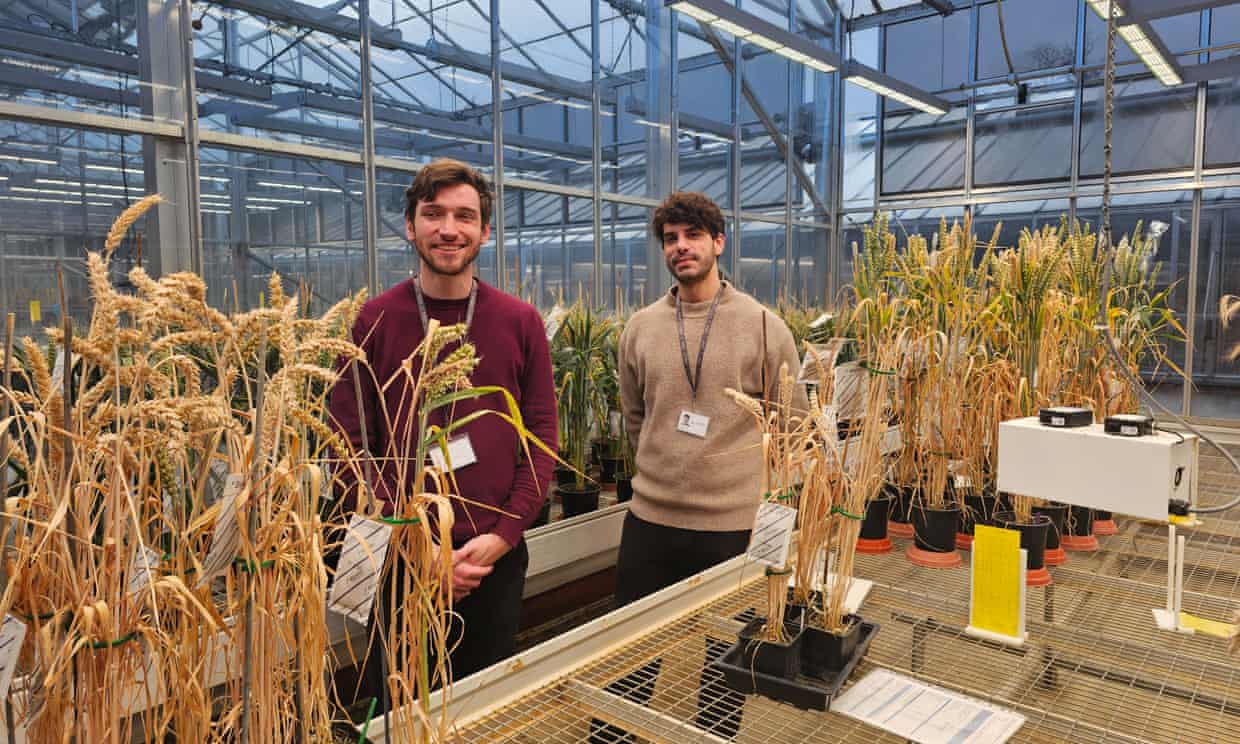
Imperial College researchers Franklin Keck, left, and Ion Ioannou are seeking a biological approach to mining copper with less danger to the environment. 

Can mining be made greener? I know it sounds implausible, but you have to love people who will tackle questions like that. Especially as the modern world is demanding more and more metals.

Robin McKie writes at the Guardian that copper “faces an uncertain future as manufacturers prepare to expand its use to make the electric cars, renewable power plants and other devices that will help the planet move towards net zero. Unrestricted extraction could cause widespread ecological devastation, scientists have warned.

“The issue is to be the prime focus for the new Rio Tinto Centre for Future Materials, based at Imperial College London in partnership with several international university groups. …

“ ‘The world needs to electrify its energy systems, and success will absolutely depend on copper,’ materials scientist and Imperial vice-provost Prof Mary Ryan, one of the centre’s founders, told the Observer last week. ‘The metal is going to be the biggest bottleneck in this process. So, in setting up the centre, we decided copper would be the first challenge that we dealt with.’ …

“Copper has become essential for powering devices ranging from smartphones to electric vehicles because it transmits electricity with minimal loss of power and is resistant to corrosion. Around 22m tons of copper were mined in 2023, a 30% increase from 2010, and annual demand will reach around 50m tons by 2050, say analysts.

“Such an output will have enormous environmental consequences because copper mining uses acids that poison rivers, contaminate soil and pollute the air. Producers such as Peru, Chile and the Democratic Republic of the Congo have seen natural habitats destroyed, wildlife populations wiped out and human health damaged near mines. Deep-sea mining has been proposed, but the idea horrifies marine biologists, who say such enterprises would devastate sea life.

“The aim of the new centre is to find ways round these problems and help provide the materials the world will need to reach net zero. It is funded by the mining group Rio Tinto and hosted by Imperial College London in partnership with the University of British Columbia in Vancouver, the University of California, Berkeley, the Australian National University and the University of the Witwatersrand, Johannesburg.

“One key project is seeking new ways to mine copper. ‘We typically extract it from minerals that have crystallized out of very saline, copper-rich brines,’ said Professor Matthew Jackson, chair in geological fluid dynamics at Imperial College. ‘However, this process requires huge amounts of energy to break open the rocks and bring them to the surface and also generates a lot of waste as we extract copper from its source ores.’

“To get round this issue, Jackson, working with international partners, has been searching for underground sites where copper-rich brines are still in liquid form. These brines are created by volcanic systems which can, crucially, provide geothermal energy for extraction.

“ ‘That means we can extract the copper by pumping the brines to the surface via boreholes – which is relatively easy – and also use local energy to power the mine itself and possibly provide excess energy for nearby communities,’ Jackson said. ‘Essentially, we are seeking to build self-powered mines and have already pinpointed promising sites in New Zealand, and there is potential to explore conventionally barren areas such as Japan.’

“A different approach is being followed by another Imperial project where a company, RemePhy, has been started by Imperial PhD students Franklin Keck and Ion Ioannou.

“They have used GM technology to develop plant-bacterial systems that have an enhanced ability to extract metal from the soil. ‘Essentially, you will be able to grow these crops on land contaminated by waste left over from the mining of metals such as copper, and they will extract that metal,’ said Keck.

“The importance of these techniques was stressed by Ryan. ‘The world will need more copper in the next 10 years than has been mined in the whole of the last century. [We] need to both reduce our demand for copper and work out how to extract it in the most sustainable way possible.’ “

More at the Guardian, here. No firewall. Donations support reliable journalism.