Here are a few recent photos, including some from a very entertaining but sweltering off-island theater excursion with the seniors.
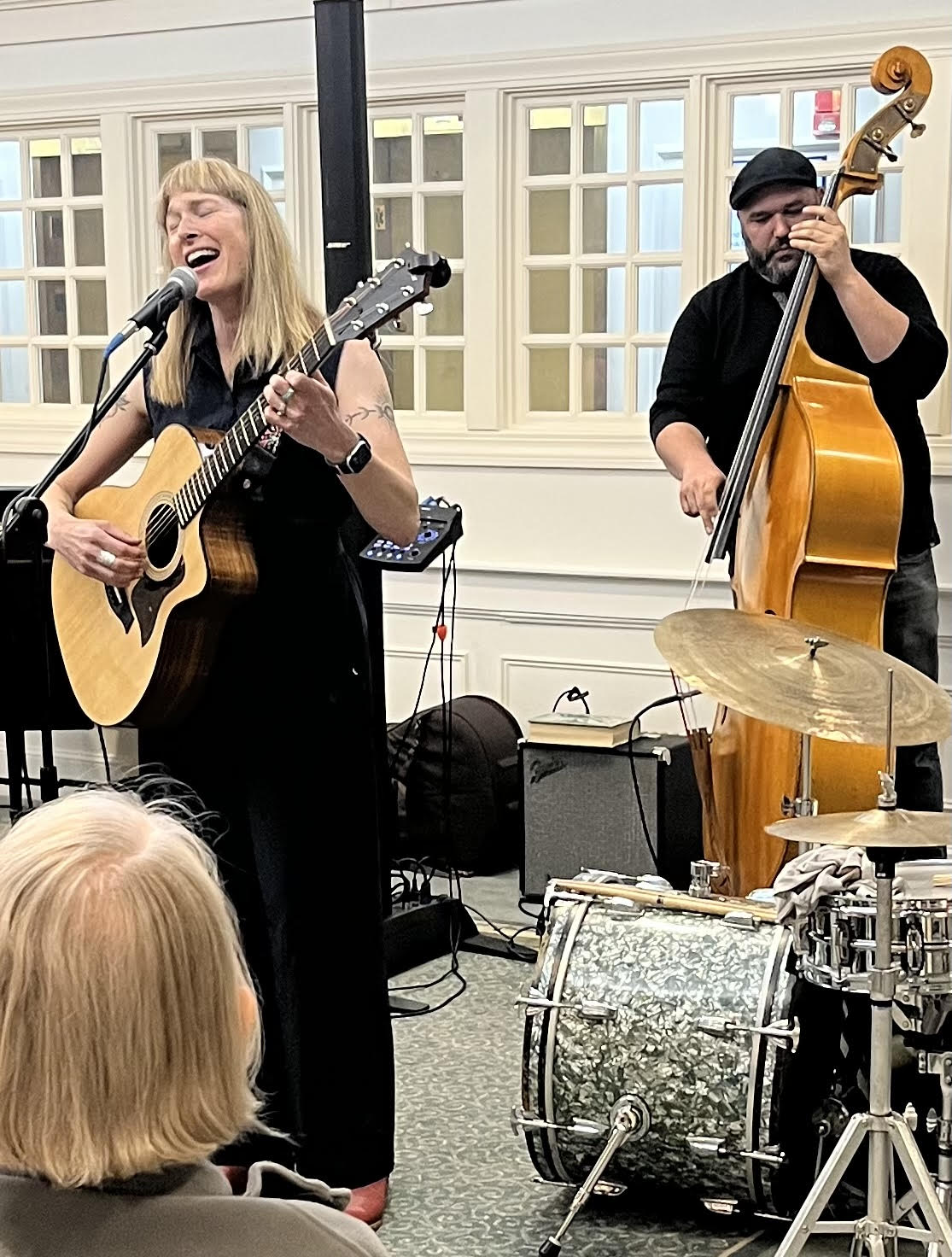
First is my wonderful chair pilates teacher, Britt, who is also a singer. Her students showed up in force at the retirement community as we had never had the opportunity before to see her perform. She was great. I’m noticing her strong fingers on the guitar in this photo. Finger strength is one of the things we all work on in her class.
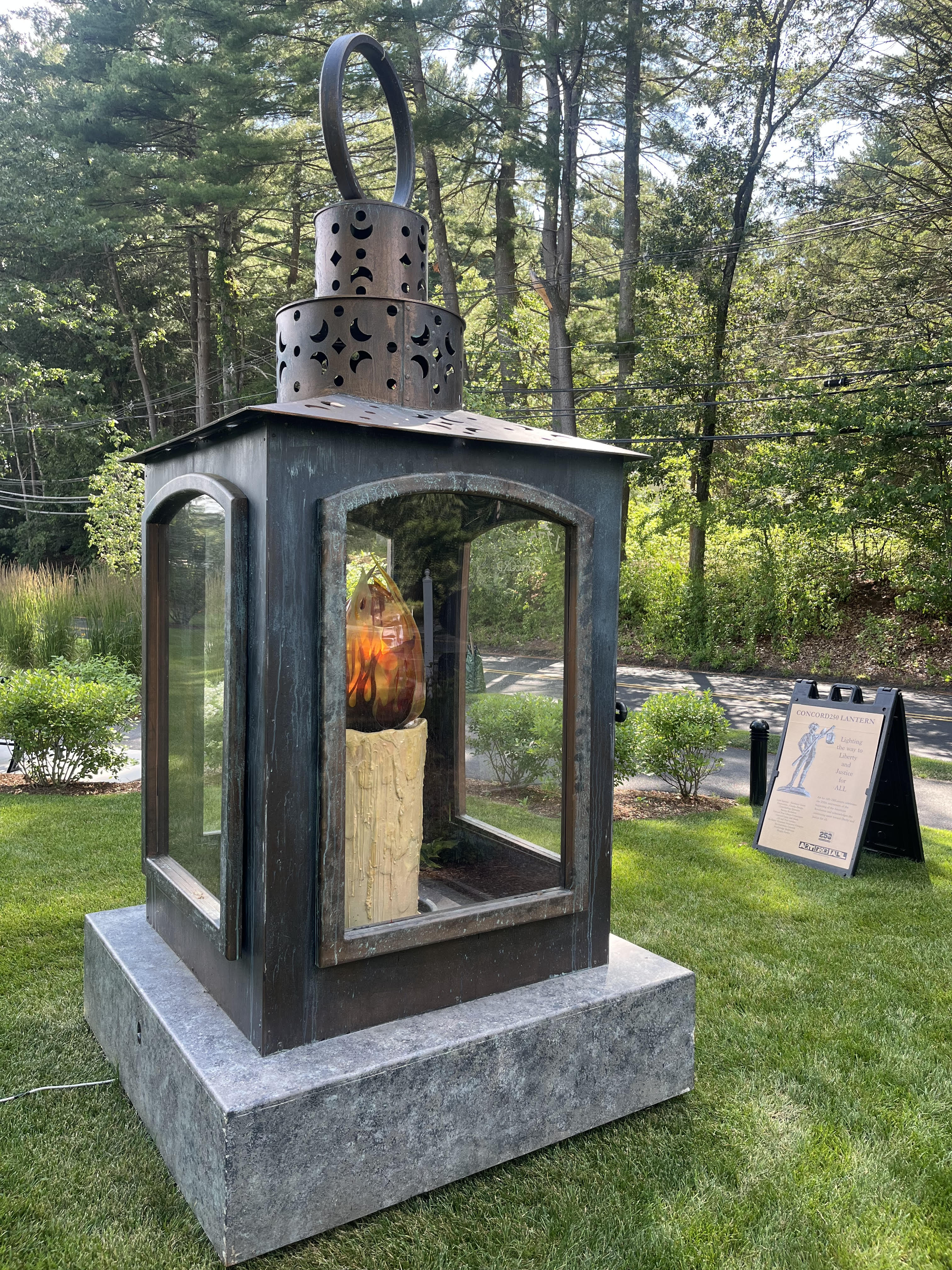
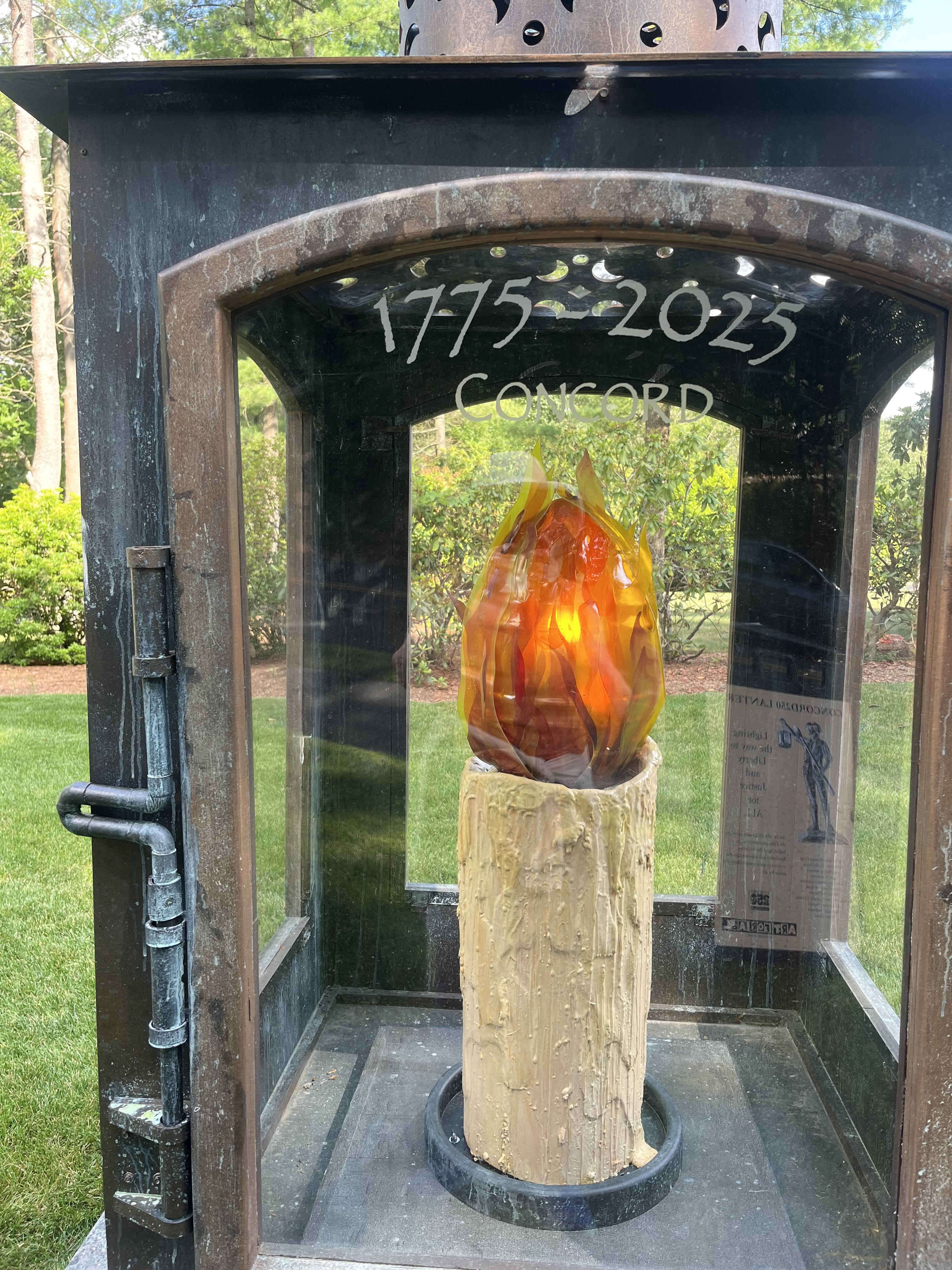
For some reason our community has acquired a large memento from the town’s 250th anniversary, A giant replica of one of Paul Revere’s lanterns (“one if by land, two if by sea”), which now resides in the town’s museum.
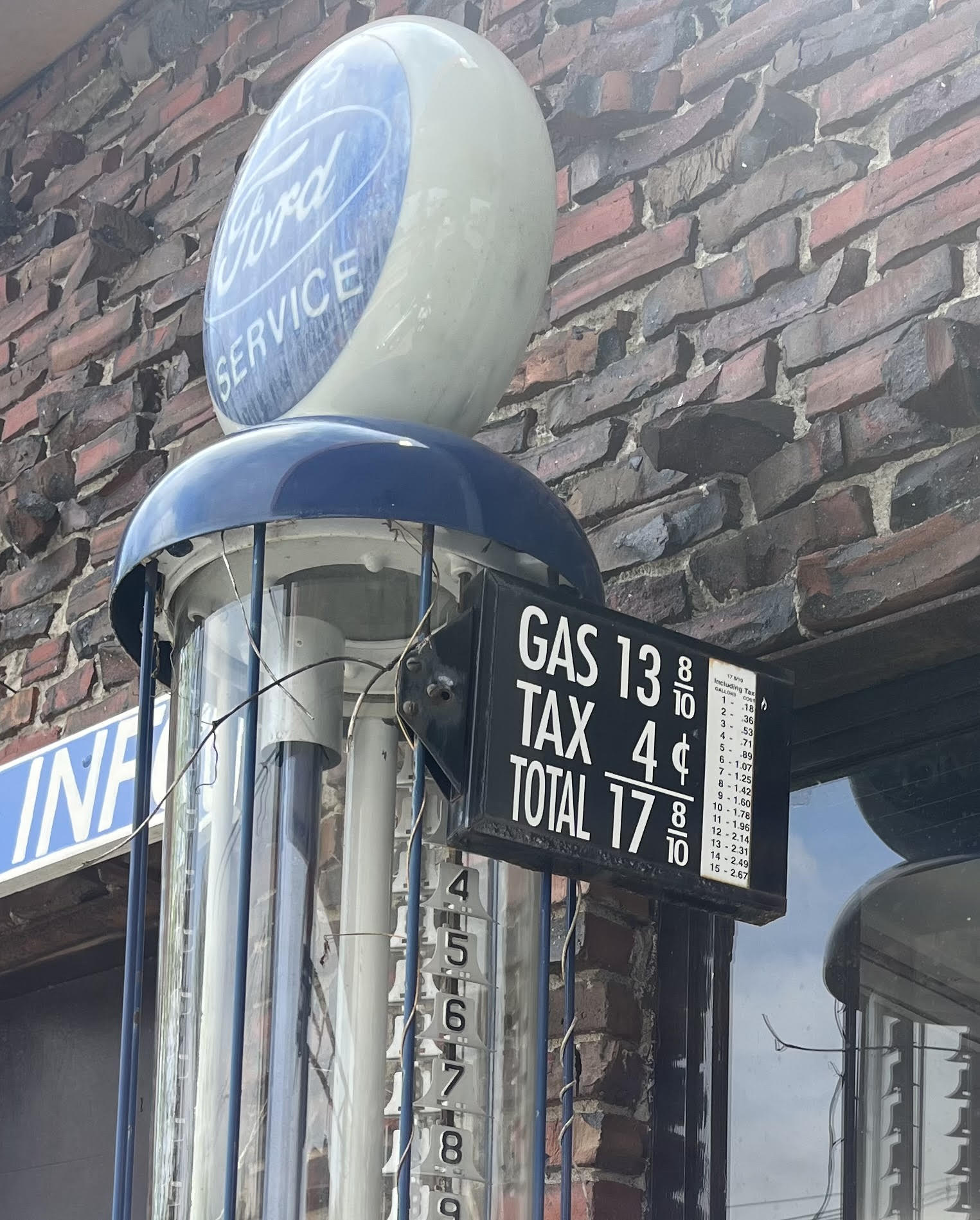
Next, there’s an old gas pump that speaks for itself.
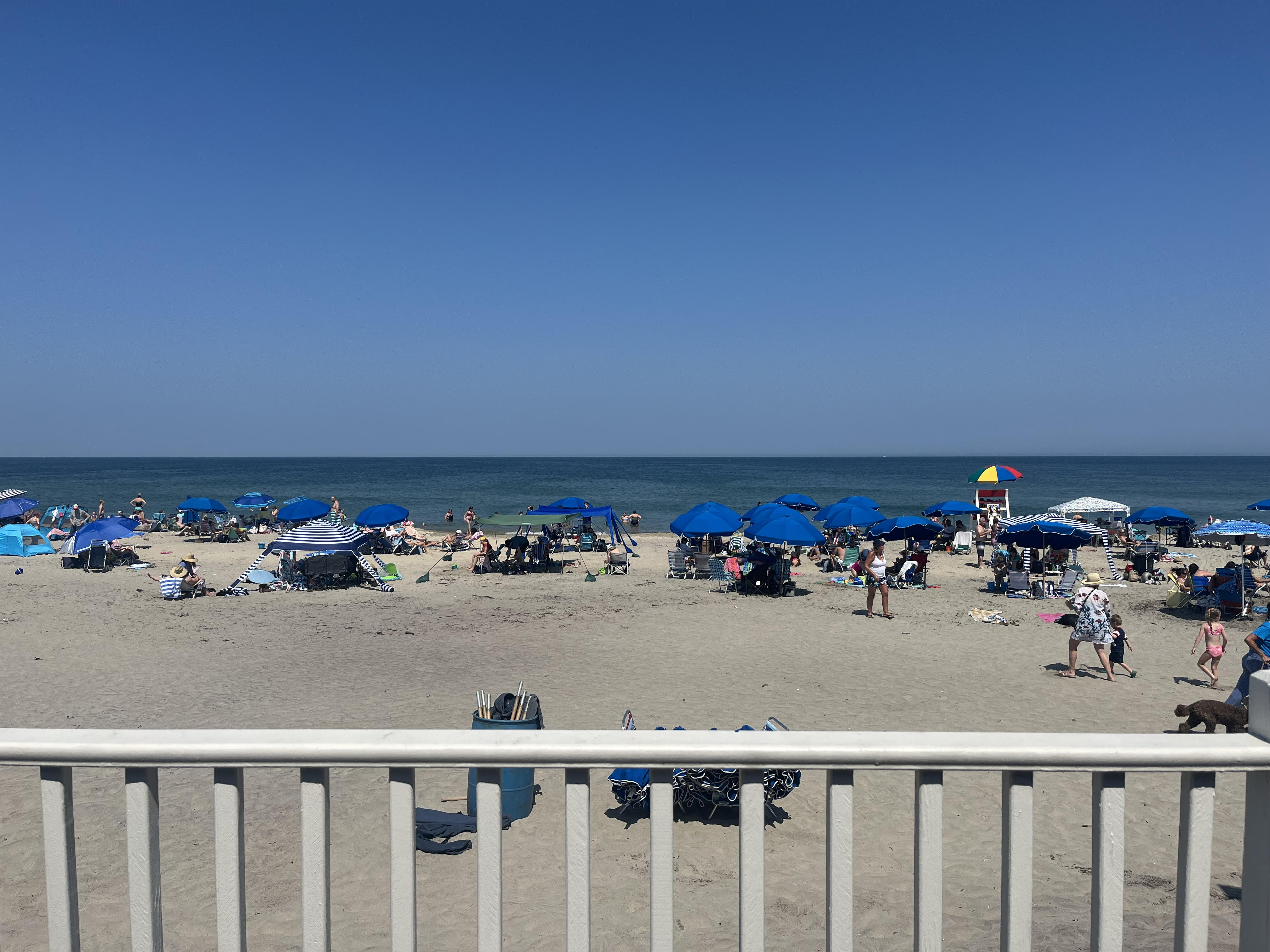
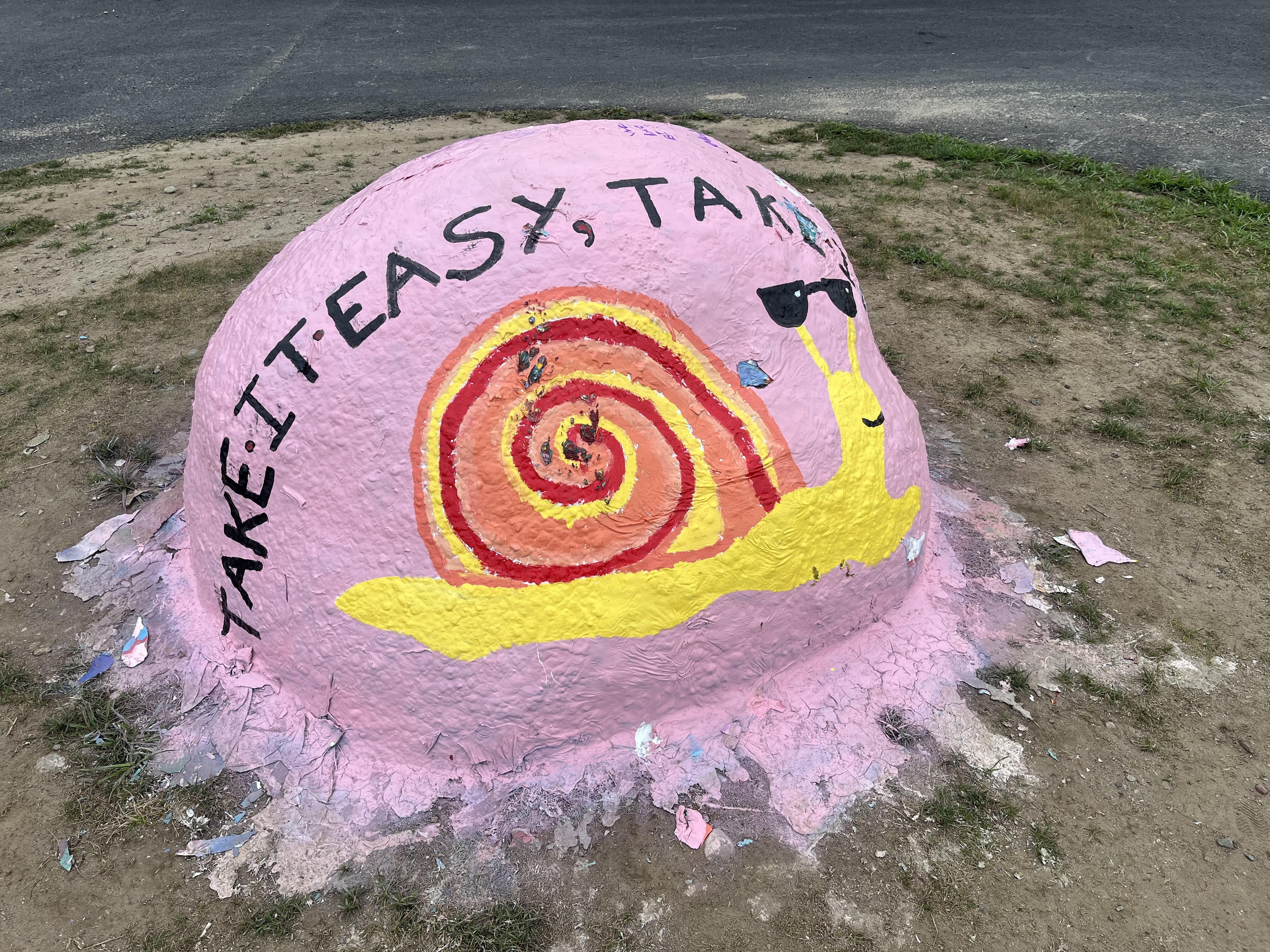
From the heat wave: days almost too hot to walk down to the water. And some advice from a snail.
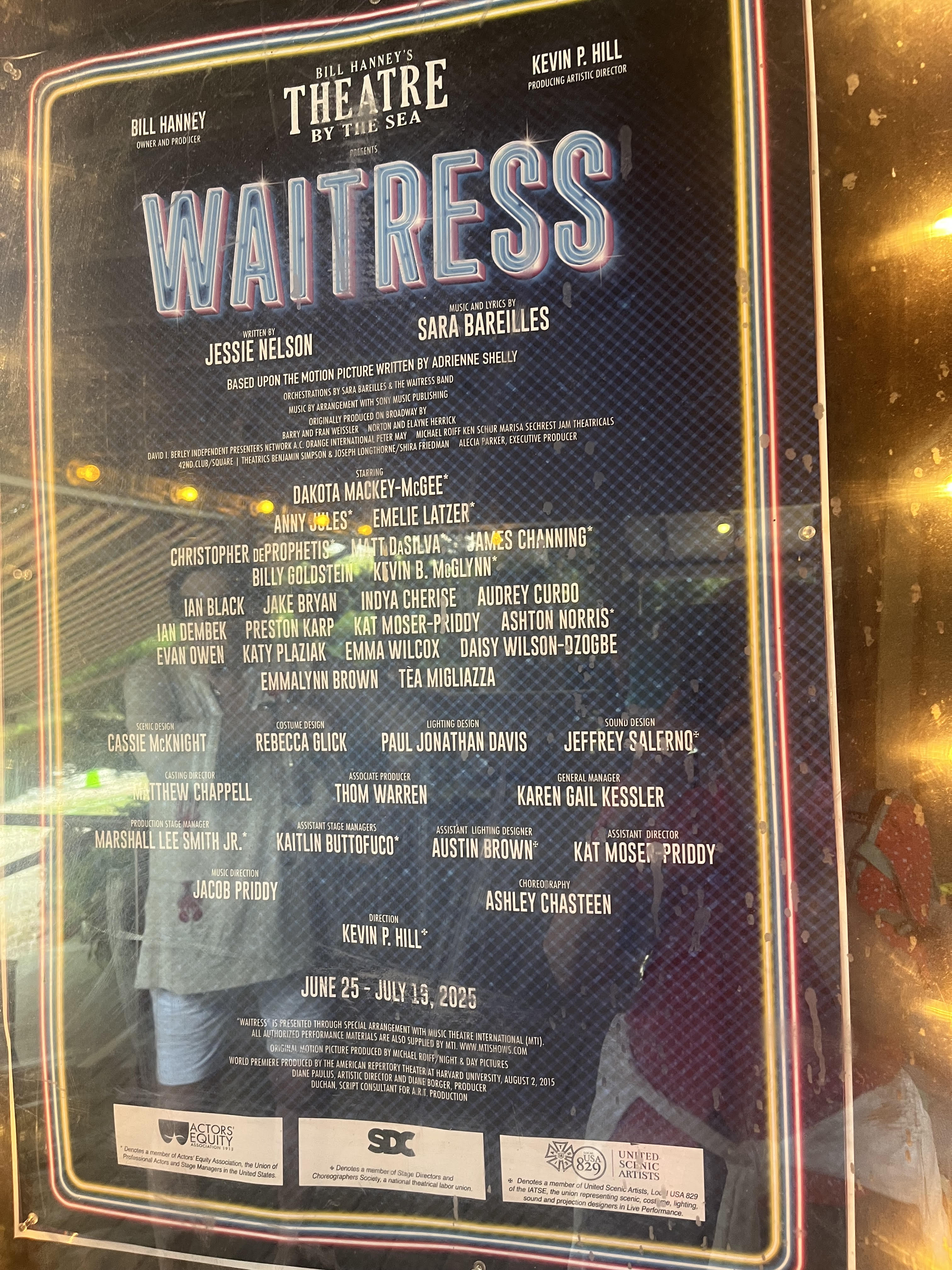
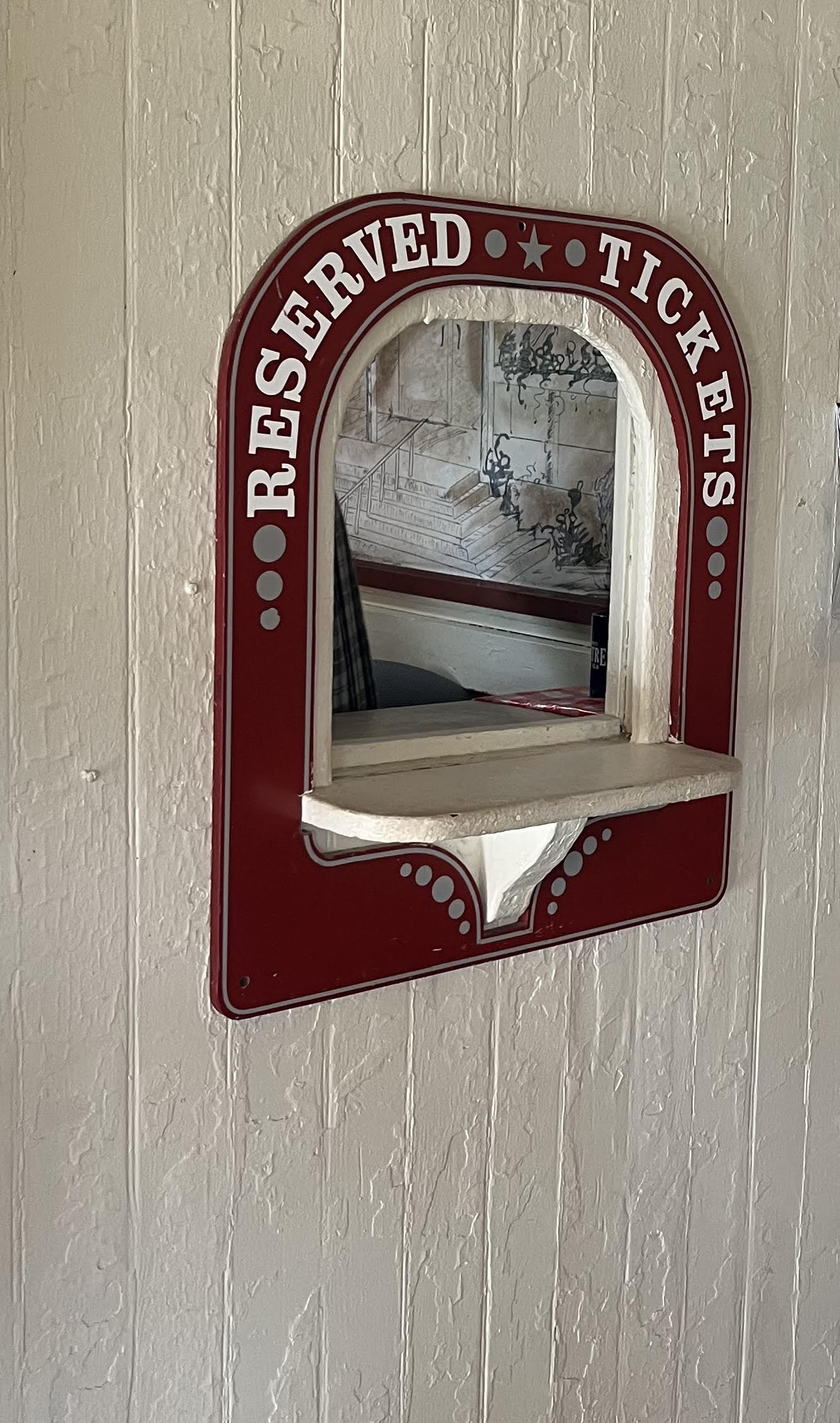
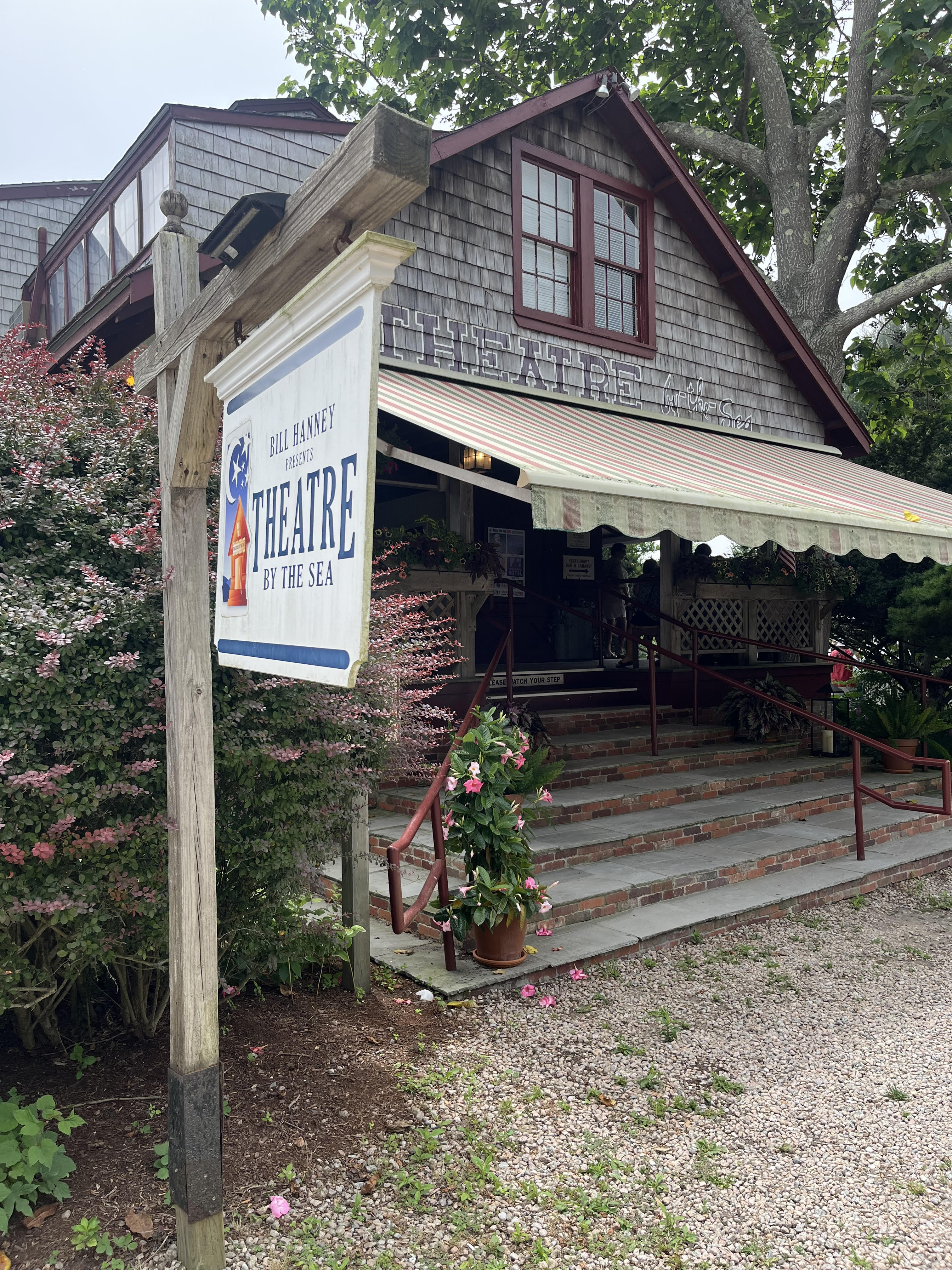
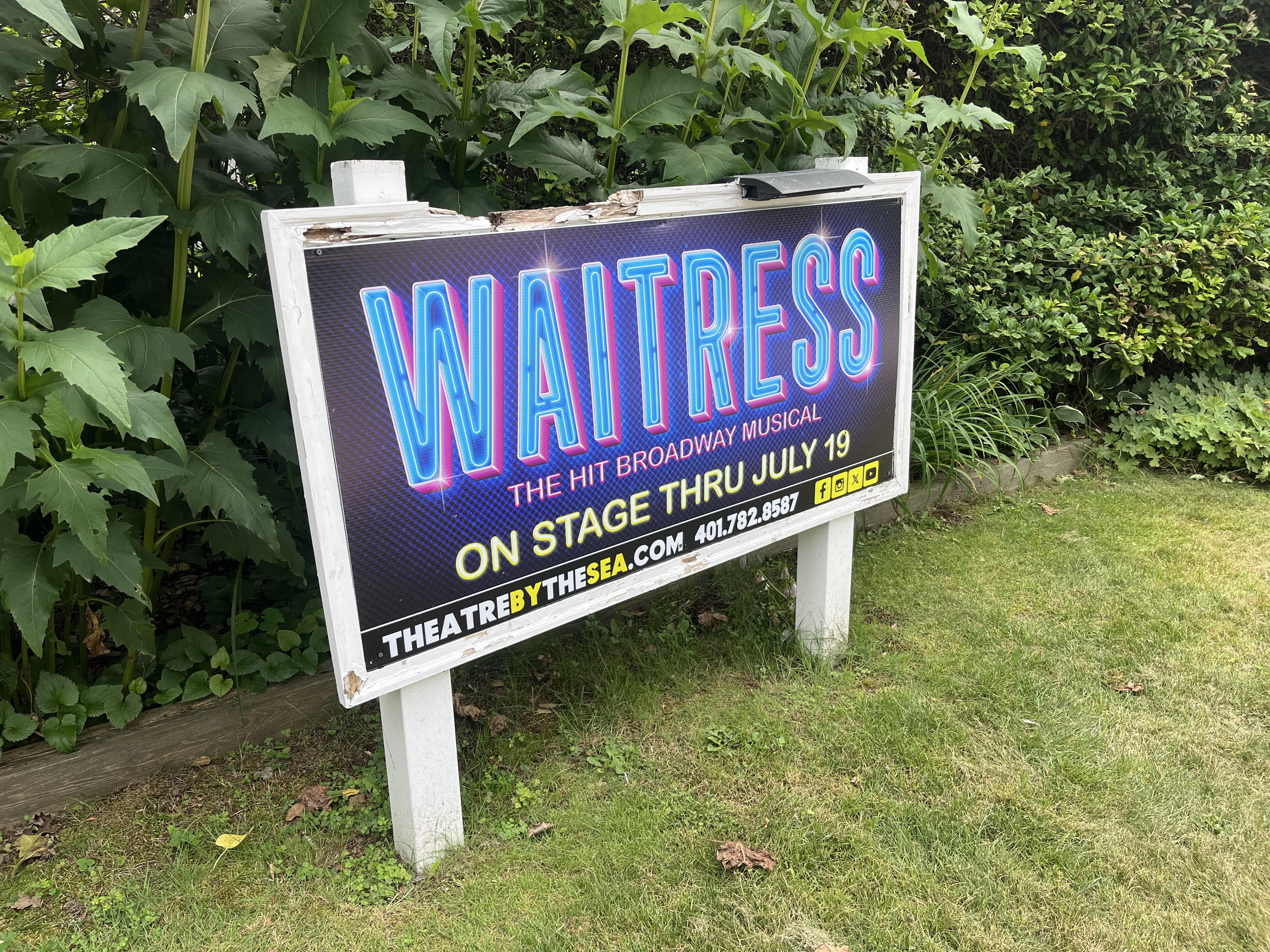
At Bill Hanney’s historic Theatre-by-the-Sea we saw the Broadway musical Waitress, a polished and fun performance. In its long history of destruction and rebirth, Theatre-by-the-Sea has featured performers like Judy Holliday, Tallulah Bankhead, Mae West, Groucho Marx, and Marlon Brando. It’s in a lovely garden setting and also has a restaurant.
I went on the seniors’ theater trip to hear this song. Here it is sung by the show’s originator, Sara Bareilles, when she performed it on Broadway.
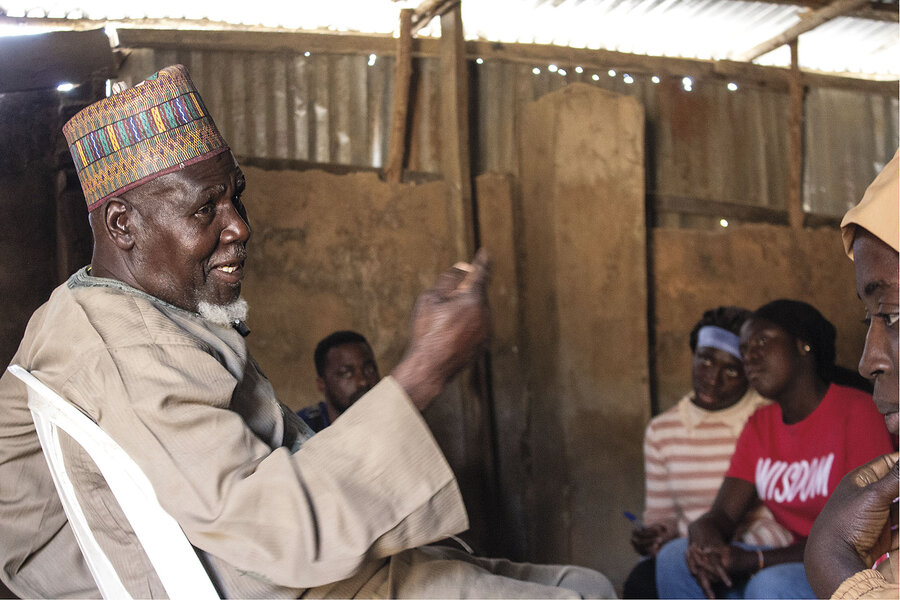
Photo: Nathaniel Bivan. Ahmed Haruna speaks during a storytelling session in Nigeria.
I know I pick sides when I read about wars. It’s pretty clear that Russia invaded an independent neighbor when it launched attacks on Ukraine, for example. I have to remind myself that civilians on all sides suffer. And then for years after — sometimes generations after — bitterness festers. Not a good thing.
So I was interested to read how some Nigerians are working to ease longlasting enmity. Whatever works, I’d say.
Nathaniel Bivan writes at the Christian Science Monitor, “Seven years ago, when Dalyop Timothy Toma was 15, an angry mob came in the night to torch his family’s home in Kyeng village. Everyone but his grandfather fled outside into the bushes to safety.
“ ‘He couldn’t run because he was disabled,’ recalls Mr. Toma, his face contorting in grief at the memory of his grandfather’s killing. Then he adds matter-of-factly, ‘We were planning revenge.’
“Mr. Toma and his family, who are Christians from the Berom ethnic group, blamed Muslims, mainly from the Fulani group, for the attack. Sectarian tensions run high in Kyeng and other communities in Nigeria’s Plateau state. Disputes often involve politics or land and sometimes erupt into violence.
“But in 2022, a youth leader from Kyeng invited Mr. Toma to do something extraordinary: Recount his painful story aloud to a large room full of people from different ethnic groups that he distrusted. That gathering, organized by a nongovernmental organization called Youth Initiative Against Violence and Human Rights Abuse (Yiavha), changed Mr. Toma’s attitude toward those he thought were his enemies.
‘Telling my story helped me heal gradually,’ says Mr. Toma, explaining that he no longer thirsts for vengeance.
“Yiavha has made him a peace ambassador, tasked with spreading his story of grace and forgiveness at intergenerational storytelling sessions in his community and in others.
“Plateau state, in central Nigeria, is home to some 4 million people. Jacob Choji Pwakim, a longtime peace-building activist in Jos, the state’s capital, founded Yiavha to change the narrative in communities that have been riven by ethno-religious attacks.
“The origins of the violence in Plateau state can be traced to a tumultuous week in Jos in early September 2001. More than 1,000 people were killed and tens of thousands displaced amid a long-running struggle for political and economic power among the area’s different ethnic groups. Disputes also flared between settlers and people indigenous to Jos.
“Yiavha has held at least 66 storytelling sessions across the state. Elders have given accounts of bygone times when residents from various ethnic groups lived in harmony, even sharing gifts during religious celebrations for Eid and Christmas. Meanwhile, young people have recounted why they destroyed farms or livestock belonging to members of a different faith or tribe.
” ‘This was what inspired me to set up Yiavha in 2014, with the objective of creating a platform where young people across the divide can talk about their experiences without judgment,’ Mr. Pwakim says.
“So far, Yiavha has worked with up to 3,300 young people, including more than 300 who have been trained as peace ambassadors who might eventually organize storytelling sessions in their communities. Other young people become agents of change after attending the sessions, organizing interfaith meals, youth soccer competitions, and trash cleanups. …
“One sunny afternoon in February, a group of young people is assembled at a soccer viewing center in Kambel, a community in the Anglo-Jos settlement within Jos. Ahmed Haruna is at the front of the room telling stories to the rapt audience, which includes residents of both Kambel and Channel Seven, another community in Anglo-Jos.
“ ‘Growing up, we didn’t even know the difference, who was Muslim or Christian among us,’ Mr. Haruna says. Over the years, residents have lived in segregated areas, with Christians mainly in Kambel and Muslims mainly in Channel Seven. But the storytelling sessions are gradually bringing them together to interact once again.
“After Mr. Haruna finishes sharing stories about the settlements’ tranquil past, peace ambassador Joshua Tsok opens the floor for questions. …
“Training for peace ambassadors is extensive. In 2023, for example, peace ambassadors gathered in Barkin Ladi, another community in Plateau state known for violent sectarian conflict. A training facilitator, Hussaini Umaru, who is an associate professor in the department of theater and film arts at the University of Jos, says he divided the young people into groups and asked them to narrate and dramatize personal experiences of conflict, and then discuss the episodes.
“It is not easy for ambassadors to trust their trainers. Umar Farouk Musa, a development consultant who facilitated a training session last August, explains that this is typically the first hurdle. ‘Some thought we were there to introduce an agenda or to spy. But we built their confidence,’ he says.
“The government’s Plateau Peace Building Agency is a key partner with Yiavha. Kenneth Dakop, a team lead for the agency, says that Yiavha’s initiatives have helped transform young people who previously were drivers of violence in their communities. ‘Most of them are either unemployed or into substance and drug abuse,’ he says.
“Yiavha’s ambassadors have seen transformations in themselves. ‘I want to become a professional teacher,’ Mr. Toma says.
“This year, Yiavha paired Mr. Toma with a Fulani boy and assigned each of them to plant a pear tree in the other’s village to signify a commitment to peace.”
Photo: @risdmuseum on Instagram. ConservatorIngrid Neuman (left) with Rhode Island School of Design undergrad student Sophie Bugat, doing repair work on a statue of Pan.
When a new artwork is acquired by a museum, it doesn’t go right on display. At least one expert must look it over and make sure it’s in good shape.
At the Rhode Island School of Design [RISD ] in Providence that expert is often Ingrid Neuman.
Kristine Yang writes at the Providence Eye, “This past November, Ingrid Neuman, senior conservator at the RISD Museum, wheeled a twelfth-century Japanese wooden Bodhisattva Avalokiteshvara into Hasbro Children’s Hospital for a CAT scan. Conservators have repaired the ancient figure, a revered Buddhist symbol, over centuries — Neuman’s examination would reveal exactly where and how they had carried out those repairs. …
“Over time, sculptures accumulate dirt and often chip, show wear, or even break. Some arrive with broken parts or past repair attempts that complicate restoration. Preparing these pieces for public exhibition falls to the museum’s conservation team.
“Through a meticulous process that integrates chemistry, art history, and craftsmanship, conservators work to stabilize and restore each object. … Neuman’s background in organic chemistry is essential to her work. Sculptures are vulnerable to a host of natural forces over time such as ultraviolet radiation, pollution, humidity, and fluctuations in temperature – all of which can degrade original materials. Pieces with organic materials like wood and ivory, along with metals such as bronze or iron, are particularly prone to these ‘agents of deterioration’ and can experience accelerated degradation if not properly maintained, says Neuman.
‘An ancient bronze beaker from China wants to corrode. It wants to go back to its original copper ore,’ says Neuman. ‘We’re trying to keep it from doing that.’
“Corrosion is a natural chemical reaction that occurs when metals like bronze are exposed to oxygen, moisture, or pollutants over time. This reaction, called oxidation, causes the metal to slowly break down. Left unchecked, this chemical process can eat away at the surface of a sculpture. …
” ‘We borrow a lot of techniques from dentists and doctors,’ says Neuman. ‘There’s a lot of overlap with the medical field.’ With limited in-house instrumentation at the RISD Museum, Neuman often relies on nearby hospitals such as Hasbro’s and research institutions for specialized evaluations.
“Understanding a sculpture’s composition and preservation history is crucial, as it directly informs the selection of repair materials. … Conservators intentionally choose repair materials that are visually similar to the original but chemically distinct, ensuring that their work can be easily differentiated from the artist’s upon chemical evaluation.
“ ‘We don’t like to use the same materials as the artist,’ Neuman says. ‘We’re not trying to be the artist, or be better than the artist, or confuse people.’
“The ease with which any added materials can be removed is also a crucial consideration for conservators, as they must ensure that any restoration work can be undone without damaging the original piece. …
“For this reason, conservators use inpainting – a technique used to fill in missing parts of an artwork – with materials that can be easily distinguished and removed. For example, Neuman says conservators often use acrylic paint when filling in an oil painting. Acrylic is water-based and chemically different from oil paint, allowing it to be safely removed. …
“Neuman emphasizes the importance of reversibility and the chemical properties of adhesives. ‘There’s so many glues in the world. A zillion,’ she says. ‘Everyone uses epoxy or Gorilla Glue, but we never use them because they’re too strong.’
“If conservators use a glue that is stronger than the sculpture’s original material, any physical stress on the object could result in new fractures, rather than breaking along existing lines. … She prepares her own adhesives in the lab, including wheat starch paste and Funori, a traditional Japanese adhesive made from seaweed — both of which are gentle yet effective enough for conservation work.
“While conservators intentionally make their repairs distinguishable from the original through their selection of materials, their work must remain invisible to the viewer. … This means conservators must address each deformity with painstaking precision and care. Inpainting demands an especially detailed approach. … Neuman says, ‘You have to use a very tiny brush, with only a few hairs in it, and you have to be really good at color matching.’
“One of the challenges of inpainting is a color perception phenomenon called metamerism, where colors that match under one light source may look different under another. … To navigate this, she moves the piece back and forth on wheeled carts between her sunlit lab and the gallery space to ensure the colors match under different lighting conditions.
“Once the restoration is complete, detailed documentation is essential, Neuman says. Photographs of the piece before, during, and after the process, along with written records, are uploaded to the museum’s database for future conservators’ reference. ‘It’s important to leave a record,’ Neuman says.”
More at the Providence Eye, here. This story reminds me of the work that Sotheby’s did on one of my mother’s Pousette-Dart paintings, one that had been too close to a chimney fire!
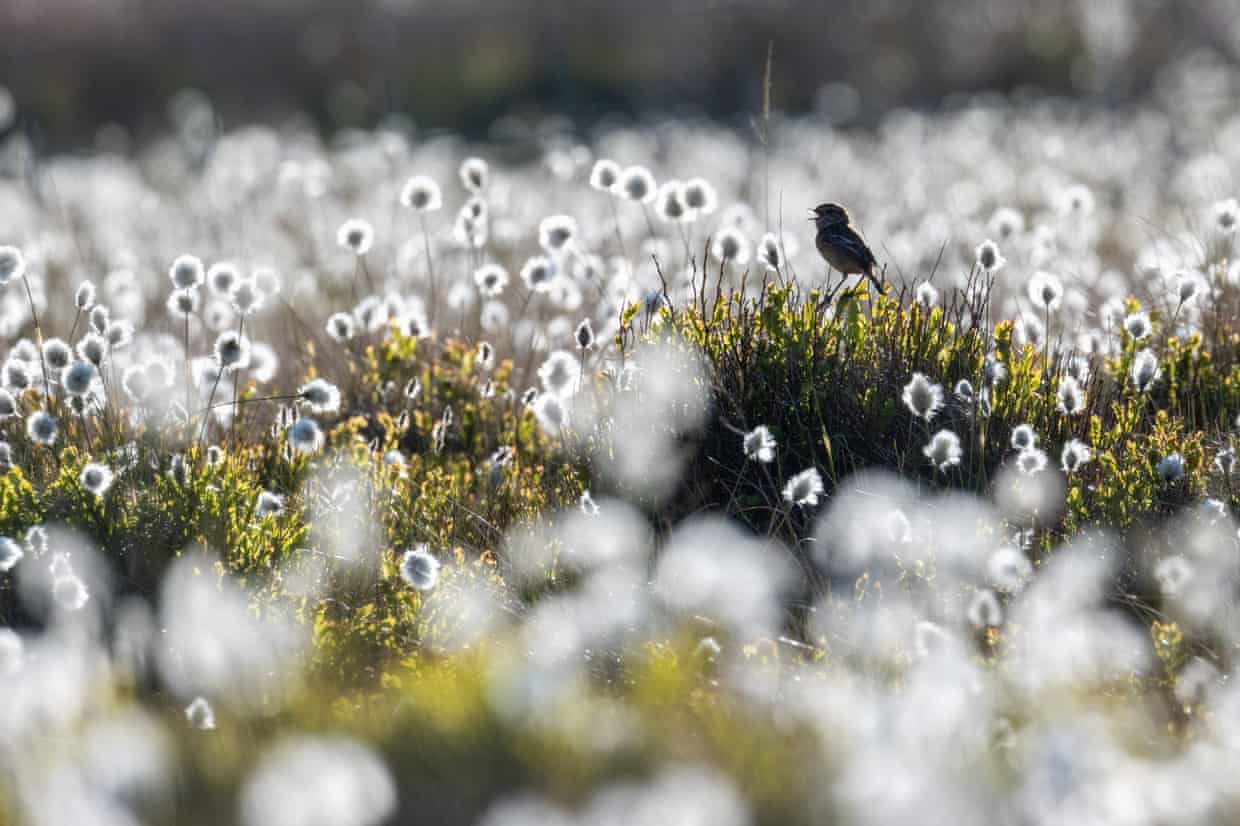
Photo: Rebecca Cole. A female stonechat calls from a bilberry bush. Cooperation between farmers and conservationists in England is bringing back “ghost woodlands” and wildlife habitat.
When do tree-planting programs accomplish what they set out to do? That is the question as we hear more and more that some massive initiatives haven’t worked. In a story from Yorkshire we learn that cooperation among different interest groups is one route to success. Another is using native species to reawaken ancient species buried deep in the soil.
Phoebe Weston writes at the Guardian about a restoration effort by both conservationists and farmers to transform barren sheep fells.
“The Howgill Fells are a smooth, treeless cluster of hills in the Yorkshire Dales national park, so bald and lumpy that they are sometimes described as a herd of sleeping elephants. Their bare appearance – stark even by UK standards – has been shaped by centuries of sheep grazing. Yet beneath the soil lie ancient tree roots: the silent traces of long-lost ‘ghost woodlands.’ …
“Over the past 12 years, 300,000 native trees have been planted across these hills in sheep-free enclosures. The results are beginning to be seen: birds and flowers are returning. … Says ecologist Mike Douglas from South Lakes Ecology, who is monitoring birds in the enclosures, ‘We are 10 years into what was ecologically very damaged land.’ …
“Big rewilding projects often happen on private land with limited public access. These enclosures are a result of agreements reached between dozens of farmers on common land with public access. ‘Doing so much tree-planting on a common was groundbreaking,’ says Peter Leeson from the Woodland Trust. …
“Bluebells are popping up and there are patches of bracken, which suggest the soils and seed banks retain the memory of being a woodland despite hundreds of years of sheep grazing. “We call these memories ‘ghost woodlands,’ says Leeson. These ancient woodland indicators could offer a blueprint of where trees should return. …
“Last year, there were 14 breeding species here. Before the enclosure was created, he says, just four would have been found: meadow pipit, skylarks, wren and grey wagtails. Eleven new breeding bird species have been recorded since the original 2016 survey, with numbers increasing year-on-year. ‘I’m surprised by how quickly birds have colonized, and the diversity of species,’ says Douglas. …
“The enclosures were possible thanks to a 10-year government agri-environment scheme, signed by farmers with grazing rights to the fell as part of the Tebay Common Grazing Association, and the owner of the fell, Lonsdale Estates, supported and monitored by the Woodland Trust. …
“Across Europe, conflicts between farmers and conservationists are increasing due to the need for maintaining food production while creating space for nature. This conflict tends to be especially pronounced in the uplands because the land is relatively unproductive for farming. ‘Farmer and conservation collaboration is the real joy,’ Leeson says. ‘We want the same things. We want to be listened to, and heard and involved. I’d say we’re friends now.’
“John Capstick, chair of the Ravenstonedale Common Graziers Association, which hosts 187 hectares (462 acres) of fenced off land, says at first some farmers ‘were dead against it being fenced off. They were frightened it was an ulterior motive to get sheep off the fell.’ …
“In fact, the trees are not proving a threat to hill farming. The money is a lifeline for farmers, who earn as little as £7,500 a year from selling sheep and have been reliant on disappearing government subsidies. The Tebay scheme provides payments of £25,600 a year for maintaining the trees and fences and for loss of grazing rights, which are shared equally between the landowner and the farmers.
“Twenty-five years ago, there were 25 farmers on Tebay common. Now there are 10. For those who still graze on the common, the payments are ‘keeping them going,’ says Tim Winder, chair of the Tebay Common Grazing Association, whose father’s family have been farming for as long as they can remember.
“Now Winder is working with researchers on using the fells for peatland restoration and natural flood management. ‘We have to look at different ways of farming,’ he says. ‘We’ll invite anyone to work with us.’
“In the years to come, patches of mature woodland and scrubland will develop here, and common birds such as great tits, blue tits, dunnocks and blackbirds, will move in, says Douglas. It is a mystery what these hills may have looked like hundreds of years ago – no detailed historical records exist. Ghost woodlands speak of not only what has been lost, but what could one day return. ‘This was a leap in the dark for the farmers, as much as anyone else,’ says Leeson. ‘Hats off to them.’ “
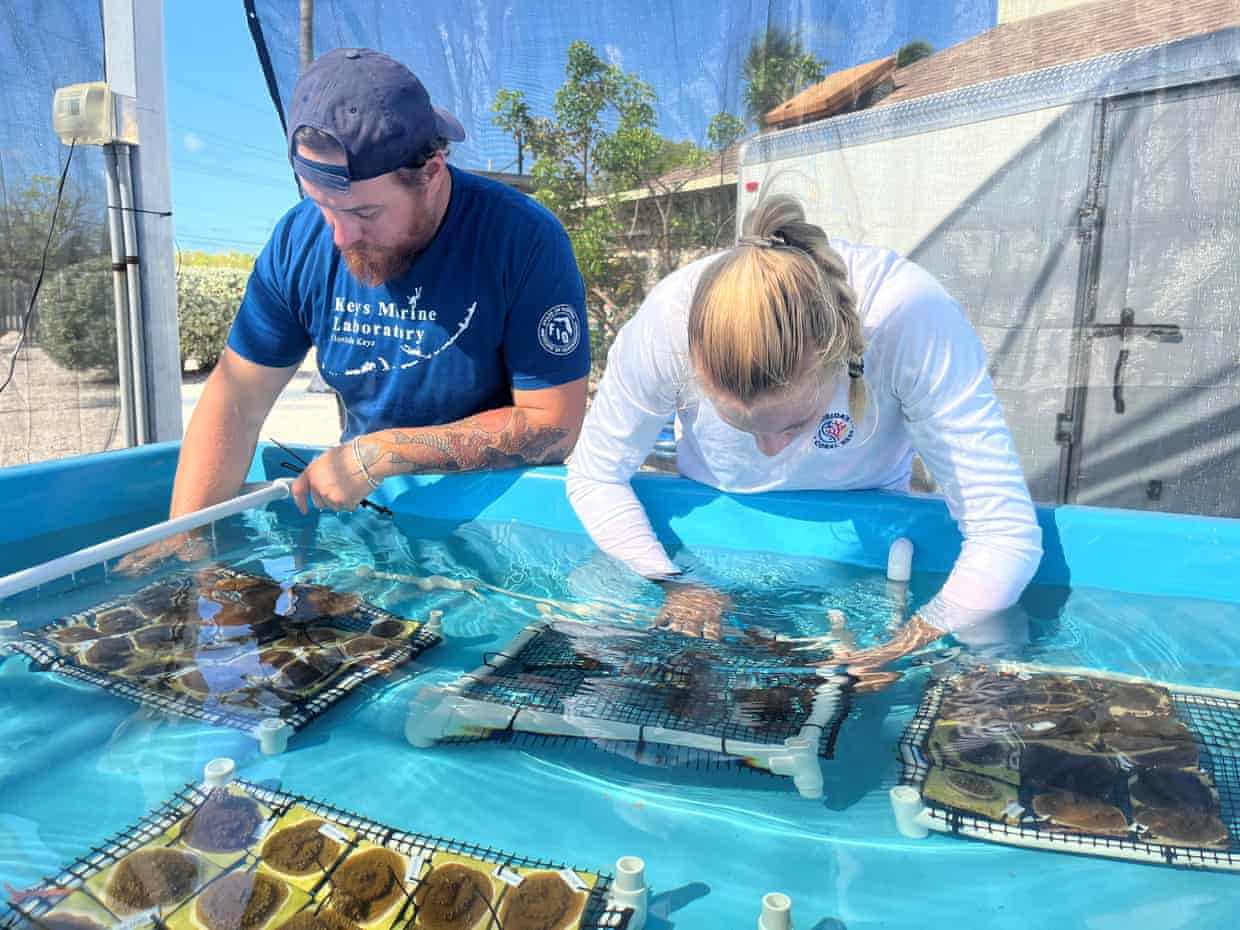
Photo: Keys Marine Lab. Experts inspect nursery-grown juveniles from the reef-building elkhorn coral species. They’re testing them to withstand warmer temperatures.
Scientists don’t give up, do they? They will surely have a harder time without federal grants, but I hope they will find ways to keep improving life on Planet Earth.
Take this effort to address the damage that global warming poses to coral. Richard Luscombe reports at the Guardian that a group pf experts are seeking “to save Florida’s dying reefs with hardy nursery-grown coral.”
“A taskforce of experts looking into the mass bleaching and decline of Florida’s delicate coral reefs is planting more than 1,000 nursery-grown juveniles from the reef-building elkhorn species in a new effort to reverse the tide of destruction.
“Marine biologists from the Keys Marine Laboratory of the University of South Florida (USF) partnered with scientists from Tampa’s Florida Aquarium to develop a large-scale restoration project involving elkhorn coral, which is critically endangered but also one of the fastest-growing and most resilient species.
“[In May], the USF facility in Long Key, halfway along the ecologically fragile Florida Keys island chain, took delivery of 1,050 young elkhorn corals spawned between 2022 and 2023 at the aquarium’s conservation and research center in Apollo Beach.
The corals are acclimatizing in temperature-regulated seawater beds in Long Key.
“They will be distributed to research partners including the Coral Restoration Foundation, the Mote Marine Laboratory, Reef Renewal USA, and Sustainable Oceans and Reefs for planting at seven designated offshore sites around the Keys during the next two months.
“Teams will monitor their progress over the following months and years. While project managers say not all will survive, they hope some of the juveniles will thrive and grow, and the knowledge gleaned will help better inform future recovery efforts.
“ ‘Maybe there will only be 100 out there a year from now, but even if it’s only one out of a hundred that survives that’s particularly tough, we can propagate that one,’ said Cindy Lewis, director of the Keys Marine Laboratory. …
“ ‘The coral juveniles we just transferred are made up of many new mother and father combinations that we hope will be more resilient to future stressors,’ Keri O’Neil, director of the [Florida Aquarium] coral conservation program, said.
” ‘Without human intervention, these parent corals would not be able to breed due to the extent of the loss. They’re a sign that, even during a crisis, we can make a difference. By working together we’re protecting a reef that’s essential to our environment, our economy and the thousands of species that call it home.’
“Lewis said the elkhorn project was a small component of a vast wider effort by numerous universities, environmental groups, and state and federal partners to try to restore as much lost coral as possible. …
“ ‘All these different organizations produced over 25,000 pieces of coral this winter to put out on the reef that are going to make a difference, along with our elkhorn.
“ ‘Even though it seems dismal and depressing, the ray of hope is that we can produce these corals, we can get these corals out there, and that everybody has banded together to work together. No one organization is going to do it all. We need everybody, and we need everybody’s ideas.’ “
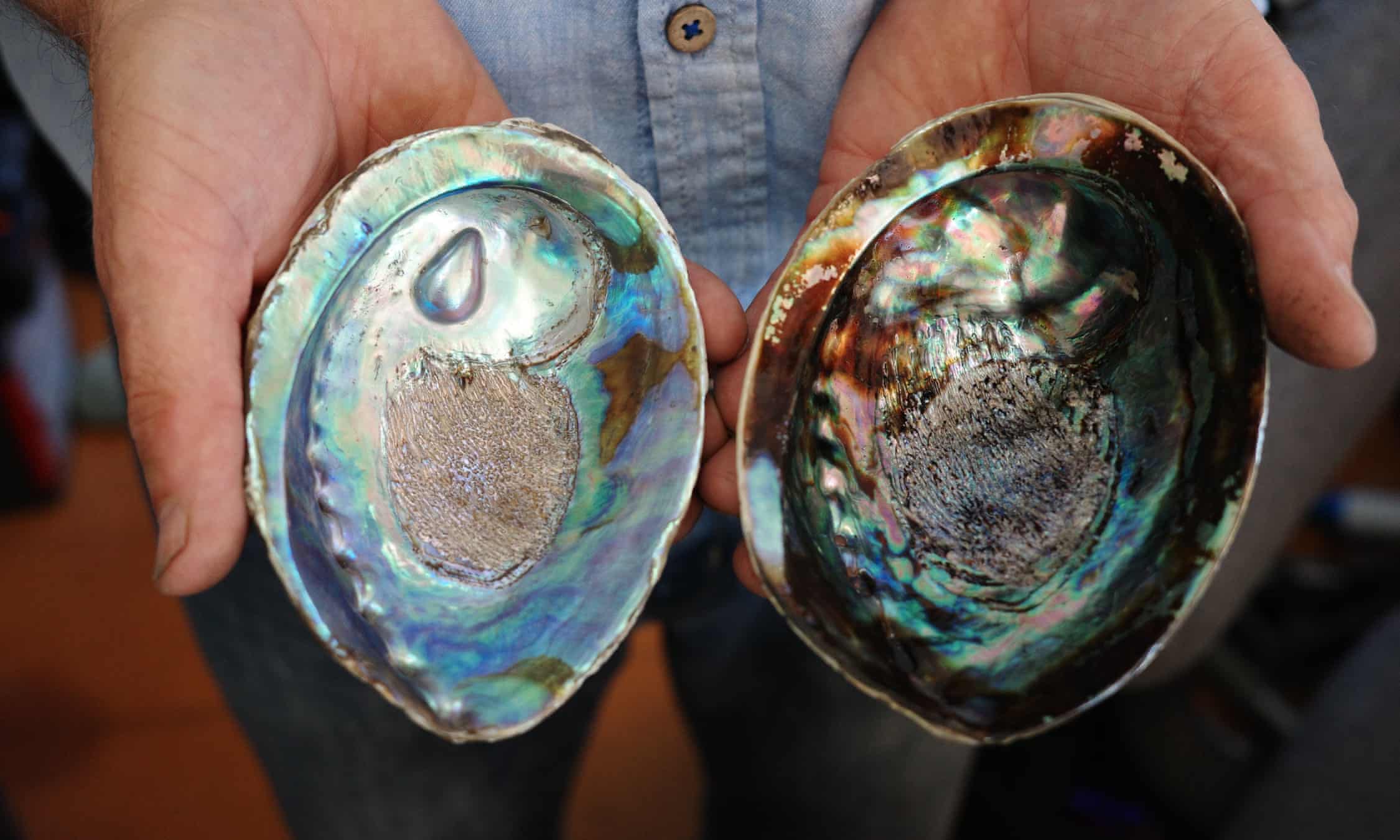
Photo: Shanti Mathias. A farmed pāua shell with a pearl inside (L) held next to a wild pāua shell in New Zealand.
During the pandemic lockdown, there didn’t seem to be much point in dressing up or wearing jewelry. I certainly got comfortable with being casual all the time, and even now I mostly wear jeans. Except for funerals.
But the other day, I noticed my grandmother’s pearl necklace in a box and felt a little sorry that I hardly ever wear jewelry (unless from Suzanne’s company). I always liked pearls.
In today’s story, we learn about unusual blue pearls and how the reality of global warming suggests we better enjoy them now, while abalone can still make them.
Shanti Mathias writes at the Guardian, “Roger Beattie was diving off the Chatham Islands, about 800km [~500 miles] east of New Zealand, when he saw his first pāua pearl. Beattie was familiar with pāua, the Māori word for abalone, and their iridescent shells of shimmering purples and greens. But the pearl that had formed inside was unlike anything he had ever seen, gleaming with layers of the pāua’s natural colors. …
“That was in the early 1990s, and Beattiesoon started experimenting ways of farming pāua, and creating pearls in the shell. A decade later, he began selling the so-called blue pearls commercially.
“Now a small industry exists in New Zealand cultivating the unique gems. They are rare, with only a handful of companies running farms, each producing only a few thousand pāua pearls each year. But the delicate operations are being made more complicated as changing conditions and warming seas alter the environments pāua need to survive.
“ ‘Warm waters cause physiological stress to the pāua,’ says Shawn Gerrity, an ecologist at the University of Canterbury who has studied the pāua.
“There are four species of pāua endemic to New Zealand. The blackfoot pāua is the biggest species, known for its vibrant shell and succulent flesh. All cultivated pāua pearls come from the blackfoot pāua. The pearls appear shades of blue, turquoise, purple and green.
“ ‘Only this abalone, in this water, produces such an unusual color of pearl,’ says Jacek Pawlowski, a jeweler in Akaroa, a seaside town southeast of Christchurch on New Zealand’s South Island. … ‘They have that rainbow, opal shine.’ …
“As juveniles, pāua are taken out of the water, where their flesh is pried up and a small implant placed under their shell for a pearl to form on. If their soft bodies are nicked, the pāua will bleed to death, so the process must be gentle. Only one in five pāua will create a jewelery-grade gem, Beattie says.
“Each mollusk needs to be fed vast quantities of kelp and live in water about 16 degrees for the three to four years it takes for a pearl to form. …
“But rising ocean temperatures pose a threat to their survival. … Marine heatwaves have dramatically increased in frequency around New Zealand, with a particularly severe event in 2017/18 causing thousands of sea creatures to die.
“Increased marine temperatures have caused mass die-offs of abalone species in other areas of the world, like California, where warming water has reduced abalone’s access to food and sped up the transmission of a withering disease. Beattie has had an algal bloom – which is more likely in warm water – kill a harvest of pāua by depriving them of oxygen.
“Gerrity has researched the recovery of pāua in Kaikōura, on the north-east coast of the South Island, where thousands of pāua died after the sea floor was lifted six metres [~20 feet] in a 2016 earthquake. Nine years later, with careful management, the population is healthy again. …
“Dr Norman Ragg, senior shellfish scientist at science organization Cawthron Institute, says pāua are a ‘really interesting quirk of nature’ that have remained unchanged for millennia. While New Zealand’s populations are still healthy, there is no room for complacency. … Ragg believes cultivating blue pearls could go some way to bolstering appreciation for pāua and securing its future in the face of climate change.”
More at the Guardian, here. With no paywall at the Guardian, donations are vital.
Photo: NOAA/AP file. A North Atlantic right whale swims in New England waters.
Can we save treasured wildlife if we try? I can’t help thinking that before we pushed dodos and passenger pigeons to extinction, humans were not as aware. Now that we understand the dangers of losing species, can we put in the extra effort to preserve them?
Some humans are all in on protecting one particular species — the North Atlantic right whale.
Nate Iglehart reports at the Christian Science Monitor, “By the time Herman Melville wrote Moby Dick in 1851, New England was already famous for its whaling industry – hunting the North Atlantic right whale to near extinction. …
“Today, the once-targeted whales are prized conservation targets as New England leads efforts to bring them back from the brink. An emerging linchpin to their survival is taking form in a small but mighty network of coastal signaling devices.
“North Atlantic right whales are one of the most endangered large whale species in the world, with only about 370 left. Although whaling was almost entirely banned worldwide in 1986, the whales’ numbers have not recovered. Eleven new right whales were born this year, far below the 50 per year needed to create a stable population. Some models predict their extinction by 2035. …
“Now, everyone from fishers and marine ecologists to maritime corporations and coastal residents [is] leaning into technology to help stem the decline. …
“Mariners already try to avoid whales to protect the animals and their ships. But they don’t always know when one is around. When a whale is spotted, the National Oceanic and Atmospheric Administration (NOAA) sets up a slow zone, in which mariners are asked to slow their speed to 10 knots (11.5 mph) or less to reduce the likelihood of hitting a whale and the risk of fatally injuring it. The zones are separate from seasonal management areas, which have mandatory speed rules.
“Boaters are mainly alerted through email and text updates, and an app called WhaleAlert, which acts as a database for whale sightings and slow zones, says Greg Reilly, the International Fund for Animal Welfare’s marine campaigner. However, both need an internet connection, which is not required for boaters and is often spotty at sea.
“That’s where Moses Calouro, CEO of Maritime Information Systems, comes in. Over the last two years, Mr. Calouro has partnered with businesses, nonprofits, and coastal towns to install devices called StationKeepers along the entire Atlantic coast. These small 20-pound boxes sit high on coastal buildings and lighthouses. Using an Automated Identification System (AIS), they transmit locations of whales and speed zones directly to the navigation screens of ships. …
“Mr. Calouro’s 2024 pilot program focused on the Stellwagen Bank National Marine Sanctuary, an underwater plateau and feeding ground for right whales off the coast of Cape Cod. Upon entering, over 85% of ships slowed down, with an additional 10% doing so after receiving an automatic message warning.
Pete DeCola, the sanctuary’s superintendent, says the StationKeepers, combined with other efforts already under way to protect right whales, have reduced the risk of ships encountering whales by over 80%. …
“In 2010, NOAA researchers at the sanctuary created a program with the Massachusetts Port Authority and the International Fund for Animal Welfare that grades boaters and companies on their compliance. Last year, 91% of the 104 companies … that passed through slowed their boats appropriately. …
“Vessels that didn’t slow down were mainly new to the area. … That lack of knowledge is another challenge Mr. Calouro’s system aims to address. Mariners are skilled at avoiding hazards; it’s what they do for a living, says Mr. Reilly. But ‘they have to know where the hazard is.’ …
“But perhaps the biggest threat to North Atlantic right whales is entanglements, often in fishing gear. Even if the whale survives the tangle, the damage and stress of thrashing in the lines hurt their ability to give birth, says Courtney Reich, coastal director of the Georgia Conservancy.
“Technological advancements can reduce the need for buoy lines. Mike Lane, a lobsterman based out of Cohasset, Massachusetts, has worked with the underwater technology company EdgeTech to create prototypes of ropeless fishing gear. Typically, rope connects traps with buoys at the surface. But with ropeless gear, the traps use pop-up buoys, lift bags, or buoyant spools that, when remotely triggered, inflate or detach and bring the trap to the surface for collection.
“The gear is not perfect, Mr. Lane says, but it allows lobster fishers to keep working during the months that fisheries close due to the whales’ migration paths. He says that extra work can help lobster fishers financially, and it helps to know their gear is not snagging whales.
“But this gear, compared with a buoy and rope, is costly and can stress the fishers’ thin profit margins. There’s also a learning curve. … One of the biggest issues, he says, is keeping track of the traps so they don’t interfere with other fishers. If you tried to plot hundreds of ropeless traps in the water, the mapping data would be too cluttered to use effectively. Losing the expensive gear would be devastating. …
” ‘I’m not a huge fan of it,’ he says. ‘It’s not the way I prefer it. … The [mapping] technology is there; someone’s just got to package it properly.’ “
More at the Monitor, here. No paywall, but supporting this great news source is reasonable.
Photo: John Okot. A volunteer for The Mango Project places mango slices in a solar dryer for preservation in Midigo, Uganda, where malnutrition is a serious issue.
One of my grandsons has had an interest in Uganda for several years — first, through learning about endangered mountain gorillas, then through helping support a start-up water business in the country. As a result, I pay extra attention to Ugandan news.
John Okot reports at the Christian Science Monitor about two brothers in Uganda who launched a mango initiative to help their neighbors.
“Francis Asiku’s plan to fight hunger in his village began, quite naturally, under a bountiful mango tree. It was 2011, and he had just landed his first nursing job at Midigo Health Centre IV in Yumbe district in northern Uganda. He was excited and joyful. But in his first month at work, Mr. Asiku was surprised to learn that what many infants and expectant mothers seeking care needed wasn’t necessarily medicine. It was nutritious food.
“He recalls one hot afternoon, in particular, when a young mother rushed into the health center with a 4-year-old child in her arms. Mr. Asiku hurried to help. He quickly diagnosed poor feeding as the root of the child’s problem. …
“He headed home on a dirt road in the inky-dark evening. When he spotted birds feasting on rotting mangoes along his path, a question struck him: Why were so many people in his community malnourished when it experienced two plentiful mango seasons a year?
“He raised the issue later that night with his younger brother, farmer Emmanuel Mao. Soon afterward, the brothers met with village elders under the huge mango tree where community meetings were held. That was the start of their nonprofit, The Mango Project, which distributes glass jars full of mangoes to schools, to health centers, and directly to hungry individuals.
“The toll of hunger in Uganda is staggering, according to the Global Hunger Index, a report published by several global nonprofits. Almost 37% of the population is undernourished, and about one-quarter of children have stunting, a condition that is associated with malnutrition.
“When Mr. Asiku and Mr. Mao met with the Midigo elders, [they said] the brothers needed to figure out a way to preserve Midigo’s abundant mangoes throughout dry periods, when they are scarce. …
“Mr. Asiku and Mr. Mao embarked on researching a simple way to preserve food. They began ‘jarrying’ – cutting fruit pulp into thin slices and putting them in a glass container of boiling-hot water and sugar. While canning is practiced throughout the world, many Midigo villagers can’t afford sugar, not to mention glass jars with secure lids. The relatively easy preservation method – and the brothers’ fundraising efforts to obtain the necessary supplies – delighted village elders. …
“The brothers initially collected mangoes that were scattered throughout the village, but have since expanded their initiative to preserve the fruit from their family’s ancestral land. The jarred fruit is safe to eat for up to a year.
“Mr. Asiku knows that the mangoes alone will not end malnutrition in the community, since humans need a balanced diet. But the initiative, he says, is a great start to breaking the hunger cycle in Midigo. …
“Irene Andruzu, who supervises one of the Midigo Health Centre’s facilities, says she receives at least 50 jars of mangoes monthly to help malnourished patients. During the pandemic alone, more than 12,000 jars of mangoes were distributed to health clinics and refugee settlements.
“Scovia Anderu, a social worker for Calvary Chapel Midigo, lauds The Mango Project for instructing villagers. She says that most villagers lack knowledge about nutrition and that there are few qualified personnel who can educate them on the subject at the grassroots.
“Zuberi Ojjo, the district health officer for Yumbe, [says] The Mango Project ‘reminds people of the importance of nutrition to our well-being.’ …
“One obstacle for The Mango Project is that charcoal, which is needed to heat the water used to sterilize jars, can be difficult to obtain. Since 2023, the government has banned commercial charcoal production in the northern region over concerns about the alarming depletion of trees there. Nevertheless, illegal, large-scale tree-cutting has disrupted weather patterns in the region, where communities rely mainly on agriculture amid erratic, unpredictable rainfall. …
“Mr. Asiku has found one alternate form of fuel. Over the years, he has been scrimping and saving, and last year he purchased a solar-powered dryer worth $600. Besides mangoes, he dries vegetables such as okra and eggplant to give to villagers.
“He hopes to distribute the food more widely as he acquires a license from the government to do so – and more dryers. He also has an orchard with 310 hybrid mango trees. This is meant to supplement the seasonal mangoes in case there is low supply because of damage caused by fruit flies.
“ ‘It’s fulfilling to see my people smiling at the end of the day,’ Mr. Asiku says.”
Photo: Sonja Dümpelmann, CC BY-SA. Window-box gardening has been a Philly tradition since the 1800s.
Although not a gardener myself, I love looking at other people’s gardens. Who doesn’t? It’s not surprising that landscaping plays a big role in quality of life, even in urban renewal.
That’s why Sonja Dümpelmann, Professor of Environmental Humanities, Ludwig Maximilian University of Munich, decided to research the role of Philadelphia’s flower boxes. She was interviewed at the Conversation.
“How did you become interested in window boxes? “When I first moved to Philadelphia from Cambridge, Massachusetts, in August 2019, I was immediately struck by the window boxes. The lushness and freshness of the plants in many of the boxes, and sometimes in sidewalk planters, made walking more pleasant and interesting. ….
“I noticed that there were three categories of window boxes. Many were visibly cared for, often freshly planted and decorated several times a year in accordance with the changing seasons. Some were derelict and had spontaneous growth of saplings and different grasses. And a third category were boxes outfitted with plastic plants, perhaps signaling absentee owners or landlords who seek to simulate care.
“What makes them landscape architecture? “Window boxes – especially the planted boxes, but also painted boxes that are empty – change outdoor space and building exteriors. They make them more colorful and interesting, and they break up plain vertical walls by protruding from the facade.
“You could say that the window boxes ‘greet’ passersby. They connect private indoor space with the public realm of the street. … ‘Gardens in a box,’ as they were also referred to by early promoters, can make homes and entire neighborhoods look and feel different. They forge distinct identities with their plant selection and the style and color of the boxes.
“Window gardening became a means of female social reform during the Progressive Era. During this period in the late 19th and early 20th centuries, when industries and cities were growing fast, women sought to improve education, public health and living conditions, especially for poor and immigrant communities. By offering plants, flowers and entire window boxes, the women supported homemakers of lesser means.
“However, these boxes were also a way to make sure that order in and outside of homes was maintained. Window gardens became cultural symbols of cleanliness and good housekeeping. …
“When did it become political? “In Philadelphia there were two big window-gardening movements. The first occurred in the late 19th and early 20th centuries, and I describe it as ‘window-box charity.’ The second, which I call ‘window-box activism,’ began in the 1950s.
“Window-box charity was carried out primarily by white philanthropists and social workers who would distribute plants and goods sent from outside the city to the urban poor and sick, especially immigrants and Black Americans. Sometimes the window boxes were ready to be installed outside the windows. Other times recipients built and planted boxes themselves.
“Several decades later, in the mid-20th-century, plants became a vehicle for white suburban garden club ladies and Black inner-city residents to counter urban decay resulting from racism and public disinvestment. On annual planting days, the garden club ladies brought plants into the city and joined residents in planting and installing window boxes to brighten up their neighborhood blocks.
“Plants were key in both window-box charity and window-box activism. People came together to care for plants, creating friendships among neighbors and ties between low-income and wealthy neighborhoods. The women used plants and window boxes to protect private space and increase the safety of public space. In the 1960s, the Philadelphia police reported less crime on streets with window boxes.
“Of course, window boxes and plants alone could not solve larger urban social problems such as poor housing conditions and racial discrimination. So while they could be catalysts of neighborhood change, they also helped to camouflage and quite literally naturalize larger social problems that required political responses.
“Like a smaller version of public parks, community gardens and street trees, window gardens can contribute to green gentrification. This occurs when the construction of parks or the planting of trees contributes to an increase in property values that leads to the displacement of long-term residents in low-income neighborhoods.
“Window gardening did help save some of Philly’s old row house neighborhoods from demolition during urban renewal beginning in the 1950s. However, quite a few of these neighborhoods – such as Washington Square West and Graduate Hospital – have since been gentrified. …
“The 20th century window-box activism drew the attention of sociologists and other national and international observers, especially because it brought white and Black residents together during the tensions of the Civil Rights Movement. It also raised public awareness about unequal access to urban green spaces. Yet despite the movement’s good intentions and positive effects, racial segregation remains a persistent problem in Philadelphia.”
Read more at the Conversation, here. No paywall. Lovely pictures. Tip of the Hat to radio show Living on Earth for the lead.
Photo: Wave Murano Glass. Roberto Beltrami, pictured, is one of the youngest Murano glass masters, founding his workshop when he was just 25 years old.
I had a memorable trip to Europe when I was 16, and one of the highlights was Venice and the glassmaking island of Murano. Have you been there?
Rebecca Cairns reports at CNN that the ancient craft of Murano glassmaking has benefited from new and younger talent.
“Born in the Italian town of Brescia, Roberto Beltrami grew up just a few hours’ drive from Venice and the island of Murano, world-famous for producing beautiful glassware. But it was nearly 4,000 miles away in Boston, Massachusetts, that he first came across the art of glassblowing. …
“It was 2011, and Beltrami, then a sophomore physics student at Boston University, was captivated by an exhibition of the work of American artist Dale Chihuly. Known for pushing the boundaries of contemporary glassblowing, Chihuly’s pursuit of his craft has taken him around the globe, including a stint in Murano in the 1960s.
“Beltrami visited the island on his summer break, taking up a class in glassblowing. That class turned into an apprenticeship, and the summer turned into a year. Beltrami quit university, trading lecture halls for roaring furnaces, sweating it out in centuries-old workshops, and studying under some of the world’s most renowned glassblowing masters.
“At one time, Murano was the global leader in glassmaking, renowned for unparalleled quality, style, and innovation, including the invention of ‘cristallo,‘ clear glass. …
“With a long legacy of closely guarding their trade secrets, workshops in Murano are reluctant to welcome newcomers, said Beltrami, 34. ‘Everybody was afraid you were going to steal their job, and nobody wanted to teach you anything.’ …
“Frustrated by the lack of opportunities, Beltrami decided to strike out on his own. In 2017, the then-25-year-old started his own workshop, Wave Murano Glass.
“Now with a team of 20, many of them in their twenties and thirties, Beltrami — believed to be the youngest glassmaster in Murano — is ushering in a new generation of artisans. …
“In Venice, glass has been manufactured for over 1,000 years. To prevent fires from the hot furnaces and keep trade secrets from escaping the city, all the glass factories were moved to Murano in 1291, where they’veremained since.
“In addition to the invention of cristallo, Murano became well-known for its ability to add vibrant color to clear glass.
“ ‘It’s not so easy to have different colors of glass together and have them match chemically,’ said Beltrami, explaining that each shade uses a unique element — such as cobalt for purple-blue, lead for pale yellow, or tellurium for a pink tint — which expand and contract at different rates when they heat and cool. …
“The size and weight of many of the glass objects require at least one person to hold the pipe and turn the molten glass, while another shapes it, and another person may be required to torch the glass to keep it pliable, or add embellishments. ‘It’s like a choreography,’ Beltrami added. …
“The small factories struggle to compete on large-scale industrial orders, said Beltrami. Murano instead focuses on luxury and artistic glassware, although that too has been threatened by an influx of counterfeit goods. … The industry has been further impacted by a series of crises, including the financial crash of 2008, the Covid-19 pandemic, and rising gas prices. But despite the challenges, Beltrami is optimistic about the future of the craft.
“A major problem he saw across the factories he worked in previously was antiquated equipment and inefficient processes. So, at Wave Murano Glass, he introduced a variety of modern technologies, including streamlining administrative workflows with AI-enabled software and introducingmore energy-efficient furnaces.
“Designed in the US, these furnaces capture heat that is typically lost via exhaust fumes and reuse it to preheat the air going into the burner, reducing gas usage by 80% compared to furnaces of a similar size, said Beltrami.
“According to Beltrami, Murano’s factories have historically worked on small-scale industrial orders, with many rejecting commissions of less than a few hundred but unable to cater for those of a few thousand. Seeing a missed opportunity, he set up his furnaces to be flexible, allowing Wave to cover anything from one-off pieces, to a few dozen, up to 1,200 pieces.
“While the bulk of Wave’s output iswhite label products for brands, designers, and artists, up to 10% of the company’s turnover comes from classes and tours, which Beltrami hopes can share the art of glass blowing with awider audience.
“His efforts have already paid off. Beltrami has made a point of offering internships to young, enthusiastic talent from around the globe, many of whom are now employed at Wave, including several women, who are underrepresented in the industry.
“For Beltrami, finding new talent is an essential step in preserving the craft he’s come to love — and continuing its legacy of artistry and innovation.”
More at CNN, here. No paywall. Great videos of glassmaking.
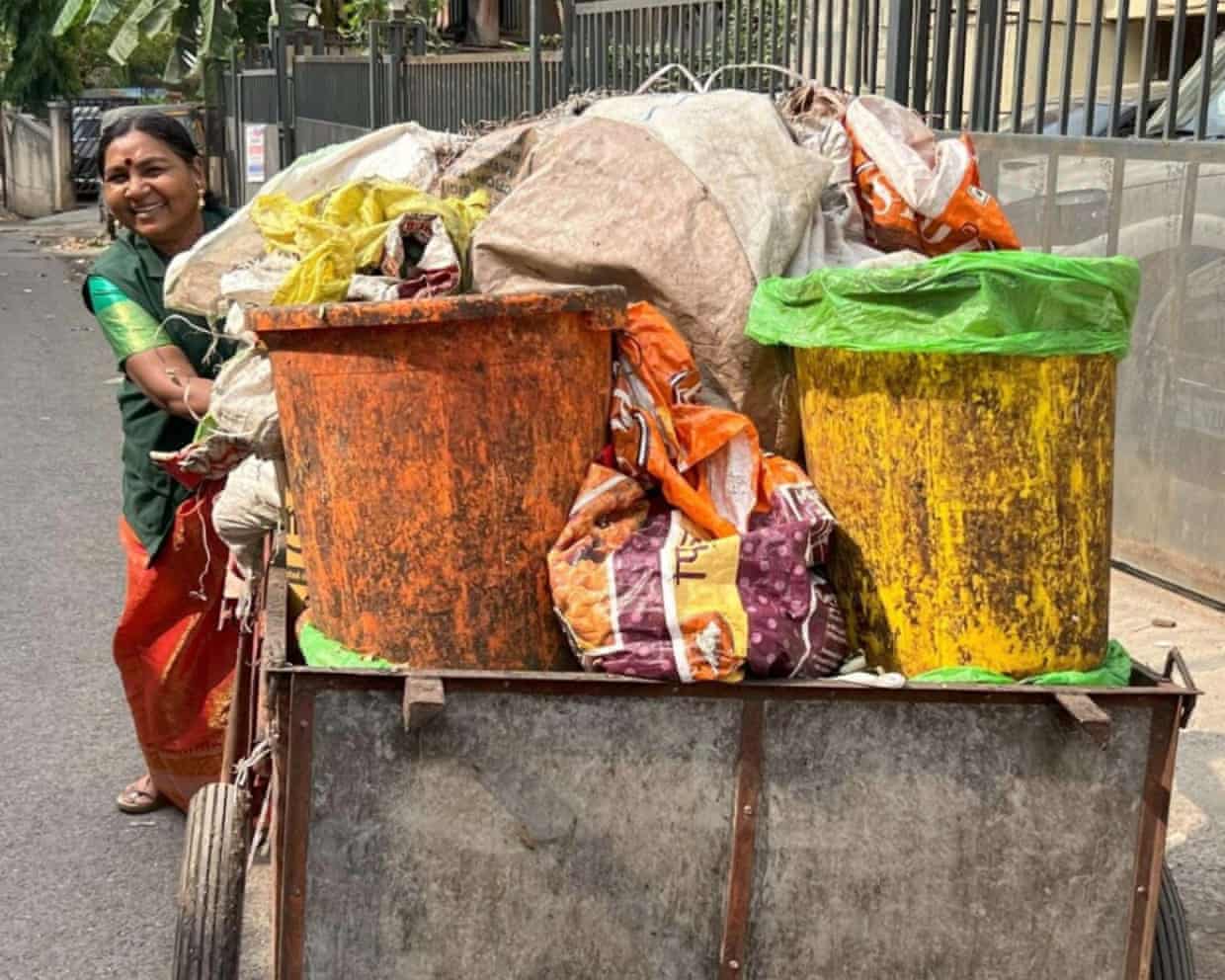
Photo: Swach Cooperative, Pune. More than 70% of Swach waste collectors in Pune, India, are women.
I like stories about win-win-wins. Today Shatakshi Gawade writes at the Guardian about a cooperative in Pune, India, that is diverting waste from the landfill and cleaning a city while also alleviating poverty. Trash collection is a job the mostly female workforce fought hard to retain when the city failed to renew the contract.
“Three decades ago, Rajabai Sawant used to pick and sort waste on the streets of Pune with a sack on her back. The plastic she collected from a public waste site would be sold for some money that saved her children from begging.
“Today, dressed in a dark green jacket monogrammed with the acronym Swach (solid waste collection and handling) over a colourful sari, the 53-year-old is one among an organized group of waste collectors and climate educators who teach residents in urban Pune how to segregate and manage waste, based on a PPPP – a pro-poor private public partnership.
“ ‘Even though we were earning money and running our homes by collecting and selling recyclable waste in the past, our job was not valued and we were not respected for the work we did,’ Sawant says as she pushes a loaded four-wheeled metal cart up a gentle slope. …
“Swach was set up in 2005 by a trade union of waste pickers, Kagad Kach Patra Kashtakari Panchayat (KKPKP), which was not in favor of contractor-run private models and envisioned a scheme that enhanced waste collectors’ work instead of displacing them.
“Lakshmi Narayan, one of the co-founders of Swach and KKPKP, says: ‘Contractor models typically end up hiring males and displacing the people who traditionally did the work. We strongly felt that a person who has been doing the work for so long brings in the knowledge, experience and intelligence to handle the material in a particular way, and should be the first claimant of that work.’ …
“Rehabilitating the waste workers by teaching them a new skill such as embroidery, and taking them away from their work of waste collection, segregation and sale was not the long-term solution, Narayan says. ‘The waste sector generates a large number of jobs not just in Pune but across the world.’ …
“Through detailed discussions with waste pickers, KKPKP realized that they were diverting a significant amount of waste from the landfill. Segregation at source, plus recycling material recovered from the waste, was contributing to climate change mitigation by minimizing landfill waste, reducing greenhouse gas (particularly methane) emissions, lowering the demand for scarce raw materials and saving taxpayers money by reducing solid waste management costs. …
“The waste sector is the third-largest source of anthropogenic methane emissions, one of the most potent of greenhouse gases, and Swach calculates that its work saves 100,000 tons of CO2 every year.
“In negotiations over a global plastics treaty in Busan, South Korea, last year, the chair’s text highlighted that countries should take measures to ‘promote a just transition for plastic waste management workers, especially waste pickers and other informal workers.’
“Narayan says: ‘We have argued that waste collection itself is green work but it’s not necessarily decent work. And there has to be a way to make it decent.’ Narayan says the Swach model helped transition the work of waste collectors from the informal sector, in which they spent their whole day at public bins and roadsides in tattered clothes, to a more formalized setup, where they began wearing a uniform and started speaking directly to residents.
“Rani Shivsharan, a waste picker and board member of Swach, says: ‘We did not know how to talk to people, since we had never been included in society. We wouldn’t have dared to talk in front of even two people, but now we can fearlessly articulate our demands and thoughts with conviction in front of an audience of 500.’ “
Read at the Guardian, here, about current threats to employment of the traditional waste picker. This story is an abridged version of a piece originally published by Mongabay.
Photo: Zakir Hossain Chowdhury/Anadolu Agency/Getty Images/Anadolu. In Bangladesh, there’s hope that stacking bricks in a new way in kilns — in a zig-zag pattern that increases airflow — will ensure that coal-fired kilns operate more efficiently and with less pollution.
Too often I think in black and white terms, right and wrong, good and bad. There are plenty of times times when things are that clear, but not always. Life is complicated.
Take the issue of burning coal in a poor country. At this point in its history, Bangladesh, for example, doesn’t have many choices. Bricks house the population, and coal-fired kilns are what’s available. So although coal is bad, just reducing some of the pollution will have to be good enough for now.
Jonathan Lambert reports at National Public Radio, NPR, “During the dry winter months in Bangladesh, thousands of workers shovel millions of tons of coal into kilns across the country. As columns of hand-packed bricks bake and harden, dark plumes of smoke pour out of more than 8,000 smokestacks that mark the skyline of both rural and urban areas.
” ‘It’s a lot of black smoke, impacting the workers and nearby villagers, but also the overall air quality of the region,’ said Sameer Maithel, an engineer with Greentech Knowledge Solutions, a consulting firm in Delhi, India.
“Bangladesh’s air consistently ranks among the most polluted on Earth. Brick kilns contribute anywhere from 10 to 40% of the tiny particles that make up that pollution. Those particles can enter our lungs and even our bloodstream, causing health problems, including respiratory diseases, stroke and even cognitive problems.
“But something as simple as stacking the bricks a different way could put a significant dent in that pollution, according to a new study of over 275 kilns published in Science by Maithel and his colleagues.
” ‘This is wonderful evidence of how simple low cost interventions can have a big impact on energy use,’ said William Checkley, an epidemiologist at Johns Hopkins University who wasn’t involved in the study. ‘If we can implement these, we could have a significant impact in energy use and emissions, improving air quality throughout southeast Asia.’
“Bricks are the main building block for Bangladesh. The densely populated and rapidly urbanizing country produces nearly 30 million bricks a year – more than 90% from loosely regulated, coal-burning kilns.
” ‘It’s quite simple and inexpensive to set up traditional-style brick kilns, so they’ve just proliferated,’ said Nina Brooks, a global health researcher at Boston University.
“The process goes something like this: First, dun-colored clay bricks are molded with a wooden box and stacked in the sun to dry. Next, hundreds of thousands of bricks are stacked in the firing chamber and covered with ash. Then, workers shovel lots and lots of coal as the bricks fire, firming them up.
” ‘The combustion efficiency of these brick kilns is really low,’ said Brooks, meaning they end up burning a lot more coal than they need to, ‘Which is why they’re so heavily polluting here.’
“Each kiln can employ up to 200 workers. They’re the most directly impacted by the smoke, with one study finding nearly 80% report some kind of respiratory problems. But they’re not the only ones. Kilns are often close to densely populated areas, adding to the smog that comes from city life.
“While there are regulations on where kilns can and can’t operate, they’re not always followed, said Brooks. ‘We found that 77% of brick kilns are illegally located too close to a school.’
“Modern, high-tech kilns produce substantially less pollution, but they’re up to 25 times more expensive to build and operate. ‘They’ve not really taken off,’ said Brooks.
“Instead, the team looked for solutions that would be easier and cheaper for the average brick producer to adopt.
“In his decades of working with brick kiln owners in India as a consulting engineer, Maithel has noticed questionable practices.
“Many kiln operators pack too many bricks in the kiln too tightly, he said. That tight spacing chokes out oxygen flow, which is needed for efficient burning. It also means hot coals get stuck at the top of the stack instead of falling to the bottom, leading some bricks to be overbaked and others not fired enough. …
“As an energy systems engineer, Maithel knew that a few simple changes could really help. Simply stacking the bricks in a zig-zag pattern that increases airflow and ensuring coal gets delivered more consistently should help the kilns operate more efficiently, he said. ‘The better you are able to provide fuel and air mixing, the probability of black smoke will be less.’
“To see if such simple interventions could help reduce air pollution and boost profits, the team planned a massive experiment across 276 kilns. One group of kiln owners and workers were taught how to implement these interventions. Another group got the same training plus info on how the changes would save money. The control group got no training.”
Read about results that benefited both the air and the kiln operators at NPR, here.
Learn how to protect NPR and other public media here.
A classroom in the village of Wahat al-Salam/Neve Shalom, an Israeli village where Jews and Palestinians live together to promote peace.
Here’s an impossibly hopeful story that is in danger because its approach to peace is not the same as the government’s.
Chris Osuh reported at the Guardian in May, “An Israeli village where Jews and Palestinians live together to promote peace is in danger of losing vital overseas funding following Israeli government proposals to impose an 80% tax on foreign donations, residents have warned.
“Leading figures from the unique community – Wahat Salam/Neve Shalom, which translates as ‘Oasis of Peace’ – flew to the UK [in May] in a visit hosted by the Co-operative Group, which is calling for the UK government to support peace-building cooperatives worldwide with foreign and development policy.
“Samah Salaime, an Israeli Palestinian, and Nir Sharon, an Israeli Jew, co-direct the village’s educational institutions, which include the School for Peace for activists and a primary school where 250 Jewish and Palestinian children learn each other’s histories, in Arabic and Hebrew.
“The co-directors addressed a parliamentary round table, attended by Labour and Co-operative MPs and non-governmental organizations (NGOs) … in a visit coinciding with the 77th anniversary of the Nakba, when more than 700,000 Palestinians were dispossessed. On Saturday, the pair addressed the Co-operative Group’s annual general meeting in Manchester.
“Before the meeting, Salaime told the Guardian of the threat posed by a bill being debated in Israel’s Knesset. If it became law, it would decimate the finances of NGOs in Israel that receive funding from foreign states. …
“ ‘The biggest supporters for Wahat Salam come from the UK, from the Co-op, our friends in Switzerland, in Sweden, in the US. We don’t have any local Israeli support for our project … financially and ideologically, they are against us.’ …
“Conceived by Bruno Hussar, a Jewish Catholic priest, the village started with a handful of residents in 1978, in ‘no man’s land’ between Jerusalem and Tel Aviv.
“It now has 300 residents, half Israeli Palestinians and half Israeli Jews, including academics and tech professionals, with a waiting list of about 200 families.
There is no synagogue or mosque: instead, residents pray or meditate in a dome called the Court of Silence.
“Surrounded by olive trees, communal life in the village revolves around committee meetings where the co-operative’s decisions are voted on, shared meals, the swimming pool and the Garden of Rescuers, which commemorates heroes of global catastrophes. There is a guesthouse in the village, and children from surrounding areas are bussed in to attend the school.
“Salaime said: ‘We were attacked by settlers three times. … We have all kinds of unfortunate incidents, and we survive. … We break the rules, we break the stereotype, the brainwashing of the Israeli mainstream that peace isn’t possible,’ Salaime said. ‘We have to win this and offer a different agenda.’ “
More at the Guardian, here. France’s Le Monde has more here.
Photo: Marina Totino. A miniature vintage kitchen created by artist Marina Totino.
As the tsunami of Covid anxiety recedes back into the ocean, many of us are finding interesting flotsam and jetsam scattered around the beach. It is not only Zoom calls and working at home that remain. It’s increased engagement with Nature. It’s art suited to confined spaces (remember Shelter in Place Gallery back in 2020?).
The art of miniature making flourished when we were stuck at home and is still going strong. Alina Hartounian has a story about that at National Public Radio (NPR).
“Miniatures are huge right now,” she writes. “Social media feeds are chock-full of people painstakingly re-creating tiny kitchens where they may cook button-size eggs over the heat of a tealight. Creators give tours of carefully crafted homes decorated with handsewn, postage-stamp-sized pillows. …
“The pandemic is largely responsible for this talent boom, according to the miniaturists themselves. Artists on lockdown began showing off their to-scale creations and sharing their techniques. The resulting talent feedback loop has led to miniatures that are more detailed and thoughtful than ever.
“Kelly’s work incorporates the tiniest details, like minuscule coffee rings, balled-up tissues the size of pinheads and teeny banana peels. …
“Why is social media so smitten by a working scaled-down sink, or books with printed words too small to read with the naked eye?
“The answer is as complex as some of the miniature-scapes themselves, according to experts and miniaturists.
” ‘It’s definitely about control,’ said Kelly. ‘It’s like when you play The Sims or some sort of simulation game where you have control of everything that happens in this little space, in this in this little world that you’re creating.’
“Susana Martinez-Conde, a neuroscientist at the State University of New York Downstate, agrees. … In our distraction-filled world, she said that getting to watch someone painstakingly craft the scenes is mesmerizing: ‘We’re almost craving deep attention, especially now that we’re pulled in so many different directions.’ …
“Most of the time, there are no humans in the art, just the relatively giant hands of the creator. And there’s almost always a backstory.
” ‘You can slow down and think about the little stories and you can get lost in creating what world you want,’ [Ashley Voortman, miniature artist and author of Creepy Crafts:60 Macabre Projects for Peculiar Adults] said. Her stories are usually of the macabre variety, like an elaborate scene she made about an ‘unethical’ mental health facility, because, according to her, ‘an ethical one wouldn’t be very scary.’
“Montreal-based artist Marina Totino‘s tiny scenes tap into her love of nostalgia, particularly from the ’80s and ’90s, and transporting the viewer back to childhood. ‘I fell in love with just creating spaces that once existed that will never exist again,’ said Totino.
“Her work includes a shoebox-size video store with hundreds of DVDs. Its brick walls are tagged with graffiti, and a busted-up ‘Sorry we’re closed’ sign lies at the bottom of the front door. Mirror effects make its shelves of videos seem infinite. …
“The scale of these projects — usually at a ratio of 1:12 — makes them a special kind of challenge to construct. ‘It takes so long to build miniatures.’ said Totino. ‘It’s such a time-consuming medium, and I superglue my fingers together all the time. I drop things on the floor, I lose things because they’re so tiny and then I have to restart.’
Totino analyzes the shapes of objects to try to re-create them, like the curves on a corded phone that she carved from wood.
“Voortman starts her projects with a vague idea of what she wants to create. ‘I make miniatures out of a lot of used stuff, so I just would pile all my trash in front of me and then just start putting stuff together,’ she said.
“Using craft supplies and the junk she collects — like old soy sauce bottles, trinkets and lids. — Voortman has made a tiny haunted house out of a matchbox and an abandoned city on a teapot. …
“The miniatures community is a welcoming one, according to creators. There are a host of them who encourage one another online and meet up at miniature shows, conventions and sales, which are held across the U.S. For those who want to get in on the trend, Totino said there is no wrong approach.
” ‘It doesn’t matter how perfect your miniature world is. It could be made out of paper or cardboard and it’s still a way to be creative and make art and live in a space that is only yours that no one else can go to,’ said Totino.”
More at NPR, here. Please add more things that Covid-enforced contemplation gave the world.
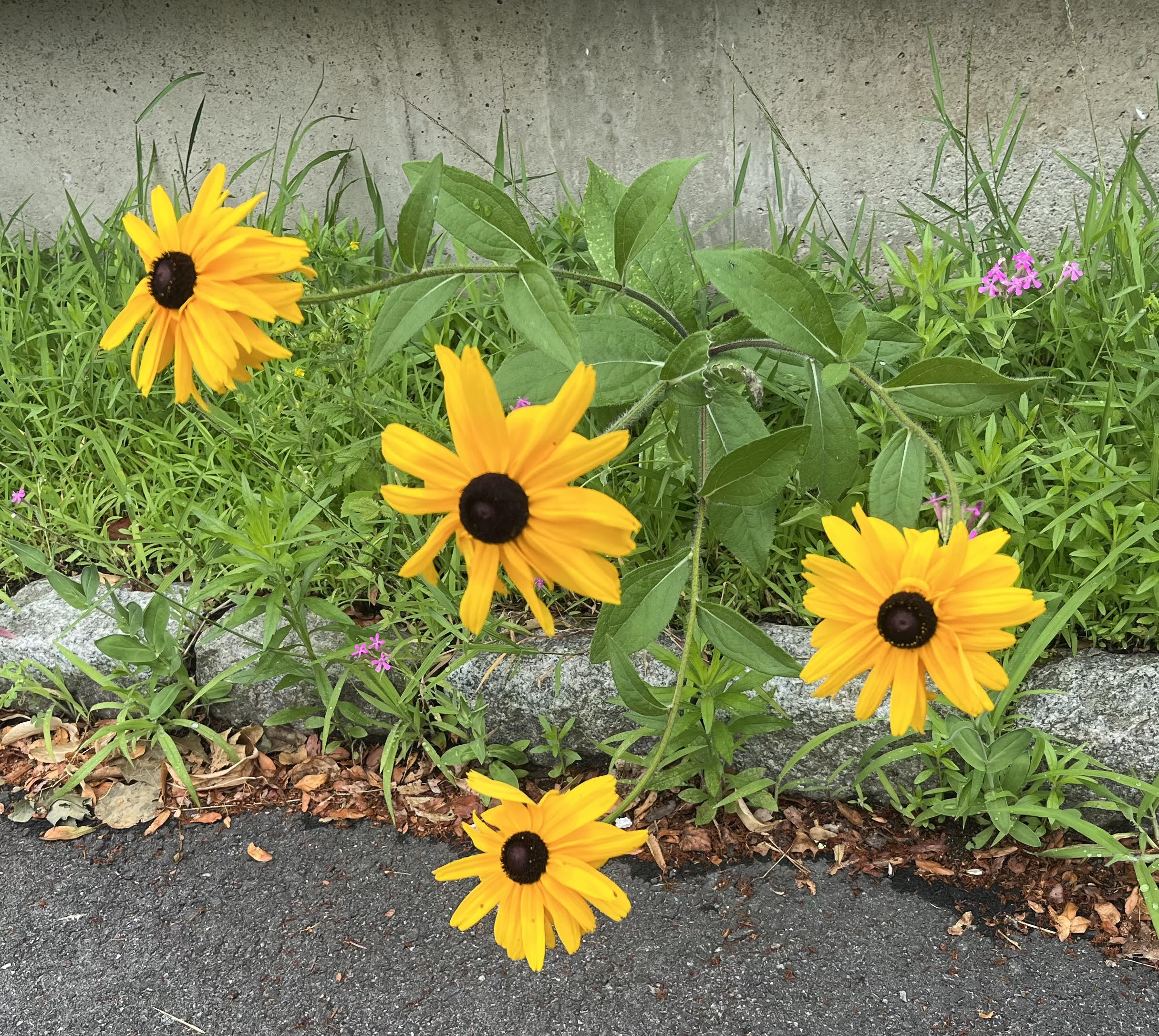
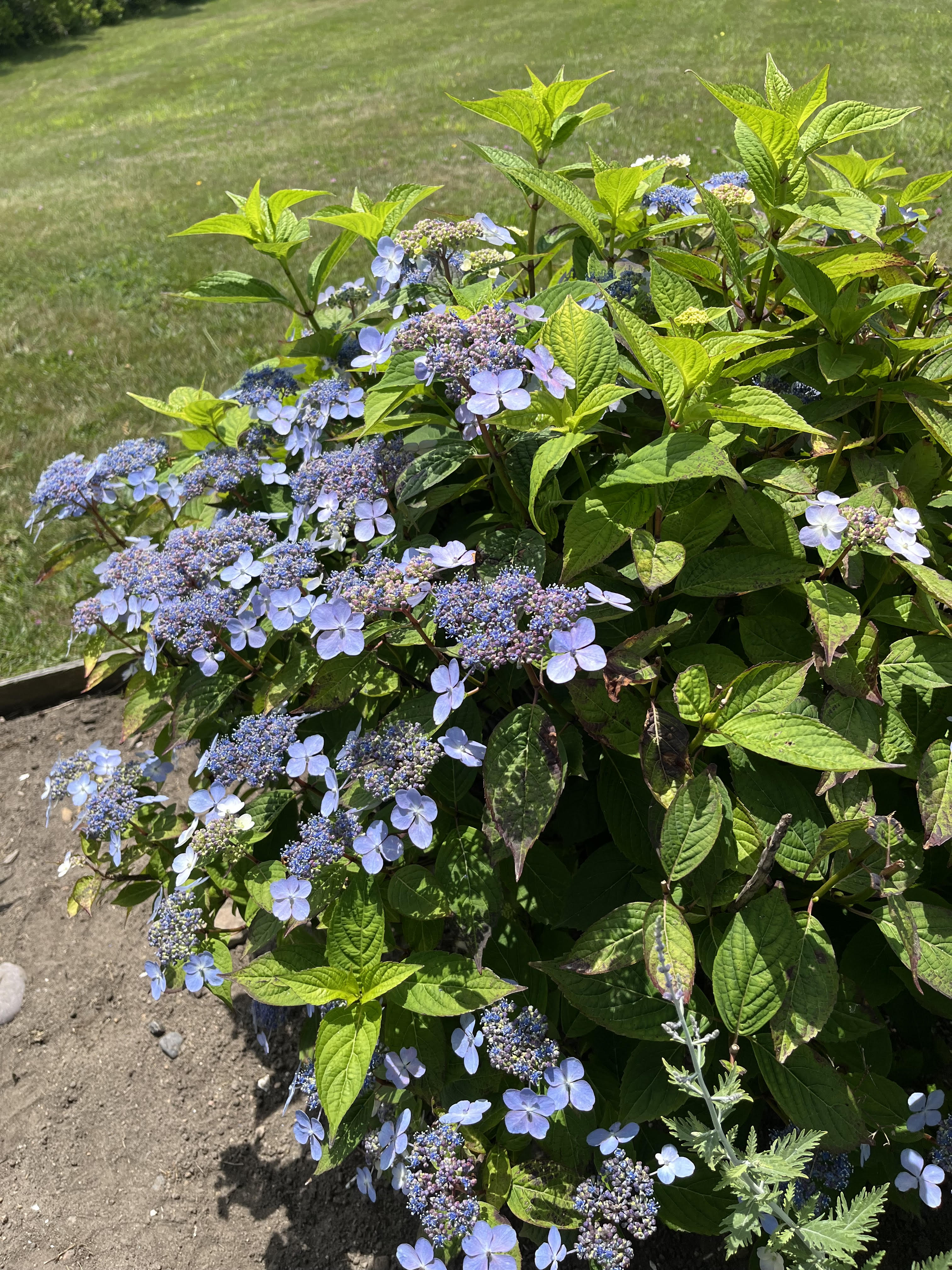
Photos: Suzanne and John’s Mom. Blue lacecap hydrangea on a sunny day.
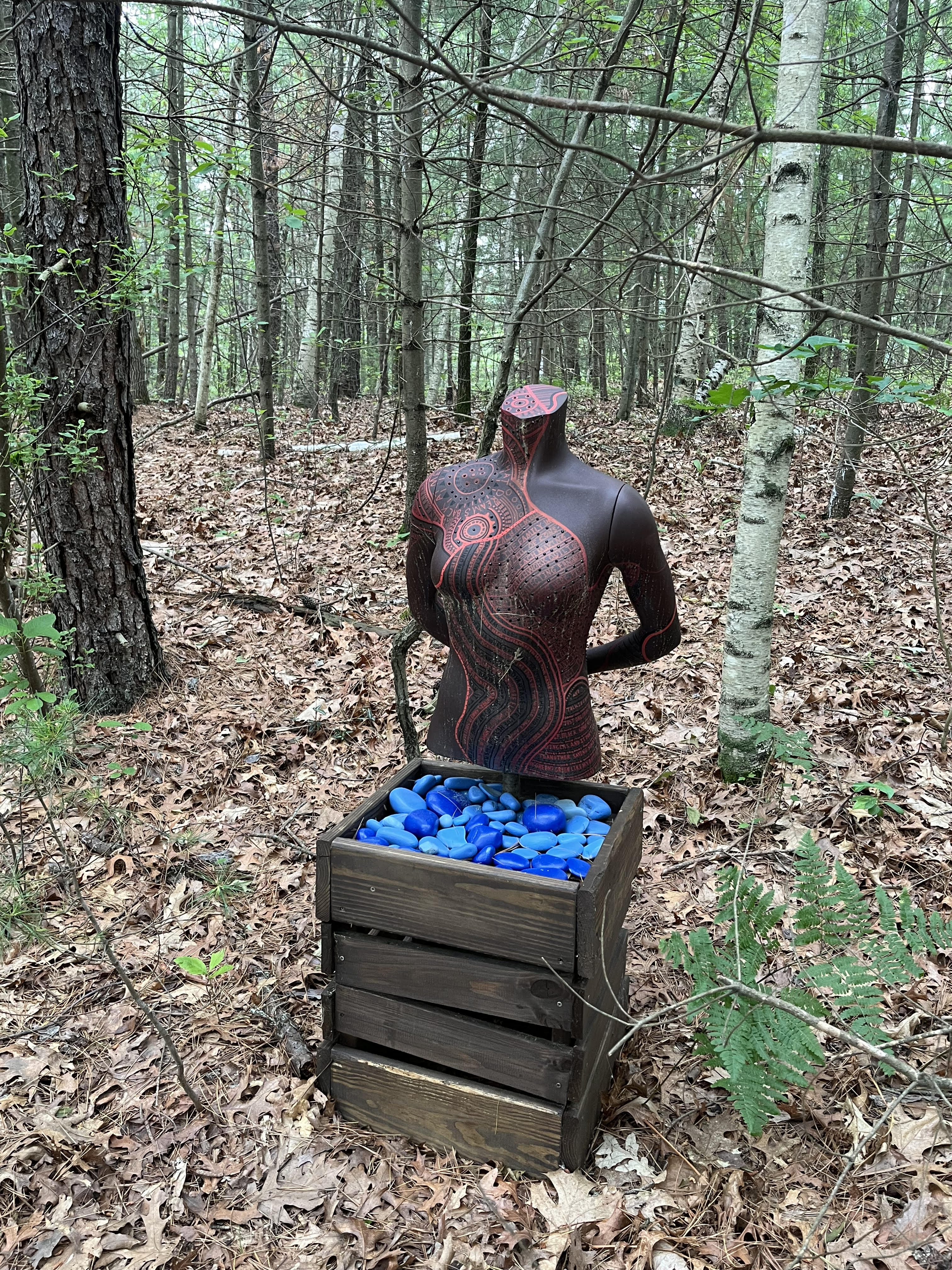
The photo collection below starts with my visit to the annual Umbrella Art show in the woods, which this year was located on Brister’s Hill for the town’s 250th Anniversary.
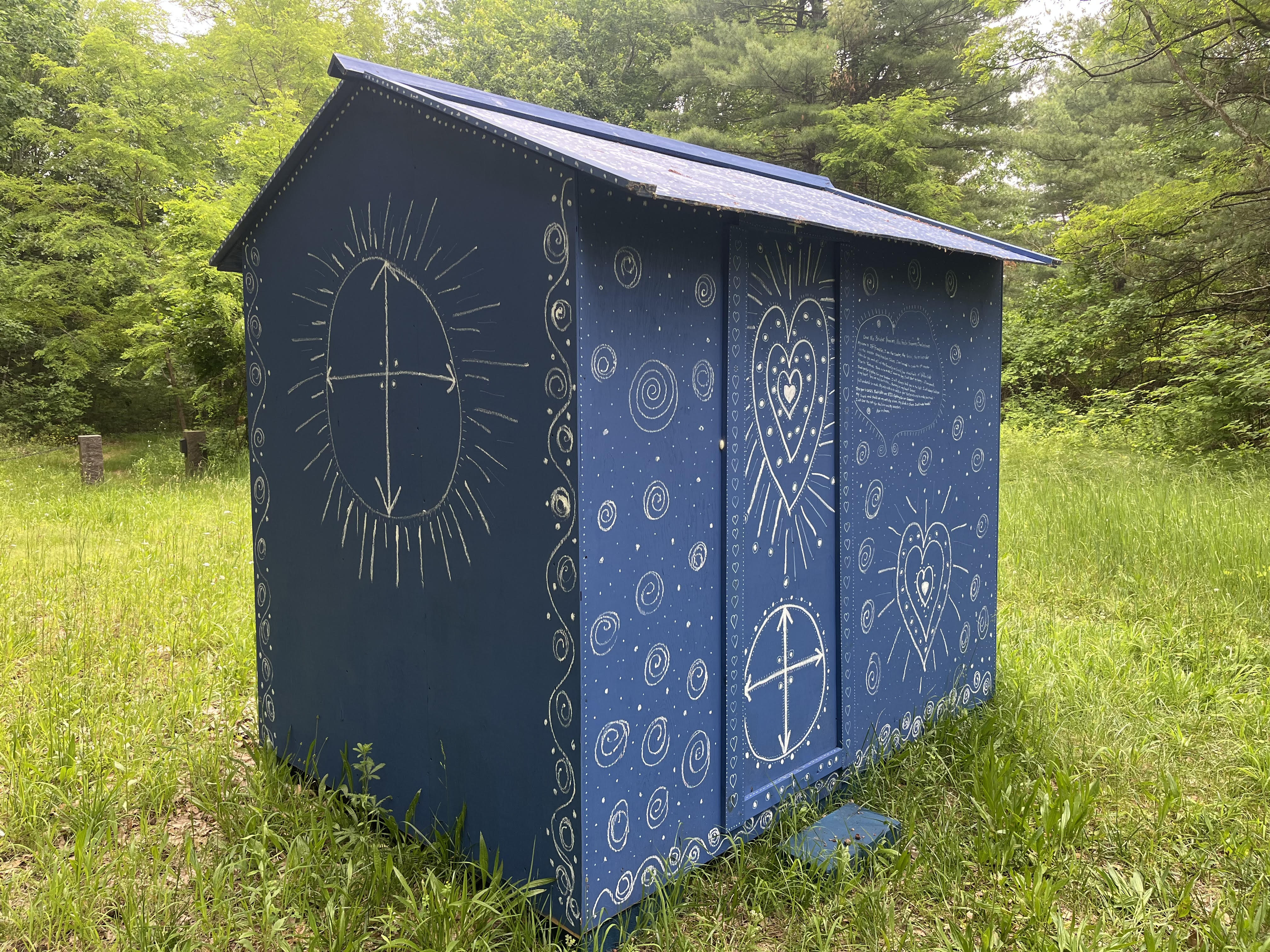
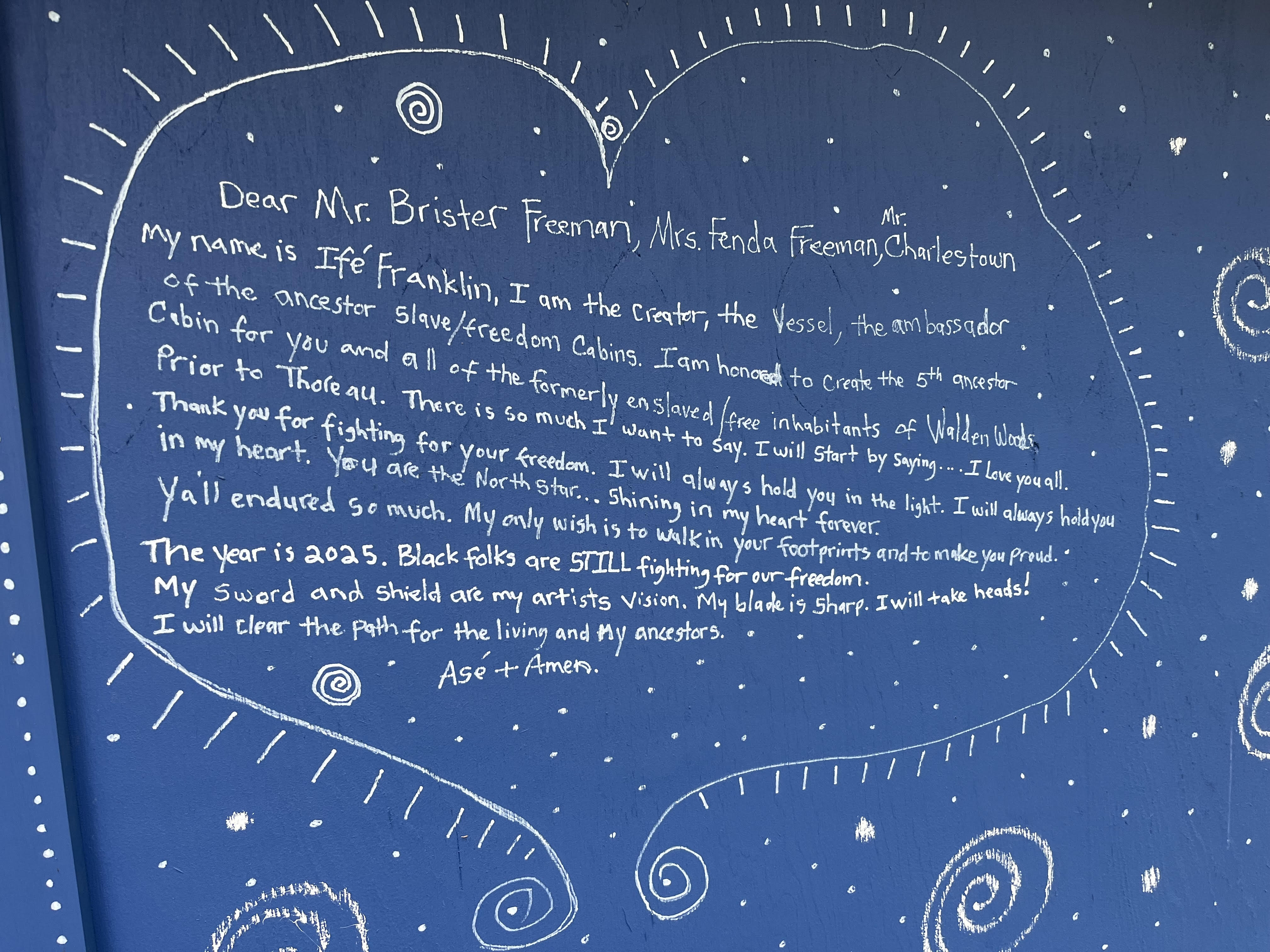
Brister Freeman was a man who started life in slavery. Thoreau spoke of him. The art show honors the travails and aspirations of enslaved Americans in New England, which was not an exception to slavery. You can read about the show, “Weaving an Address,” here.
The artist of the indigo slave cabin, Ifé Franklin, wrote a personal message to Brister Freeman and his wife on one wall. The color indigo references slavery’s “other cash crop.” Click here for info on that.
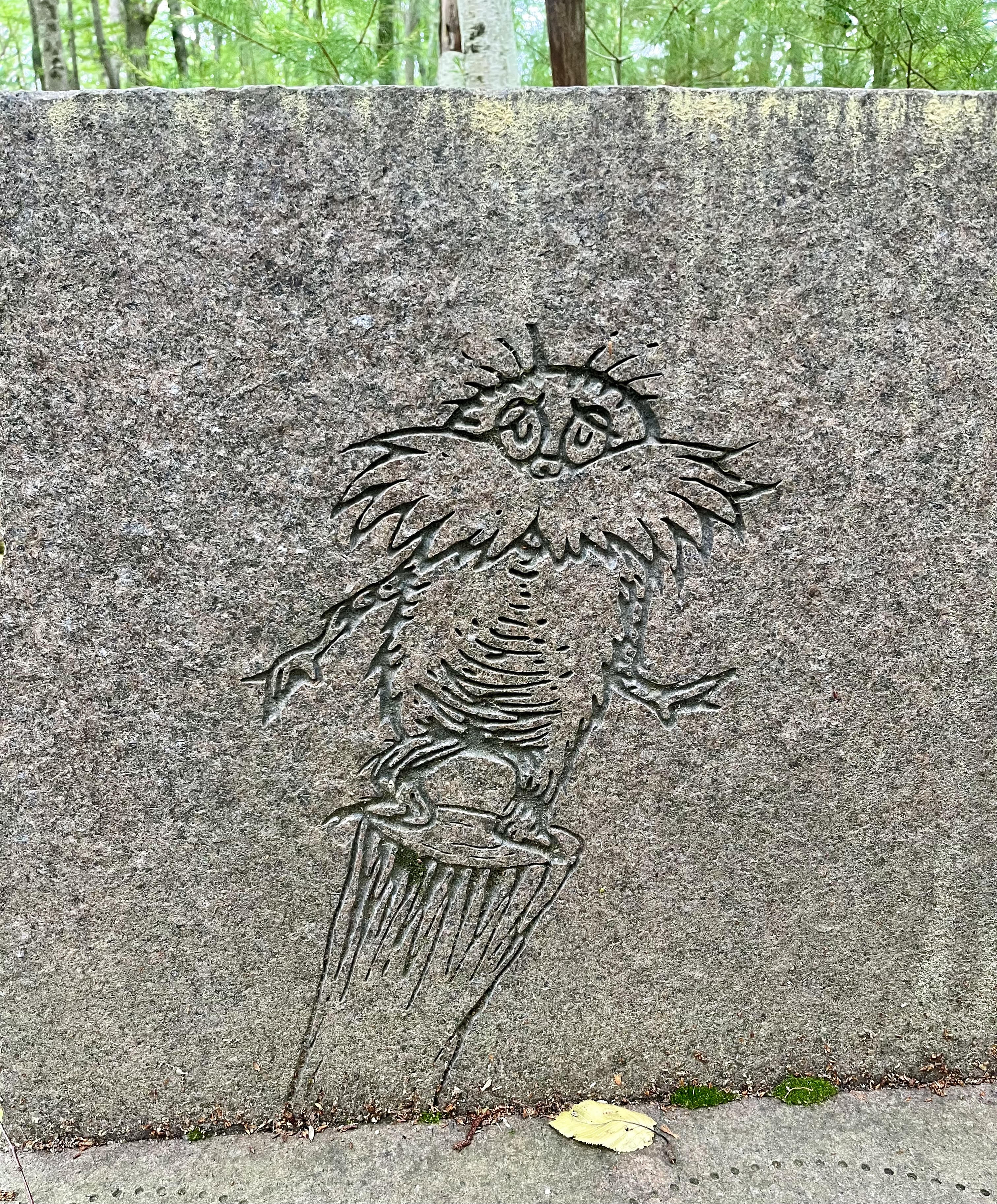
Incongruously, a Lorax hangs out in nearby Walden Woods. I had to take a picture of him as he represents what Dr. Seuss had to say about protecting nature.
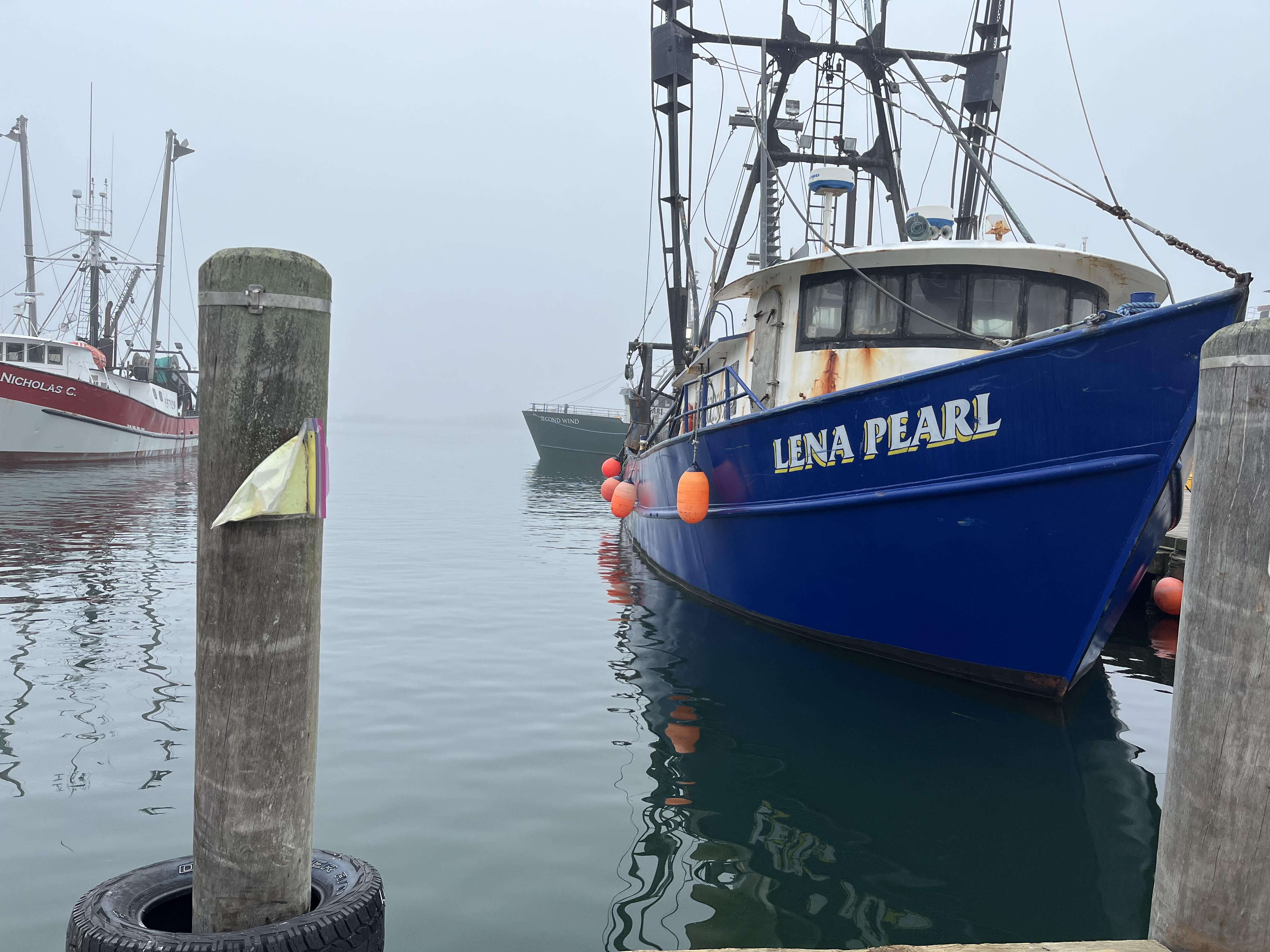
Transitioning from Massachusetts to vacation in Rhode Island, I include a fishing boat seen in Point Judith on a foggy day. Point Judith is where I catch the boat to New Shoreham, but it’s also a working port.
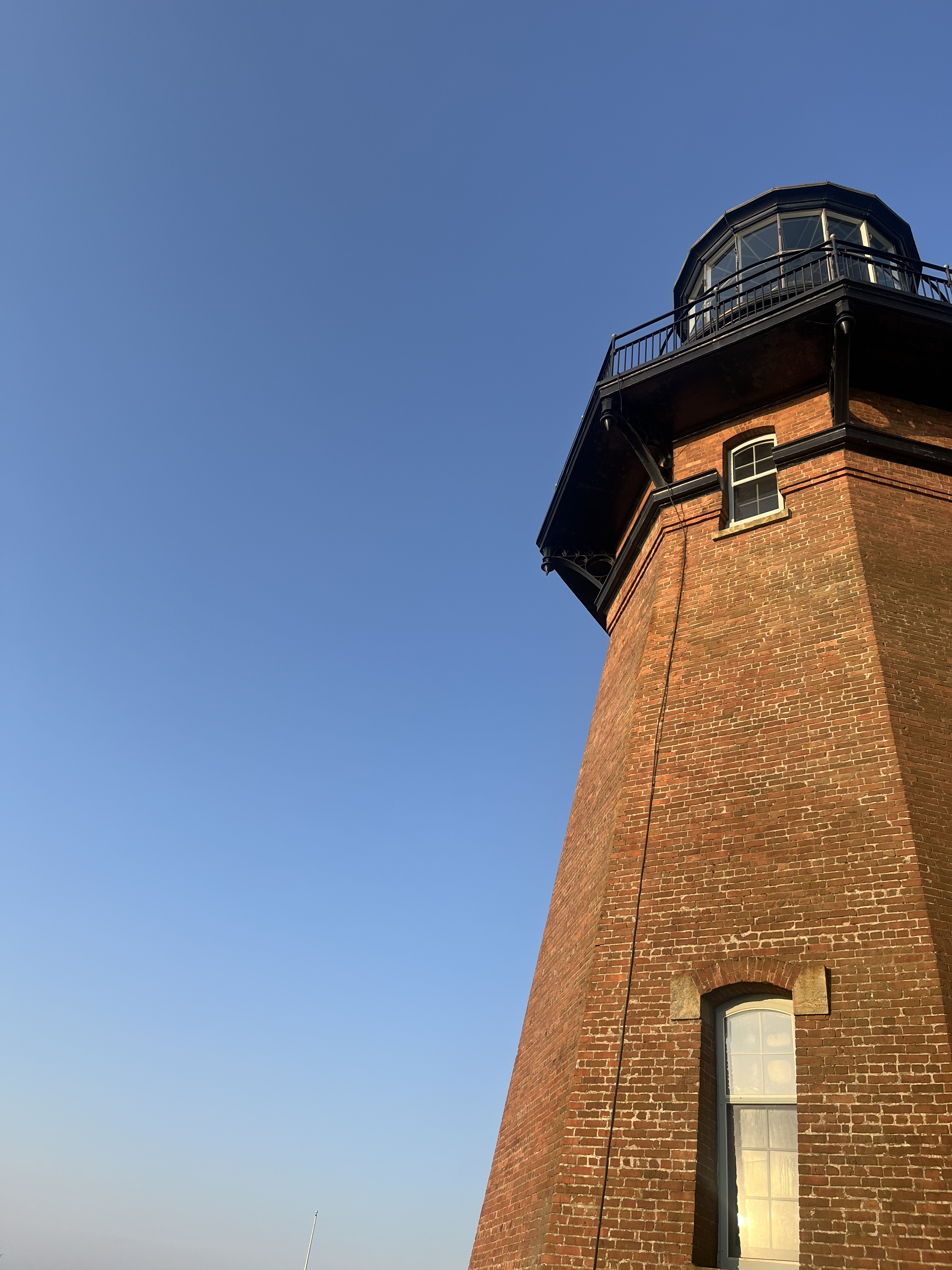
New Shoreham’s iconic Southeast Light is the first of my recent New Shoream photos.







 Suzanne's Mom's Blog