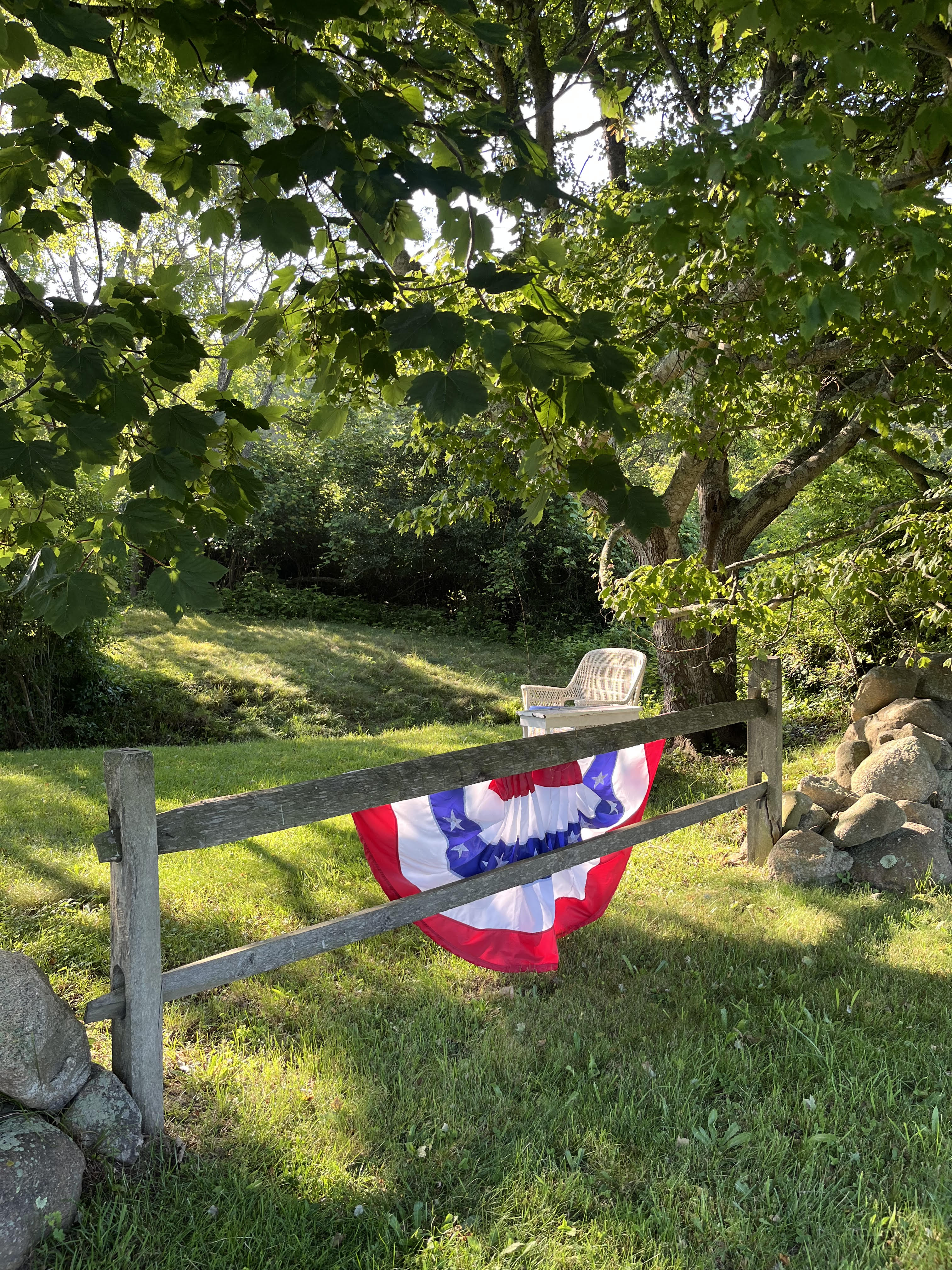
Sometimes love of country is a quiet thing.
A Happy Fourth to you, quiet or loud.

Sometimes love of country is a quiet thing.
A Happy Fourth to you, quiet or loud.
Posted in Uncategorized | 3 Comments »

Photo: Peter Quadrino.
A Texas club has been reading Finnegans Wake for 12 years. And making progress.
I have a bunch of reactions to today’s story about a book group reading the same James Joyce novel for 12 years and still going. One is that I would have benefited from reading Finnegans Wake with others because there was so much I didn’t understand. Another is that my stereotype about Texans needs constant correction: of course, there are people in Texas who tackle literature!
Sean Saldana wrote about this book club at Texas Standard, which I follow on Mastodon.
“In 1939, Irish author James Joyce published Finnegans Wake, a piece of literature that defies comprehension.
“ ‘riverrun, past Eve and Adam’s,’ it begins, ‘from swerve of shore to bend of bay, brings us by a commodius vicus of recirculation back to Howth Castle and Environs.’
“The book starts and ends with a sentence fragment, combines multiple languages and has no clear or linear plot. It’s a work that’s so dense, one group that started in Austin has been working on it for more than a decade.
“ ‘We’re only reading one page at a time,’ said Peter Quadrino, founder and organizer of the Finnegans Wake Reading Group of Austin, TX.
“Every other week, Quadrino hosts a Zoom call where people from around the world gather and attempt to understand one of the most infamous books in English literature.
“The group spends the first 15 minutes of each meeting socializing. Then they all go around in a circle and each person reads two lines until they’re done with that week’s page.
“After that, they spend about an hour and a half researching, annotating and trying to make sense of Joyce’s experimental prose.
“ ‘We used to read two pages per meeting,’ said Quadrino. ‘Then at a certain point there was just so much going on in the pages and so much in the discussion that we had to lower it to one page per meeting.’ …
“The book’s complexity has made it a point of fascination for literary enthusiasts in the eight decades since it was first published. Houston, New York, Boston, Seattle, Dublin, Kyiv and many other cities around the world host groups dedicated to reading and analyzing Finnegans Wake. …
“ ‘I never really consider what it’s going to be like when we finish because I don’t want it to end,’ explained Quadrino, ‘and if we do finish we’ll just circle right back to the beginning and keep reading.’ ” More at Texas Standard, here.
Would you want to join a book group like that? I have heard of similar ones. Humans just don’t want to be defeated by complexity. The Athenaeum in Boston reads Proust’s Remembrance of Things Past over and over, too.

Posted in Uncategorized | Tagged Athenaeum, book club, Finnegans Wake, irish, James Joyce, Proust, texas | 11 Comments »

Photo: SRG/SSR.
Construction of this year’s Eurovision stage began in early April, three weeks before rehearsals kicked off.
You have to admire the ambition that goes into producing an extravaganza. Just envisioning it seems beyond the imagination of normal mortals. Today’s story describes the behind-the-scenes magic of the 2025 European song competition known as Eurovision, in which fans root for their own countries.
Mark Savage reports at the BBC, “Thirty-five seconds. That’s all the time you get to change the set at Eurovision. Thirty-five seconds to get one set of performers off the stage and put the next ones in the right place. Thirty-five seconds to make sure everyone has the right microphones and earpieces. Thirty-five seconds to make sure the props are in place and tightly secured. …
” ‘We call it the Formula 1 tire change,’ says Richard van Rouwendaal, the affable Dutch stage manager who makes it all work. ‘Each person in the crew can only do one thing. You run on stage with one light bulb or one prop. You always walk on the same line. If you go off course, you will hit somebody.’
“The stage crew start rehearsing their ‘F1 tire change’ weeks before the contestants even arrive. Every country sends detailed plans of their staging, and Eurovision hires stand-ins to play the acts. …
“As soon as a song finishes, the team are ready to roll. As well as the stagehands, there are people responsible for positioning lights and setting pyrotechnics; and 10 cleaners who sweep the stage with mops and vacuum cleaners between every performance. …
“The attention to detail is clinical. Backstage, every performer has their own microphone stand, set to the correct height and angle, to make sure every performance is camera perfect.
” ‘Sometimes the delegation will say the artist wants to wear a different shoe for the grand final,’ says Van Rouwendaal. ‘But if that happens, the mic stand is at the wrong height, so we’ve got a problem!’ …
” ‘It’s a big logistics effort, actually, to get all the props organized,’ says Damaris Reist, deputy head of production for this year’s contest. ‘It’s all organized in a kind of a circle. The [props] come onto the stage from the left, and then get taken off to the right. Backstage, the props that have been used are pushed back to the back of the queue.’ …
“What if it all goes wrong?
“There are certain tricks the audience will never notice, Van Rouwendaal reveals. If he announces ‘stage not clear’ into his headset, the director can buy time by showing an extended shot of the audience. …
” ‘There’s actually lots of measures that are being taken to make sure that every act can be shown in the best way,’ says Reist. …
“It’s no surprise to learn that staging a live three-hour broadcast with thousands of moving parts is incredibly stressful. …
“The shifts are so long that, back in 2008, Eurovision production legend Ola Melzig built a bunker under the stage, complete with a sofa … and two (yes, two) espresso machines.
” ‘I don’t have hidden luxuries like Ola. I’m not at that level yet!’ laughs Van Rouwendaal ‘But backstage, I’ve got a spot with my crew. We’ve got stroopwafels there and, last week, it was King’s Day in Holland, so I baked pancakes for everyone.’ “
More at the BBC, here.
This year the winner was Austria’s Johannes Pietsch, or JJ, and the song was “Wasted Love.”
Posted in Uncategorized | Tagged band, behind the scenes, competition, countries, eurovision, JJ Wasted Love, music, set changes, song | 3 Comments »

Photo: Noah Stewart.
On 2 May, J’s Grocery in Clarksdale, Mississippi, reopened after a yearlong renovation. Through a new food-access initiative, J’s Grocery provides its mostly Black community with hard-to-come-by fresh produce.
The best medicine is often a healthful diet. But in many communities around the US, nourishing food is hard to access. That’s why a community in Mississippi is rejoicing about a newly renovated grocery store.
Adria R Walker writes at the Guardian about J’s Grocery revitalizing its majority-Black town with fresh produce.
“With the recent release of Ryan Coogler’s Sinners, Clarksdale, Mississippi, known as the home of the blues, has been thrust into the spotlight. But while the nation and world are captivated by a version of Clarksdale from more than 90 years ago, residents today are focused on the future.
“On 2 May, rain and warnings of thunderstorms were not enough to keep people in Clarksdale’s Brickyard neighborhood away from the reopening of J’s Grocery, a local staple since 1997 that had been under renovation for the last year.
“A collaboration between the store owner, Al Jones, and local farmers, J’s, the only Black-owned supermarket in the area, now carries fresh produce. …
“The new stock and collaboration was made possible by a deal among Jones; Partnership for a Healthier America (PHA), a nonprofit that works to provide access to nutritious food; Rootswell, a Mississippi Delta-based group that was formed to ‘shift the paradigm of food apartheid‘; Novo Nordisk, a pharmaceutical company; and other groups.
“ ‘At a time in our country when the federal government is just pulling money back everywhere, we invested in people and community,’ Noreen Springstead, PHA’s president and CEO said at the opening. …
“Jarvis Howard of Tunica, Mississippi, a visual artist who goes by DudeThatDraw, painted a mural, a smaller version of one he is installing at nearby George H Oliver elementary school. ‘Food is medicine,’ the mural reads over vibrantly colored vegetables. …
“Clarksdale, which today has a population of nearly 14,000 people, is primarily Black. The grocery store is in a walkable, mixed-income community, with an elementary school almost right across the street. A middle school, a Head Start center, a nursing home and senior citizen housing, low-income apartments and single-family homes are all in close proximity. In addition to the newly offered produce, the store also features a third space: a seated, shaded area surrounded by raised beds planted with herbs, where residents can gather and chat.
“The Mississippi Delta is abundant in fertile land and crops; agriculture is the state’s No 1 industry. Though some 30% of the state is farmland, most of that land is dedicated to cash crops, which are exported. In 2022, nearly 20% of Mississippians were food-insecure.
“Farms in the region ‘produce a lot of commodity crops, like corn, soybean, cotton. They don’t produce a lot of food that we eat,’ said Robbie Pollard, one of the farmers whose produce is now sold at J’s. ‘We’re trying to change the landscape to start producing more food in the Delta, like converting some of that land that’s used for row-crop production.’ …
“Pollard said that while the Mississippi Delta region is abundant in farmland, there’s a gap in what reaches the community. His initiative, Happy Foods Project, which is part of his farm, Start 2 Finish, is working to remedy that by collaborating with other farmers, and introducing youth to farming through farm visits and farm-to-school programs.
“J’s Grocery reopening will be a gamechanger for the neighborhood, he said. Some residents lack transportation to be able to get to big box stores that sell imported produce. Rural counties in the Mississippi Delta, like Coahoma county in which Clarksdale is the largest town, average one supermarket per 190.5 sq miles . …
“After Clarksdale lost its Kroger in 2017, residents initially pushed for another big box store to move in. But Tyler Yarbrough, the director of Mississippi Delta Programs for PHA, and others wanted the town to be able to return to its locally owned, locally operated roots. …
“Yarbrough said that stories from his grandmother and other older residents of shopping in the 1960s provided inspiration for what they might be able to bring back to the town. At the time, locals didn’t need to leave their communities to procure groceries. Instead, they went to the local grocery stores, which, like J’s, had a butcher who sold chicken, pork, freshly sliced bacon and produce.
“ ‘It is in our food-system history of having these neighborhood corner stores,’ he said, noting that the Brickyard and downtown Clarksdale once had 12 such shops. ‘This project is honoring that legacy and reminding us that we can own our food and the stores that we shop from.’ ”
More at the Guardian, here. No paywall, but donations keep this reliable news source alive. Help if you can.
Posted in Uncategorized | Tagged Blsck community, fresh produce, grocery, health, medicine, mississippi, rx | 4 Comments »

Photo: Brian Howell, Flickr Commons.
A helicopter circles a wildfire on Kaua‘i, where these fires are becoming increasingly common during drier summer months.
A Guardian update on what governments are doing about increased environmental costs sent me to Hawaii’s website. The island state, already grappling with the effects of global warming, is the first in the US to approve a tourism tax designated for climate issues.
The article says, “Lawmakers in Hawaii have passed first-of-its-kind legislation that will increase the state’s lodging tax to raise money for environmental protection and strengthening defenses against natural disasters fueled by the climate crisis. …
“[Gov. Josh] Green said in a statement. ‘Hawai‘i is truly setting a new standard to address the climate crisis.’
“The bill passed [adds] a 0.75% levy to the state’s existing tax on hotel rooms, timeshares, vacation rentals and other short-term accommodations. It also imposes a new 11% tax on cruise ship bills, prorated for the number of days the vessels are in Hawaii ports.
“Officials estimate the tax will generate nearly $100m annually. They say the money will be used for projects like replenishing sand on eroding Waikiki beaches, promoting the use of hurricane clips to secure roofs during powerful storms and clearing flammable invasive grasses like those that fed the deadly wildfire that destroyed downtown Lahaina in 2023. …
“Hawaii already levies a 10.25% tax on short-term rentals. As of 1 January, the tax will rise to 11%. Hawaii’s counties separately charge a 3% lodging tax, and travelers also have to pay the 4.712% general excise tax that applies to all virtually all goods and services. The cumulative tax bill at checkout will climb to 18.712%, among the highest in the nation. …
“As many visitors travel to the state to enjoy the environment, [Green] predicted they would welcome committing dollars to protect shorelines and communities.
“ ‘The more you cultivate good environmental policy, and the more you invest in perfecting our lived space, the more likely it is we’re going to have actually lifelong, committed travelers to Hawaii,’ he told the Associated Press.
“Zane Edleman, a visitor from Chicago, said … ‘If you really focus on the point – this is to save the climate and actually have proof that this is where the funds are going, and that there’s an actual result that’s happening from that, I think people could buy into it.’ …
“John Pele, the executive director of the Maui Hotel and Lodging Association, said there’s broad agreement that the money raised will go to a good cause. But he wonders if Hawaii will become too expensive for visitors.
“ ‘Will we be taxing on tourists out of wanting to come here?’ he said. ‘That remains to be seen.’ ”
The website Hawaii.gov notes that “2015 and 2016 were Hawaiʻi’s warmest years on record, and average air temperatures are 2 degrees warmer than they were in 1950. In 2019, Honolulu experienced its hottest recorded day three times, representing the hottest year ever recorded in the city. The last five years have seen peak average annual temperatures years across all islands. In 2015-2016, it was so hot in Honolulu that emergency public service announcements were issued to curtail escalating air conditioning use because it stressed the electrical grid.”
Among other global-warming consequences the website lists are the loss of 1.5 million acres of native forests, increasing numbers of wildfires, rapid growth of invasive species, “mass coral bleaching and mortality,” and a severe strain on water and energy infrastructure.
More at the Guardian, here, and at Hawaii’s official website, here.
Posted in Uncategorized | Tagged climate change, global warming, hawaii, infrastructure, tax, tourism, wildfire | 3 Comments »

Art: Leonora Carrington/Arts Rights Society, New York.
“Pastoral” (1950) is among the works included in “Leonora Carrington: Dream Weaver” at Brandeis University’s Rose Art Museum in Waltham, Massachusetts.
All praise to the Rose Art Museum at Brandeis University for thinking differently. Compared with other museums in New England, it has always been a little bit “out there.” In today’s story that involves taking a new look at the surrealists, especially a previously underappreciated one.
Mackenzie Farkus writes at the Christian Science Monitor, “Shape-shifting creatures. Dreamscapes of greenery. Prancing hyenas and noble white horses. These are just a few of the hallmarks of surrealist Leonora Carrington.
“The artist – who was born in 1917 in England and died in 2011 – was once on the periphery of the surrealist movement. But in the decade following her death, Ms. Carrington’s work has experienced a revival.
“While her adopted homeland of Mexico has long embraced her art, the celebration of Ms. Carrington’s legacy has reached a crescendo in other parts of the world in recent years. Her reemergence follows a trend of increased attention to fellow women creators. …
“In the case of Ms. Carrington, her ‘Les Distractions de Dagobert’ (1945) sold for $28.5 million at Sotheby’s in 2024, cementing her status as the highest-selling female artist in British history. … Her first solo exhibition in New England – at Brandeis University’s Rose Art Museum – is on display until June 1, and then moves to the Katonah Museum of Art in New York. …
” ‘What Leonora offers – and what surrealism offers – are alternative ways of understanding the world: not through the capitalist economic system of transactional politics, but tapping into empowerment through the imagination, invisible truths, things that have to do with our subconscious,’ says Gannit Ankori, director and chief curator of the Rose Art Museum in Waltham, Massachusetts.
“Dr. Ankori curated the museum’s exhibit ‘Leonora Carrington: Dream Weaver.’ A number of the pieces on display – including works in tempera, gouache, acrylic, oil, pencil, pen, and fiber – have rarely been seen outside private collections. …
“In the 1950 painting ‘Pastoral,’ water fowl, a hyena, and other animals congregate around an androgynous couple as ethereal animal-human hybrids float above. Ms. Carrington often emphasized the coexistence of humans and animals in her work.
“Of particular resonance to Dr. Ankori was Ms. Carrington’s love for Mexico … ‘a welcoming country that embraced and offered safe haven to refugees from war-torn Europe in the 1940s,’ says Dr. Ankori. … ‘And these immigrants, many of them intellectuals and artists, resettled in this new, embracing homeland and felt welcome. They built community and developed cultural excellence in the arts and philosophy and literature and more.’
“Alongside her many paintings, textile works, and sculptures, Ms. Carrington was also a prolific writer. Her 1944 memoir, Down Below, details her experiences of institutionalization in Spain. Her fictional work includes a wide range of surrealist short stories, plays, and novels. …
“Born into an upper-class Catholic family in England, Ms. Carrington often rebelled against the societal restrictions imposed on her. She was twice expelled from convent schools, and favored reading Irish fairy tales, Lewis Carroll, and Beatrix Potter over learning how to become the perfect debutante.
“A viewing of Max Ernst’s 1924 painting ‘Two Children Are Threatened by a Nightingale’ and a copy of Herbert Read’s 1936 book Surrealism influenced her artistic development, as did her tutelage under the French modernist Amédée Ozenfant.
“Women in the surrealist movement were often relegated to the role of the femme enfant – often young, beautiful women who were expected to be subservient to male artists.
“Ms. Carrington, however, had other plans. ‘I didn’t have time to be anyone’s muse,’ she once said. ‘I was too busy rebelling against my family and learning to be an artist.’ …
“Ms. Carrington eventually found her way to Mexico and married Hungarian photographer Emérico ‘Chiki’ Weisz.
“There, she encountered a community of European artists who had fled the horrors of World War II, often exhibiting her art in local galleries. She became close friends with fellow émigré and artist Ms. Varo. Together, they studied kabbalah, alchemy, Tibetan Buddhism, and Mayan mystical writings – the ideas of which feature prominently in Ms. Carrington’s art. She went on to become one of the founding members of Mexico’s 1970s feminist movement. …
“Ms. Carrington’s first solo museum show in Italy will open at Milan’s Palazzo Reale in September, on view until January 2026. An exhibition at the Musée du Luxembourg in Paris will be on view from Feb. 18 to July 19, 2026.”
More at the Monitor, here. No paywall.
Posted in Uncategorized | Tagged Brandeis University, Leonora Carrington, painting, rose art museum, surrealist | 7 Comments »

Photo: Moriah Ratner for the Washington Post.
At the home of the Cosmetology & Barber apprenticeship program, four instructors teach incarcerated people on mannequins, No sharp blades allowed.
I’ve always been interested in prison programs that help the incarcerated learn skills that can help them find work on the outside and avoid recidivism. It seemed so stupid to lock people up for months or years and then dump them on the side of the road somewhere with not much more than a toothbrush to get on with life.
Today’s focus is on teaching cosmetology skills to people who might be interested in eventually pursuing a license. A license requires serious application, but sometimes the effort starts with a little encouragement.
Samantha Chery writes at the Washington Post, “When Chet Bennett accepted a job in 1998 to teach incarcerated people in D.C. how to style hair, he was ‘scared to death.’ A native Washingtonian and Howard University alum, Bennett had never even seen the inside of a jail before his first day of work. Now, the 56-year-old is glad he took the chance.
“He makes weekly visits to the jail’s hair-care room, a small salon on the fifth floor of the city’s Correctional Treatment Facility, complete with dryer chairs and four shampoo bowls. At the home of the Cosmetology & Barber apprenticeship program, four instructors teach incarcerated people on mannequins, and the student stylists comb, braid and loc the hair of fellow jail residents, relatives and other clients from outside the facility.
“Since Bennett founded the program, he’s won a Legacy of Service Award and graduated thousands of hairstylists, many of whom now work in salons or have their own studios. …
“Teaching jail residents comes with logistical challenges: They aren’t allowed to use shears or razor blades, paint nails, or dye hair due to the facility’s restrictions, and they don’t have enough time during their short sentences — which typically run a year or less — to finish their necessary training for licensing.
“People trying to complete the 1,500 training hours required to receive a cosmetology license have the option to transition from the jail salon to Bennett’s off-site beauty school, the Bennett Career Institute near Catholic University, after finishing their sentences.
“When Angelina Millner was jailed in 2005, in her mid-30s, the cosmetology program improved her styling technique and helped her find work after her release.
“Despite homelessness and other personal battles, she said, Millner was able to attend Bennett’s school in 2012 to get her license, and now does business as Mo’ Hair by Angelina. She recalled how gratifying it felt to return to the jail in 2020 — as a teacher instead of a resident: ‘I just had to stay on the straight and narrow ever since.’
“Bennett said he has learned it’s best to reserve judgment. He doesn’t look at his students’ records, hoping to give them a clean slate. … There’s ‘something that we’ve all done and have fallen short, but by grace and mercy, we were allowed to straighten our ways and continue to move on,’ he said. ‘It has meant so much for me to know that I can go into a facility and give people a second chance.’ ” More at the Post, here.
Some years ago, in one of the English as a Second Language classes where I volunteered, a student decided to go for a cosmetology license at a Rhode Island training school. It was a pretty serious commitment of time and money. It took her more than a year. Watching her, I learned it’s not something you can be casual about and still be successful.
Looking up Washington DC licensing, I found these details: you are required to be “at least 17 years old. Have a High School Diploma or GED. Have completed and been credited with 1,500 hours of fundamental training.”
One place describes its course thus: “The General Cosmetology Course at Bennett Career Institute is a comprehensive 1,500-clock-hour program designed to provide instruction in a wide range of cosmetology skills and techniques.
“Students will learn about sanitation and sterilization, decontamination, and infection control practices, as well as hair cutting, coloring, perms, and other chemical services. The curriculum also covers hair styling techniques and other occupational requirements such as manicures, pedicures, and facials. BCI’s General Cosmetology Curriculum is designed to meet the requirements of the District of Columbia Board of Barber and Cosmetology, preparing students for a cosmetology operator’s license. …
” Individuals who obtain a license can provide a variety of beauty services such as shampooing, cutting, coloring, styling hair, apply makeup, dress wigs, perform hair removal as well as provide nail and skin care services.” More here.
Once you have a license and keep it up-to-date, you may go into completely different kinds of jobs, but you always have that to fall back on.
Posted in Uncategorized | Tagged barber, beauty school, Cosmetology, jail, prison, training, Washington DC | 4 Comments »

Photo: UW/NSF-OOI/CSSF-ROPOS via CNN Science.
White clouds of microbial waste billow from the seafloor — the result of a volcanic eruption.
Rachel Carson thought it would be hard for humans to pollute the oceans because they were so vast. I guess she was wrong about that, but the oceans’ vastness does make them likely to remain a source of wonder and discovery — mysterious no matter how much we study them.
Today’s example of deep-sea wonder comes from the New York Times, where Maya Wei-Haas reports that scientists have witnessed a volcanic eruption that had never been experienced in person.
“Andrew Wozniak, a chemical oceanographer at the University of Delaware,” she writes, “struggled to process what his eyes were taking in. Dr. Wozniak was parked on the bottom of the Pacific Ocean beneath nearly 1.6 miles of water in Alvin, a research submersible. As far as he could see lay a mostly barren expanse of jet-black rock.
“Just a day before, at this same spot, a vibrant ecosystem had thrived in the sweltering waters of the Tica hydrothermal vent, about 1,300 miles west of Costa Rica. Creatures inhabited every inch of the rocky seafloor, writhing in a patchwork of life. The crimson tips of giant tube worms waggled in the current, tangling around clusters of mussels. Buglike crustaceans scuttled through the scene while ghostly white fish languidly prowled for their next kill.
“Now, only a single cluster of tube worms remained in the blackened terrain, all dead. A haze of particulates filled the water as glints of bright orange lava flickered among the rocks.
“ ‘My brain was trying to understand what was going on,’ Dr. Wozniak said. ‘Where did things go?’
“Eventually it clicked: He and the sub’s other passengers were witnessing the tail end of a submarine volcanic eruption that had entombed the flourishing ecosystem under fresh lava rock.
“This was the first time scientists had witnessed a clearly active eruption along the mid-ocean ridge, a volcanic mountain chain that stretches about 40,000 miles around the globe, like the seams of a baseball. The ridge marks the edges of tectonic plates as they pull apart, driving volcanic eruptions and creating fresh crust, or the layer of the Earth we live on, beneath the sea. About 80 percent of Earth’s volcanism happens on the seafloor, with the vast majority occurring along the mid-ocean ridge. …
“Observing such an event live offers a unique opportunity for scientists to study one of our planet’s most fundamental processes: the birth of new seafloor, and its dynamic effects on ocean chemistry, ecosystems, microbial life and more.
“ ‘Being there in real time is just this absolutely phenomenal gift — I’m really jealous,’ said Deborah Kelley, a marine geologist at the University of Washington who was not part of the research team.
“Dr. Wozniak and colleagues sailed on a ship, the R/V Atlantis, before setting out in the Alvin sub. Their original goal was to study carbon flowing from the Tica vent, funded by the National Science Foundation. Hydrothermal vents are like a planetary plumbing system, expelling seawater that’s heated as it seeps through the ocean floor. The process transports both heat and chemicals from Earth’s interior, helping regulate ocean chemistry and feeding a unique community of deep marine life.
“The dive on [on that May] Tuesday morning started like any other. Alyssa Wentzel, an undergraduate at the University of Delaware who joined Dr. Wozniak aboard Alvin, described the enchantment of sinking into the darkness of the ocean depths on the 70-minute journey to the seafloor. As the light vanished, bioluminescent jellies and tiny zooplankton drifted by.
“ ‘It was magical,’ she said. ‘It really takes your words away.’
“But as they approached the site, a darker magic set in as temperatures slowly ticked upward and particles filled the water. The usual dull gray-brown of the seafloor was capped by tendrils of inky rock that glimmered with an abundance of glass — the result of rapid quenching when lava hits chilly water.
“As particulates clouded the view from Alvin, Kaitlyn Beardshear of the Woods Hole Oceanographic Institution, the pilot in command of the day’s journey, slowed the sub, keeping close watch on the temperatures. As they ticked up, so too did concerns for safety of the submersible and the crew. Eventually, the pilot made the call to retreat. …
“The team learned after returning to the ship that sensitive microphones, called hydrophones, aboard the Atlantis had detected the volcanic eruption earlier in the day. It registered as a series of low frequency booms and campfire-like crackle.
“This was the third known eruption at the Tica vent since its discovery in the 1980s. Over the decades, Dan Fornari, a marine geologist at Woods Hole, and his colleagues have closely monitored the site, tracking changes in temperature, water chemistry and more. …
“In 1991, he and his colleagues had arrived at Tica within days of an eruption’s start. It might even have still been active, he said, but they saw no flashes of lava to confirm. This time, he said, there’s no doubt of what the Alvin crew saw. ‘This has been the closest that we ever come to witnessing the initiation of an eruption’ along the mid-ocean ridge, he said.
“The team is continuing to study the volcanic activity. Given safety concerns, they’re collecting data and taking photographs remotely from the Atlantis.
“The data will help researchers unravel the mysteries of deep-sea volcanism and the role it plays in marine ecosystems. ‘All of this has to do with understanding this holistic system that is Earth and ocean,’ Dr. Fornari said. ‘It’s so intertwined, and it’s both complex and beautiful.’ ”
More at the Times, here.
Posted in Uncategorized | Tagged Alvin, deep-sea, eruption, ocean, pacific, scientist, volcanic | 2 Comments »

Photo: Jake Michaels.
Pam Elyea and her husband, Jim, have run the theatrical properties business History for Hire for almost 40 years, but now rent is going up and business is down.
When I was in the Junior Antrim Players production of Alice in Wonderland (age 10), my mother volunteered to do props. [Scroll way down here for fun information on the Junior Antrim Players and famous actors who got their start there.] You know, finding all those odds and ends that a script says are needed onstage to carry the story — a gavel for the Knave of Hearts trial, paintbrushes for painting the roses red, the caterpillar’s hookah. For opening night, she provided real tarts from a local bakery, but found out she’d have to do that for the dress rehearsal, too. Props are a big deal.
Matt Stevens wrote recently at the New York Times about prop mavens calling themselves History for Hire.
“When the Netflix series Wednesday needed a guillotine recently, it did not have to venture far. A North Hollywood prop house called History for Hire had one available, standing more than eight feet high with a suitably menacing blade. …
“The company’s 33,000-square-foot warehouse is like the film and television industry’s treasure-filled attic, crammed with hundreds of thousands of items that help bring the past to life. It has a guitar Timothée Chalamet used in A Complete Unknown, luggage from Titanic, a black baby carriage from The Addams Family.
“Looking for period detail? You can find different iterations of Wheaties boxes going back to the ’40s, enormous television cameras with rotating lenses from the ’50s, a hair dyer with a long hose that connects to a plastic bonnet from the ’60s, a pay phone from the ’70s and a yellow waterproof Sony Walkman from the ’80s.
History for Hire, which Jim and Pam Elyea have owned for almost four decades, is part of the crucial but often unseen infrastructure that keeps Hollywood churning. …
“ ‘People just don’t realize how valuable a business like that is to help support the look of a film,’ said Nancy Haigh, a set decorator who found everything from a retro can of pork and beans to a one-ton studio crane there for Once Upon a Time in Hollywood, which she won an Oscar for. ‘But it’s because people like them exist that your moviegoing experience has such life to it.’ …
“When the director, George Clooney, really wanted an old Moviola editing machine, [Good Night, and Good Luck set decorator Jan Pascale recalled] the Elyeas found her one at a local school. And they had not only the telex machines that the production needed, but also workers who knew how to get them to work. …
“ ‘I don’t know what we would do without them,’ said Pascale, who has won an Oscar for Mank. …
“But with fewer movies and television shows being shot in Los Angeles these days, and History for Hire getting less business, the Elyeas fear they may not be able to afford to renew their lease. …
“[Jim’s] parents owned an antique store, and Jim had always been a collector. So when a friend who was a production designer asked Jim to come work on sets, he was sold. …
“The couple opened their prop-rental business out of their apartment. Their first big break came when they got the gig to rent flak vests, field radios and medic equipment to Oliver Stone’s 1986 film Platoon. (They now admit that they may have exaggerated their size and expertise.) …
“On a recent afternoon inside the warehouse, Dave McCullough, a prop maker, was hunkered over a work station fitting a microphone stand to a base it was not designed for. He would later use a 3-D printer to make a new tally light — the light which tells performers which camera is on at any moment — for an original RCA TK60 television camera from the 1960s and consider whether to use a heat gun to make it a slightly richer shade of red.
“ ‘What is great about being in a building like this is I’ve got the last century of objects as a reference,’ said McCullough, who has worked at History for Hire for nine years. ‘A lot of the things here had multiple lives before they got to us.’ …
“A Broadway-bound musical centered around Soul Train recently needed to rent some TV cameras, Pam said. While researching the cameras, the History for Hire team discovered that the show was one of the first to employ female camera operators. So they sent over a camera — and a photo. And now, audience members will see a female camera operator in the show, a spokesman for the musical, Hippest Trip: The Soul Train Musical, confirmed. …
“The Elyeas would have to rent many drum sets and many, many, many drum sticks to cover the $500,000 they pay annually to rent the building where they store them all. Pam said that she is fine with some work going other places. … But Pam said that she would need more local production in Los Angeles to keep her doors open. …
“ ‘Neither Jim or I are really ready to throw in the towel yet,’ she said. Maybe, she said, they will sign a two-year lease, rather than a five-year lease. And then they’ll see how it goes.”
More at the Times, here.
Posted in Uncategorized | Tagged hollywood, movies, properties, props, theatrical | 5 Comments »

Photo: Colleen Reichmuth, NMFS 23554, via the New York Times.
Ronan, a California sea lion of the Long Marine Laboratory at the University of California, Santa Cruz.
Do you recall reading about the dancing cockatoo Snowball with the head-banger technique? Snowball was a big hit for a while there. I think critter behavior is interesting even when it does not look like human behavior, but it seems that scientists can’t get enough of animals dancing like humans.
Here are two relevant Guardian reports — one on on sea lions and one on rats.
“Ronan the sea lion can still keep a beat after all these years. She can groove to rock and electronica. But the 15-year-old California sea lion’s talent shines most in bobbing to disco hits such as ‘Boogie Wonderland.‘
“ ‘She just nails that one,’ swaying her head in time to the tempo changes, said Peter Cook, a behavioral neuroscientist at New College of Florida who has spent a decade studying Ronan’s rhythmic abilities.
“Not many animals show a clear ability to identify and move to a beat aside from humans, parrots and some primates. But then there’s Ronan, a bright-eyed sea lion that has scientists rethinking the meaning of music.
“A former rescue sea lion, she burst to fame about a decade ago after scientists reported her musical skills. From age three, she has been a resident at the University of California, Santa Cruz’s Long Marine Laboratory, where researchers including Cook have tested and honed her ability to recognize rhythms. …
“What is particularly notable about Ronan is that she can learn to dance to a beat without learning to sing or talk musically.
“ ‘Scientists once believed that only animals who were vocal learners – like humans and parrots – could learn to find a beat,’ said Hugo Merchant, a researcher at Mexico’s Institute of Neurobiology, who was not involved in the Ronan research.
“But in the years since since Ronan came into the spotlight, questions emerged about whether she still had it. Was her past dancing a fluke? Was Ronan better than people at keeping a beat?
“To answer the challenge, Cook and colleagues devised a new study. … The result: Ronan still has it. She is back and better than ever. This time the researchers focused not on studio music but on percussion beats in a laboratory. They filmed Ronan bobbing her head as the drummer played three different tempos – 112, 120 and 128 beats per minute. Two of those beats Ronan had never been exposed to, allowing scientists to test her flexibility in recognizing new rhythms.
“And the researchers asked 10 college students to do the same, waving their forearm to changing beats. Ronan was the top diva.
“ ‘No human was better than Ronan at all the different ways we test quality of beat-keeping,’ said Cook, adding, ‘she’s much better than when she was a kid.’ “
Meanwhile, at the Guardian, Hannah Devlin writes that rats, too, “instinctively move in time to music. This ability was previously thought to be uniquely human and scientists say the discovery provides insights into the animal mind and the origins of music and dance.
“ ‘Rats displayed innate – that is, without any training or prior exposure to music – beat synchronization,’ said Dr Hirokazu Takahashi of the University of Tokyo.
“ ‘Music exerts a strong appeal to the brain and has profound effects on emotion and cognition,’ he added.
“While there have been previous demonstrations of animals dancing along to music – TikTok has a wealth of examples – the study is one of the first scientific investigations of the phenomenon.
“In the study, published in the journal Science Advances, 10 rats were fitted with wireless, miniature accelerometers to measure the slightest head movements. They were then played one-minute excerpts from Mozart’s Sonata for Two Pianos in D Major, at four different tempos: 75%, 100%, 200% and 400% of the original speed. Twenty human volunteers also participated.
“The scientists thought it possible that rats would prefer faster music as their bodies, including heartbeat, work at a faster pace. By contrast, the time constant of the brain is surprisingly similar across species.
“However, the results showed that both the rat and human participants had optimal beat synchronicity when the music was in the 120-140 beats per minute (bpm) range – close to the Mozart composition’s original 132bpm – suggesting we share a ‘sweet spot’ for hitting the beat. The team also found that rats and humans jerked their heads to the beat in a similar rhythm, and that the level of head jerking decreased the more that the music was sped up. …
“The team now plans to investigate how other musical properties such as melody and harmony relate to the dynamics of the brain.
“ ‘Also, as an engineer, I am interested in the use of music for a happy life,’ said Takahashi.”
Posted in Uncategorized | Tagged cockatoo, dancing, innate, rats, research, rhythm, scientist, sea lion | 1 Comment »
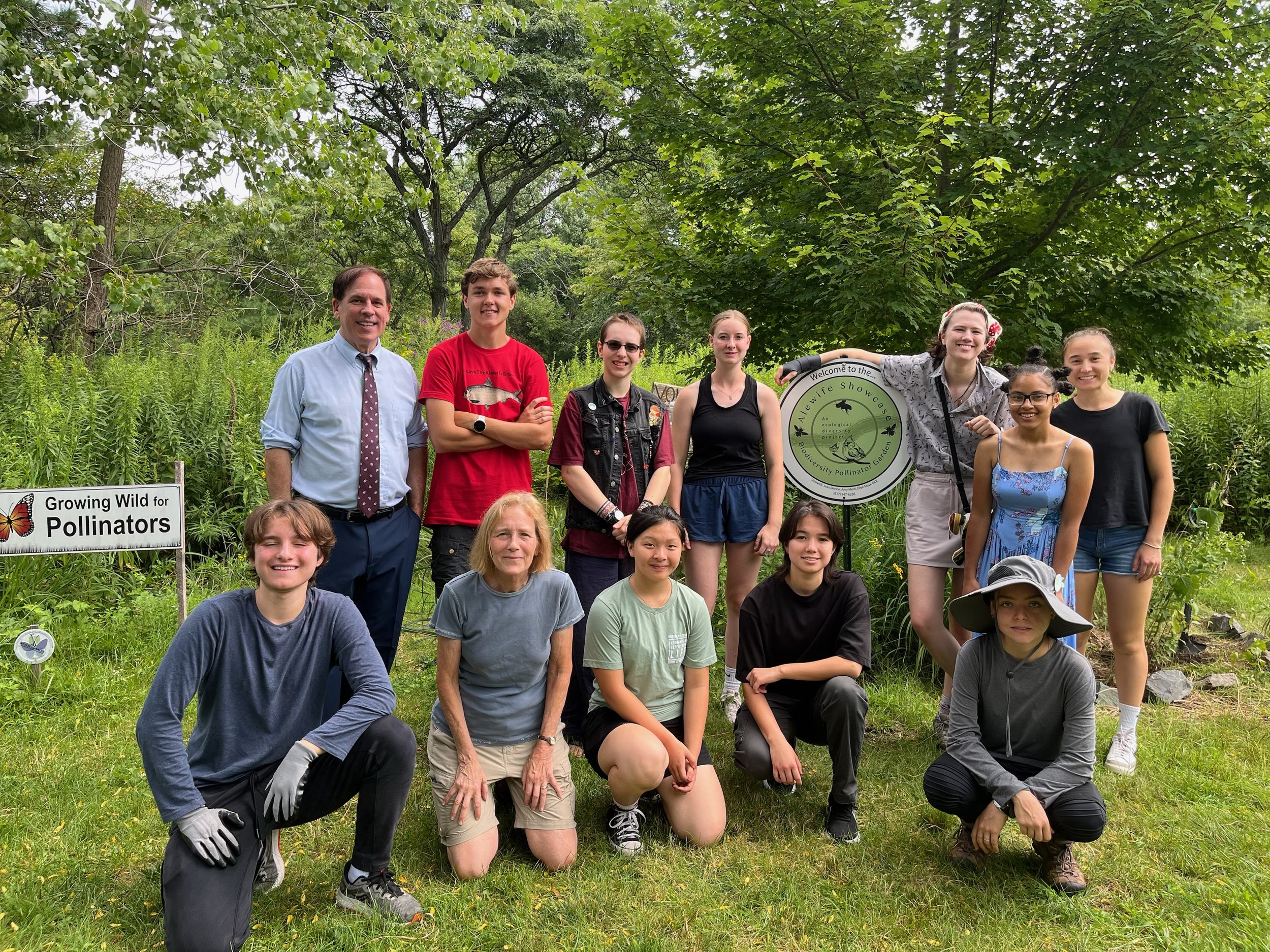
Photo: Devine Native Plantings.
Jean Devine, founder of Biodiversity Builders, is in the front row, second from left. She engages young people in the important work of improving the environment.
Recently, I blogged about my friend Jean Devine, founder of Biodiversity Builders, and described how she took me on a tour of local urban forests. (Click here.)
Now I find that Edible Boston has caught up with her and is highlighting the amazing environmental work Jean’s been doing with young people.
Nicole Estvanik Taylor writes, “Ask the average Gen Z-er to name their favorite native plant and you might expect a blank stare. But for alumni of the Biodiversity Builders program, the hard part is narrowing it down.
“Strawberries come to mind for Jasmine Rancourt, International School of Boston graduating senior — ‘or maybe butterfly weed, because it’s really pretty and vibrant … and it attracts butterflies, obviously.’
“Belmont High School’s Sophia Shaginian chose to plant bleeding heart in front of her house because it’s ‘absolutely gorgeous’ and ‘blooms all summer long.’
“Leia Ahmad-LeBlanc of Arlington Catholic High School gravitates to the striking red pods of wild sumac. ‘You can actually make lemonade out of it, and it’s a good source of food for animals.’
“And UMass Amherst student Kira O’Neill is partial to black birch trees: ‘They have such beautiful yellow leaves in the fall. And if you scratch a twig, it smells like root beer.’
“The students got to know these and many other plant species native to Massachusetts through a six-week paid summer internship created and run by Jean Devine, a Belmont-based environmental educator, native plant coach and specialty landscaper.
“Entering its fourth year, Biodiversity Builders has provided 55 high school students from Arlington, Belmont and Cambridge with hands-on experience designing and installing native plant gardens and removing invasive flora. The curriculum also covers entrepreneurial concepts like mission and marketing and culminates in a native plant sale run entirely by the students. …
“It’s only been a decade or so that Devine herself could tell you much about birch trees or bleeding hearts. …
“ ‘I was looking for opportunities to mentor youth and get them outdoors as an antidote to “nature-deficit disorder,” ‘ she says, referencing a term coined by journalist Richard Louv in his book Last Child in the Woods.
“A walk with a scientist opened Devine’s eyes to the ecological value of native plants, including as a source of food and shelter for pollinators and other wildlife, and the threat invasives pose to biodiversity. Teaching kids how to restore this balance struck her as ‘an ideal project with a purpose that helped the world and the youth at the same time.’ …
“After several years running nature programs for school kids in Cambridge and Brookline, she launched her own business, Devine Native Plantings, in 2021. Biodiversity Builders followed a year later, operating as a nonprofit under the fiscal sponsorship of the Vermont-based Tiny Seed Project. It partners with the Cambridge Mayor’s Summer Youth Employment Program to support the participation of students from that city and covers the rest of its budget through grants and crowdfunding. This July, it will recommence with a fresh batch of 14 high school students and a pair of college mentors, plus four young professionals interested in the Biodiversity Builders approach.
“ ‘Jean is so high energy and enthusiastic about the curriculum,’ says O’Neill, who did the program in 2022 and returned last summer as a mentor. ‘She very easily connects with the students … and she knows so many of the people in the area doing similar kinds of work.’
“Among her many affiliations, Devine is a co-founder of the Mystic Charles Pollinator Pathways Group, which maps local gardens that support declining populations of native bees, butterflies and birds. She guided Belmont High School’s Climate Action Club in creating a pollinator garden and is part of an intergenerational committee of Belmont residents organizing to plant a Miyawaki miniforest. As a member of the Native Plant Community Gardeners group in Cambridge, she’ll help install Danehy Park’s first pollinator garden this summer — with upkeep to come from the 2025 Biodiversity Builders crew. …
“For 2024 Biodiversity Builders participant Rancourt, who has artistic leanings, planning gardens that are aesthetically pleasing and ecologically useful was a highlight of the program.
“ ‘It turns out you have many colorful native plants that can be used,’ Rancourt reasons, ‘instead of those other plants that are colorful but look like plastic for pollinators.’ …
“Ahmad-LeBlanc, part of last summer’s cohort, says she applied to Biodiversity Builders after watching her sister go through the experience two years prior.
“ ‘She would always come home covered in dirt, she would have to wear super high socks because there were a lot of ticks, but she had a great time,’ she says. When it was her turn to get dirty, she understood why. ‘I think it was easier for us to process the information because it was all really hands-on … It’s a way that we’re not usually able to learn in school.’
“The Alewife reservation is Biodiversity Builders’ home base, but the students tend plots in other community spaces. … Last summer they removed invasives at Mass Audubon’s Habitat Education Center and Wildlife Sanctuary with the aid of its resident goats; toured Mount Auburn Cemetery with a herpetologist, a horticulturalist and an artist; and took the T to East Boston for birdwatching in Belle Isle Marsh. They also donned gloves and climbed into canoes with the Mystic River Watershed Association to remove thick, spiny mats of invasive water chestnuts from the Arlington Reservoir—filling 270 laundry baskets by day’s end.
“ ‘It was just amazing how we were all collaborating and working all together,’ says Shaginian, who shared a canoe with Devine. ‘I remember how big that pile was. It was huge.’
“Shaginian says pulls like that one, or the sweaty hours spent uprooting black swallow-wort along the edge of the Minuteman Bike Path, impressed upon her both the enormity of the problem and the importance of doing her part. …
“ ‘For me, the idea of getting paid to do gardening, which I did at my house for fun, was novel and exciting,’ says O’Neill, ‘and definitely cemented the idea that I wanted to study something related to working outside when I got to college.’ “
Posted in Uncategorized | Tagged balance, biodiversity, cambridge, edible Boston, environment, invasive, Jean Devine, nature, paid work, summer program, youth | 2 Comments »

Photo: Christie’s Images Ltd. 2025.
Eva Hesse, “Landscape Forms” (1959).
If you found a painting you loved in some cheap second-hand shop, what would you do with it? Even if it turned out to be valuable? I think if I bought it because I loved it, I’d want it on my walls. Everything in the world is not valued only in terms of gold.
In April, Laurie Gwen Shapiro reported at Hyperallergic about a brother-sister team who are in it for the gold.
“One afternoon last fall, 55-year-old Kara Spellman was working from her Upper East Side apartment when her phone pinged. Her big brother Glenn, 58, a longtime licensed appraiser and self-described ‘picker,’ who lives in the same building, had texted a photo and a short message: ‘Take a look at this.’
“The image was of a small abstract painting — 30 by 24 inches — titled ‘Landscape Forms’ and newly listed on ShopGoodwill.com, the online auction wing of the national thrift store chain. The brushwork was gestural, the color palette felt just right, and in the lower-right corner, a signature: E.H.
“Glenn had a hunch. Kara, director of Estates and Acquisitions at Hollis Taggart Gallery in Chelsea, had a stronger one.
“ ‘We both have a good eye,’ she told Hyperallergic, laughing. ‘The brushwork looked too specific to be a copy.’
“But instinct wasn’t enough. The siblings, who’ve teamed up before on treasure hunts, needed the catalogue raisonné — the official compendium of an artist’s authenticated work.
“Kara emailed the Watson Library at the Metropolitan Museum of Art and begged them to pull the volume by the end of the day. Miraculously, someone she knew replied right away: They’d do it. She jumped in a cab.
“ ‘There it was,’ she said. ‘Landscape Forms’ (1959). Signed. Documented. And officially marked: ‘Whereabouts Unknown.’
“The only visual in the book was an off-color image made from an unmarked slide in the artist’s papers at Oberlin College’s Allen Memorial Art Museum. In fact, as noted in the catalogue raisonné, it’s ‘one of 15 paintings known only by unmarked slides’ included in that archive. But it matched exactly. And it was lost for decades until it popped up at a Goodwill warehouse in Frederick, Maryland.
“The Jewish artist Eva Hesse, born in Hamburg in 1936, escaped the Nazis as a child via the Kindertransport to London with her sister. Their desperate parents followed soon after, and the family eventually resettled in New York. Hesse would go on to become one of the most influential figures of the postwar American avant-garde. Best known for her radical, impermanent sculptural work in materials such as latex, fiberglass, and cheesecloth, she died in 1970, at just 34. Fragile and emotionally charged, her most important pieces helped define Post-Minimalism and, though rarely offered at auction, have sold for millions. Most are held in the collections of major museums.
“But before all that, Hesse painted. ‘Landscape Forms,’ made while she was an MFA student at Yale under Josef Albers — who affectionately called her ‘my little colorist’— is part of that rare early body of work. …
“And then one day, it was gone. Was it lost? Stolen? A gift quietly passed along, then forgotten?
“ ‘I’m not an artist,’ Glenn said in a phone call late at night after a grueling 10-hour day looking at estates. ‘I’m a treasure hunter. A detective.’ …
“ ‘Once or twice a year, something outstanding shows up there,’ he said of ShopGoodwill. ‘You just have to know what you’re looking at.’ …
“For bigger finds, Glenn often partners with Hollis Taggart, his former boss and longtime friend. They agreed it was worth pursuing together. After winning the lot for $40,000 — not exactly a steal, but Hesse’s auction record is above $4 million — Glenn drove to Frederick, Maryland, himself. …
“Back in New York, Glenn brought the painting to Hollis Taggart Gallery. There, it underwent conservation: surface cleaning, minor restoration, and re-stretching.
“It was shown at two major art fairs, including the Armory Show last September. There was interest — almost a sale — but no one bit. …
“Now, after regrouping, ‘Landscape Forms’ is headed to Christie’s Post-War and Contemporary Art Day Sale in May, with an estimate of $60,000–$80,000. [Update: It sold for $107,100.]
“The Spellman siblings, Gen Xers who’ve been in New York for decades, grew up in Ballston Spa, near Saratoga Springs, and got their start as bottle diggers.
“ ‘There was an old slaughterhouse near the creek bed,’ Glenn recalled. ‘We’d find colored, hand-blown bottles and sell them downtown, because there was also a one-cent candy store in town. If we sold an old bottle for a quarter, we’d get 25 pieces of candy. A home run would be a dollar bottle, which equaled 100 pieces of candy!’ …
“Both are longtime fans of American Pickers (2010–), the History Channel’s reality TV series whose hosts travel across the country in search of valuable artifacts. ‘I still watch it religiously,’ Glenn added. ‘You pick up more than you’d think.’
“When asked how it felt to hold the Hesse in his hands for the first time, Glenn got quiet.
“ ‘It was very exciting,’ he said. ‘You get the thrill when you win it, but when you finally handle it, when you know it’s real, that’s the magic.’ ”
More at Hyperallergic, here. No paywall, but your donation helps keep great art coverage going.
Posted in Uncategorized | Tagged art, auction, Eva Hesse, Goodwill, Nazi, painting, picker, sculpture | 5 Comments »

Photo: Caitlin Kelly.
The Bombali Bike Ladies of Sierra Leone hope that by learning to ride a motorbike and take up package delivery services it will be possible to improve their lives.
I’ve been reading a mystery about some Minnesota Indigenous women who, fed up with a spate of kidnappings, unite to fight back. Whenever I read stories about women uniting to improve their lives and the lives of other women, I rejoice. After all, the individual women who eventually get to run their countries do not always operate differently from their male predecessors, but women in mutual-support initiatives definitively behave differently.
In today’s Guardian article, Caitlin Kelly writes about Mariama Timbo, the sole female biker in her Sierra Leone province ferrying people and goods to town and “training a new generation of women to follow her lead.”
“Streaming through the green fields of Sierra Leone’s Bombali district, Mariama Timbo sits tall on her pink motorbike. Women selling nuts on the side of the road wave as she glides by; policemen give an approving nod as she passes through checkpoints. ‘They don’t give me any trouble,’ she says – a badge of honor in the rural district. Taking her time on the rocky roads, she brakes, slowly approaching the bumps. …
“The 26-year-old is the sole female motorcyclist in the northern province ferrying people and goods to Makeni, one of Sierra Leone’s fastest growing cities. …
“At a petrol station en route, male drivers greet Timbo with fist-bumps and high fives. ‘At first when I started, people were mocking me,’ she says. ‘Now they see how my life has changed since I started riding the bike.’
“In Sierra Leone, motorcycles are a lifeline. The locally known okadas are often the only accessible and affordable way to reach markets, hospitals and cities. With nearly 60% of the country’s rural population living in poverty, commercial riding offers income to hundreds of thousands – nearly all of them men.
“In her early teens, Timbo left her village, Kagbere, to ‘join society’ and attend school in Makeni, but the opportunity turned into a nightmare when she was sexually abused by a male relative who was helping her financially. ‘I didn’t feel safe,’ she recalls.
“She managed to move out and pay for the last years of school by doing odd jobs in Makeni but couldn’t afford further education. In 2022, she turned to Kisimi Kamara at eWomen Sierra Leone, a local NGO that supports business initiatives for women. One thing she had learned during her time away was how to ride a motorbike. The NGO helped Timbo get funding for a motorbike via a World Bank grant.
“ ‘I decided to ride because I knew I could survive,’ says Timbo.
“Defying stereotypes, Timbo has since started transporting goods and people – earning about 50NLE [$2.42] a day.
“Since the civil war in the early 2000s, okadas have become a popular mode of transport after the fighting destroyed public infrastructure. A recent survey by the Institution of Civil Engineers found that women make up almost half of motorcycle taxi passengers in rural Sierra Leone – but the drivers are almost always men.
“Timbo makes the 45-minute journey between Makeni and Kagbere twice a day, mostly to the market. Like many rural villages in Sierra Leone, Kagbere is isolated, agriculture-dependent, and cut off from mains electricity and water. As she arrives, women flock to greet her.
“ ‘We are exchanging things – we are constantly giving to each other because we are family,’ says ‘aunty Marie,’ one of the women in the village.
“Marie hops on the back of Timbo’s bike to sell pepper and groundnuts at the market, but she also helps tend the land Timbo has recently been able to invest in.
“ ‘Mariama has changed over the past few months … because of that motorbike,’ says Kamara. According to him, more than 60 local women – including sex workers in search of alternative work – have shown interest in learning to ride after seeing Timbo on her bike in Makeni.
“On International Women’s Day in March, a group of young women gathers in a dusty school playground, watching as Timbo skids around confidently. One by one, they jump on the bike, nervously revving the engine. They are the newly formed Bombali Bike Ladies – under Timbo’s leadership. Timbo recently won a grant from the UNFPA and the government to teach others how to ride.
“ ‘It’s good for women to ride bikes, because they are very patient and caring,’ says Aysha Kamara, a 21-year-old student who hopes the motorbike could help her secure work with an NGO.
“ ‘Job opportunities for young people in Sierra Leone are so difficult … unless you create one for yourself,’ says Adama Makaloko, 24, who is hoping to master the bike to ’empower herself’ and sell produce.
“Sibeso Mululuma at the UNFPA says: ‘The challenge presented by the group was that young women in Bombali district faced economic hardship, making them vulnerable to exploitation and gender-based violence due to a lack of skills and financial independence.
“ ‘It sends a strong message … that there’s nothing wrong with taking up space or doing things differently. That’s powerful.’ ”
More at the Guardian, here. Great photos and no paywall.
Posted in Uncategorized | Tagged Afroca, bike ladies, independence, motor bikes, self-sufficient, Sierra Leone, solidarity, women | 1 Comment »
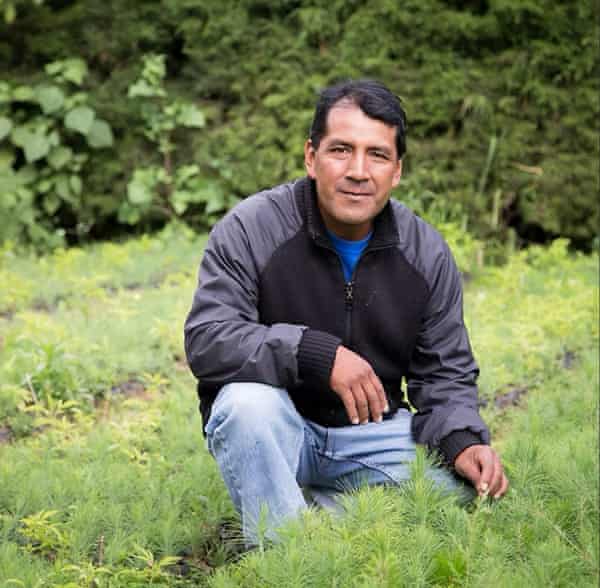
Photo: Zach Mordan.
Armando López Pocol, who set up Guatemala’s Chico Mendes Reforestation Project in 1999.
Sometimes I am just overwhelmed at the power of one person to make the world better. It may be the man who starts a regreening project on ruined land. It may be the woman who draws cheery pictures on patients’ insurance bills. It may be you when, after getting a long run-around on a robotic telephone chain, you are kind to the poor schlemiel who is the first human you talk to.
Let’s start with the artist in the billing department. Steve Hartman at CBS, recounts what happened to a patient called Melody Morrow.
“A few years ago, Melody Morrow of New York City hurt her foot and needed physical therapy. However, she said what really made her feel better was paying the bill.
” ‘On the envelope, on the front of the envelope, it had these little music notes,’ Morrow told CBS News of the billing statement she received in the mail, a play on her name, ‘Melody.’ …
” ‘This was a stranger,’ Morrow said. ‘And she was doing that just for me. And that’s the beauty of it.’ ” More at CBS, here.
Now let’s turn to Armando López Pocol in Guatemala. Suzanne Bearne has an in-depth report at the Guardian on what he started.
It begins, “Armando López Pocol is showing off some of the thousands of trees he has planted in Pachaj, his village in the highlands of western Guatemala, when he suddenly halts his white pickup truck. Alongside an American volunteer, Lyndon Hauge, he gazes out over a charred field. Clouds of smoke are still billowing from the ground.
“As he walks through the ash-covered field, his optimistic speech turns to sadness and he pauses in silence to take in the barren landscape.
“Before the fire, this 2-hectare (5-acre) plot of land in the mountains of Cantel was home to 2,000 trees, all planted through Pocol’s reforestation project.
“Over a quarter of a century, he and his small team of volunteers and community members have planted thousands of trees, regenerating the landscape of Guatemala’s highlands and mitigating the impacts of the climate crisis, while also generating revenue for local communities.
“Pocol initiated the Chico Mendes Reforestation Project in Pachaj – located 2,400 metres (7,900ft) above sea level and about 6 miles (10km) from the town of Quetzaltenango, known as Xela – in 1999. At that time, the region had suffered extensive deforestation over several decades.
“The organization was named after the Brazilian environmentalist Chico Mendes, who fought to preserve the rainforest and for Indigenous rights until he was murdered by a cattle rancher in 1988.
“ ‘The struggles he went through in Brazil are similar to the ones we go through in Guatemala,’ Pocol says.
“ ‘From the 1960s to the 1990s, there was a lot of deforestation in Cantel, as the wood was used extensively for building houses and as firewood for families,’ he says. ‘I started Chico Mendes to stop the deforestation, as I was worried about climate change and environmental problems in Guatemala, with mining companies destroying the community forests of Indigenous people.’
“He says deforestation is now largely caused by fires during the dry season, and attributes the latest one – the third in his fields so far this year – to an arson attack.
“ ‘We’re losing many tree plantations,’ he says, adding that the region lost more than 100,000 trees to fires in 2023 alone.
‘What keeps my spirit alive are the workers and volunteers showing their support and not giving up.’
“Since he embarked on his tree-planting mission, Pocol has become resigned to the fact that he cannot stop fires. ‘We just don’t have enough staff,’ he admits. ‘It’s expensive to have people out here watching all this land.’
“While he believes some of the fires are due to foul play, he says they have tried to reduce the number by creating fire corridors in the forests. …
“Pocol says his organization has not received any money. ‘We don’t receive funds from the government as we are against mining projects and environmental injustices in Guatemala, and we know that all the funds the government manages come from transnational companies.’ …
“Without a regular income, the Chico Mendes project depends on donations and a ‘volunteering fee’ (equivalent to about [$20] a day), which covers a homestay and three meals. Volunteers gather seeds, source decomposed leaves, fill bags with soil, and plant trees.
“Donations and the volunteering fee are crucial for Chico Mendes, as Pocol sees his initiative as much more than a reforestation project. The organization also supports the community through ecotourism, with funds circulating through the local economy via homestays and treks, as well as volunteers spending money in the village. …
“[Dr René Zamora-Cristales, outgoing director of the Latin American restoration initiative 20×20 at the World Resources Institute] praises Pocol’s work and says Guatemala needs more people like him. ‘Deforestation has always been an issue, but different efforts, such as the one from Armando, have reduced the overall deforestation in the country. We certainly need more local leaders committed to improving the livelihoods of local communities by restoring nature,’ he says.
“Pocol, who works on his project every day without a break, including weekends, and tops up his income in the evenings as an Uber driver, admits he is exhausted.
“ ‘I wake up in the night and wonder what the future is going to be for the project as there’s been a lot of difficult times. But I’ve never given up, and it always lifts my spirits when volunteers come.’ ”
More at the Guardian, here.
Posted in Uncategorized | Tagged guatemala, insurance bill, power of one, reforestation, regreening, volunteer | 7 Comments »

Photo: Atlantic Shark Institute.
A Great White shark.
Here I am on the island of New Shoreham reading about a Great White shark that people in Australia actually dared to rescue. Oy! Some sharks are harmless, but keep me away from that particular shark!
In New Shoreham, we know that warming seas are bringing more seals north. And seals, of course, mean lunch to the Great White. Grandchildren are told to keep clear of seals.
Recently, I read an Associated Press article at the Guardian about a different kind of shark adventure down under. A rescue.
“Tourist Nash Core admits he felt some fear when he and his 11-year-old son waded into the ocean off the Australian coast to help rescue a three-meter [10 foot] great white shark stranded in shallow water.
“Three local men managed to return the distressed animal from a sand bank into deeper water after an almost hour-long rescue effort [near] the coastal town of Ardrossan in South Australia.
“ ‘It was either sick or … just tired,’ said Core, who was visiting with his family from the Gold Coast in Queensland. ‘We definitely got it into some deeper water, so hopefully it’s swimming still.’
“Core came across the unusual human-shark interaction while traveling around Australia with his wife, Ash Core, and their sons, Parker, 11, and Lennox, 7.
“Nash Core used his drone to shoot video of the writhing shark before he and Parker decided to help the trio who were struggling to move the shark into deeper water. …
“The three men had used crab rakes – a garden rake-like tool for digging small crabs from sand – to move the shark into deeper water by the time the father and son arrived. …
“ ‘They … got it into deeper water where I thought it’s probably not a good idea to go any further. That’s its territory and I’ll stay back,’ he said. …
“Macquarie University wildlife scientist Vanessa Pirotta said while shark strandings were not common, they were becoming more visible through social media. …
“ ‘If you see something like this, human safety comes first and foremost,’ Pirotta said. ‘You can contact environmental authorities … who will get someone appropriate to come and assist.’ More at the Guardian, here.
Meanwhile, here is a relevant research project being conducted at the Atlantic Shark Institute. It’s called “White Shark and Seal Interaction — Block Island, RI.”
“The focus of this study is the White Shark (Carcharodon carcharias), a growing Gray Seal (Halichoerus grypus) population, and the potential for interaction between the two in the waters off Block Island, RI.
“Through the use of an extensive acoustic array, the tagging of white sharks and seals with acoustic transmitters, the tagging of seals with satellite (SPLASH) tags, and detailed seal counts and assessment using cameras and visual counts, the team hopes to better understand the ecology of white sharks and gray seals in this area, and potential interactions between the two.
“With a wide variety of white sharks being tagged (young-of-the-year [YOY], juvenile, sub-adult and adult) and little baseline data for either species at Block Island, this is a unique opportunity to investigate if and when predator-prey dynamics are established. The Atlantic Shark Institute, RI Department of Environmental Management, Mystic Aquarium, NOAA Northeast Fisheries Science Center, Dr. Greg Skomal, Atlantic Marine Conservation Society and the Block Island Maritime Institute are collaborating on this study.”
Read about other Atlantic Shark Institute studies here.
Posted in Uncategorized | Tagged Atlantic Shark Institute, australia, block island, Great white shark, rescue, research, seal, shark | 8 Comments »

 Suzanne's Mom's Blog