Feeds:
Posts
Comments

Art: Charles Arthur Cox, “Bearings” (1896), via Hyperallergic.
Art Nouveau posters often reflect both a love of books and young women enjoying more freedom.

Do you like the Art Nouveau, a style identified as roughly 1890 to 1910 in Europe? After reading about the literary posters of that time, my already considerable appreciation for it is has only increased.

Sarah Rose Sharp writes at Hyperallergic about a recent exhibition at the Metropolitan Museum of Art in New York.

“The literary poster occupies a special place at the intersection of American art history and literature. Advances in color printing technology at the end of the 19th century made way for a flood of colorful and intricately detailed materials, often in the form of handbills and posters, which were suddenly more affordable as a vehicle to advertise the latest books, magazines, periodicals, and other forms of literature.

“Accompanying an eponymous exhibition at the Metropolitan Museum of Art, The Art of the Literary Poster: The Leonard A. Lauder Collection illuminates the expansive genre through several examples culled from the titular collection, accompanied by essays on the form by exhibition curator Allison Rudnick, scholar Jennifer A. Greenhill, paper conservator Rachel Mustalish, historian Shannon Vittoria, and Lauder himself. …

“Both historically astute and visually delightful, the book captures the influence of the Art Nouveau movement on printed materials at the turn of the century, as well as showcases the evolution of graphic design as innovations in multi-color plate printing that allowed text and imagery to come together in increasingly complex ways. Vittoria’s essay highlights the particular power of literary posters as a genre ‘by women, for women,’ noting that American illustration was one of the few professions young women were encouraged to pursue at the time.

” ‘As male artists and critics worked to defeminize illustration by minimizing women’s contributions to the field, female artists and advocates saw the potential of the visual arts, particularly printed media, to advance the campaign for women’s suffrage,’ Vittoria writes. ‘The art poster became a potent tool in this struggle.’

“Turn-of-the-century literary journals like Lippincott’s Monthly Magazine and Harper’s were some of the first publications to avail themselves of this new technology, with cover art featuring thoroughly modern Gibsonesque girls riding bikes, snuggling cats, and of course, reading. Though the magazine and visual digest Bradley, His Book was only published between 1896 and ’97, the cover works by Art Nouveau illustrator and film director William H. Bradley, its publisher, are dazzling examples of the intricacies made newly possible in literary art posters. …

“In her catalog essay, Rudnick examines a cover of the July 1896 issue of Lippincott’s as the essence of the burgeoning form. Created by Joseph J. Gould Jr., the image features a woman in a day suit equipped with the exaggerated sleeve caps and narrow skirt of the era, perched calmly on a bike with a straw hat on her head, which partially obscures the masthead’s bold red letters. She is biking out of a richly blue background, presumably off to enjoy the copy of Lippincott’s held against the handlebars in her right hand.  ‘The poster itself represented something new: an advertisement that looks and functions like a work of art,’ Rudnick writes, ‘an image made for public consumption in which commercialism and culture coalesce.’

“The distinctive print also captures the spirit of new possibilities for women, as a cavalcade of unbothered women on bikes became the visual heralds of the era’s first-wave feminism that paved the way for women’s movements of the following century. A 1911 ‘Votes for Women‘ poster by artist and educator Bertha Margaret Boyé, chosen as the winner of a poster competition held by the San Francisco College Equal Suffrage League, embodies this renewed sense of possibility as a woman in flowing yellow robes stands before a landscape displaying the titular banner. Behind her, the rising orange sun halos her head, giving the effect of saintliness while hinting at the dawning of new opportunities.

“Full of aplomb women on bikes with literary and political ambitions (and, of course, cats), The Art of the Literary Poster gathers inarguably beautiful printed materials that — even beyond their political and promotional implications — demonstrate the elegance, interests, and aesthetics of a pivotal moment in art history.”

Check out the gorgeous collection of posters at Hyperallergic, here. No firewall. Subscriptions encouraged. And for those interested in learning more about Art Nouveau in general, see at Wikipedia, here.
Weaver and Shepherd

Photo: John Burcham.
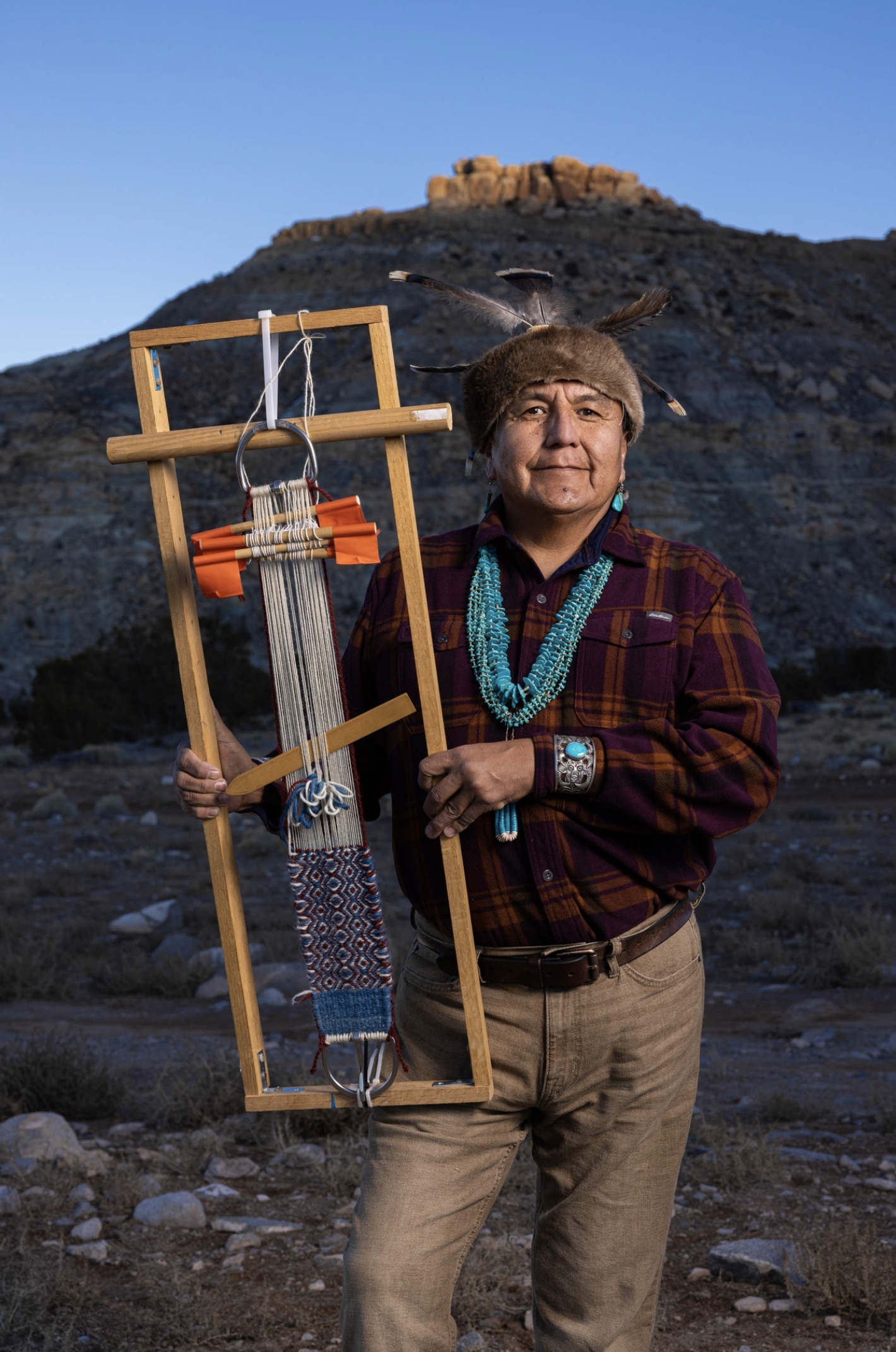
Textile weaver and fiber artist Roy Kady.

Today’s story is about a man for whom work and art are inseparable: Navajo weaver Roy Kady.

Elaine Velie at Hyperallergic conducted the interview.

“Diné weaver and fiber artist Roy Kady sat down for a video interview wearing a shirt that read ‘Sheep is life.’ Kady is a shepherd and an artist, roles he sees as definitively intertwined. ‘I am first a shepherd, then art comes with it,’ he said.

“Kady’s decades-long career has been one of constant learning, and in recent years, teaching. He shares weaving techniques and Diné stories that he says are too often missing from younger generations. Kady spoke to Hyperallergic about Diné conceptions of gender, apprenticeship in his small Arizona town, and being accepted as a gay man in his community.

Hyperallergic: What are your earliest memories of weaving, and how did your mother’s practice influence your own?

Roy Kady: My sisters and I grew up in a single-parent household where my mother brought us up, so we were taught everything from building a house to repairing a roof to working under the hood of a vehicle, the sort of things the colonized world would call ‘man’s work.’ We learned inside, too. From washing dishes and getting the house tidied up to cooking and baking, we did what would be considered ‘women’s work.’ But for us, it’s not.

“I was taught about weaving at the young age of nine years old. I have some recollections before that of sitting by my grandmother, grandfather, and mother, who all also partook in fiber arts — weaving and processing the fiber. My mom gifted and shared weaving techniques with me: vegetable dyeing and some of the family designs that came with it. I was fortunate; I was given the tools she and our kin relations had, and that’s what inspired me to become an artist. We learned farming and goat and sheep herding, too. …

“Sheep provide you with sustainability, food, and the opportunity to learn how to maintain the land. We take care of them so that they can take care of us.

“As a shepherd, you know what they like to eat and what keeps them healthy. They also know that themselves, so they’ll take you on journeys to where particular plants exist. On those journeys, you’re able to be inspired by color and the environment, by the mesas. You start to see geometric forms that you can bring back to your weaving repertoire.

“That’s what traditional Navajo weaving is: an interpretation of your environment. A lot of my earlier pieces were designed with that in mind. They’re not necessarily just stripes; they represent rainbows. They’re not just step patterns; they’re mesas or clouds.

“There’s a whole opening of the universe that is represented. In order to understand and have that knowledge, you must have the knowledge of shepherding. But it’s a rarity now because there are not many shepherds. The sheep population has really declined. Navajo fiber artists and textile weavers create beautiful artistry, and while they may no longer have herds, they have memories from their grandparents or parents or maybe from within themselves around growing up with sheep. …

“My mother would sometimes say something like, ‘You’re at the age when you are going to learn about horsemanship.’ She was a horsewoman type. She would teach us, then she would want us to ask a neighbor or other kinfolks to learn other forms. I remember growing up and learning a lot from the neighboring kids. We would go to their houses and learn different types of fiber arts, traditional recipes, or plant foraging. …

“I would go spend a day, a weekend, or even a month in their home and helping them with their livestock. That’s how I would earn the opportunity to learn from them. They’ve always told me that this knowledge doesn’t just belong to one individual, saying, ‘It was gifted to me. It goes all the way back to the creation story.’ That’s how I model my apprenticeships now. …

“I don’t just use wool. I use anything that’s of natural origin, including tree bark and wild cotton, nettle, silk, you name it — whatever I can get my hands on. If I can find somebody who says, ‘I have a herd of bison,’ then I say, ‘What do you do with their wool?’

H: Are there any works that you particularly love?

RK: That would be the one titled ‘Shimá,’ meaning ‘my mother.’ I would wheel her into the sheep corral in her wheelchair, and the sheep knew who she was and come up and greet her. They knew the scent of her hands and how she cared for them. I took a beautiful picture of her making those interactions and decided to weave it. I broke ground for myself by incorporating all different types of techniques that I’ve learned along my weaving journey. At this point, that would be my favorite. …

H: Are there any projects you’re working on now or that you’re excited to start in the future?

RK: There’s an upcoming gallery exhibit near us in Cortez, Colorado, that I’m starting with my grandson, Tyrell Tapaha. He’s come back to learn about shepherding and be my apprentice. We’re doing a collaborative type of show. I will show what took place between the two of us, and it will include his interpretation of what I taught him about sheep, the landscape, or a particular plant.

“We are utilizing what we call barbed wire art. When you’re a sheepherder in this country, you have barbed wires lying around everywhere that are rusty, but we create these wonderful shapes and incorporate that into our textiles or fiber work. We’re excited to venture.”

Read more and see how the artist wove an image of a sheep at Hyperallergic, here. No firewall. Subscriptions encouraged.

Photo: University of the Witwatersrand.
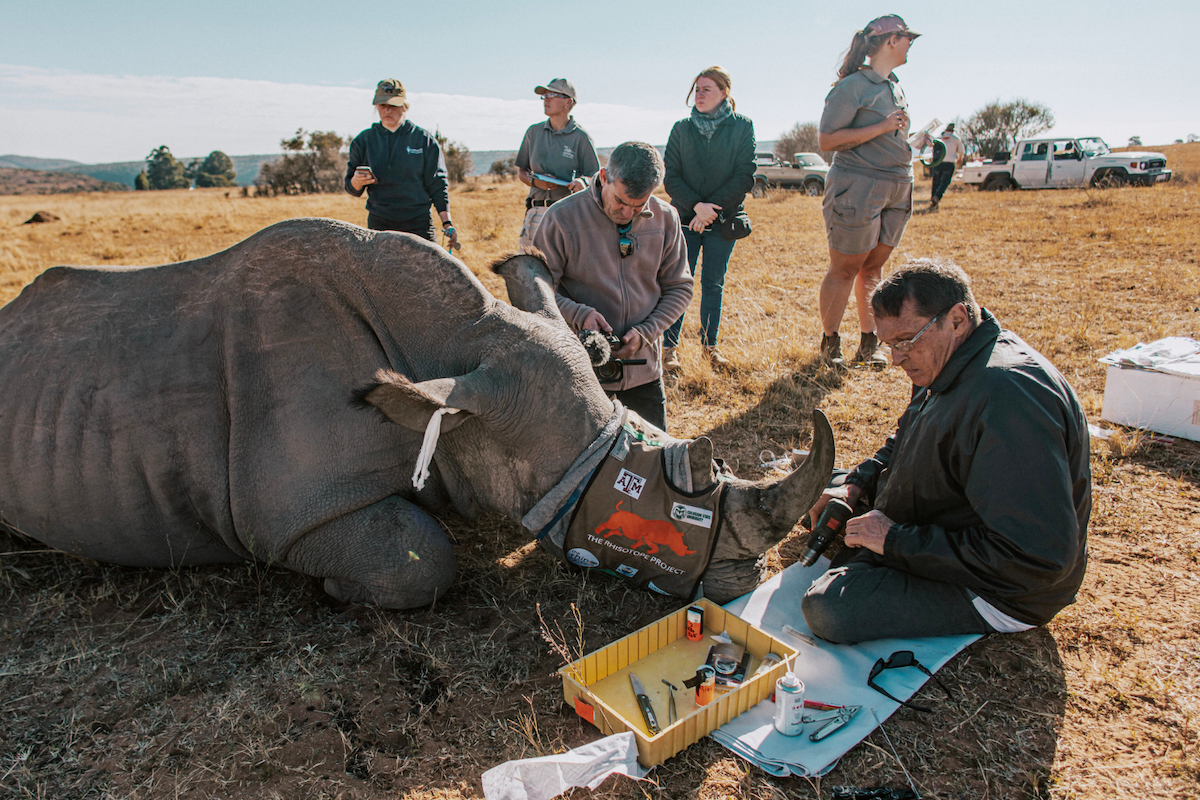
To protect rhinos and scare off poachers, researchers add radioisotopes to a rhino horn at the Waterberg Biosphere Reserve in South Africa. 

Who would think of protecting endangered rhinos by injecting something radioactive into their horns? Researchers in Africa, that’s who.

YaleEnvironment360 reports that “South African researchers have inserted radioactive material into the horns of 20 live rhinos. Their goal: to track horns from rhinos that were hunted illegally.

“Researchers say radioisotopes added to horns would be picked up by radiation detectors at airports, harbors, and border crossings, and so would send up a red flag. There are more than 11,000 such detectors at ports of entry around the globe, part of a vast infrastructure aimed at stemming the flow of illicit nuclear material. And the thousands of security personnel devoted to operating these detectors far outnumber officials working to stem the illegal wildlife trade.

“ ‘Ultimately, the aim is to try to devalue rhinoceros horn in the eyes of the end users, while at the same time making the horns easier to detect as they are being smuggled across borders,’ said project lead James Larkin, of the University of the Witwatersrand in Johannesburg.

“ ‘Every 20 hours in South Africa a rhino dies for its horn. These poached horns are then trafficked across the world and used for traditional medicines, or as status symbols,’ Larkin said. ‘This has led to their horns currently being the most valuable false commodity in the black-market trade, with a higher value even than gold, platinum, diamonds, and cocaine.’ “

The University of the Witwatersrand website adds: “These radioisotopes will provide an affordable, safe and easily applicable method to create long-lasting and detectable horn markers that cause no harm to the animals and environment. At a later stage, the work will expand to elephants, pangolins and other fauna and flora. …

“Starting on Monday, 24 June 2004, Professor Larkin and his team carefully sedated the 20 rhinos  and drilled a small hole into each of their horns to insert the non-toxic radioisotopes. The rhinos were then released under the care of a highly qualified crew that will monitor the animals on a 24-hour basis for the next six months. ‘Each insertion was closely monitored by expert veterinarians and extreme care was taken to prevent any harm to the animals,’ says Larkin. ‘Over months of research and testing we have also ensured that the inserted radioisotopes hold no health or any other risk for the animals or those who care for them.’    

“The development and application of the Rhisotope Project nuclear technology has the capacity to help deter poaching, increase the detection capabilities of smuggled horns, increase prosecution success, reveal smuggling routes and deter end-user markets.

“Rhino poaching reached crisis levels since 2008 where close to 10 000 rhinos were lost to poaching in South Africa, with wildlife trafficking being the third biggest organized crime globally.

“Professor Lynn Morris, the Deputy Vice-Chancellor: Research and Innovation at Wits University says: ‘This is an example of how cross-disciplinary research and innovation makes a real difference. This novel approach pioneered by Prof Larkin and his colleagues has the potential to eradicate the threat of extinction our unique wild-life species, especially in South Africa and on the continent. This is one of many projects at Wits that demonstrates research with impact, and which helps to address some of the local and global challenges of the 21st Century.’

“The Rhisotope Project at Wits was set up by a small team of likeminded individuals as a South African-based conservation initiative in January 2021 with the intention of becoming a global leader in harnessing nuclear technology to protect threatened and endangered species of fauna and flora as well as communities of people.

“Aside from developing a solution to combat the illicit trade and trafficking of wildlife products, the Rhisotope Project seeks to provide education and social upliftment to empower people and local communities. A special focus is aimed at uplifting the girls and women of rural communities, who are often the backbone of these communities in the remote areas where endangered species are found and are the greatest components of success in changing the hearts and minds of local communities thereby creating rhino ambassadors and champions.”

More at Yale e360, here, and at the university’s website, here.

Photo: South China Morning Post composite/Zhihu.
“Teeth Playing” is one of China’s most terrifying, and difficult, forms of folk art. Performers manipulate up to 10 wild boar tusks at a time with their mouths. 

At Halloween in the US, children often think it’s fun to be vampires and go trick-or-treating with scary wax fangs in their mouths. But the fake dentures soon come out and go in a pocket because they are so uncomfortable.

In China, there’s a performance art that involves singing with actual boar tusks in the performer’s mouth. Talk about uncomfortable! At the South China Morning Post, you can see a photo of the damage that tusks are causing a young performer.

Zoey Zhang reports on the strange art of “teeth playing.”

“A performer with a fierce makeup conceals the tusks of several wild boars in their mouth, flipping them up and down with their tongue and teeth. Throughout this process, they need to sing, read and dance.

“It could well be the most terrifying, and most difficult, folk art in China. It is called shua ya, which literally means ‘teeth playing.’

“Shua ya is a stunt used in traditional Chinese opera designed to portray the dark, dangerous and complex psychology of villainous characters.

“The tusks of male wild boars that it uses are polished and disinfected and usually reach the length of an adult index finger.

Performers need to manipulate four to 10 tusks in their mouths, using their lips, teeth, and breath to make them move, conveying the emotions of characters.

“Lowering the tusks indicates relaxation and satisfaction, while shaking them vigorously indicates anger. …

“Shua ya has a history spanning over 400 years and is a distinctive feature of opera performances in Ninghai, a county located in Zhejiang province in eastern China.

“The most classic shua ya performance is Jinlian Slays Jiaolong. Jiaolong, or the Chinese water dragon, diverges from the auspicious portrayal of Chinese dragons, causing chaos and bringing misfortune to people. Artists portraying Jiaolong need to master shua ya to perform the part of a villain.

“The stunt is recognized by the government as an intangible piece of cultural heritage. Due to the arduous training process, the art form is on the brink of extinction. Its exponents must keep sharp tusks in their mouths at all times, except when eating or sleeping, until they can speak clearly. It typically takes over a decade of practice to fully master.

“Xue Qiaoping, 41, from Zhejiang province, is a sixth-generation inheritor of China’s shua ya art and one of its few female performers.

“She told China Central Television: ‘When training with eight tusks in my mouth because they are very hard, my entire gums were worn out. I couldn’t eat or drink for a week, only relying on intravenous drips for nutrition.’

“When she reached 10 tusks, Xue needed to use both hands to open her mouth wide enough to fit in all the teeth. Her mouth cracks after each performance.

“Meanwhile, Li Yi, 19, from Henan province in central China, is a shua ya artist with 1.4 million followers on Douyin. He has been practicing this stunt for eight years.

“ ‘My mouth has torn and ulcerated more than 70 times, my jaw muscles enlarged, my teeth were ground down and my appearance changed dramatically,’ Li said. ‘But I am willing to devote my youth entirely to traditional culture.’ “

More at South China Morning Post, here. No paywall.

Photo: West Virginia University.
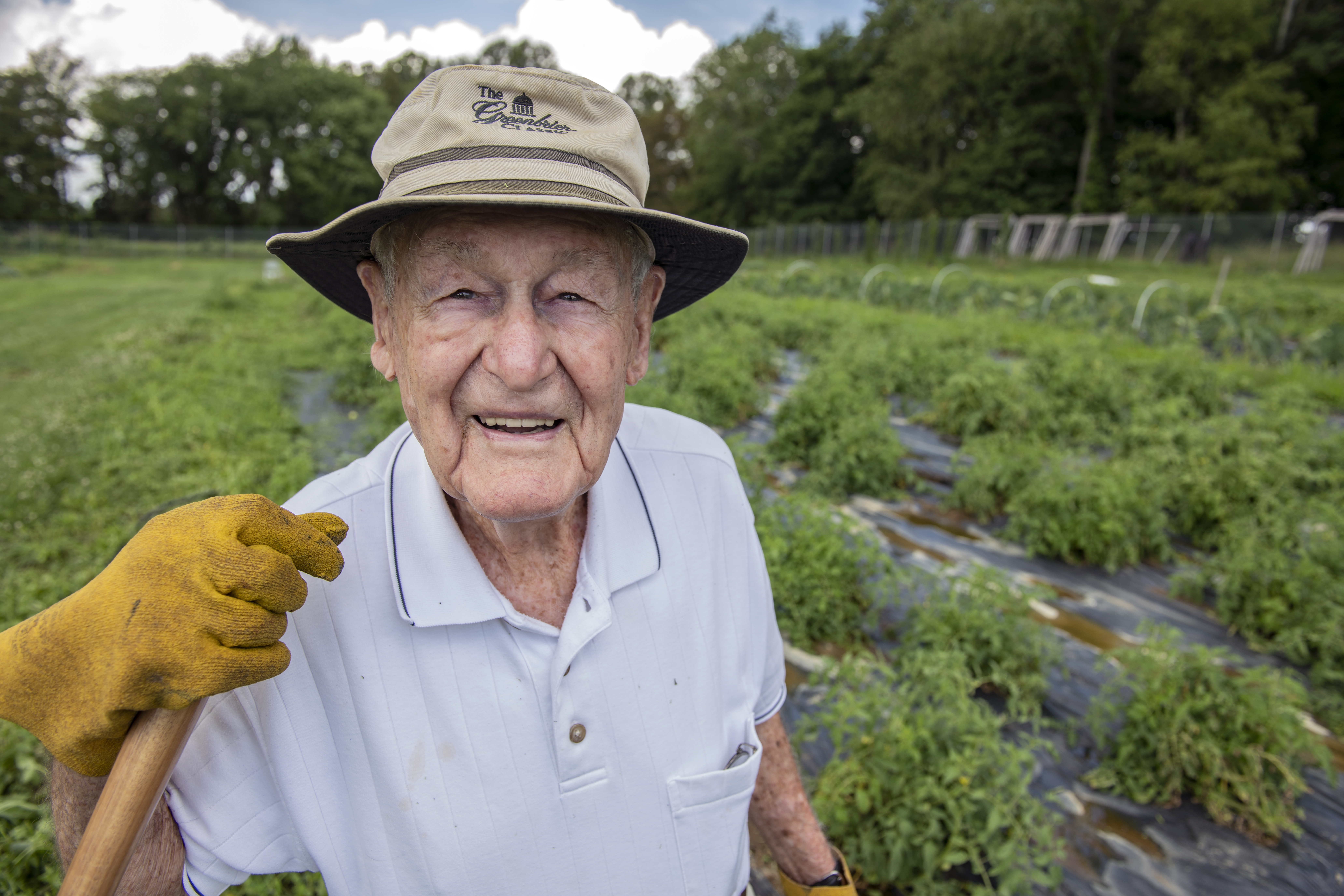
Mannon Gallegly, WVU plant pathology professor emeritus, has created four tomato varieties, including his last, “Mannon’s Majesty,” free to West Virginians.

For a short time in my childhood, I was a member of a 4-H club and won a $0.75 check for a tomato that my father really grew — a check I failed to cash before it expired!

I still love tomatoes. This is the time of year for gorgeous tomatoes. Ashley Stimpson writes at the Washington Post about the 101-year-old West Virginia professor who brought four special varieties into the world, including one he made free to West Virginians.

“You may not have heard of Mannon Gallegly, but chances are you’ve eaten one of his tomatoes, and perhaps even grown one in your garden. More than 60 years ago, Gallegly bred the first tomato that could stand up to Phytophthora infestans, otherwise known as tomato blight. The West Virginia ’63, sometimes called ‘the people’s tomato,’ is still a seed-catalogue superstar and beloved around the world, gracing gardens from Alabama to Africa.

“This year marks the first time since 1949 that Gallegly, who moved into a nursing home after falling ill in the spring, has missed the annual planting. … This morning’s planters are a mix of graduate students from WVU’s Davis College of Agriculture — where Gallegly worked for 38 years — and volunteers who have known the plant pathologist for decades. Gallegly developed three more hardy tomato varieties since 1963, each of which has claimed a spot in this year’s field, including his latest and likely his last.

“After the college publicized the release of the tomato, called Mannon’s Majesty, earlier this year — noting that it was free for any West Virginian who wanted seeds, per Gallegly’s insistence — WVU’s greenhouse manager Whitney Dudding came to work the next Monday morning to find 2,000 email orders waiting in her inbox, a number that far outstripped availability. …

“Until very recently, Dudding held out hope Gallegly might make it to the organic farm for the occasion. … ‘Every year, even last year, he’s been out there on the soft soil, out there in the heat, walking around, right there with us,’ she says. ‘I really don’t know how he does it.’

“The son of a carpenter and a school dietitian, Gallegly grew up in the rural southwest corner of Arkansas. ‘We were pretty poor people,’ he says. During the Great Depression, his parents grew cotton on rented land, where Gallegly logged the first of many hours spent walking between crop rows.

“A teacher from Future Farmers of America inspired Gallegly to attend college, and a Sears Roebuck scholarship made it financially feasible. After graduating from the University of Arkansas with a degree in agriculture, Gallegly went to the University of Wisconsin to get his master’s in plant pathology, working on a rice disease called white tip.

“In June 1949, Gallegly arrived in Morgantown. … ‘That was my favorite month,’ he recalls. ‘I had a new job, I had a new wife, I had a new baby.’ He also had a new three-acre research farm on the grounds of the nearby medium-security prison, where he could conduct trials on plant diseases, including tomato blight.

“By the following summer, Gallegly’s fields swayed with potato and tomato plants of all different varieties. Then disaster struck. ‘The disease farmers and gardeners feared most’ arrived, he says: late blight. The pathogen leaves ugly brown bruises stretching across the leaves, stem and fruit until the plant looks like it’s been blasted with a blow torch.

“That year, Gallegly lost nearly his entire crop of tomatoes to late blight — except for a few wild varieties with tiny fruit that showed a curious resistance to the disease.

“In the 1950s, late blight was more than just an annoyance for the home gardener. In the right conditions, Phytophthora infestans, which is Greek for ‘plant destroyer,’ can wipe out entire food supplies, as it did during the 1840s, when about 1 million people starved during the Irish Potato Famine. …

“For 13 years, Gallegly worked on developing an indestructible tomato, crossing those initial wild varieties that showed genetic resistance to blight with popular commercial tomatoes. …

“Finally, he stumbled upon a variety that was both blight-resistant and delicious. ‘Good things happen sometimes,’ he says.

“Gallegly, who primarily views himself as a public servant, called his creation ‘the people’s tomato.’ When it was released to the public in 1963 as part of the state’s centennial celebration it was given a new name: the West Virginia ’63. …

“Gallegly retired in 1986, but that didn’t stop him from coming into work every day. …

“In addition to writing books and breeding tomatoes, Gallegly has mentored countless plant pathologists getting their start in Morgantown. Dudding, who has helped Gallegly with cultivating diseases (to test for resistance in plants) and crossbreeding, ‘because my hands were smaller and steadier than his,’ says the scientist ‘is never in a hurry. He has always had time to talk to me and teach me.’

“WVU graduate student Inty Hernández, who’s been working with Gallegly on breeding new tomatoes, agrees, saying: ‘He’s very supportive all the time. It has been very inspiring to work with him. Sometimes you feel tired, you know, and then you arrive to the greenhouse and there’s a 100-year-old man hard at work.’ ”

More at the Post, here. Is your garden producing tomatoes right now?

A Plastic-Free Month

Photo: Naja Bertolt Jensen/Unsplash.
Can we ever escape plastic?

When I think about all the plastic we have created and put into our landfills and oceans, I am close to despair about ever cleaning it up.

Still, there are always people willing to fight the odds. Consider the initiative called Plastic Free July. Jacob Fenston has the story at the Washington Post.

“The idea took root in Australia more than a decade ago, and in recent years it has been gaining popularity in the United States. It all began when Rebecca Prince-Ruiz visited her local recycling sorting center in Perth, Australia, in 2011. She had always thought of herself as being eco-conscious, but after looking around at the heavy machinery sorting an endless stream of bottles, tubs, jars, cans and boxes, she had an aha moment.

“ ‘I suddenly realized that filling my recycling bin each fortnight didn’t make me the great green citizen I thought I was,’ Prince-Ruiz says. ‘The most important thing I should be doing was actually reducing my waste in the first place.’

“She decided to try to avoid single-use plastic for an entire month. The next month happened to be July. So Plastic Free July was born.

“Since then, the idea has spread around the globe. According to the Plastic Free Foundation, the nonprofit that Prince-Ruiz founded, 89 million people in 190 countries pledged to reduce their plastic use during July last year. The countries with the most participants are China and India.

“Over the last five years, participants have avoided more than 1.5 million tons of plastic waste, according to the campaign. That’s enough to fill about 80,000 garbage trucks. …

“Sending anything to the landfill or incinerator has a negative impact on the environment. But plastic is particularly problematic, experts say.

“ ‘Plastics are one of the greatest threats facing our planet today,’ says Melissa Valliant, a spokesperson for Beyond Plastics, a plastic-pollution-fighting nonprofit. … ‘We are not going to recycle our way out of this problem,’ Valliant says.

“Plastic waste chokes oceans and the creatures who live there. And plastic production is a major contributor to climate change: The industry emits four times the planet-warming emissions as the airline industry, according to a recent U.S. Energy Department report.

“But from the beginning, the Plastic Free July campaign has focused on solutions rather than the problem. In fact, the campaign’s website contains almost nothing about the harms of plastic, other than its sea turtle logo — a reference to one of the animals most at risk from ocean plastic.

The website offers ideas for plastic-free beginners — small changes like using reusable shopping bags. There are also suggestions for those further along the journey, including making your own toothpaste, sans plastic tube.

“Prince-Ruiz says that first plastic-free month was harder than she’d thought it would be. … Her best advice for newbies: Don’t try to quit plastic cold turkey. Instead, start with a quick inventory of your plastic use — go through your fridge and pantry and trash — and choose one or two places to work on eliminating or reducing your consumption. …

“Freweyni Asress, a D.C. resident who has written about living a zero-waste lifestyle, recommends finding a buddy or two to do the plastic-free challenge with.

“ ‘When there’s a community of people participating in something like Plastic Free July, it really reinvigorates you,’ Asress says. …

“Of course, going plastic-free can be more challenging depending on your circumstances. In the Midwest, for example, store clerks are not always receptive to the idea of skipping plastic bags, Harper says. On one shopping trip where he was only buying a few things and didn’t need a bag, the checker forced one on him, citing concerns about shoplifting.

“ ‘She would not let me leave without a bag,’ Harper says.

“When Asress started her zero-waste journey in 2016, she was working at a food co-op that had a large bulk section and many plastic-free products. But she found not all plastic-free products worked for her.

“ ‘A lot of the hair products that were sustainably packaged or provided in bulk bins were specifically for White people’s hair,’ says Asress, who is Black. … ‘It has to be practical, and we have to be able to figure out ways to be able to include everybody.’ …

“Valliant says the key is to move away from disposable containers and packages and go with materials that can be used over and over. Refundable deposit systems can make this economical.

“Travel to Latin America, Africa or Asia, for example, and you’ll find refillable soda and beer bottles are still common — each one can be filled, purchased and returned as many as 30 times before it breaks or is worn out.”

More at the Post, here.

Mariachi in Schools

Photo: Scott Ball / San Antonio Report.
The SWISD mariachi band performs during a school event at Stinson Field, San Antonio, Texas, in February. 

When education programs unite with family culture and community culture, a unique energy is born, and students are more likely to stay in school. That can be seen in this story from south Texas.

Nicholas Frank writes at the San Antonio Report, “In 1969, educator Belle Ortiz introduced mariachi to a ballet folklórico class at Lanier High School, which soon added a dedicated mariachi class. 

“Over the next decades, Ortiz’s pioneering effort would grow into dozens of mariachi education programs in middle schools, high schools, colleges and universities throughout the San Antonio area, now serving more than 2,000 students in 17 schools in the San Antonio Independent School District (SAISD) alone. …

“Musician Juan Ortiz met Belle Ortiz in that Lanier folklórico class, and the pair would emerge as changemakers establishing mariachi as an educational mainstay in the region, building off of deep Mexican American cultural roots throughout South Texas.

“Belle Ortiz spearheaded the first collegiate-level mariachi education program in 1974 at San Antonio College, and Juan Ortiz and musician Pete Moreno are widely credited with creating the first university mariachi program at Texas A&M University at Kingsville, a program that still flourishes today

“Northside ISD Director of Fine Arts James Miculka said he’s regarded as a person who could sell a tree off of an asphalt lot, but more than salesmanship helped him secure his district’s first mariachi education programs in the 1990s.

“Belle Ortiz served as Miculka’s primary research contact for his music education degree studies at UTSA because he ‘was working on a middle school band curriculum that had more cultural pieces and connected to the Hispanic population’ in a way that his knowledge of jazz and classical music did not.

“A professional trumpeter, Miculka had experience performing in salsa bands and developed a special appreciation for the art form of mariachi when he witnessed firsthand the professional mariachi ensemble assembled by Juan Ortiz for Fiesta Texas.

“Seeing and hearing the array of trumpets, violins, guitars and vihuelas, Miculka said his ‘jaw hit the floor. When I heard that I thought, “Holy cow, this is what a mariachi group should really sound like.” ‘ …

“Miculka hired Roland Sandoval as music director of the program established in 1990 at John Jay High School. Miculka then expanded to start a program at Holmes High School and created ‘feeder’ programs at middle schools in the district. …

Both Miculka and Sandoval credit parents in their districts with establishing the importance of formalized mariachi education programs.

“ ‘It’s such a visible part of our culture,’ and when parents realized their children could access the traditional music through formal education, ‘they started advocating for that,’ said Sandoval. …

“Cynthia Muñoz has been working to bring visibility to the art form of mariachi for decades, starting the Mariachi Vargas Extravaganza competition in San Antonio in 1995.

“The annual competition invites high school mariachi groups from around the country to hone their skills toward winning recognition in the prestigious event, with groups from the Rio Grande Valley regularly winning top honors.  

“Muñoz credits Belle Ortiz with inspiring her own work to promote mariachi culture, having witnessed Ortiz’s first mariachi festival in San Antonio in 1979 featuring the world-renowned Mariachi Vargas de Tecalitlán

“ ‘This had a significant impact on me as a young teenager as I realized that our culture, music and history was way deeper and more beautiful than I ever could have imagined,’ Muñoz wrote in a Facebook memorial post commemorating Ortiz’s influence. …

“Education programs need certified teachers. Miculka said that as mariachi learning evolved from being passed along through families to professional apprenticeships and public school programs, musician John Lopez saw the demand and led the effort to establish a mariachi-focused degree-level program at Texas State University in San Marcos. …

“Lopez said the Kingsville program ‘was like lighting a match,’ with students going on to create ensembles at schools in their home communities throughout the Rio Grande Valley and South Texas, many of which have been formalized as programs as those former students rose into the ranks of school administrations. …

“Despite overall growth in mariachi education programs, Poe Middle School mariachi director Augustine Ortiz nearly lost his program in February, with SAISD facing declining enrollment, budgetary tightening and school closures. But Poe principal Elizabeth Castro was able to save the program through a special allocation, in part because hundreds of students prioritized their mariachi studies.

“Studying mariachi not only creates enthusiasm for his students to come to school, Ortiz said, but helps them excel overall. ‘The standard of the students’ education is rising when they’re in programs like these,’ he said. ‘What helps is that it’s culturally relevant to them since we do have a huge Mexican American population in our school.’

“Ortiz said he has been open with his students about the challenges faced by the programs. ‘They need to learn that we need to advocate for ourselves,’ he said. ‘That way we can get the best education [for] our students, not just currently but in the future as well.’ …

“ ‘There’s a supply and demand now for mariachi teachers,’ he said. ‘If you’re gonna go into music education right now, the place to be is mariachi education.’ ”

More at San Antonio Report, here.

Photo: Melanie Stetson Freeman/CSM Staff.
Jason Tackie’s summer job is at Parkway Community YMCA in Boston.

I was a day-camp counselor, my husband scooped ice cream back in the day and delivered newspapers, my sister checked out grocery-store items. Those were a few of the typical summer jobs people had.

Then came the years when it seemed like no one was taking those jobs anymore unless they were on a work-first-and-tour-America program from Eastern European or Turkish universities. US young people were taking internships at hedge funds and that sort of thing.

Now the Christian Science Monitor says summer jobs are back, at least according to a Northeastern University study of the Boston area.

Reporters Troy Aidan Sambajon and Oli Turner write, “Getting a summer job used to mean scooping ice cream at the mall or working the drive-thru at Burger King. Then came the Great Recession, followed by a rush for teens to spend their summers padding their college résumés with coding and language camps.

“That changed again when the world closed for COVID-19, and then reopened. Not all adults returned to their jobs. The virtual ones came and went. Enter the teenage worker. …

“The year before the pandemic, teens accounted for just over 2% of new hires, according to Gusto, a human resources and payroll company. In 2023, teens accounted for 20% of new hires. This summer, the share of teens working or looking for work hit a 14-year high – 38%, reversing a decades-long decline, according to the Bureau of Labor Statistics

“ ‘Employers suddenly rediscovered teenagers as an important source of labor in the post-COVID economy, when adults realized they didn’t want to come back,’ says Alicia Sasser Modestino, associate professor at Northeastern University, who has been surveying Boston’s summer employment program for nearly a decade.

“The return of teens to lifeguard stations, grocery checkout lines, and summer camps has benefits beyond the paycheck, according to experts and the teens themselves. In addition to learning CPR or how to run a social media campaign, teens interviewed talk about learning financial literacy, planning for their future, and feeling part of a community. 

“Consider Jayden Orr, 16, who just started in July at ABCD SummerWorks in Boston. …

“ ‘The main thing that’s on my mind lately is my family,’ says Jayden, ‘because I got to help my family out. That’s how the family’s gonna eat.’

“Zariyah Witherspoon, 17, also helps out her family, giving her mother $100 from her paychecks, the bulk of which she’s saving for college. …

“Zariyah talks about growing up at the South Street Youth Center and finding her passion in the center’s boiler-room-turned-recording studio. As a 10-year-old, she helped replace the youth center’s floors and paint the walls a cheerful blue. She says the program and the mentorship she has received from her manager have helped her focus on her future. …

” ‘Nearly 70% of the young people in the summer jobs program are using some of their earnings to pay some kind of household bill. They’re helping pay rent, groceries, or utilities,’ [Modestino] says. ‘They’re paying for their own cellphone or their own clothes now.’ 

“Allison Vernerey has been handling hundreds of applications a day. As executive director of the city’s Office of Youth Employment and Opportunity, she has also been meeting with families to place their youths in the right job.

“The pandemic was especially tough for teens, says Ms. Vernerey. ‘I speak to a lot of the parents. … There’s really this eagerness to in some way catch up and make sure that the youth are set up for success in the future.’ …

“The benefits of a summer job can shape teens’ academic and social success in both the short and long term, according to a 10-year study conducted by Northeastern University on Boston’s teen summer employment programs. 

” ‘In the short term, young people increase their aspirations to go to college, have higher GPAs, and less absenteeism in school,’ says Dr. Modestino. …

“In the long term, the social-emotional skills developed on the job also reduce anxiety and conflict by training youths to deal with stressful situations. ‘We found that those soft skills – like managing emotions, resolving conflicts with a peer, and asking adults for help – those things are highly correlated with a reduction in criminal justice involvement. Young people in the program are 35% less likely to be involved in a violent crime and 29% less likely to be involved in a property crime,’ says Dr. Modestino. …

“ ‘What I see is that more kids are getting jobs because parents aren’t always going to be able to buy the stuff they want, so teens want to be more independent,’ says Jason Tackie. …

“Jason started working after his first year of high school to buy new shoes and basketball equipment. He didn’t expect to be learning new skills, gaining new mentors, or frankly, learning to have fun while working.  He says having a job has improved his time management in school, too. Jason wants to study nursing at a four-year college, something he said he has only realized recently. …

“ ‘There’s a lot of stuff that I learned on the job that I didn’t know that I was going to learn,’ he adds. ‘I feel like it motivates me every day to come here and make sure everyone’s having a good time. It’s helped me grow up a lot.’ ”

More at the Monitor, here. No paywall.

Photo: Lane Turner/Boston Globe.
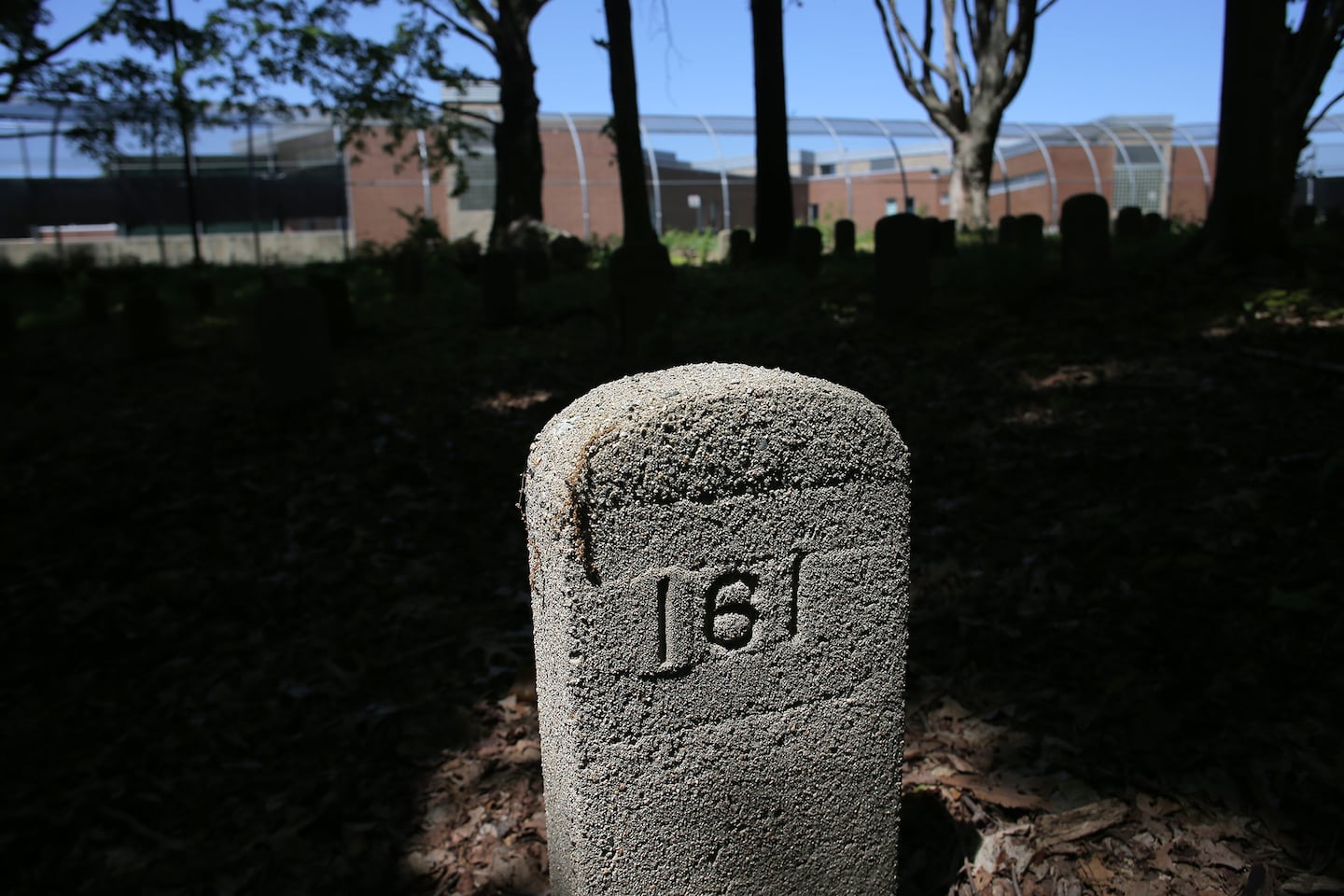
A numbered grave just outside the Rhode Island Training School Thomas C. Slater Youth Development Center in Cranston, Rhode Island. Teens incarcerated at the facility helped bring the paupers’ graveyard to light, writing obituaries for the forgotten.

Recently, I read a Victorian novel (The Three Clerks, Anthony Trollope) in which the notorious Dickens villain Bill Sykes was favorably compared to a villain who was born with every opportunity to live an upright life. Trollope’s point was that for a pauper raised in poverty with no access to education or higher things it might be considered understandable that he went bad and died in ignominy.

I’m thinking about this in connection with today’s story about how paupers’ graves raised the consciousness of some youths in trouble with the law today.

Amanda Milkovits wrote at the Boston Globe, “Sometimes, as they played basketball outside at the Rhode Island Training School, the teens would glance through the security fence to the woods and brush that shrouded rows of small stones.

“ ‘What are they?’ A 16-year-old boy incarcerated at the Training School remembered asking one of the staff members.

“Graves, he was told. The plain, numbered concrete headstones marked the burial sites of 1,049 people who died a century ago.

“Some had been residents of the state asylum. Some were teenagers who lived at the former Sockanosset Boys Training School. Some had spent their last years in the state poorhouse. Some were stillborn infants who were never given names, factory workers who fell on hard times, immigrants who sought a better life, only to die far from home.

“What they all had in common was poverty and no one to claim their bodies. From around 1915 until 1933, the state gave them a simple burial in this place, known as the State Farm Cemetery Annex, or Cranston Historical Cemetery No. 107. Prisoners made the concrete headstones, which were engraved with numbers instead of the names of those buried 6 feet below.

“ ‘I thought it was just a regular grave site, but I’d never seen a grave with a number before,’ another boy told the Globe. … ‘It’s sad. No one should just be a number.’

“For decades, the cemetery has been a lonely, quiet place, cut off from public access because it’s bordered by the state’s maximum security prison, Route 37, and the Training School. …

“John Scott, a senior community development training specialist at the Training School, had been interested in the cemetery since he first caught a glimpse of it in the 1990s. The teens’ curiosity made him wonder whether those on probation or who needed to perform community service could help restore the cemetery, even if only by clearing some of the brush.

“But Theresa Moore, president of T-Time Productions, saw potential for more. Her company designs educational curriculums with the goal of shining light on untold or little-known stories, and was already working with the Training School on its educational programs for incarcerated youths. …

“ ‘I’ve always looked for projects to enhance their lives,’ Moore said, ‘so when John mentioned it, I thought, “Why don’t we make it happen?” ‘

She called the project: ‘They Were More Than A Number.’

“Moore reached out to the leaders of the Rhode Island and Cranston historical cemeteries commissions, who were delighted to share their knowledge — they’d wanted to restore that cemetery for years, but could never get access. She contacted Secretary of State Gregg Amore, who assisted with resources at the state archives, giving the teens access to records from the state infirmary that include doctors’ notes, reports from the state institutions … and burial records. …

“The students started their research. Records and documents from the state archives, the drone footage, and other resources were used to help them put the history into context. Some materials, such as a video of Lorén Spears, executive director of the Tomaquag Museum, explaining the ‘pencil genocide’ of Indigenous people, were scanned into a Google drive for about 50 students and their teachers. …

” ‘At first, I didn’t really care,’ admitted one 16-year-old boy, ‘but I wouldn’t like it if I was just a number.’ …

“A 16-year-old boy said he chose No. 500, and learned it was the grave of a man named John Holland, who died in 1915. When he wrote Holland’s obituary, ‘It made me feel bad that they didn’t have names,’ he said. …

“One day in late May, the teens and the adults involved with the cemetery project met in person along the security fence at the Training School. The view through the fence was clear now. Brush and saplings and debris had been hauled away, and there were two new signs, marking the site as a state and city historical cemetery. The cemetery was serene, shaded by the old silver maples.

“As the teens in their dark blue uniforms listened, accompanied by their teachers, Scott, Moore, and volunteers from the Cranston Historical Cemeteries Commission thanked them for their work and told them it had meaning.

“John Hill, chairman of the Cranston Historical Cemeteries Commission, had read some of the obituaries written by the students.

“ ‘You’re giving them their names back,’ Hill told them. ‘You are making them human beings again.’ …

“Scott knew why the teens incarcerated at the Training School could relate. ‘If anyone can understand what it means to be a number,’ he said, ‘it’s our students.’”

Read this long, beautiful article at the Globe, here.

Photo: Jackie Valley/The Christian Science Monitor.
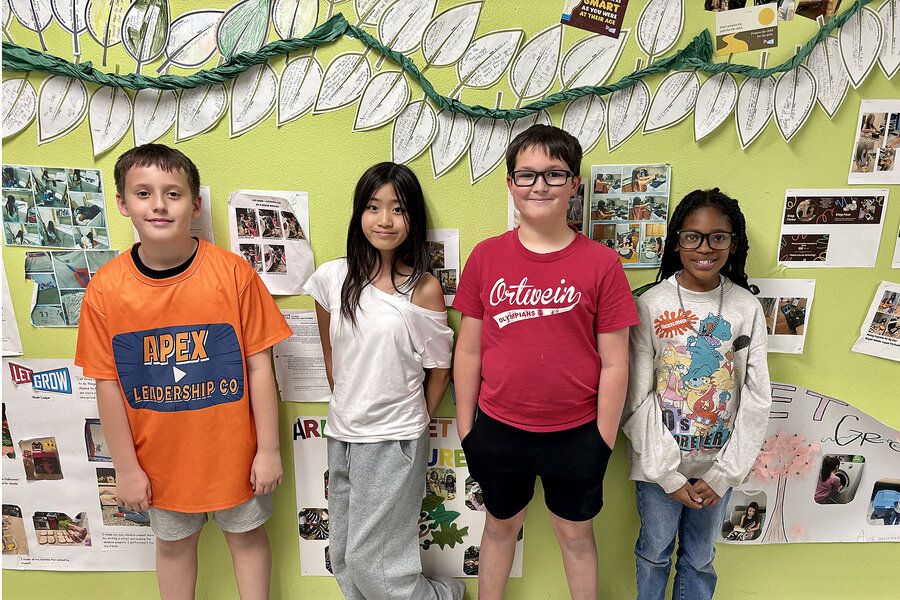
Fifth graders at Dennis Ortwein Elementary School in Las Vegas, Nevada, and their Let Grow posters.

Ultimately, you want your children to grow up able to take care of themselves. Love and convenience give parents plenty of temptation to do things for them beyond the point where the help is beneficial. That’s why a school in Nevada is lending a hand to kids and parents alike to so that fledglings may have a good chance to fledge.

Jackie Valley has the story at the Christian Science Monitor.

“Walking the dog. Wrapping a package. Cooking dinner.

“For adults, these activities often represent mundane to-do list tasks. But for fifth graders in Las Vegas, they offered something different this past school year – a taste of independence. 

“ ‘I can do things by myself more instead of having my dad or my mom do them,’ says Deven Doutis, who learned his dog goes a little nuts when he spots another canine out for a stroll.

The small steps toward greater – and lasting – independence came about in a very intentional way.

“Deven’s teacher, Amy Wolfe, sensed students were entering higher grades with more needs than in past years. Some couldn’t open a water bottle, for instance, or navigate minor conflicts with their peers. So when Ms. Wolfe heard about a program called Let Grow, she decided to pilot it within select classrooms at Dennis Ortwein Elementary School in Las Vegas.

“The program’s premise is simple: When children gain independence, they grow into more confident and capable people. …

“But what, exactly, are kids allowed to do by themselves nowadays? Terms such as ‘helicopter parent’ or ‘overparenting’ have become shorthand to describe adults who are overly involved, sometimes to the detriment of their child’s developmental growth. …

“A poll conducted last year for C.S. Mott Children’s Hospital at the University of Michigan found that three-quarters of parents say they have their children do things for themselves; however, the percentage of parents who report their children do specific activities independently is lower. Only a third of parents, for example, allow their 9-to-11-year-old child to walk or bike to a friend’s house. A similar portion say they encourage their 5-to-8-year-olds to decide how to spend their own gift or allowance money.

“Safety concerns emerged as the top reason those same parents don’t allow their children more free rein. The results did not come as a surprise to Lenore Skenazy, president of Let Grow and author of Free-Range Kids. For years, she has been on a mission to unleash children in a society where they increasingly have little independence in the physical world. …

“She says the backlash stems from a pervasive, heightened sense of danger built by media narratives and litigious tendencies. …

“In a commentary piece published by the Journal of Pediatrics last year, researchers pointed to evidence showing a correlation between children’s dwindling independence and increasing mental health problems over several decades.

” ‘We are not suggesting that a decline in opportunities for independent activity is the sole cause of the decline in young people’s mental well-being over decades, only that it is a cause, possibly a major cause,’ the authors wrote. (The lead author, Peter Gray, is a research professor in psychology at Boston College and a founding member of Let Grow.)

“In Ms. Wolfe’s classroom each month, students chose an independent activity, loosely tied to a theme, and completed it by themselves. Then they reported back to their classmates and teacher about the experience. There were no grades or critiques. If Ms. Wolfe asked any probing questions, it was to suss out how her students felt after, say, baking a cake or pulling weeds. …

“ ‘It’s more about developing the conversations with students to where they see independence … as a value,’ she says. …

“For her first project, Giwan Istefan’s 11-year-old daughter, Aria, decided to make miniature lemon-and-blueberry cheesecakes. Ms. Istefan says it turned into an exercise in parental restraint as well.

“ ‘I was like, “Oh my gosh, I see the disaster happening,” ‘ she says. ‘But I had to step back. It was growth not just for her, but it was growth for also myself.’ “

More at the Monitor, here. What are some of the ways you have encouraged independence in children, not necessarily only as a parent?

Photo: Jackson School.
A research team treks across a field in South Africa in search of carbon-sequestering termite mounds.

Termites in South Africa build mounds that sequester carbon in the soil, which unbeknownst to them, benefits a planet struggling with climate change. Can humans learn to extend those benefits?

Michele Francis, a researcher in the department of soil science at South Africa’s Stellenbosch University, shares some ideas at the Conversation.

“The landscape along the Buffels River in South Africa’s Namaqualand region is dotted with thousands of sandy mounds that occupy about 20% of the surface area. These heuweltjies, as the locals call them (the word means ‘little hills’ in Afrikaans), are termite mounds, inhabited by an underground network of tunnels and nests of the southern harvester termite, Microhodotermes viator.

“I’m part of a group of earth scientists who, in 2021, set out to study why the groundwater in the area, around 530km from Cape Town, is saline. The groundwater salinity seemed to be specifically related to the location of these heuweltjies. We used radiocarbon dating; dating the mounds, we reasoned, would allow us to see when minerals that were stored in the mounds were flushed to the groundwater.

“The tests revealed far more than we expected: Namaqualand’s heuweltjies, it turns out, are the world’s oldest inhabited termite mounds. … This is more than just an interesting scientific find or historical curiosity. It offers a window into what our planet looked like tens of thousands of years ago, providing a living archive of environmental conditions that shaped our world.

“It is also hugely important today: there is growing evidence that termites have a substantial, but still poorly understood, role in the carbon cycle. By studying these and other termite mounds, scientists can gain a better understanding of how to sequester (store) carbon. This process removes CO₂ from the atmosphere and is vital for mitigating climate change.

“Namaqualand is a global biodiversity hotspot renowned for its spring flowers, but it is a dry area. Surface water is in short supply and the groundwater is saline.

“Although most of Namaqualand receives very little rainfall, there are rare, high intensity rainfall events. When these do occur, the termite burrows on the mound surfaces serve as water flow paths that can harvest rain and channel water into the mound. This causes the salts that built up in the mounds over thousands of years to be flushed into the groundwater system via flow paths created by the tunneling action of the termites, pushing the dissolved minerals ever deeper. This process also pushes down the carbon that slowly built up in the center of the mounds when termites collected plant material and brought it into the mound. …

“The ability of these mounds to sequester carbon is linked to the termites’ unique behavior. The insects transport organic material [from] small woody plants – deep into the soil. This way, fresh stores of carbon are continuously added. …. Deep storage reduces the likelihood of organic carbon being released back into the atmosphere. So the mound acts as a long-term carbon sink.

“Not only do the termites take the organic carbon material deep underground into their nests, but their tunnels also allow dissolved inorganic carbon (known as soil calcite or calcium carbonate) in the mound soil to move into the groundwater along with other soluble minerals. So the termite mounds also offer a mechanism to sequester carbon dioxide through dissolution and leaching of soil carbonate-bicarbonate to groundwater. …

“These findings are further evidence that termites fully deserve their reputation as ecosystem engineers. They modify their soil surroundings to maintain ideal humidity and temperature conditions. …

“Termite mounds can help provide a more comprehensive understanding of global carbon dynamics. In Namaqualand, mounds occupy 27% of the total area but contribute 44 % of the total soil organic carbon stock. …

“Public awareness and policy integration are key, too. Termite mounds are often cleared for agriculture or termites are considered pests. Raising awareness about the ecological importance of termite mounds and integrating these findings into environmental policies can help promote practices that support natural carbon sinks.”

More at the Conversation, here. Listen to the story at The World, here.

Photo: Arian Zwegers/Flickr.
The monumental statues of Easter Island. 

Imagine all the work that has gone into figuring out how dead civilizations died! Even now it often feels like guesswork. But I like how new research provides new details on how people lived.

Consider this report at YaleEnvironment360.

“A new study casts doubt on the narrative often told about Easter Island, of an ancient society that plundered its forests to the point of collapse. Researchers have found fresh evidence for another [story] that the islanders learned to live within the bounds set by nature.

“When Europeans first arrived to the remote South Pacific island in 1722, they found hundreds of massive statues, evidence of considerable manpower, but only around 3,000 people, too few to easily explain the monuments. Historians inferred that the Polynesians who settled Easter Island must have seen their population grow to a large and unsustainable level, at which point they destroyed their forests, exhausted their soils, and hunted seabirds to oblivion before seeing their own numbers collapse.

“But in recent years a competing narrative has taken hold. It posits that the population never exploded, but that instead a small number of people learned to sustain themselves on the arid and relatively barren island. Researchers found evidence for this view in the remains of ‘rock gardens,’ where islanders grew sweet potatoes, their staple crop.

“To protect crops from sea winds and supply minerals to the soil, islanders grew potatoes among densely packed rocks. It has been difficult to determine, however, how much of the island was composed of rock gardens, which would indicate how many people farming sustained. Prior research found that rock gardens potentially covered more than 12 percent of Easter Island, which, scientists estimate, could have supported as many as 25,000 people.

“For the new study, researchers aimed to improve on previous inventories of rock gardens by studying gardens on the ground and then training artificial intelligence to identify them in satellite imagery. To better distinguish between rock gardens and rocky outcroppings, they also gathered satellite data on the levels of moisture and nitrogen in the soil, markers of cultivation.

“With this additional data, researchers determined that rock gardens covered less that 0.5 percent of the island. Accounting for other potential sources of food, such as fish, bananas, taro, and sugar cane, they estimated that Easter Island would have supported around 3,000 people, the number first recorded by Europeans. The findings were published in Science Advances.

“ ‘The population could never have been as big as some of the previous estimates,’ said lead author Dylan Davis, a postdoctoral researcher at Columbia University. ‘The lesson is the opposite of the collapse theory. People were able to be very resilient in the face of limited resources by modifying the environment in a way that helped.’

“History will show that the islanders did ultimately face collapse, but after Europeans arrived.” Europeans, alas, brought disease and slavery. No wonder the population died out!

More at YaleEnvironment360, here.

Photo: Scotsman.
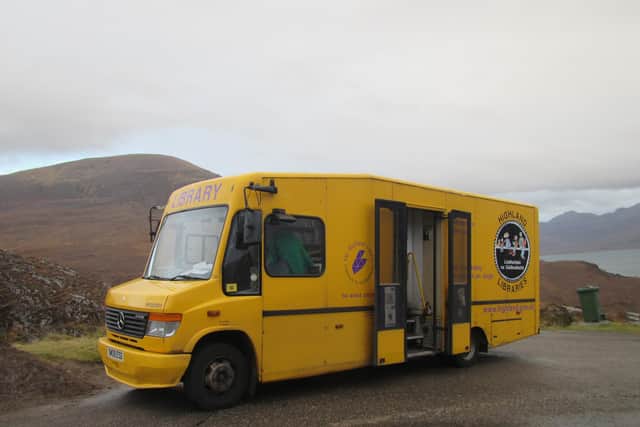
A yellow mobile library in the Highlands. The fleet has dwindled from 10 to seven. Transit vans, with fewer books packed in crates, are now filling the gaps.

All over the world, fans of books and libraries have found ways to reach readers in largely inaccessible regions. We’ve had stories here about using camels, horseback riders, vans, carts, and more.

Today’s article from the Scotsman, bemoans the gradual disappearance of Scotland’s yellow library buses.

As Alison Campsie reported in June, “For those living in the most isolated pockets of the Highlands, the sight of the yellow library van coming into view has long been a welcome one.

“But now, concerns for the future of the mobile libraries have been raised after the distinctive vans – complete with desk and bookshelves – dwindle in numbers.

“Mr Preston said a fleet of 10 yellow mobile libraries – plus a spare – has now been reduced to seven vans. Of these, five are standard Transits, which are now packed with crates, carry fewer books and have to be loaded and unloaded.

“The librarian, whose yellow van did not return from the garage in April, said: ‘I am worried that the mobile library service will fizzle out and die.

“ ‘People love the service and they want to see it continue. A lot of the people I serve are single people living by themselves and they might not see people, apart from the postman, for two or three weeks and then the library arrives. …

“Megan MacInnes, a co-opted community councillor for Applecross, said the mobile library was ‘a hugely important service.

” ‘The range of demographics of folk who use it demonstrates that. We have to drive nearly an hour to get to the nearest library at Lochcarron. That is just not feasible for many.

” ‘Personally, I completely rely on the mobile library for my books and as a parent it has been hugely important in helping my son to read and become interested in books. The children at school love being able to use the mobile library and they come out with such a range, from history and geology to novels and cartoons and the latest David Walliams or Harry Potter.

“Everyone here is very aware of the financial pressures that Highland Council is under but when it comes to these lifeline services, we really urge them to be continued.’ We are so far from population centres that we really can’t afford for our outreach services to go.’ …

“A spokesperson from Highlife Highland said it was working with Highland Council, which owns the vans, ‘to better understand how such services can be delivered including accessibility and customer needs. This will also help to inform replacement fleet requirements and to establish specifications and costs.’

“A statement added: ‘High Life Highland is providing an alternative service for rural customers with the option of a drop-off of books to their homes to ensure that they have access to reading material and schools are also given the option of a drop-off of books to their building.

” ‘We recognise that mobile libraries are an essential part of life in the Highlands and while this service is not a like for like replacement, it may help to ease some of the difficulties for the most vulnerable and isolated service users during this time.’ ”

More at the Scotsman, here. PS, if you search this blog on “mobile library,” you could get enough material for a dissertation, almost! Mobile libraries are cherished all over the world.

Photo: Instagrammer @maxfennell.
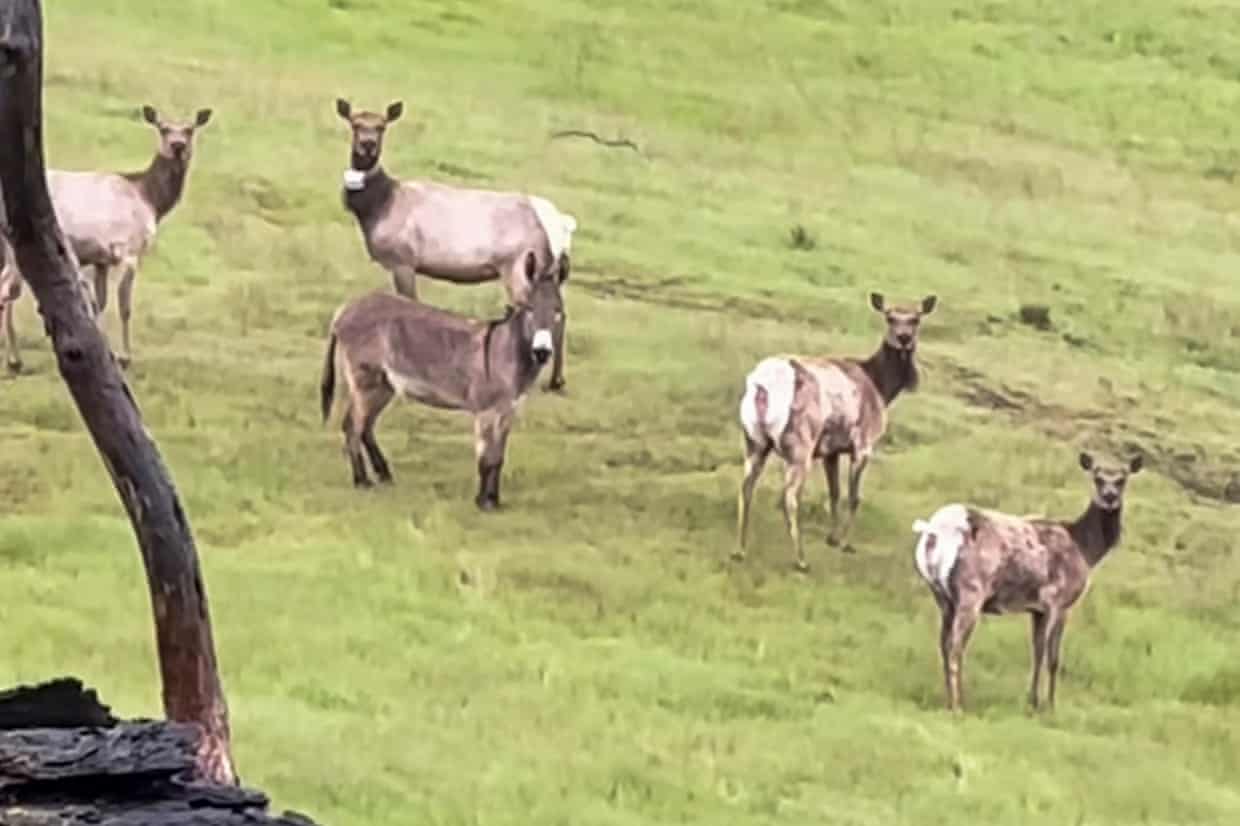
A hunter spotted a donkey living with elks in northern California.

A donkey-owning family in California lost its pet to a wild elk herd — and decided he was better off. What would you have done? Would it depend on how long your pet was missing?

The Guardian reports: “A donkey spotted apparently living with a herd of wild elk in a video that went viral on the internet has been identified as Diesel, a once beloved pet who had apparently run away five years ago.

“The video was taken earlier this year, when Max Fennell, a hunter in northern California, filmed a group of wild elk apparently hanging out with a donkey who appeared to be a member of their herd.

“The short clip of the unusual scene rapidly spread across social media. Now Terrie Drewry and her husband, Dave, have told CBS news that they are convinced the free-roaming burro is their missing pet Diesel, who had scarpered into the wilderness five years earlier. …

“ ‘Finally, we know he’s good. He’s living his best life. He’s happy. He’s healthy, and it was just a relief,’ Drewry told CBS.

“The Drewrys revealed that Diesel had gone missing after getting scared on a trail while on a hiking trip with his human family. They searched for him in vain, though a trail camera spotted him, and hoof prints showed that he was still alive.

“Despite their joy, in seeing Diesel alive and apparently thriving as a want-to-be elk, they have no plans to try to capture him.” More at the Guardian, here.

That got me curious about donkeys that normally live in the wild, and poking around on the web, I ended up at the Young People’s Trust for the Environment (YPTE), which works to inspire “young people to look after our world.”

“There are still several types of donkey living wild in various parts of the world including: the ‘Kiang’ in India and Nepal the ‘Somali’ wild ass in Africa the endangered ‘Onager’ in Mongolia, Turkestan, Iran and Syria. …

“In the wild, donkeys don’t live in such close herds as horses and ponies do, since they occupy marginal desert-lands where food is generally scarce. As a result they have developed very loud ‘voices,’ which can carry just over three kilometres [~2 miles]. This allows them to keep in contact with one another. Their larger ears also allow them to hear the distant calls of their neighbors. Donkeys also use their ears as a form of visual communication and they may help dissipate some of the hot desert heat.

“Donkeys have a very tough digestive system that can break down almost inedible vegetation and at the same time extract and save as much moisture as possible.” More here.

Photo: Trilogy Captain’s Log.
“Lahaina Strong Paddle Out” expresses the determination of young Hawaiian climate activists after the fires in Maui.

I am so relieved to see young people taking charge of some of the issues that have messed up our planet. They focus on goals and don’t get distracted by the usual specious arguments for not upsetting the apple cart or for taking more time. Good things do happen when you don’t realize your goal is “impossible.”

Consider these young people in Hawaii.

Dharna Noor and Lois Beckett write at the Guardian, “Hawaii officials have announced a ‘groundbreaking’ legal settlement with a group of young climate activists, which they said will force the state’s department of transportation to move more aggressively towards a zero-emission transportation system.

“ ‘You have a constitutional right to fight for life-sustaining climate policy and you have mobilized our people in this case,’ Josh Green, the Hawaii governor, told the 13 young plaintiffs in the case, saying he hoped the settlement would inspire similar action across the country.

“Under what legal experts called a ‘historic’ settlement, announced [in June], Hawaii officials will release a roadmap ‘to fully decarbonize the state’s transportation systems, taking all actions necessary to achieve zero emissions no later than 2045 for ground transportation, sea and inter-island air transportation,’ Andrea Rodgers, one of the attorneys representing the plaintiffs in the case, said at a press conference with the governor.

“ ‘This is an extraordinary, unprecedented victory for the youth plaintiffs,’ Michael Gerrard, the faculty director of the Sabin Center for Climate Change Law at Columbia University, told the Guardian.

“While Hawaii has long embraced a progressive climate change agenda, with 2045 as a target year for decarbonization, the new settlement is ‘as big a deal as everyone said it is,’ said Denise Antolini, an emeritus professor of law at the University of Hawaii Law School, who has followed climate change litigation for decades. …

“The June 2022 lawsuit, Navahine F v Hawaii Department of Transportation, was filed by 13 young people who claimed the state’s pro-fossil fuel transportation policies violate their state constitutional rights. By prioritizing projects like highway expansion instead of efforts to electrify transit and promote walking and biking, the complaint says, the state created ‘untenable levels of greenhouse gas emissions.’ As a result, state officials harmed the plaintiffs’ ability to ‘live healthful lives in Hawaii.’ …

“It named the Hawaii Department of Transportation and its director, as well as the state of Hawaii and its former governor David Ige, as defendants.

“The plaintiffs, most of whom are Indigenous, alleged that by contributing to the climate crisis, the state hastened the ‘decline and disappearance of Hawaii’s natural and cultural heritage.’ When the case was filed, the plaintiffs were between the ages of nine and 18. …

“Navahine, whose name is on the lawsuit, is a 16-year-old Native Hawaiian whose family has been farming the land ‘for 10 generations.’ Drought, flooding and sea level rise were all having immediate effects on her family’s crops, she said. ‘Seeing the effects, how we were struggling to make any money for our farm, kind of pushed me to this case,’ she said.

“Officials said the legal settlement brings together activists with all three branches of the state’s government to focus on meeting climate change goals, including mobilizing the judicial branch. The court will oversee the settlement agreement through 2045 or until the state reaches its zero emission goals, Rodgers said.”

More at the Guardian, here. No paywall. Donations sought.