Feeds:
Posts
Comments

Photo: Nathaniel Bivan.
Wuni Bitrus (co-founder of the Deaf Technology Foundation) and some of his students sign “I love you” in Jos, Nigeria.

Things change so fast in our world that I can only hope a positive story I read in June is still true in August. It’s a worry. At the same time, we do know that people keep a good thing going — somehow — even with turmoil all around them.

I preface today’s story with that observation because I have been hearing about protests and riots in Nigeria that started with grievances about the economy and then went berserk as the government overreacted.

Nathaniel Bivan at Christian Science Monitor wrote in June about progress for the deaf community in Nigeria.

“In a one-room apartment in Jos, Nigeria, instructor Wuni Bitrus and almost a dozen students gather around a table cluttered with equipment – a toolbox, a 12-volt adapter, a coding panel, a set of jumper cables, a mix of colored wires. The students’ idea: to build the prototype for a ‘smart’ door that opens with the touch of a finger.

“The students chat back and forth in sign language, and Mr. Bitrus signs back. The group discusses using Arduino, an open-source electronics platform, and one student wonders how fingerprints can be stored. Mindful of Nigeria’s electricity problems, Mr. Bitrus genially advises the group to use a battery-powered keypad lock system first and incorporate a fingerprint feature later. 

“ ‘It works well, rather than waste time reinventing the wheel,’ Mr. Bitrus says. After nodding in agreement, the students excitedly start working.

“This is just another afternoon in a club run by the Deaf Technology Foundation, a nonprofit co-founded by Mr. Bitrus in 2017 that trains Nigerian children and young adults who are deaf in computer programming and robotics. The students also work to improve their reading skills, and receive career guidance and counseling to help them believe in themselves.

“Mr. Bitrus’ … desire to change the prospects of Nigeria’s deaf and hard-of-hearing community was sparked in 2014 by his encounter with a 13-year-old girl while he was teaching as part of the National Youth Service Corps in Zamfara state. Mr. Bitrus had noticed that the teen faced discrimination, and he became determined to learn sign language and teach her to use a computer. Three years later, he marshaled the resources, including funding from the Massachusetts Institute of Technology, to form the Deaf Technology Foundation.

“One of the darkest memories that Mercy Samson Grimah, a foundation student, has about growing up is looking at the faces of people around her and recognizing insults and negative energy directed at her. 

“ ‘That hurt me so bad because I knew in my heart that I could do anything. They just see us as lesser human beings,’ she says. ‘I wanted to show them that deaf people can become whatever they want to be.’ … 

“Ms. Grimah says her private secondary school did not formally teach sign language to her, nor much of anything else. But there was one teacher who knew how to sign, and she taught Ms. Grimah. … She dropped out in her third year because her parents could not pay her school fees, but fortunately, she had already formed a bond with the Deaf Technology Foundation. …

“Five years ago, Ms. Grimah and several other students made a road trip from Jos to Nigeria’s capital, Abuja, to compete in MakeX, a robotics contest. … Although Ms. Grimah’s team was not chosen to go on to represent Nigeria in the international competition, it emerged fourth among about 15 teams.

“ ‘Our team was the only one made up of the deaf,’ says Ms. Grimah, her eyes lighting up.

“Her father, Grimah Samson, adds, ‘What they are doing changed her.’ …

“Joy Yusuf, another Deaf Technology Foundation student, had wanted to become a doctor. But she was moved to a new school where the principal and staff said there was no way that could happen, even though the school welcomed students with disabilities.  

“ ‘It was a blow for me,’ Ms. Yusuf says. ‘I cried. I had to call Mr. Bitrus and my father to beg them, but [the principal and staff] still refused. For me, Deaf Tech is the only way I can have anything close to [studying] medicine.’  Now, she, too, wants to become a web developer.” 

More at the Monitor, here. No paywall.

The part of Nigeria where this story takes places is Jos. Online I found something interesting about it: “The state has over forty ethno-linguistic groups. Some of the indigenous tribes in the state are the Berom, Afizere, Amo, Anaguta, Aten, Bogghom, Buji, Challa, Chip, Fier, Gashish, Goemai, Irigwe, Jarawa, Jukun, Kofyar (comprising Doemak, Kwalla, and Mernyang), Montol, Mushere, Mupun, Mwaghavul, Ngas, Piapung, Pyem, Ron-Kulere, Bache, Talet, Taroh (Tarok), Youm and Fulani/Kanuri in Wase.” Wow.
Bronze Age Shipwreck

Photo: Ilan Ben Zion.
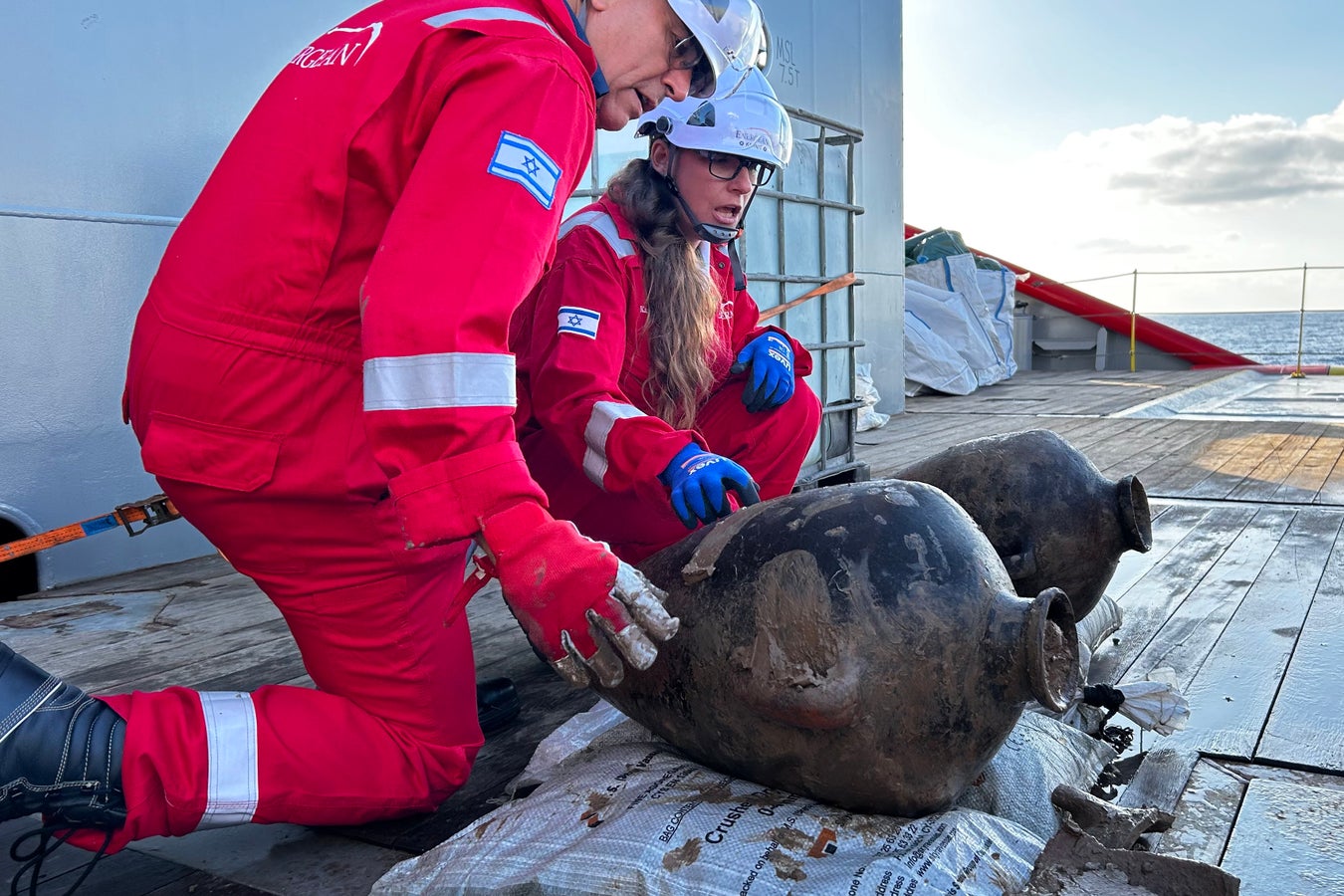
IAA archaeologist Jacob Sharvit (left) and Energean environmental lead Karnit Bahartan examine Canaanite storage jars retrieved from the seafloor of the Mediterranean on May 30, 2024. They are from the Bronze Age (which ran about 3300 to 1200 BC, according to Wikipedia). 

Judging from past comments here, we all like archaeology stories, especially those that explore the mysteries of shipwrecks. It must be something about realizing that nothing is ever completely lost.

At Scientific American, Ilan Ben Zion reports on the recent discovery of a Bronze Age shipwreck in the Mediterranean.

“Golden sunlight fell on the two amphorae, still caked in brown ooze, as they breached the Mediterranean’s waves. Their ascent from the seafloor, more than a mile down and 60 miles from land, had taken three hours. It was the first daylight they had seen in at least 3,200 years, and they came from the only Bronze Age shipwreck discovered in deep waters.

“Archaeologists retrieved these Canaanite storage jars, just two from a cargo of dozens located far off northern Israel’s coast in May.

” ‘It’s the only ship from this period that was found in the deep sea,’ one of the final frontiers of archaeology, says Jacob Sharvit, director of marine archaeology at the Israel Antiquities Authority. Only a handful of other Late Bronze Age ships have been discovered — all of them in shallow coastal waters of the Mediterranean Sea, including in the Aegean Sea.

“Sharvit helped spearhead a complex archaeological operation far offshore, along with the Israel Antiquities Authority (IAA) and offshore gas firm Energean to retrieve the jars from the seafloor.

“In the Bronze Age people shipped these storage jars across the Levant starting around 2000 B.C.E., when maritime trade in the Mediterranean exploded.

“ ‘They’re always either pointy or rounded at the bottom,’ so they rock with ship’s motion but don’t tip over and break, says Shelley Wachsmann, a nautical archaeology expert at Texas A&M University, who was not involved in the research.

“These workaday ceramics evolved so consistently over the centuries that they can be reliably dated with an examination of their shape and design. Based on the recently discovered jars’ neck, the pronounced angle of their shoulders and their pointed base, these amphorae are estimated to date to between 1400 and 1200 B.C.E., the IAA said in a recent press release.

“At that time, the ship and its crew sailed a world of prolific international trade, diplomacy and relative stability in the eastern Mediterranean, which was dominated by the Egyptian and Hittite empires. Merchant ships carrying olive oil, wine, ores, timber, precious stones and numerous other goods plied the seas between Greece, Cyprus, Anatolia, the Levant and Egypt.

” ‘This is the time that the Mediterranean is globalized,’ says Eric Cline, a professor of archaeology at George Washington University. ‘You’ve got lots of commerce, lots of diplomacy and lots of interconnections’ between the Egyptian, Hittite, and Assyrian empires and the lands between them, says Cline, whose newly published book, After 1177 B.C.: The Survival of Civilizations, explores the aftermath of the collapse of this Late Bronze Age international order.

In our own era of globalization, this disintegration draws particular interest among scholars looking for clues into how stable civilizations foundered in the past.

“The first signs of the shipwreck surfaced in 2023, during an environmental survey that Energean conducted ahead of its development of a new undersea natural gas field. The survey’s sonar scans were meant to locate and protect deep-sea ecological hotspots from undersea construction, says Karnit Bahartan, Energean’s environmental lead.

“Subsea surveys of the nearby Leviathan gas field conducted in 2016 by Noble Energy (now part of Chevron) reportedly turned up at least nine deep-sea archaeological sites, including a Late Bronze Age shipwreck. But details of the finds were never disclosed, and the sites were never excavated, according to a Haaretz report in 2020.

“ ‘What we were doing is looking for sensitive areas, sensitive habitats, anything that can be worth saving,’ Bahartan recalls.

“Closer examination of the sonar hits revealed that most were modern trash, Bahartan says as she flips through photographs taken by a remotely operated vehicle (ROV). The images show plastic bags, deck chairs, oil drums and a porcelain toilet, seat included. Occasionally, she says, she and her colleagues might find a solitary amphora or ceramic fragments.

“But one sonar blip turned out to be a large assemblage of jars jutting out of the seabed. ‘I didn’t know if it was something dramatic or not. I just sent it to the [Israel] Antiquities Authority,’ Bahartan says.

“Energean offered the IAA a ride onboard the Energean Star, an offshore supply and construction vessel. … Six hours out of Haifa’s port, the Energean Star hovered over the wreck’s coordinates, and a crane lowered a truck-sized, canary-yellow-and-black ROV into the sea. It took an hour to descend to the bottom. Nearing the seabed, operators released the ROV toward the site. …

“Dozens of jars, nearly identical and about half a meter long, clustered in an oblong patch roughly 46 feet long and 19 feet across. … The ROV circumnavigated the wreck, taking a high-resolution video that would be stitched into a photomosaic of the site. Sharvit picked out a couple jars from the fringes that could be extracted with minimal disturbance.

“Sharvit had hoped to find the ancient crew’s personal effects to help nail down the ship’s origin but spotted none. The IAA is running a so-called petrographic analysis of the ceramics to try to pinpoint where they came from; analyses of residue and trace elements could help identify their contents.

“Cline, who was not involved in the IAA mission or its preliminary study, says the proposed date ‘would place the wreck right in the middle of the most interconnected period of the Late Bronze Age in the Aegean and eastern Mediterranean, which is exciting.’ ”

More at Scientific American, here.

Photo: Melanie Stetson Freeman/CSM Staff.
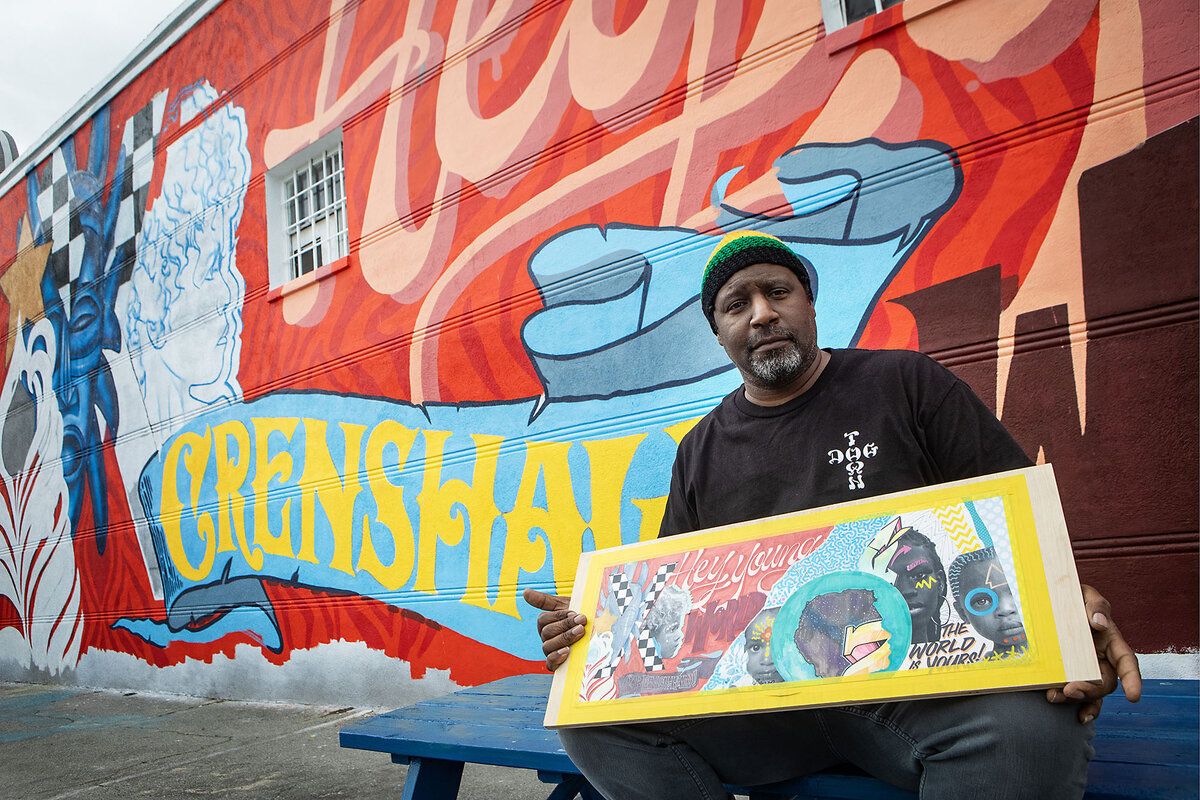
Anthony “Toons One” Martin created this mural as part of a $100 million art-focused initiative in South Los Angeles called Destination Crenshaw.

To bring out the beauty inherent in a marginalized community, you need to get everyone on board. Because the beauty is there.

Ali Martin writes at the Christian Science Monitor about Destination Crenshaw, a part of Los Angeles that used to be known as South Central.

“Growing up in South Los Angeles, Anthony Fagan was ‘very much part of all of the problems that take place in this community,’ he says. Today, he’s overseeing construction on a park that is at the heart of efforts to make the Crenshaw District a must-visit stretch of LA.   

“ ‘We’re going to change lives with this park on so many different levels,’ says Mr. Fagan, an assistant superintendent with PCL Construction. 

“The $100 million initiative has drawn public and private funding to transform a 1.3-mile stretch of Crenshaw Boulevard into the largest Black-centered public art display in the United States. Destination Crenshaw is a holistic plan that weaves economic and community development together with cultural celebration to recast this neighborhood as a tourism center and create economic stability for those who live here – and for generations to come. …

“Destination Crenshaw runs north-south through the Hyde Park neighborhood – part of South LA, known as South-Central Los Angeles until 2003, when the LA City Council changed the name, hoping to dissociate the 16-square-mile area from a reputation for gang violence and race riots. 

“Destination Crenshaw touches three census tracts that fall in California’s highest quartile for poverty and unemployment. On average, about three-fourths of the residents who live in these neighborhoods are Black.

“In the 1950s, South LA had the highest concentration of Japanese Americans in the country. … African American families soon followed, and by the late 1960s, Crenshaw Boulevard was a corridor of flourishing Black-owned businesses. Leimert Park, capping the northern end of the district, was a center of artistic expression.

“Rosemary Williams moved here from Chicago in 1968. She opened Dog Lovers Pet Grooming on Crenshaw Boulevard in 1980. … Ms. Williams’ daughter convinced her to participate in Destination Crenshaw’s mural program, which pairs artists with storefronts. Her reluctance gave way, she said, because of the organizers’ efforts to support small businesses and to clean up the area. …

“Anthony ‘Toons One‘ Martin answered the call. He grew up in South LA in the ’70s, and remembers it as vibrant. He turned a talent for graffiti art into a career and worked around the world as a muralist. … His design is titled ‘Hey Young World,’ inspired by the hip-hop song with the same name. He hopes, in turn, to inspire the youth who live here to take pride in their neighborhood and themselves – and dream big about their futures. … He says, ‘If we want to see [solutions], we have to be a part of that process.’  

“Nobody knows that better than Marqueece Harris-Dawson, City Council member representing the 8th District and a driving force behind Destination Crenshaw. The South LA native came into office as plans were underway to build a light rail station at Leimert Park.

“Residents were upset that the line would be built at street level, instead of below or above ground, bisecting their main throughway and disrupting foot traffic. But Mr. Harris-Dawson took a cue from Beverly Hills, which lobbied to have its light rail at grade to showcase the world-famous shopping district around Rodeo Drive, where palm trees punctuate power lunches and luxury stores.

“He enlisted the Crenshaw community for ideas about building on the city’s investment. … What emerged was a plan to capitalize on the art and culture that radiate from this district, stimulate economic development, and strengthen community ties. …

“People associate Black culture with Harlem, Chicago, or Atlanta, ‘but they don’t think of LA. And it’s because we just don’t put it forward,’ says Mr. Harris-Dawson. … Organizers describe Destination Crenshaw as ‘unapologetically Black.’ Sankofa Park showcases that spirit. The triangle-shaped plot sits across from Leimert Park Station, one of a half dozen pocket parks. …

“Every detail is intentional: The park name – Sankofa – is for the African bird that represents moving forward while learning from the past.”

More at the Monitor, here. No firewall. Subscriptions are reasonable.

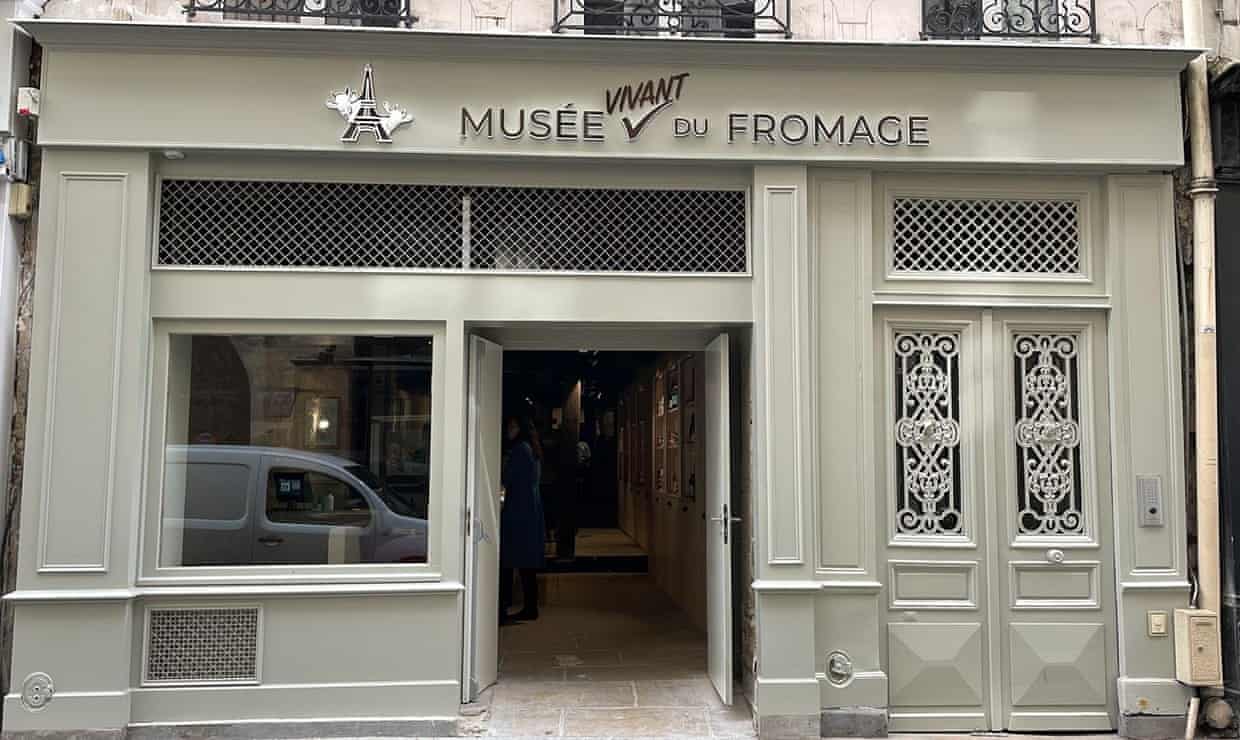
Museum of Cheese

Photo: Capucine Gillier/Musée du Fromage.
The exterior of the newly-opened Musee du Fromage in Paris. The French are estimated to eat about 44 pounds to 60 pounds of cheese per person annually. 

With the eyes of the world on Paris and the summer Olympics just now, it’s a good time to highlight a museum that could only be in Paris: The Museum of Cheese.

Kim Willsher writes at the Guardian, “Say ‘cheese’ and Pierre Brisson is a happy man. The founder of France’s first cheese museum is passionate about the subject – and not just eating it but passing on the traditional skills of cheesemaking to future generations.

“ ‘It’s not an easy job but a marvelous one and there is a real risk that it could disappear,’ he said. … ‘We hear a lot about wines and how they are made and the subtleties of taste and how they are produced and nothing about cheese. Although people like eating it and the demand for cheese is still high, fewer youngsters want to make a career of it.’ …

“Visitors will be charged [~$20] to watch a demonstration of how various cheeses are made, take part in a tasting and learn the history of cheese and regional varieties through interactive displays.

Farmers and agriculture students will be allowed in for free.

“Brisson, 38, the son of Burgundy winemakers, said his passion for cheese developed as a boy. ‘My father would take me to the cheesemonger every Sunday after Mass.’ …

“After studying at the National Dairy Industries School, Brisson set up Paroles de Fromagers to run courses in cheesemaking for the public and training for professionals.

“He chose to locate the museum, which has been a decade in the planning, in Paris to appeal to the French and tourists and to avoid regional rivalries. A plaque reminds visitors of General de Gaulle’s aphorism: ‘How can one govern a country where there are 258 varieties of cheese?’ …

“Brisson said: ‘When I moved to Paris I realized there were lots of places promoting wine, its culture and how it is made and lots of shops selling cheese, but nothing showing people how it is made.’

“He has recruited half a dozen cheesemakers to help visitors understand the art of producing different varieties from live milk, including the role of bacteria, and the animals and the land on which they graze. …

“Agathe de Saint-Exupéry will be one of the experts explaining the process, including how makers ‘read’ the milk and how small details can affect the final product.

“ ‘It’s a very individual process that depends on so many things, even the humor of the animals whose milk is being used. You can make the same good cheese every day, and every day it will taste different. It just cannot be done industrially,’ she said.

“Guillaume Gaubert, a cheesemaker, said the aim was also to remind the French – particularly those living in towns and cities – of their traditional links with the terroir, an untranslatable concept that covers not only the soil, environment and human interactions with it, but a sense of history and geography, and which is a cornerstone of French gastronomy. …

“France has 56 official cheese appellations – registered regional varieties – which is nine more than Italy and more than three times the number in the UK. … The Campagne de France, a cooperative of milk producers, estimates there could be as many as 1,500 different varieties, not including those produced at home in small quantities. …

“Brisson said the museum would be a ‘little window’ on country life in the heart of the capital.

“ ‘My dream is that in 20 years’ time someone will say they decided to become a cheesemaker after visiting the museum.’ ”

More at the Guardian, here.

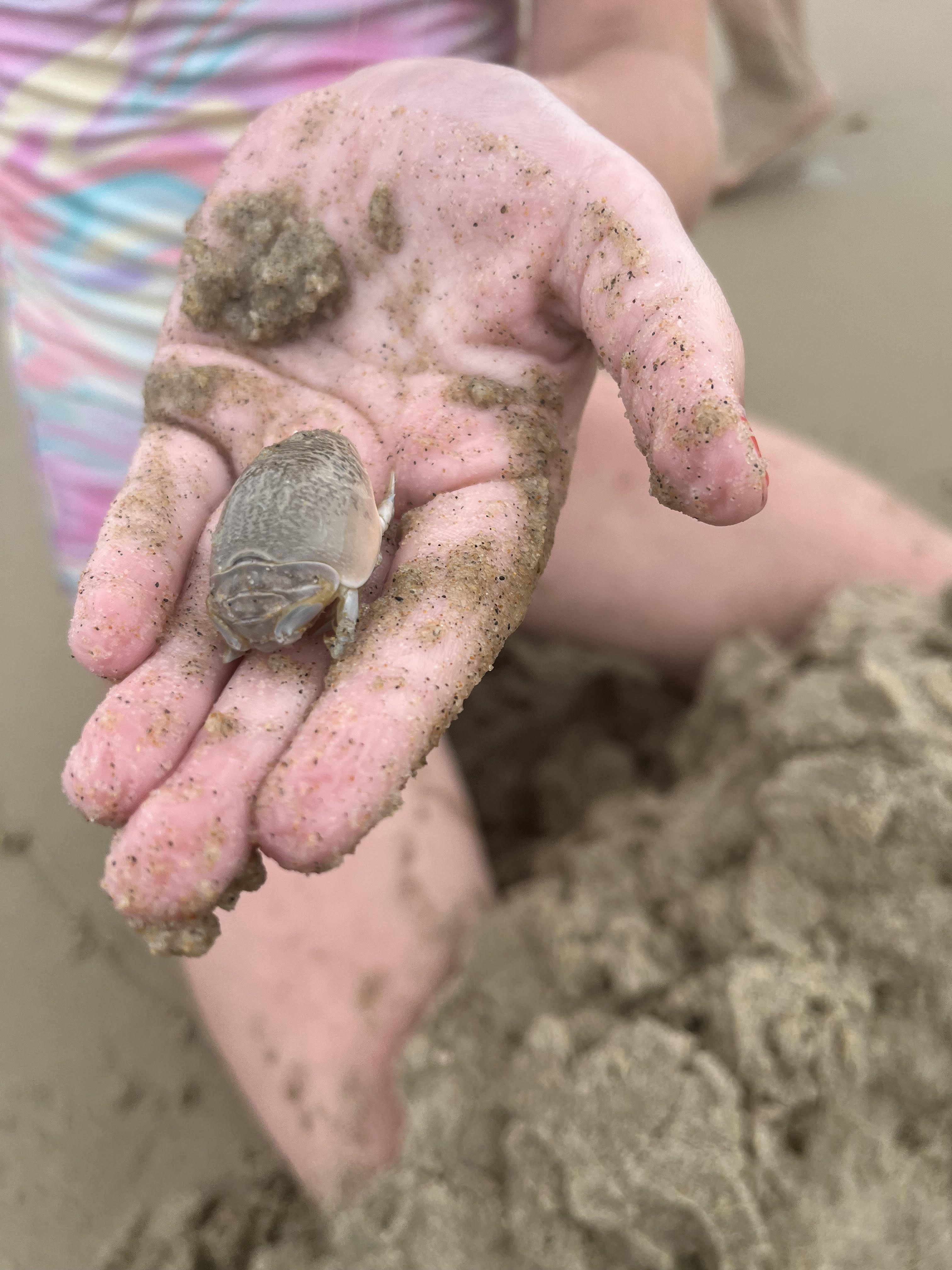
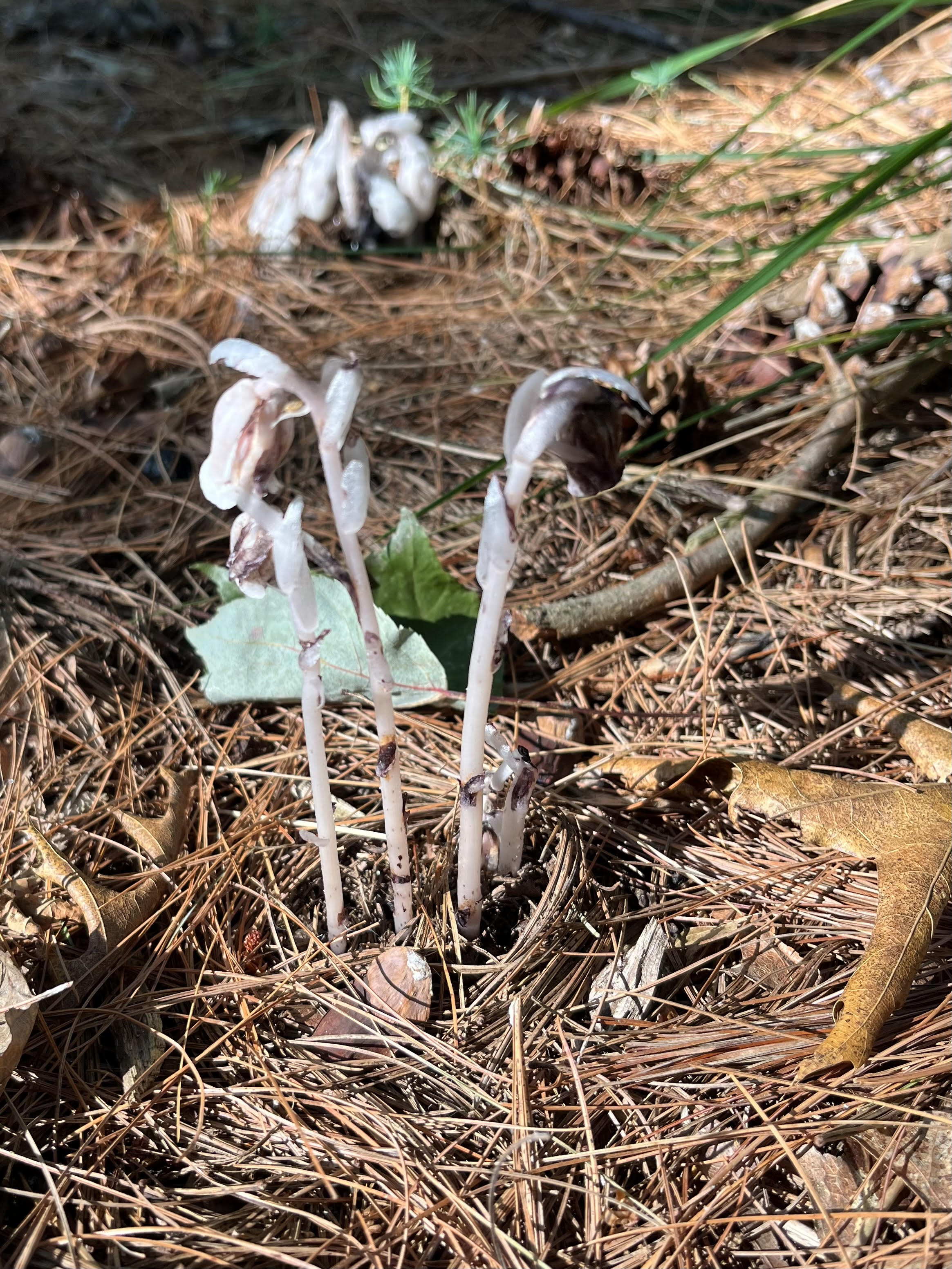
I took a lot of photos in July. The light was so wonderful. If you have questions about what you are seeing here, please let me know in the comments.

I’ll just point out a few things. I took a close-up of a hosta flower. They normally look so droopy. This perky one caught my eye.

The raised flower and vegetable beds were just inaugurated at my retirement community for the many residents with green thumbs. I visit the gardens most mornings and take in the lovely scents. Is anyone else enamored of the way tomato plants smell — the leaves, the stems?

I was wildly excited when a granddaughter dug up a mole crab at the beach. I hadn’t seen one in decades. On Fire Island we used to call them “jumpies.”

I love Indian Pipes, too.

I greatly appreciated all the birthday flowers — from my son-in-law and from a dear niece and nephew.

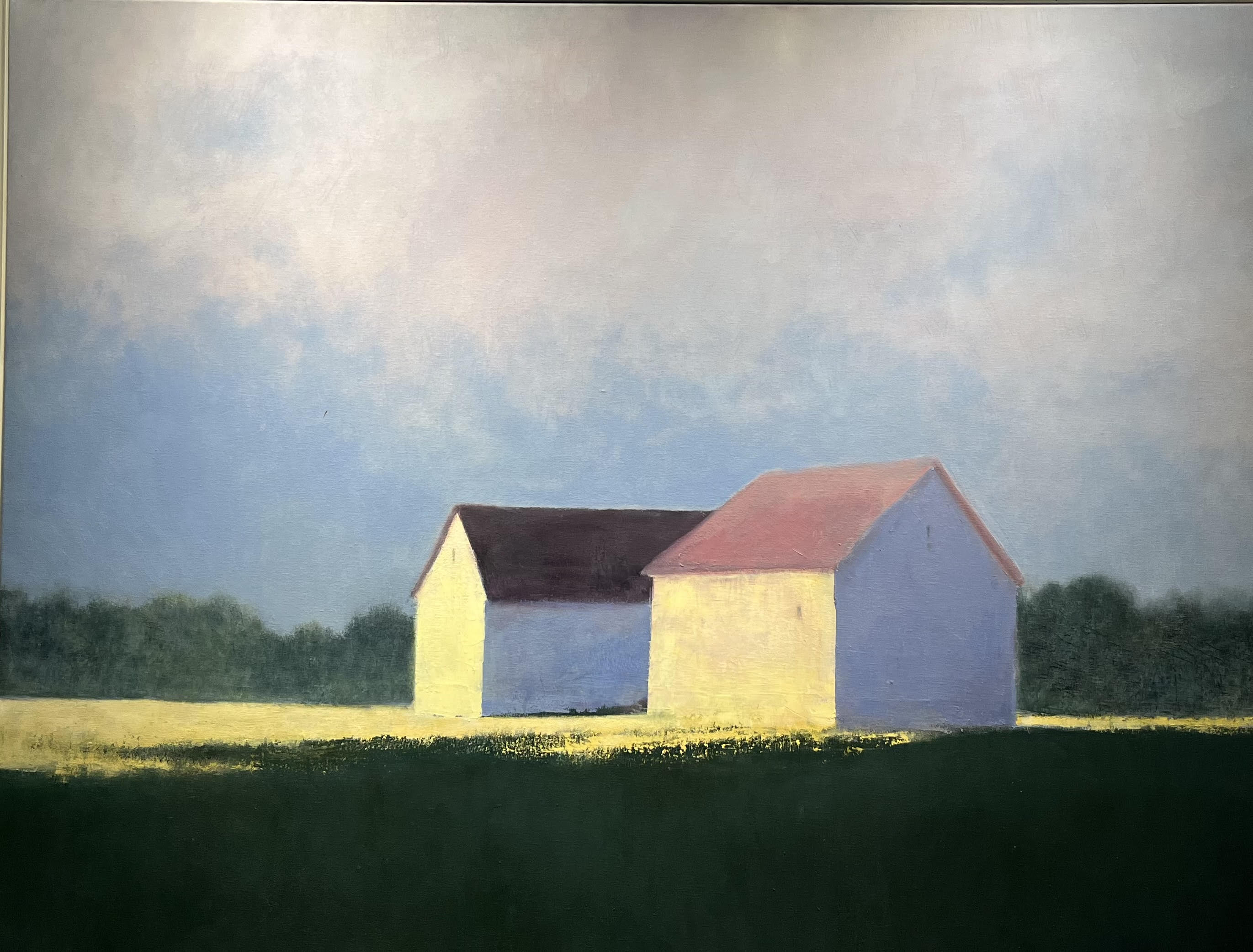
There’s a lovely new exhibit of paintings where we live. Notice the light on those buildings.

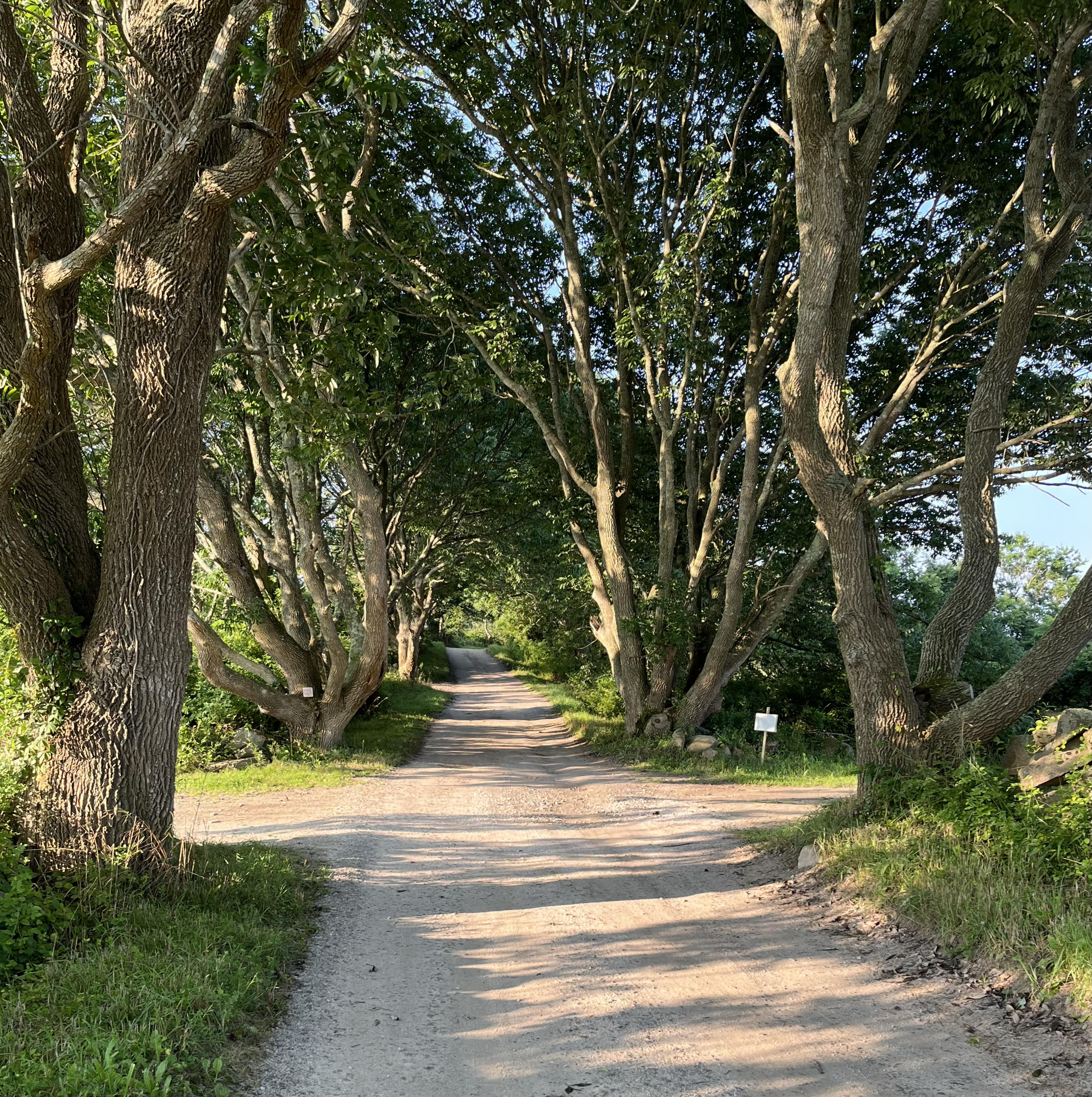
Also notice that a dirt road can make art, too. This dirt road makes leaf prints!

I look forward to comments.

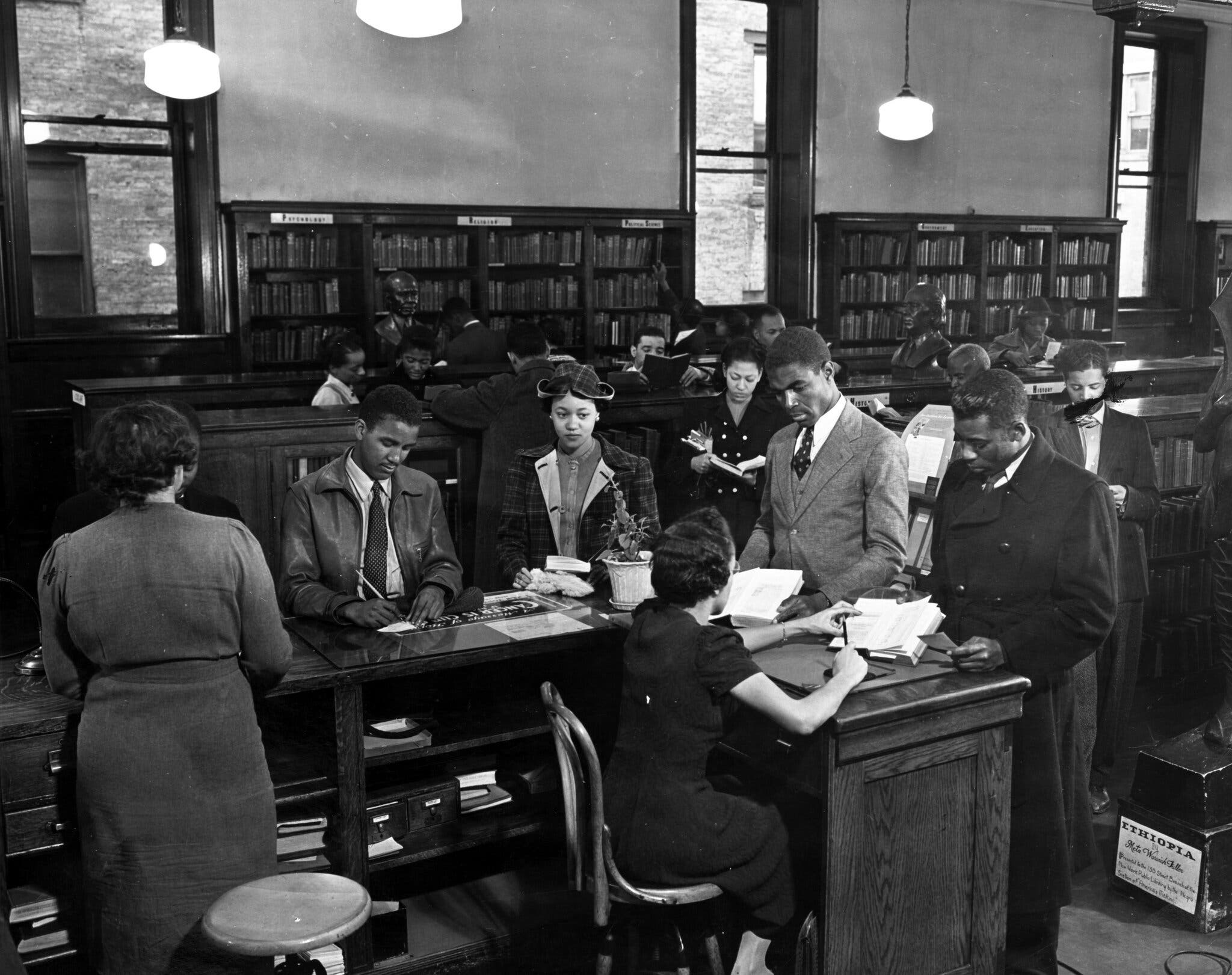
Photo: New York Public Library.
In 1925, the New York Public Library system established the first public collection dedicated to Black materials at its 135th Street branch in Harlem, now known as the Schomburg Center for Research in Black Culture.

I have read numerous accounts of what a public library has meant to poor children with insatiable curiosity. The most recent was the autobiography Up Home by future intellectual and university president Ruth J. Simmons. She grew up in a desperately poor Black sharecropper’s family in Texas. Books and encouragement from Black teachers meant everything.

Meanwhile in Harlem, Black librarians meant everything to generations of Northern children.

Jennifer Schuessler reports at the New York Times, “It was a banner day in the history of American libraries — and in Black history. On May 25, 1926, the New York Public Library announced that it had acquired the celebrated Afro-Latino bibliophile Arturo Schomburg’s collection of more than 4,000 books, manuscripts and other artifacts.

“A year earlier, the library had established the first public collection dedicated to Black materials, at its 135th Street branch in Harlem. Now, the branch would be home to a trove of rare items, from some of the earliest books by and about Black people to then-new works of the brewing Harlem Renaissance.

“Schomburg was the most famous of the Black bibliophiles who, starting in the late 19th century, had amassed impressive ‘parlor libraries’ in their homes. Such libraries became important gathering places for Black writers and thinkers at a time when newly created public libraries — which exploded in number in the decades after 1870 — were uninterested in Black materials, and often unwelcoming to Black patrons.

“Schomburg summed up his credo in a famous 1925 essay, writing, ‘The American Negro must remake his past in order to make his future.’ In a 1913 letter, he had put it less decorously: The items in his library were ‘powder with which to fight our enemies. …

“Today, figures like Schomburg and the historian and activist W.E.B. Du Bois (another collector and compiler of Black books) are hailed as the founders of the 20th-century Black intellectual tradition. But increasingly, scholars are also uncovering the important role of the women who often ran the libraries, where they built collections and — just as important — communities of readers.

“ ‘Mr. Schomburg’s collection is really the seed,’ said Joy Bivins, the current director of the Schomburg Center for Research in Black Culture, as the 135th Street library, currently home to more than 11 million items, is now known. ‘But in many ways, it is these women who were the institution builders.’

“Many were among the first Black women to attend library school, where they learned the tools and the systems of the rapidly professionalizing field.

On the job, they learned these tools weren’t always suited to Black books and ideas, so they invented their own.

“At times, they battled overt and covert censorship. … But whether they worked in world-famous research collections or modest public branch libraries, these pioneers saw their role as not just about tending old books but also about making room for new people and new ideas.

“ ‘These librarians were very tuned in and understood that a cultural movement also needs a space,’ said Laura E. Helton, a historian at the University of Delaware and author of the recent book Scattered and Fugitive Things: How Black Collectors Created Archives and Remade History. …

“In the 1920 census, only 69 of the 15,297 Americans who listed their profession as librarian were Black. Many cities in the segregated South had no library services at all for Black citizens. And even in the North, those branches that did serve them often had few books geared to their interests, and sometimes no card catalogs or reference collections at all.

“That started to change, if slowly. In 1924, in Chicago, Vivian Harsh became the first Black librarian to lead a public library branch there. [But] no place captures the transformations of the era more than Harlem, where, starting in 1920, a white librarian named Ernestine Rose hired four young Black librarians at the 135th Street library. …

“The poet Arna Bontemps (who himself later became a librarian) recalled visiting the 135th Street library after his arrival in Harlem in 1924. ‘There were a couple of very nice-looking girls sitting at the desk, colored girls,’ he said. ‘I had never seen that before.’ …

“Other ‘girls’ at the branch fostered the neighborhood’s artistic ferment in different ways. Among them was Regina Andrews, a young librarian from Chicago (where she was mentored by Harsh) who came to New York City on vacation in 1922 and decided to stay. She … soon settled into an apartment at 580 St. Nicholas Avenue with two friends who worked at Opportunity, a new magazine that aimed to capture the creative ferment bubbling up in Harlem. Nicknamed Dream Haven, the apartment quickly became a salon and crash pad for some of the most celebrated figures of the period.

“It was there that Alain Locke held some planning meetings for the special issue of the Survey Graphic magazine that later grew into his landmark 1925 anthology The New Negro. And it was there that many Black artists and writers who attended the 1924 Civic Club dinner now recognized as an opening bell of the Harlem Renaissance gathered.”

Read more at the Times, here.

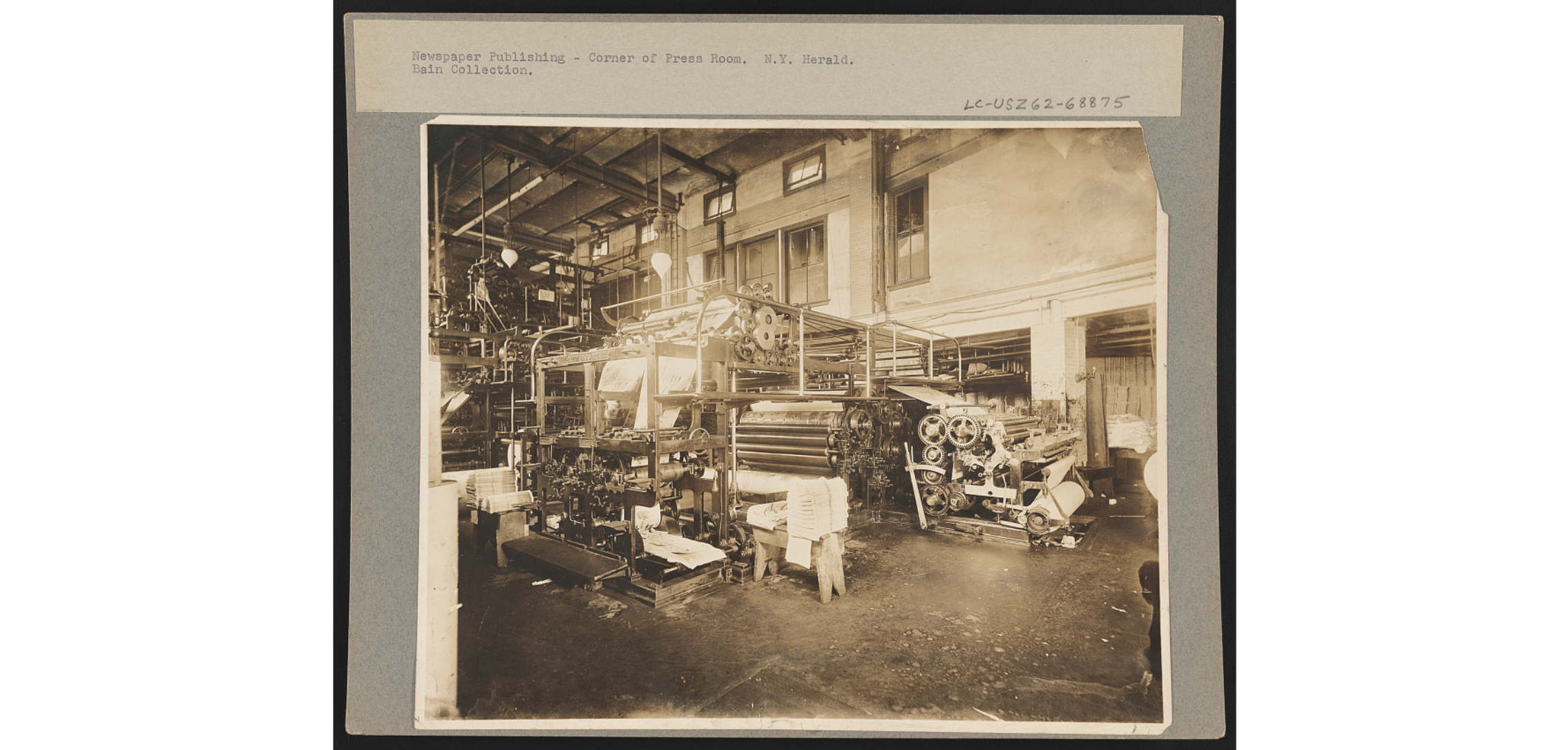
Photo: Library of Congress.
New York Herald press room back in the day. Times change.

To stay relevant, businesses need to keep moving forward. That’s what an Austrian journal with a long history decided recently. It has a few tips for other businesses thinking of modernizing.

Lucinda Jordaan writes at the World Association of News Publishers, “A government-owned national daily founded in 1703 in Vienna, Austria, Wiener Zeitung had faced the possibility of closure for most of this century. In October 2022, the threat was realized when a new law was adopted by the Austrian parliament that effectively cut off the main revenue stream of what was the official government gazette until 2020.

“Government job ads and companies’ annual financial results – required by law to be published in the paper – had largely funded WZ’s [annual] revenue. That would be stripped away by the end of 2022.

“This led to, arguably, the fastest, most radical transformation in newsroom history. ‘It was super quick; we had to do it in no time,’ acknowledges Editor-in-Chief Katharina Schmidt. ‘The law made us a publicly-funded news outlet in May 2022; we started the product development process in December 2022 and, by 1 July 2023, everything had changed.’

Wiener Zeitung is now WZ, an about-face from its roots in print and an aging audience. WZ has  a dedicated website, several newsletters, podcasts, and a growing following on TikTok and Instagram.

“Schmidt, the paper’s first female editor, shared the company’s challenges and learnings with a packed audience at WAN-IFRA’s recent World News Media Congress in Copenhagen. 

“In October 2022, Wiener Zeitung’s newspaper subscription totaled 8,000, within a population of about 9 million. ‘Most of our 8,000 subscribers were over 90 years old,’ [Schmidt says]. …

“Along with revenue loss, the newsroom faced multiple challenges in its reconstruction, as it fought for sustainability. They not only had to reduce staff by 60 percent (from 55 to 20) – and overcome internal resistance to this – but were also restricted by law in the topics they could cover.

“ ‘We really had to focus because, of course, there were so many ideas that we really wanted to put in practice, but we couldn’t. So we just focused on constructive journalism, and our target audience: the 20 to 29-year-olds. …

” ‘And of course, we checked out their needs. We had many focus groups and usability testing so that we could really focus on, on the needs of our audience.’

“The development process was also a reiterative process of testing and developing, then adapting to needs. ‘This is very important in this process; you cannot fixate on some framework,’ explains Schmidt. …

“Within weeks of the launch, they saw positive results: WZ had 750,000 unique monthly users, and Instagram figures increased by a third in the first three weeks. In September, they launched a newsletter dedicated to politics; subscription is at 12,000, with other topic-focused newsletters in planning.

“By November 2023, WZ’s relaunched and refreshed website has had up to 3 million users; their new TikTok channel had 11,500 followers, and Instagram followers went up by 46 percent from July to November 2023.

“Here’s how they did it. “1) Make friends in high places – get the publisher on your side; 2) Form a core group, comprising an interdisciplinary team – but don’t underestimate the number of editors you need; 3) Renew your news product following a development process – learn from other areas to adapt to your need ; 4) Focus your journalism: stay on track, and find your audiences.; 5) Involve the rest of the editorial team in the process. Over-prepare yourself. … Let the motivation of the core group carry your load; 6) Lead by example: say goodbye to hierarchical leadership, and find allies in-house, and externally, within the industry; 7)  Know that change takes time – this relates to new editorial direction, as well as mentally.” More here.

Photo: MassAudubon.
The invasive multiflora rose forms dense thickets in fields and field edges, crowding out other species.

The problem with invasive species that aren’t native to a region is that they crowd out the local species, and that has a snowball effect. We colonists crowded out indigenous people, which among other things, undermined wisdom about protecting nature. In the plant world, local pollinators don’t get what they need to pollinate. The list goes on.

Frank Carini reports at ecoRINews on how invaders hurt both the environment and the economy: “Invasive Asian shore crabs are outcompeting young lobsters. Invasive snake worms and hammerhead worms are burying themselves deeper into southern New England, where the former consumes the top layer of soil and dead leaves where the seeds of plants germinate, and the latter is toxic and transmits harmful parasites to humans and animals.

“Invasive multiflora rose and oriental bittersweet have long been embedded in the region, crowding out native vegetation and strangling trees. …

“Last summer, the Intergovernmental Science-Policy Platform on Biodiversity and Ecosystem Services (IPBES) for the United Nations issued a global assessment providing clear evidence of this growing threat.

“In a paper recently published in the journal Nature Ecology & Evolution, the authors of last year’s assessment — 88 experts representing 101 organizations from 47 countries — outline the main findings from that report and echo the need for urgent action.

Laura Meyerson, a University of Rhode Island professor of invasion science and habitat restoration ecology and editor-in-chief of the journal Biological Invasions, is a contributing lead author on the IPBES assessment and a lead author on the recent paper. …

“She said, ‘Our research produced overwhelming and unequivocal evidence that the negative impacts of biological invasions far outweigh any benefits and that those who depend most on nature suffer the worst consequences.’

“The researchers documented some 37,000 invasive species that had been introduced by people to areas around the world. Of those, about 3,500 species were considered harmful invaders that negatively affect nature and people’s quality of life. 

“The number of invasive species — major drivers of global biodiversity loss, according to Meyerson — are expected to continue to grow. Some 200 new species are expected to be added annually by human activities in regions that have not recorded such invaders before, according to the June 3 paper. And established invasives will continue to expand their ranges, spreading into new countries and choking out native species.

“The paper also noted that simple extrapolations from current impacts from invasive species are likely to underestimate the level of future impacts, and drivers of biodiversity loss, such as the climate crisis, are acting in concert and those interactions are increasing biological invasions. …

“ ‘It’s critically important that we all do our part to reverse current trends,’ Meyerson said. ‘The public can make sure that the plants they are buying for their gardens are native species. Pet owners should not release animals, like rabbits or Burmese pythons, that are no longer wanted into the wild.’

“For example, red-eared sliders — native to the Southeast, the south-central United States, and northern Mexico — are the most popular pet turtle in the United States and available at pet shops around the world. But this turtle species lives for about 30 years, so they are often released where they don’t belong after pet owners tire of them. As a result, they are considered one of the world’s 100 most invasive species.

“Meyerson is also the senior author on a global study that explored the extent of biological invasions on lands owned or managed by Indigenous people. The study was published in Nature Sustainability in late May.

“The spread of animal and plant species into new regions by humans is increasing rapidly worldwide, with thousands of species now present in regions outside their native range. The research team, which included scientists from Australia, Austria, Germany, Hungary, and the United States, investigated the spread of invasive species to lands managed by Indigenous people and found significantly fewer invaders in those areas compared with other natural areas.

“ ‘This was a really important finding because even after controlling for the remoteness and accessibility of Indigenous peoples’ lands and how land is used, in general, the numbers of invasive species are lower, as is biodiversity loss,’ Meyerson said. …

“Researchers analyzed millions of available data points from around the globe on the distribution of non-native plant and animal species. On average, there were 30% fewer non-native species on Indigenous lands. The study suggested the enormous difference is primarily due to sustainable land use, a higher proportion of forests, and lower accessibility to humans.

“Indigenous people represent ethnic groups that settled in regions long before the arrival of Europeans, such as Native Americans, the Aborigines of Australia, and the Sami in Scandinavia. About 28% of the land surface around the globe is inhabited by Indigenous people. Most of these areas are in remote regions and many have enormous importance for conservation of biodiversity such as the Amazon basin and wilderness areas in the Arctic.”

More at ecoRI News, here. No firewall. Donations solicited.

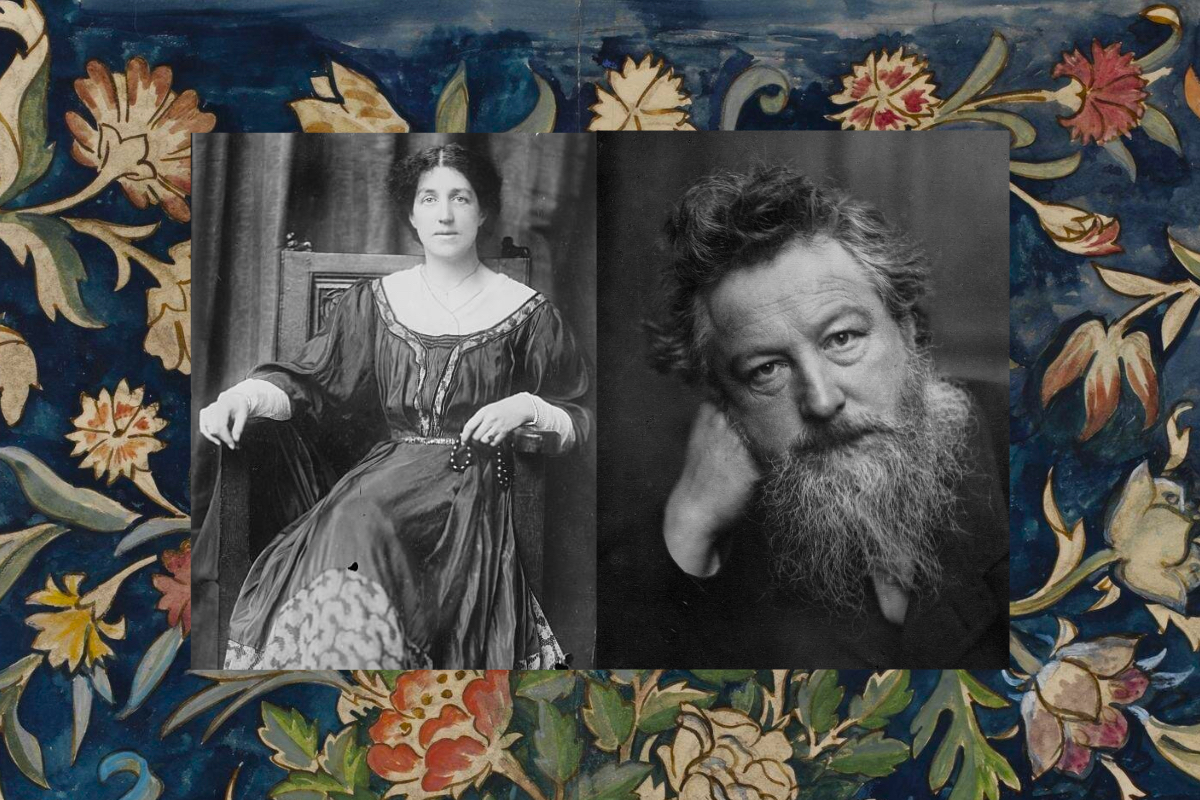
Photo collage: Isabella Segalovich/Hyperallergic, using images from Wikimedia Commons.
Detail of embroidery design by May Morris overlaid with portraits of May and her father William Morris.

Is this the year that the contributions of women get recognized in a big way? There seems to be something in the air.

In any case, today’s story draws attention to art that most of us have known about for years as the work of William Morris. Who knew that much of it was by his daughter May?

Isabella Segalovich wrote recently at Hyperallergic, “On a bright, sunny day in Victorian England, a little curly-haired May Morris gleefully handed a ball of wriggling worms to her father, William. The legendary textile and wallpaper designer smiled: He was both glad to have fresh bait for his favorite pastime of fishing and proud to see his daughter happily playing in the dirt, a freedom afforded to few girls of their social class. 

“There’s plenty to admire about artist William Morris, from his timeless ornamental wallpaper designs to his late-in-life turn to socialist politics, where he imperfectly but tirelessly fought for workers rights and against British imperialism. Less well known is that by all accounts, William was a pretty great dad, who encouraged his two daughters, Jenny and May, to grow into incredibly talented designers themselves. …

“The sisters soaked up their father’s aesthetic brilliance as they carefully observed him experiment with drawing, calligraphy, and textile dying; William even provided them with their own dying kits for messy, colorful play. May enrolled in what is today the Royal College of Art in 1878, where she studied embroidery. This was in no way preparing her for a life of a housewife with an under-appreciated textile skill. Rather, her father had been slowly training her to take over the reins at his historic company’s embroidery department at only 23 years old — a business decision typically reserved for the sons of the era, not its daughters.

“There, she began designing patterns for Morris & Co. that became mainstays of the company, some of which, unfortunately, were later misattributed to her father. She supervised a team of embroiderers as they produced all manner of textiles, from bedspreads to book covers to altar cloths. Soon, she was a leading artist of the progressive Arts and Crafts Movement.

“Before long, the two were close comrades in the small but mighty English socialist movement: May stood close on blustery London sidewalks as William became a kind of socialist street preacher. Together, they broke from the Social Democratic Federation in 1885 and took part in founding the Socialist League, where May took charge of the group’s library and became close friends with Karl Marx’s daughter, Eleanor, another one of the league’s founders. …

“Scholars have noted that William Morris was certainly a flawed crusader for women’s rights, once proclaiming that ‘it would be poor economy setting women to do men’s work’ in the same breath that he called for ‘absolute equality of condition between men and women.’ A powerful feminist, May greatly improved upon his political legacy by co-founding the Women’s Guild of Arts for the crafters who were not allowed into the Arts and Crafts Movement’s foundational Art Worker’s Guild. 

“It’s quite likely that no one knew William Morris better than May did. After his death, while caring for her older sister who struggled with epilepsy, she edited a whopping 24 volumes of her father’s writing, each with introductions so studied and lengthy that they were later published as their own two volume set. Biographer Fiona MacCarthy wrote that their relationship was ‘partly suffocating, in the intensity of its demands, but in another sense a kind of freedom … It released her latent talents and brought her into contact with ideas and activities far beyond the reach of most young women of her period and class.’ 

“Even so, May was undervalued in her time, and she knew it. ‘I’m a remarkable woman – always was,’ she wrote to playwright George Bernard Shaw in 1924. ‘Though none of you seemed to think so.’ “

Gorgeous pictures at Hyperallergic, here. No firewall. Subscriptions encouraged.

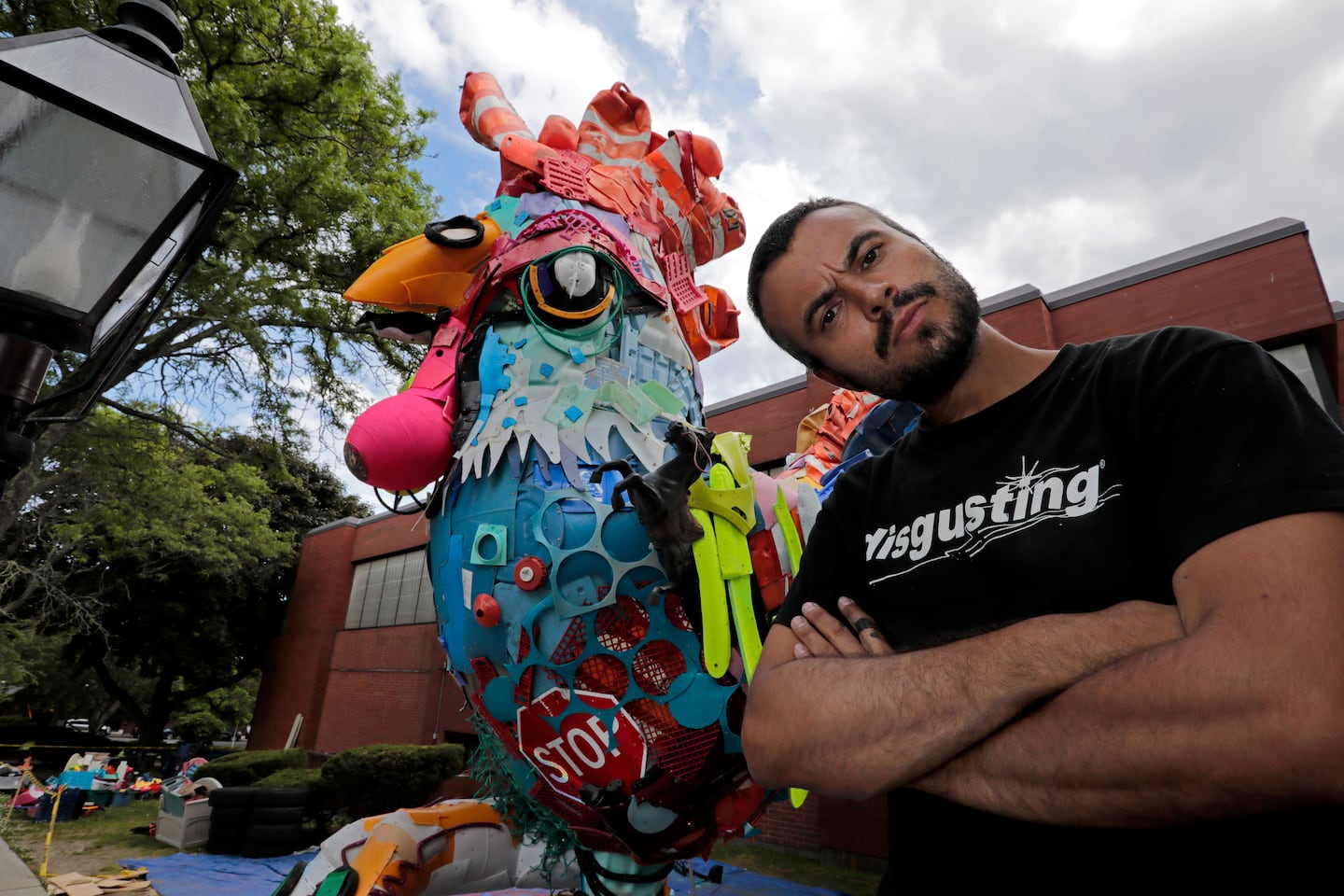
Art: Bordalo II.
Photo: Pat Greenhouse/Boston Globe.
I’ve been following this Portuguese sculptor on Instagram for several years. Now he’s worked with high school students to create a sculpture for Portuguese-speaking New Bedford, Mass., not too far from where I live.

I have been curious about this artist, age 36, for a long time. He makes vibrant sculptures from trash and shows them on Instagram.

Cate McQuaid wrote recently at the Boston Globe about Bordalo II’s “Plastic Rooster.” 

“There’s a new rooster in town,” she says, “and he’s close to 20 feet tall and kind of trashy. Portuguese artist Bordalo II’s ‘Plastic Rooster’ sits beside the New Bedford YMCA, the centerpiece of Massachusetts Design Art and Technology Institute’s (DATMA) ‘TRANSFORM: Reduce, Revive, Reimagine’ public-art initiative through Oct. 14. …

“Bordalo has traveled the world, from Bora Bora to Montreal, painting and building gaudy, charismatic animal sculptures out of waste materials. He was in town in mid-June putting finishing touches on ‘Plastic Rooster.’ The giant bird is clad in nautical refuse, plastic, street signs, and more collected by locals. He wears a plastic penguin under his beak like a bowtie, and his talons are cut from bright-pink safety cones. …

“[He says] ‘My grandfather, he was an artist. I was really young and I always tried to dig into his studio and steal his paints and draw stuff.’

“The artist, whose first name is Artur, calls himself ‘Bordalo II’ as a tribute to his grandfather, Real Bordalo. At 11, the younger Bordalo became a graffiti artist.

“ ‘It shaped the person I am, the way we do everything,’ he said. “Not being afraid to risk, to really do it. The scale. The sense of how it connects with the street.’ …

“The artist’s lighthearted characters carry messages about over-consumption and conservation. ‘With the big trash animals, it’s like you make portraits of the victims with what destroys them or their habitats,’ he said. …

“ ‘Plastic Rooster’ was commissioned by DATMA, which has partnered with local landfill management departments and the Greater New Bedford Regional Vocational Technical High School to involve the community.

“Bordalo sent his rooster image to the school’s 11th-grade Metal Fabrication students, who built the structure from steel and wood.

“ ‘After that we have a list of plastic trash materials that we know we’re going to need, and we ask the local production team to collect all those materials,’ Bordalo said. ‘My team starts to cover it, to make the first skin. I join them in the middle of the process, and I make more skin, more volumes, all the details. I make the head, the eyes, the nose.’ …

“Public art and programming presented around New Bedford by Massachusetts Design Art and Technology Institute through Oct. 14, www.datma.org/transform.”

I am adding more fromWikipedia, as I felt I had more questions.

“He studied painting at the Faculty of Fine Arts at University of Lisbon in Lisbon for eight years, but never finished the course, instead experimenting with ceramics, sculpture, and other materials. …

“His work has been shown in solo and group exhibitions and mounted in streets across the world, including Singapore, the United States, French Polynesia, and Europe. In the 10 years between 2012 and 2022, he used over 60 (or 115, by another estimate) tons of waste materials to create around 200 sculptures of animals.

“Bordalo’s work is focused on the themes of ecology, waste, and recycling, and makes use of garbage in his work as a method of critiquing over-consumption in the world. Using materials such as old tires, pieces of wrecked cars, discarded appliances, plastic waste, and aluminum cans, he challenges materialism and consumerism in the modern world. …

“Bordalo supports Portuguese refugee advocacy organization Humans Before Borders, which helps to fund five medical NGOs working in refugee camps on the Greek islands of Lesbos and Samos.

“A short documentary film entitled Bordalo II: A Life of Waste was released by the Irish Film Board in 2017.”

More at the Globe, here, and at Wikipedia, here.

Photo: Thomas M Jauk.
This theatre’s climate impact report found wood made up half of the 41 tons of raw materials it used last year, but produced only 1% of its emissions.

What does it take to be climate neutral? This theater in Germany believes we all have role to play.

In June, Kate Connolly reported at the Guardian, “A handful of Spanish conquistadors fight through thick undergrowth to emerge in the ivy-clad ruins of a fallen civilisation during a rehearsal of Austrian playwright Thomas Köck’s Your Palaces Are Empty.

“Premiered last month at the Hans Otto Theater in Potsdam, south-west of Berlin, the bleak and unforgiving drama probes the wounds of a shattered capitalist world that has exploited its people and the planet’s resources.

“But it is not just the dystopian play that is embracing the subject of the climate crisis.

“The production itself has been declared climate neutral under a €3m [~$3.3 million] pilot project launched by Germany’s federal ministry of culture. The project, called Zero, is sponsoring the Potsdam theatrer and 25 other cultural institutions across Germany, from dance companies to libraries and museums, to completely restructure their creative modus operandi.

“ ‘It leads to restrictions,’ says the director, Moritz Peters, crouching on a wooden stool on stage as he takes a break from rehearsals. ‘But it also forces greater creativity.’

“No aspect of the process of making a play has been left unturned. From the lighting (switching to LED bulbs) to reducing travel (rehearsals are longer but less frequent to cut down on journeys) ‘everything has come in for scrutiny,’ says Marcel Klett, the managing director.

“Swapping to a green source of electricity in 2022 had already improved the theatre’s carbon footprint, reducing its annual 661 tons of emissions, or the ‘equivalent of 66 households,’ by more than 10%, but did not go far enough, Klett says. No less challenging is tackling a change in attitude. ‘Nurturing a sense that we all – from the set designer to the theatergoer – have a role to play and have to ask ourselves: “what can I concretely do?” ‘ Klett says.

“The costume designer, Henriette Hübschmann, says she initially struggled with having to abandon her usual task of creating new costumes from scratch. ‘At least half of the costumes have to come from the existing collection of props and costumes now,’ she says, on a tour of the wardrobe in the theater’s underbelly. ‘The rest should be from recycled, easily recyclable or renewable materials.’ …

“An inventory of its resources forms the basis of the theater’s first climate impact report. … It states that wood makes up half of the 41 tons of raw materials that the theater used last year, but is responsible for only about 1% of the emissions produced, while just four tons of steel and aluminum used in productions made up almost 30%. …

“Other forms of stage-set building are also being experimented with, such as growing constructions out of the organic building material mycelium. The potential use of this in other areas, such as exhibition architecture, is already being explored.

“Most [theaters], from a certain size upwards, will be required to do so from next year, under EU legislation that will treat theaters the same as all big commercial enterprises.

“Klett is hopeful of a knock-on effect among audiences and theatre staff as well as from other cultural institutes joining in. …

“He is appealing to local politicians to embrace the project by sponsoring the erection of solar panels on the theater’s roof and allowing the space – a former Prussian military stables – to be insulated, which is currently not allowed because the building is listed.

“The success of the project, though, will largely depend on the audience and the way they choose to travel to the theater. … Travel remains the theater’s single biggest polluting factor, contributing to about 50% of Hans Otto’s emissions. In response, theater tickets will double up as public transport passes in the three hours before and after the play.”

More at the Guardian, here. No paywall. Donations solicited.

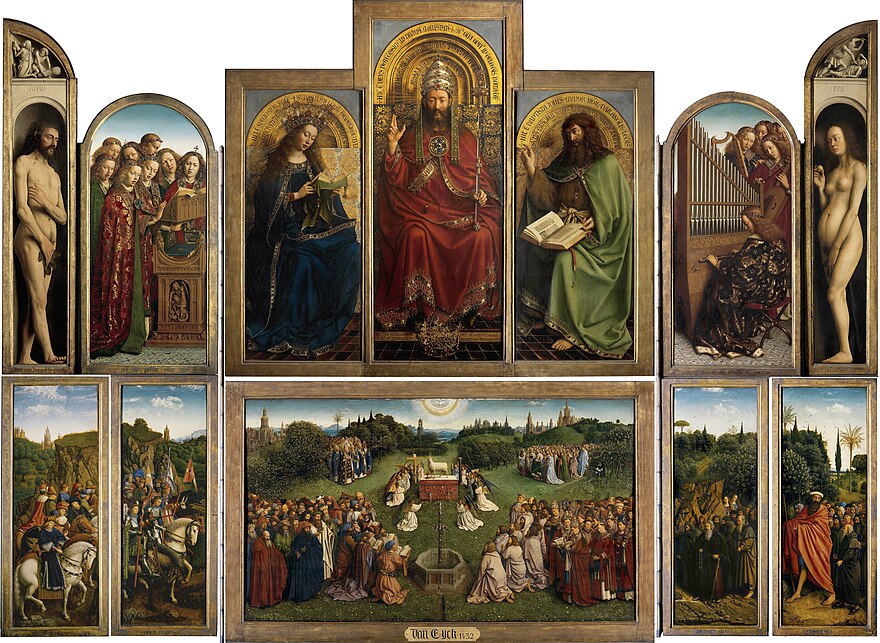
Art: Hubert and Jan van Eyck. 
Ghent Altarpiece (completed 1432).

In New England, when we hear about an art thief’s confession, it makes our heart beat a little faster. That’s because we are hoping so much that the Isabella Stewart Gardner Museum heist (see where I wrote about it, here) will be solved in our lifetimes.

Today’s story, however, is about a much older art theft, equally puzzling.

Noah Charney reports at the Guardian, “Just about everything bad that could happen to a painting has happened to Hubert and Jan van Eyck’s Adoration of the Mystic Lamb (also known as the Ghent Altarpiece). It’s almost been destroyed in a fire, was nearly burned by rioting Calvinists, it’s been forged, pillaged, dismembered, censored, stolen by Napoleon, hunted in the first world war, sold by a renegade cleric, then stolen repeatedly during the second world war, before being rescued by The Monuments Men, miners and a team of commando double-agents. …

“In 1934, one of its 12 panels was stolen in a heist that has never been solved, though the case is still open and new leads are followed all the time.

“On 11 April of that year, Ghent police commissioner Antoine Luysterborghs pushed through a crowd at the St Bavo Cathedral that had gathered to gawk at something that was no longer there. One of the panels, depicting The Just (or Righteous) Judges, was gone. …

“The theft was followed quickly by a ransom demand for one million Belgian francs. As a show of good faith, the ransomer returned one of the panel’s two parts (a grisaille painting of St John the Baptist). But police remained baffled.

“Then a stockbroker called Arsène Goedertier had a heart attack at a Catholic political rally. He summoned his lawyer, Georges de Vos, to his deathbed. Just before he died, De Vos claimed, Goedertier whispered: ‘I alone know where the Mystic Lamb is. The information is in the drawer on the right of my writing table, in an envelope marked “mutualité.” ‘

“The lawyer followed the instructions and found carbon copies of the ransom notes, plus a final, unsent note with a tantalizing clue about the stolen panel’s whereabouts: ‘[it] rests in a place where neither I, nor anybody else, can take it away without arousing the attention of the public.’

“But if Goedertier did steal the panel, why? The church has been defensive, and there is an air of cover-up – as well as evidence that other members of the bishopric were involved. One theory goes that a group of church members, Goedertier among them, were involved in a failed investment scheme that lost church money. Rather than admit their failure, they stole the panel and ransomed it to cover the losses. But Goedertier was wealthy and devout; it seems odd he would resort to extorting his beloved diocese. …

“De Vos failed to alert police about Goedertier’s confession for a month. Eventually, after many false leads, police concluded Goedertier had been the thief. The case went cold. …

“The greatest strides in solving the crime have not been made by an active officer, though. Karel Mortier was chief of the Ghent police from 1974 to 1991, and fascinated with the Just Judges theft. It was a huge unsolved mystery, not just for Ghent, for Flanders, for Belgium, but for the art world. Mortier has dedicated his quiet hours to the hobby that drives him to this day: the hunt for the lost panel.

“Now in his 80s, he has done more than anyone to shed light on the case. He was the first to note that Goedertier had an eye problem that meant he could barely see in the dark, much less rob a cathedral at night. He turned up information that Goedertier already had more than the million francs demanded in the ransom in his bank account. What, then, was the motivation for stealing the panel?

“Mortier also suggested Goedertier could not have acted alone: the panel was taken from the altarpiece’s framework, which was so high off the ground that it needed a ladder, and at least two people, to remove it. Surely, Mortier concluded, one of the four church custodians was involved, if only to provide the ladder.

“Mortier’s investigation met many obstacles. The church granted him access to 600 pages of archives relating to the painting – but not the period between 1934-1945. It seemed there was either a conspiracy to hide the truth, or that those involved in the investigation, the police in particular, were wildly inept.”

More at the Guardian, here. No firewall.

Prison Newspaper

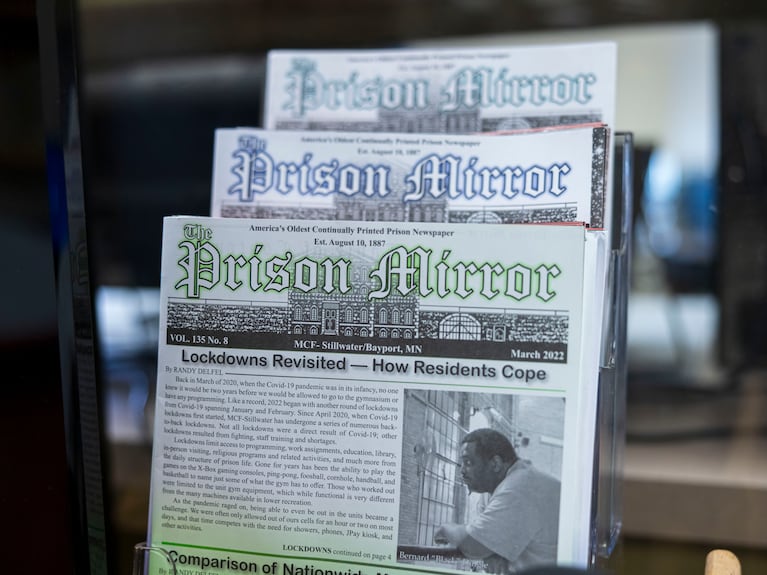
Photo: Kerem Yücel/MPR News via Oregon Public Broadcasting.
Previous issues of the Prison Mirror, which has been publishing since 1887, sit on display in the Minnesota Correctional Facility in Stillwater.

From time to time I like to run a story about interesting prison programs or ex-offenders trying to make good. I’m pretty sure we don’t have the right kind of prisons in the US. You may recall me writing about the system in Norway, which is completely different. (Click here and here.)

Meg Anderson (Minnesota Public Radio NPR) wrote recently about a longtime enrichment program at a prison in Minnesota.

“Inside a state prison near Stillwater, Minn., past the guards and the wings of cells stacked one on top of another, tucked in the corner of a computer lab, Richard Adams and Paul Gordon are fervently discussing grammar.

“Both men are on staff at the Prison Mirror, a newspaper made by and for the people held at the Minnesota Correctional Facility – Stillwater. Gordon had written a profile on the prison art instructor. He read it aloud to Adams. …

“Conversations like this have been happening in this prison for more than a century. The Prison Mirror is one of the oldest prison newspapers in the country, running since 1887. Publications like this aren’t common, but in an era where many journalism outlets in the free world are struggling to thrive amid scores of layoffs, journalism behind bars is actually growing.

“ ‘Overall we do see a growth and a lot of interest in starting publications, starting podcasts even. And so that’s really quite exciting,’ says Yukari Kane, CEO of the Prison Journalism Project.

“Thirty years ago, she says there were estimated to be only six prison newspapers. Today, there are more than two dozen. That doesn’t take into account the hundreds of incarcerated writers submitting work to publications on the outside, like The Marshall Project’s Life Inside series.

“Kane says this kind of work can offer a window into what prison is actually like, one that prison administrators aren’t necessarily going to offer up freely. … Even if a newspaper doesn’t circulate far beyond the prison yard, it can offer a sense of empowerment for its writers. …

“The Stillwater prisoners write book reviews, legal explainers, and summaries of local, national and international events for the monthly newspaper. One man recently submitted an essay on homesickness. Another wrote an editorial criticizing lockdowns. The men on staff — there are only three of them — had to apply for these unpaid jobs, and they’re highly sought after.

“Adams says the job requires a lot of reading and research about what’s going on around the world and the prison. There are challenges. They don’t have the internet, for instance, so they have to rely on print media and articles printed out by prison staff.

“The prison also has to approve everything the paper publishes. The men say that can limit what they write about, especially if they want to report on the harsher aspects of their lives.

“ ‘I am limited in the sense of, they’re not going to let me print all types of crazy things about the water or the lockdowns or getting restrained or anything like that, which is understandable to a degree,’ Gordon says.

“Last fall, around 100 Stillwater prisoners refused to return to their cells. Gordon says the disobedience was their way of protesting extreme heat, poor water quality, and staffing shortages, which he says often result in lockdowns. He plans to write about it, but says he has been retaliated against in the past for sending reporting to outside publications.

“ ‘I was a lot more aggressive in my writing back then, and that was a learning experience for me,’ he says.

Brian Nam-Sonenstein, a senior editor at the Prison Policy Initiative, says punishment for doing journalism behind bars is common. ‘You can lose what are called good time credits, which are essentially time off of your sentence based on good behavior. You could go to solitary confinement. You could have your privileges revoked,’ he says. …

“Marty Hawthorne works at the Stillwater prison and oversees the Prison Mirror.

“ ‘They have a lot of freedom. My philosophy is: It’s their newspaper. It’s not my newspaper,’ he says. ‘I believe they have a right to do what they’re doing.’ He says if the men plan to publish something critical, he makes sure whoever they’re writing about has an opportunity to respond. But he says he also pushes back when leadership tries to censor stories he believes are fair.”

More at NPR, here. No firewall.

The White Buffalo

Photo: Erin Braaten/Dancing Aspens Photography via AP.
A rare white buffalo calf in Yellowstone National Park in Wyoming on 4 June 2024. 

In the early days of TV, a show we watched regularly was Rin Tin Tin. It featured a dog and a boy and the US Army patrolling out west. I’m sure there were many elements that would be considered offensive today, but you know, children pick up nice things from anywhere. I can still sing the song about the White Buffalo.

After a white buffalo was born in June, Oliver Milman wrote about the event at the Guardian.

“A rare white buffalo has been born in Yellowstone national park, with the arrival prompting local Lakota Sioux leaders to plan a special celebration, with the calf representing a sign of hope and the need to look after the planet.

“The white calf was reportedly spotted shortly after its birth … by park visitor Erin Braaten, a photographer. She took several shots of the wobbly baby after spotting it amongst a herd of buffalo in the north-eastern corner of the large park, located in Wyoming and a small slice of Montana.

“ ‘I couldn’t believe what I was seeing,’ Braaten told ABC News. ‘It was so surreal. I just knew it was something special and one of the coolest things I’ve ever photographed.’

“Braaten and her family watched the calf and its mother for another half an hour before coming back on each of the following two days to look for the white calf, but with no further sighting. …

“Members of the Lakota Sioux tribe will hold a ceremony to celebrate the arrival at the headquarters of the Buffalo Field Campaign, which advocates for the animals, in West Yellowstone on 26 June.

“The birth of a white buffalo holds a special significance to the tribe, according to the Buffalo Field Campaign. ‘The birth of this calf is both a blessing and warning. We must do more,’ said Chief Arvol Looking Horse, the spiritual leader of the Lakota, Dakota and the Nakota Oyate in South Dakota, according to AP, referring to looking after nature and the environment.

“Tens of millions of buffalo once roamed the plains of the western US, only to be slaughtered on an enormous scale for their hides by settlers, hunters and traders in the 19th century, leaving just a few hundred of the animals unscathed.

“The mass killing of buffalo caused severe harm to native American communities that relied upon the animals as a sustainable food source, as well as being a key cultural touchstone.” More at the Guardian, here.

At a National Park Service (NPS) site, you can read a lot more about the legends surrounding the White Buffalo. For example: “To American Indians, a White Buffalo Calf is the most sacred living thing on earth. The calf is a sign to begin life’s sacred loop. Some American Indians say the birth of a white calf is an omen because the birth takes place in the most unexpected places and often happens among the poorest of people. The birth is sacred within the American Indian communities, because it brings a sense of hope and is a sign that good times are about to happen.” More at NPS, here.

If you go to the YouTube clip below, you will see many happy comments from people who loved the Rin Tin Tin episode about the White Buffalo when they were kids.

The Offline Club

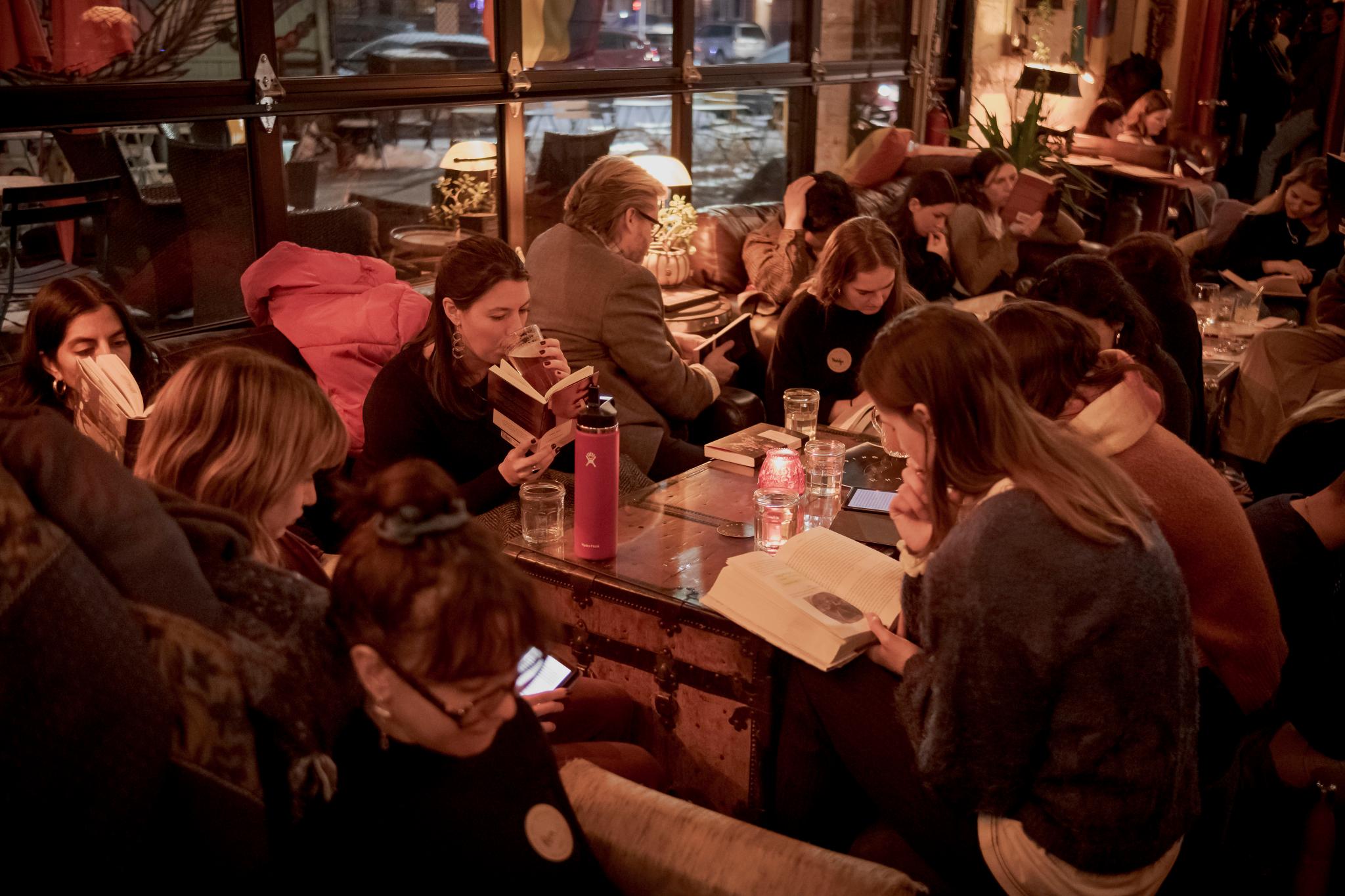
Photo: Stefano Giovannini for N.Y.Post.
A reading party in New York. No phones.

I often wonder why anyone agrees to get notifications on their mobile phones. To me, it feels like some sort of conspiracy to keep us all from ever finishing a thought. That’s why I love hearing about people who have said “enough already” to cellphones, at least for a fewer hours a day.

Today’s story is from the Netherlands, and Orla Barry covers it at the radio show The World.

“Saliha Gündüz, a PhD student from Turkey, has just handed over her smartphone to one of the founders of The Offline Club in Amsterdam, who places it carefully in a ‘phone hotel’ — essentially a locker with dividers that holds up to 60 phones.

“Gündüz said she doesn’t feel apprehensive yet — and she settled down to a cup of herbal tea at the New Yoga School cafe in the center of Amsterdam.

“ ‘The withdrawal symptoms will kick in later,’ she said. ‘But maybe a withdrawal is what’s needed if I’m going to cure myself of my addiction.’ …

“Gündüz is among 20 people of all ages and nationalities who turned up at The Offline Club on a wet Friday evening in May to see if they could wean themselves off of their addiction.

“The club’s founders — Ilya Kneppelhout, Valentijn Klok and Jordy van Bennekom — started the venture in 2022 with a plan to host offline weekend getaways. Kneppelhout said, at the time, each of the co-founders felt their phones had been dominating their lives.

“Earlier that year, he took a short trip to the north of the Netherlands on his own with ‘some books, a journal and myself.’ No phone. He said something shifted over those four days.

“ ‘I felt so much creativity and, at the same time, a sense of peace.’

“Van Bennekom did the same and loved it. They began organizing weekend getaways with groups in a house in the countryside. Everyone was required to hand over their phones upon arrival. The three-day events were a hit. But Kneppelhout said that not everyone can afford to pay a few hundred dollars for the experience. So, the idea of The Offline Club was born.

“Each attendee at the club pays around $8 at the door. The events and venues differ each time. At the New Yoga School in Amsterdam, van Bennekom lays out the rules for the evening.

“First, there’s 45 minutes of quiet time, then a 30-minute break to chat, then a further 30 minutes of time to yourself. Most people bring books to read. Soft music plays in the background as van Bennekom lays out coloring books and markers for anyone who wants to draw or doodle.

“On that rainy Friday, three men from Puglia in Italy were huddled in one corner drinking tea. Two of them were visiting their friend Pietro Maggi who lives in Amsterdam. Maggi, who works for electric carmaker Tesla, said the evening was his idea and that he persuaded his two visitors to join him. …

“[Damiano Caforio admits] ‘I keep looking at the news constantly, checking to see what’s going on in the world, or, more specifically, with my job.’ He works at the Italian Chamber of Commerce.

“ ‘I need to know what’s going on, I feel I need to control the environment. … Actually, I desperately need this experience tonight,’ he laughed. …

“Leah Davies from Wales said she spotted a post about The Offline Club on Instagram.

“ ‘I saw people reading books and knitting and playing piano,’ she said. ‘And I just loved the idea of being able to go somewhere where you’re not checking your phone all night.’ …

“Davies said she would like to see phones restricted at other events too, like concerts and nightclubs, ‘so people can just dance or talk like you did in the ‘90s.’

“Phone-free music events are already happening elsewhere in the Netherlands. In Tilburg, a city in the south of the country, another group, Off the Radar, organizes music gigs where attendees are expected to hand in their devices at the door.

“There isn’t anything quintessentially Dutch about the desire to have smartphone-free events, said Ilya Kneppelhout, co-founder of The Offline Club. But work-life balance is an important aspect of life in the Netherlands. …

A study by the Organization for Economic Cooperation and Development (OECD) found only 0.3% of employees in the Netherlands work very long hours in paid work, the lowest rate in the OECD, where the average is 10%. In January, smartphones were banned in secondary schools across the country under government guidelines.

“A similar ban is set to be introduced in Dutch primary schools in the 2024-25 school year. A study last month by Radboud University in the Netherlands found that students were generally positive about the change, saying breaks were more enjoyable and there was less bullying during school hours.”

More at The World, here. No firewall. See my earlier post on the new book-reading parties, here.