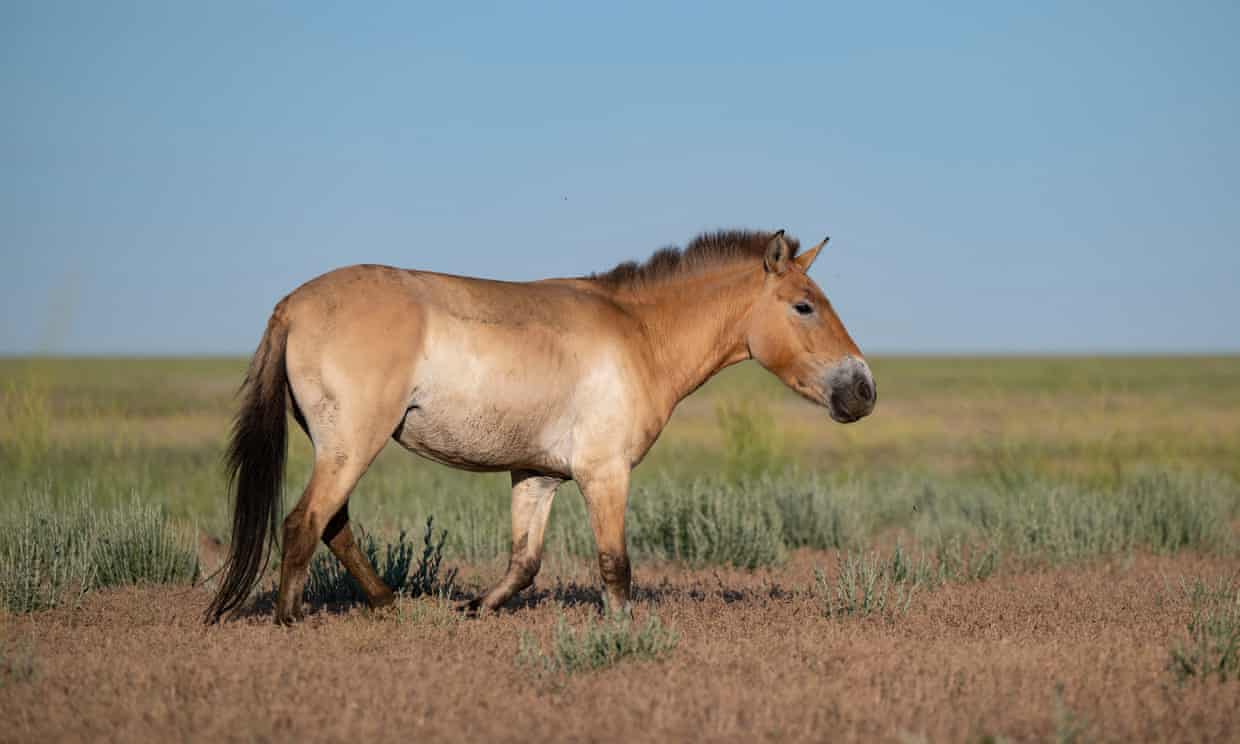
Photo: D Rosengren/Global Rewilding Alliance. The wild Przewalski’s horses are said to be the only horses in the world that have never been domesticated. They are being reintroduced to the steppes of Kazakhstan.
The woman who cuts my hair has convinced me that, on the whole, zoos are bad for animals — that elephants shifting from one leg to the other for hours at a time are not doing a little happy dance but are bored witless.
Even so, we do hear of zoos doing good work to protect endangered species.
Sophie Kevany reports at the Guardian about some zoos’ recent win for biodiversity.
“A group of the world’s last wild horses have returned to their native Kazakhstan after an absence of about 200 years. The seven horses, four mares from Berlin and a stallion and two other mares from Prague, were flown to the central Asian country on a Czech air force transport plane.
“People are known to have been riding and milking horses in northern Kazakhstan nearly 2,000 years before the first records of domestication in Europe.Human activity, including hunting the animals for their meat, as well as road building, which fragmented their population, drove the horses close to extinction in the 1960s.
“Filip Mašek, Prague zoo’s spokesperson, said: ‘These are the only remaining wild horses in the world. Mustangs are domesticated horses that went wild.’
“The horses reintroduced into Kazakhstan are descended from two groups that survived in Munich and Prague zoos.
“Originally, eight horses had been scheduled to travel, said Mašek, but one horse sat down before the flight from Prague and had to be unloaded and returned to Prague zoo.
“ ‘He was just a little dizzy returning, but he is fine now. These horses have to stand for the entire journey – they can’t sit down, mainly because their blood needs to circulate properly. It is a 30-hour journey in total, and the horses will only survive if they stand all the way,’ he said.
“Returning the horses from Prague zoo would help increase biodiversity in the region, said Mašek. ‘The horses spread seeds in their dung and when they dig up plants, they help the water get down into the soil. They also fertilize the steppe with their dung.
“ ‘For me,’ he said, ‘the goal of a modern zoo is not just about protecting and breeding endangered species, it is about returning them to the wild where they belong.’ …
“In 2011, Prague zoo was involved in a reintroduction of Przewalski’s horses to Mongolia. The project, which involved nine flights of horses, continued until 2019 when the population stabilized, said Mašek, adding that there were now about 1,500 of the wild horses in Mongolia. Mašek said the plan was to transport a total of 40 horses to central Kazakhstan over the next five years.”
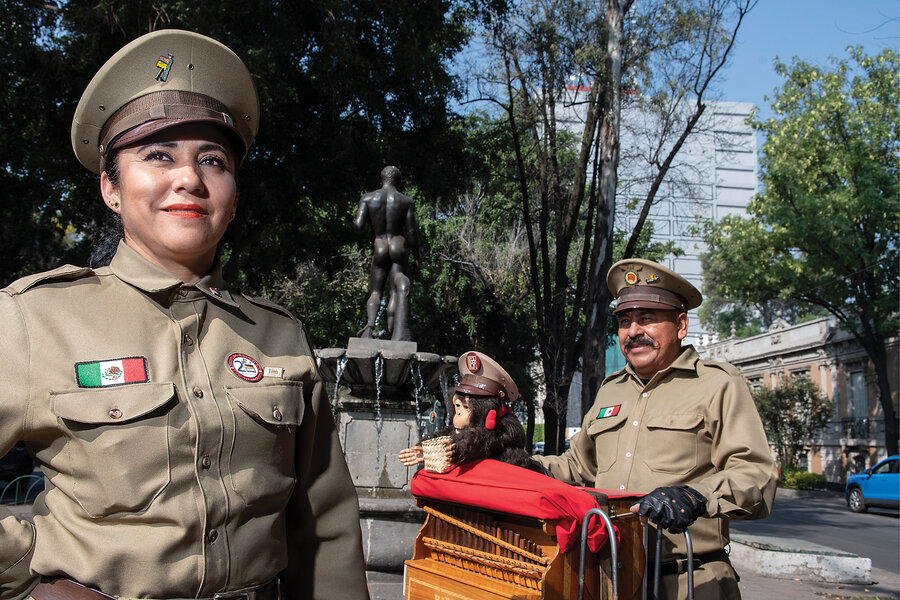
Photo: Alfredo Sosa/CSM Staff. Elsi Sastre (left) and Cresencio Torres work as a team of organ-grinders in the Roma neighborhood of Mexico City.
Between the two of us, my husband and I can tell our grandchildren about having seen an ice-delivery man, a huckster selling vegetables door-to-door, a traveling knife-sharpening guy. Wouldn’t it be great to show such things in person once in a while, not just in historic villages with costumed interpreters?
Today’s article is about something we will need to hurry up to see before it fades into history: the traditional organ grinder in Mexico.
Whitney Eulich writes at the Christian Science Monitor, “Hunched over a weatherworn hand-crank organ in his repair shop, Roman Dichi explains why the work of Mexico’s organilleros has endured for a century and a half.
“ ‘This music evokes happiness, tradition, and childhood memories of going out to a plaza with Mom and Dad – or of falling in love,’ says Mr. Dichi, president of the organ-grinders union in Mexico City. …
“Organ-grinders, especially ubiquitous in Mexico City’s historic center, date back to the presidential administration of Gen. Porfirio Díaz in the late 1800s. The dictator’s adoration of all things European inspired Mexico’s elite to import organs into their homes. Eventually, the instruments moved out of private parlors and onto the streets as public entertainment. They were used to draw customers to circuses, with the help of monkeys, and to keep soldiers in good spirits. Over time, the European songs inside the machines were replaced with revolutionary ballads and local classics, such as ‘Las Mañanitas,’ the Mexican birthday song.
“Despite these deep roots, today the tradition is at risk. Not everyone is charmed by the tip-seeking musicians. A crank organ’s sound – akin to the pitchy puff of air from a slide whistle – can be loud. In the wrong hands, an organ can be positively off-key, an assault against the ears. …
“The organs are also expensive, with many organilleros renting them from the small stock available locally. And upkeep gets costlier with each passing year. The heavy instruments can get damaged while being wheeled down crowded city streets or warped by weather and time.
“Edgar Alberto Méndez Hernández has been slowly turning the crank on his organ in the capital’s historic center for some 15 years. He nets about 250 pesos (a little more than $15) on a good day after paying 250 pesos for his rental. …
“After several hours working along a bustling sidewalk near the Bellas Artes theater, he pushes his black-and-brown antique wooden organ on its dolly and heads several blocks toward the Zócalo square. When he shows up at this even busier – and potentially more lucrative – spot, the two young men already playing organs there take their cue, as if in a dance, and move to a side street. These shifts are imperceptible to the public but tediously negotiated with the union’s help. …
“They ‘live off of tips,’ notes Yuleina Carmona, the Mexico City coordinator for Women in Informal Employment: Globalizing and Organizing, an international nonprofit. Shoeshiners and strolling mariachi bands have fixed rates for their services, but organ-grinders churn out music whether they are paid or not. …
“In March, Mr. Dichi’s union submitted a proposal to Mexico City’s Congress to have organilleros’ work recognized as a cultural heritage. It was the fourth attempt – and this time it was approved.
“The legal recognition is expected to translate to better protection on the street from police harassment and greater support for organ-grinders in their disputes with residents and businesses. Ms. Carmona notes it will also give organ-grinders ‘a seat at the table’ – a say in how Mexico City uses funds for cultural activities in the center.”
More at the Monitor, here. Great pictures. No paywall.
Now, what is the coolest old-timey thing in your memory?
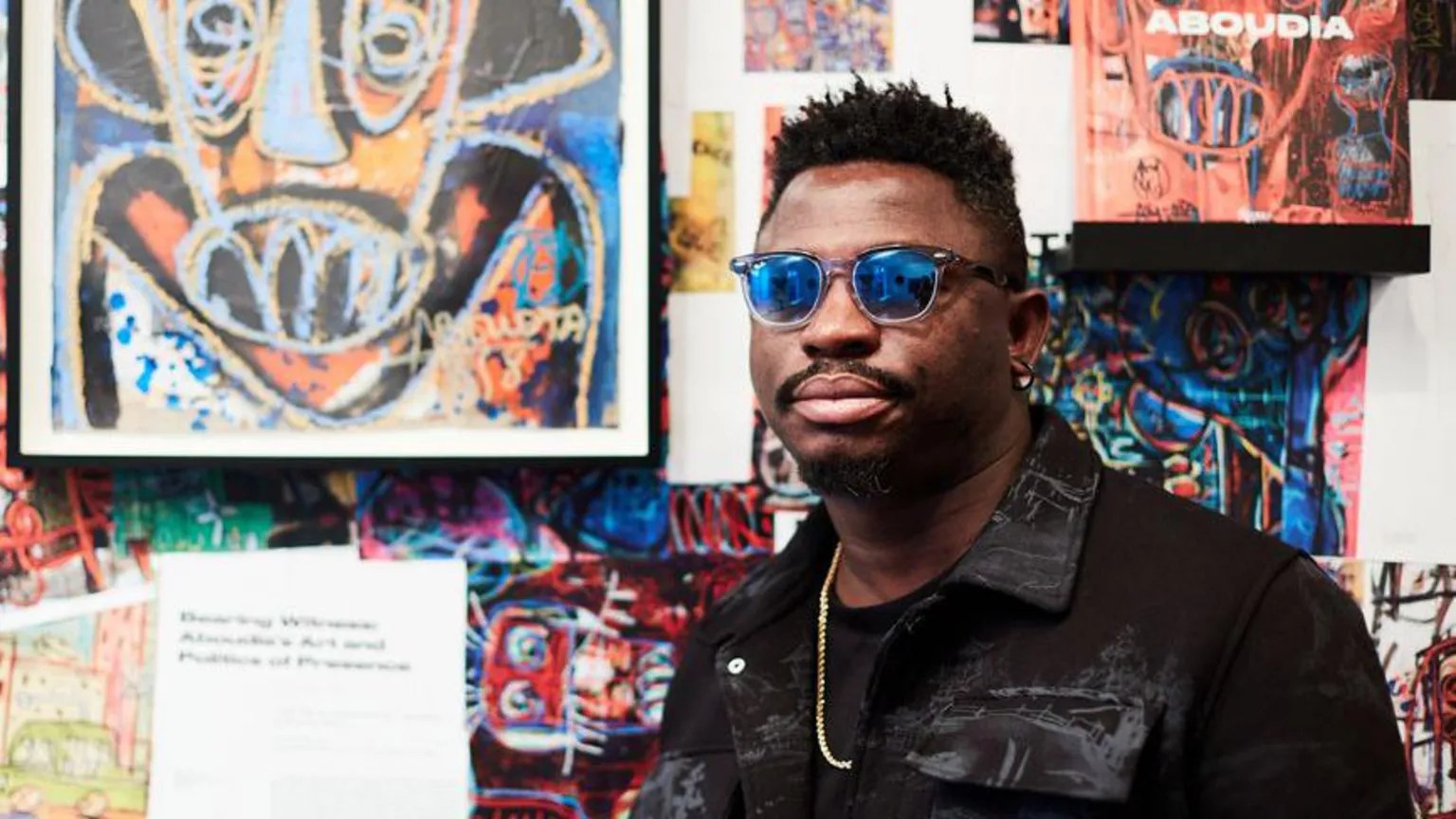
Photo: Larkin Durey. Aboudia’s work has been shown in exhibitions held in Abidjan, London, New York and Tel Aviv. Hiscox Artist Top 100 says he sold more than even Banksy in one year.
The art world is becoming more international, and that’s a good thing. For too long, people have used their own world’s cultural references to judge the quality of art. And how can only one culture be the only worthy measure?
Wedaeli Chibelushi reports at the BBC about an African that is currently making a big splash internationally.
“Back in September, global art experts were taken aback by the name topping a fresh list of the world’s best-selling artists.
“Aboudia, a graffiti-inspired artist from Ivory Coast, had beaten well-known names, like Damien Hirst and Banksy, to sell the most pieces at auction the previous year.
“According to the Hiscox Artist Top 100, Aboudia, real name Abdoulaye Diarrassouba, had flogged 75 lots. One of these canvasses had gone for £504,000 ($640,000).
“Leading online marketplace Artsy called Aboudia’s triumph ‘striking,’ while The Guardian said market experts were ‘blindsided by the ranking.
“Months later, sitting in a London gallery plastered with his paintings, Aboudia tells me the survey results were no surprise to him. ‘Because if you work hard, the success is going to come,’ he says. …
“Aboudia’s mellow disposition clashes with the art surrounding him – his vividly colored, heavily layered canvases feature a cast of cartoon-like figures plucked from the streets of Abidjan, Ivory Coast’s largest city. Through a blend of oil sticks, acrylic paints and recycled materials like newspapers, Aboudia depicts the hardships of life in downtown Abidjan.
He particularly focuses on the children who live and work on the city’s streets.
“His eyewitness portrayals of Ivory Coast’s 2011 civil war are equally arresting. Figures gaze at the viewer with vacant eyes, while armed soldiers and skulls crank up the intensity. …
“Aboudia was born in 1983, in Abengourou, a small town around [124 miles] from Abidjan. In a 2012 essay, the artist said he was kicked out of his home aged 15 after telling his father he wanted to paint for a living.
“After being cast out, the young Aboudia pressed on and enrolled in art school. Due to a lack of financial support, he slept in his classroom after the other students went home for the day. These uncomfortable nights paid off — after graduating in 2003 the soon-to-be-star was accepted into Ivory Coast’s leading art school, École des Beaux-Arts.
“Abidjan’s École des Beaux-Arts would expose Aboudia to the Ivorian art icons whose influence can be found in his current work. For instance, Aboudia’s focus on his direct surroundings and his use of recycled materials can be traced back to Vohou Vohou, a modernist collective established in the 1970s by artists like Youssouf Bath, Yacouba Touré and Kra N’Guessan.
“Aboudia began to veer away from traditional styles of art, instead using untamed brushstrokes and earthy colors to recreate graffiti produced by Abidjan’s underprivileged children. In Aboudia’s words, these young, de facto street artists ‘draw their dreams on the world.’
“The children are his main influence, he says. …
“After establishing his core style, Aboudia would lug his paintings around the galleries of central Abidjan, hoping for a way in.
” ‘It was very hard. … They’d say: “Are you crazy? What is this work? You better go to London, to United States or Paris, because this work … here it doesn’t make sense,” ‘ Aboudia recalls.
“The adversity did not end there. In 2010, Laurent Gbagbo, the then president of Ivory Coast, refused to step down after losing an election to rival Alassane Ouattara. A civil war broke out, killing 3,000 people and forcing another 500,000 from their homes.
“Throughout the four-month conflict, Aboudia sought refuge in his basement studio, documenting the horrors he saw when venturing above ground.
“The war ended with Mr Gbagbo’s dramatic capture by UN and French-backed troops — and Aboudia emerged from his haven with 21 disconcerting paintings.
“Art-lovers and journalists from Ivory Coast and beyond lauded his work and Aboudia’s ascent to global success began. He was championed by renowned art collectors Charles Saatchi and Jean Pigozzi — and went on to exhibit his work at prestigious venues like Christie’s New York and the Venice Biennale.
“Aboudia’s first solo exhibition was at the setting for this interview, London’s Larkin Durey (then named the Jack Bell gallery). Owner Oliver Durey, who has now known Aboudia for over a decade, tells the BBC: ‘There is something we can all relate to in his paintings; hiding amidst the uncertainty and horror there are balanced moments of strength and beauty.’
“African art expert Henrika Amoafo [notes] reasons for his success … like his ‘authenticity, the really raw emotional power that he’s able to convey, the way that he speaks to urban life, the way that he speaks about conflict and its impact on children.’ …
“Aboudia’s rise also coincides with that of the African art market. In 2021, art analysis firm ArtTactic reported that the auction sales value of contemporary and modern African art surged by 44% to a record high of $72.4m. …
“Aboudia’s rise has led to him splitting his time between his country of birth and New York. When he is back in Ivory Coast, he pours his efforts into the Aboudia Foundation, an organization he launched to support the country’s children and young artists.
“This is yet another example of the star’s drive — but when I ask him if he has any plans lined up for his career, he … says he takes things one day at a time.”
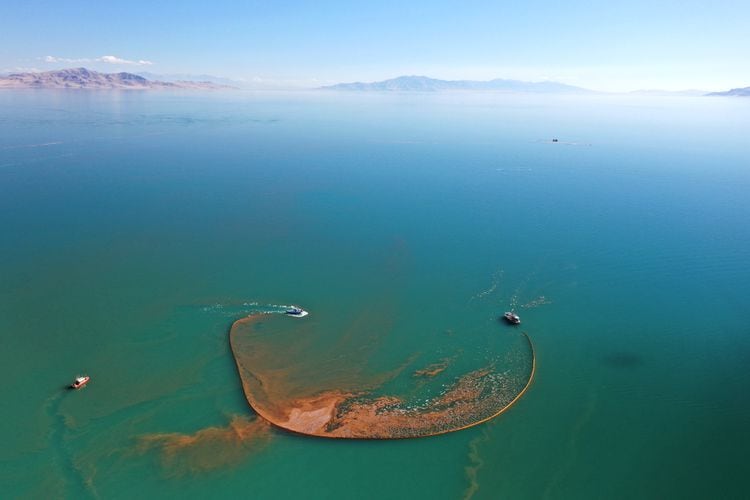
Photo: The Salt Lake Tribune. Harvest watercraft encircle brine shrimp in Great Salt Lake using containment booms in preparation for harvesting.
Although today’s story about brine shrimp feeding the world is interesting in itself, the thing that stands out to me is thinking of Uzbek scientists. Uzbekistan feels so foreign to me, it’s like talking about scientists from the far side of the moon. That’s how limited my world view is, alas.
Here’s what Leia Larsen and Levi Bridges have to say at the Salt Lake Tribune about scientists in Uzbekistan and elsewhere who are studying brine shrimp.
“As the rising sun casts golden rays over the Aral Sea, a group of Uzbek fishermen wearing sweatshirts and knit caps gathered on a chilly beach to discuss the day’s plan.
“For two days they had waited in vain for brine shrimp. A dead calm in the first cold days of winter replaced winds that usually blow large slicks of the tiny crustaceans to shore.
“Standing and smoking cigarettes beside ramshackle cabins covered in sheets of plastic to keep out the elements, the fishermen debated whose turn it was to check if any shrimp had drifted in. Two volunteers jumped on a rattling old truck and chugged off miles into the distance to scour the beach.
“When the winds blow just right, Aral Sea fishermen work up to 36 hours gathering brine shrimp eggs, also known as cysts. They often labor with headlamps through the darkness. Winter temperatures can dip as low as minus 40 degrees Fahrenheit.
“ ‘Sometimes we get so sleepy you feel drunk,’ said Miyrbek Mirzamuratov, an Uzbek fisherman who has spent two winters gathering cysts on the Aral Sea.
“The Great Salt Lake remains the world’s largest source of brine shrimp cysts, exporting 40% of the global supply. The shrimp are a key food source used in aquaculture. Seafood is the main source of protein for billions of people across the planet, and aquaculture, fueled by brine shrimp, now produces roughly half of the world’s commercial seafood.
“But drought and decreasing water resources have put new pressure on brine shrimp in both Utah and Central Asia. In 2022, the Great Salt Lake’s shrimp populations almost collapsed due to record-low water elevation and spiking salinity.
“ ‘We’re all starting to realize just how much the lake touches us in many ways that we don’t appreciate,’ said Tim Hawkes, a former Utah state representative and current general counsel for the Great Salt Lake Brine Shrimp Cooperative. …
“Environmental challenges are also forcing scientists in Uzbekistan to devise ways to save their own brine shrimp – and help keep the world fed if Utah can’t ensure its own inland sea survives. Despite being too salty for fish, the Great Salt Lake’s aquaculture industry infuses Utah’s economy with up to $67 million each year, thanks to brine shrimp.
“That’s because their cysts, no bigger than a grain of sand, tolerate extreme conditions.
“ ‘You can boil them, you can freeze them, you can send them to outer space,’ Hawkes said. ‘And still, under the right conditions, if you put them in a little bit of salt water and give them some light, they’re going to hatch out.’
‘It makes brine shrimp cysts an ideal product to package and ship across the world, where they’re raised as an essential food source for the farmed seafood humans eat, particularly prawns and cocktail shrimp.
“Globally, the average person ate 44.5 pounds of seafood in 2020, up from 31.5 pounds in the 1990s, according to the U.N. More than half of that came from farms.
“ ‘If we lost the Great Salt Lake,’ Hawkes said, ‘or we lost the ability to produce brine shrimp from the Great Salt Lake, it would have a significant impact on our ability to feed the world.’ …
‘Companies on the Great Salt Lake gather brine shrimp cysts from the water with boats and floating booms similar to those used to contain oil spills, but the work is still mostly done by hand in Uzbekistan and other Asian countries. …
‘Islambek Shumomurodov said he earns about $1.50 for every pound of Aral Sea cysts he gathers. The average annual household income in Uzbekistan is around $1,600. ‘Some people even buy new houses and cars from working here,’ Shumomurodov said.
“Although Uzbekistan’s brine shrimp production represents just a fraction of Utah’s output, the crustaceans created an economic opportunity after the Aral Sea’s traditional fishery shriveled.
“The Aral Sea, like the Great Salt Lake, has declined significantly from agricultural demand and human water consumption. Once a freshwater lake teeming with fish, the Uzbek portion of the Aral turned saline — a trend scientists don’t expect will change.
“Neighboring Kazakhstan spent millions damming off their portion of the North Aral Sea to keep the freshwater fishery viable. Brine shrimp, which likely hitchhiked to the region as cysts stuck to the feathers of visiting shorebirds, are the only creatures with commercial value able to survive in the shrinking southern Uzbek portion of the lake. …
“ ‘It’s just a matter of years now before [the Uzbek side of] the Aral Sea can no longer support brine shrimp,’ said Ablatdiyn Musaev, a biologist at the Uzbek Academy of Sciences.”
More at the Salt Lake Tribune, here. No firewall. Nice photos. There’s an audio version of the story at PRX’s The World.
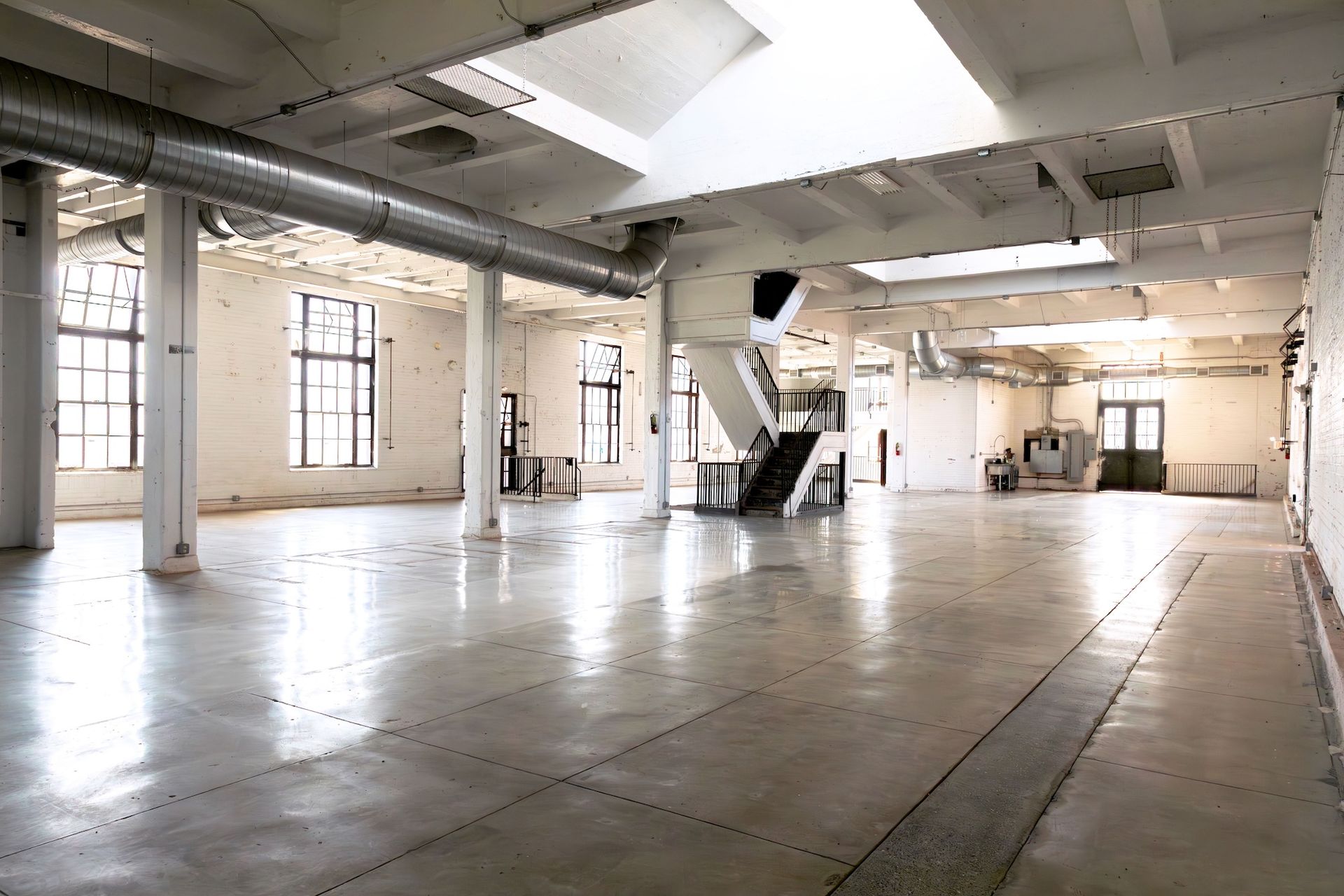
Photo: Isabel Kokko, Forman Arts Initiative, Philadelphia, via the Art Newspaper. Inside the former electrical substation as it appears today. The Forman Arts Initiative plans to renovate four buildings in Kensington to hold a gallery, performing arts venue, garden area, and FAI offices.
One of the cool places I get leads from is ArtsJournal. The variety of topics is great because they check out way more sources than any one person could monitor (or pay the fees for). Today’s story is from the Philadelphia Inquirer and covers an art initiative not far from where I used to live in Pennsylvania.
Rosa Cartagena writes, “A new 100,000-square-foot arts campus coming to West Kensington will open in stages over the next two years. The Forman Arts Initiative, an arts organization that awards grants to local creatives and arts nonprofits, plans to renovate four buildings on American Street. The multipurpose space will hold a gallery, performing arts venue, and garden area, in addition to FAI’s offices.
“Michael Forman and Jennifer Rice, the art-collecting couple behind FAI, envision the campus as a cross between an arts center, coffee shop, art-making studio, and gallery space where they can publicly display their collection of more than 800 artworks. The collection — largely works from artists of color and women — includes such names as Philadelphia ceramist Robert Lugo, legendary photographer Gordon Parks, and abstract painter Alma Thomas.
“ ‘We live with our art, and we think of our collecting more as stewardship than ownership,’ said Rice. … ‘We’re really looking at using art as a tool for education, community engagement, performance, and inspiration.’
“In late 2022 and early 2023, the couple purchased a vacant lot and four adjoining buildings on the 2200 block of American Street. … FAI will work with Philadelphia architecture firms DIGSAU and Ian Smith Design Group to transform the 100,000-square-foot site. Forman said it’s too early to know how much the restoration and renovation will cost, but FAI plans to finance it internally and will seek government funding and potential support from local foundations.
“FAI has also attracted one of the most influential people in the art world to serve as lead designer: urban planner and sculptor Theaster Gates. Forman and Rice first connected with him as collectors of his art and when they began developing plans for the campus, they approached Gates for his unique style that combines ‘social practice and art practice,’ said Forman.
“In Chicago, where Gates lives and works, he is renowned for repurposing abandoned industrial buildings into arts spaces, archives for Black culture, affordable housing, and artist residences that have revitalized a South Side neighborhood.
“Philadelphia has been a site for his artwork, as well. In 2020, Gates created the public work Monument in Waiting, in a response to the movement to tear down Confederate monuments. The sculpture, which critically questions national heroes, has been on display at Drexel University since 2022. …
“FAI is undertaking an extensive listening tour to determine what exactly the West Kensington neighborhood needs and wants from a space such as this. Gates will work with newly appointed FAI executive director Adjoa Jones de Almeida, who was previously at the Brooklyn Museum, and associate executive director Sunanda Ghosh, a local nonprofit strategist who has worked with BlackStar and Asian Arts Initiative, among others.
“ ‘We are very intentionally saying to people, “We actually don’t know,” because, truly, we are emphasizing the design of a communities engagement strategy,’ said Jones de Almeida, who moved to East Kensington earlier this year. The plan is to incorporate input from the neighborhood’s residents and organizations into the design of the space.
“She’s interested in ‘radical collaboration’ with neighborhood organizations such as the Norris Square Neighborhood Project and Taller Puertorriqueño, both recipients of last year’s FAI grants. …
“Forman and Rice believe that West Kensington is the best location because, despite being systemically overlooked and under-resourced, the community has a strong arts community, including Crane Arts and the Clay Studio.
“ ‘We were interested in the notion that we’re not displacing anybody — the buildings that we bought were all commercial,’ said Rice. ‘It’s just repurposing.’ …
“ ‘You have to enter with big ears and an open and pliant heart,’ said Gates. ‘The work of creating a creative space and making a significant investment in a place that’s been highly underinvested is hard work when you’re trying to really listen, because there’s a lot of bruised feelings.’ ”
More at the Inquirer, here. And the Art Newspaper version has no paywall, here.
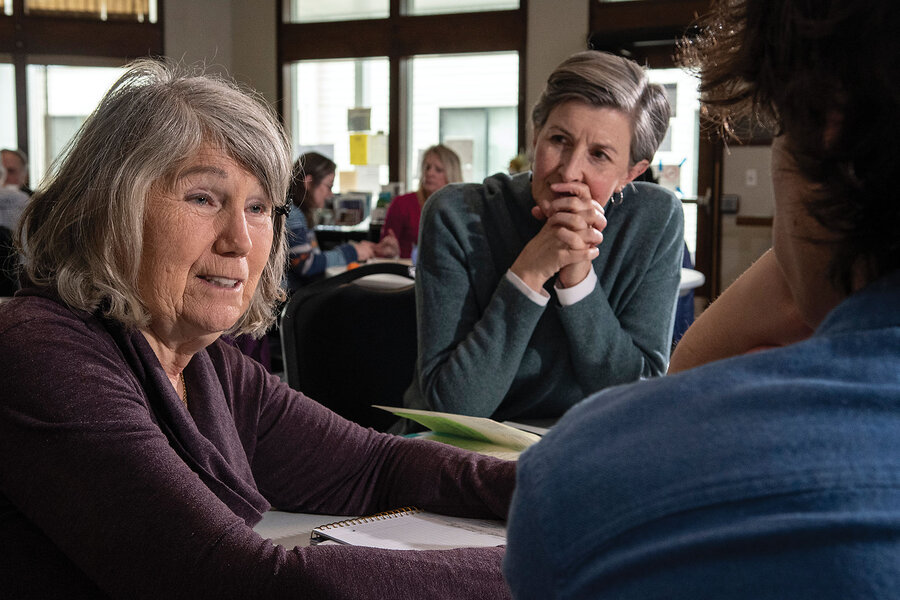
Photo: Alfredo Sosa/CSM Staff. Virginia Frederick (left) and Sarah Duncan (center) participate in a conversation table training workshop hosted by the East County Citizens’ Alliance in Washougal, Washington.
Sometimes it seems we have nothing in common with other passengers on spaceship Earth, and it sure is anxiety making. But if we were invaded by aliens from deep space, you know, we’d suddenly all band together. We’d realize what we have in common.
What else do we have in common? What can we build on? Some people in the state of Washington reaiized they could start with trash.
Stephen Humphries has the story at the Christian Science Monitor. “Before the troubles started, Melanie Wilson believed she’d finally found paradise.
“She and her husband had moved from Washington, D.C., to Washougal, Washington, in 2019. After the cacophonies of the U.S. capital, they immediately felt at home with tranquil views of the mountains, including the snowcapped peak of Mount Hood in the Oregon distance. … The pace of life here is as unhurried as the logging barges wending through its gorge.
“ ‘I’ve been looking for a home my whole life,’ Ms. Wilson says of the town of 17,000 people. ‘I want to make friends here. I want to put down roots here.’
“That was five years ago. Then the pandemic hit in March 2020. Two months after that, George Floyd was murdered by Minneapolis police. And the Wilsons’ paradise, it seemed, suddenly erupted into the kind of rancor they thought they had left in Washington, D.C.
“Protests sprang up in the conjoined towns of Washougal and Camas that summer. By August, pro-police rallies were attracting hundreds of supporters waving American flags in support of law enforcement. On opposite sides of the street, half as many counterprotesters hoisted Black Lives Matter signs in a clash of highly charged remonstrations.
“The area has been called the ‘crossroads to discovery.’ Today both towns are at the crossroads of America’s deepening political and cultural divides. The bedroom communities are just a 30-minute drive west from progressive Portland, Oregon. A few miles to the east, however, horses, cows, and alpacas graze on gentle swells of verdant farmland, scattered with barns. …
“The protests in Washougal and Camas were mostly peaceful. Mostly. The police broke up a couple of push-and-shove scuffles. …
“Ms. Wilson was getting increasingly worried. Then, at a school board meeting in 2021, the vitriol she’d been witnessing reached a tipping point, jolting the sense of home that had become so important to her life.
“During the meeting, a man stood up and jabbed his finger at the elected officials sitting in front of them. ‘ “Civil war is almost here. We’re sharpening our bullets,” ‘ Ms. Wilson recalls the man saying. …
“She was startled once again by the crowd’s response. ‘People around the room clapped and stamped their feet on the floor,’ she says. ‘It seemed to me, that’s a flashing red warning in a community.’
“After the meeting, she began talking to others in the community about the violent rhetoric. She joined a group of citizens in Washougal and Camas to think about how to counter the civic vitriol that seemed to be tearing their community apart. Over time, she conceived a simple idea: People would gather to pick up trash, together.
“Today, Ms. Wilson is the co-founder and executive director of the East County Citizens’ Alliance. Its volunteers don’t chant and shout. They don’t tote signs and megaphones, let alone AR-15s. What they do carry, however, are seedlings, paintbrushes, and trash bags. One volunteer even brings his tractor.
“The organization engages in other projects, too, from feeding the hungry to mentoring students. It’s all in service of an underlying mission: Getting people out of their news silos and partisan bubbles to gather together outside – their outside, their gorgeous, scenic, pastoral part of the world – and make an effort to work together and get to know each other.
“This idea, too, is simple: To fix our politics, we must first mend our culture.
“There are groups like Ms. Wilson’s springing up all over America, in fact. From Wilkesboro, North Carolina, to Madison, Wisconsin, to Compton, California, small bands of volunteers are working to improve their quality of life, not only in their neighborhoods, but also in their hearts.
“There’s little glory in it. Sometimes, volunteers may even wonder if they’re making any progress at all. But with each small act of kindness, they’re working to weave a social fabric of grace, stitch by stitch, and rooted in tolerance, respect, and faith in each other, as different as that other may be. …
“Ms. Wilson, riding shotgun, plays tour guide to Monitor journalists along for the ride [with Barbara Seaman]. A few days previously, the duo transported braised barbecue to ReFuel Washougal, a program that serves free meals to residents in need. The East County Citizens’ Alliance took a turn hosting a dinner in collaboration with Washougal High School’s culinary arts program.
“ ‘If you were in my car, it’d be full of traffic cones and trash bags and trash,’ Ms. Wilson says. ‘This is what community-building looks like. It doesn’t look like fancy discussions about policy.’
“But the group’s members did get their start with discussions. About 90 residents, including Ms. Wilson and Ms. Seaman, held regular meetings in 2021 about the culture war issues roiling their schools. The topic of political extremism in the area started cropping up more and more.
“The discussions soon grew into the organized alliance. People decided they were done focusing on politics as a community. ‘I’m so sick and tired of everybody labeling everybody,’ says Ms. Seaman, the group’s assistant executive director. ‘I just want to get people together to build relationships.’ …
“The emerging alliance needed a project that could both build community ties and be free of controversy. So it decided to start simply, getting people with opposing political views outside, working together for a common purpose in the offline world.
“ ‘Nobody likes trash,’ says Ms. Wilson. ‘They’re both picking up trash next to each other. They’re talking about, “Who would leave a tire on here? … And I’m sick of these beer cans out here. What are people doing?” ‘
“That could lead to conversations about drinking and driving, she continues. ‘We’re all against drinking and driving. They’re finding what they’re against and for, together, in the moment. And if you have to start out small because everybody hates trash, that’s where you start.’ ”
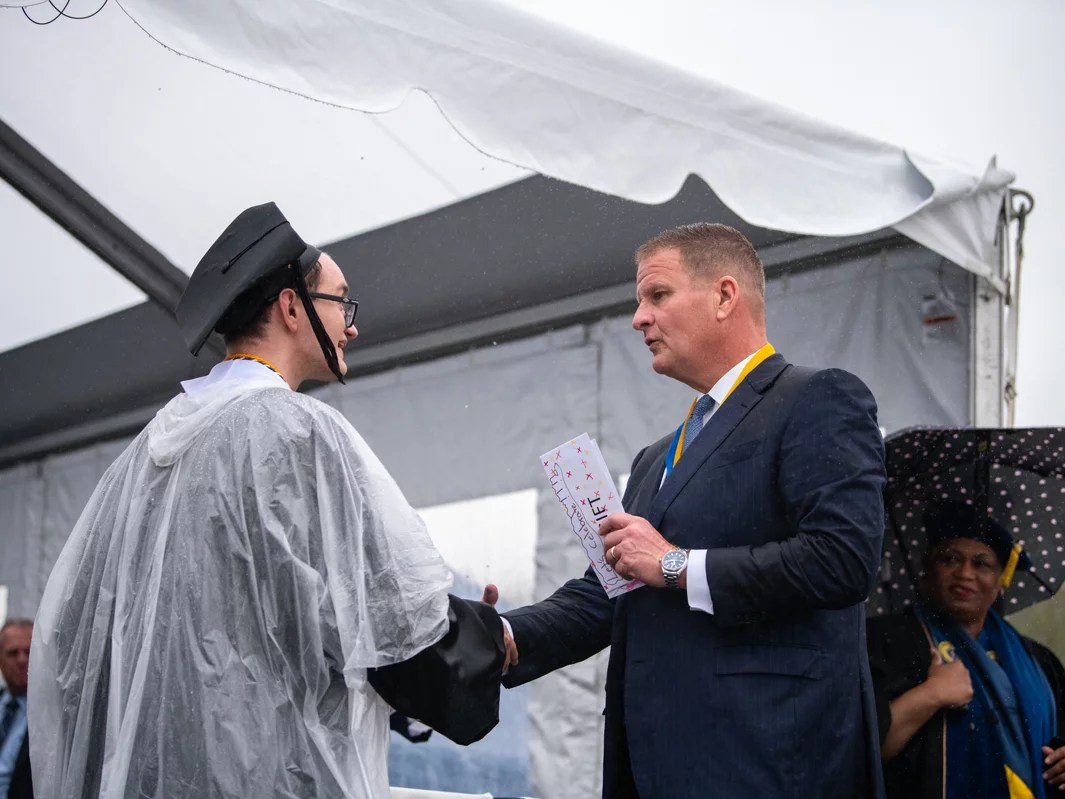
Photo: Karl Christoff Dominey/University of Massachusetts Dartmouth via NPR. Robert Hale gives an envelope with cash to a graduating UMass Dartmouth student at commencement. Each of the 1,200 graduates received $1,000 onstage, half to keep and half to donate.
Here’s a story from the most recent graduation season: a speaker who gave graduates the inspiration and also the means to start being productive members of society right away.
Jenna Russell reported at the New York Times in May, “Until the final minutes of their commencement ceremony last Thursday, the 1,200 graduates of the University of Massachusetts Dartmouth thought they knew what they would remember most about it: the supremely bad weather during the outdoor ceremony, where they sat drenched and shivering in a torrential rainstorm.
“Then, as they prepared to collect their diplomas, their commencement speaker, Rob Hale, a billionaire philanthropist from Boston, returned to the dripping podium. He brought along two cash-stuffed duffel bags, he announced, and would hand every graduate $1,000 as they crossed the stage — $500 to keep for themselves, and $500 to give to any good cause. …
“Hale, the co-founder and chief executive of Granite Telecommunications … told the graduates at UMass Dartmouth he has never forgotten the experience of losing everything, when the first company he built went bankrupt in the dot-com crash more than 20 years ago.
“Since that disaster, he said in an interview this week, he and his wife have found deep joy and satisfaction in giving their money away. In granting college students a chance to experience the same feeling, he said he hoped to light a spark that they will carry with them — even if he had no guarantee that they will honor his request. …
“ ‘If they get to feel that joy themselves, then maybe it becomes something they want to do again, and make part of their own lives,’ Mr. Hale, 57, said.
‘In America and the world, these are times of turmoil, and the more we help each other, the better off we’ll be.’
“In the week since a businessman they had never met handed them two damp envelopes onstage — one labeled ‘GIFT and the other ‘GIVE’ — the new graduates have packed up dorm rooms, fine-tuned résumés and snapped last campus selfies. They have also pondered where to send what for most will be the largest charitable gift they have ever had the chance to give.
“Tony da Costa, a graphic design major who graduated with high honors, considered giving his $500 to a charitable organization but decided instead to hand it over to an acquaintance of his mother, someone he has never met, who is suffering from an illness and struggling to pay bills. …
“Kamryn Kobel, an English major, gave her $500 to the Y.W.C.A. in Worcester, Mass., where she learned to swim as a child, to support its programs for young women and survivors of violence. Her donation felt like something to be proud of, she said — once it sank in that the envelopes she tucked under her rain poncho contained exactly what Mr. Hale had promised. …
“UMass Dartmouth enrolls about 5,500 undergraduates, more than half of them first-generation college students. Eighty percent come from Massachusetts; 80 percent receive financial aid. It is the fourth Massachusetts college campus in the last four years where Mr. Hale has thrilled graduates with his signature split gift. Each time, he has selected a public school with high concentrations of first-generation and lower-income students who have ‘worked their tails off to get there,’ he said. …
“In an interview … he briefly grew emotional describing how one of the UMass Dartmouth graduates had given her $500 to a local group that provides holiday gifts for children in need — a program that had helped her family when she was a child.
“ ‘Seeing things like that is very cool,’ he said.”
More at the Times, here. There’s a story on this at NPR, too, where there’s no paywall.
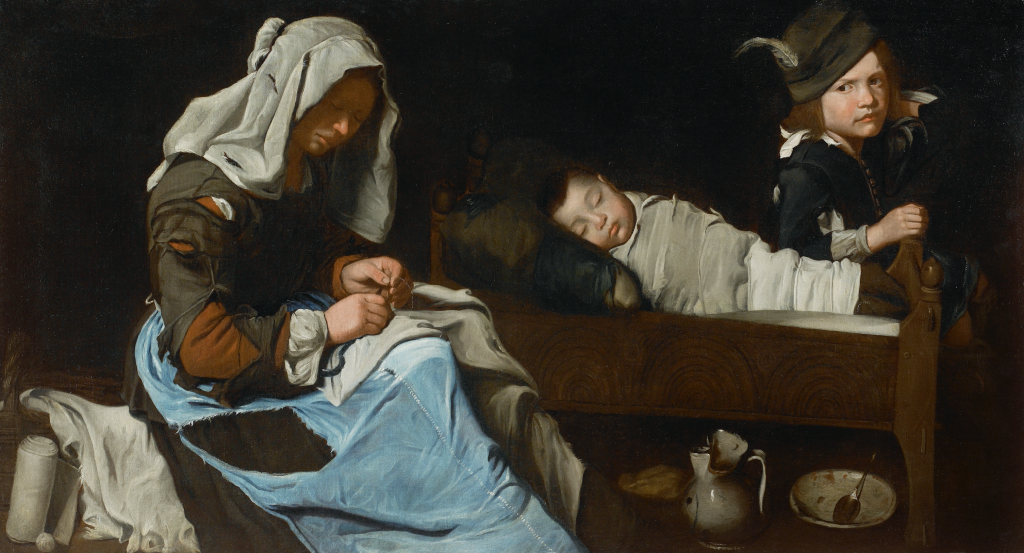
Photo: Galerie Canesso. An unknown artist now dubbed “Master of the Blue Jeans” created “A Woman Sewing with Two Children” (c. 17th century).
In case you missed it, several outlets wrote recently about a Parisian gallery’s exhibit drawing attention to what looks like blue jeans in 17th century paintings. What? They weren’t invented by Levi Strauss?
Vittoria Benzine writes at Artnet News, “A new exhibition opening at Galerie Canesso will highlight the contested origins of blue jeans, with the display of 17th-century paintings that appear to depict the fabric. Levi Strauss is often credited with creating the sartorial staple in California 150 years ago, though France and Italy have made their own claims. But 10 early artworks featuring blue jeans complicate the narrative.
“In 2004, curator Gerlinde Gruber reattributed these works to an unknown artist dubbed the Master of the Blue Jeans. By 2010, the Italian dealer Maurizio Canesso had bought up all of the mysterious painter’s works. Two will appear in his gallery’s 30th anniversary show, taking place in Paris (May 16—June 23) and Milan (May 23 — June 23), but only one of them, Woman Begging with Two Children, will be for sale.
“Since Galerie Canesso’s last exhibition in 2010, which presented the full-known oeuvre of the Master of the Blue Jeans, the dealer has located one additional example, which he bought in Buenos Aires.
“The original 10 paintings by the Master have always been traced to Northern Italy during the 17th century, but were previously attributed to Michael Sweerts, Diego Velásquez, and Georges de Latour. While they are all early genre scenes centered on society’s poorest people, most feature flashes of prototypical jeans crafted from blue cloth and white thread.
“ ‘People are still not very familiar with the true history of blue jeans, as they confuse it with the material made by Levi Strauss,’ Canesso told Artnet News. ‘One has to distinguish between blue jeans and denim: jeans come from Genoa, while denim comes from the French city of Nîmes.’ The Italian specimens were woven with perpendicular stitches, while their French kin were woven in chevron patterns.
“ ‘An amazing thing is that until the 11th century, no one could wear blue fabric because they didn’t know how to make blue color adhere to the fabric,’ Canesso continued. ‘Only in the year 1000 did this begin to happen using woad leaves, and at a very high cost. The genius of the Genoese was to find the indigo stone in India and make this an industrial and therefore low-cost process.’ …
“Genre painting flourished in the century that followed, but these works stand out. ‘The Master of the Blue Jeans is the only one who painted jeans,’ Canesso wrote. ‘These paintings are the story of a family: they are always the same characters, wearing the same clothes — clothes that they used every day. And they are true jeans fabric: when it tears, the white thread comes out.’
“This feature is especially visible in ‘A Woman Sewing With Two Children’ — another work by the Master of the Blue Jeans set to go on view at Galerie Canesso. It will be on loan (like most works in the anniversary show) from the collector that Canesso originally sold it to.”
More at Artnet News, here. No paywall. If you prefer an audio version of the story, check out radio show The World, here. That’s where I first learned about this.
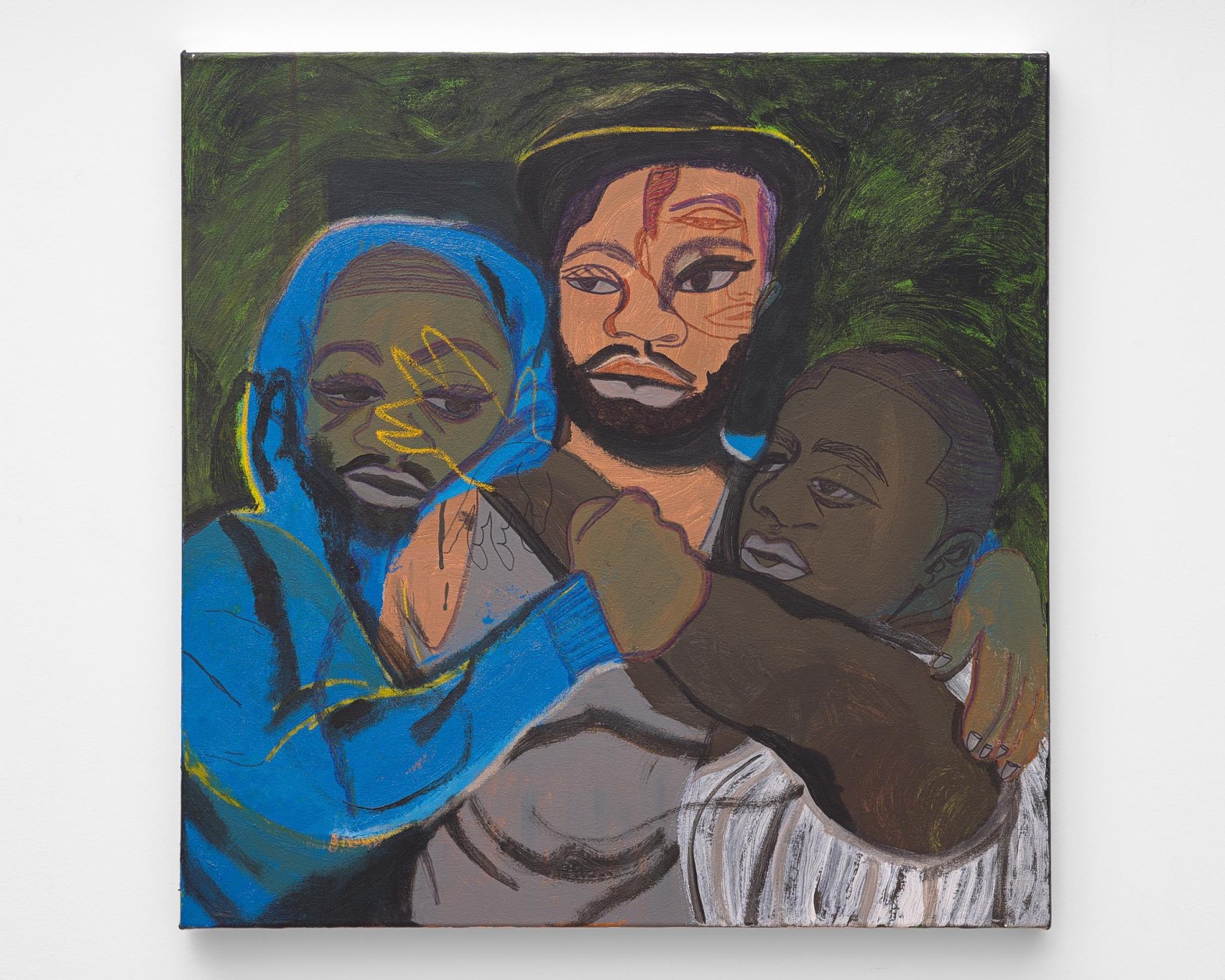
Art: Jonathan Lyndon Chase. “Calm Touches” (2021), acrylic paint, oil stick, and marker on canvas, 20 x 20 inches. One of the pieces that students chose for the art collection at Wake Forest University.
I’ve been reading Just Kids, Patti Smith’s memoir about her life with artist Robert Mapplethorpe, and I’ve been thinking about how young artists carve out new ways, how they realize they have a different vision and develop the confidence to stick with it.
So it was with interest that I read at Hyperallergic about a university tapping youthful insights about art to form a very special collection.
John Yau reports from Winston-Salem, North Carolina, “Wake Forest University is one of the few American institutions of higher education to establish a collection of student-acquired art.
“Once every four years, a small group of students, along with faculty advisors, travels to New York City to buy art for the Mark H. Reece Collection of Student-Acquired Contemporary Art. This collection was started in 1963, at the beginning of a convulsive era in American history.
“Mark Reece, the dean of students and college union advisor, decided the school should establish a collection of contemporary art chosen by an acquisitions committee composed solely of students. In June of that year, Reece, Dean Ed Wilson, Professor J. Allen Easeley, and two students, David Forsyth and Theodore Meredith, drove to New York to visit contemporary art galleries. Working within a budget that Reece had cobbled together from unused funds, Forsyth and Meredith chose 18 works by 17 artists.
“Earlier this year, Wake Forest University celebrated the 60th year of this program — and the 16 trips that have taken place since the program’s inception — with a selection of works obtained by previous generations of students. The exhibition, Of the Times: Sixty Years of Student-Acquired Art at Wake Forest University at the Charlotte & Phillip Hanes Art Gallery, was curated by Jennifer Finkel, who also contributed to the catalog, along with Leigh Ann Hallberg and J. D. Wilson.
“The collection comprises more than 130 works, including, paintings, sculptures, drawings, photographs, and prints. Unsurprisingly, given that the acquisitions committee changes every four years, no style, movement, or material dominates. The one constant holding the collection together, though in no obvious way, is the mandate that Reece gave the first two students, which has been followed ever since: the art they buy must be ‘a reflection of the times.’
“During my time on campus, I was invited to sit on Professor John J. Curley’s class, titled Slow Looking. The small group of students, seated in a semicircle, faced Ida Applebroog’s ‘Promise I Won’t Die?’ (1987), a work on paper combining lithography, linocut, and watercolor that the acquisition group elected to buy in 1993. …
“By asking students to research an artist and carefully scrutinize a particular work of art, Curley encouraged them to go down a rabbit hole, where they can consider what they are looking at and how it communicates with them. This level of engagement is hard to achieve without being in the presence of a physical artwork. That it was chosen by a group of students 30 years ago underscores this collection’s ongoing vitality and relevance.
“On campus, I also met some of the students who participated in the most recent New York buying trip. All were genuinely excited. They talked about how they prepared for the trip, beginning with Reece’s original mandate. They began compiling the initial list of 300 artists once they had been accepted into Contemporary Arts and Criticism. Throughout the semester the list expanded and contracted until it was down to 20 names. The students met in and outside of class. Each week, they presented a short list to their two professors, Finkel and Curley.
“The students discussed what they thought art reflecting the times would look like, and who might make it, resulting in a racially diverse group. Before the trip, they made appointments with the artists’ galleries. Some dealers, I learned, were arrogant to them, treating them as if they didn’t know what they were doing. Others were warm and welcoming. At least one gallerist kept looking to the professors who accompanied them, convinced it was they who would make the final decision. …
“This immersive art-buying experience … mirrors this country’s changing demographics. For the first decades, the artists on the list were all or nearly all White. In 1989, the students bought Robert Colescott’s painting ‘Famous Last Words: The Death of a Poet’ (1988). … Four years later, the students bought ‘Untitled (Four Etchings)’ (1992) by Glenn Ligon and ‘Untitled (from the Empty Clothing series)’ (1991) by Whitfield Lovell. In 2001, they added South Korean artist Do-Ho Suh and Pakistani-American artist Shahzia Sikander to the collection. They confronted controversial subjects, such as Congolese child soldiers, photographed by Richard Mosse, and Pakistani artist Salman Toor’s paintings of queer Brown men.
“This year, the eight students chose the work of eight artists: Tunji Adeniyi-Jones, Jonathan Lydon Chase, Melissa Cody, Adebunmi Gbadebo, Emilie Gossiaux, Melvin L. Nesbitt Jr., Willa Wasserman, and Zhang Xiaoli.
“My only criticism,” Yau writes, “is that the university has no building dedicated to this collection, and it really should. Yet the diversity of artists, mediums, and practices is to be applauded. Taking their cues from Reece’s mandate, Wake Forest’s students have assembled an impressive gathering of art.”
I love how the university recognizes that young people have different sensibilities and how it honors that. More at Hyperallergic, here. No paywall. Subscriptions encouraged.
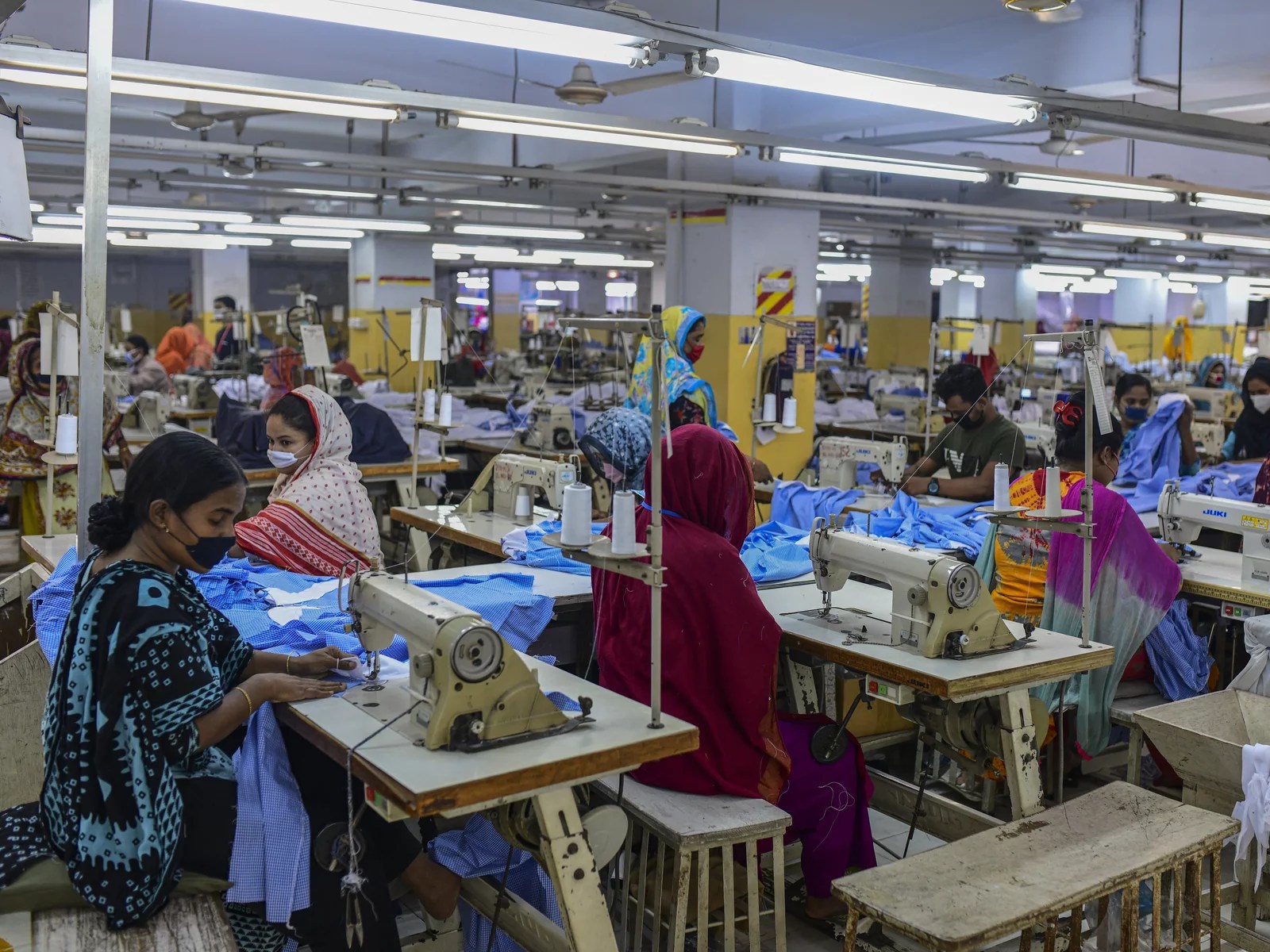
Photo: Zabed Hasnain Chowdhury/SOPA Images/LightRocket via Getty Images. Garment workers were deemed essential employees during the Covid lockdown in Bangladesh, when workers were more worried about hunger than the pandemic and customers in wealthier places were still demanding new clothes.
Here’s a support group that most of the world needs. It’s one that recognizes capitalism — or at least acquiring more and more “stuff” — as an unhealthy addiction for Spaceship Earth.
Gerry Hadden reports at Public Radio International’s The World, “Twice a month, members of the support group Capitalists Anonymous gather in a small room in Paris, France, beset by chronic buyer’s remorse.
“Some arrive worried over how much they consume and don’t know how to stop.
“On a recent night, each of the eight people stood up, introduced themselves, and gave their reasons for coming to the support group. A woman named Claire, who didn’t want to share her last name, said she wants to be with people who share her concerns for the planet and mental health. …
“ ‘Where I live in southwest France’ [said participant Olivier Montegut], ‘it reached 90 degrees one day — in April. We’ve just had a baby, and I am scared for her future,’ he told the group.
“Most scientists agree extreme weather is being fueled by climate change, which is exacerbated by the burning of fossil fuels. And capitalism is the force behind it all, said the group’s founder, Julien Lamy.
“He said it’s a global system that pushes unfettered consumption on the rich and poor alike, and virtually everyone, he said, is addicted.
“ ‘To push back, I searched for support groups with a focus on recovery and eventually found Alcoholics Anonymous, with its 12-step method,’ Lamy explained. …
Capitalists Anonymous has just eight steps but starts with the same one — admitting that you have a problem.
“ ‘It means recognizing that we’re participating in a system that’s destroying life on our planet,’ he said. …
“These steps might sound familiar to people in drug or alcohol programs, but Lamy said in some ways, capitalism is harder to shake because it permeates every part of modern life.
“ ‘I often say that what we’re trying to do is like striving for sobriety,’ he said, ‘but while living inside a bar.’ A planet-sized bar.
“To avoid feeling overwhelmed, Lamy suggests people take small steps to reduce their impact just to feel better in their personal lives, such as biking to work or cutting back on red meat. …
“Resident Anne-Christelle Beauvois said she heard Lamy on the radio and reached out to learn more.
“Beauvois worked for years in the fashion industry. She said she became alarmed in the 1990s when so-called fast fashion arrived — that system of mass-producing cheap clothes in sweatshops that then get shipped all over the world.
“ ‘It’s nuts,’ she said. ‘You can wake up in the middle of the night, jump on Instagram to follow some influencer or brand and click, you place an order.’
“Beauvois said she has never ordered anything online in her life. But she’s hardly ‘holier than thou,’ she said as she lit a cigarette and took a puff on another addiction.
“It may be hard to avoid capitalism when the entire global economy depends on it, but Beauvois said people can still produce differently.
“ ‘Do we need to make stuff we don’t need? Must we work 50 hours a week? Is it such a problem to add more pleasure to our lives and less work?’ she said. …
“Lamy, the founder, said people from all over Europe — even Mexico — have written to ask how to start their own chapters.”
So my question is, How do we stop unnecessary acquiring and still ensure that the people who are providing all the “stuff” not only have enough to eat but can have a decent life?
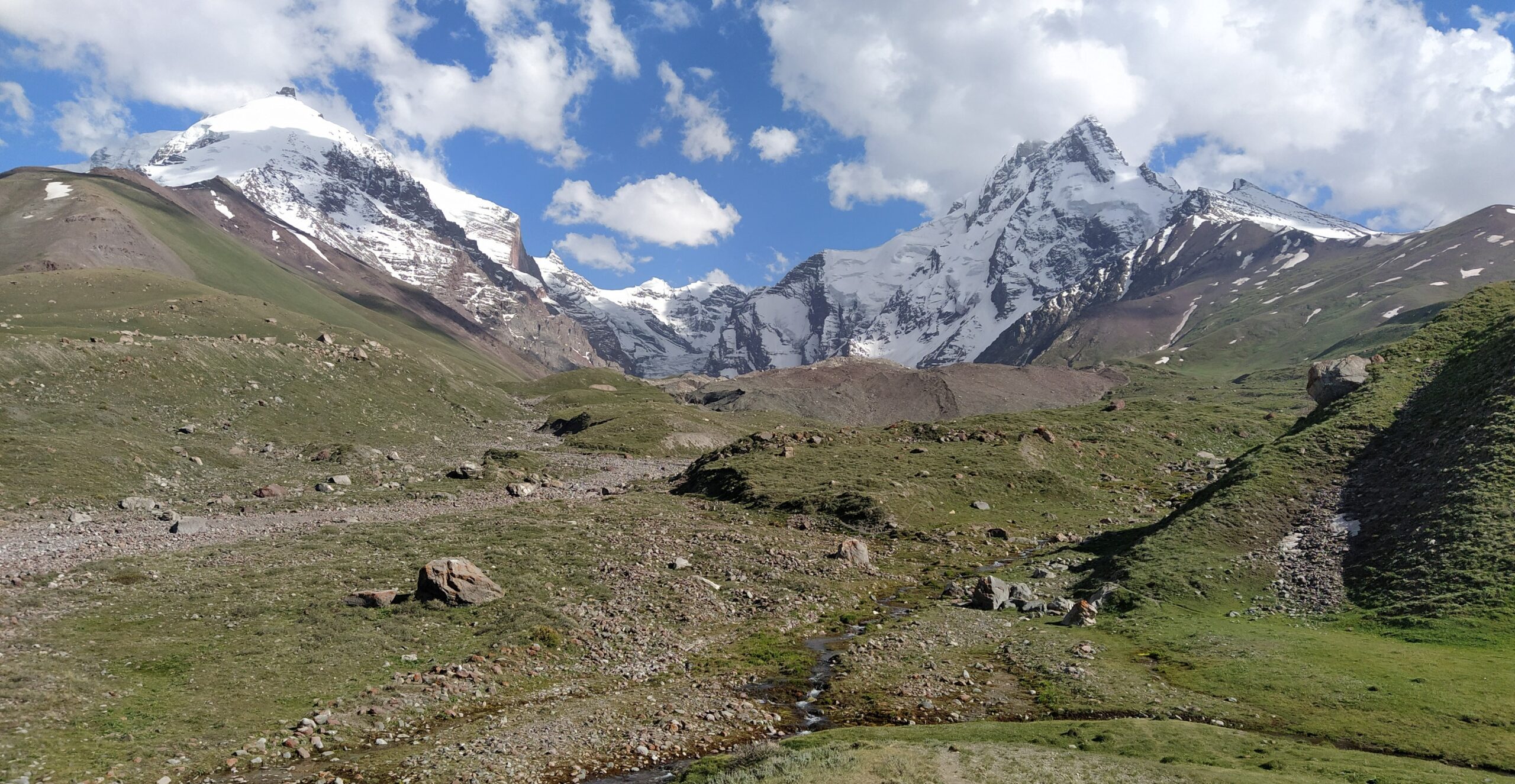
Photo: Achille Jouberton at the Pamir Project. Swiss scientists are tackling the mysteries of ice in countries that can be dangerous to work in.
Today Levi Bridges at the great international radio show The World brings you the latest on glaciers in Kyrgyzstan and Tajikistan, countries that could be more important to us than we realize as we wallow in the anxieties of our own places, those bits of Earth we imagine are the only important ones.
“On a sunny summer day two years ago,” Bridges reports, “a massive chunk of ice broke off from a glacier on a mountain in the Central Asian country of Kyrgyzstan. An avalanche quickly raced down the mountain toward a group of hikers below, which one man caught on film.
“The hikers braced themselves for impact as the cascade of snow and ice poured down the mountain toward them. Miraculously, the group survived with only several people receiving minor injuries.
“The event highlighted the challenges facing the world’s glaciers. This year, the UN declared that climate change reached record levels in 2023. And glaciers, which hold most of the Earth’s freshwater, are melting at an unprecedented rate.
“But some glaciers located in mountainous parts of Central Asia aren’t melting and, in some cases, are actually growing. This cold, arid region, known as the Third Pole, is one of the only places in the world outside the interior of Antarctica where ice has so far been relatively unaffected by the climatic changes associated with rising temperatures.
“Even during the summer it remains so cold in parts of Tajikistan that ice on a glacier’s surface can turn into a gaseous state instead of melting through a process known as sublimation. That can cause spectacular ice formations on a glacier’s surface that look like inverted icicles or ice pyramids, according to Evan Miles, a glaciologist at the Swiss Federal Research Institute who studies Tajikistan’s glaciers. …
“Miles is the scientific coordinator for a team of Swiss and international scientists who have formed a research group known as the Pamir Project that hopes to discover what makes some of the region’s glaciers so unique. Each summer, they travel to isolated locations in Tajikistan’s mountains to study glaciers. Scientists must spend days trekking up to altitudes sometimes as high as 15,000 feet just to visit their research sites, carrying in supplies and scientific equipment by donkey.
“Miles said the remote locations the team visits in Tajikistan pose different challenges than research sites he has visited on Mount Everest where there are established trails and usually other people nearby.
“ ‘In Tajikistan, there’s nobody — there’s no helicopter that’s going to come rescue you if something goes wrong,’ he said.
“But understanding these glaciers is worth the risk because millions of people in Asia depend on them as a water source.
“Scientists believe these glaciers aren’t melting because water is evaporating from vast, irrigated farmland in nearby Pakistan, China and Uzbekistan. An increase in atmospheric moisture drives changes in weather patterns, so more snow gets dumped on Tajikistan’s glaciers and helps their size remain stable.
“These mountains are just one of many unsolved mysteries glaciologists are working on. It can be difficult for scientists to predict how much ice most glaciers will lose — and when — because there are still basic unanswered questions, like how much snowfall many mountains get. …
“Scientists who are part of the Pamir Project have [teamed up] with historians and geographers who are searching for Soviet documents that contain earlier data about Tajikistan’s glaciers. Some members are also conducting oral histories with locals in Tajikistan’s mountains.
“Sofia Gavrilova, a researcher at the Leibniz Institute for Regional Geography in Germany that’s helping with the initiative, met a Tajik schoolteacher as part of her oral history work who kept dated records of changes in the level of a local river.
“ ‘This is really very valuable, large-scale data that you cannot necessarily capture any other way,’ Gavrilova said. …
“Although some of Tajikistan’s glaciers remain stable for the moment, scientists predict that they, too, will eventually start to melt and get smaller. Researchers believe it will prove very difficult to stop that process after it starts.
“ ‘Let’s say that we actually manage to withdraw carbon from the atmosphere effectively by 2050, there’s still actually going to be quite some time, probably 20 to 30 years, that the glaciers will continue shrinking and losing mass,’ said Miles, of the Pamir Project.
“He stressed that every effort we make to stop global warming — even by lowering the Earth’s temperature by just a tenth of a degree — can help save the world’s glaciers in the long run.”
More at The World, here. There’s no paywall, and you might enjoy some delightful pictures of the local people in that part of Asia.
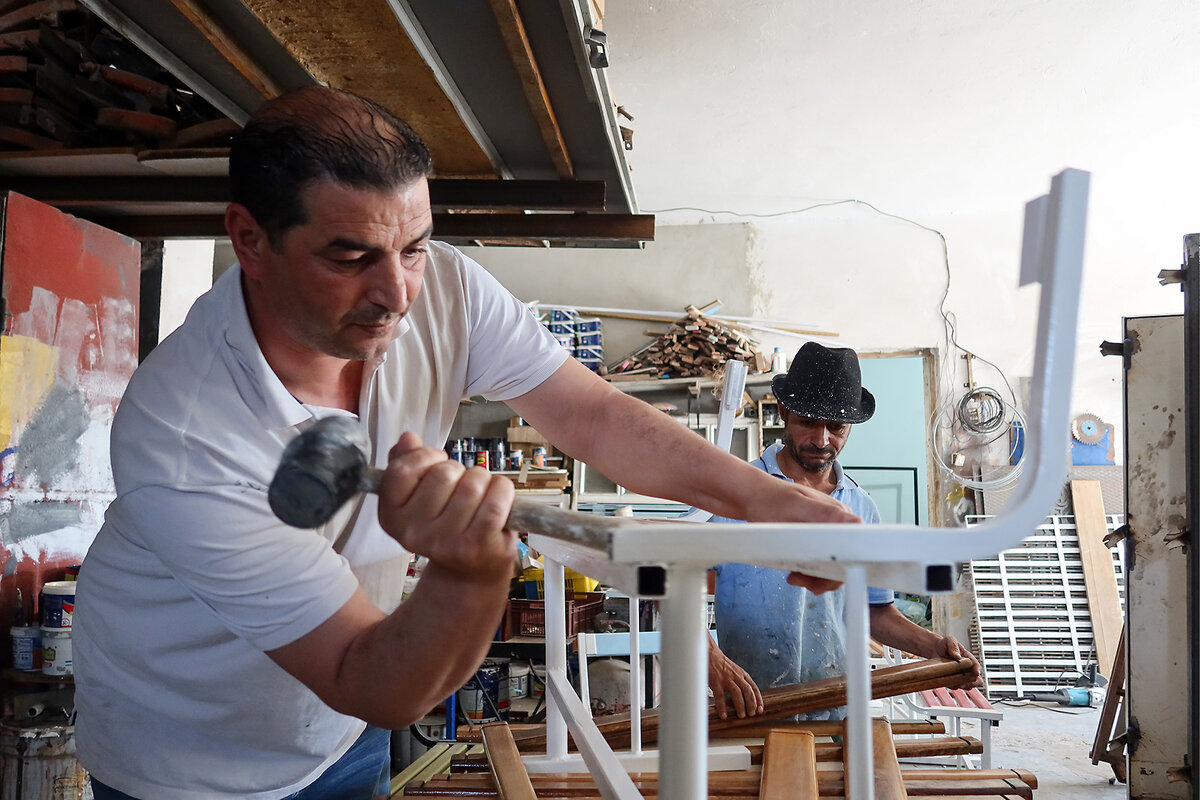
Photo: Erika Page/Christian Science Monitor. Karim Arfa (left) works on a bench in his workshop in El Mourouj, a neighborhood of Tunis, Tunisia.He often shoulders jobs that government should have been tackling.
You were thinking from this post’s title that it was about the US? No. Not overtly. I certainly am preoccupied with harnessing the power of ordinary people in the US these days.
But no, this post is about Tunisia.
Erika Page writes at the Christian Science Monitor about how good, no-nonsense people can — and do — take civic problems into their own hands. Just because the work needs doing.
“Chadia Jarrahi can still taste the sting of embarrassment she felt when the principal sent her young sons home from school, their clothes too wet and muddy to attend class. From that day on, whenever the river was high, Ms. Jarrahi took the two boys piggyback across the ravine separating her village from the main road on the other side. …
“It’s a common story in the mountainous, interior regions of rural Tunisia, where fewer government resources are directed to infrastructure and services than along the more urban coast. The residents of Al Taraiya, in the northwestern province of Béja, had been fighting since the 1990s for a bridge connecting their community to the only nearby school, mosque, grocery store, and hospital. [Local] officials deemed the project too expensive.
“Then Karim Arfa caught wind of the residents’ plight. In recent years, the building and painting contractor has made it his mission to take on just that sort of impossible-seeming project. Using mainly scrap metal and his own creativity in his workshop in Tunis, he has built much-needed infrastructure and equipment, from furniture for schools to pedestrian bridges.
“Mr. Arfa’s work serves to assure those who have long felt abandoned by their national and local governments that regular people can come up with solutions to entrenched problems – even where resources are scarce. …
“Today, a bright pink bridge stretches from the winding highway to the rolling hills on the other side of the river. Ms. Jarrahi’s children play with other kids along the walkway; neighbors lead donkeys and motorcycles to and from the homes that are just visible across the valley. Residents no longer worry about missing work, running out of places to buy food, or not being able to go to the hospital when rain makes the river swell. …
“The bridge will help reduce absenteeism and school dropouts in the area, predicts Mohamed Jouili, a professor of sociology at the University of Tunis, over email. He also says Mr. Arfa’s initiative ‘encourages other members of the community to recognize their own agency and actively contribute to improving their environment.’
‘If everyone does something small, we can do it all,’ says {Karim] Arfa.
“Mr. Arfa himself grew up in a rural area of Tunisia, some 100 kilometers (62 miles) south of Al Taraiya. He nearly dropped out of school because of the difficulty of getting to and from class. … He eventually opened his own workshop on the outskirts of Tunis. But he never turned away from his rural roots. ‘I wanted to do something to repair their situation, as if I was repairing something for myself,’ he says.
“He started with a school dormitory that burned down in 2018, redecorating the space and then building a new library for the school in an abandoned room. From there, he began repairing desks and chairs in schools and maintenance hole covers for roads. After hearing about a young girl who died crossing a river on foot in 2019, he and his team of volunteers began building their first bridge, in the province of Kasserine.
Steep mountains meant the machinery couldn’t get to the bridge site, so they had to dig out the base by hand.
“ ‘Karim goes to the places the government doesn’t go,’ says Cherif Ait Daoud, a Tunis-based architect who helped design the bridge. …
“The bridge in Béja, Mr. Arfa’s sixth such project, was finished in 2023. ‘One year, seven days, and two hours ago,’ recalls Ahmed Terroui, a resident of Al Taraiya. He and others spent two months helping Mr. Arfa assemble the bridge, often after working long shifts as day laborers on nearby farms.
“The bridge’s railings are made of rods from old school desks, refurbished and repainted at Mr. Arfa’s workshop. Three-fifths of the steel is recycled. Only the cement, gravel, sand for the foundation, and the rest of the steel had to be bought. Officials had predicted that construction could total 2 million dinar (about $635,000). … Mr. Arfa and his team pulled it off for 41,000 dinar. …
“So far, he has relied on donations alone, either in the form of scrap metal or money. But it has been difficult to secure stable funding.
“As trucks and motorcycles whir by, Basma Ammouri rolls dough into a ball, presses it into a wide circle, and sticks it on the inner wall of an open clay oven to bake. She set up her makeshift roadside bakery across the bridge from her home in Al Taraiya, just after it was inaugurated. She now has reliable access to customers who stop along the highway to buy her traditional tabouna bread. That income helps support her young children.”
When we think, “What can one person do?” it helps to remember people like Mr. Arfa. Even if you can’t build an actual bridge, you can build bridges to others. And then there’s the “stable funding” piece of the puzzle: even small monthly donations to worthy causes help people who do the work you value and lets them know how much they can plan for.
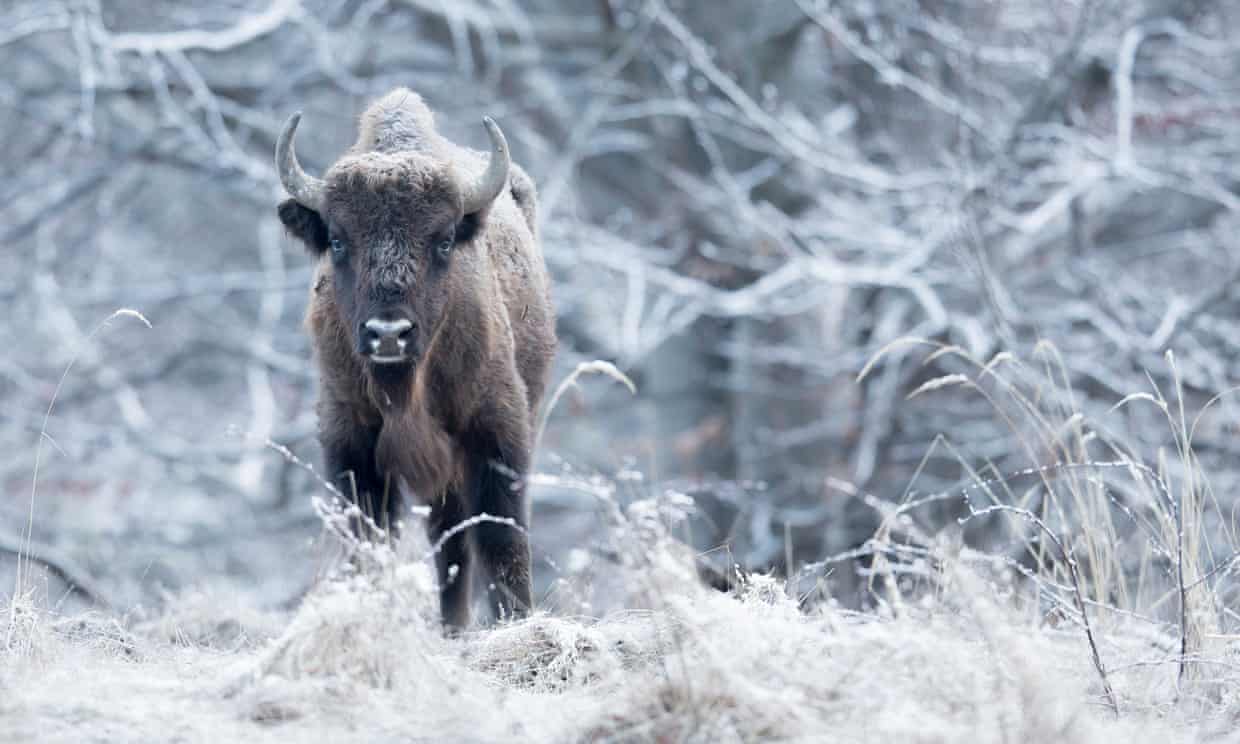
Photo: Michel Doutemont. “European bison disappeared from Romania more than 200 years ago,” says the Guardian, “but the species was reintroduced to the southern Carpathian mountains in 2014.”
We think of bison as iconically North American. Who knew about the bison in Europe — also nearly wiped out by humans? It turns out they are worth bringing back, if only to store carbon.
Graeme Green explains at the Guardian, “A herd of 170 bison reintroduced to Romania’s Țarcu mountains could help store CO2 emissions equivalent to removing 43,000 US cars from the road for a year, research has found, demonstrating how the animals can help mitigate some effects of the climate crisis.
“European bison disappeared from Romania more than 200 years ago, but Rewilding Europe and WWF Romania reintroduced the species to the southern Carpathian mountains in 2014. Since then, more than 100 bison have been given new homes in the Țarcu mountains, growing to more than 170 animals today, one of the largest free-roaming populations in Europe. The landscape holds the potential for 350-450 bison.
“The latest research, which has not been peer-reviewed, used a new model developed by scientists at the Yale School of the Environment and funded by the Global Rewilding Alliance, with the bison paper funded by WWF Netherlands. The model, which has been published and peer reviewed in the Journal of Geophysical Research: Biogeosciences, calculates the additional amount of atmospheric CO2 that wildlife species help to capture and store in soils through their interactions within ecosystems.
“The European bison herd grazing in an area of nearly 50 sq km [~19 square miles] of grasslands within the wider Țarcu mountains was found to potentially capture an additional 54,000 tonnes of carbon a year. That is nearly 9.8 times more carbon than without the bison – although the report authors noted the 9.8 figure could be up to 55% higher or lower, so making the median estimate uncertain. This corresponds to the yearly CO2 released by a median of 43,000 average US petrol cars, or 84,000 using the higher figure, or a median of 123,000 average European cars, due to their higher energy efficiency, the researchers said.
“Prof Oswald Schmitz of the Yale School of the Environment in Connecticut in the US, who was the lead author of the report, said: ‘Bison influence grassland and forest ecosystems by grazing grasslands evenly, recycling nutrients to fertilize the soil and all of its life, dispersing seeds to enrich the ecosystem, and compacting the soil to prevent stored carbon from being released.
“ ‘These creatures evolved for millions of years with grassland and forest ecosystems, and their removal, especially where grasslands have been plowed up, has led to the release of vast amounts of carbon. Restoring these ecosystems can bring back balance, and “rewilded” bison are some of the climate heroes that can help achieve this.’
“[Alexander Lees, a reader in biodiversity at Manchester Metropolitan University, who was not involved with the study] said more in-the-field research would help validate the models and assist understanding of how long it would take for bison benefits to accrue, adding: ‘This study reinforces an emerging consensus that large mammals have very important roles in the carbon cycle.’ …
“A keystone species, bison play an important role in ecosystems – their grazing and browsing helps maintain a biodiverse landscape of forests, scrub, grasslands and microhabitats. In the Țarcu mountains, their return has also inspired nature-based tourism and businesses around rewilding. Schmitz noted that the Carpathian grasslands have specific soil and climate conditions, so the effect of the European bison could not necessarily be extrapolated internationally – American prairies, for example, have much lower productivity.
“ ‘This research opens up a whole new raft of options for climate policymakers around the world,’ said Magnus Sylvén, the director of science policy practice at Global Rewilding Alliance. ‘Until now, nature protection and restoration has largely been treated as another challenge and cost that we need to face alongside the climate emergency. This research shows we can address both challenges: we can bring back nature through rewilding and this will draw down vast amounts of carbon, helping to stabilize the global climate.’ …
“Schmitz said the team had looked at nine species in detail, including tropical forest elephants, musk oxen and sea otters, and had begun to investigate others. He added: ‘Many of them show similar promise to these bison, often doubling an ecosystem’s capacity to draw down and store carbon, and sometimes much more. This really is a policy option with massive potential.’ “
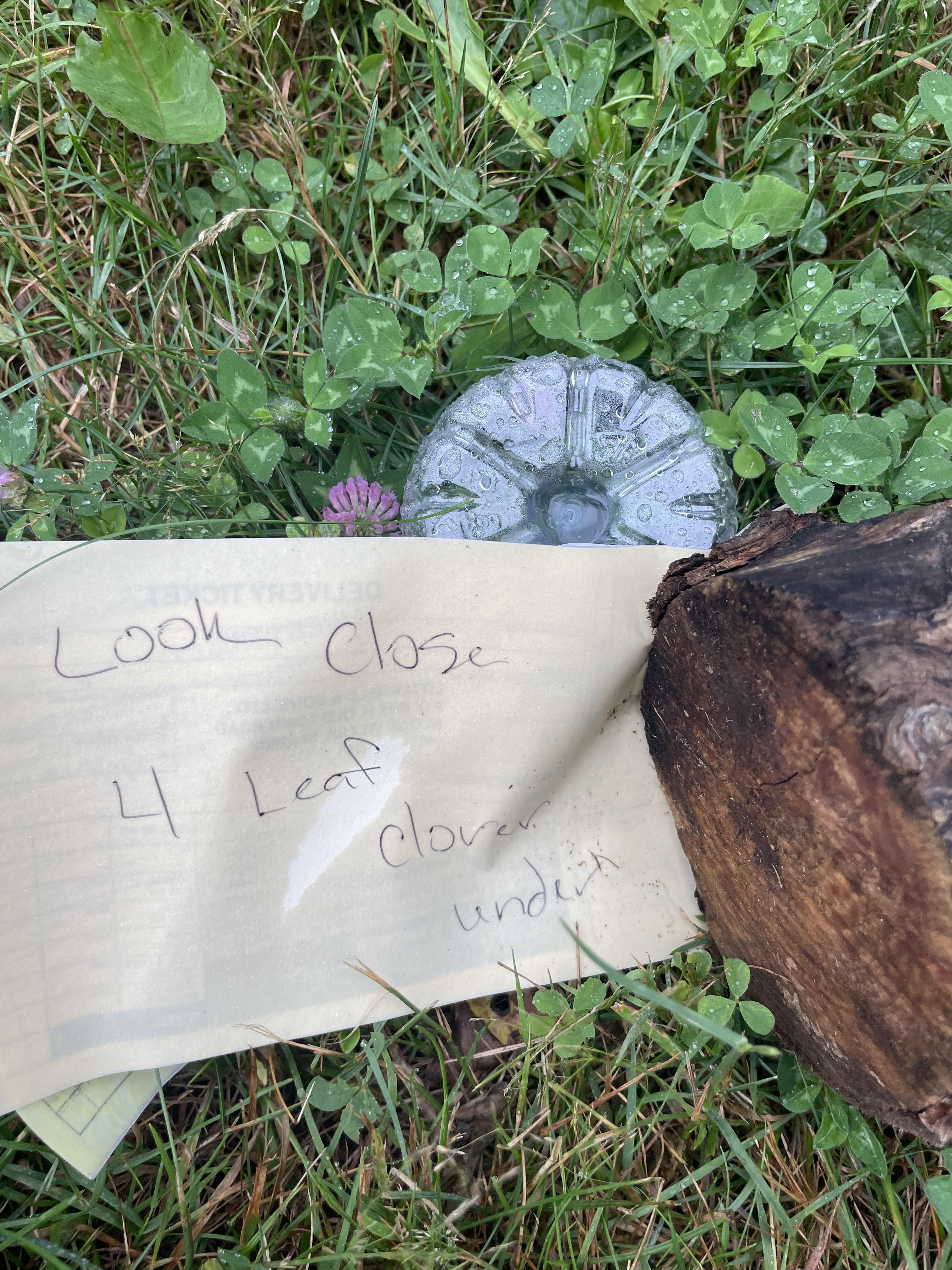
Clover photos: Suzanne. What the propane-delivery guy left for us.
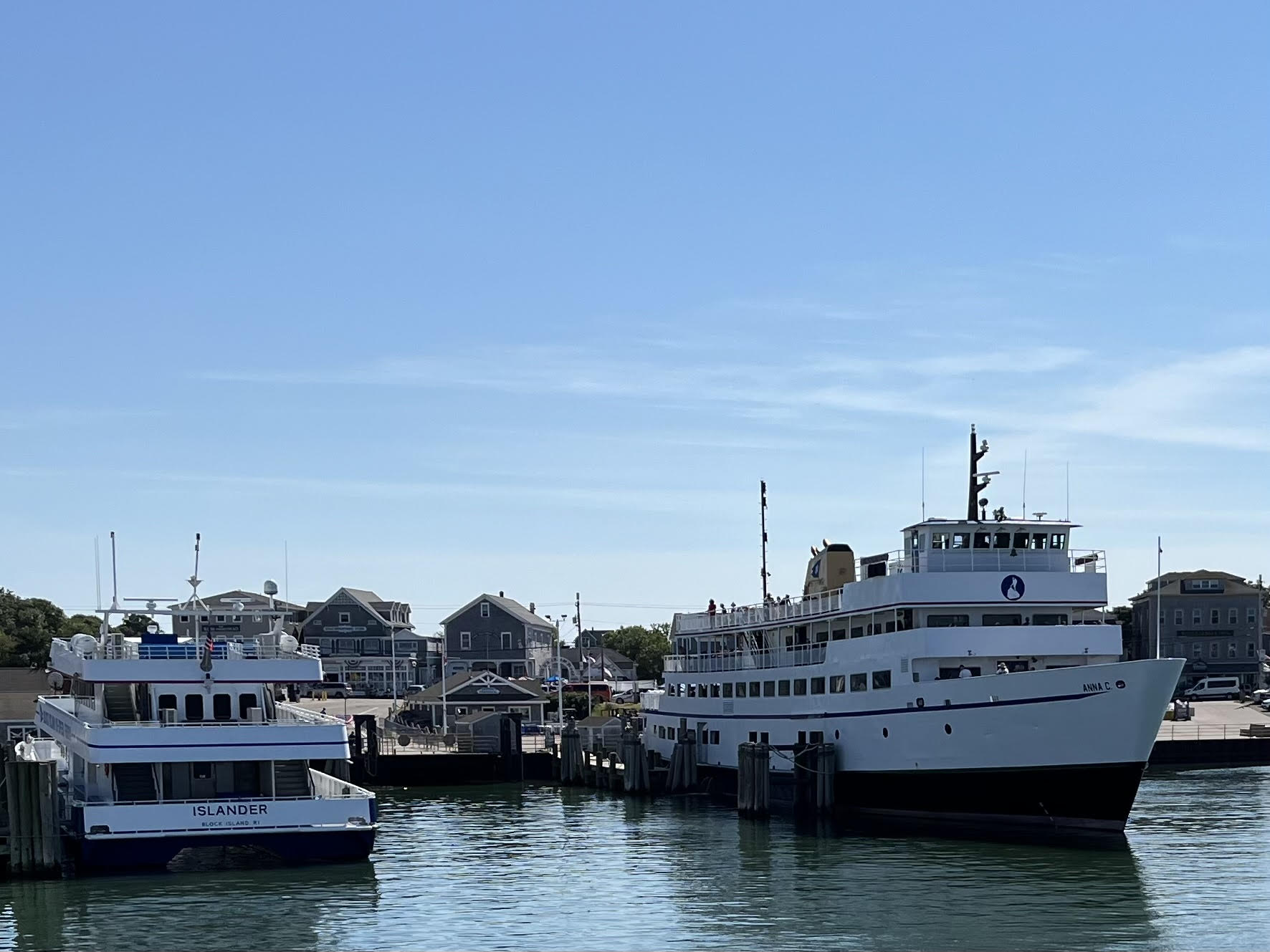
Summer sunshine is always good for photos. And when we haven’t been swimming in a pea-soup fog here, we’ve had beautiful sunshine. A few of today’s photos have little stories that go with them, too.
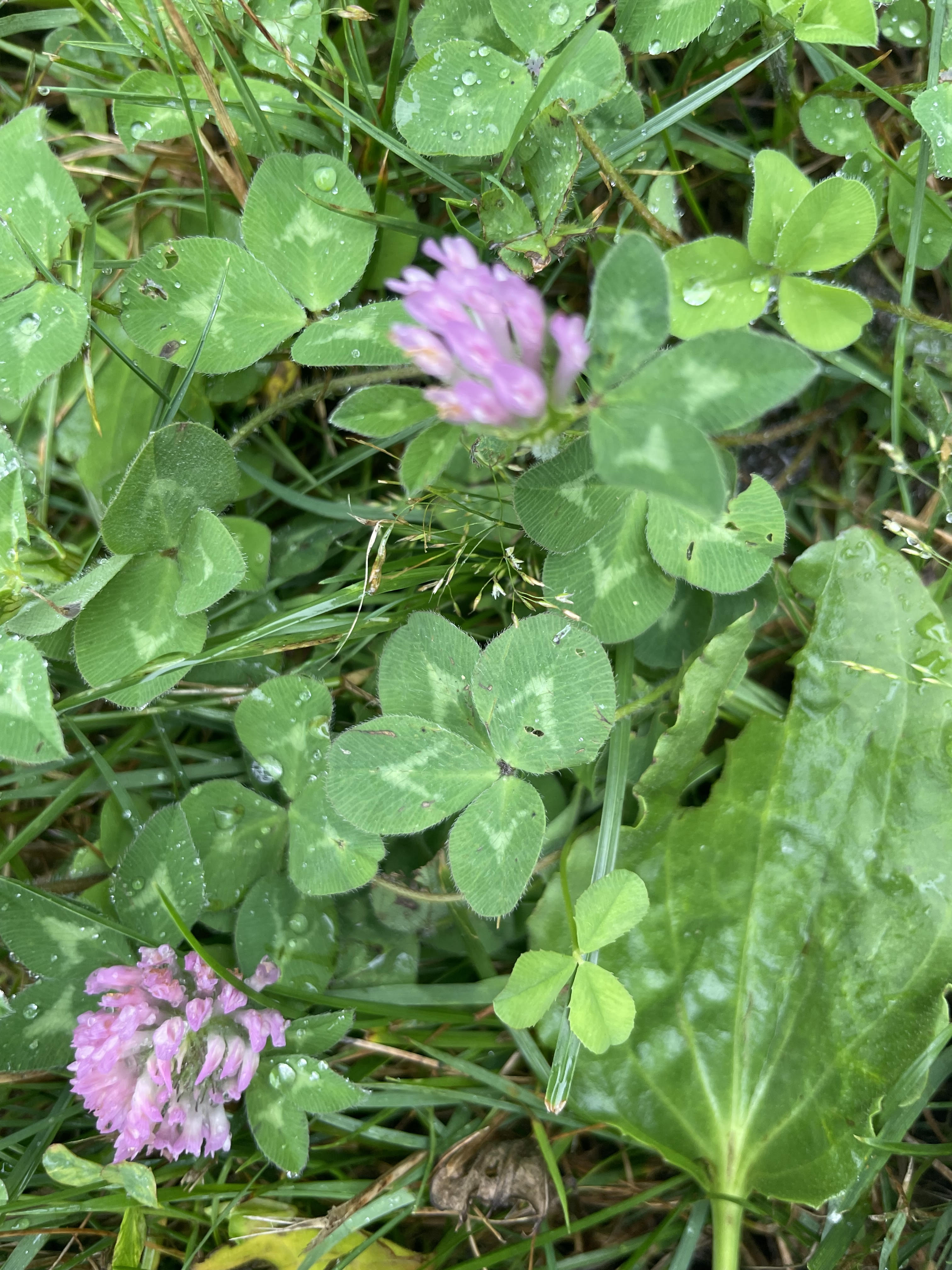
Here’s one. In New Shoreham, we still need propane. The person who delivered our last tank somehow noticed a four-leaf-clover in the grass by the garage. When we came back from wherever we were that day, we found a note and a small display under a piece of plastic bottle. How amazing is that? I called the propane company to say thank you.
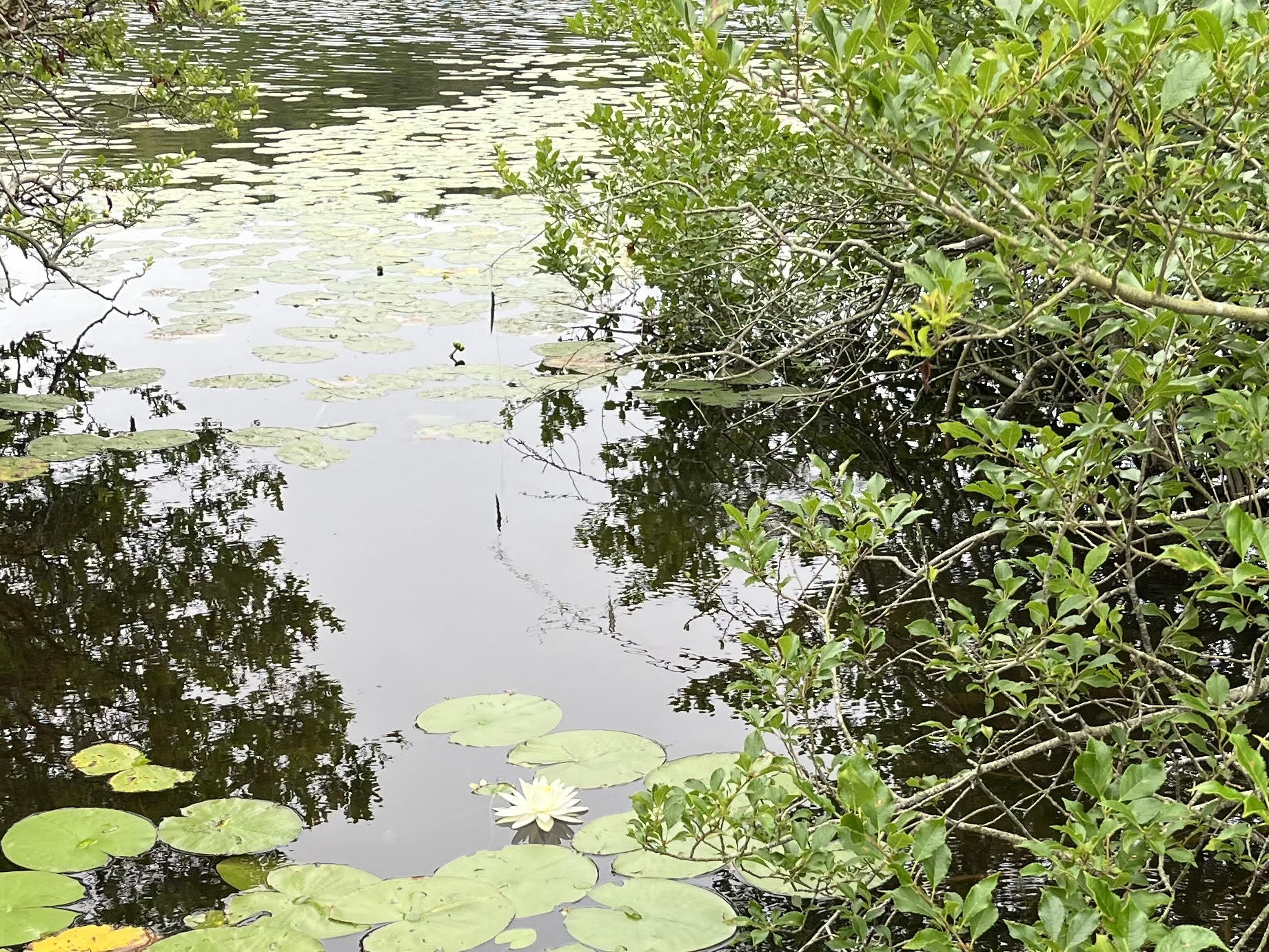
Water lilies are still the flower for July despite the changes to our climate.
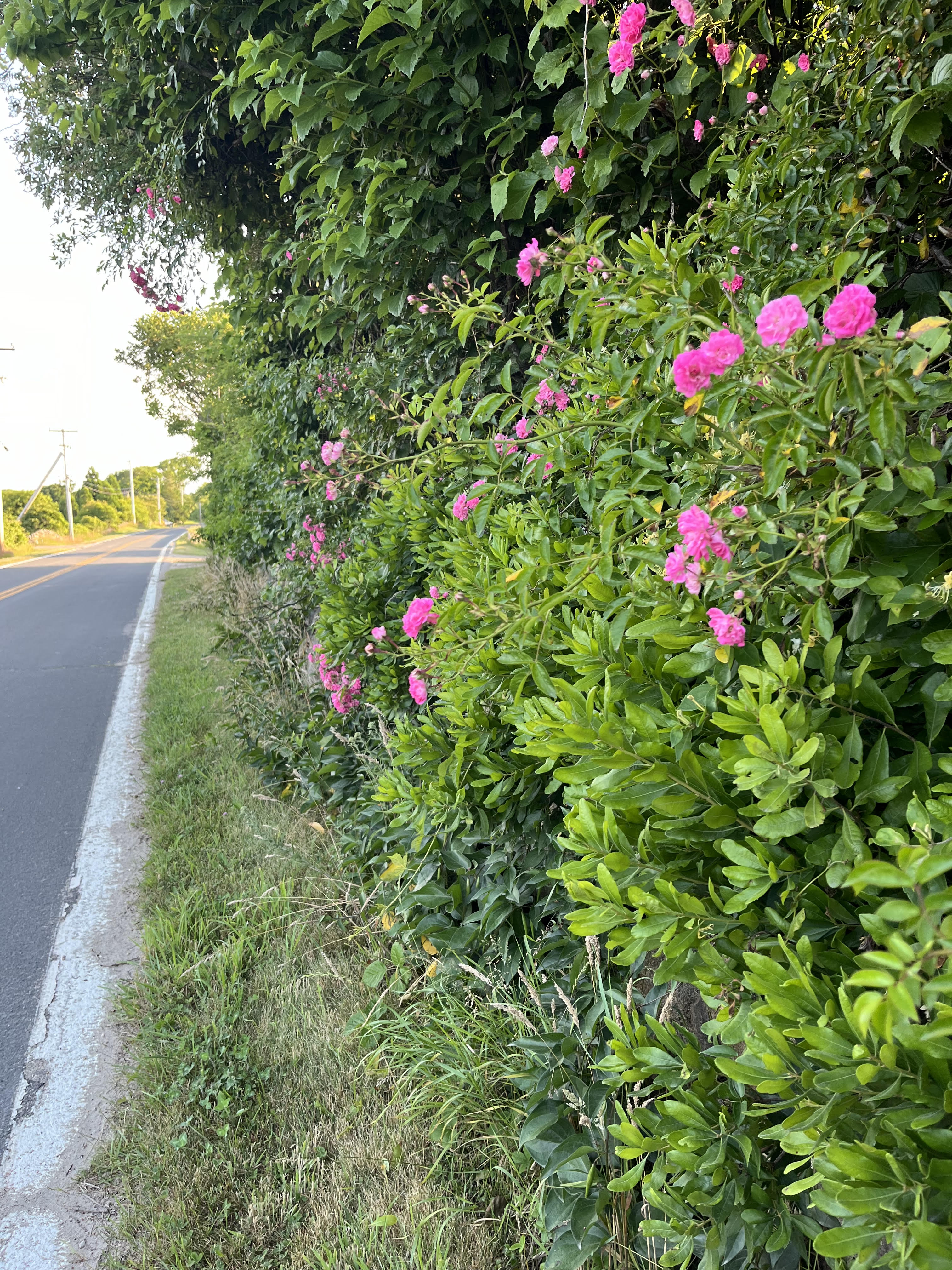
Rosa Rugosa grows everywhere. Also this other wild rose. My app calls that one a China rose.
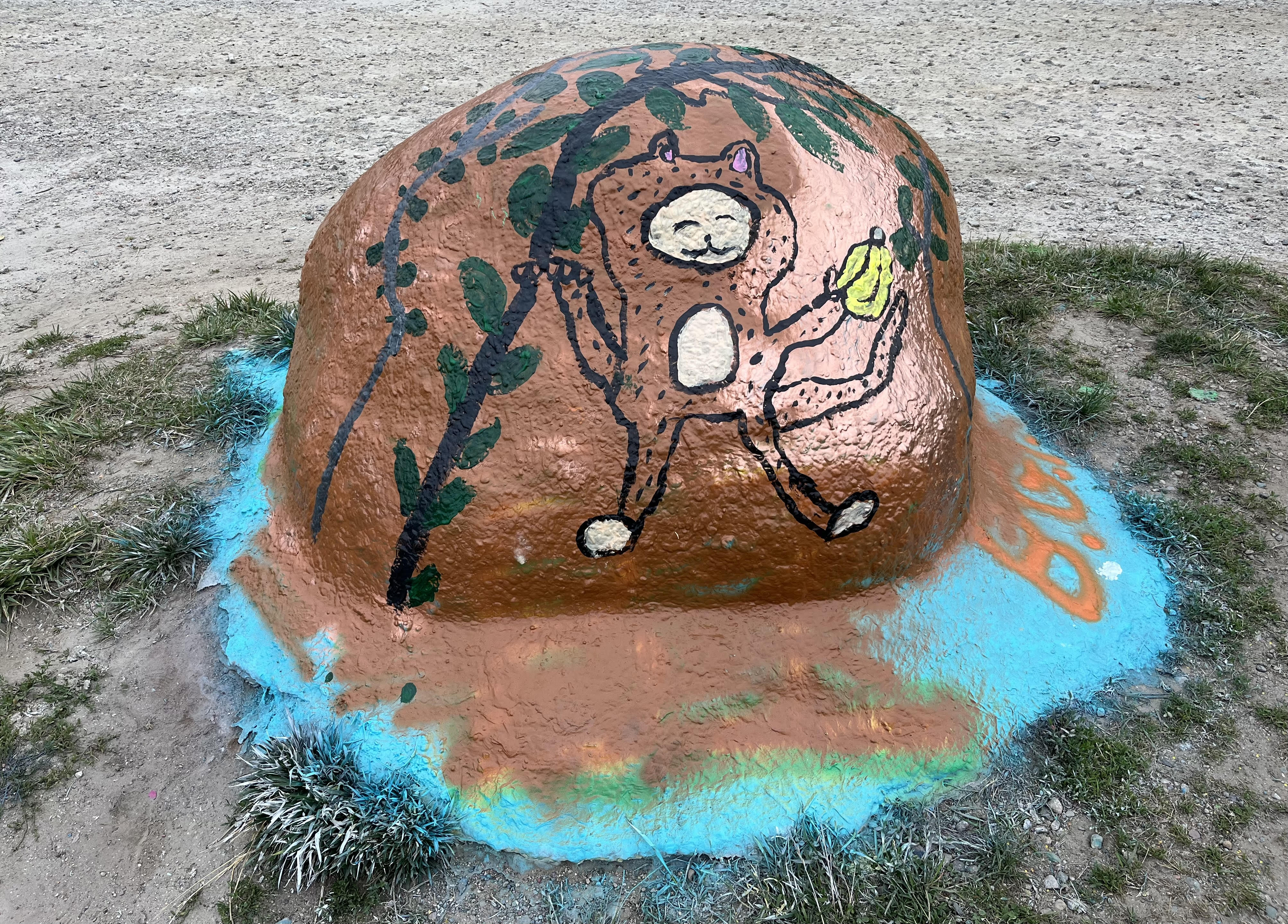
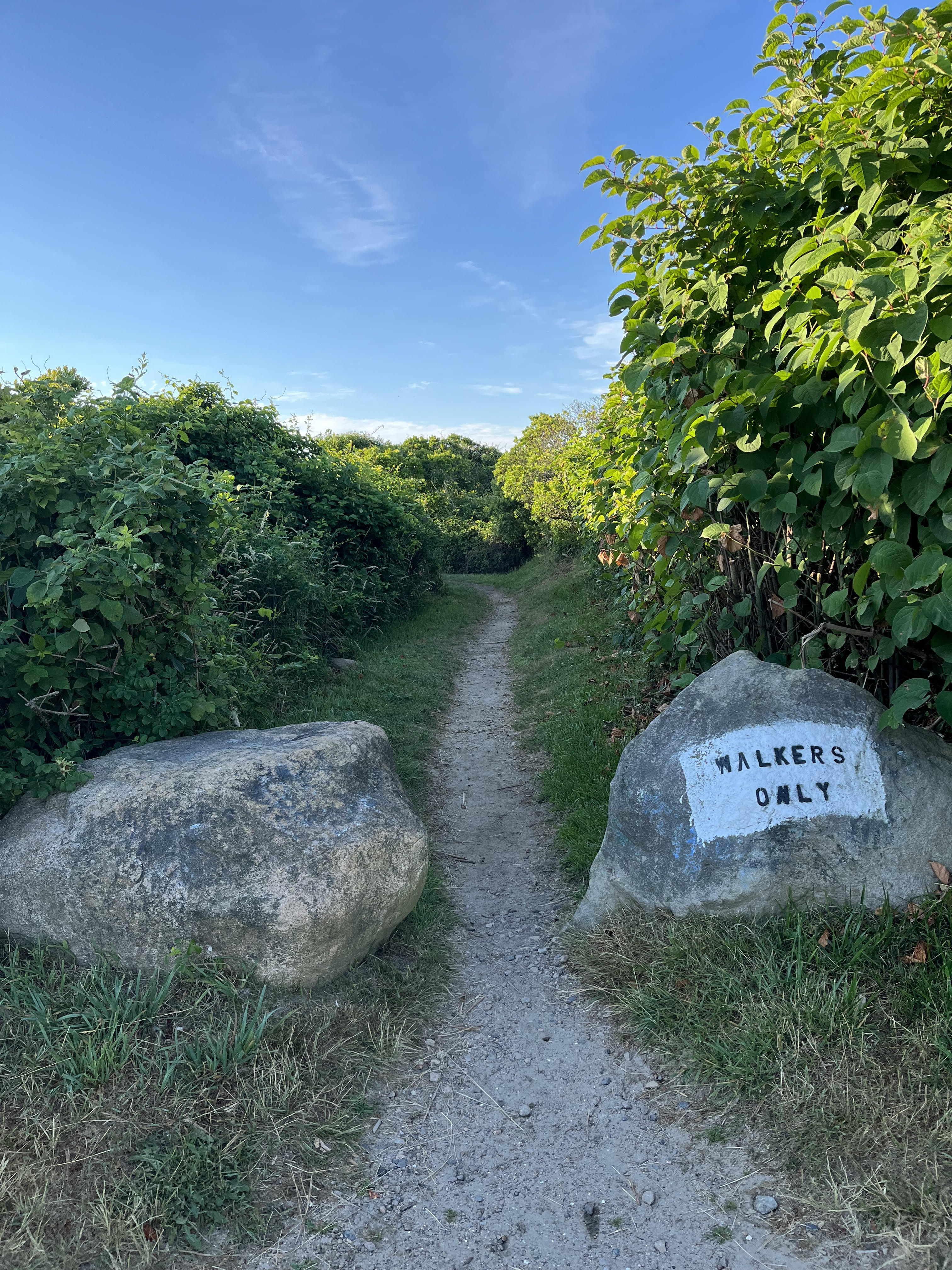
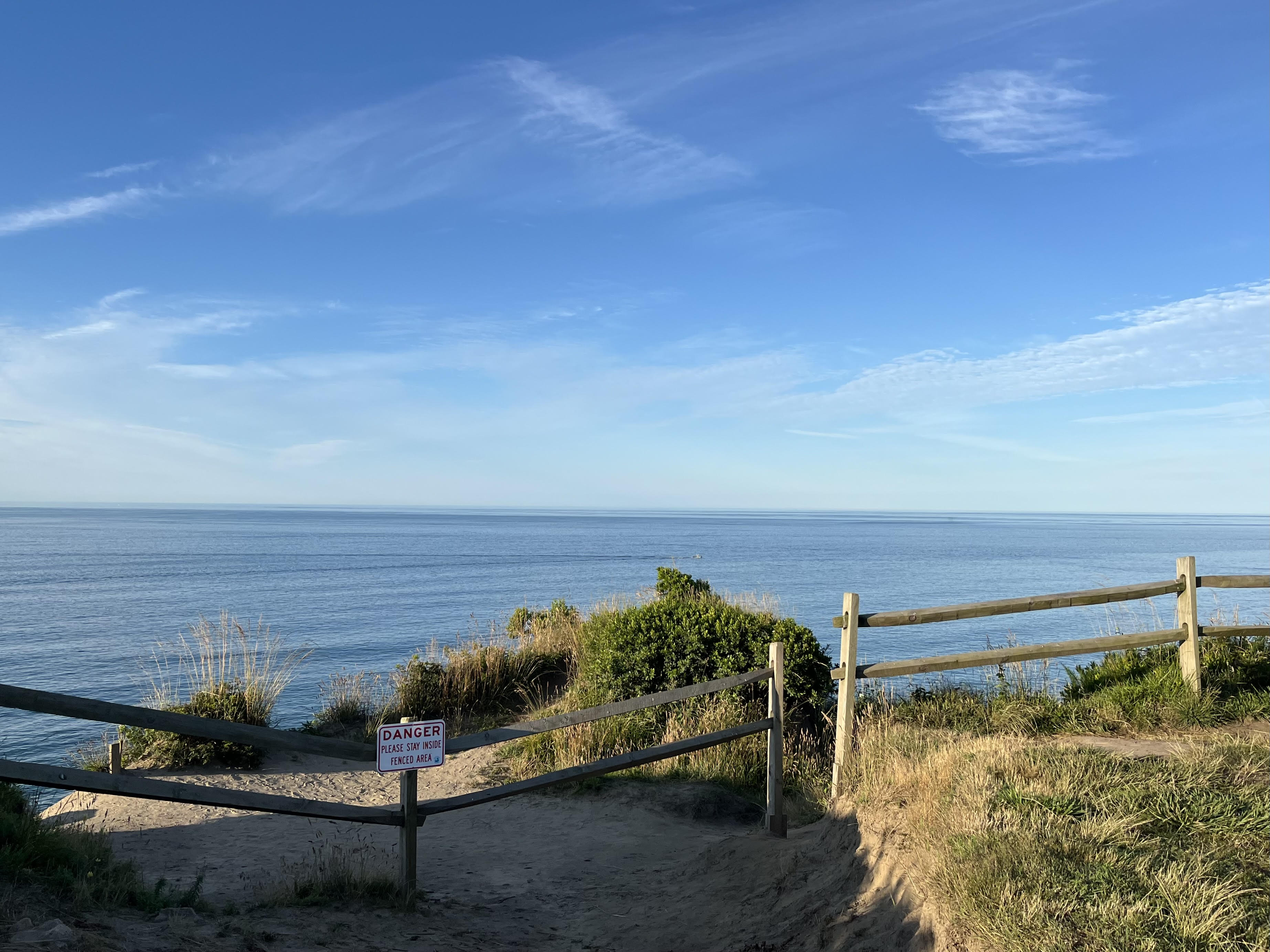
Next is the Painted Rock, a path to the bluffs, the eroding bluffs, a cactus (What? In New England?), and one granddaughter’s concept of a modern hotel. She tells me that there is a village in this hotel and a park with trees on top.
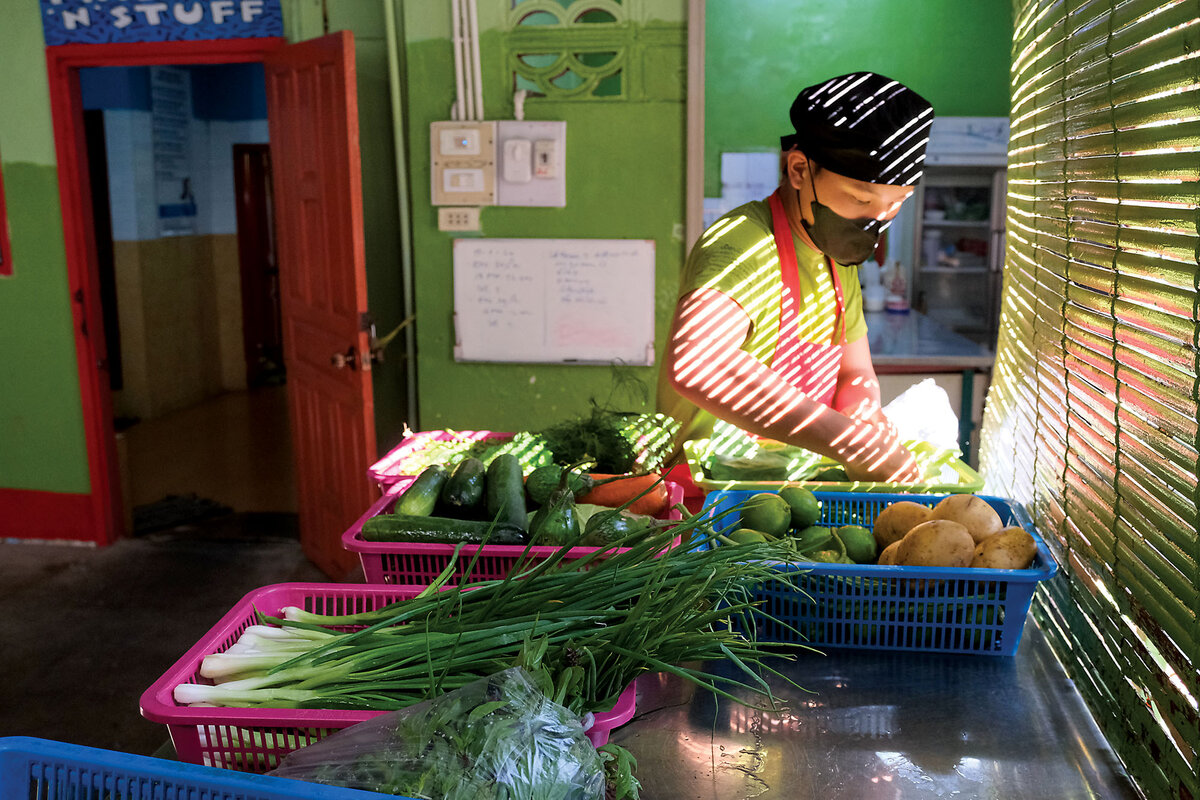
Photo: Zinara Rathnayake. A student prepares vegetables before lunch begins at Mini-Makphet, a vocational restaurant in Vientiane, Laos.
I can’t read anything about Laos without thinking of the mystery series that Colin Cotterill wrote, which includes a plea for the poor of that country and for removing the explosive mines left by the US. Since today’s article is about training young restaurant workers in Laos, I’m particularly remembering the noodle shop in the mystery series, run by Daeng, the wife of investigator Dr. Siri Paiboun.
Zinara Rathnayake wrote the following story for the internationally focused Christian Science Monitor.
“Until about a year ago, Xue Xiong had never seen a town,” wrote Rathnayake. “She lived in a small village with a dirt road that turns muddy when it rains, making travel difficult. She dropped out of school early to help her parents farm rice and breed cattle to feed her 10-member family.
“It was at Khaiphaen, a charming restaurant two hours away in Luang Prabang, that Ms. Xiong learned to dream. The Laotian fusion eatery trained her to prepare and serve food for the tourists who flock every day to the bustling city.
“ ‘I want to save money and open my little Lao food stall, because tourists love Lao food,’ says Ms. Xiong, who is Hmong, one of Laos’ marginalized ethnic minorities. ‘Because I feel like I can do anything now.’
“Khaiphaen was opened by the Cambodia-based organization Friends-International and collaborates with the Lao government and other nonprofits to aid young people interested in culinary education as a path to more prosperous futures.
“Laos is one of Asia’s least-developed countries, and poor education and the lack of economic opportunities often force children and young people there to work in lower-paid, menial jobs under exploitative conditions. Many others are trafficked into factories or prostitution.
“At almost 10 a.m. on a chilly January morning, an hour before Khaiphaen opens for the day with plates of laab (spicy minced-meat salad) and beer-battered Mekong River fish, Ms. Xiong laughs as she watches her friend, another young woman, slice carrots. Ms. Xiong shows off her yellow T-shirt from Le Petit Prince, a nearby Korean cafe where she started working after Khaiphaen. She thinks the cafe’s owner is nice, her English is improving, and soon she will play the piano at the cafe, Ms. Xiong tells her friend.
“ ‘I see children tremble the first time they come to serve,’ says Khaiphaen’s restaurant manager, Anousin Phanthachith, ‘and then in a few years, you see them grow into entrepreneurs.’ He joined the team at Friends-International in 2014 when Khaiphaen was just a concept with a few dining tables, and he has never thought of leaving. ‘You feel fulfilled because you help many young people – especially children who come from remote, underprivileged communities, some of them with traumatic childhoods.’
“Nearly a third of Laos’ population lives in poverty, subsisting on less than $4 a day, according to 2022 figures from the World Bank. Children bear the brunt of it. Although Laos has made progress on child mortality, 43 out of every 1,000 children die before reaching age 5 – one of the highest child mortality rates in Southeast Asia (down from 154 in 1990). The government is pushing for primary education for all children, but the number of dropouts is high.
“More than 130 students have graduated from Khaiphaen. Yet it is not a traditional cooking school, says Friends-International social worker Ae Thongkham. Besides waiting tables, students gain experience making noodle bowls with their teachers from scratch in the kitchen as well as preparing beverages. Mr. Thongkham adds that when students arrive from minority ethnic groups, many of them don’t speak Lao, the country’s official language. So at the social work center upstairs, students learn basic Lao and English, in addition to life skills such as managing their finances.
“Students aren’t salaried but receive free training, accommodations, meals, transportation, and health care. After graduation, they are placed in hotels, cafes, and restaurants across Luang Prabang’s flourishing tourism industry.
“For Mr. Phanthachith, who left his village at age 18 and studied at a temple before working at the city’s restaurants, looking after his young students has always been the priority. ‘We always talk to our students even after they leave the program to make sure that they are in a safe workplace that benefits them and treats them well,’ he says.
“Khaiphaen is part of a series of vocational restaurants that Friends-International operates across Southeast Asia. Although some of the eateries shuttered during the coronavirus pandemic, Khaiphaen began delivering food to locals to stay afloat. In the capital, Vientiane, Khaiphaen’s sister restaurant Mini-Makphet turned into a soup kitchen, feeding underprivileged children and their mothers. Housed in a tin-roofed space with varnished wooden tables and chairs, Mini-Makphet is much more modest and mainly serves Vientiane residents.
“Ketsone Philaphandet, Friends-International’s country program director for Laos, is quick to highlight that Vientiane receives far fewer tourists compared with Luang Prabang. The quiet, industrial Lao capital serves only as a pit stop for many foreign travelers exploring the country’s far-flung karst mountain towns and vibrant cultural hubs. ‘So we keep our prices lower and food spicier,’ Ms. Philaphandet says, smiling.
“For many young people, Mini-Makphet is a social lifeline. Mala Thoj has worked at the restaurant for only two months but can already pour a latte with a little foam heart on top. ‘I feel happy here, because I have friends who support me,’ she says. She used to live with abusive relatives and was compelled to toil at a rubber estate. …
“Emi Weir, founder of the social enterprise Ma Té Sai, which sells handmade products crafted by Laotian women [notes] that although Khaiphaen lacks marketing to reach tourists who are ‘ready to spend more for a good cause,’ its program has excellent social work, training, and outreach initiatives.”
More at the Monitor, here. No firewall. You can learn a lot more about our world from the Monitor or The World, on radio, than you can from the Washington Post or the New York Times. Check them out.



 Suzanne's Mom's Blog