Feeds:
Posts
Comments

Posts Tagged ‘african’

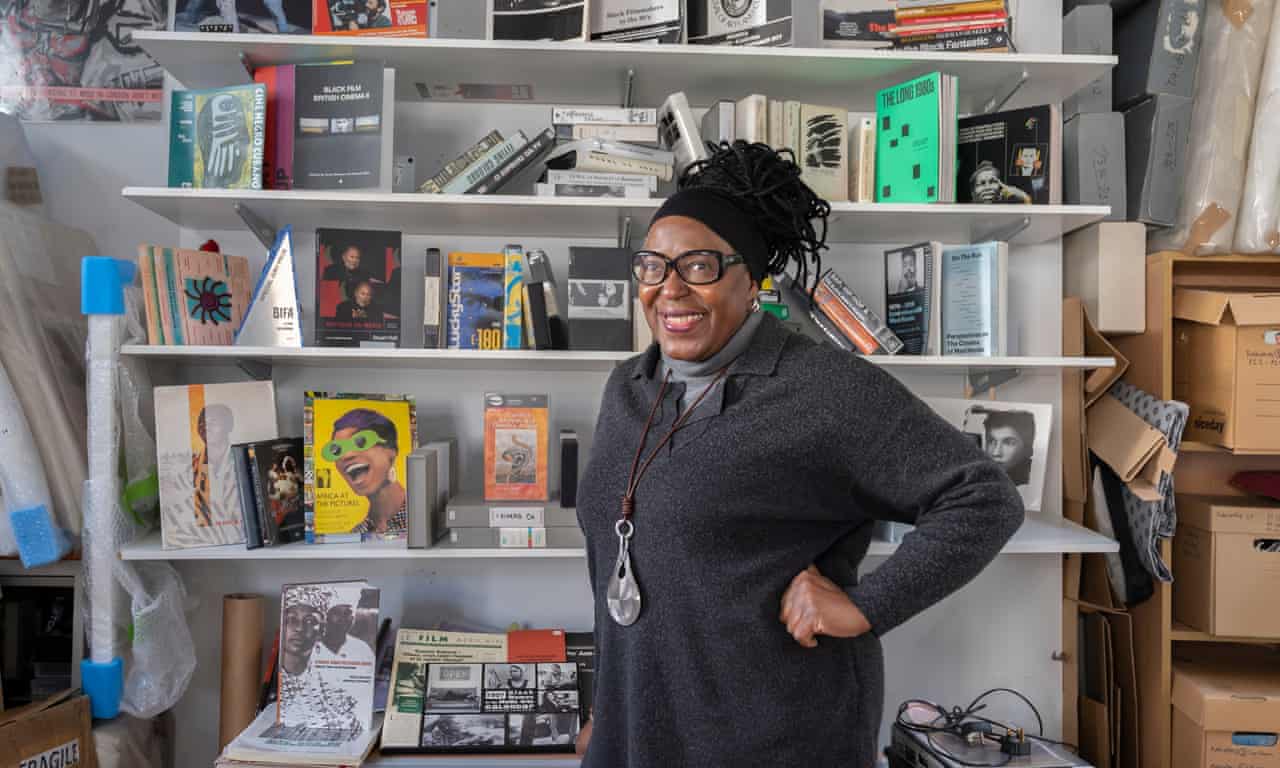
Photo: Amaal Said/JGPACA [June Givanni Pan African Cinema Archive].
From a Mogadishu film week
poster to VHS videos of pioneering art movies, June Givanni has collected a range of Black film artifacts and is now ready to share.

Sometimes people whose childhood struggles involve race-based discrimination grow up to embrace and trumpet the beauty of their heritage. I enjoy stories like that.

At the Guardian, Leila Latif interviews one such person, the founder of June Givanni Pan African Cinema Archive.

Discussing her recent exhibition, “PerAnkh: The June Givanni Pan African Cinema Archive,” Givanni played down the show’s title. Says Latif, “The Black British film curator, activist and archivist who created it is hesitant about positioning herself front and center.

“ ‘I don’t want it to sound like it’s all me, me, me,’ she worries. ‘My name is part of it because I worked as a curator for many years and collected work throughout the non-digital era, which developed into this archive.’

“Though she wants the films, documents, artworks and objects she has preserved to be the focus of people’s attention – from an installation of the earliest audiovisual works by the Black Audio Film Collective to new works by the Chimurenga collective from South Africa – Givanni is more than worthy of the spotlight. When she received the British independent film awards’ grand jury prize in 2021, the organizers said that she had ‘made an extraordinary, selfless and lifelong contribution to documenting a pivotal period of film history.’

Born in British Guiana 72 years ago, Givanni moved to the UK aged seven and was immediately underestimated.

“ ‘They put me with the five-year-olds because I was Black and I’d come from the Caribbean,’ she remembers. ‘My mum went to the school twice before they moved me up to my age range.’

“As an adult, Givanni collaborated with some of the most significant figures and institutions in pan-African cinema and across ‘different territories, different continents.’ She kept adding elements to her collection, she says, ‘because I needed to use them for subsequent programs and as part of building a body of knowledge and a whole series of resources that can be shared with others.’

“Lack of preservation has meant many of pan-African cinema’s masterworks have disappeared. In America alone, it is estimated more than 80% of Black films from the silent era are lost, and technological advances endanger film further. While physical film has a potential shelf life of hundreds of years, digital preservation requires constant migration to keep up with changing technology. …

“Givanni has faced changes in technology, politics and culture since she began in the early 80s. The first film festival she worked on was called Third Eye, inspired by the Latin American Third Cinema movement which set out to challenge Europe and North America’s dominance in film. For Givanni, the festival provided ‘an area to develop our own ideas about representation and taking charge. Pan-African cinema has always been a cinema of resistance. I can’t tell you how inspiring it was that there were all these people out there doing things that really chimed with what I thought should be happening.’ …

“She programmed festivals on five continents; worked for Greater London Council’s ethnic minorities unit and the Independent Television Commission; ran the BFI’s African Caribbean film unit and co-edited Black Film Bulletin, which relaunched in 2021 as a quarterly collaboration with Sight and Sound magazine, and has celebrated the under-sung work of film-makers. …

“The spirit of pan-Africanism was a guiding light, connecting all cultures that originated on the continent without treating them as a monolith. Givanni explains, ‘When I say pan-African, it’s not just the African continent; it’s the entire diaspora. All those significant histories are interconnected and cinema is very much part of that.’

“Choosing how to represent that history at Raven Row, with selections from an archive that now surpasses 10,000 items, was a gargantuan task. But Givanni immediately knew she wanted to include ‘a poster of the Mogadishu film week, given to me at my first attendance at the Fespaco film festival in 1985 by a Somali film-maker. Now people mention Somalia and they don’t picture these vibrant and strategic cultural events taking place there. …

“ ‘At the Havana film festival I bought a collection of silkscreen posters that will be exhibited. Lots of art can be seen digitally, but to see a silkscreen poster, the texture and the color of it – there’s an experience of culture and artifacts that goes beyond digital representation.’

“Beyond allowing the public to admire key objects from Givanni’s collection, the exhibition is structured around a program of films from the likes of Sarah Maldoror and Ousmane Sembène (the mother and father of African cinema). There is also an archive studio and reading room in the spirit of the exhibition’s title, PerAnkh – an Egyptian term for ‘a place of learning and memory.’ “

More at the Guardian, here. No firewall.

Read Full Post »

Body Percussion

Photo: K. Linnea Backe.
Leonardo Sandoval of Music From The Sole uses body percussion in dance.

Music is everywhere. You just have to listen for it. Children know. Most of them make music out of pots and pans before they can walk. I have pictures of my children and grandchildren sitting on the kitchen floor surrounded by everything they pulled out of the lower cupboards and getting ready to drum a joyful noise. You may have pictures like that, too.

Brenda Dixon-Gottschild at Dance Magazine writes about a kind of percussion that’s even more accessible than your pots and pans.

“Crash. Bump. Thump. Thwack. Whack. Knock. These are a few of the many synonyms of the word ‘percussion.’ All of them are appropriate when we look at the ways world cultures use the body as an instrument. …

“Clapping, stomping and striking body parts from head to feet in rhythmic or repetitive ways is a timeless means of human interchange, whether for pleasure, protest, entertainment, ritual, healing or survival. Hand- and body-clapping children’s games accompanied by sung or spoken rhymes are common around the world. … Enslaved Africans used body percussion as furtive communication — fearful of its messaging potential, plantation owners prohibited the use of drums, and to sabotage this taboo, the Black body became the drum.

“The juba dance, brought to the Americas in Middle Passage — the grueling sea journey of Africans captured from their homelands to live enslaved on foreign territories — was performed during plantation gatherings. In this dance of prowess, one person entered a circle of movers to exhibit their extraordinary variations on jig, hop and jump steps and was joined by a second dancer as the outer circle alternated rotating and remaining stationary. Pattin’ juba, the juba dance accompanied by clapping hands, chest and thighs, and the juba song — composed of short, rhymed verses that seemed like nonsense but carried double meanings — were ingenious later adjustments made to accompany the dance and send messages when drums were banned. Pattin’ juba further morphed into the hambone, a variation that centers on body percussion and is performed standing in place or seated, while retaining the original rhythm of the dance. …

“For Rennie Harris, legendary hip-hop concert dance choreographer and artistic director of Rennie Harris Puremovement and RHAW (Rennie Harris Awe-Inspiring Works), hambone was second-nature: ‘I don’t remember exactly when I learned or who taught me. In fact, I don’t even remember seeing it or being introduced to it — I just remember doing­ it,’ he says. ‘I was 7 or 8 years old; this was on Master Street in North Philadelphia. We used to sit on the stoops and challenge each other, doing the hambone, seeing who could do it the fastest, cleanest. It was a summer pastime. We sang the song, as well. Being older, I’d run into people who still do it, so it’s kind of interesting and cool. We’d add parts of it to dance steps. I didn’t learn the history of it, pattin’ juba, until later in life.’ …

“The basic hambone beat got a second life in the world of popular music. The 1950s R&B legend Bo Diddley made the five-accent hambone rhythm famous as the Bo Diddley Beat, a recurrent riff that has been appropriated by many white rock musicians.

“Tap dance, another style of body percussion, has impacted almost every culture. Using toes, heels and the full foot in rhythmic fashion goes beyond any one era or continent and includes traditions as diverse as African American buck dancing, Irish step dancing, English clogging and South Indian bharatanatyam.

“Beyond those traditional examples, the complex, polyrhythmic fusion of tap, combined with hambone-inspired body percussion, has proliferated with present-day artists across continents. The South African gumboot dance was transformed into a performance mode from its goldmine workforce origins, where it was created by Black miners as a sly replacement for conversation, since the white mine owners exacted harsh punishments for verbal communication among the workers.

“Other spinoffs include ensembles like Colombia’s Tekeyé; The Percussion Show, from Egypt; and the U.S.-based Music From The Sole, which draws on Afro-Brazilian influences. These artists transform a combination of tap and hambone to a glorious, millennial sensibility through the lens of hip hop and jazz.

“The art of flamenco includes a special kind of tapping — zapateado — as well as body-percussion elements that resonate with hambone.

” ‘Flamenco was being born in the mid-19th century. Certainly, by the 1902 arrival of the cakewalk in Spain, Black dance cultural motifs were transmitted, and flamenco artists expressly emulated Black American dance,’ says Dr. K. Meira Goldberg, author of Sonidos Negros: On the Blackness of Flamenco. “New forms that were created in explicit response to competition from Black artists in Spain emphasized percussive footwork, and over the past 30 or so years flamenco footwork techniques are increasingly influenced by tap and hip hop. It is fair to say that other modes of body percussion (hambone, or making percussion by snapping fingers, clapping hands or hitting hands on various parts of the body mixed with footwork) are also increasingly emphasized. Flamenco is always ready to absorb new performative ideas, and these ideas are reinterpreted and reinvented: In Spanish, the saying is “Llevarlo a tu terreno,” or “Make it your own.” ‘ …

“Indonesia has its share of corporeal clapping traditions as well. The Saman (‘dance of a thousand hands’) of the Gayo ethnic group of Aceh, Sumatra, is known across the island and performed by large groups to celebrate special occasions. Dancers sit on the ground with their legs crossed or folded beneath them, torsos upright. Though there are also mixed-gender performances today, ensembles had traditionally been separated by gender: Women do gentle tapping or patting on chest and thighs accompanied by hand-clapping, singing and rhythmically moving the torso and head, while the men move vigorously and their taps become slaps. …

“Exploring body percussion reinforces the understanding that everything we humans create has roots in something that went before. Even the most sublime innovations have a precedent. … The concealed riches of ‘the before time’ have become available on a global basis, thanks to social media, YouTube, streaming platforms and international touring by artists of every origin.

“Interestingly, hip-hop movements and music act as a unifying factor crossing cultural, class, racial and economic divides, transgressing differences, blurring boundaries and allowing a current generation of artists to travel beyond the assumed limitations of their genres, to try new things and experience other realms.”

More at Dance Magazine, here. No firewall.

Read Full Post »

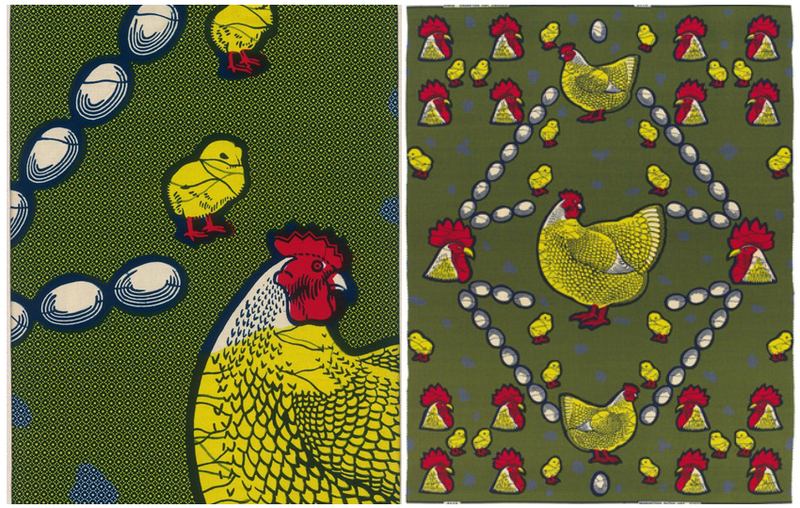
I had to share a delightful report from the radio show Studio 360 in which Khrista Rypl looks at the cultural aspects of African textiles.

She writes, “African textiles are distinctive for their vibrant colors, bold patterns, and batik dyes that give the fabric a unique crackled texture. But I had no idea that some of the trendiest of these prints are actually designed and produced in the Netherlands by a company called Vlisco.

“Inge Oosterhoff wrote a wonderful deep dive into the history behind the Vlisco textile house, and explained how their designs have remained hugely popular in Africa since the late 1800s. But Vlisco doesn’t just make fabric; they’re known for their printed designs. … Some patterns are designed with different countries in mind, while others are distributed widely around the continent. As the patterns catch on among shopkeepers and consumers, many of them get colorful names like ‘Love Bomb,’ ‘Tree of Obama,’ and ‘Mirror in the Sun.’ …

“Many patterns are sold widely in Africa, and different countries and cultures adopt different meanings and associations. [A swallow] print is a perfect example. The fabric was used for airline uniforms in Togo, so there the pattern is commonly referred to as ‘Air Afrique.’ The pattern also symbolizes asking for a favor, like the hand of a woman in marriage. In Ghana, the swallow refers to the transience of wealth, and the pattern is referred to as ‘Rich Today, Poor Tomorrow.’ It has a similar connotation in Benin, where it’s referred to as ‘L’argent vole,’ where it could either be interpreted as ‘Money Flies’ or ‘Stealing Money.’ ”

More designs and more of Studio 360 report, “Textiles Tell a Cultural History,” here.

Photos: Vlisco

Read Full Post »