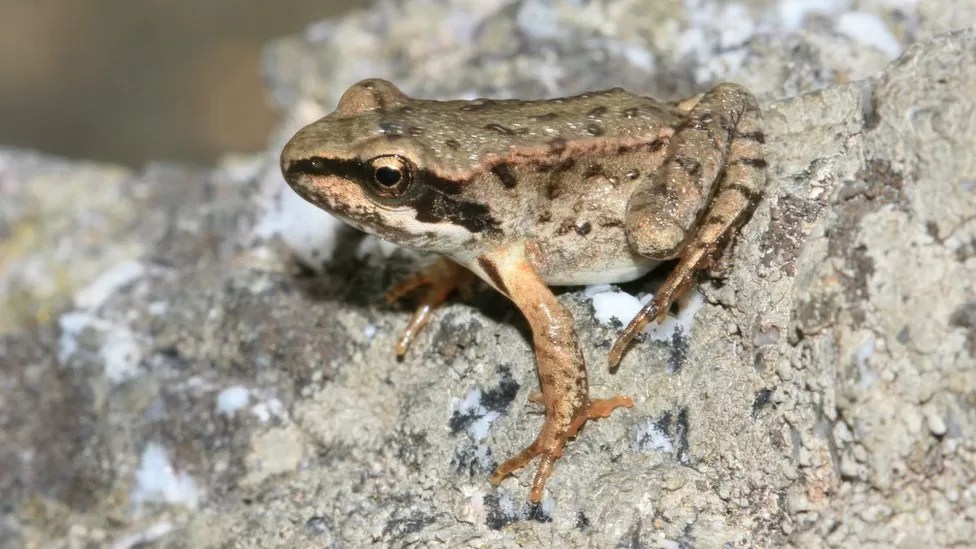
Photo: Christoph Vorburger.
European common frogs were among the beneficiaries of an initiative to dig ponds.
Where I grew up, there was a pond that was good for frogs. We hunted for tadpoles in the spring, and later I learned to catch the big bullfrogs in my hands and immobilize them briefly by running a finger down their spine. I still dream of doing that in front of my grandchildren one day, but the frogs around here have no interest in helping me look cool.
Rowenna Hoskin writes at the BBC about a recent effort in Europe to increase the numbers of vanishing frogs.
“Switzerland has reversed the decline of more than half of endangered frogs, toads and newts in one region, research finds,” she reports. “After conservationists dug hundreds of new ponds in the canton of Aargau, amphibian numbers significantly increased.
“The European tree frog population in particular ‘exploded,’ scientists say. …
“Globally, amphibian populations are in significant decline due to factors including habitat loss, urbanization, road infrastructure, disease and invasive species.
“In 1999 Aargau decided that a mass conservation effort was needed to combat the loss of amphibians. The collapse of the European tree frog was of particular concern.
State authorities, nonprofit organizations, private landowners and hundreds of volunteers worked for 20 years to build 422 ponds in five regions in Aargau.
‘Older ponds had become unsuitable for some amphibians due to lack of space, a high number of predators, and dense vegetation. By creating new ponds, the conservationists gave the species more space to thrive. Of the eight endangered species, 52% increased their regional populations and 32% were stabilized.
“Lead author of the study Dr Helen Moor told BBC News she was excited to see ‘such a clear increase’ in numbers considering the simplicity of the solution.
” ‘Species will come, they will settle and start using the space if you offer it to them,’ she said.
“One of the species that dramatically increased was the tiny European tree frog. This frog likes to jump from shrubs to trees, Dr Moor explains, and is one of the most mobile species, capable of traveling several kilometers.
“It needs a very specific habitat to thrive, preferring shallow ponds created by meandering rivers on floodplains. But this type of habitat has disappeared in many places in Switzerland, leading to the species’ decline. Switzerland, like the UK, has high population density with large road and railway networks, and much of the non-urban land is intensely farmed, Dr Moor explains. …
“Over 20 years the regional population of the European tree frog quadrupled in one area. It could only be found at 16 sites in Reusstal in 1999 but by 2019 the species was living in 77 places. …
‘The key message is that it pays to do something, even if it feels overwhelming,’ Dr Moor said. …
“Some ponds will need to be cleared of vegetation and drained to remove predator larvae that threaten tadpoles. Dr Moor hopes this conservation success will convince other landowners to create ponds and diversify habitats.
“The research is published in the Proceedings of the National Academy of Sciences.“
This shows what can be accomplished when people identify a problem and make up their minds to do something about it.
More at the BBC, here. No firewall.


 Suzanne's Mom's Blog