Feeds:
Posts
Comments

Posts Tagged ‘ancient’

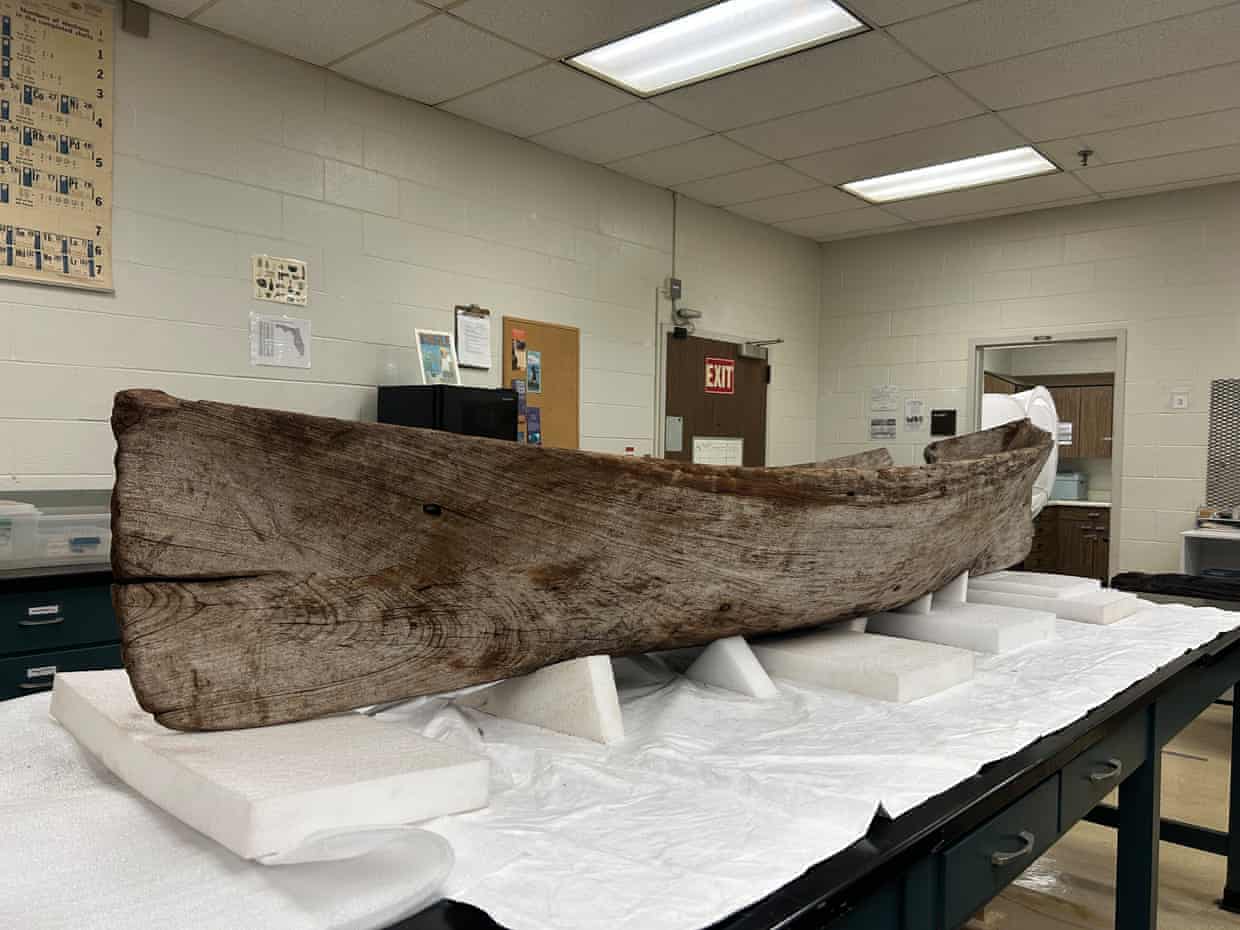
Photo: Florida Division of Historical Resources.
A 16th century canoe was discovered by a resident of Fort Myers, Florida, when Hurricane Ian made landfall in 2022. 

When I was a kid on Fire Island, a big storm always meant there would be treasures on the sand the next day. We would hurry up the sidewalk to the ocean to see how the beach had reshaped itself and what flotsam and jetsam had washed up. Often the shore was littered with shells, jellyfish, or starfish.

Not that we wish for hurricanes, but extra big storms like that can uncover even larger surprises than starfish.

Richard Luscombe notes at the Guardian, “Florida already claims to be the world capital of golf, shark bites and lightning strikes. Now a remarkable discovery following a devastating hurricane has enhanced its position as a global leader in another distinctive field: ancient canoes – some even prehistoric.

“State archeologists have just completed a painstaking preservation of an ancient wooden canoe discovered by a resident of Fort Myers during the cleanup from Hurricane Ian in 2022.

“It joins 450 other log boats or canoes dating back thousands of years recorded or preserved by the Florida division of historical resources. But this one is unusual, officials say, because it is the first they have seen made of mahogany, and probably the first to originate outside Florida, possibly in the Caribbean.

“The age of the fragile 9ft canoe is under analysis through carbon dating and other scientific processes. Investigators are pursuing a theory that it might be a dugout cayuco crafted by Spanish invaders who settled in the region during the 16th century.

“ ‘We compared it to canoes that we have in our collection and previously recorded, and it’s a very unusual form, so that was the first hint it was not necessarily from Florida,’ said Sam Wilford, Florida’s deputy state archeologist. ‘On the surface there’s tool marks made by iron tools, and we know that that is a historical date because that’s when the Europeans introduced iron tools into the Americas.’ …

“ ‘The tree may have died much earlier than when the canoe was constructed from it. It might have been driftwood, or stored somehow before it was made as a canoe.’

Hurricane Ian caused ‘catastrophic’ damage when it slammed into south-west Florida in September 2022 with 150mph winds and a storm surge of 18ft. The canoe is believed to have been pulled from a riverbed and ended up in the yard of a Fort Myers resident, who discovered it as he cleaned up after the storm and alerted state officials.

“ ‘It had been clearly submerged in water; there’s lots of stain marks on it, [but] it was dry when we received it,’ Wilford said, adding that it was then lightly vacuumed and cleaned with soft brushes, and that each stage of its careful conservation was photographed.

“Florida has had more discoveries of old canoes than any other place in the western hemisphere, and more than 200 separate sites have been recorded, officials said. Many of the canoes were made and used by Native American tribes, including the Miccosukee and Seminole tribes, who inhabited large swathes of the state, particularly the wetlands of the Florida Everglades.

“The oldest, Wilford said, is a canoe discovered near Orlando, estimated to come from the middle Archaic period up to 7,000 years ago.

With about one-fifth of Florida covered by water, the prolific use of canoes by its residents throughout history is unsurprising.

“ ‘It’s because of the environment,’ Wilford said. ‘Native Americans and then later on Europeans needed canoes to get around, and then the wet environment also led to preservation.’

“Canoes collected in the state’s historical resources division are stored in what Wilford said was a central archeological collections facility that is not open to the public. But the department operates an artifact loan program, with 26 canoes currently on display at museums across the US.

“ ‘It’s incredibly exciting,’ Wilford said. ‘Every canoe, and every fragment of a canoe, tells a story, and each one is unique.’ ”

More at the Guardian, here. (Although the Guardian has no paywall, I just upped my random donations to an actual subscription as independent journalism seems especially important in these trying times. Even tiny donations are welcome there.)
Read Full Post »

Photo: R.L. Easton, K. Knox, and W. Christens-Barry/Propietario del Palimpsesto de Arquímedes.
AI was used to translate this palimpsest with texts by Archimedes.

In general, I am wary of artificial intelligence, which one of its first developers has warned is dangerous. I use it to ask Google questions, but it’s a real nuisance in the English as a Second Language classes where I volunteer. Some students are tempted by the ease of using AI to do the homework, but of course, they learn nothing if they do that.

There’s another kind of translation, however, that AI seems good for: otherwise unreadable ancient texts.

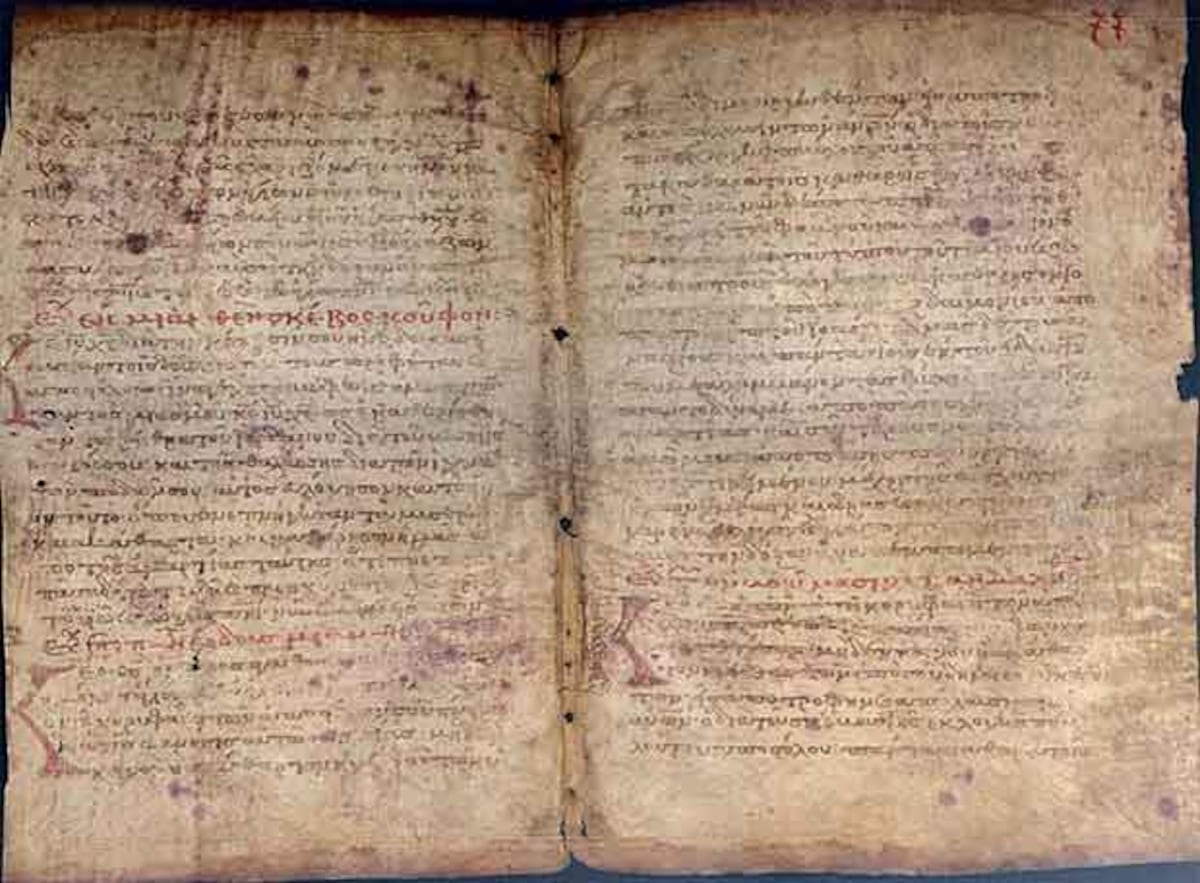
Raúl Limón writes at El País, “In 1229, the priest Johannes Myronas found no better medium for writing his prayers than a 300-year-old parchment filled with Greek texts and formulations that meant nothing to him. At the time, any writing material was a luxury. He erased the content — which had been written by an anonymous scribe in present-day Istanbul — trimmed the pages, folded them in half and added them to other parchments to write down his prayers.

“In the year 2000, a team of more than 80 experts from the Walters Art Museum in Baltimore set out to decipher what was originally inscribed on this palimpsest — an ancient manuscript with traces of writing that have been erased. And, after five years of effort, they revealed a copy of Archimedes’ treatises, including The Method of Mechanical Theorems, which is fundamental to classical and modern mathematics.

“A Spanish study — now published in the peer-reviewed journal Mathematics — provides a formula for reading altered original manuscripts by using artificial intelligence. …

“Science hasn’t been the only other field to experience the effects of this practice. The Vatican Library houses a text by a Christian theologian who erased biblical fragments — which were more than 1,500-years-old — just to express his thoughts. Several Greek medical treatises have been deciphered behind the letters of a Byzantine liturgy. The list is extensive, but could be extended if the process of recovering these originals wasn’t so complex.

“According to the authors of the research published in Mathematics — José Luis Salmerón and Eva Fernández Palop — the primary texts within the palimpsests exhibit mechanical, chemical and optical alterations. These require sophisticated techniques — such as multispectral imaging, computational analysis, X-ray fluorescence and tomography — so that the original writing can be recovered. But even these expensive techniques yield partial and limited results. …

“The researchers’ model allows for the generation of synthetic data to accurately model key degradation processes and overcome the scarcity of information contained in the cultural object. It also yields better results than traditional models, based on multispectral images, while enabling research with conventional digital images.

“Salmerón — a professor of AI at CUNEF University in Madrid, a researcher at the Autonomous University of Chile and director of Stealth AI Startup — explains that this research arose from a proposal by Eva Fernández Palop, who was working on a thesis about palimpsests. At the time, the researcher was considering the possibility of applying new computational techniques to manuscripts of this sort.

“ ‘The advantage of our system is that we can control every aspect [of it], such as the level of degradation, colors, languages… and this allows us to generate a tailored database, with all the possibilities [considered],’ Salmerón explains.

“The team has worked with texts in Syriac, Caucasic, Albanian and Latin, achieving results that are superior to those produced by classical systems. The findings also include the development of the algorithm, so that it can be used by any researcher.

“This development isn’t limited to historical documents. ‘This dual-network framework is especially well-suited for tasks involving [cluttered], partially visible, or overlapping data patterns,’ the researcher clarifies. These conditions are found in medical imaging, remote sensing, biological microscopy and industrial inspection systems, as well as in the forensic investigation of images and documents. …

“The researchers themselves admit that there are limitations to their proposed method for examining palimpsests: ‘The approach shows degraded performance when processing extremely faded texts with contrast levels below 5%, where essential stroke information becomes indistinguishable from crumbling parchment. Additionally, the model’s effectiveness depends on careful script balancing during the training phase, as unequal representation of writing systems can make the deep-learning features biased toward more frequent scripts.’ ”

More at El País, here. What is your view of AI? All good? Dangerous? OK sometimes? I can’t stop thinking about the warning from Geoffrey Hinton, the ‘godfather of AI,’ that it could wipe out humanity altogether. 

Read Full Post »

Photo: J. Przedwojewska-Szymańska / PASI.
The head of the male figurine is decorated with tattoos or scarification. Made between 410 and 380 B.C.

Here’s a story to tickle the frustrated archaeologist in you. I say “frustrated” because I’m not aware of any actual archaeologists who follow this blog, but many of us find the mysteries of of the field fascinating.

Sonja Anderson wrote recently at the Smithsonian about the excavation in El Salvador of “puppets that resemble modern toy dolls” with movable parts. They look like humans, but creepier.

“Researchers have discovered a trove of ancient clay puppets at an archaeological site in El Salvador, ” Anderson reports. “The five carved figurines are about 2,400 years old, and they may help shed new light on an ancient Mesoamerican society.

Jan Szymański and Gabriela Prejs, two archaeologists from the University of Warsaw, discovered the artifacts atop a ruined pyramid at the site of San Isidro. As they write in a new study published in the journal Antiquity, the items are known as Bolinas figurines: rare puppet-like artifacts that have been found in other ancient Central American sites, such as the early Maya site Tak’alik Ab’aj in Guatemala.

“All of the recently discovered Bolinas figurines have open mouths. The two smallest puppets measure around four inches and seven inches, while the other three stand at about a foot tall. These larger figurines have detachable heads and small holes in their necks and craniums. As the researchers write, this allows for ‘a string to be passed through the neck and tied on the top of the head.’ …

“Compared with neighboring countries, El Salvador’s pre-Columbian history is poorly understood, according to a statement from Antiquity. Excavations are challenging due to the country’s high population density, and volcanic eruptions over thousands of years have damaged and buried archaeological sites.

“ ‘Very little is known about the identities and ethnolinguistic affiliations of the creators of ancient settlements that predate the arrival of Europeans in the early 16th century,’ Szymański says in the statement. ‘This gets worse the further back in time we look.’

“The San Isidro site is a complex of mostly clay structures built by an unknown group, and it remains largely unexcavated. The researchers found the Bolinas figurines while digging at the top of the site’s largest pyramidal structure. Through carbon dating, they’ve concluded the five figurines were made between 410 and 380 B.C.E. [Before Current Era].

“ ‘This finding is only the second such a group found in situ, and the first to feature a male figure,’ Szymański says in the statement. The male puppet sports what appear to be facial tattoos, and the other four are female.

“The researchers think that these versatile Bolinas figurines could have been used during ‘rituals that would involve recreation of some actual events or mythical events,’ Szymański tells IFL Science’s Benjamin Taub.

“ ‘In Mesoamerican thought, still visible today, to recreate something was to actually create it,’ he adds. ‘So if a ruler decided to commission a sculpture of himself, he was effectively cloning himself, allowing himself to look over his people even when he was away.’ …

“Figurines like these have been found in Guatemala and elsewhere in El Salvador, and jade pendants unearthed nearby resemble similar artifacts discovered in present-day Nicaragua, Panama and Costa Rica, per the statement. As such, the ancient inhabitants of San Isidro may have been connected to distant peoples.

“ ‘This discovery contradicts the prevailing notion about El Salvador’s cultural backwardness or isolation in ancient times,’ Szymański adds. ‘It reveals the existence of vibrant and far-reaching communities capable of exchanging ideas with remarkably distant places.’ ”

Reading this story, I kept thinking about a clay figure from a completely different culture, the golem. Wikipedia says the golem “is an animated anthropomorphic being in Jewish folklore, which is created entirely from inanimate matter, usually clay or mud. … In modern popular culture, the word has become generalized, and any crude anthropomorphic creature devised by a sorcerer.”

There must be something in human nature that needs to invent these creatures.

More at the Smithsonian, here. No firewall.

Read Full Post »

In ancient times, Arabic translations of Greek helped spur scientific inquiry.

You may have seen that there are contemporary publishers planning to use artificial intelligence to translate texts. Ha! What could possibly go wrong? If you have ever used Google Translate, you know the answer to that: AI works only up to a point.

Today’s excerpt from Josephine Quinn’s book How the World Made the West, focuses on benefits that came from the traditional type of translation.

“In the eighth-century CE the Abbasids undertook to collect the wisdom of the world in their new capital at Baghdad. … The operation was lavishly funded by [the second Abbasid caliph, al-Mansur] as well as by members of his household, courtiers, merchants, bankers, and military leaders. …

“What is often now called the ‘Translation Movement’ … was part of a wider commitment by Islamic scholars and political leaders to scientific investigation that also saw caliphs commission new works of science, geography, poetry, history, and medicine.

The real legacy of the Arabic translations is the impetus they gave to further thought. 

“It is well-known that classic works of Greek science and philosophy were translated into Arabic before they were translated into other European languages — including Latin. What is less well-known is that the point of translating foreign works was not to preserve them but to build on them. As links around the Mediterranean continued to increase, that Arabic scholarship began to reach western Europe, and to change the way people there thought.

“Back in Baghdad, as so often happened, cultural change began from the outside — and in this case with the collection and comparison of foreign knowledge. The fundamental model and first material for the Abbasid translation project came from Iran, where sixth-century Sasanian shahs had commissioned Persian translations of important Indian and Greek works.

“Living Iranians were an inspiration too. … Persian scholars had already started to translate classic works of their own literature into Arabic. This ensured their preservation, and advertised the history and high culture of Iranian lands. Sasanian intellectuals also maintained useful links with scientific traditions farther east, above all with Indian mathematicians, the most advanced in the ancient world, and they had already translated important works from Sanskrit into their own language. …

“Incorporating the work of Greek thinkers into the Arabic canon was by contrast a declaration of cultural hegemony over the rump Roman empire at Constantinople, where older learning had been set aside in favor of Christian genres from sermons to saints’ lives, and where ancient science and philosophy now moldered in archives and monasteries.

“More immediately, the project took inspiration from the contemporary intellectual culture of western Asia, revitalized by the unification under Islam of regions once subject to either Persia or Rome. … This world produced well-traveled intellectuals expert in topics from military strategy to astrology, and comfortable in Greek, Syriac, Middle Persian (Pahlavi), and now Arabic as well.

“The final key component came from farther east. Paper had been invented in China in the second century BCE and by the second century CE it is found in the trading oases of the Tarim Basin. … As paper was much cheaper to produce than papyrus, it finally made writing in great quantity a practical prospect.

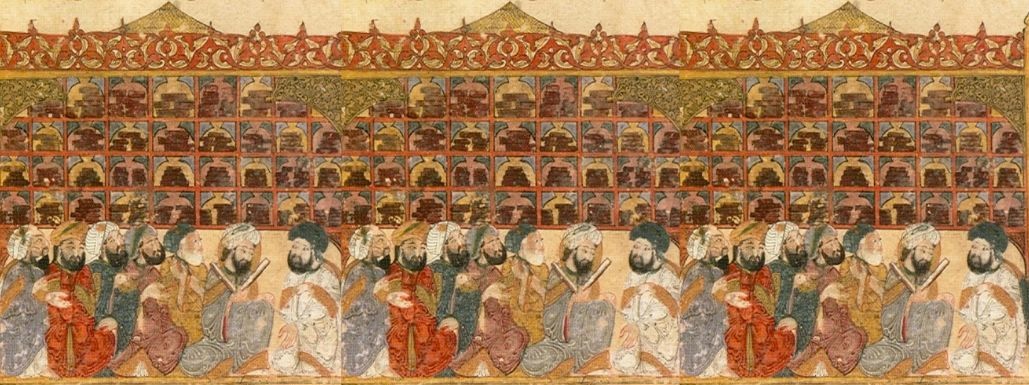
“In the early ninth century scientific scholarship in Baghdad coalesced around a library called the ‘House of Wisdom’ (Bayt al-Hikma), and the translation efforts were put on a more organized footing. … Persian scholars translated into Arabic works that had already been translated from other languages into their own, and since there was comparatively little direct Greco-Arabic bilingualism, Arabic translations of Greek works were often made from Syriac versions. …

“We have a useful guide to the foreign works considered worthy of investigation in the form of an encyclopedia entitled Keys of the Sciences written by Muhammad ibn Musa al-Khwarizmi (c. 780–850), a Persian-speaking mathematician and astronomer from the central Asian oasis of Khwarazm, south of the Aral Sea, who worked at the House of Wisdom.

“He divided the work into two books: one describes ‘Islamic religious law and Arabic sciences,’ defined as law, theology, grammar, secretaryship, poetry, and history; the other is devoted to ‘the sciences of foreigners such as the Greeks and other nations’: philosophy, logic, law, medicine, arithmetic, geometry, astronomy/astrology, music, mechanics, and alchemy. …

“Practical Greek texts also found their way into the collection, on topics from engineering to military tactics to falconry. Popular literature included books of fables, ‘wisdom sayings,’ and letters supposedly exchanged between famous historical figures. …

“Some of the Greek texts were acquired through personal request, even from the caliph himself. Other manuscripts were found on investigative missions. [A] tenth-century compendium of literature written in Baghdad reports that camel-loads of old works were discovered in a pagan Greek temple that had been locked since the arrival of Christianity, getting worn and gnawed at by pests. …

“Most ancient science was indeed lost to western Europe for almost a millennium: such works were usually written in Greek, even by Romans, and they disappeared with the knowledge of that language. …

“Greek texts were far from the only inspiration for Arabic science. [But the] manipulation, criticism, and sometimes outright rejection of foreign works by intellectuals working in the Islamic world catalyzed a scientific revolution.”

More at Literary Hub, here.

Read Full Post »

Photo: Sky2105, CC BY-SA 3.0/Wikimedia Commons.
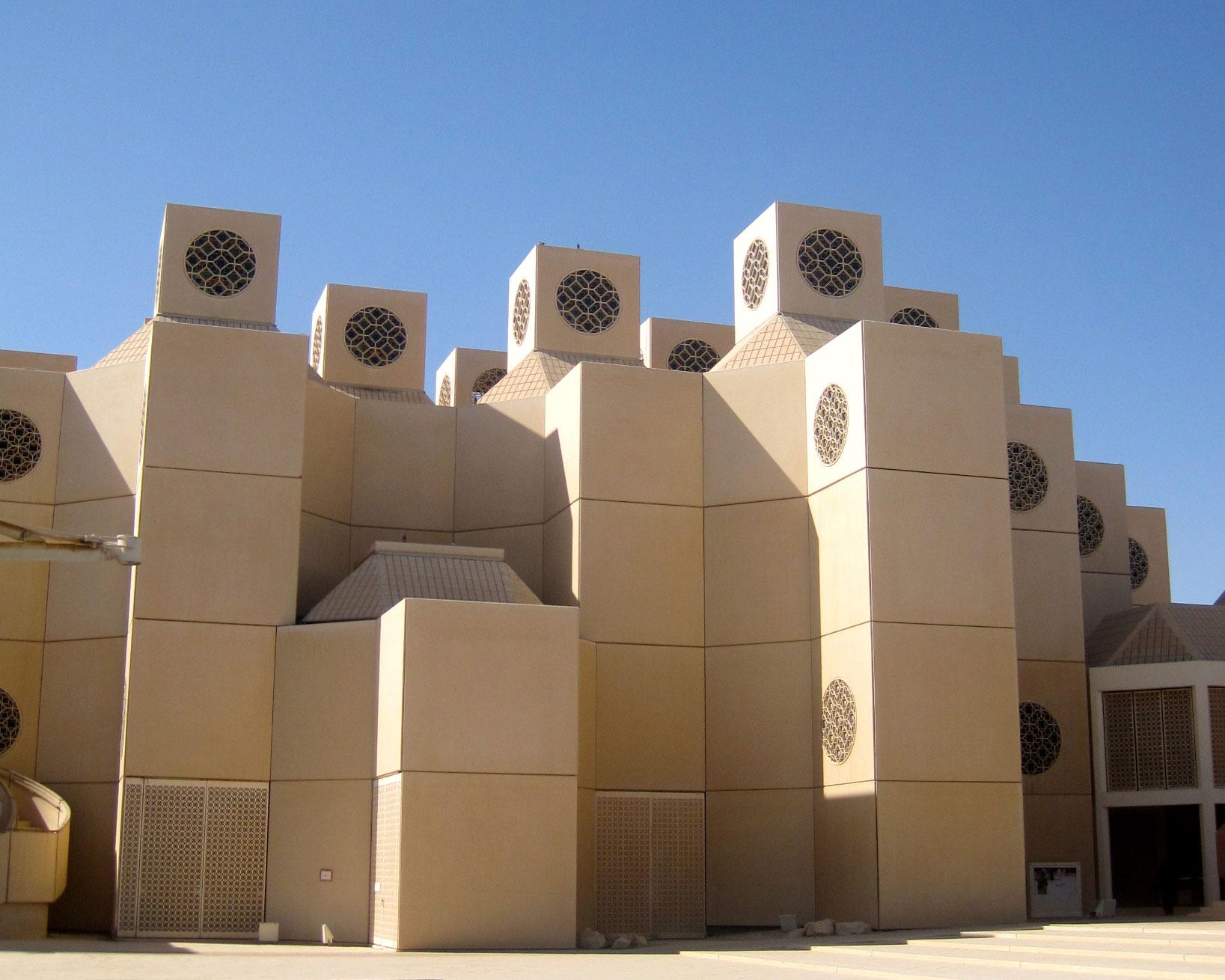
Qatar University campus features a new wind catcher design built into the architecture. The science behind it is borrowed from 12th C Iran.

Here’s a “cool” air-conditioning concept that was new to me but apparently known in Iran for centuries.

Durrie Bouscaren reports at radio show The World, “As a kid, radio producer Sima Ghadirzadeh spent her summers in one of the hottest places on earth — the desert city of Yazd, Iran. … Here, intricate wind-catching towers rise above the alleyways — they’re boxy, geometric structures that take in cooler, less dusty air from high above the city and push it down into homes below. 

“This 12th-century invention — known as badgir in Persian —  remained a reliable form of air-conditioning for Yazd residents for centuries. And as temperatures continue to rise around the world, this ancient way of staying cool has gained renewed attention for its emissions-free and cost-effective design. 

“Wind catchers don’t require electricity or mechanical help to push cold air into a home, just the physical structure of the tower — and the laws of nature. Cold air sinks. Hot air rises. 

“Ghadirzadeh said she can remember as a child standing underneath one in her uncle’s living room in Yazd. 

“ ‘Having been outside in the heat, and then suddenly, going inside and being right under the wind catcher and feeling the cool breeze on you, was so mysterious,’ Ghadirzadeh said. 

“Temperatures in Yazd can regularly reach 115 degrees Fahrenheit. But somehow, it was bearable, Ghadirzadeh said. … Historians say wind catchers are at least 700 years old. Written records in travelers’ diaries and poems reference the unique cooling structures. 

“ ‘From the 13th century, we have references to the wind catcher — by some estimates, they were in use in the 10th and 11th centuries,’ said Naser Rabbat, director of the Aga Khan program for Islamic architecture at MIT. 

“Most wind catchers only cooled the air by a few degrees, but the psychological impact was significant, Rabbat said. They soon appeared all over the medieval Muslim world, from the Persian Gulf to the seat of the Mamluk empire in Cairo, where they are called malqaf. 

“In Iran, the wind catcher is a raised tower that usually opens on four sides because there’s not a dominant wind direction, Rabat said. The ones in Cairo are ‘extremely simple in form,’ usually with a slanted roof and a screen facing the direction of favorable wind, he added.

“Over time, wind catchers became symbols of wealth and success, growing increasingly elaborate. Homeowners would install intricate screens to keep out the birds. Water features and courtyard pools could bring the temperature down even more.  

“ ‘They would even put water jars made out of clay underneath — that would cool the air further,’ Rabbat said. ‘Or, you can put a wet cloth and allow the breeze to filter through, and carry humidity.’ 

“Many of the older techniques that kept life comfortable in the Persian Gulf fell out of favor after World War II, said New York and Beirut-based architect Ziad Jamaleddine. …

“Those shaded walkways, created by overhanging buildings and angled streets so beloved in historic cities like Yazd, were no longer considered desirable. 

“ ‘What they did is they substituted it with the gridded urban fabric city we are very familiar with today. Which perhaps, made sense in the cold climate of western Europe,’ Jamaleddine said.  But in a place like Kuwait or Abu Dhabi, mass quantities of cool air are necessary to make this type of urban planning comfortable. 

“Attempts to re-create wind catchers occurred during the oil crisis of the 1970s and 1980s in cities like Doha, where the Qatar University campus incorporates several equally distributed wind towers. But these projects became less common when oil prices returned to normal. Wind catchers are not easy to replicate without a deep understanding of the landscape and environment, Jamaleddine said. …

“Today, air conditioners and fans make up more than 10% of global electricity use, according to the International Energy Agency. The air conditioners are leaking refrigerant into the atmosphere, which acts as a greenhouse gas. And they no longer function when the power goes out — as seen this summer during extreme heat waves across the world. 

“Architect Sue Roaf thinks it’s ‘almost criminal’ to build structures that continue to rely on air-conditioning, knowing its impact on the climate. Roaf focuses on climate-adaptive building and chose to build her home using the same principles of ventilation and insulation that she learned while studying the wind catchers of Yazd.”

More at The World, here. No paywall.

Read Full Post »

Photo: Fine Art Images/Heritage Images/Getty Images.
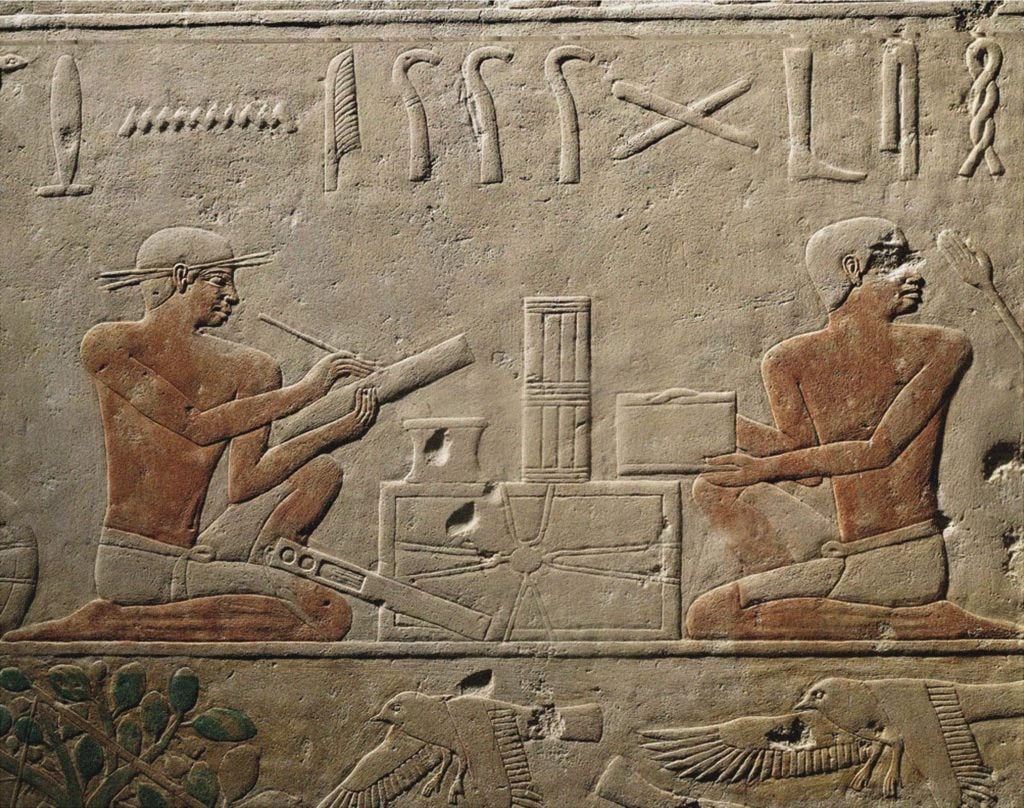
Relief depicting two scribes from Saqqara, Old Kingdom, 5th Dynasty, in the collection of the Egyptian Museum, Cairo.

I went for a massage the other day, and the masseuse noted that the muscles in my shoulders and neck were really tight. “Have you been working at the computer a lot?” she asked.

Writing on computers is the usual culprit these days, but back in Ancient Egypt, research suggests, writing on papyrus did even more damage.

Adnan Qiblawi wrote at ArtNet, “According to a new study published in Scientific Reports, scribes were suffering with similar issues back in the days of the pyramids.

“A team of archaeologists examined dozens of adult males’ skeletons from the necropolis at Abusir, Egypt, which was used between 2700 and 2180 B.C.E. Written evidence indicates that 30 of the studied males lived as scribes. These high ranking dignitaries enjoyed privileged lives with an elevated social status thanks to their literacy, at a time when only one percent of ancient Egypt could read and write.

“Records indicate that influential families sent their sons to the royal court for education and training. Eventually, they became scribes who served a similar societal role to contemporary government workers. 

“ ‘These people belonged to the elite of the time and formed the backbone of the state administration,’ explained Veronika Dulíková, an Egyptologist and member of the archaeology team. ‘Literate people worked in important government offices such as the treasury (today’s Ministry of Finance), the granary (today’s Ministry of Agriculture). They also played an important role in the collection of taxes.’ …

“While Egyptian scribes’ lives have been studied in detail, their archaeological remains have never before been examined for anomalies. The study’s lead author, Petra Brukner Havelková, is an anthropologist at the National Museum in Prague who has specialized in identifying activity-induced bone markers for nearly two decades.

“When comparing the remains of scribes to non-scribes, the former were found to suffer from osteoarthritis, a breakdown of the joint tissue. The condition was found in joints connecting the lower jaw to the skull, the right collarbone, the upper right arm bone connected to the shoulder, the bottom of the thigh, right thumb bones, and throughout the spine. 

“Just as modern-day government workers suffer neck and spinal injuries from sitting at desks and arching forward to stare at screens, ancient Egyptian scribes endured comparable physical stresses from hunching over papyrus for prolonged sessions.

It is theorized that scribes often squatted on their right legs, which may explain why significant damage was found on the skeleton’s right sides, with particular degeneration in their right knees.

“Historical sculptures, such as The Seated Scribe, corroborate that scribes frequently knelt or sat cross-legged while writing. They recorded their notes on sheets of papyrus, pottery notepads called ostraca, or wooden boards. Scribes generally wrote in hieratic cursive, a simpler script more practical for everyday note-taking, rather than using the elaborate hieroglyphs carved on monuments by specialists.

“Researchers were most surprised to discover damage in the scribes’ jaws, which is explained as a consequence of chewing on rush stems to make brush-like heads. They used these rush pens, and later reed pens, to write their notes, pinching the utensils between the index and thumb fingers of their right hands.

“Looking to the future, the study’s scientists are seeking to collaborate with other research groups to analyze scribes’ remains across other ancient Egyptian cemeteries.”

More at Artnet, here. No word yet on whether scribes had access to a massage.

Read Full Post »

Art: Hubert and Jan van Eyck. 
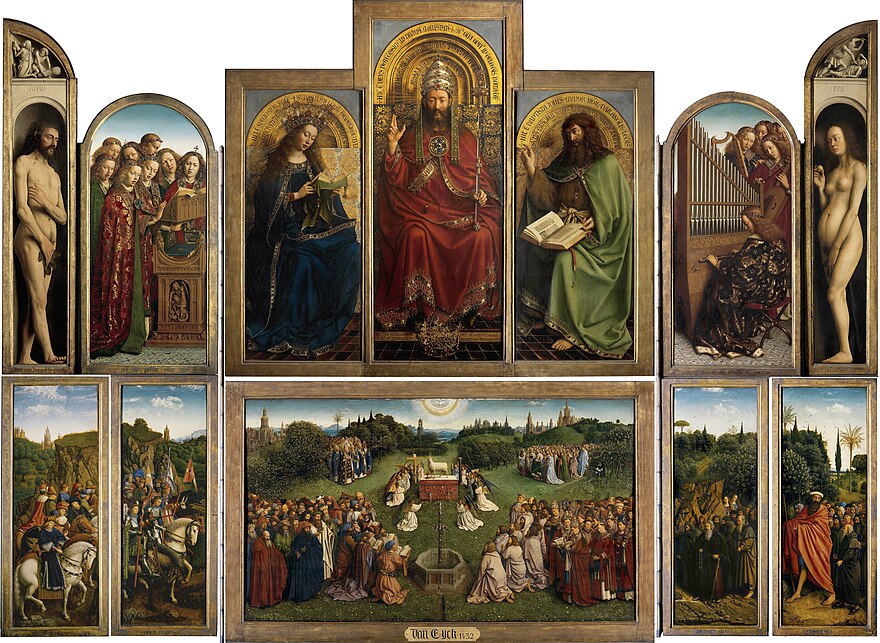
Ghent Altarpiece (completed 1432).

In New England, when we hear about an art thief’s confession, it makes our heart beat a little faster. That’s because we are hoping so much that the Isabella Stewart Gardner Museum heist (see where I wrote about it, here) will be solved in our lifetimes.

Today’s story, however, is about a much older art theft, equally puzzling.

Noah Charney reports at the Guardian, “Just about everything bad that could happen to a painting has happened to Hubert and Jan van Eyck’s Adoration of the Mystic Lamb (also known as the Ghent Altarpiece). It’s almost been destroyed in a fire, was nearly burned by rioting Calvinists, it’s been forged, pillaged, dismembered, censored, stolen by Napoleon, hunted in the first world war, sold by a renegade cleric, then stolen repeatedly during the second world war, before being rescued by The Monuments Men, miners and a team of commando double-agents. …

“In 1934, one of its 12 panels was stolen in a heist that has never been solved, though the case is still open and new leads are followed all the time.

“On 11 April of that year, Ghent police commissioner Antoine Luysterborghs pushed through a crowd at the St Bavo Cathedral that had gathered to gawk at something that was no longer there. One of the panels, depicting The Just (or Righteous) Judges, was gone. …

“The theft was followed quickly by a ransom demand for one million Belgian francs. As a show of good faith, the ransomer returned one of the panel’s two parts (a grisaille painting of St John the Baptist). But police remained baffled.

“Then a stockbroker called Arsène Goedertier had a heart attack at a Catholic political rally. He summoned his lawyer, Georges de Vos, to his deathbed. Just before he died, De Vos claimed, Goedertier whispered: ‘I alone know where the Mystic Lamb is. The information is in the drawer on the right of my writing table, in an envelope marked “mutualité.” ‘

“The lawyer followed the instructions and found carbon copies of the ransom notes, plus a final, unsent note with a tantalizing clue about the stolen panel’s whereabouts: ‘[it] rests in a place where neither I, nor anybody else, can take it away without arousing the attention of the public.’

“But if Goedertier did steal the panel, why? The church has been defensive, and there is an air of cover-up – as well as evidence that other members of the bishopric were involved. One theory goes that a group of church members, Goedertier among them, were involved in a failed investment scheme that lost church money. Rather than admit their failure, they stole the panel and ransomed it to cover the losses. But Goedertier was wealthy and devout; it seems odd he would resort to extorting his beloved diocese. …

“De Vos failed to alert police about Goedertier’s confession for a month. Eventually, after many false leads, police concluded Goedertier had been the thief. The case went cold. …

“The greatest strides in solving the crime have not been made by an active officer, though. Karel Mortier was chief of the Ghent police from 1974 to 1991, and fascinated with the Just Judges theft. It was a huge unsolved mystery, not just for Ghent, for Flanders, for Belgium, but for the art world. Mortier has dedicated his quiet hours to the hobby that drives him to this day: the hunt for the lost panel.

“Now in his 80s, he has done more than anyone to shed light on the case. He was the first to note that Goedertier had an eye problem that meant he could barely see in the dark, much less rob a cathedral at night. He turned up information that Goedertier already had more than the million francs demanded in the ransom in his bank account. What, then, was the motivation for stealing the panel?

“Mortier also suggested Goedertier could not have acted alone: the panel was taken from the altarpiece’s framework, which was so high off the ground that it needed a ladder, and at least two people, to remove it. Surely, Mortier concluded, one of the four church custodians was involved, if only to provide the ladder.

“Mortier’s investigation met many obstacles. The church granted him access to 600 pages of archives relating to the painting – but not the period between 1934-1945. It seemed there was either a conspiracy to hide the truth, or that those involved in the investigation, the police in particular, were wildly inept.”

More at the Guardian, here. No firewall.

Read Full Post »

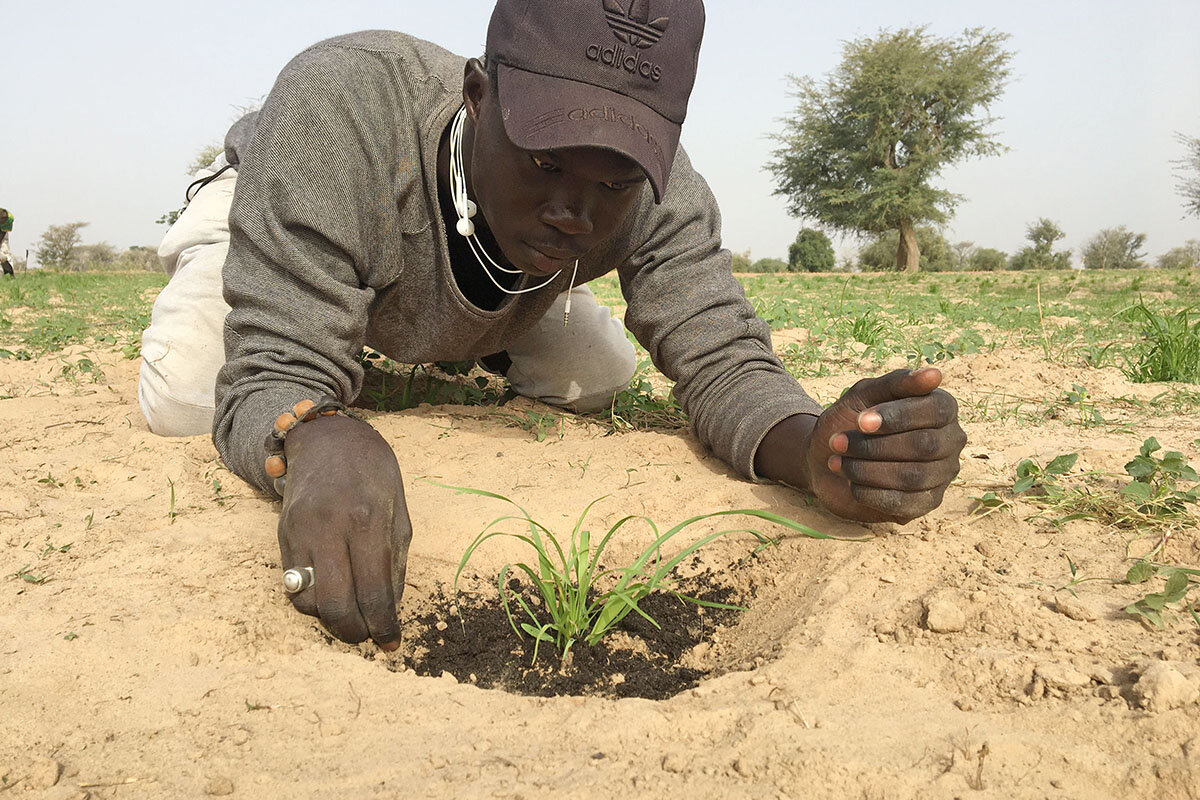
Photo: Jack Thompson.
From the Christian Science Monitor: “Farmers in Ndiob, Senegal, are experimenting with ‘zaï’ planting pits, an ancient practice to conserve moisture even during acute droughts.

With climate change and drought in Africa affecting crop yields, some farmers are adopting ancient techniques for conserving water.

Jack Thompson writes at the Christian Science Monitor, “Rain is like alchemy for farmer Thialla Badiane in the Sahel region of Senegal. Suddenly, it transforms dusty dunes into rich verdure, barren plains into crop-laden fields. 

“But rain is increasingly scarce here on the edge of the Sahara desert. Temperatures are rising by 50% more than the global average and threatening Mr. Badiane’s most precious resource to feed himself and his seven children. 

“Annual rainfall could drop by 38% in Senegal in the coming decades, a threat to the way of life for the nation’s 8 million farmers. Already the growing climate emergency means rainfall has become more unpredictable, water scarcer, and droughts longer.

“So in Mr. Badiane’s hometown of Ndiob, hundreds of farmers seeking to combat those effects have revived an ancient farming technique – with a 21st-century twist. ,,,

“Mr. Badiane [drills] repeatedly into the thick crust of the earth with a giant motor-powered corkscrew, leaving a pattern of perfectly spaced holes. In one hectare, he will drill 10,000 holes for his millet seeds, a planting technique known as zaï

“Originally from neighboring Burkina Faso, zaï is the traditional technique of making small indentations in the ground that capture rainfall and increase the fertility of the soil. It’s painstaking work, but a lot easier than digging the holes by hand with a hoe.

“Millet has been making waves on the international stage … because the crop can grow on arid land, can survive extreme heat, and is high in protein and micronutrients.

“And with his modern take on an ancient practice, Mr. Badiane has increased his yield of millet by 50% – though research shows zaï can triple production. If it were to become widespread, this Indigenous technique could help farmers become more resilient to a changing climate. …

Zaï combats [water runoff] by creating pockets for the water, making sure it doesn’t run off and take nutrients and minerals with it. 

“This is the ambition of Ndiob’s Mayor Oumar Ba, renowned in Senegal for his commitment to agroecology, a form of sustainable farming based on millennia of Indigenous knowledge and innovation. …

“Across the continent, many officials, scientists, and ordinary citizens are already looking to adapt. Faced with increasingly unpredictable weather in Ndiob, Mr. Ba traveled to Burkina Faso, a landlocked nation that gets even less rain than Senegal, to search for ways to beat intensifying drought. Four years ago, he brought back zaï

“ ‘Before, it used to rain consistently for five months; it would start in June and end in November,’ says the mayor’s agricultural advisor, Mame Kor Faye. ‘Now, not one farmer can tell you when the season will start.’ …

“Drought is a vicious circle for farmers: As rainfall decreases, the soil compresses. When it finally does rain, the dehydrated, packed  land cannot absorb the water and the top layer of fertile topsoil washes away. … ‘Zaï is a solution to this scarcity of water and to restore the fertility of our soils,’ Mr. Faye says.

“For Mr. Badiane, the planting plots are a double win.  Under the burning November sun, he bends over each small pit and delicately places a handful of rich, dark fertilizer. It’s a far smaller amount than he used when he composted his entire field. 

“Prices of fertilizer have skyrocketed since Russia, the world’s top exporter, invaded Ukraine and supplies were squeezed. Since then, animal manure, an alternative to chemical fertilizer, has been in short supply.

“ ‘The reason zaï interested me is because I wanted to save on organic manure,’ Mr. Badiane says. ‘Before, you didn’t have to pay for manure – livestock herders would give it to you. Now it’s hard to find, and you have to pay.’ 

“ ‘When the rain falls on the manure, it retains the humidity that the plant needs,’ says Isidore Diouff, an agronomist from the Senegalese nongovernmental organization Enda Pronat and who has been leading the zaï experiments in Ndiob. He kneels down to inspect a newly planted seed in its pit. ‘You can go 20 days without rain, and the pit will still be damp.’ 

” ‘Four months later, Mr. Badiane admires his ready-to-be-harvested, fingerlike plants. Nurtured by the moist soil, their soaring leaves tower over the 6-foot-tall farmer. Assessing the plant’s density and weight, Mr. Badiane predicts a good yield.”

More at the Monitor, here. No firewall. Subscriptions encouraged.

Read Full Post »

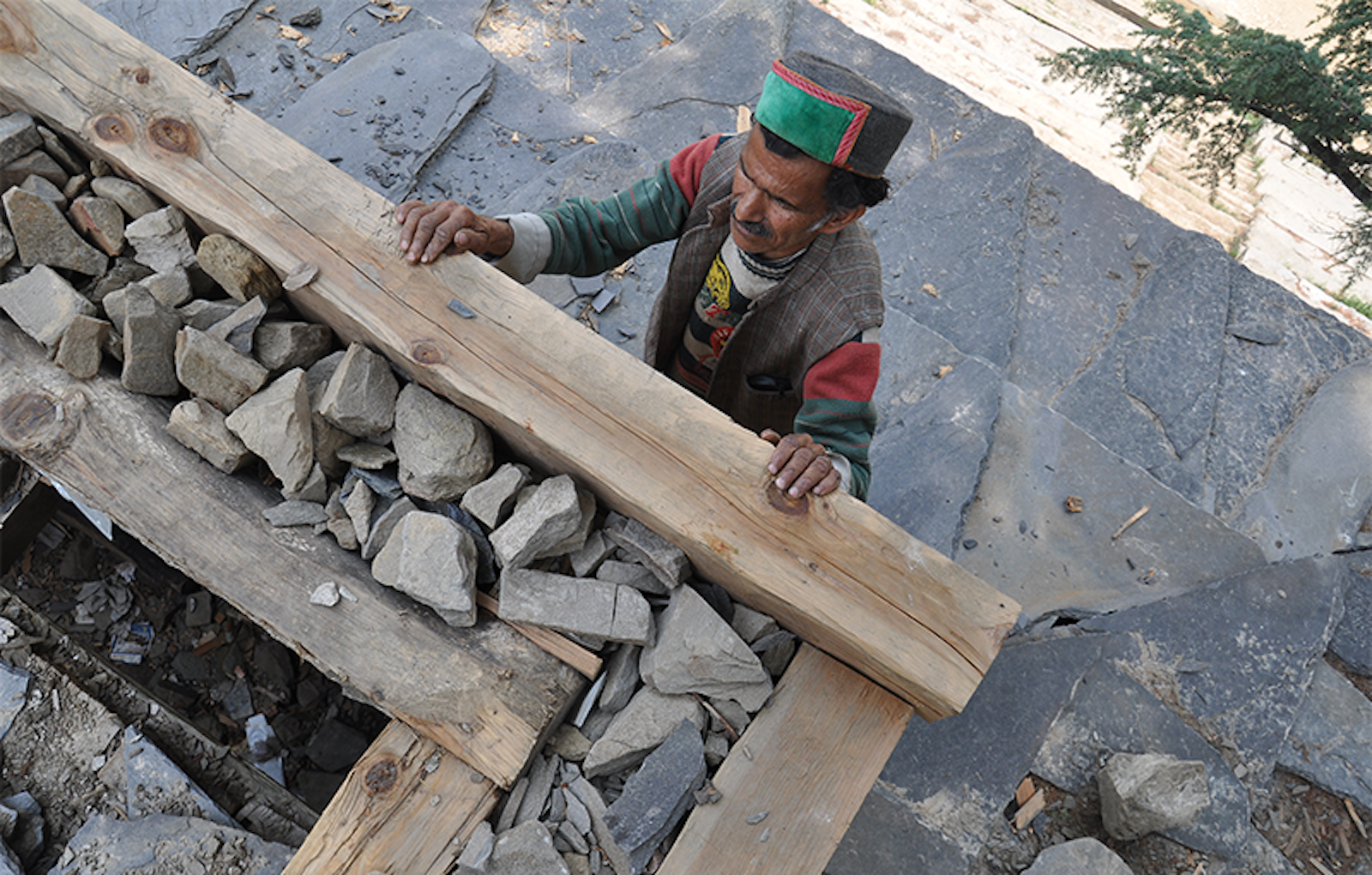
Photo: Jay Thakkar.
A worker examines a wooden beam in a traditional Indian kath kuni building. These earthquake-resistant structures lack metal and mortar, allowing them to flex as needed during a tremor.

I keep learning about ancient construction techniques that beat modern ones. Remember the post about self-healing concrete, here? That was in Rome. Today’s story explains why some buildings in Turkey and Syria withstood the earthquakes in February and points to ancient buildings in northern India.

Shoma Abhyankar writes at Nautilus, “The powerful 7.8 magnitude earthquake that struck Turkey and Syria on February 6 killed almost 50,000 people, most of whom died under rubble.

“The tragedy falls in a decades-long history of outsized death and destruction from recent earthquakes: The 1999 İzmit earthquake near Istanbul killed at least 17,000 people. … The immediate cause of the human tragedies was not the shaking ground itself, but the buildings people were in, most of which were constructed of reinforced cement concrete, a relatively quick and cheap building method.

“Earthquakes don’t have to be so deadly, say scholars who study this issue. Many traditional buildings have stood the test of time in regions that have endured high seismic activity for centuries.

“In Japan, people had long built earthquake-resistant structures mostly from wood. But a different tradition shows that even stone buildings can withstand vigorous shaking — if they are built with clever physics and architectural adaptations, honed over the centuries.

“In the mountainous region of Himachal Pradesh in India, near where the Indian Plate is colliding with the Eurasian Plate, many structures built in the kath kuni style have survived at least a century of earthquakes. In this traditional building method, the name, which translates to ‘wood corner,’ in part explains the method: Wood is laced with layers of stone, resulting in improbably sturdy multi-story buildings.

“It is one of several ancient techniques that trace fault lines across Asia. The foundations for the timber lacing system of architecture may have originally been laid in Istanbul around the fifth century. … Despite their ancient origins, this model of construction has mostly fared better over centuries than much of the contemporary building across the continent’s many active seismic zones.

“Built along the natural contours of the hills, kath kuni buildings typically get their signature corners from giant deodar cedars, which grow upward of 150 feet tall and 9 feet across in the Himalayas. These wooden beams layer between dry stones, which create walls. A single wooden ‘nail’ joins the beams where they come together.

“As the ponderous-looking structures rise vertically, usually up to two to three stories, the heavy stone masonry reduces, giving way to more wood. The overhanging roof typically has slate shingles resting on wooden beams. ‘The structure is like a body with heavy base, the projecting wooden balconies are limbs, and the heavy slate roof is like a head adding stability to the structure,’ says Jay Thakkar, a faculty member at the Centre for Environmental Planning and Technology University in Ahmedabad, India, who co-authored the book Prathaa: Kath-kuni Architecture of Himachal Pradesh

“The buildings stand free of any mortar or metal, which makes them more capable of shifting and flexing along with torques in the ground. This brilliance of mobility even continues underground. They are built over a trench at least a few feet deep filled with loose stone pieces that works as a flexible plinth. While a building constructed out of what seems almost like rubble to begin with might seem a strange defense against earthquake damage, it works. The gravitational force of the structure itself holds the stones in place.

“ ‘Unlike the cement brick wall, which becomes a single solid mass, the dry stone masonry is flexible,’ Thakkar says. ‘Staggered joints allow the external forces like tremors of earthquakes to be dispersed through the masonry thus preventing cracks in walls.’ He adds, ‘The wooden pin at the corner joint of two beams also allows movement. So when an earthquake hits, the structure sways and shakes but doesn’t collapse.’ ”

More at Nautilus, here. No firewall.

Read Full Post »

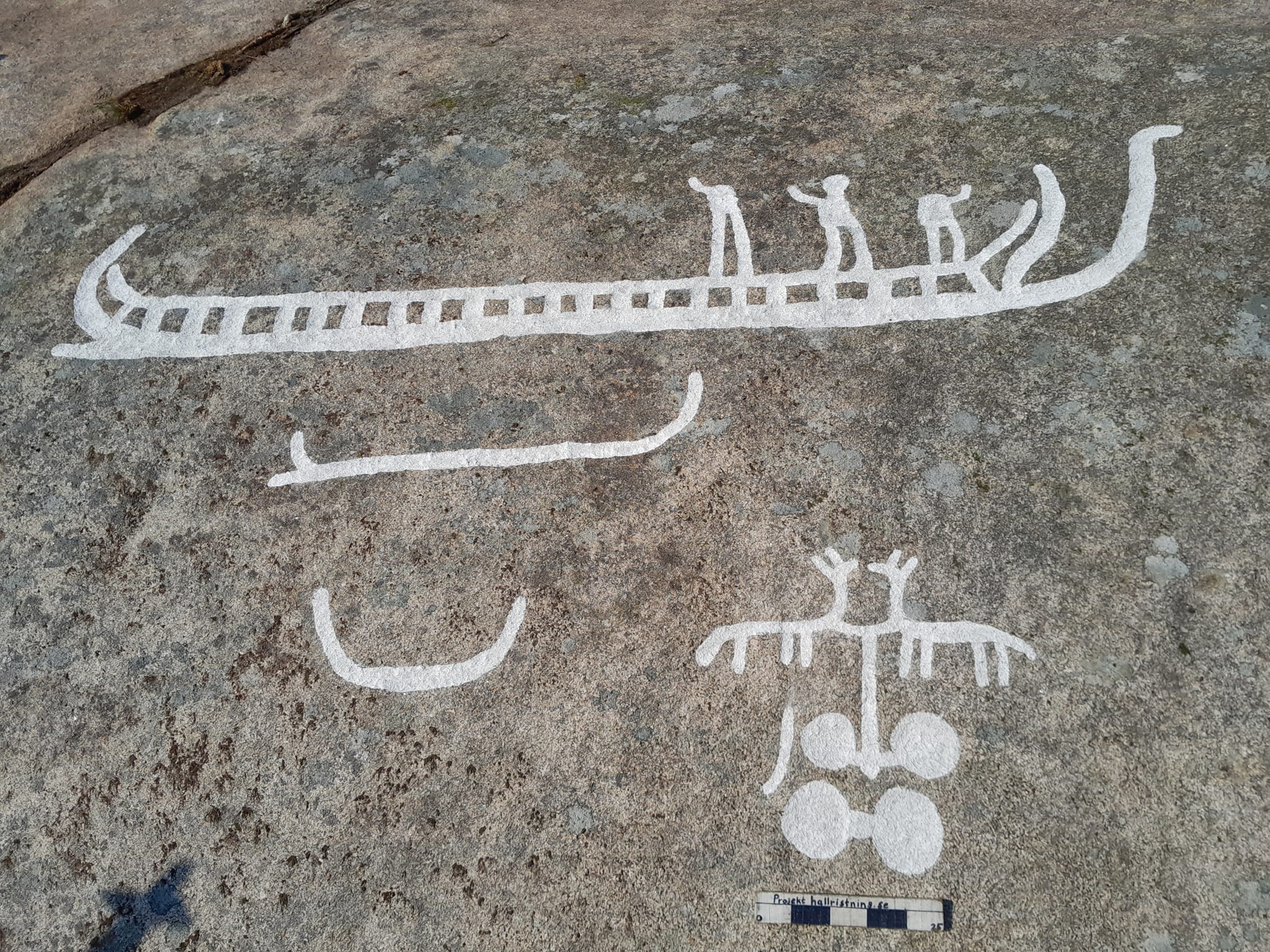
Photo: The Foundation for Documentation of Rock Carvings in Bohuslän.
One of the petroglyphs recently discovered on a farm in western Sweden.

Erik is from Sweden, so he takes Suzanne and the kids there every summer for about a month, where they connect with his sister’s lively family and his mother (Stuga40 on WordPress).

My husband and I paid Stuga40 a visit back in 2017, and one of the many fun things we did with her was visit a UNESCO World Heritage Site featuring ancient petroglyphs. (See a post on that here.)

It turns out that ancient civilizations in Sweden are not done revealing their secrets. Recently, researchers found more petroglyphs, startling the farmer who lives on the land and adding to the world’s pool of knowledge.

Richard Whiddington reports at Artnet, “In early May, a group of researchers scouring the western Swedish province of Bohuslän spotted irregular markings on a moss-covered rock face. They seemed man-made and so the team carefully removed the vegetation and uncovered scores of rock carvings, around 40 in total, depicting ships, animals, and people.

“The rock carvings, or petroglyphs, date back around 2,700 years and are the latest find in Bohuslän, an area known for its rock art, most notably the Bronze Age images at Tanum, a UNESCO site. …

“The recently discovered petroglyphs were found on a steep rock face that once formed the edge of an island before sea levels gradually dropped an estimated 40 feet over the course of several hundred years. This has led researchers to speculate the artists used boats, or a form of scaffolding laid on ice, to reach the rock surface. …

“The designs were made through a laborious process of smacking stones against the granite rock that exposed an underlayer of white. This color, in addition to their size, made them highly visible from both the mainland and passing ships.

“ ‘What makes the petroglyphs completely unique is that they are located three meters above today’s ground surface,’ Foundation for Documentation of Bohuslän’s Rock Carvings wrote in a statement. ‘The motifs lie on an even line that follows the height of the sea surface from approximately 700 to 800 BCE. The motifs are also stylistically consistent with this time period.’

“The latest group of petroglyphs found includes a 13-foot-long ship, as well as carvings of people, chariots, carts, and horses. Their meaning remains unknown. Sometimes petroglyphs were used to mark out territory, though researchers believe the repeated motifs carved into rocks outside the town of Kville may suggest they were used to tell a narrative.

“Lennart Larsson, on whose farm the rock carvings were found, was pleased by the discovery. ‘I haven’t actively been looking for petroglyphs, but it’s a lot of fun,’ he told SVT, the country’s national broadcaster in interview. ‘I can sit at home on the balcony and watch the stick figures and the ships outside.’ ” More at Artnet, here.

Also, at Live Science, Martin Östholm, a project manager with the foundation, noted that he petroglyphs include depictions of ships, people and animal figures, “including four-legged creatures that may be horses. … It’s not certain why people created the carvings, he said, but they may have served to mark ownership. …

James Dodd, a researcher at Aarhus University in Denmark and the Tanums Hällristningsmuseum’s Rock Art Research Centre Underslös in Sweden [said that] some of the motifs — including chariots, carts and animal figures — were depicted multiple times. … ‘On the basis of the repetition of the motifs, it is possible that this collection of figures forms a narrative,’ Dodd told Live Science in an email. Studies of other petroglyphs in the region have suggested that, in some cases, they may have been used in this way, but the exact meaning in this case is uncertain, he added.”

Artnet and Live Science have good pictures — and no firewalls.

Read Full Post »

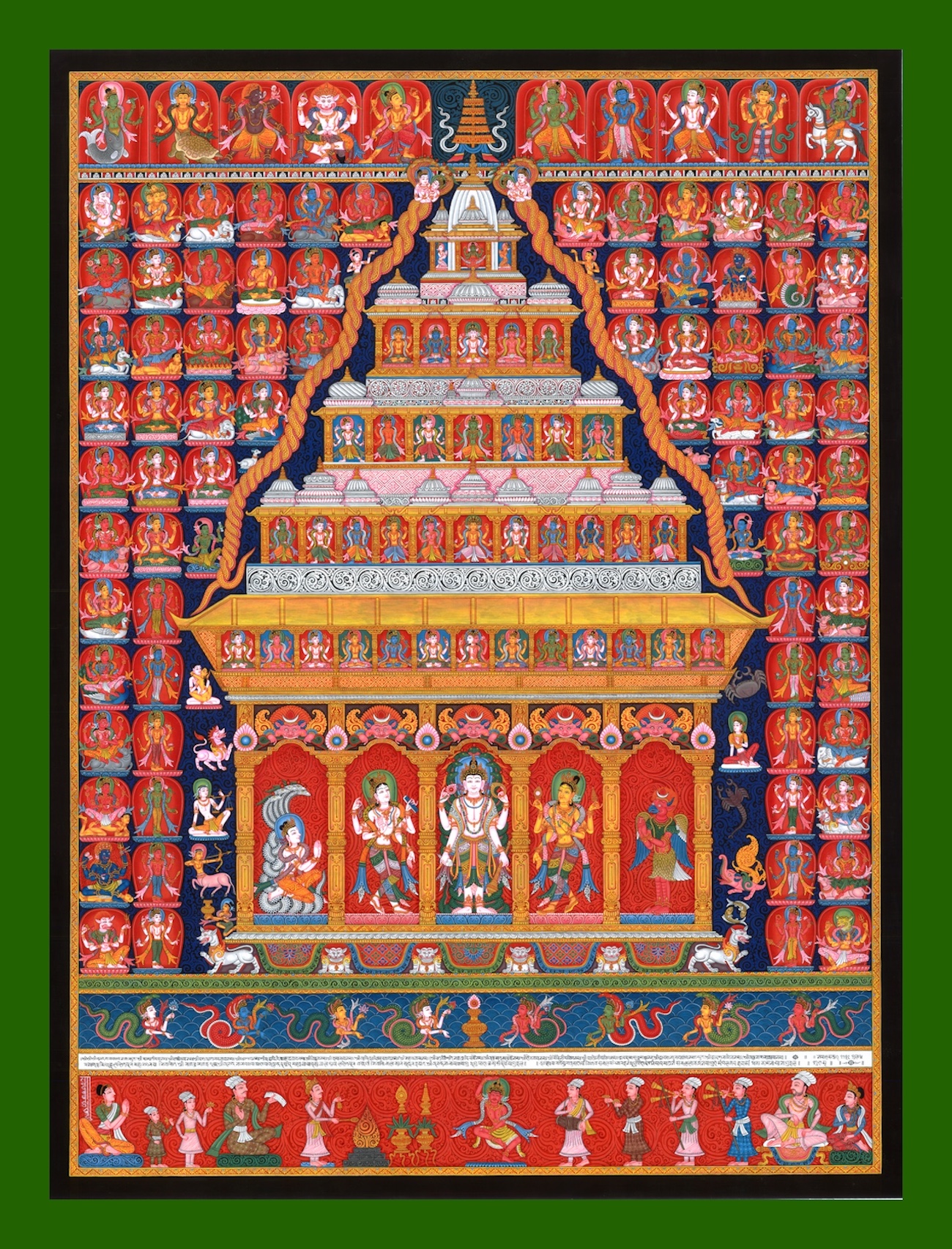
Photo: Erin L. Thompson/ Hyperallergic.
Paubhā painting of Vishnu surrounded by other major Hindu deities, based on various historical paintings from the Malla era.

Around the world, artists are finding unique ways to blend ancient and contemporary, taking the most meaningful aspects of tradition and interpreting it for new generations.

Erin L. Thompson has a story about Nepal artists at Hyperallergic.

“The Vietnamese monks said they wanted a river. So Lok Chitrakar, one of Nepal’s most prominent painters, wrote ‘need river’ amid the folds of a landscape on a preparatory sketch for the gateways of a Buddhist monastery in Vietnam.

“These drawings stretched across the wall of a room in Chitrakar’s studio when I visited Nepal late last year. I was there to see the reinstallation of a 10th-century sculpture of a deity into the shrine it had been stolen from in 1984 … but I couldn’t help being drawn into Nepal’s vibrant contemporary art scene. …

“The Chitrakars have long followed their name’s Sanskrit meaning: ‘image maker.’ But Chitrakar’s father tried to persuade him to follow a different career path, believing that it had become impossible to make a living creating paubhā, the devotional paintings used in Newar Buddhism. …

“But Chitrakar, born in 1961, persevered. His paubhās, painted following the exacting dictates of traditional form and subject matter in hand-ground mineral pigments bound with buffalo-hide glue, are now in collections and Buddhist sites across the globe. Chitrakar also receives commissions, like the one from the Vietnamese monastery. …

“Chitrakar correctly anticipated that the lull during his youth was temporary. Now, the streets around the major Buddhist pilgrimage sites in the Kathmandu Valley are lined with artists’ shops selling deities in paint, limestone, wood, and copper. Ordinary tourists take some home, but the most magnificent examples are commissioned by Tibetan Buddhists eager to establish new sanctuaries outside their homeland.         

“The Valley’s sought-after artists used the pandemic to catch up on these orders, often placed years ahead of time. Chitrakar also finished an enormous painting of the elephant-headed deity Ganesha, who is worshipped in both of Nepal’s major religions, Newar Buddhism and Hinduism. The artist had to climb a ladder to unveil the painting to me. Its intricate details took him 20 years to complete. Ganesha, worshipped as a remover of obstacles, is usually shown as a peaceful deity sampling a bowl of sweets. Chitrakar’s magnum opus depicts his wrathful side. Holding a skull cup and flourishing a variety of weapons, Ganesha dances, symbolizing the strength necessary to protect his devotees.

“Chitrakar was easy to find, but it took me much longer to track down another artist I wanted to meet. … I especially admired a mural with saddhus — Hindu ascetic sages — meditating on heaps of coals, intertwined with bouncy figures wielding spray-paint cans, wittily squirting out the traditional scroll-shaped depictions of clouds.

“I finally spoke to Sadhu X, who created the mural in collaboration with the illustrator Nica Harrison. Today, Sadhu X’s works blend traditional iconography and modern influences into his own distinct style. But when he was growing up, the only street art in Nepal was made by visiting foreign artists. In 2010, as he was completing his undergraduate degree, a teacher suggested he use the stencils he was creating on walls outside those of his art school. He followed the advice, soon met others interested in creating street art, and helped found the art space and community Kaalo.101.

“Helena Aryal, who also joined the video call, is another of Kaalo.101’s founders. She expressed her frustration at the perception, both inside and outside Nepal, that street art is a Western phenomenon. Aryal insisted that although the medium might be foreign, the form is deeply rooted in Nepal’s history. The hand-painted paper illustrations of snakes (nagas), pasted on many homes and buildings in the Valley during the annual rainy season festival, confirm that paste-ups are nothing new in Nepal. And the concept of creating art by modifying the public landscape also fits in well with the interactive, multisensory nature of devotion in Nepal, where worshippers in open street-corner shrines leave fingerprint marks in vermillion powder on deities’ foreheads and offer them marigolds, perfumes, food, and even music, by ringing bells. Some shrines are covered in names written in marker — not casual graffiti, but reminders to the gods about who has prayed for what.

Sadhu X told me that he’s never seen a rigid distinction between the style of traditional paubhās and the work of street artists he admires from other parts of the world. …

“Sometimes he thinks that his work is helping traditional Nepali art to evolve, but more often he’s just mixing together his influences and inspirations because he wants to tell stories using a visual language that he hopes his audience will understand. …

“I also had long discussions about this question with Birat Raj Bajracharya, a scholar of Newar Buddhism and part owner of a gallery selling the works of artists intent on both preserving and transforming paubhā painting. …

“Like Sadhu X, Bajracharya does not see a fundamental distinction between traditional Newar style and classical European models. For example, he pointed out to me that the texts describe paintings as portraying deities with emotionally expressive faces. But such expressions are difficult to render in the linear style of traditional paubhās. Bajracharya thus believes that the more complex shadings of emotion captured by artists who use European Renaissance techniques and the full range of colors of modern pigments may better approximate the ancient texts than the older paubhās. …

“Bajracharya advises the artists associated with his gallery about details like the color, attributes, and hand positions of deities in their paintings, making sure they follow the standards passed down in Buddhist and Hindu texts. He wants art to transform without ‘letting go of its core sense.’ “

More at Hyperallergic, here. No firewall.

Read Full Post »

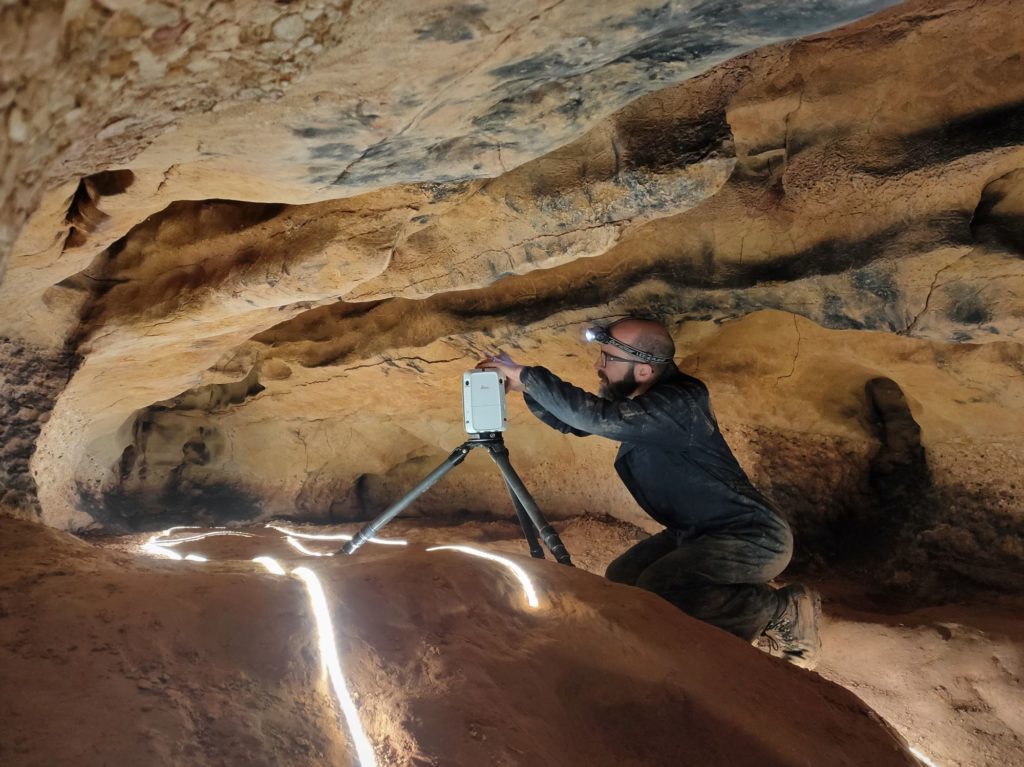
Photo: IPHES.
Archaeologist makes a 3D scan of the prehistoric cave art at Font Major in Spain.

Without going into space and littering it with our detritus and conflicts, there are plenty of unknowns here to satisfy our taste for exploration. In this article from ArtNet News, we learn, for example, about a recent discovery made in Spain that opened up a whole new batch of mysteries.

Javier Pes writes, “Experts have discovered a cave full of prehistoric carvings in northern Spain. Among the hundreds of rock carvings, some believed to be 15,000 years old, are vivid depictions of horses, deer, and bulls, as well as a wealth of mysterious and abstract symbols. Unlike the famous prehistoric paintings at Altamira, also in northern Spain, the recently discovered cave art in Catalonia is carved directly into the soft surface of the rock.

“A team of archaeologists stumbled across the richly decorated cave at the end of October 2019. … Josep Maria Vergès, who led the team from IPHES (the Catalan Institute of Human Palaeoecology and Social Evolution) described the find as ‘exceptional’ in a statement, and compared the cave to a ‘shrine.’

“The cave art is now being recorded and studied using 3D scanning technology. The engravings were created on a layer of soft sand deposited on the cave’s surface in an area that is difficult to access. The artworks are extremely fragile. … Several figures seem to have been damaged in the past by visitors who were unaware of their existence. Experts are now studying the best way to preserve the remarkable finds.

“Vergès tells Artnet News, that he felt a ‘mixture of surprise and disbelief, followed by great satisfaction,’ when the he first saw the ancient works of art. ‘Surprise because the cave is not an ideal place to find engravings due to the characteristics of the rock, the walls were very irregular, and the specialists thought that it was not suitable for painting or engraving.’ …

“The oldest art in the cave is believed to date back to the Late Stone Age, or Upper Paleolithic period. The earliest cave paintings at Altamira date from the same period, although they are around 20,000 years older. 

“Researchers uncovered the art within a nearly two-mile-long complex of caverns about 60 miles from Barcelona called the Cave of Font Major, which was first discovered in 1853. Parts of this cave complex, one of Europe’s largest, are open as a subterranean museum, although the specific stretch containing these carvings is closed to the public. …

“[In a related event] anthropologists working at Abri Blanchard in France’s Vézère Valley announced in 2017 the rediscovery of a 38,000-year-old rock engraving. It depicts an aurochs, or wild cow, and rows of dots. That ancient image is believed to be one of the earliest artworks found in Europe.”

More at ArtNet News, here.

Read Full Post »

Call me naive, but I can’t help thinking that the enmity of governments obscures what ordinary people in a country are like and the value that their cultural history holds for the people of other nations. Consider ordinary Iranians for a moment and some wondrous aspects of their ancient empire.

Eve MacDonald, a lecturer in Ancient History at Cardiff University, writes at the Conversation, “It’s simply not possible to do justice to the value of Iran’s cultural heritage – it’s a rich and noble history that has had a fundamental impact on the world through art, architecture, poetry, in science and technology, medicine, philosophy and engineering.

“The Iranian people are intensely aware – and rightly proud of – their Persian heritage. The archaeological legacy left by the civilisations of ancient and medieval Iran extend from the Mediterranean Sea to India and ranges across four millennia. …

“In the 6th century BC, Iran was home to the first world empire. The Achaemenids ruled a multicultural superpower that stretched to Egypt and Asia Minor in the west and India and Pakistan in the east. They were the power by which all other ancient empires measured themselves. Their cultural homeland was in the Fars province of modern Iran. The word Persian is the name for the Iranian people based on the home region of the Achaemenids – Pars.

“Some of the richest and most beautiful of the archaeological and historical heritage in Iran remains there. This includes Parsgardae, the first Achaemenid dynastic capital where King Cyrus (c. 590-529BC) laid down the foundations of law and the first declaration of universal rights while ruling over a vast array of citizens and cultures.

“Nearby is the magnificent site of Persepolis, the great palace of the Achaemenid kings and hub of government and administration. Architecturally stunning, it is decorated with relief sculptures that still today leave a visitor in awe.

“When the Achaemenids fell to the armies of Alexander the Great in the 4th century BC, what followed was great upheaval and also one of the most extraordinary moments in human history. The mixing of Persian and eastern Mediterranean cultures created the Hellenistic Age. …

“With new cities, religions and cultures, this melting pot encouraged the rise of a thriving connectivity that linked urban centres in Iran, Iraq, Afghanistan, Turkmenistan and Syria. … The great city of Seleucia-on-Tigris/Ctesiphon, just south of Baghdad on the Tigris river in modern Iraq, became the western capital and centre for learning, culture and power for a thousand years.

“Hellenistic rulers gave way to Parthian kings in the 2nd century BC and the … Parthian Empire witnessed growing connectivity between east and west and increasing traffic along the silk routes. Their control of this trade led to conflict with the Romans who reached east to grasp some of the resulting spoils.

“It was also a time of religious transition that not only witnessed the rise of Buddhism, but also a thriving Zoroastrian religion that intersected with Judaism and developing Christianity. In the biblical story of the birth of Christ, who were the three kings – the Magi with their gifts for Jesus – but Persian priests from Iran coming to the side of child messiah, astronomers following the comet. …

“The Sasanians ruled a massive geopolitical entity from 224-751 AD. They were builders of cities and frontiers across the empire including the enormous Gorgan wall. … The wall is a fired-brick engineering marvel with a complex network of water canals running the whole length. It once stood across the plain with more than 30 forts manned by tens of thousands of soldiers.

“The Sasanians were the final pre-Islamic dynasty of Iran. In the 7th century AD the armies of the Rashidun caliphs conquered the Sasanian empire, bringing with them Islam and absorbing much of the culture and ideas of the ancient Iranian world. This fusion led to a flowering of early medieval Islam and, of the 22 cultural heritage sites in Iran that are recognised by UNESCO, the 9th century Masjed-e Jāmé in Isfahan is one of the most stunningly beautiful and stylistically influential mosques ever built.

“This was a thriving period of scientific, artistic and literary output. Rich with poetry that told of the ancient Iranian past in medieval courts where bards sang of great deeds. These are stories that we now believe reached the far west of Europe in the early medieval period. …

“Iranian cultural heritage has no one geographic or cultural home, its roots belong to all of us and speak of the vast influence that the Iranians have had on the creation of the world we live in today. Iran’s past could never be wiped off the cultural map of the world for it is embedded in our very humanity.” More at the Conversation, here.

If you’re interested in more about the ancient culture of Iran, try Jason Elliott’s book Mirrors of the Unseen, reviewed at the Guardian, here. A related, equally fascinating, book is Destiny Disrupted, by Tamim Ansary, here. I learned a lot from those books.

P.S. An Iranian-American journalist I follow has been raising funds for healthcare workers in Iran who are dangerously short of personal protective equipment. Click here.

Read Full Post »

file-20191128-178107-1txjme0

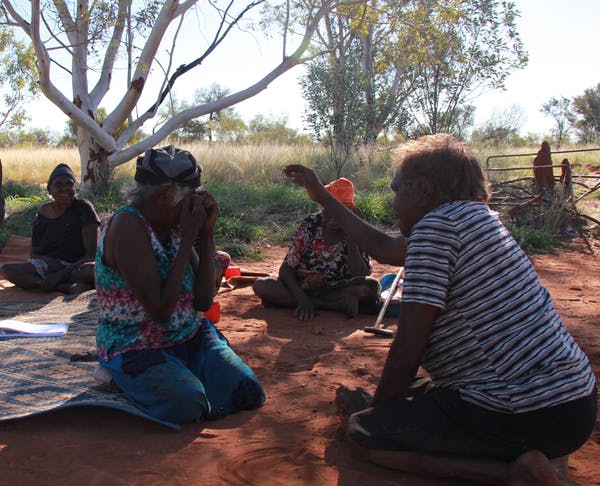
Photo: Margaret Carew
In 2014, two Warlpiri women from central Australia were photographed performing a traditional dance about a child who attempts to take seed paste from a coolamon (vessel). Ancient stories can give us insight into survival and the interconnectedness of all things.

Back in early January, when I in my ignorance thought coronavirus was just a problem for China, I saved this story about indigenous people passing along ancient wisdom. I did understand then that we’re all connected in the sense that if your island is drowning, mine will, too. I also understoood that indigenous people know a lot about protecting nature. Today I’m thinking that the wisdom of the ancients might help us in ways we have yet to explore.

Meanwhile, check out this article at the Conversation. The authors are Dana Lepofsky of Simon Fraser University, Álvaro Fernández-Llamazares at the University of Helsinki, and Oqwilowgwa Kim Recalma-Clutesi, contributor to the special issue on Ethnobiology Through Song.

“Since the beginning of time, music has been a way of communicating observations of and experiences about the world. For Indigenous Peoples who have lived within their traditional territories for generations, music is a repository of ecological knowledge, with songs embedding ancestors’ knowledge, teachings and wisdom. …

“Academics are just beginning to see the deep significance of these songs and the knowledge they carry and some are working with Indigenous collaborators to unlock their teachings.

“At the same time, non-Indigenous researchers and the general public are becoming aware of the historic and current loss of songs. Indigenous communities are also grappling with what this means. The loss of songs was brought on by brought on by colonization, forced enrollment in residential schools and the passing of the last of the traditionally trained knowledge holders and song keepers.

“A recent special issue of the Journal of Ethnobiology celebrates the power of traditional songs as storehouses of traditional ecological knowledge. …

“Although traditional music is threatened by past government-sanctioned actions and laws, with much already lost, Indigenous Peoples globally continue to use music in sacred and ritual contexts and celebrate their traditional songs.

“The lyrics in traditional songs are themselves imbued with meaning and history. Traditional songs often encode and model the proper, respectful way for humans, non-humans and the natural and supernatural realms to interact and intersect.

“For instance, among the Temiar singers of the Malaysian rainforest — who often receive their songs in dreams from deceased people and who believe all living beings are capable of having ‘personhood’ — dream-songs help mediate peoples’ relationships with these other beings. …

“The special issue was inspired by Kwaxsistalla Wathl’thla Clan Chief Adam Dick. Kwaxsistalla Wathl’thla was a trained Clan Chief, [the] keeper of hundreds of songs about the Kwakwaka’wakw people, their traditional territory in coastal British Columbia, and all aspects of their lives and their ritual world.

“In his role as ninogaad (culturally trained specialist), Kwaxsistalla Wathl’thla was the last culturally trained potlatch speaker. The cultural practice of potlatching is a central organizing structure of northern Northwest Coast peoples.

“Potlatching was banned until 1951. As a result, singing potlatch songs was a source of punishment and fear for many generations. The interruption of the transmission of traditional songs in every day and ritual life has been profound. …

“In 2002, he revealed an ancient ya’a (Dog Children song) that unlocked the mystery of lokiwey (clam gardens) on the Pacific Northwest Coast. Cultivating clams in clam gardens — rock walled terraces in the lower intertidal — is a widespread practice among Coastal First Nations. We now know this practice is at least 3,500 years old.

“Kwaxsistalla Wathl’thla’s sharing of this clam garden song unleashed a wave of research on traditional management practices and helped not only awaken people’s understanding of the extent to which Indigenous Peoples tended their landscapes, but also provided the foundation for research on how to improve clam management. …

“Despite the immense global value of traditional songs as libraries of ecological and other cultural knowledge, researchers and the general public have been slow to recognize their social and cultural importance.

“For instance, the findings of Canada’s Truth and Reconciliation Commission (TRC), highlight the importance of protecting and honouring Indigenous languages, but songs are not explicitly mentioned.[But] in many Indigenous cultures certain dialects, words and expressions are found only in certain songs, not in spoken conversations. Thus, protecting traditional songs is a critical aspect of protecting Indigenous languages. …

“Recognizing the importance of traditional songs and creating a context to promote this knowledge is fundamental to Canada’s reconciliation process. Speaking at the Truth and Reconciliation Commission’s Traditional Knowledge Keepers Forum, Blackfoot Elder Reg Crowshoe said:

‘… We need to be aware or re-taught how to access those stories of our Elders, not only stories but songs, practices that give us those rights and privileges to access those stories.’ …

“Such knowledge, as in the case of clam gardens, may provide important lessons about how people today can more respectfully and sustainably interact with our non-human neighbours.” Hmmm. What if humans had left the endangered pangolin alone? Would we have a pandemic today?

More at the Conversation, here.

Read Full Post »

2953

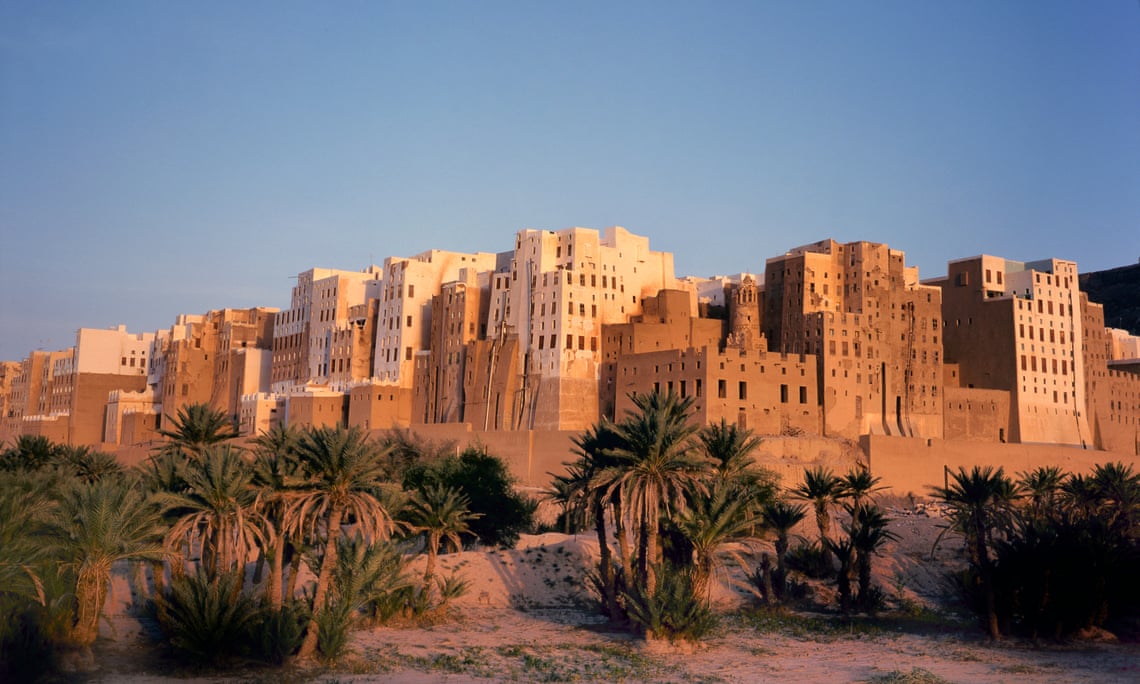
Photo: Achilleas Zavallis
Will these ancient, mudbrick, high-rise buildings survive the war in Yemen?

When I read fantasies to grandchildren, I explain that although passing through a wardrobe into another reality is not true, the feelings of the characters and the challenges they confront are. In fact, sometimes the issues of our world are made clearer through a fantasy lens.

Some fantasies I read just for my own pleasure. Having just finished Book Two of Philip Pullman’s The Book of Dust, I’m thinking about the way selfish monetary interests fuel the real world’s endless Middle East wars. In Pullman’s trilogy, a certain rose oil from the region of the old Silk Road has been found to have priceless properties, and behind-the-scenes power brokers are focused on trying to control it. Rose oil is a stand-in for whatever countries in the real world try to control, frequently another kind of oil.

One of the fiercest Middle East wars wars today is being fought in the small country of Yemen, and the report below is about amazing cultural sites we might not have heard about but for this disaster. I hope that spreading stories about the risks for civilians and cultural treasures will lead to more people demanding peace.

Bethan McKernan writes at the Guardian, “On the edge of the vast Empty Quarter desert that dominates the Arabian peninsula, white and brown towers rise together out of the valley floor like tall sandcastles. Once they welcomed weary caravans traversing the Silk Roads: now they stand as testimony to the ingenuity of a lost civilisation.

“This is the ancient walled city of Shibam, nicknamed the ‘Manhattan of the desert’ by the British explorer Freya Stark in the 1930s, in modern-day Yemen, a country also home to an untold number of other archeological treasures. The kingdom of Saba, ruled by the legendary Queen of Sheba, and many other dynasties of the ancient world rose and fell here, their fortunes linked to Yemen’s position at the crossroads of early frankincense and spice trades between Africa and Asia.

“Today, as a result of Yemen’s complex civil war – now in its fifth year – many of the country’s wonders have been damaged or are under threat. While the destruction pales in comparison to the human cost of the conflict, the country’s rich cultural heritage has also been ravaged. …

“Shibam, a 1,700-year-old settlement in the valley of Hadramawt, has largely escaped direct violence, but is still suffering from years of neglect, despite being a Unesco world heritage site.

“Named for King Shibam Bin Harith Ibn Saba, it is one of the oldest – and still one of the best – examples of vertical construction in the world. In the 16th century, Shibam’s inhabitants found they had run out of space to expand. To compensate, they began to build carefully on a rectangular street grid, and instead of spreading out, they built up …

“The city’s 3,000 residents still largely follow the traditional living pattern, with in some cases up to 40 family members in the same tower. Animals and tools are kept on the ground floor and food is stored on the second. Elderly people live on the third and the fourth is used for entertaining. Higher levels are occupied by more nimble families, with childless newlyweds on the roof. …

“Shibam is largely self-sustaining: its farmers and shopkeepers cater to the small population and many men are employed baking the straw and mud bricks used in construction. As in many Yemeni cities, goats and chickens roam the streets.

“ ‘Lots of young people have left,’ said Ali Abdullah, 28, who was looking after his family’s goats along with his 10-year-old brother, Majid.

‘Shibam is beautiful but there is no reliable money to make here unless they start preserving the buildings again.’ …

“Since Yemen’s Arab Spring revolt in 2011, funding to help preserve the city has dried up, as has the once steady flow of tourists, said Salim Rubiyah, the head of the local association responsible for looking after the public buildings inside Shibam’s walls. …

“Said Rubiyah, ‘I worry that this will be the last generation who are able to make a life here and appreciate the city’s beauty.’

“Elsewhere in Yemen, the story repeats itself. … In Sana’a, one of the oldest continuously inhabited cities in the world, ancient sites have been razed by Saudi-led coalition bombing [paid for, sadly, by the US]. … Despite Unesco having provided the coalition with a no-strike list of historical sites when the campaign began in 2015, sites such as the Castle of Taiz have been targeted, as well as the Dhamar Museum.

“ ‘We are nervous about the politicisation of heritage and the militarisation of archaeology during the conflict,’ said Sama’a al-Hamdani, director of the Yemen Cultural Institute for Heritage and the Arts. … ‘You can’t be the destroyer and the saviour at the same time.’ ”

More here.

Read Full Post »

Older Posts »