Feeds:
Posts
Comments

Posts Tagged ‘arab’

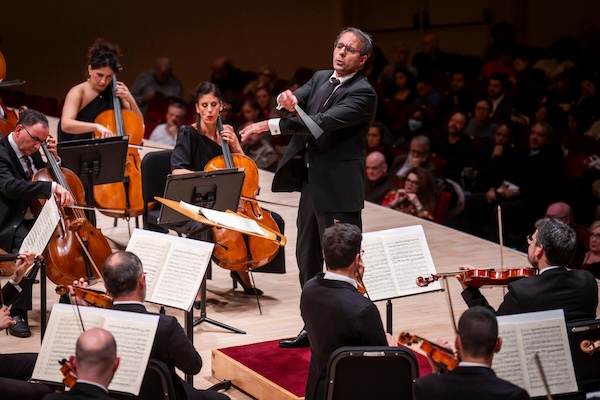
Photo: Chris Leee.
Saleem Ashkar conducted the Galilee Chamber Orchestra last November at Carnegie Hall. The orchestra has equal numbers of Arab and Jewish musicians.

Looking for a bright spot in the frightening new world order? No need to go farther that the Galilee Chamber Orchestra and the reasons why people of good will were determined to make music with equal numbers of supposedly hostile tribes.

David Patrick Stearns wrote at the Philadelphia Inquirer last fall, “On the face of it, the Galilee Chamber Orchestra could be an impossible meeting of musical minds.

“Comprising ‘equal numbers of both Jewish and Arab musicians,’ as its website notes, the orchestra has a 13-year history, and is now on a high-prestige tour with celebrated pianist Bruce Liu that includes the Kimmel Center on Nov. 19 and New York’s Carnegie Hall Nov 20.

“Based in Nazareth (known as the ‘Arab capital of Israel’), the orchestra’s common ground on this tour includes Mozart among other composers whose nationalities, from centuries past, now feel like neutral territory — while still speaking to the present.

“ ‘Classical music has become something that belongs to the world. If you go to Japan or Brazil, they feel that Mozart and Beethoven belong to them as much as anybody else.’ … said Nabeel Abboud-Ashkar, executive director of Polyphony Education, the conservatory where the orchestra is based. ‘Once you’re part of this cultural world, you instantly connect with so many people.’ …

“With that kind of mandate, it’s no surprise that the orchestra, in its last U.S. tour in 2022, was acclaimed for generating more sound than a typical chamber orchestra. This year, its 42 players draw from Polyphony students, faculty, graduates, and nearby professionals.

“Structurally, the conservatory/orchestra setup resembles Venezuela’s much larger El Sistema but also is meant to have an ethnicity mixture more like the Spain-based West-Eastern Divan Orchestra. Galilee Chamber Orchestra is firmly planted in its Jewish/Arab balance and in Israel, a country with a 20% Arab population.

“The tour program includes the Mozart Piano Concerto No. 23 with Paris-born, Montreal-raised pianist Liu, a 2021 winner of the International Chopin Piano Competition. The presence of Symphony No. 3 (‘Scotch’) by the Jewish composer Felix Mendelssohn isn’t meant to make a statement but is a piece the orchestra has wanted to do for a few years.

“Also, Abboud-Ashkar’s brother Saleem Ashkar, conductor of the tour, has considerable history with the composer, having also been the soloist in both piano concertos in a well-received, major-label recording with the Leipzig Gewandhaus Orchestra.

“More intentional is the inclusion of Nocturnal Whispers by Arab composer Nizar Elkhater, whose own Israel-based ensemble, named Abaad, seeks to fuse Western and Eastern musical styles

“The orchestra’s concerts haven’t been subject to the kinds of in-concert interruptions and demonstrations that have greeted the Israel Philharmonic and the Jerusalem Quartet in Europe and the U.S.

“But years of war, however, have strained the orchestra and conservatory in tangible ways. Planning is more provisional than ever. Concerts can be canceled on short notice, lessons planned to be in-person can suddenly switch to online, getting home from a European tour can be impeded and delayed by new conflict outbreaks in the Middle East.

“Among the musicians, tensions are heightened by constantly seesawing events, said Abboud-Ashkar. After the attack of Oct. 7, 2023, the whole operation was suddenly in unfamiliar territory, he said. …

“ ‘We feel everything that is happening around us,’ Abboud-Ashkar said in a Zoom interview from Nazareth. ‘Some people might think we’re being naive and ask … “How can you talk about collaboration and partnership being equal … with horrific things happening in Gaza?” …

‘We believe that what we’re doing has an impact. Even if it’s just making it a little better, we’re moving the needle in the right direction.’

“The main enemy may well be despair. Within the orchestra and conservatory, lack of hope for war resolution can turn into loss of musical motivation.

“ ‘On the other hand, there are cases where people show incredible empathy for others,’ said Abboud-Ashkar. ‘There’s a commitment to having this (musical) dialogue … and having more consideration for each other. When you’re in distress … you’re motivated to continue and to always find a way. You fight for your space and your values and hope there are still enough people out there who shared them. We’re going to stay together because this is what we believe in.’ ”

I am so touched by this idea of moving “the needle a little in the right direction.” That is all any of us can do, but we really must do it in order for all the little bits to add up. More at the Inquirer, here.

Read Full Post »

Photos: Beit HaGefen Arab-Jewish Cultural Center
People dance in the streets of the mostly Arab neighborhood of Wadi Nisnas in Haifa, Israel, for the 25th Holiday of Holidays festival, which celebrates religious diversity.

Most days, I find news about Israel completely depressing. Then along comes a story about an annual three-religion celebration there, and I’m reminded that not everyone associated with the 70-year-old nation and its neighbors is keen on in endless war.

Dina Kraft writes at the Christian Science Monitor. “In the port city of Haifa, two young art curators, one Jewish and one a Palestinian citizen of Israel, are dealing with something decidedly less fraught [than the daily news]: They are planning the logistics of an art installation that will include 88 pounds of white pepper, za’atar, sumac, and ginger.

“The piece is an exploration of what notions of ‘home’ mean, a loaded concept in a land claimed by two peoples. It is planned as a centerpiece of a new art exhibition for the Holiday of Holidays, the only event of its kind in Israel and a rare celebration of religious and cultural diversity in the fractious Middle East. The festival honors Christmas, Hanukkah, and Muslim traditions over three weekends in December in a gathering that is part block party, part intercultural artistic extravaganza. …

“Every year there is a different theme and this one is ‘the third dimension,’ an invitation to look at what happens when different cultures and identities influence each other to create something new – a hybrid space – as Yael Messer describes it. Ms. Messer is curator of the art gallery run by the Beit HaGefen Arab-Jewish Cultural Center. Messer, who is Jewish, is going over plans with Haneen Abed, her deputy, a Palestinian Israeli, in their shared office. The staff of the center is made up of both Arab and Jewish citizens of Israel.

“The story of the Holiday of Holidays is also the story of Haifa, Israel’s third-largest city. Haifa likes to bill itself – though not without criticism – as the country’s capital of coexistence, a place where Jewish and Arab residents live more integrated lives.

“Across the country, most Jews and Arabs live separately even in so-called mixed towns and cities, such as Haifa, where the two groups usually inhabit different neighborhoods. Social interaction is especially rare.

“But the festival brings together people from both sides of the demographic divide to dance to music performed on outdoor stages, on streets festooned with holiday lights. Arabs and Jews together follow the path of food and literary tours through the alleyways and streets of the mostly Arab neighborhood of Wadi Nisnas, eating local offerings like hummus and baklava at food stalls and attending concerts of liturgical music at churches. The massive undertaking is organized by Beit HaGefen and funded by the city of Haifa.

“Upstairs from Messer and Ms. Abed, their colleague Hila Goshen, the cultural director of Beit HaGefen, has her laptop open to a color-coded schedule of the festival’s events.

“ ‘It seems like every year there is some war, or military operation, or suicide bombing that happens [during the planning season] and we ask, “What are we doing, bringing people together to hear music and hear each other?” ‘ says Ms. Goshen. ‘And then the festival happens and this place looks like the most normal place on earth. The magic happens.’ …

“She says the example of the gathering, brief as it is, shows this concept of shared society, a place where Arabs and Jews can live together and lead equal lives.

“ ‘I know all our issues are not being solved in this festival,’ she says. ‘But even having this kind of exposure to thinking a little bit differently is a seed we have to plant.’

“Some critics believe this is gauzy naiveté. They argue that people really come to the festival for the food, not the message of unity. But [Asaf Ron, the director of Beit HaGefen,] disagrees.

“ ‘I don’t think people come for the hummus or the knafeh,’ he says. ‘I think they come for the hope.’ ”

More at the Christian Science Monitor, here. Check out past posts about the three religions interacting as the Daughters of Abraham, here, and in the pliable time of youth, here.

And for extra inspiration, click here to learn about the Parents Circle Family Forum, a beacon of light in Israel that brings together the bereaved on both sides of the conflict who understand that ending it can only come from the ground up.

Read Full Post »


Photo: The Economist
A statue of Juha, the wise old fool of Arab folklore.

It’s interesting to me that all cultures seem to have something like a wonton as part of their cuisine. Jewish cooks make kreplach, Italians make ravioli, Polish cooks make pierogis, and so on. We have more in common than we often realize.

The same goes for folktales. For example, most cultures have a wise fool, like the old court jesters or Don Quixote. I just learned about an Arab example.

The Economist comments, “Western audiences have grown used to the marauding heroes of Arabic folklore. Characters like Sinbad the Sailor and Ali Baba instantly conjure images of hidden treasure and desperate sword fights. But in the Middle East itself, many people prefer a more down-to-earth figure: Juha, a wise old fool, and his long-suffering donkey. …

“Juha first appeared in an Arabic book of the ninth century, though this was likely adapted from an older oral tradition. From there, Juha quickly splintered to the far ends of the Mediterranean world. He followed the Arabs to Sicily, where he became known as Giufà. In Turkey, his legend merged with a Sufi mystic called Nasruddin, while the Ottomans exported him to the Balkans. Some even claim that Juha inspired Cervantes’s ‘Don Quixote.’ …

“In some tales, Juha is accompanied by his faithful donkey and much amusement springs from it getting lost. One story begins with Juha looking for the animal around town; everywhere he goes, he thanks God. People are confused. ‘Why are you praising God?’ they ask. ‘Surely this is nothing to be thankful for?’ Juha smiles. ‘If I were riding the donkey right now, I’d be lost too!’

“Not all Juha’s tales are so innocent. Like court jesters in medieval Europe, his everyman style has proved an ideal vehicle for social criticism. In one fable, Juha is approached by a proud king. ‘All the great rulers of the past had honorific titles with the name of God in them,’ he proclaims. ‘There was God-gifted, and God-accepted. Can you think of a name for me?’ Juha pauses. “God-forbid,’ comes his retort. …

“Ali Ahmed Bakathir, an Egyptian nationalist, reimagined the fable of ‘Juha’s nail’ in 1951 to mock Britain’s obsession with the Suez Canal (just as Juha keeps ownership of a single nail at his old house so he always has an excuse to visit, Bakathir suggested that the British used Suez to justify their occupation of Egypt generally). …

“Amid the confusion of the modern Middle East, Juha is one way people find common ground. Last year, storytellers from around the Gulf met in the United Arab Emirates to celebrate Juha. The internet provides another space for communal appreciation. A popular Reddit page features dozens of volunteers reading a classic Juha story in their native Arabic dialect.”

More at the Economist, including sightings of Juha in unlikely parts of the world, here.

Read Full Post »

A Syrian actor who visited a refugee camp, felt compassion for the children, and returned to help them put on a play decided to start at the top. Only the best playwright would do.

From the Zaatari refugee camp in Jordan, NY Times reporter Ben Hubbard describes the scene: “On a rocky patch of earth in this sprawling city of tents and prefab trailers, the king, dressed in dirty jeans and a homemade cape, raised his wooden scepter and announced his intention to divide his kingdom. His elder daughters, wearing paper crowns and plastic jewelry, showered him with false praise, while the youngest spoke truthfully and lost her inheritance.

“So began a recent adaptation here of King Lear. For the 100 children in the cast, it was their first brush with Shakespeare, although they were already deeply acquainted with tragedy. All were refugees who had fled the civil war in Syria. …

“ ‘The show is to bring back laughter, joy and humanity,’ said its director, Nawar Bulbul, a 40-year-old Syrian actor known at home for his role in ‘Bab al-Hara,’ an enormously popular historical drama that was broadcast throughout the Arab world.

“Last year, he and his French wife moved to Jordan, where friends invited him to help distribute aid in Zaatari. …

“Children he met in the camp made him promise to return, and he did — with a plan to show the world that the least fortunate Syrian refugees could produce the loftiest theater. …

“The mere fact that the play was performed was enough for the few hundred spectators. Families living in nearby tents brought their children, hoisting them on their shoulders so they could see. …

“The crowd burst into applause, and a number of the leading girls broke into tears. Mr. Bulbul said they were overwhelmed because it was the first time anyone had clapped for them.”

More here, at the NY Times, where you can also see a slide show and watch a video about the refugee-camp theater initiative.

Photo: Warrick Page for The New York Times

Read Full Post »

Gene Sharp (founder of the Albert Einstein Institution and the go-to guy on nonviolent revolution) is proof that one and one and 50 make a million. Sharp is one man, but his writings have had a powerful influence on many of the players in the 2011 Arab Spring and democracy movements elsewhere.

Today I went with Jane’s family to see a movie about Sharp at the Boston Film Festival. (Jane’s cousin, Ruaridh Arrow, directed it.) It’s a remarkable film. There were interviews with organizers of nonviolent change in Serbia, Ukraine, Egypt, Syria, and beyond. The documentary was interspersed with news footage and video from recent uprisings around the world. A key message is that change takes strategic planning (you can’t wing it) and is a kind of armed resistance, only people are armed with ideas for undermining the pillars that support an oppressive regime. In addition to conducting research on the subject of nonviolence, Sharp has offered a list of 198 techniques that effect change.

After a standing ovation, a frail Gene Sharp, 83, his assistant, Jamila Raqib, and nonviolent-change trainer Col. Robert Helvey, retired, came up on the stage with the director and took audience questions. Raqib was asked about the funding for the Albert Einstein Institution, which operates out of a small space in East Boston. She said that likely funders back off because the ideas do relate to overthrowing a government. The institution is struggling.

I wish you could have been there to hear a young woman stand up and say that she is Egyptian and took  part in the January uprising. She said the overthrow of the government was easy but the rebuilding is hard. She wanted to know if any studies had been done comparing the transitions to democracy of other uprisings. When Sharp said that studies had yet to be done, I couldn’t help thinking what a good use of new funding such research might be. The film itself was funded by large and small donations from around the world through Kickstarter, which I blogged about here. Perhaps it can kickstart nonviolent change elsewhere.

Update: Gene Sharp died at his home in East Boston on January 28, 2018. He was 90.

Read Full Post »