Feeds:
Posts
Comments

Posts Tagged ‘archaeology’

Photo: Jeff J Mitchell/Getty Images
North Sea fishing crews have discovered archaeological artifacts in their nets.

I was saying to my husband the other day that I don’t know why scammers think older people are such a good target. Don’t we know more to watch out for after a lifetime of testing reality? But then I find myself susceptible to stories that for one reason or another I want to believe. So maybe it’s true about old folks.

Those of us who want to believe in things like the Lost City of Atlantis will have fun with this story about human settlements that may be submerged under the North Sea.

Nazia Parveen writes at the Guardian, “Lost at the bottom of the North Sea almost eight millennia ago, a vast land area between England and southern Scandinavia which was home to thousands of stone age settlers is about to be rediscovered.

“Marine experts, scientists and archaeologists have spent the past 15 years meticulously mapping thousands of kilometres under water in the hope of unearthing lost prehistoric tribes.

“[In May] a crew of British and Belgian scientists set off on their voyage across the North Sea to reconstruct the ancient Mesolithic landscape hidden beneath the waves for 7,500 years.

The area was submerged when thousands of cubic miles of sub-Arctic ice started to melt and sea levels began to rise.

“The ancient country, known as Doggerland, which could once have had great plains with rich soils, formed an important land bridge between Britain and northern Europe. It was long believed to have been hit by catastrophic flooding.

“Using seabed mapping data the team plans to produce a 3D chart revealing the rivers, lakes, hills and coastlines of the country. Specialist survey ships will take core sediment samples from selected areas to extract millions of fragments of DNA from the buried plants and animals.

“Prof Vincent Gaffney, from the University of Bradford’s school of archaeological and forensic sciences, said: ‘If this is successful it … would be new knowledge of what is really a lost continent.’ …

” ‘We can’t walk those fields looking for pottery or stone fragments, we can’t dig. We’re going to drop “grabs,” or do very small-scale dredges, to see if we can find these stones or tools, to give us a clue as to what is there. We are talking about an area that is the size of a modern European country. And we know almost nothing about it.’ …

“In previous studies funded by the European Research Council, the Lost Frontiers team mapped the Doggerland region, which is about the size of the Netherlands. The team could identify the location of river valleys, marshlands, hills and even white cliffs, but was unable to find evidence of human activity.

“Gaffney said … ‘Vast areas of the North Sea were dry land and inhabited. Then sea levels rose, and pretty much everything about the world changed in this period. The most pleasant places to live would have been on the great plains – which are now out at sea. This is where they would have wanted to be, not in the hills. But it’s all been lost.’ …

“It is understood the ancient civilisation originally covered about 260,000 sq km (100,000 sq miles). However, after the ice age ended, coastal zones became increasingly vulnerable to catastrophic flooding and entire civilisations would have been lost.”

More at the Guardian, here.

Read Full Post »

telemmglpict000194617024_trans_nvbqzqnjv4bqa7n2cxnjwnyi3tcbvbgu9twu-kwrahvlajxy1texvlq

Photos: Greek Ministry of Culture
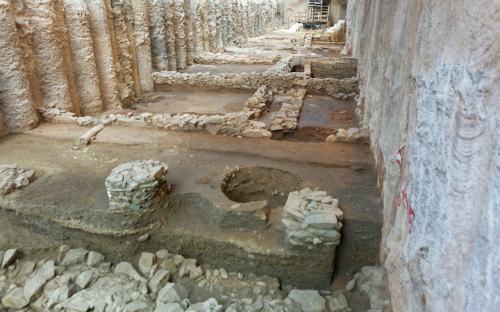
Hellenistic era building foundations, found at Agia Sophia Station, Thessaloniki.

Having studied Ancient Greek for five years in school, I retain a soft place in my heart for the culture and history of that part of the world and am always interested in the latest archaeological finds. Here is a story about setting out to build a subway system in the city of Thessaloniki and finding unexpected treasures.

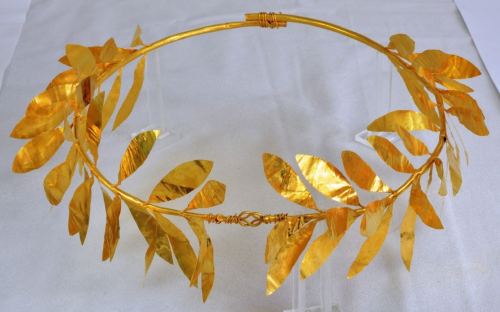
Nick Squires writes at the Telegraph, “The construction of a metro network beneath the Greek city of Thessaloniki has unearthed an extraordinary treasure trove of ancient artefacts, from gold wreaths and rings to statues of the goddess Aphrodite. …

“Archeologists have dug up more than 300,000 artefacts, from coins and jewellery to marble statues, amphorae, oil lamps and perfume vases. They were found in what would have been the thriving commercial centre of the ancient city, which was the second most important conurbation in the Byzantine Empire after Constantinople.

“During the construction of the metro network, archeologists found a stone-paved road, the Decumanus Maximus, which would have run through the heart of Thessaloniki in the sixth century AD, as well as the remains of villas, shops, workshops and an early Christian church. More than 5,000 tombs and graves were uncovered, some of them containing exquisite golden wreaths.

“ ‘The excavations are the biggest archaeological project of recent years in Greece,’ Yannis Mylopoulos, the chairman of Attiko Metro, the company building the network, told the Telegraph. …

“ ‘A large number of statues depicting Aphrodite have been found in the city centre, while several more came to light in the area around the Church of the Acheiropoietos (a fifth century AD Byzantine church),” Dr Polyxeni Adam-Veleni, the head of the antiquities department in Thessaloniki, told a recent conference on the discoveries. …

“Work on the new metro system, which is designed to ease traffic congestion and reduce air pollution in the city, began in 2006. The network of 18 stations was supposed to have been finished in 2012, but progress was stalled by the discovery of so many antiquities. It is now due to be operational next year.

“The 100 yard-long paved road – the Decumanus Maximus – will remain in situ and will be incorporated into one of the network’s stations, Eleftherios Venizelos, named after a prominent politician and national hero from the early 20th century.

“ ‘People will be able to see it when they enter and exit the metro station and can even go down and walk on it if they want,’ said Prof Mylopoulos. …

“Incorporating ancient archeological sites into an underground rail network was a huge challenge in terms of both engineering and expense. … Findings from the metro excavation will be displayed in various museums in Thessaloniki.”

More here.

Gold crown from a burial dating to the late 4th – early 3rd century. BC found at Syntrivani Station, Thessaloniki.

telemmglpict000194617025_trans_nvbqzqnjv4bqo3jbnce98wracn_ld9fncsjzdweakvyotoziza28su0

Read Full Post »

Image: Casto Vocal
Virtual reconstruction of northernmost section of pre-Incan temple in Bolivia.

Here’s why a general education may equip the workforce of the future better than job-specific training: you never know what skills will be needed. In this example, a new breed of adaptable archaeologist is expanding the use of 3-D technology to reimagine lost worlds.

George Dvorsky writes at Gizmodo, “The 1,500-year-old Pumapunku temple in western Bolivia is considered a crowning achievement of Andean architecture, yet no one knows what the original structure actually looked like. Until now.

“Using historical data, 3D-printed pieces, and architectural software, archaeologist Alexei Vranich from UC Berkeley has created a virtual reconstruction of Pumapunku — an ancient Tiwanaku temple now in ruins. Archaeologists have studied the site for over 150 years, but it wasn’t immediately obvious how all the broken and scattered pieces belonged together. The surprisingly simple approach devised by Vranich is finally providing a glimpse into the structure’s original appearance. Excitingly, the same method could be used to virtually reconstruct similar ruins. The details of this achievement were published [last December] in Heritage Science.

“First, some background on the structure. Pumapunku, which means ‘door of the puma,’ was a temple designed and built by the pre-Incan Tiwanaku culture, who lived and thrived in what is now western Bolivia from 500 AD to 1,000 AD. …

“Pumapunku displayed a level of craftsmanship that was largely unparalleled in the pre-Columbian New World, and it’s often considered the architectural peak of Andean lithic technology prior to the arrival of the Europeans. …

“Unfortunately, the ruins of Tiwanaku, and the Pumapunku temple in particular, have been ransacked repeatedly over the past half-millenium. Archaeologists have virtually no idea what the structure actually looked like. None of the blocks that once comprised the original structure are currently located in their original place, and many of them are badly damaged or decayed. …

“To overcome these difficulties and limitations, Vranich and his colleagues integrated historical archaeological data with modern computer software and 3D-printer technology to reconstruct the ancient temple, and by doing so, devised an entirely new approach to reconstructing and visualizing ancient ruins that would otherwise be impossible to build.

“The team created miniature 3D-printed models, at 4 percent actual size, of the temple’s 140 known pieces, which were based on measurements compiled by archaeologists over the past 150 years and Vranich’s own on-site observations of the ruins. … The researchers could have performed this work exclusively in the virtual realm, but they had better luck with tangible, physical pieces they could freely move around.

“ ‘It was much easier to use the 3D-printed models,’ Vranich told Gizmodo. ‘You can quickly manipulate them in your hand and try position after position. It is much slower and less intuitive on the computer.’ …

“Satisfied with their Lego-like configurations, the researchers keyed their creations into an architectural modeling program, culminating in a single hypothetical model of the temple complex. This wasn’t terribly difficult, as the construction methods used by the Tiwanaku people, and how they formed their incredibly geometric stones, are well documented, explained Vranich. But the exercise yielded some new findings.

“ ‘What we found out is that it appears they were making prototypes for each type of stone type, and then would have copied one after the other. It’s almost like it was a pre-Columbian version of Ikea.’ …

“Another interesting finding was that the gateways scattered around the site were lined up in a way to create a mirror effect. That is, ‘one big gateway, then another smaller one in line, then another,’ he said. ‘It would create an effect as if you were looking into infinity in the confines of a single room.’ ”

Read more here.

Read Full Post »

Photos: Ciro Fusco / Pompeii Parco Archeologico
Frescoes in Pompeii’s newly discovered “Enchanted Garden” room. The ashes of Mount Vesuvius left the ancient city remarkably intact after the volcano erupted in 79 AD.

When my younger grandson told me about a volcano in Guadalupe, where Suzanne’s family spent the holiday, he hastened to reassure me that it didn’t erupt. He’s six, and a stickler for fact.

Whether young or old, we are all fascinated by the extraordinary power of volcanoes and the way they change the world very suddenly, sometimes with no warning at all.

The complete destruction of Pompeii by the volcano Vesuvius in Italy is one of the reasons eruptions have such a hold over the collective imagination.

Interestingly, Pompeii continues to yield previously unseen beauty to archaeologists even after all these years.

As Sarah Cascone reported in October at ArtNetNews, “Pompeii is the city that keeps on giving. More than two hundred and fifty years after the ancient Roman town was discovered buried under a heap of volcanic ash, the archeological finds show no sign of abating. Now, archaeologists for the Great Pompei Project have uncovered yet another impressive discovery: an ancient shrine, or lararium, covered in gorgeously preserved frescoes, in a 16-by-12-foot room containing an altar, a garden, and a small pool.

“The Italian media has dubbed the new room, which would have been partially covered by a tile roof, ‘the Enchanted Garden.’ The figures in the paintings include two serpents, a wild boar fighting unidentified creatures against a blood-red backdrop, and a mysterious man with the head of a dog that may have been inspired by the Egyptian god Anubis. In front of a painted peacock, strolling through the plants, there would have been a planted flower bed, extending the illusionistic decorative design into the real world.

“ ‘It is the first time that such complex decoration has been found in a space dedicated to worship inside a house,’ Massimo Osanna, the director of the Parco Archeologico di Pompei, told the Wall Street Journal, praising the find as exceptional.

“ ‘Every house had a lararium of some kind,’ Ingrid Rowland, a professor at the University of Notre Dame and the author of From Pompeii: The Afterlife of a Roman Town, told the New York Times. But ‘only the wealthiest people could have afforded a lararium inside a special chamber with a raised pool and sumptuous decorations.’

“After clearing out the volcanic rock fragments, or lapili, that had buried the room for almost two millennia, archaeologists found an altar decorated with eggs, a symbol of fertility. There are burnt remains, which archaeologists believe may have contained food offerings, such as eggs, figs, or nuts, to fertility deities. The altar is flanked by paintings of the Roman gods of household rituals. …

“New excavations are much more careful than the original explorations of the site, which began in 1748. Without modern technology and techniques to aid their excavations, early archaeologists could be quite destructive. The new discovery helps provide a better understanding of what the early excavations would have looked like when first uncovered. …

“Since 2011, Italy has been carrying out much-needed preservation and restoration work to preserve the UNESCO World Heritage Site. The Great Pompeii Project, an initiative aimed at stemming the deterioration of the ancient structures, had an initial budget of €105 million ($140 million). … The discovery of the ‘Enchanted Garden’ represents perhaps the project’s greatest success thus far.”

More here.

In Pompeii, a recently uncovered household shrine, or lararium, features two serpents among its beautifully preserved frescoes.

Read Full Post »

Photo:  Svt Nyheter
Saga Vanecek, an 8-year-old Swedish-American girl, pulled a 1,500-year-old sword from a lake in southern Sweden last July, prompting comparisons to Arthurian legends about the Sword in the Stone and the Lady of the Lake.

You never know when wonders will appear. This little girl was not out helping archaeologists on a dig like the 13-year-old boy in this earlier post. She was just dawdling in a lake while her father was calling her to hurry so he could watch the World Cup on television. And then — a miracle.

Jon Henley writes at the Guardian, “An eight-year-old girl has pulled a 1,500-year-old sword from a lake in southern Sweden.

“ ‘I felt something with my hand and at first I thought it was a stick,’ Saga Vanecek told the local Värnamo Nyheter [VN] newspaper. ‘Then it had a handle that looked like it was a sword, and then I lifted it up and shouted: “Daddy, I found a sword!” ‘

“The find, made in July but announced only [in October] for fear it would trigger a summer stampede to the site at Tånnö on the shore of Lake Vidöstern, felt ‘pretty cool and a bit exciting,’ she told the Swedish public broadcaster Sveriges Radio. …

“Her father, Andrew, said in a Facebook post that the sword, estimated by experts from the nearby Jönköping county museum to date to the 5th or 6th century AD, before the Viking era, was still in the remains of its wood and leather scabbard.

“He told VN he had been waiting impatiently for his daughter to come in from the water because the football World Cup final was about to start, but she was busy skimming stones. Then she stooped and held up the ancient weapon.

“Neighbours confirmed to the Swedish-American family, who moved to Sweden from Minnesota last year, that the rusted artefact did indeed look old, and Nevecek called an archaeologist the next day.

“Annie Rosén, from the museum, said: ‘I was on holiday, but when I saw the pictures I went straight away. You cannot imagine such a sword – so well preserved.’

“Another expert at the museum, Mikael Nordström, [said] they were exploring the possibility it could have been a place of sacrifice. … Subsequent searches by museum staff and local council workers uncovered a brooch from roughly the same period but there were no other significant finds.”

More at the Guardian, here. And you can read Saga Vanecek’s own report here.

May 2019 be the year that girls everywhere pull miracles from lakes and stones.

Read Full Post »

3709018635_ecef9dc046_b

Photo: Tom Blackie via Flickr
The Avenue of Sphinxes on the Al-Kabbash road in Luxor. Recently, a previously unknown sphinx was discovered by construction workers.

Every day new discoveries. Today I have a story about a recent discovery in Egypt. But first, to refresh your classical memory, the mythological creature called a sphinx has the body of a lion and the head of a human. Although the most famous sphinx story — the one that involved Oedipus — took place in Greece, all the statues of sphinxes are in Egypt.

Naomi Rea writes at artnet news, “A previously unknown statue of a sphinx has been discovered in Egypt, the general director of Luxor Antiquities, Mohamed Abdel Aziz, announced [in August].

“Construction workers upgrading the historic Al-Kabbash Road between the famous Luxor and Karnak temples stumbled upon the find, the English-language Egypt Today reports. …

“The Ministry of Egyptian Antiquities is developing a way to lift the newfound statue from its resting place. … In the meantime, construction work has been paused on the road and the Minister of Antiquities, Khaled al-Anani, is encouraging tourists to visit the site to see the statue.

“A researcher in Egyptology, Bassam al-Shamma, told Egyptian media that the find is not altogether surprising as many similar sphinx statues have been found across Luxor. Several new discoveries have been found in recent years, and the road is already lined with many other small stone versions of the mythical creatures dating from around 1400 BC. …

“The mythical creature of the sphinx has the head of a human and the body of a lion. In ancient Greek tradition, the sphinx’s head is often a merciless female. … For the Egyptians, though, the guardian creature was seen as benevolent, and the heads of the statues were often carved in the likeness of pharaohs. This is the case with the famous Great Sphinx; the monumental statue is thought to have been sculpted in likeness of the pharaoh Khafra.

“Other famous Egyptian sphinxes include a granite example with the head of the pharaoh Hatshepsut, which is now in the Metropolitan Museum of Art in New York. The Great Sphinx of Tanis in the Louvre is one of the largest sphinxes outside of Egypt.”

More at artnet, here

Read Full Post »

Photo: Jason Moon / NHPR
These large stones come from the foundation of an early 17th century garrison house near Durham, New Hampshire’s Great Bay. Sea-level rise is adding urgency to archaeological digs.

I’m losing count of the ways that melting glaciers and global warming are beginning to affect our lives. This story comes from New Hampshire, which some readers may be surprised to learn has a border on the ocean. As glaciers melt and waters rise, parts of that border are washing out to sea.

New Hampshire Public Radio’s Jason Moon “joined a [University of New Hampshire] researcher for a hike to see a centuries-old archaeological site that is literally washing away.

“UNH anthropological archaeologist Meghan Howey has a map. It was made in 1635 and it shows the location of garrison houses that once stood near Great Bay in what is now Durham. Garrison houses, in case you’re wondering, were a sort of fortified log cabin built by early colonial settlers in New England.

“But Howey says even though we’ve had this map for almost 400 years, until recently, no one has actually gone out to find the sites. To look for what may have been left behind. …

“Howey and a team of volunteers discovered the location of one of the garrison houses on that map – the remains of a structure where some of the earliest Europeans to ever be in this region lived, worked, and died.

“But that exciting discovery came with some sobering news.

“We reach the end of the forest, where a steep bank drops to a narrow strip of sandy beach. Howey points to the ground beneath our feet.

“I realize that she’s not showing me what’s here, so much as what’s gone. Most of the land where the garrison house once stood has been eaten away by the rising tidal water of the bay.

“ ‘Like quite literally washing away,’ says Howey, ‘and it’s gone, whatever the artifacts were with it – they’ve been, over the years, just washed away.’

“Just one corner of the garrison house’s foundation remains on solid ground. A few feet away, Howey points out a couple of bricks submerged in the shallow salty water. She says the bricks were likely part of the garrison house’s chimney and could date back to the 1600s. They are what remains of an archaeological site that’s largely been lost.

“ ‘Yeah it’s gone. It was a pretty depressing find,’ says Howey. …

“In a new report, she combined sea-level rise projections from climate scientists with the location of historic sites on the Seacoast. She found that as many as 1 in 7 of the region’s known historic sites are at risk.

“But even that number could be a low estimate because it doesn’t include sites like this one, which weren’t known until Howey found it just last year. …

“In many cases, saving historic sites like this from climate change just isn’t feasible. So the best Howey can do is to document what’s here before it’s gone — an archaeological race against time.

“ ‘I feel a great sense of urgency especially after finding these sites are washing away,’ says Howey, ‘there’s a part of me that feels I’m 20 years too late to the problem.’ ”

More here.

Read Full Post »

Photo: Vincent Francigny / Sedeinga archaeological mission
A large cache of recently discovered texts offers insight into one of Africa’s oldest written languages.

Archaeologists, whether professionals or amateurs like those in a recent post, keep discovering new wonders. They remind us never to make the mistake of thinking that everything has been discovered.

Jason Daley writes at Smithsonian magazine, “Archaeologists in Sudan have uncovered a large cache of rare stone inscriptions at the Sedeinga necropolis along the Nile River. The collection of funerary texts are inscribed in Meroitic, one of Africa’s earliest written languages.

“As Charles Q. Choi at LiveScience reports, the find is full of potential. … The archaeological site of Sedeinga — once part of the kingdoms of Napata and Meroe (which were jointly referred to as the ‘Kush kingdom’ by their ancient Egyptian neighbors) –- includes the remains of 80 small brick pyramids and more than 100 tombs created during a cultural period from about 700 B.C. to roughly 300 C.E.

” ‘The necropolis’ miniature pyramids were initially inspired by Egypt’s massive monuments, but during a later time, Meroitics refashioned the tombs and pyramids to include chapels and chambers where they could worship the dead. …

“In addition to the funerary texts, archaeologists also found pieces of decorated and inscribed sandstone. … One of the more interesting new finds from the dig is a lintel, or structural beam from a chapel with a depiction of Maat, the Egyptian goddess of order, equity, and peace. This is the first time archaeologists have found a depiction of Maat with black African features.

“Another find of note, a funerary stele, describes a high-ranking woman by the name of Lady Maliwarase and details her connections with royalty. Similarly, a lintel uncovered during the excavation explores the lineage of another woman of high rank, Adatalabe, who counts a royal prince among her blood line.

“These kinds of inscriptions are sure to help historians continue to piece together the story of Meroe. For instance, as Francigny tells Choi, the aforementioned finds reveal that in Meroe kingdom matrilineality — the women’s lineage — was important enough to record.”

More here.

Read Full Post »

Photo: beniculturali.gov.it
The newly discovered “commander’s house” was found while digging Rome’s Metro C subway line. It dates back to the 2nd century.

Nowadays, archaeologists get involved at construction sites early, especially if there’s a suspicion of buried culture deep down. It must be frustrating for builders to delay a project when something of historical significance is unearthed, but I like to think that some builders (or perhaps some low-level workers) find it exciting to be part of history. I like to imagine that once in a while an inspired worker goes back to school and becomes an archaeologist.

In Rome, a subway project first revealed unexpected treasure in 2016. Elena Goukassian has a report at Hyperallergic.

“In the summer of 2016, while digging the new Metro C subway line in Rome, workers came across a rare archeological find, a 2nd-century CE Roman barracks. [More recently] archeologists uncovered the remains of a ‘commander’s house’ (domus) connected to the barracks, ‘the first discovery of its kind in the Italian capital,’ according to the Agenzia Nazionale Stampa Associata (ANSA).

“Complete with marble floors, mosaics, and frescoes, the Hadrian-era house was found [roughly 39 feet] under the Amba Aradam station, close to the Basilica of San Giovanni Laterano. …

“Measuring 300 square meters (~3,200 square feet), the house contains 14 separate rooms, including a ‘bathhouse with underfloor heating.’

“The house will be dismantled piece by piece and temporarily moved, before returning to its original location and incorporated into the new metro station, which ‘will surely become the most beautiful metro station in the world,” [the head of Rome’s monuments authority, Francesco Prosperetti] told reporters.”

Great pictures at Hyperallergic, here.

Who wouldn’t love the mosaic owl discovered under a subway line in Italy?

Read Full Post »

Photo: Judy Benson, Day Staff Writer
Kevin McBride, far right, anthropology professor at the University of Connecticut and director of research at the Mashantucket Pequot Museum, contemplates artifacts uncovered by Hurricane Sandy.

Today I’m linking to a couple articles about the work of Prof. Kevin McBride, director of research at the Mashantucket Pequot Museum in Connecticut. The first describes how he found a mutually beneficial way to work with metal detectionists so that details of finds would not be lost.

The partnership is surprising as archaeologists put a high priority on removing artifacts from their surroundings in a scientific way, and are usually at loggerheads with people using metal detectors.

The New York Times, where I read about this, has new firewalls that make it hard to share excerpts of articles like this one, alas, so I scouted out a related article by Judy Benson, a Day staff writer. In this one, Kevin McBride’s team turned up signs of Manisses activity on Block Island after Hurricane Sandy.

Judy Benson wrote, “Each no bigger than a fingernail, the two brown shards easily could have been mistaken for insignificant bits of rock, hardly a fitting reward for a day’s work. But to Kevin McBride and his dozen-member archaeology crew … at Grace’s Cove beach [that was] exactly what all the careful digging, scraping and sifting were about. … They probably are pieces of pottery left by the Manissee tribe that once inhabited the island. …

“McBride has been running archaeological digs here since 1983, but it wasn’t until 2012, when Superstorm Sandy gouged out broad sections of these dunes, that his chance to lead this project — the most comprehensive archaeological study of Block Island that’s ever been done, he said — came along. The state of Rhode Island decided to use about $500,000 of federal storm relief funds earmarked for assessments of cultural resources damaged by the storm to fund archaeological work along the state’s shoreline and the Block Island coast. …

” ‘Sandy did things to this island’s coastline that no one’s ever seen before, stripping away these dunes. The sites we’re focusing on are at risk in the next storm. The artifacts we’re finding will be lost if you don’t pick them up.’ ”

More at the Day, here.

Read Full Post »

Now for something a little different in the Christmas cookie department. How about gingersnaps that look like ancient clay tablets? With cuneiform inscriptions.

As Jennifer A Kingson writes at the New York Times, that’s what Katy Blanchard of the University of Pennsylvania Museum of Archaeology and Anthropology brought to her holiday party a few years ago. Now everyone wants to try it.

“Ms. Blanchard, whose passions are archaeology and baking, used chopsticks, a fish knife and a gingerbread recipe that came packaged with a Coliseum-shaped cookie-cutter she once bought. Not only did her cuneiform cookies beguile her colleagues at the office party, they also gained some measure of internet renown after a Penn Museum publicist posted an article about how she made them. (Sample comment from the public: ‘Mine will probably taste more like the Dead Sea Scrolls.’)

“From there, cuneiform cookies started to become — as the newspaper The Forward put it — ‘a thing.’ Bloggers were enthralled, including one who said she was taking a class in Hittite and opted to practice on shortbread. …

” ‘It really struck the world in just the right nerdy place,’ said Ms. Blanchard, noting that a number of people, including home schooling parents, classroom teachers and scholars of ancient languages, had taken the idea and run with it. …

“Inspired by Ms. Blanchard’s cuneiform cookies, Esther Brownsmith, a Ph.D. student in the Bible and Near East program at Brandeis University who has been studying Akkadian for years, went all out: For a New Year’s party, she baked four tablets of gingerbread, each on a 13-by-18-inch pan, and copied part of the Enuma Elish, a seven-tablet Babylonian creation myth, onto them. A stunning step-by-step description of this feat has drawn thousands of ‘likes on her Tumblr blog.”

More here, at the Times.

Photo: The Forward and Kay Blanchard
The online world is snapping up recipes for these gingerbread cuneiform cookies by Katy Blanchard of the University of Pennsylvania Museum of Archaeology and Anthropology.

Read Full Post »

There is always so much to discover, sometimes right under our feet. That’s why I suspect that archaeology, despite the drudgery, is a happy career.

Washington Post reporter Patricia Sullivan found some happy archaeologists who discovered an ancient ship where a hotel is being built. (Of course, the hotel people are probably tearing their hair out right about now.)

Sullivan writes, “A large, heavy ship, scuttled between 1775 and 1798, is being dug out of its damp grave at the site of a new hotel construction project in Old Town Alexandria.

“Archaeologists found the partial hull of a ship at 220 S. Union Street, part of the city’s major redevelopment of the Potomac River waterfront. It’s on the same one-block site where workers two months ago discovered a 1755 foundation from a warehouse that is believed to have been the city’s first public building.

“ ‘It’s very rare. This almost never happens,’ said Dan Baicy, the hard-hatted field director for Thunderbird Archaeology, the firm watching for historic evidence during construction. ‘In 15 years that I’ve done this work, I’ve never run into this kind of preservation in an urban environment where there’s so much disturbance.’ …

“Digging by hand, archaeology crews uncovered a nearly 50-foot-long remnant of the keel, frame, stern and flooring, estimated to be about one-third of the original hull. The wood did not decay, Baicy said, because once it was buried, oxygen could not reach it. …

“The find has archaeologists surprised and ecstatic. Unlike the warehouse, which was noted in old city records, there was no known documentation of the buried ship’s existence.”

More at the Washington Post.

Photo: Kate Patterson/The Washington Post
Remnants of a late-18th-century vessel were discovered during excavations for a new hotel on the Old Town Alexandria waterfront.

Read Full Post »

In her comment at my post about artists returning a discarded museum to life, KerryCan wondered if all the old, weird museum collections ended up at the dump. All is not lost if they did, as dumps seem to attract amateur archaeologists with a nose for uncovering treasures.

Eve Kahn wrote recently in the NY Times about collectors who look for terra cotta shards in the Staten Island landfill and poke around promising demolition sites.

“This summer, true shard collectors [led] me into the weedier parts of the Northeast, where slag heaps and demolition debris survive from the long vanished factories that once thrived.

“These particular experts are interested in manufacturers of windowpanes and architectural ornament. They write books and lead tours, but they also pack their homes and workplaces with excavated artifacts from what seems to be a limitless supply. Anyone can follow in their trail and gain an understanding of American ingenuity as well as accumulate booty for gardens and windowsills or even more ambitious art projects.

“You must stay off private property, of course, but I also recommend that you avoid the comical errors that I made on my early expeditions. … I was so bedazzled by glass that I was about to sit down with shards in my front pockets.”

More on Kahn’s scavenging adventures, here. You might also like the blog “Tiles in New York,” here.

Photo: Agaton Strom for The New York Times
Tina Kaasman-Dunn searching for terra cotta shards on Staten Island.

Read Full Post »

The concrete that the ancient Romans created is so durable that it may hold lessons for those who want to reduce carbon emissions.

Paul Preuss, from the Lawrence Berkeley National Laboratory, explains.

“The chemical secrets of a concrete Roman breakwater that has spent the last 2,000 years submerged in the Mediterranean Sea have been uncovered by an international team of researchers led by Paulo Monteiro of the U.S. Department of Energy’s Lawrence Berkeley National Laboratory (Berkeley Lab), a professor of civil and environmental engineering at the University of California, Berkeley.

“Analysis of samples provided by team member Marie Jackson pinpointed why the best Roman concrete was superior to most modern concrete in durability, why its manufacture was less environmentally damaging – and how these improvements could be adopted in the modern world.

“ ‘It’s not that modern concrete isn’t good – it’s so good we use 19 billion tons of it a year,’ says Monteiro. ‘The problem is that manufacturing Portland cement accounts for seven percent of the carbon dioxide that industry puts into the air.’ …

“The Romans made concrete by mixing lime and volcanic rock. For underwater structures, lime and volcanic ash were mixed to form mortar, and this mortar and volcanic tuff were packed into wooden forms. The seawater instantly triggered a hot chemical reaction. The lime was hydrated – incorporating water molecules into its structure – and reacted with the ash to cement the whole mixture together.”

Apparently the key ingredients are found all over the world, enough to make a big difference in construction — and carbon emissions.

There’s more at the Berkeley Lab site for readers who can follow a technical explanation.

Photo: Berkeley Lab

Read Full Post »

If you are going to London, try to see where archaeologists have recently located theaters used by Shakespeare.

Matt Trueman writes at the Guardian, “The sites of two Jacobean theatres in London, both used by William Shakespeare, could host drama once again, following planning applications for new theatres.

“The Curtain theatre in Shoreditch, once home turf for the Lord Chamberlain’s Men, was discovered last year after an extensive archeological dig. Under plans submitted to Hackney council, it would be transformed into a 250-seat open-air amphitheatre …

“Meanwhile, just around the corner, it could soon be joined by a six-storey theatre with a 235-seat auditorium, on the site of a performance space known simply as the Theatre.

“Launched a year before the Curtain, this was only the second permanent theatre built in England and hosted the Lord Chamberlain’s Men when its proprietor Richard Burbage joined the company. The Theatre’s remains were uncovered five years ago  …

“Alan Taylor of the Belvedere Trust, the organisation behind the plans, said, ‘We expect to have a Shakespearian piece to what we are offering, but it will by no means be all Shakespeare.’

“Meanwhile, planners at The Curtain, to be called The Stage, have reportedly approached Shakespeare’s Globe about jointly programming the space, but is aiming for similar plurality. Architect John Drew said: ‘It would be great if the performance space was used for all sorts of purposes, such as music as well as theatre.’ ” More.

Can’t help wondering what the characters in my favorite recent TV show, Slings and Arrows (who are completely real in my imagination), would think about adding the non-Shakespeare entertainments.

(By the way, if you rent Slings and Arrows from Netflix, skip the first episode. Not a good introduction.)

Photograph: The Guardian
Excavations at the Curtain theatre in London

Read Full Post »

« Newer Posts - Older Posts »