Feeds:
Posts
Comments

Posts Tagged ‘army’

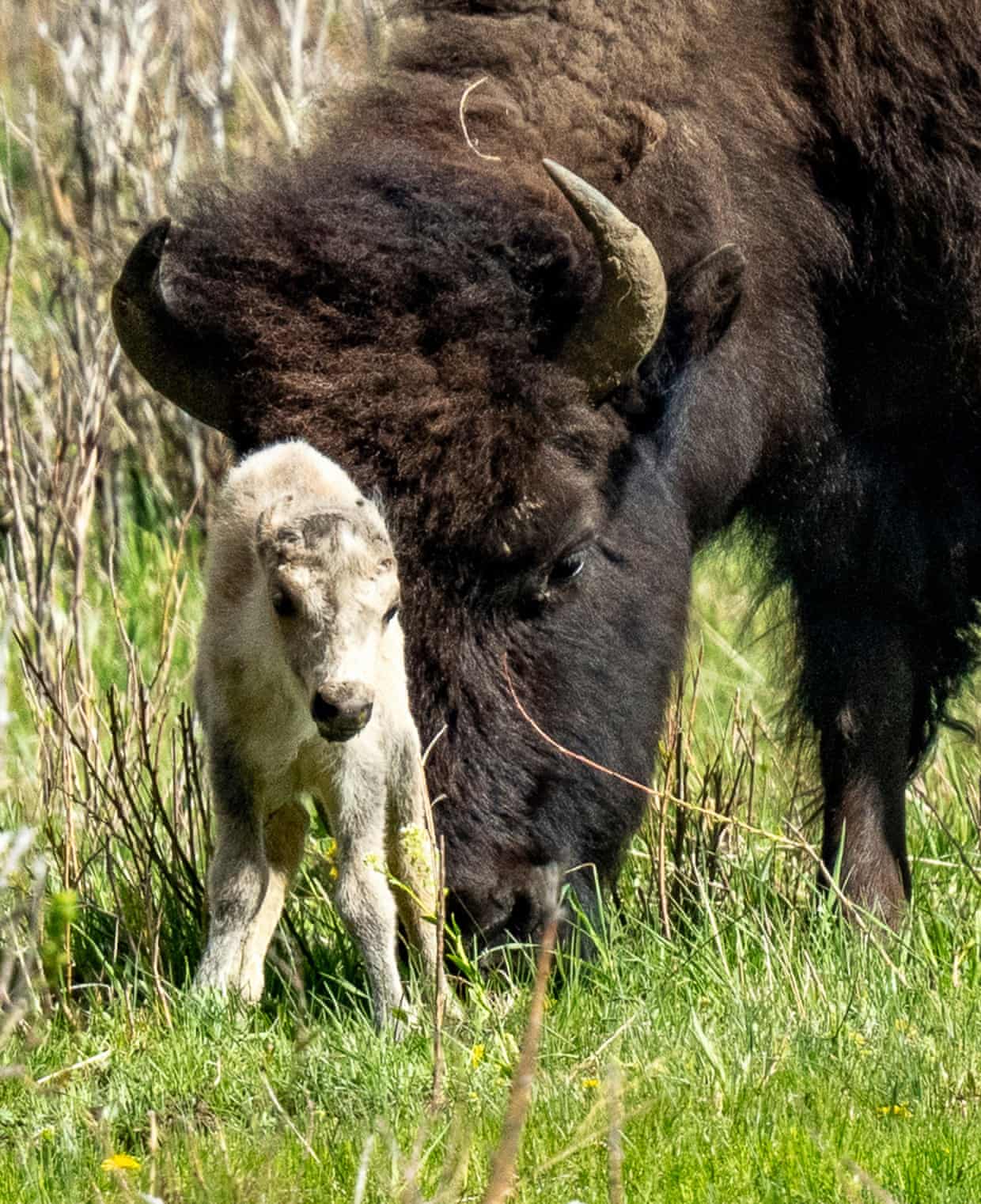
Photo: Erin Braaten/Dancing Aspens Photography via AP.
A rare white buffalo calf in Yellowstone National Park in Wyoming on 4 June 2024. 

In the early days of TV, a show we watched regularly was Rin Tin Tin. It featured a dog and a boy and the US Army patrolling out west. I’m sure there were many elements that would be considered offensive today, but you know, children pick up nice things from anywhere. I can still sing the song about the White Buffalo.

After a white buffalo was born in June, Oliver Milman wrote about the event at the Guardian.

“A rare white buffalo has been born in Yellowstone national park, with the arrival prompting local Lakota Sioux leaders to plan a special celebration, with the calf representing a sign of hope and the need to look after the planet.

“The white calf was reportedly spotted shortly after its birth … by park visitor Erin Braaten, a photographer. She took several shots of the wobbly baby after spotting it amongst a herd of buffalo in the north-eastern corner of the large park, located in Wyoming and a small slice of Montana.

“ ‘I couldn’t believe what I was seeing,’ Braaten told ABC News. ‘It was so surreal. I just knew it was something special and one of the coolest things I’ve ever photographed.’

“Braaten and her family watched the calf and its mother for another half an hour before coming back on each of the following two days to look for the white calf, but with no further sighting. …

“Members of the Lakota Sioux tribe will hold a ceremony to celebrate the arrival at the headquarters of the Buffalo Field Campaign, which advocates for the animals, in West Yellowstone on 26 June.

“The birth of a white buffalo holds a special significance to the tribe, according to the Buffalo Field Campaign. ‘The birth of this calf is both a blessing and warning. We must do more,’ said Chief Arvol Looking Horse, the spiritual leader of the Lakota, Dakota and the Nakota Oyate in South Dakota, according to AP, referring to looking after nature and the environment.

“Tens of millions of buffalo once roamed the plains of the western US, only to be slaughtered on an enormous scale for their hides by settlers, hunters and traders in the 19th century, leaving just a few hundred of the animals unscathed.

“The mass killing of buffalo caused severe harm to native American communities that relied upon the animals as a sustainable food source, as well as being a key cultural touchstone.” More at the Guardian, here.

At a National Park Service (NPS) site, you can read a lot more about the legends surrounding the White Buffalo. For example: “To American Indians, a White Buffalo Calf is the most sacred living thing on earth. The calf is a sign to begin life’s sacred loop. Some American Indians say the birth of a white calf is an omen because the birth takes place in the most unexpected places and often happens among the poorest of people. The birth is sacred within the American Indian communities, because it brings a sense of hope and is a sign that good times are about to happen.” More at NPS, here.

If you go to the YouTube clip below, you will see many happy comments from people who loved the Rin Tin Tin episode about the White Buffalo when they were kids.
Read Full Post »

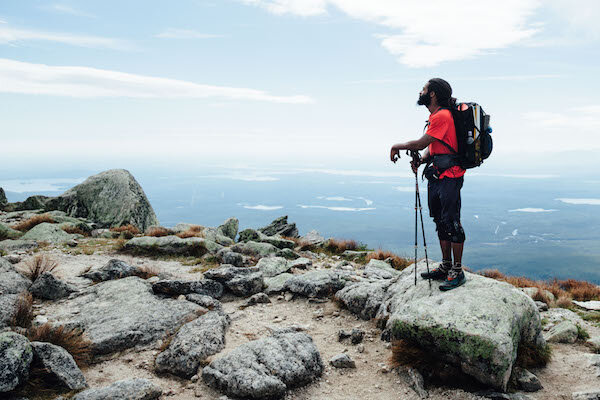
Photo: AkunaHikes.
“I learned that I was capable of living, I was capable of leading,” said the 41-year-old Army veteran who had struggled with post-traumatic stress disorder after Iraq.

I know that the Sound of Music is a little corny, but there is wisdom in the line “I go to the hills when my heart is lonely,” which Maria (soon to be Maria von Trapp) sings. Nature can be healing.

Andrea Sachs writes at the Washington Post about an Iraq war veteran and how the mountains healed him.

“Will Robinson was about 100 miles into his hike on the Pacific Crest Trail when the dark clouds started to lift. Not the ones high in the California sky, but the ones clustered in his head.

“ ‘I learned that I was capable of living, I was capable of leading. I was capable of inspiring and motivating people. That was something I had completely lost for a decade-plus,’ said the 41-year-old Army veteran who struggled with depression, anxiety and post-traumatic stress disorder after his medical discharge in 2003. …

“Since that first long-distance hike in 2016, his mileage has multiplied to more than 11,000 miles and counting. In 2019, he became the first Black American man to earn the Triple Crown of thru-hiking by completing the trifecta of legacy trails: the 2,650-mile PCT from California to Washington state, the 2,194-mile Appalachian Trail from Georgia to Maine and the 3,100-mile Continental Divide Trail from New Mexico to Montana. Two years later, ESPN declared Robinson ‘the trailblazing superstar of thru-hiking.’ He also received the 2022 George Mallory Award, which honors exceptional outdoor explorers. …

“Before the PCT, Robinson had never seriously hiked, though the military had prepared him for similarly tough challenges. ‘The closest thing I did to hiking was drill marching,’ said Robinson, who grew up on bases with his Army father. ‘It’s a lot different with a 100-pound pack and an M16, but it gave me a basis for hiking.’ In the armed forces, he powered through his pain, a practice he had to unlearn as a trekker. …

“After six months in Iraq and a stop in Germany for medical treatment, he returned to Louisiana, where he often felt too broken to leave the house, much less pursue outdoor activities. He underwent multiple surgeries and tried various therapy treatments and medications, to no avail. ‘After Iraq, I was disabled at 23,’ he said. A chance ‘encounter’ with celebrity long-haul hiker and Wild author Cheryl Strayed provided the jolt he needed to recharge his life.

“On that fateful day in March 2016, Robinson was in his room, ‘like always,’ when he glanced at the TV and saw Wild on the small screen. In the film version of Strayed’s best-selling memoir, he watched Reese Witherspoon lug her pack by a PCT trail marker, a scene that stirred up a memory from Iraq. During his downtime, Robinson would often pore over a PCT guidebook that someone had sent to the soldiers in a care package. ‘One day I’d love to do this,’ he said, reminiscing about that period in his life when he envisioned a future filled with adventure.

Without waiting for the closing credits, he jumped onto his computer and acquired a free long-distance permit, one of 5,657 issued that year.

“On April 2, he arrived in Southern California and embarked on a journey of personal discovery and recovery that resembled Strayed’s transformative quest two decades earlier. …

“In addition to the physical benefits of hiking in nature, medical experts extol its psychological virtuesStanford University-led research from 2015 determined that walking at least 90 minutes in a non-urbanized setting can help alleviate depression, lower stress and anxiety, and reduce rumination, the infinite loop of negative thoughts. A 2019 study called ‘Nature and mental health: An ecosystem service perspective’ also explored the wide-ranging rewards, such as a happier state of mind, more positive social interactions, a clearer sense of purpose and a sturdier grip on life’s demands. …

“Robinson did not initially set out to complete the entire PCT, which runs from the Mexican border to the Canadian border. His primary goal, he said, ‘was to try to see if I could find me again, regardless of how many miles it would take.’ With only a few weeks to prepare, he trained around Slidell, about 30 miles northeast of New Orleans. …

“Early in the hike, he found his trail family and earned his trail name, ‘Akuna,’ a riff on a Swahili phrase (and The Lion King refrain) that translates to ‘no worries.’ The nicknames are bestowed by other long-distance hikers or are given to oneself. They are often fanciful, silly or philosophical.

“About five miles in, he was resting on a rock, feeling sluggish, when a woman named ‘Cookie’ appeared at his side. She determined that he needed food and proceeded to stuff her namesake snack into his mouth. The pair forged a bond, along with ‘2Pie,’ a teacher from Ohio, and ‘Nothing Yet,’ a veteran who had tackled the AT [Arizona Trail] the previous year to quell his PTSD. The group hiked together for long stretches, a major breakthrough for Robinson, who for years had avoided social situations because of his fraught mental state.

“ ‘Being around people triggered panic and anxiety attacks, and I didn’t want any part of it. I just shut down,’ he said. ‘But on the trail, I ran into so many great individuals who were there for me. All they wanted was to be part of my adventure and help me accomplish my goal.’ …

“He said, ‘For me, every hike is like a therapy session in progress. I’m going through things in my head, working out problems. When I find a solution, I can zone out and be in peace.’ “

More at the Post, here, and at AkunaHikes, here.

Read Full Post »

There’s nothing like concentrating on something completely “other” to calm one down. Here, at the tension-filled demilitarized zone between North and South Korea, soldiers take a break to concentrate on ballet.

Kim Hong-Ji reports at Reuters the Wider Picture,”The 15 male ballet students groaned as they strained to do the splits and laughed with relief after their teacher counted to five and let them relax.

“Once a week, a group of South Korean soldiers near the Demilitarised Zone (DMZ) that divides the Korean peninsula trade army boots for ballet shoes in a class intended to ease the stress of guarding the world’s most heavily fortified border.

” ‘There’s a lot of tension here since we live in the unit on the front line, which makes me feel insecure at times,’ said Kim Joo-hyeok, a 23-year-old sergeant doing his nearly two years of military service that is mandatory for South Korean men.

” ‘But through ballet, I am able to stay calm and find balance as well as build friendships with my fellow soldiers,’ said Kim, who is learning ballet for a second year and plans to continue when he is discharged from the army. …

” ‘Being in the army itself can be difficult, so I wasn’t sure what kind of help I can be here,’ said Lee Hyang-jo, a ballerina at the Korean National Ballet who visits the base once a week to train the soldiers.

” ‘But as the soldiers learn ballet little by little, they laugh more and have a great time and seeing that makes me think that coming here is worthwhile,’ she said.”

I suspect it is fun for her, too, in the same way that teaching English lit to a class of engineers was fun for one professor I heard about. The fresh perspectives of those who come from an entirely different discipline has to be rewarding for a teacher.

More at Reuters.

Photo: Reuters

Read Full Post »

I thought today would be a good day to note that, with the right supports in place, veterans who have suffered post-traumatic stress while serving the country can move forward with their lives.

The willingness of some of these service men and women to expose their story in the media strikes me as an extra level of bravery.

Kathy McCabe writes at the Boston Globe about Army veteran Michael Saunders.

“Saunders, who served from 2002 to 2006, deployed twice to Iraq … He started therapy at the VA outpatient clinic in Lynn, where a counselor suggested he focus on a new mission: going to college.

“ ‘She said I would make more money with a college degree,’ said Saunders, who worked for a lumberyard after his discharge from the Army.

“He enrolled in VITAL — an acronym for Veterans Integration to Academic Leadership — a national program that helps veterans transition from soldier to student. VITAL brings VA services, including mental health counseling, to college campuses. …

“According to Pam Flaherty, dean of students, Middlesex Community College had nearly 600 student veterans in 2014-15. In the last year, 70 who have PTSD have taken part in VITAL and received mental health care on campus. …

“The Bedford VA also offers the VITAL program at Bunker Hill Community College in Charlestown, Mount Wachusett Community College in Gardner, Northern Essex Community College in Haverhill, North Shore Community College in Danvers and Lynn, Endicott College in Beverly, and Salem State University.

“Saunders, who graduated from Everett High School in 1999, is in his second year studying liberal arts at Middlesex Community College in Bedford. He has discovered a talent for writing, and hopes to transfer to Emerson College next year.

“ ‘It was a rough start, but I’m doing fine now,’ said Saunders, who also has a job at the college’s Veterans Resource Center. ‘Had the VA not had the service in place here, I wouldn’t have come.’ …

“ ‘I can sit in class now, for an hour and 20 minutes,’ Saunders said. ‘I couldn’t sit still for 10 minutes before.’ He has a lingering fear of crowds, so he adjusted his seat in the classroom.

“ ‘ I have to be able to see the door, and I don’t like anybody behind me,’ Saunders said. ‘If I can’t do that, I can’t focus.’

“For one class, Saunders wrote a story called ‘The Dark Is Afraid of Me,’ a fictional account of a military mission in Iraq.

“ ‘It was really easy for me to tell the story,’ Saunders said. ‘When the professor read the paper, she was like, “You need to go see a publisher, now.”

” ‘Maybe I will.’ ”

More such stories at the Globe, here.

080115-flag

Read Full Post »

Photo of Gertrude Ely: Bryn Mawr College Collection

I was on the brink of unsubscribing to the American Academy of Poets poem-a-day e-mail because I let so many pile up and then have to slog through all sorts of contemporary brain twisters.

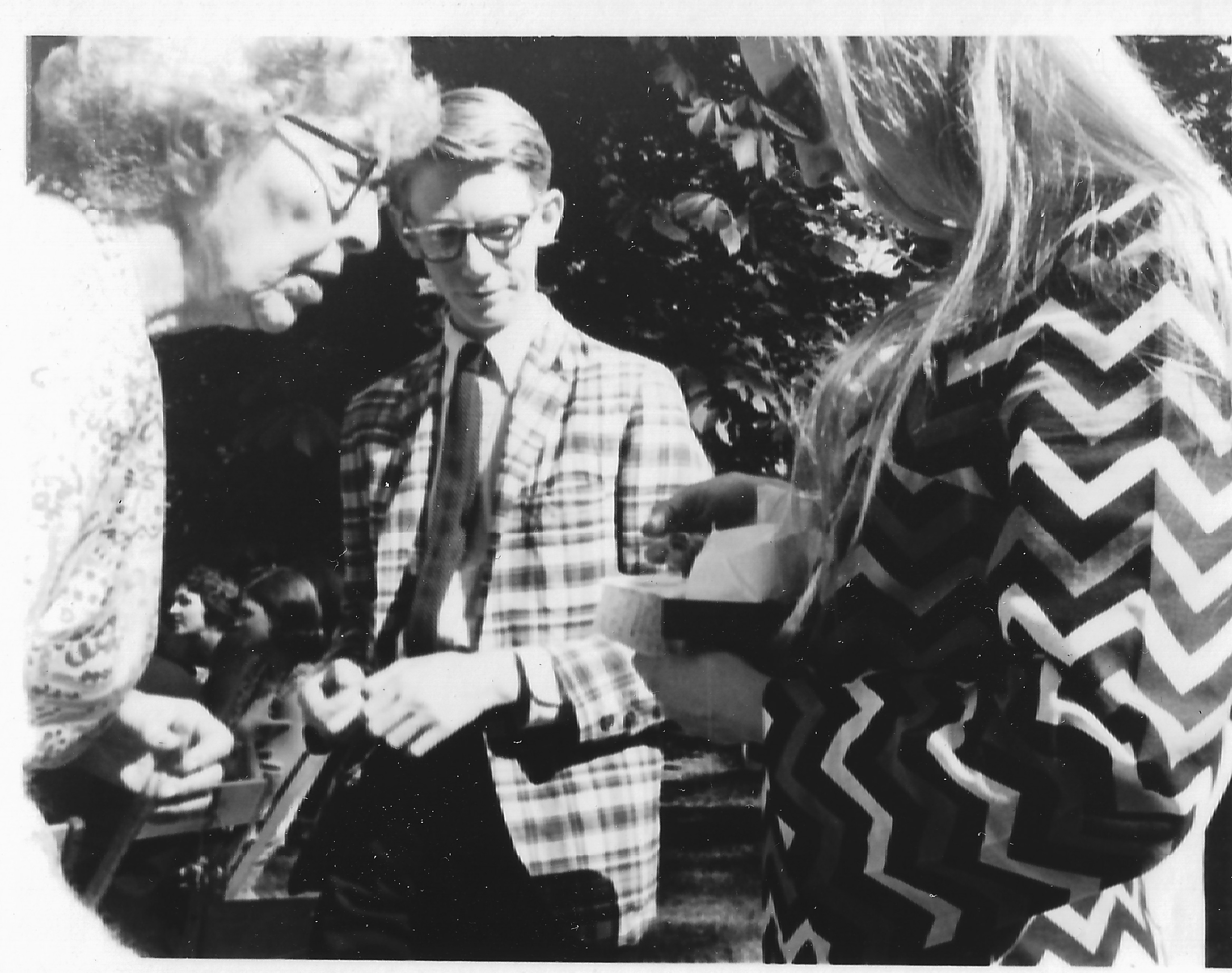
But as I was working my way through the poems today, I came across the one below. I thought, “Oh, I know exactly what this is about” and was carried back to my college days and hanging out at the home of my great aunt’s friend Gertrude Ely.

Gertrude Ely was quite elderly at that time but really interesting to be around. She knew all sorts of movers and shakers and was an awesome storyteller. I happened to be staying at her house one weekend when she received an unusual letter.

An elderly Philadelphia gentleman wrote that he had read in the Bulletin that she had received some civic award, and he just had to write and tell her a memory he had from his service in WW I in Europe. The Army was sending over carloads of friendly, proper young volunteers to chat with and cheer soldiers and bring a breath of home. The man wrote he would never forget a load of girls pulling up in an open car and Gertrude Ely calling out, “Any of you boys from Philadelphia?” He said, “At that moment, I believe every soldier there was wishing he was from Philadelphia.”

Gertrude Ely at my college graduation.

1966-GS-ELY-AT-CB-GRADUATION

***

American Boys, Hello! by Ella Wheeler Wilcox

Oh! we love all the French, and we speak in French
As along through France we go.
But the moments to us that are keen and sweet
Are the ones when our khaki boys we meet,
Stalwart and handsome and trim and neat;
And we call to them—“Boys, hello!”
“Hello, American boys,
Luck to you, and life’s best joys!
American boys, hello!”

We couldn’t do that if we were at home—
It never would do, you know!
For there you must wait till you’re told who’s who,
And to meet in the way that nice folks do.
Though you knew his name, and your name he knew—
You never would say “Hello, hello, American boy!”
But here it’s just a joy,
As we pass along in the stranger throng,
To call out, “Boys, hello!”

For each is a brother away from home;
And this we are sure is so,
There’s a lonesome spot in his heart somewhere,
And we want him to feel there are friends
right there

In this foreign land, and so we dare
To call out “Boys, hello!”
“Hello, American boys,
Luck to you, and life’s best joys!
American boys, hello!”

[Ella Wheeler Wilcox wrote “American Boys, Hello!” while visiting France during the latter stages of World War I as entertainment for the American soldiers stationed there.]

Photo of Ella Wheeler Wilcox: American Academy of Poets, here.

Read Full Post »