Feeds:
Posts
Comments

Posts Tagged ‘south korea’

Photo: Radio Free Asia.
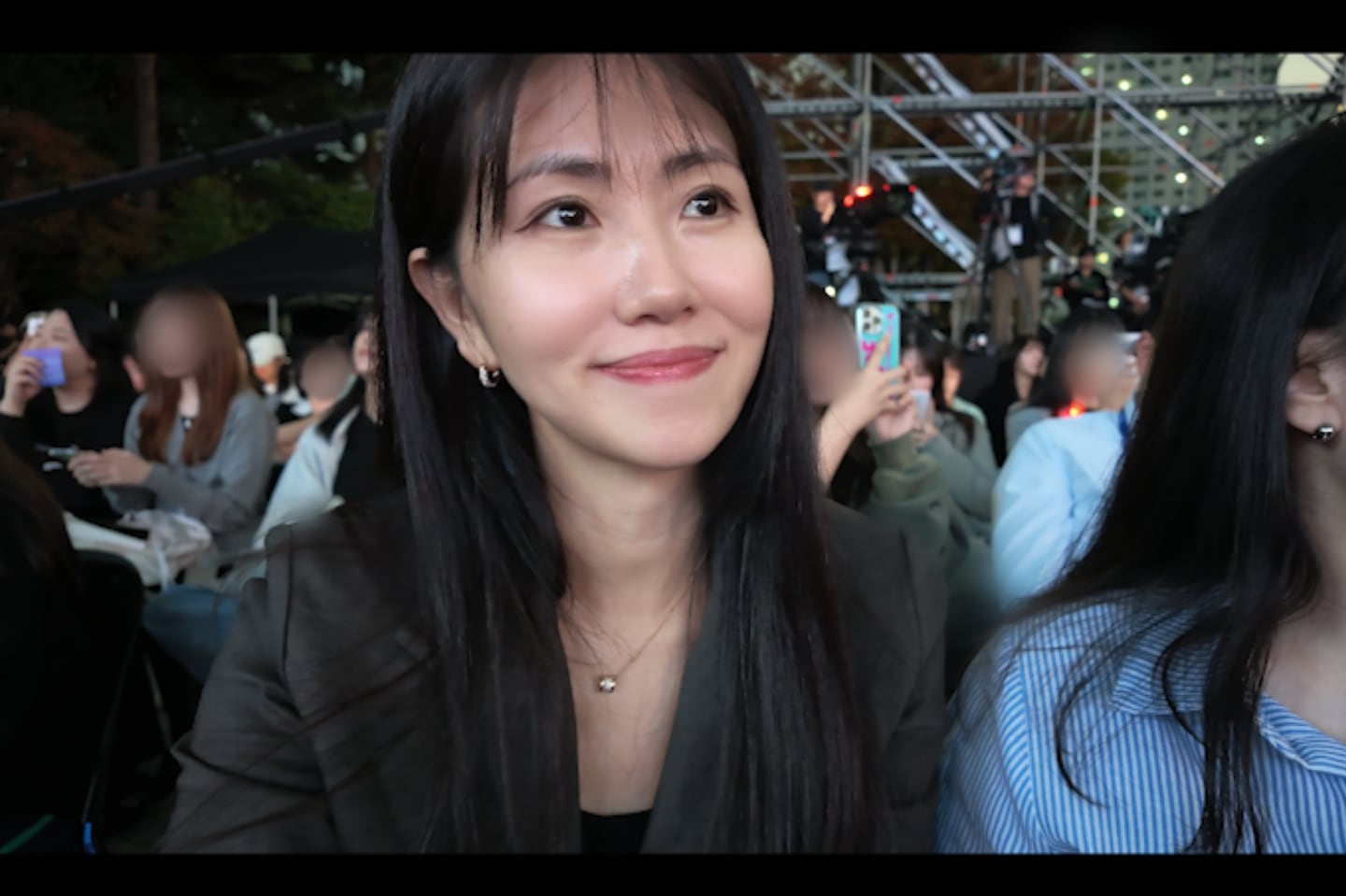
Cho Mi-young watches a live broadcast of KBS Music Bank at the National Museum of Korea in Seoul, Oct. 16, 2026.

In North Korea, the internationally popular South Korean music called K-Pop is illegal and the ban is strictly enforced. But as the Guardian wrote in 2024, “Despite such harsh measures, the influence of South Korean culture, including recent television shows, appears unstoppable, according to a recent North Korean defector.

“ ‘The speed of South Korean culture influencing North Korea is seriously fast. Young people follow and copy South Korean culture, and they really love anything South Korean,’ a woman in her early 20s who defected from North Korea told reporters at a briefing in Seoul.’ “

This month, Kim Jisu wrote for Radio Free Asia about another defector’s reaction to seeing a K-Pop show in person for the first time.

“A white tiger entered the courtyard outside the National Museum in Seoul. He mugged for the camera and darted up the steps. At the top were the six members of BOYNEXTDOOR, wearing quasi-traditional outfits that mixed elements of hanbok with modern formal wear and a tinge of ‘bad boy’ biker gear.

“As they danced in unison and sang the opening lines of their hit single ‘Animal,’ the crowd went wild.

“Sitting in the audience was Cho Mi-young – born in Chongjin, North Korea – who arrived with her family in the South in 2004. …

“Cho is in the audience at an episode of KBS Music Bank, a Friday night K-pop showcase program with all the latest acts. It has been the start of the K-pop weekend for most of its 28-year runtime. Surprisingly, it’s her first time ever seeing a live K-pop performance in person after 22 years in the South.

“Tickets to studio tapings of KBS Music Bank are hard to come by. Fans either have to know someone, know someone who knows someone, or enter the ticket lottery. The episode she’s watching on Oct. 16 is special — it’s a live broadcast and the biggest boy bands, girl bands, and boy-girl bands are plying their craft on an outdoor stage on the grounds of the National Museum of Korea, which the show’s special intro vignette called the ‘beating heart of Korean culture.’ …

“ ‘I’ve seen it a lot on TV, but today is the first time I’ve seen it with my own eyes,’ Cho told Radio Free Asia. ‘Seeing such beautiful and handsome people dancing and singing right in front of me, moving like that, is absolutely mesmerizing.’

“Cho is no stranger to music, or to the stage. In North Korea she had been a vocalist for a state-run provincial arts troupe. After settling in the South, Cho was a fixture in Seoul’s burgeoning musical theater scene and she toured as an accordion player. She later transitioned into broadcasting. …

“But today, she’s just a fangirl in a sea of other diehards, most of whom are screaming the names of the idols on stage.

“On the night of her first live K-pop concert, Cho reminisced about how she first encountered South Korean music in North Korea. At the time, she didn’t have access to what most would describe as K-pop today; instead she took in a lot of trot – a unique South Korean genre that mixes Western foxtrot dance rhythms with pentatonic minor scale melodies. Most young South Koreans consider trot to be music their grandparents like. …

“Today’s performances on the Music Bank stage were a far cry from her own back in North Korea. For one, everyone on stage just seems happy to be there, she said.

“ ‘When I performed in North Korea, I was always stiff,’ she said. ‘When we were on stage, we performed with the mindset of conveying the Party’s voice, so I don’t think I ever had the thought that we were actually enjoying our own music.’

“Several more musical acts came and went and then the undistorted electric guitar of indie rock band Jannabi’s Kim Do-hyung echoed through the air as vocalist Choi Jung-hoon sang the first few lyrics of ‘Thoughts on an Autumn Night.’ … The song struck a chord with Cho. Performed by just one singer and one guitarist it was a bit of a shift from the rest of the evening’s heavily choreographed bangers.

” ‘The lyrical melody seems to have a bit of North Korean sensibility to it.’ …

“When it was all over, Cho talked about her experience on the show, but it wasn’t only the dazzle of the K-pop acts that caught her eye. She was also amazed by the devoted fans, who sang along with every lyric from memory and chanted in pre-arranged cheers in unison. She thought back to how strange that seemed when she first arrived. …

“The best performance of the evening, according to Cho, was by a co-ed group called AllDay Project. She thought they looked cool in their all-black outfits, some in furs, others in biker leather – almost like warriors.

“But as an artist, Cho’s thoughts naturally turned to the massive effort that must have gone on behind the scenes. The meticulous choreography alone must take many months of practice, she said. …

“She said, ‘In terms of the sheer volume of training, it might be difficult to see a significant difference between the North and South.’

“But she noted that the payoff in the South is individual success, unlike the North, where it would merely advance the goals of the state.”

More at the Radio Free Asia, here. No paywall.

Read Full Post »

Photo: Hong Seo-yoon 
Hong Seo-yoon is a South Korean advocate for accessible tourism. In her book Europe: There’s No Reason Not to Go, she even has a section on paragliding.

International tourism may be in a Covid-19 slump, but there are lots of people aching to get back to it. At Public Radio International (PRI), Jason Strother reports on a South Korean world traveler who uses a wheelchair and has shown through her life and writing that sometimes it takes only small changes to enable everyone to travel.

“Hong Seo-yoon maneuvers through shifting clusters of picture-snapping tourists outside of Deoksugung, a palace in downtown Seoul. Before passing through the former royal residence’s wooden gate, she adjusts her motorized wheelchair’s speed ahead of a gradual incline in the stone walkway that leads into a tree-lined courtyard.

“The 32-year-old explains that even small modifications, such as replacing a step with a ramp, give people like her access to places that otherwise would have been difficult if not impossible to enter independently.

“Hong says that many people are often unaware that when it comes to tourism, sightseeing or even extreme sports, many people with disabilities, whether they are blind, deaf or use a wheelchair, ‘all want the same things.’

‘They want to travel, they want to visit places, I don’t think there’s a difference,’ Hong said. ‘Having a disability is not something special or weird.’

“Hong is the founder of Tourism for All Korea, a nonprofit that advocates for greater inclusion in the country’s tourism industry for people with disabilities and makes policy recommendations for improvements in this sector. She’s also the author of Europe, There’s No Reason Not to Go — the first travelogue written by a wheelchair user from her country.

“Her work has informed Seoul’s efforts to make its streets, transit and tourism locations more inclusive for citizens and visitors with disabilities. … A generation ago, a person with a physical or intellectual difference might have been ‘a  shame to their family,’ she said, theorizing this attitude was a consequence of South Korea’s postwar trauma that placed economic growth and competition paramount to other concerns.

“The Korean War in the early 1950s left the South in ruin and poverty. In 2007, South Korea passed the Disability Anti-Discrimination Act, but Hong believes some people still hold onto old biases. …

“Her own experience facing physical and social obstacles underlie her advocacy. When Hong was 10 years old, she suffered a spinal cord injury during a swimming pool accident that paralyzed her from the waist down. At that time, ‘Korea wasn’t accessible at all’ for wheelchair users, she said.

“She recalls her brother pushing her alongside cars in the street since there were no sidewalk curb cuts in her provincial hometown. Hong says she also faced discrimination when her parents were told to send her to a distant institution for people with disabilities because there wasn’t an elevator in the local, four-story grade school.

“Her family instead moved to the Philippines, where a nurturing teacher told Hong that ‘being disabled was not abnormal,’ she said.

“When she returned to South Korea to attend the university, Hong had learned to stand up for herself. She got a taste for activism when her school’s administration refused to relocate a class to the ground floor. Hong fought back and won. …

“Her book idea was rejected by two publishers that told her ‘no one would read about disability stories,’ she said. ‘It really hurt me.’

“After promising to buy any unsold copies, Hong convinced the company Saenggak Bi Haeng in 2016 to take a chance with her book. But, she did not have to live up to her end of the deal — all 3,000 copies sold out, and now, the title is in a second-print run. …

“She believes travel and tourism are ways people with disabilities and the nondisabled can connect with each other and help nondisabled people overcome their biases.

“ ‘Suddenly, they meet a disabled person in their life and they change,’ she said. ‘They change their mind about what [are] disabled people and how to live with disabled people.’ ”

More here.

Read Full Post »

There’s nothing like concentrating on something completely “other” to calm one down. Here, at the tension-filled demilitarized zone between North and South Korea, soldiers take a break to concentrate on ballet.

Kim Hong-Ji reports at Reuters the Wider Picture,”The 15 male ballet students groaned as they strained to do the splits and laughed with relief after their teacher counted to five and let them relax.

“Once a week, a group of South Korean soldiers near the Demilitarised Zone (DMZ) that divides the Korean peninsula trade army boots for ballet shoes in a class intended to ease the stress of guarding the world’s most heavily fortified border.

” ‘There’s a lot of tension here since we live in the unit on the front line, which makes me feel insecure at times,’ said Kim Joo-hyeok, a 23-year-old sergeant doing his nearly two years of military service that is mandatory for South Korean men.

” ‘But through ballet, I am able to stay calm and find balance as well as build friendships with my fellow soldiers,’ said Kim, who is learning ballet for a second year and plans to continue when he is discharged from the army. …

” ‘Being in the army itself can be difficult, so I wasn’t sure what kind of help I can be here,’ said Lee Hyang-jo, a ballerina at the Korean National Ballet who visits the base once a week to train the soldiers.

” ‘But as the soldiers learn ballet little by little, they laugh more and have a great time and seeing that makes me think that coming here is worthwhile,’ she said.”

I suspect it is fun for her, too, in the same way that teaching English lit to a class of engineers was fun for one professor I heard about. The fresh perspectives of those who come from an entirely different discipline has to be rewarding for a teacher.

More at Reuters.

Photo: Reuters

Read Full Post »

Here’s an interesting start-up by a couple of entrepreneurs who love to eat. The two women decided to build a business around helping travelers find truly authentic cooking.

According to Aashi Vel and Steph Lawrence’s website, “Traveling Spoon believes in creating meaningful travel. We are passionate about food, and believe that by connecting people with authentic food experiences in people’s homes around the world we can help facilitate meaningful travel experiences for travelers and hosts worldwide.

“To help you experience local cuisine while traveling, Traveling Spoon offers in-home meals with our hosts. In addition, we also offer in-home cooking classes as well as market tours as an extra add-on to many of the meal experiences. All of our hosts have been vetted to ensure a safe and delightful culinary experience.

“Traveling Spoon currently offers home dining experiences in over 35 cities throughout Bangladesh, Cambodia, China, Hong Kong, India, Indonesia, Japan, Singapore, South Korea, Sri Lanka, Taiwan, Thailand, Turkey and Vietnam, and more countries are coming soon!” More here.

I have no doubt that Traveling Spoon is also boosting international understanding. What a good way to use an MBA! Business school is not all about becoming an investment banker, as Suzanne and Erik would tell you.

Photo: Traveling Spoon
Traveling Spoon founders Aashi Vel and Steph Lawrence met at the Haas School of Business.

Read Full Post »

And speaking of Korea, the culture in the south might as well be on the other side of the world from North Korea.

My husband and I, lifetime fans of Broadway musicals, may sometimes feel concerned that the audiences are mostly old folks like us, but in South Korea, musicals are cool. Young people dig them.

Patrick Healy writes for the NY Times, “The packs of young women arrived 90 minutes early for the evening’s show: Murder Ballad, a rock musical that flopped off Broadway in July and then opened here four months later in an all-Korean production.

“They wanted time to shoot smartphone video of Seoul’s newest theater, built inside a shopping mall, and start scoring autographs: of actors, sure, but lighting operators and makeup artists too.

“Or anyone, really, working on American musicals, whose head-spinning popularity here has changed the game for New York producers looking to extend the lives of their shows.

“Seoul has become a boomtown for American musicals, with Korean and Broadway producers tapping into an audience of young women raised on the bombast of Korean pop and the histrionics of television soap operas.”

Bombast and histrionics? Now, wait just a minute, here! Hmmm. I guess musicals can be bombastic, like opera. But the kind I like are more thoughtful and quirky.

Recent shows we enjoyed were Side Show, which I talked about here, and
Brian Crawley and Andrew Lippa’s take on A Little Princess, a story by the author of the Secret Garden.

Come to think of it, both Side Show and A Little Princess had moments of bombast and histrionics. I guess I don’t notice that anymore.

Photo: Lim Hoon
Korean actors in the Seoul production of
Wicked.

Read Full Post »

I know it’s hard to believe, but in South Korea, Spam is considered a holiday treat, one that inspires happy memories.

The BBC’s Lucy Williamson had a story about it in September.

“South Korea,” she wrote, “is preparing for the annual lunar thanksgiving holiday, which is known as Chuseok.

“Locals celebrate the holiday by visiting relatives, paying respects to family ancestors as well as the giving and receiving of packaged cans of Spam.

“While that might sound odd, the tins of pre-cooked pork have become a staple of South Korean life.”

Brand manager Shin Hyo Eun explains, ” ‘Spam has a premium image in Korea. It’s probably the most desirable gift one could receive, and to help create the high-class image, we use famous actors in our commercials.’ …

“Spam was introduced to Korea by the US army during the Korean War, when food was scarce – and meat even scarcer. Back then, people used whatever they could find to make a meal.

“But the appeal of Spam lasted through the years of plenty and it’s now so much a part of South Korean food culture, that it’s the staple ingredient in one of the country’s favourite dishes: budae jigae or army stew.”

Ho Gi-suk runs a restaurant near a U.S. base.

” ‘Back then,’ she tells me, ‘there wasn’t a lot to eat. But I acquired some ham and sausages… the only way to get meat in those days was to smuggle it from the army base.’ …

“Army Stew is now well-established as part of South Korea’s culinary landscape — as traditional here as Spam gift-sets for thanksgiving.

” ‘It’s salty, and greasy, and goes very well with the spices,’ one customer told me. ‘Korean soup and American ham – it’s the perfect fusion food.’ ”

More.

Read Full Post »