Feeds:
Posts
Comments

Posts Tagged ‘art’

A Year of Art Discoveries

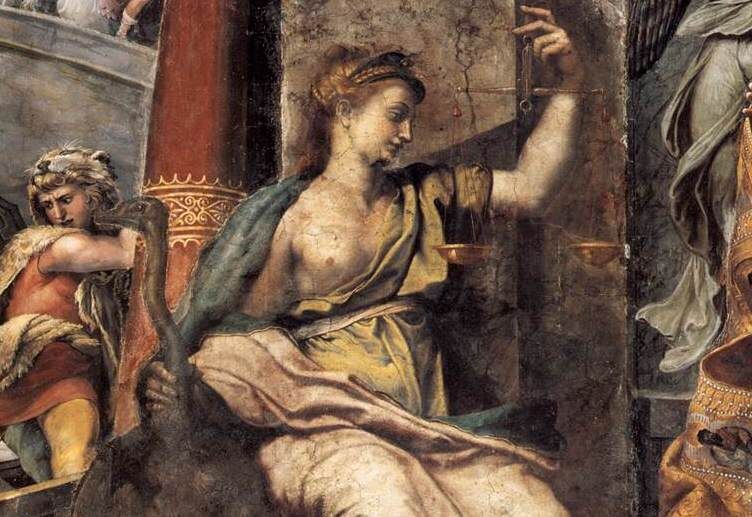
Photo: Wikimedia Commons
Two Allegory of Justice figures in the Vatican, once attributed to Raphael’s followers, were identified in 2017 as being by the master himself.

This Artsy report on 2017 art discoveries was pretty cool. Curiously, I had already written about one of the finds — here. It was the Rodin sculpture discovered in a New Jersey town hall.

Abigail Cain writes, “Art history is, by definition, primarily a thing of the past — but each year, some small portion of it is rewritten by those in the present.

“In 2017, we gained new insight on the early years of Leonardo da Vinci and the final ones of Andy Warhol; amateur archaeologists were rewarded with major finds; and several masterpieces were discovered, simply hiding in plain sight. From newly mapped Venezuelan petroglyphs to a long-lost Magritte, these are 10 of the most notable art-historical discoveries of the year.”

I especially loved that volunteers made the find that occurred in England. “A team of amateur archaeologists,” writes Cain, “dug up one of the most significant Roman mosaics ever discovered in Britain.

“The discovery was made in a field outside of Boxford, in southern England, by a group of local volunteers supervised by professional archaeologists. Although the project began in 2011, it wasn’t until August of this year — during the final two weeks of the scheduled dig — that organizers realized they’d found something extraordinary.

“As it turned out, they’d uncovered a remarkably well-preserved mosaic, built as part of a Roman villa that dates to roughly 380 A.D. Not only is it a rare find for the country — experts have labeled it the most exciting of its kind unearthed in 50 years — the subject and style of the artwork is highly unusual for the area. The work illustrates the story of Bellerophon, a Greek mythological hero tasked with killing the Chimera.”

Check out Artsy, here, to read about: the discovery that two figures in the Vatican were painted by Raphael and not his assistants; two ancient tombs in Egypt; the likely identity of Leonardo’s mother; a portrait by Peter Paul Rubens found hanging in a historic Glasgow house; a miniscule carving recovered from a Bronze Age tomb with “detailed handiwork centuries ahead of its time”; the last piece of a lost René Magritte painting found in Belgium; and drone technology that helped researchers map “massive, 2,000-year-old petroglyphs in Venezuela for the first time.”

Doesn’t it make you want to go out and discover some long-lost treasure?

Read Full Post »

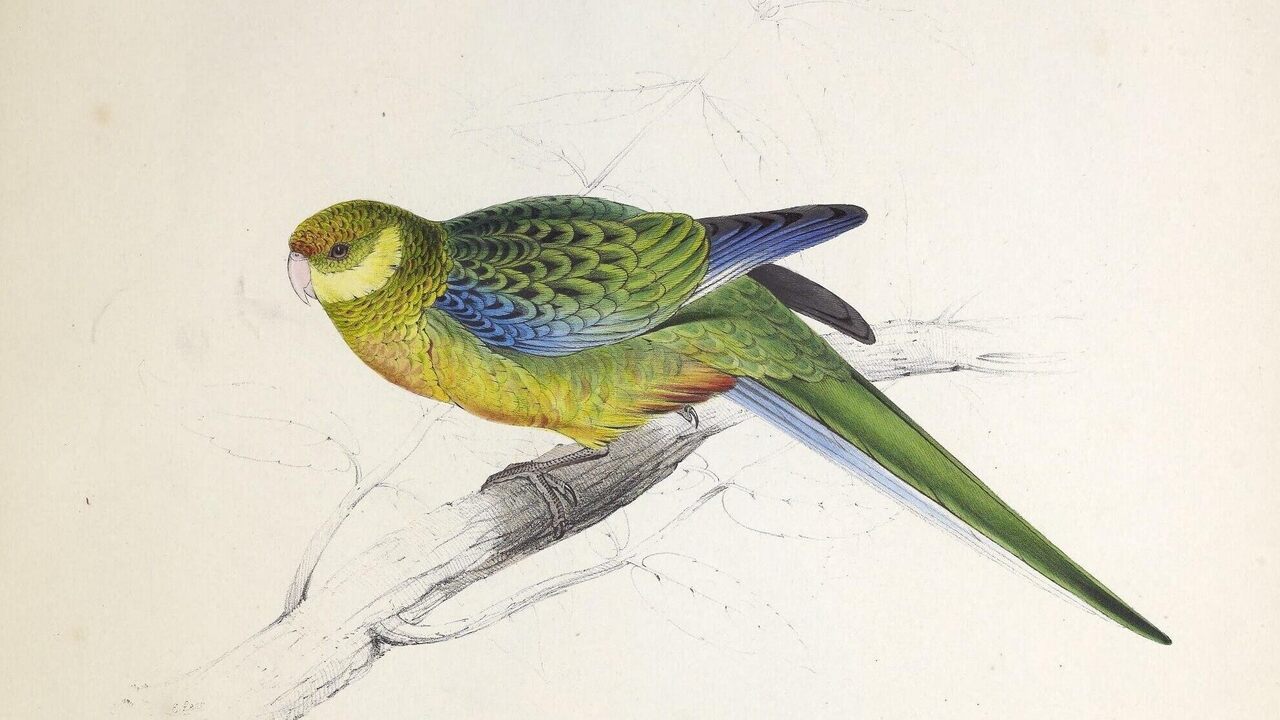
Source: Biodiversity Heritage Library
A Stanley parakeet, one of 42 plates in Edward Lear’s
Illustrations of the Family of Psittacidae, or Parrots.

Years ago, I read a biography of Edward Lear in which I learned that Lear had distinguished himself at a young age as an illustrator of nature — long before his playful limericks found an audience.

A new biography by Jenny Uglow brings more details to Lear’s story. And Cara Giaimo has a post about him at Atlas Obscura, where she reviews Peter Levi’s Lear biography.

“Edward Lear was a man unafraid of his own imagination,” writes Giaimo. “In his best-known nonsense poems and limericks, he wrote of things the world has never seen: green-headed Jumblies; toeless Pobbles; oceanic romances between birds and cats.

“But before he began bringing these impossibilities to life, Lear had a different focus: he drew parrots. When he was young, Lear was employed as an ornithological illustrator, and he spent years learning to draw birds, favoring live models in an era when most worked from taxidermy. Before he turned 20, he’d published Illustrations of the Family of Psittacidae, or Parrots, a critical success, and the first monograph produced in England to focus on a single family of birds.

“Lear was born in London in 1812. One of the youngest of a gaggle of kids. … He was raised mostly by his oldest sister, Ann. According to biographer Peter Levi, it was Ann who taught Lear to draw. …

“Early on in Lear’s childhood, his father went into debt, and his family fell on hard times. When he turned 15, he decided to put his talents to work professionally, and began taking commissions for everything from decorative fans to ‘morbid disease drawings for hospitals,’ as he later wrote a friend. In this way, he explained, he managed to make enough money ‘for bread and cheese.’

“But when he found the time to choose his own subjects, he often made his way to London’s Zoological Gardens. … While many artists of the time relied on taxidermied specimens—which, after all, were better at staying still—Lear preferred drawing live animals, and was known to occasionally enter their cages, so as to get a better look. …

“Lear’s models inspired at least one bit of verse. In December of 1830, he ended a letter to a friend with an account of a parrot-filled day that had left him rather peckish:

‘Now I go to my dinner,
‘For all day I’ve been a-
‘way at the West End,
‘Painting the best end
‘Of some vast Parrots
‘As red as new carrots,—
‘(They are at the museum,—
‘When you come you shall see ‘em,—)
‘I do the head and neck first;
‘—And ever since breakfast,
‘I’ve had one bun merely!
‘So — yours quite sincerely.

“As this poem suggests, the job was rather demanding. … Eventually, though, he boiled the process down to a science. First, Levi writes, ‘A young zookeeper would hold the bird while Lear measured it in various directions.’ Then Lear would make a few pencil drawings of the parrot, in different poses, doing his best to ignore the curious public (although sometimes he drew them, too). …

“By 1831, he and Ann had moved houses to be closer to the Zoo; the next year, he put out what would be his final batch of parrot lithographs, drew up a table of contents, and encouraged his subscribers to bind them into a complete book. He was 19 years old.

“Although he started out expecting to produce 14 sets of illustrations, depicting about 50 species, Lear ended up stopping just short. … He didn’t want to make the same mistakes as his father. ‘To pay colourer and printer monthly I am obstinately prepossessed,’ he explained, ‘[and] I had rather be at the bottom of the River Thames than be one week in debt.’ …

“Levi writes of Lear’s participation in [John] Gould’s Birds of Europe, ‘The queerer the animal the more it arrested him.’ ”

More here.

Lear-inspired plates that my family members have cherished for years.
012518-Edward-Lear-plates


Read Full Post »

Photo: Sven Creutzmann/Mambo photo/Getty Images
A performance at the 2015 Havana Biennial. When the Cuban government postponed this year’s event, artists took matters into their own hands.

The recent hurricanes have stressed official budgets all over the Caribbean, and in Cuba, the government blames Irma recovery costs for its decision to postpone a popular arts biennial.

So artists and art lovers decided to organize an alternative event, as Laurie Rojas reports at the Art Newspaper.

“A crowdfunding campaign was launched [in December] for the #00Bienal (5-15 May 2018), an independent alternative event that is due to take the place of the 13th Havana Biennial, which the Cuban government has postponed until 2019 because of a lack of resources after Hurricane Irma hit the island. …

“ ‘The democratically minded #00Bienal will be ‘the Havana Biennial for everyone,’ says the artist Luis Manuel Otero Alcántara, one of the main organisers of the event.

“The aim is to provide a platform for artists who do not have the visibility or official status to participate in a government-sponsored biennial. Street, Outsider, performance, digital and conceptual artists and photographers are all invited to submit proposals. …

“[Alcántara] says that ‘the government made a grave error’ when it postponed the Havana Biennial, describing it as ‘the most important cultural event in the country.’

“Other artists and curators, including Tania Bruguera, Alvaro Saavedra and Coco Fusco, as well as independent cultural spaces in Havana, have volunteered to help realise the #00Bienal. It will be completely self-funded and will not seek money from the state.”

Check out the Art Newspaper, here, as well as the Havana Times, here. Hyperallergic details here the government hostility Alcántara ran into for organizing the alternative event.

Two couples I know went to Cuba last year and loved it. If you go in May, please let me know if you see the arts event.

Read Full Post »

Photo: Flying Studio / Mary Corse, Kayne Griffin Corcoran
Mary Corse transformed the exterior of her studio into “Untitled (White Light Bands).” The art takes on an otherworldly glow at dusk.

Here is a story about art works that you have to see in person because the light shifts when you move.

Carolina A. Miranda reports at the Los Angeles Times,”If you stand outside of Mary Corse’s studio in Topanga Canyon at just the right hour, you might get to see one of her works come to life. The painter, who is known for playing with the properties of light, last year transformed the exterior of her studio into one of her largest pieces to date. Along the building’s exterior face, she painted a sequence of four simple columns employing one of the materials for which she is best known: white paint mixed with glass microbeads. The material is what gives street signs and lane markings their illuminative properties.

“ ‘They don’t reflect light, they prism,’ Corse says. ‘It makes a triangle between the surface, the viewer and light. So if the viewer moves, then it changes.’

“In broad daylight, the columns on Corse’s studio are barely perceptible. But at dusk, when the light dims, it is a different story. The moment the wall is hit by any stray beam of light, the columns take on an otherworldly glow.

The effect is that of a portal opening into a parallel universe. …

“Since the 1960s, the Los Angeles artist has produced a body of work that toys with light and the emotional states it can induce — using reflective and refractive materials to create pieces that can shift and change in surprising ways as you move before them. …

“As an artist, she has remained somewhat under the radar — known to a circle of art world insiders; less so to the general public.

“That is changing. [Corse had a November show at] Kayne Griffin Corcoran in Los Angeles, with works from various stages in her career — including an immersive environment she first conceived in the 1960s titled ‘The Cold Room,’ a free-standing structure kept at near-freezing temperatures, in which floats a spectral light box. …

“In May, Dia:Beacon, the temple to minimalism in New York’s Hudson Valley, will present a long-term installation of four recently acquired works covering the span of her career. And the following month, the Whitney Museum of American Art will open the doors on Corse’s first solo museum survey.

“ ‘It will be focusing on her critical moments,’ says the exhibition’s curator, Kim Conaty, ‘starting with her early experiments with shaped canvases, when she was beginning to think about how to find light within painting. …

” ‘She has not only used materials in innovative ways to literally capture light,’ Conaty says, “but to also capture the metaphysical qualities of light. And she has done a lot of it through painting.’ …

“Conaty says the work requires some commitment from the viewer.

“ ‘You pass it, you do the double take, you come back, you move along the side of it,’ she says. ‘You can’t just walk through.’ ”

Conaty is a close friend of Suzanne, so if you are in New York City in June, please go see the Mary Corse show she’s curating.

More on Corse at the Los Angeles Times, here.

Read Full Post »

Photo: David Brichford
This eight-panel folding screen, a late 1800s example of Korean “Chaekgeori,” makes one observer think of a kind of instagram photo popular today. The screen was displayed in a recent Cleveland Museum of Art exhibition.

Some people call instagram pictures of their beautifully appointed bookshelves “shelfies.” They might think the fad is a 21st C. idea, but in 18th C. Korea, something similar was going on.

Claire Voon writes about the Cleveland Museum of Art’s recent chaekgeori exhibit at the website Hyperallergic.

“You could call it a very early precursor to the ‘shelfie.’ Long before we were snapping pictures of our bookshelves to show off our literary troves on the ‘gram, there was chaekgeori, a style of Korean still-life painting that emerged in the late 18th century. Spread across the panels of folded screens, these images of near-life-size bookshelves were also meant to express an individual’s intellect, and often stood in a scholar’s room as a beautiful, dignifying backdrop.

“More broadly, they were markers of one’s social status, putting on full view the objects of refined taste and affluence. Chaekgeori (pronounced check-oh-ree) literally means ‘books and things.’ Aside from tomes stacked on tomes on tomes, these massive paintings also featured writing tools, luxury goods from abroad, and gourmet delicacies, all neatly arranged. …

“The interest in depicting bookshelves grew under the reign of King Jeongjo of the Joseon Dynasty, between 1776 and 1800, and flourished through the early 20th century. As Sooa McCormick, the museum’s assistant curator of Korean art explained, Jeongjo [began] commissioning chaekgeori as a royal emblem to display around his royal throne. …

“ ‘Books became a symbol of high social status and power,’ McCormick told Hyperallergic. … ‘Learned individuals made up a very, very small percent of the population.’ …

“In a few instances, screens also included Western objects: one of the paintings on view [in Cleveland] boasts a rare depiction of European mechanical clocks — a subtle yet significant record of the kinds of cultural exchanges that occurred during this period.

” ‘When historians look at ancient, premodern Korea, they often describe Korea as “a hermit kingdom” — as if Korea never really interacted with the bigger world,’ McCormick said. ‘But when you look at these works, you see that Koreans traveled to Beijing, and that European materials were also introduced to Korean audiences at the time.”

More at Hyperallergic, here. (This lead came from twitter.)

Read Full Post »

Photo: NJ Advance Media
Rodin sculpture of Napoleon turns up in a New Jersey town hall. Drew University grad student Mallory Mortillaro did the legwork to authenticate it. She is pictured here with Rodin expert Jérôme Le Blay.

Sometimes lost treasures actually get found. In this story, a bust by famed sculptor Auguste Rodin turned up in a New Jersey town hall, thanks to a determined grad student.

Justin Zaremba wrote about the discovery at NJ Advance Media.

“The art world lost track of acclaimed sculptor Auguste Rodin’s bust of Napoleon in the 1930s, but it’s apparently been on display for the past 85 years in the most unlikely of places — the council chambers in Madison [New Jersey] Borough Hall. …

” ‘Napoléon Enveloppé Dans Son Rêve’ (‘Napoleon Wrapped in his Dream’) was ‘long rumored’ to be Rodin’s work but the borough and the Hartley Dodge Foundation, which owns the sculpture, didn’t know for certain until about two years ago … [when] Drew University graduate student Mallory Mortillaro was hired by the foundation to go through the various art pieces at the Hartley Dodge Memorial Building.

“The bust was able to hide for so long, he said, because it weighs 700 pounds and requires about five people to move it and its attached pedestal. Rodin’s signature had been hidden from view for decades because that side of the sculpture was pushed against the wall. …

“The building and the artworks inside it were deeded over to Madison by Ethel Geraldine Rockefeller Dodge in the 1930s as a memorial to her son, Marcellus Hartley Dodge Jr., who died in a car accident at the age of 22. The foundation’s sole focus is on preserving the art and architecture of the building. …

“Mortillaro began her detective work by researching every book on Rodin she could find, doing online searches, visiting the Rockefeller archives and contacting officials in the art world.

“Mortillaro, now a teacher at Lawton C. Johnson Middle School in Summit, pursued the case despite receiving the brush off from various art experts.

” ‘No one was being very receptive,’ she said.

Nevertheless, she persisted.

“Mortillaro got in touch with the world’s leading Rodin expert, Jérôme Le Blay, formerly of the Rodin Museum in Paris. …

“According to Mortillaro, when Le Blay walked into the council chambers he turned and said ‘Hello my friend, so is this where you have been hiding?’ …

“The bust had originally been conceived and begun in 1904 at the behest of New York collector John W. Simpson in 1904, but the commission wasn’t completed. Four years later, Thomas Fortune Ryan saw the unfinished piece in Rodin’s studio and acquired it. Rodin completed the piece in 1910. …

“[Hartley Dodge Foundation trustee Nicholas] Platt said the borough and the foundation kept the bust’s identity hidden until now because the insurance company wouldn’t insure the piece for its value and allow them to have the bust open to the public. That’s why for a limited time, it’ll be open to the public — though protected by security — before it leaves the Garden State.

“Platt estimated the piece was worth anywhere from ‘the mid-millions to the 10 million’ range depending on the market.”

The bust will go out on loan to the Philadelphia Museum of Art for a year.

More here.

Read Full Post »


Photo: anekoho/shutterstock
As art classes get cut back, Philadelphia foundations are stepping up to protect a vital part of education.

In this time of cutbacks in school arts programs, it is heartening to see some organizations stepping up to the plate. If the trend continues, we may all need to start volunteering in schools — just as scores of parishioners at my church did for an amazing arts and crafts day yesterday. The only problem is, Who has the time for sustained volunteering when government doesn’t do its part?

In Philadelphia, foundations are providing some respite, as Mike Scutari reports at Inside Philanthropy.

“In June of 2013, Philadelphia’s School Reform Commission approved massive cuts in funding in what critics referred to as ‘The Doomsday Budget.’ Cuts included mass faculty layoffs, reduction of materials and athletics programs, and the complete elimination of arts and music programs.

“Four years later, Peter Dobrin, the Philadelphia Inquirer‘s culture writer, surveyed the city’s music education landscape and convincingly argued that funders sufficiently rose to the challenge, pointing to city’s web of innovative music education programs, including:

  • Play On, Philly!, launched in 2013 with seed money from Carole Haas Gravagno and the Lenfest Foundation.
  • The Philadelphia Youth Orchestra’s Tune Up Philly, which receives support from Impact100, a women’s giving collective.
  • AristYear Philadelphia, which will pay 12 arts teaching fellows in area schools with a high percentage of children from low-income families. The Knight Foundation has supported both Artist Year Philadelphia and Play On, Philly!

“Knight is only one of many influential funders active in the city. William Penn Foundation has doubled down on arts education, allocating more than $12 million over the last 4 years …

“The Andrew W. Mellon Foundation, meanwhile, recently awarded more than $2.5 million to a new program called the Philadelphia Music Alliance for Youth.

“Other examples include the Neubauer Family Foundation, which, in tandem with other local organizations, is ‘working to figure out what arts education programs are here already to determine what’s needed’  …

“The city’s financial woes were so calamitous that, funders, most of whom already had extensive footprints in the city, had no choice but to respond en masse. …

“In many cases, we’re not talking about your standard music education programs.

“Play On, Philly!, for example, is billed as ‘music for social change.’ Its 2017 summer programming included anti-child obesity and ‘active play’ programming at neighborhood recreation centers. ,,,

“More than ever, funders tend to support arts experiences that are immersive, experiential, and drive positive social outcomes.

“Now, consider the supporting role of big data in framing the arts as a means for driving social change.

“Play On, Philly!’s pilot collected data to show that students in the program improve their self-perceptions, academic motivation and school attendance, all while learning to play and perform a musical instrument. …

“Funders, increasingly beholden to this ROI [return on investment] mindset, are more inclined to cut checks when backed by compelling data. …

“All involved parties agree that access and equality is the key. Funders, more than ever, intuitively rally around this idea. Breadth is important, as well — ‘the net must be cast wide to capture all the talent out there,’ said Dorbin. Music education shouldn’t be just for future Julliard students.”

More here.

Read Full Post »


Photo: http://www.mlive.com/
Seitu Jones, a St Paul, Minnesota, artist who teaches urban food systems at the University of Minnesota is behind the community meal that won an art award.

Minnesota is home to many cutting-edge artistic endeavors, and the one described by Jim Harger at mlive.com is no exception. It’s neighborhood picnic as work of art.

“The ArtPrize Nine jurors — each of them experts in art — went for a neighborhood picnic in awarding the $200,000 juried grand prize for ArtPrize Nine.

” ‘Heartside Community Meal,’ an outdoor meal for 250 guests in Heartside Park on Sept. 23, was entered by Seitu Jones, a Saint Paul, Minnesota, artist who teaches urban food systems at the University of Minnesota.

” ‘This is a project that came out of love,’ said Jones after the award was announced on Friday, Oct. 6.

“The meal, served on a 300-foot-long table in Heartside Park, was aimed at engaging residents of the mixed-income neighborhood with each other over a table of locally produced foods. …

” ‘Seitu’s work speaks to some of the key issues in America now,’ [juror Gaetane] Verna said. ‘Access to food, access to community and people being able to create a space of conversation, exchange and synergy for everyone. He speaks to what is important in the context of the “now” in his practice, not just the ability to paint or draw.’

“Juror Scott Stulen, director and president of Philbrook Museum of Art in Tulsa, Oklahoma, nominated ‘Heartside Community Meal,’ saying he was struck by the event, where

‘people were sitting down and talking to people they would never talk to otherwise.’ …

“Inviting residents of condos and luxury apartments to dine with homeless residents who live beneath overpasses was a challenge for both groups, Jones said.

“Guests, both rich and poor, were moved by the experience, said Jones, who declared, ‘Of course this is art!’ when asked about the artistic nature of the big meal.”

More here.

Read Full Post »

1011-ddp-turquoise-director-ledePhoto: Scott Peterson/Christian Science Monitor
Nathan Stroupe, Afghanistan country director for Turquoise Mountain, in the courtyard of one of the 112 buildings the British charity has restored so far to create an institute for Afghan artisans to revitalize their heritage.

Christian Science Monitor has great stories about people and organizations that make a difference. I loved this one on a UK nonprofit called Turquoise Mountain, which is reviving ancient crafts in Afghanistan and providing much-need work for craftsmen and -women. More than 500 artisans have graduated from Turquoise Mountain specializing in traditional crafts such as woodworking, jewelry-making and gem cutting, ceramics, and elaborate calligraphy.

Writes the Monitor, “What sounds like a lovely effort to revive traditional culture in a place where art had been almost stomped out by war is about more than making jewelry. As a former ambassador says: ‘It is about preserving the soul of the country.’

“When Turquoise Mountain took on the restoration of Murad Khani, one of Kabul’s poorest historical neighborhoods, its aim was to do more than clear away wartime debris. From the beginning, the British charity also sought to revive the disappearing arts of Afghan culture, among them jewelry-making, woodworking, and gem cutting.

“Rays of hope are rare in Afghanistan, but in the process of revitalizing Murad Khani, Turquoise Mountain has created a model now being applied in Myanmar (Burma) and Saudi Arabia, and soon in Jordan, with Syrian refugee artisans. A project that started by hiring 1,000 workers to remove deep layers of trash has so far renovated 112 buildings and created an art institute, primary school, and a clinic that sees 2,000 patients a month. The institute has produced 500 graduates, and their work has been exhibited at the Smithsonian. That helps change perceptions. …

“In her heart, Ramzia Sarwary-Khorami always wanted to make jewelry. But the path to success in Afghanistan is narrow, especially for a woman, no matter how intrepid or ambitious.

“Then on the radio a decade ago, she heard about a new urban reclamation project …

“Ms. Sarwary-Khorami signed up with Turquoise Mountain and learned soldering, sandpapering metals and stones, and the secrets of the six cultures of Afghan jewelry making.

“ ‘I found my dreams,’ says Sarwary-Khorami, who now works as a teacher and quality controller for the charity and sells her own creations through high-end jewelry designers in London – a pathway established by Turquoise Mountain for its graduate artisans.

“ ‘Every year we have more students, I tell them: “Come to Turquoise Mountain, we can support you,” ‘ she says.”

I will be talking to Suzanne about the jewelry. Maybe there would be a way for Luna & Stella to work with Turquoise Mountain. (And speaking of Luna & Stella, do check out the latest — antique lockets to complement the company’s contemporary birthstone jewelry. Think Christmas, Hanukah, weddings …)

More at the Christian Science Monitor, but it’s behind a firewall.

Read Full Post »

Sandcastle Artist

Photo: Calvin Seibert
Artist Calvin Seibert lives frugally in order to make his ephemeral art. He favors New York beaches for his sandcastles.

Here’s something a bit warmer to think about as winter’s cold brings out our heavy coats, boots, gloves, hats, and scarves: sandcastles at the beach.

Alexxa Gotthardt writes at Artsy, “It’s early September on New York’s Rockaway Beach, and the strong winds — aftershocks of Hurricane Harvey — keep most beachgoers away. But not sandcastle artist Calvin Seibert.

“He’s sitting on the shore, midway through sculpting the latest of the many whimsical castles he’s made over the course of the summer. This one — whose angled edges and shadowy nooks resemble a Brutalist temple by way of M.C. Escher — rises from a plot close to the crashing waves. …

“The artist, now 59 years old, has been making sandcastles most of his life. Over the last five years, he’s made the ephemeral structures the focus of his overall art practice, which has also included sculptures forged from cardboard salvaged from the street. ‘I’ve always made things outdoors from the materials I find around me, so this is sort of a long continuation of that,’ Seibert tells me …

“Seibert grew up in Vail, Colorado, in the 1960s, when the resort town was growing fast and mired in construction projects. ‘Everywhere you looked, there were construction and sand piles to play in, and scrap and garbage mounds to pull stuff from,’ he remembers. From these leavings, he built treehouses, fantasy worlds, and models of buildings that he’d glimpsed, like the TWA Flight Center at New York’s JFK Airport. …

“Like most other aspects of Seibert’s life, his process is economical. ‘I do this partly because the main materials I use, sand and water, are free — and there’s a lot of them,’ he explains, smiling. ‘I also live very frugally. No eating out. No movies. No air conditioning. No dog. No car. That’s how I can afford to do this.’ …

“This past winter, Seibert [exhibited] his sandcastles at Ramiken Crucible on New York’s Lower East Side. For several months, he made them on the gallery floor with construction-grade sand trucked in from a local lumberyard. The show marked a rare occasion that Seibert’s castles were for sale (one went to an unnamed private collector).

“Seibert has made money from his sand creations in other ways, too. … Hermès also tapped Seibert’s skills for one of the luxury brand’s photo shoots. The trip to took him first to Paris, where he gathered supplies. ‘On Facebook, I said, “I knocked that off my bucket list … I’m in Paris, shopping for buckets!” ‘ he laughs.”

More great pictures at Artsy, here.

Read Full Post »


Photo: Eric Sander
Monet’s water garden and the Japanese footbridge in Giverny, France. Gilbert Vahé has been working to maintain the aesthetic of the Impressionist painter’s gardens since 1977.

I’ve always admired historic preservation efforts that save beautiful, old buildings while giving them new, modern purposes. There is a recognition of beauty as both immutable and changeable.

Similarly, ensuring a garden continues to look the same as when an artist painted it is a matter of germinating, blooming, dying, and rebirth. You can’t preserve a garden in amber.

Casey Lesser writes at Artsy about a horticulturist who practices a complicated art that is at the mercy of the seasons.

“Each year, from late March to early November, more than 500,000 people travel to Giverny, France, to visit a place they’ve primarily seen in paintings,” Lesser writes.

“They arrive to find a charming pink farmhouse with emerald-green shutters, set among brilliant flowerbeds that overflow with tulips, lavender, or sunflowers, depending on the season. They follow signs to a tunnel, and are led to an oasis of weeping willows and bamboo shoots, where they can amble along a pond packed with waterlilies, before crossing a familiar Japanese footbridge cloaked in wisteria.

“More than just the idyllic inspiration and open-air studio behind some of the world’s most famous paintings, Claude Monet’s gardens in Giverny have long been understood as a total work of art in their own right. …

“On July 10th, Jean-Yves Le Drian, French Minister for Europe and Foreign Affairs, announced that the site would be a candidate for a UNESCO World Heritage Site designation. That achievement is due in no small part to Gilbert Vahé, Giverny’s head gardener. …

“Vahé’s post at Giverny began with the restoration of the gardens in 1977. While Michel Monet, the artist’s son, had left the property to Paris’s Académie des Beaux-Arts upon his death in 1966, with a view for it to become a museum, it went untouched for a decade.

“An initiative to revive the garden eventually materialized thanks to the French philanthropist and curator Gérald Van der Kemp, who is also known for spearheading the restoration of the Palace of Versailles, and who would go on to become the first director and curator of at Giverny. In 1970, he set up the Versailles Foundation in New York, which was backed by American patrons, and would also fund Giverny. But it was not until an auspicious meeting with Vahé that the gardens really began to take shape. …

“The process of revitalizing the gardens was slow, spanning a long four years. Vahé worked alongside a team of fellow gardeners, including one who had worked alongside Monet himself. …

“Monet had bought the farmhouse and its land in 1883, stumbling upon it while on a walk, and later permanently traded the avenues of Paris for the rolling hills of Normandy. After fitting the house to his needs — painting its walls in hues of blue and yellow, setting up a studio, and hanging it with his collection of Japanese prints — he turned to the gardens.  …

“The plants we see today are not exactly the ones that Monet painted a century ago, and they’re not all placed where they were when the artist lived, but Vahé believes that’s not what’s important. Rather, he works to maintain the original aesthetic — a certain profile of color and light — that corresponds to Monet’s vision.”

More at Artsy, here. The article includes some pictures you’ll like.

Read Full Post »


Photo: Jared Soares for the New York Times
Dupont Underground, a converted trolley station, functions as an experimental art and cultural space in Washington’s Dupont Circle neighborhood.

Kids are pretty literal about things they hear adults say. I knew a girl, a granddaughter of John D. Rockefeller, who when very young was supposed to recite Bible verses with all the students in her school. In her mind, the words “Praise and magnify Him forever” were “Praise the grandfather with a feather.” Someone corrected her.

If I were to tell one of my young granddaughters about underground art, I suspect she’d picture art that was literally under the ground, maybe for the ants that “go marching one by one, down to the ground, to get out of the rain.”

In Washington, DC, she’d be close to the mark. As Avantika Chilkoti wrote recently for the New York Times, an experimental-art space is located under Dupont Circle.

“Roaming the streets of the Dupont Circle neighborhood about 20 years ago, Julian Hunt spotted a grimy staircase leading down from the pavement to a boarded-up door.

“He spent many hours on the phone and in the city’s archives, which led Mr. Hunt to crawl through filthy tunnels with a flashlight to discover an old trolley tunnel inhabited by a small group of homeless people.

“Since the city’s trolley service shut down in 1962, the 75,000-square-foot labyrinth had been the site of a subterranean murder, rumored ’80s rave parties and a Cold War-era bomb shelter. Now, Mr. Hunt, an architect who was a founder of the Hunt Laudi Studio, has turned the tunnels into the Dupont Underground art space, which draws 3,000 visitors every month. …

“The tunnels are now part of a wave of spaces — from small galleries that host artists to sitting rooms that accommodate musicians — where local talent can showcase work in the capital rather than fleeing to New York. …

“ ‘We’re this intermediate opportunity,’ said Noel Kassewitz, director for arts programming at Dupont Underground. ‘We’re a young nonprofit so we have the flexibility to host more experimental works here while at the same time having the space.” …

“The tunnels belong to the District of Columbia government. But after much haggling with the authorities, delayed further by the turmoil of the global financial crisis, Mr. Hunt won a five-year lease in 2014.

“His nonprofit has since spent about $300,000 — raised through crowdfunding and private donations as well as ticket sales — to clean the space and install basic lights and ventilation. Local officials are watching its success closely after an attempt to draw people to the tunnels with a food court on another platform failed in the 1990s.

“For Mr. Hunt, the project is a form of activism in a city where, when people think of beautiful architecture, they think mostly of the preservation of historic buildings.

“ ‘It’s not the kind of activism where you actually do things, new things and where you experiment,’ Mr. Hunt said. ‘That’s not here. This is not an entrepreneurial city.’ ” More here. Check out the pictures.

I do like the concept, but I wish the reporter had told me what happened to the homeless people that Hunt found there 20 years ago.

Read Full Post »

Map: Nations Online Project
Fergus Falls didn’t need much money from the National Endowment for the Arts to create both economic benefits and constructive conversation across the political divide.

As Victoria Stapley-Brown wrote recently at the Art Newspaper, the arts benefit communities in many ways, and in rural America, a little funding can go a long way.

“A grant of $25,000 is not even a drop in the bucket of the US federal government’s spending, around $3.5 trillion per year. But it was able to effect visible change in Fergus Falls, a small rural community in Minnesota with a population of 13,000, which received $25,000 from the National Endowment for the Arts (NEA), the government agency that funds art and culture across every congressional district in the nation, in 2011. …

“With the $25,000 NEA grant, the St Paul, Minnesota-based arts non-profit, Springboard for the Arts, which calls itself ‘an economic and community development organization for artists and by artists,’ opened an office in Fergus Falls and was able to launch a multi-year cultural project. Since 2011, the organisation has been given a total of $145,000 in NEA grants — but has also received over $1.2m in funding from private donors, such as the McKnight Foundation. …

“The project explores ‘how artists can be a part of rural economies and rural communities,’ … to encourage young people to stay in the town and see it as a viable place to make a living and raise their families …

“Artists from other communities working across all media, from the visual arts to music to film-making, have also come to Fergus Falls for the Hinge Arts Residency, a programme that has hosted 45 artists for one to three months. These artists live in apartments on the property of the formerly disused hospital complex, which has spurred a local conversation about preservation and the use of historic buildings in the town, and local politics. …

“The artists-in-residence have carried out their own work during their residencies, which often involve the local community, such as the folk and punk musician Shannon Murray’s research into music and Minnesota working class history. They have also shown work in empty storefronts and organised community art projects, such as casting architectural elements of disused buildings, and giving art classes to local children.” More here.

Hat Tip: Arts Journal.

Photo: Rick Abbott
Kirkbride Art & History Weekend at the former Fergus Falls State Hospital Complex, which is on the National Register of Historic Places.

Read Full Post »

072117-Cynthia-Bloom-Block-Island-art

I went to the deCordova Sculpture Park and Museum in Lincoln Friday to see what New England women had been doing with abstract art since 1950.

I was drawn to the painting above, and no wonder. It turned out to be Cynthia Bloom’s way of seeing New Shoreham, Rhode Island, my favorite place in the smallest state. The explanatory text says the artist “incorporated the natural materials and textures she found there into her work, including dried petals and butterfly wings.”

The gigantic heart sculpture looks sweet enough from a safe distance, but when you get close to Jim Dine’s “Two Big Black Hearts” (1985) and see all the broken tools, horseshoes, ladies shoes, etc., smashed roughly into the surface, you may feel a chill.

What’s nice is that on a summer’s day, you can walk in the shady woods on the deCordova grounds and see art along the paths. The serene head is “Humming,” by Jaume Plensa (2011), and the more abstract piece is “Maiden’s Dream,” by Isaac Witkin (1996). That one makes me ask, “Is it a good dream?”

After spending time on the grounds and in the galleries, I took the elevator to the roof deck and photographed the romantic turrets of what was once the home of art collector Julian de Cordova (1851-1945). I don’t think I had ever been on the roof before. The view over Flint’s Pond is amazing.

072117-Cynthis-Bloom-Block-Island-art-at-decordova

072117-Jim-Dine sculpture-decordova

072117-Plensa- sculpture-in-decordova-woods

072117-Witkin-sculpture-in-decordova-woods

072117-decordova-art-museum-turrets

2117-Flints-Pond-deCordova-Lincoln-MA

Read Full Post »


Photo: Ruairi Gray/Twitter
Students tricked a museum into exhibiting an ordinary pineapple as a piece of art.

They used to say of the Walker Art Center in Minneapolis that the janitorial staff had to be careful not to leave a mop and bucket in a gallery even for a moment or they could come back to find a cluster of museum-goers studying it.

Actually, that can happen.

Recently, Roisin O’Connor wrote at the Independent that students left a pineapple in a gallery of a Scottish museum and someone on the staff thought it was the real thing.

“Students claim they managed to pass off a pineapple they bought for £1 at a supermarket as a work of art, after leaving it in the middle of an exhibition at their university,

“Ruairi Gray, a business information technology student at Robert Gordon University in Scotland, and his friend Lloyd Jack, reportedly left the fruit at the Look Again exhibition at RGU’s Sir Ian Wood building, hoping that it might be mistaken for art.

“When they returned four days later he found that the pineapple had been put inside its own glass display case at the event. …

“Natalie Kerr, a cultural assistant for the festival who organised the display, said she wasn’t the one who included the fruit as an artwork because she is allergic to pineapple.

” ‘We were moving the exhibition, and came back after 10 minutes and it was in this glass case,’ she told the Press & Journal. …

“The incident recalls a similar prank last year when a 17-year-old placed a pair of glasses on the floor at the San Francisco Museum of Modern Art.

“Apparently unimpressed with some of the work on display and wanting to test the theory that people will try to interpret any object provided it is in a gallery setting, TJ Khayatan placed the glasses on the floor and walked away.

“Soon after, visitors to the gallery surrounded them and began taking pictures.”

More at the Independent, here, and at the NY Times, here.

Read Full Post »

« Newer Posts - Older Posts »