Feeds:
Posts
Comments

Posts Tagged ‘art’

Photo: Tim Tai/The Inquirer
Lifelike statues by Seward Johnson mysteriously appeared in a West Philadelphia parking lot this year.

Although parts of West Philadelphia are lovely (consider the campus of the University of Pennsylvania), other parts have been rundown for decades. Many approaches to lifting up West Philadelphia have been tried. Maybe the attention drawn by a new, mysterious art project will be the key to success.

Stephan Salisbury has the story at the Inquirer. “It seems as though a wormhole in time has opened up on West Market Street, and 10 figures from midcentury America have tumbled out right into the center of an empty lot beneath the Market-Frankford El.

“There is a strolling professor, in a suit, reading an open chemistry text as he walks, utterly oblivious to the bikinied woman in a lounge chair over his left shoulder. Nearby are some besuited businessmen wearing black cordovan wing tips. A hot dog vendor holds a bun in his hand for no one in particular.

“Around them – there are 10 figures in all — is a rubble-strewn lot between 47th and 48th Streets. …

“As unlikely as it may sound, it appears that the 4700 block of Market Street has been targeted by a somewhat reclusive private foundation — the Daniel Veloric Foundation — as the site for a museum sometime in the future. The figures are all sculptures by Seward Johnson, the New Jersey-based artist of ordinary folks doing ordinary things.

“A check of city records indicates that the Veloric Foundation acquired the entire block along Market Street in 2017. Two lots at the corner of Market and 48th were sold to Philadelphia Community College at ‘below market value,’ according to the college, as part of a 63-acre parcel Veloric dealt to PCC. The college intends to use the land to expand its Automotive Technology Program.

“But the rest of the block, now studded with the Seward Johnson figures, Veloric sees as a spot for ‘a museum, classroom, and public meeting space and other community activities in West Philadelphia,’ according to the foundation’s 2017 federal tax return. …

“Veloric is the sole manager and trustee of the $84 million foundation, according to the tax return, which states no mission, an unusual omission according to nonprofit officials. (The Veloric Foundation is registered with the government as a nonprofit charitable foundation.) …

“Veloric, who is 91, referred questions to his attorney, Albert S. Dandridge, III, a partner in the law firm of Schnader, Harrison, Segal & Lewis. Dandridge was a bit vague.

“ ‘It’s an opportunity zone,’ he said of the location along Market Street. He said the statues are ‘sort of a holding spot for now,’ and may not end up at that precise location.

“I don’t know exactly how they were acquired,” Dandridge said.

“Dandridge characterized Veloric as an entrepreneur who has labored in West Philadelphia his entire life, running multiple businesses, in the health-care and financial services industries. …

“Dandridge said that Veloric wanted the sculptures out in the open to be seen. ‘It gives the neighborhood hope’ he said, describing Veloric’s thinking. ‘People walking by are going to say: “Oh my god. Somebody wants to do something here. All these years it’s just a vacant lot.” ‘ ”

Read more here.

Read Full Post »

Photos: MOCA Cleveland
This museum is experimenting with new ways to be more inclusive, including free admission.

I’m impressed by the museum in this story because it has free admission every day in order to be more inclusive. Very unusual. The big museum where I live, Boston’s MFA, has one free day. It does have decent student hours, but it’s prohibitively priced for families on most days. Cleveland is going to have to raise a lot of money from grants.

Sarah Douglas writes at ArtNews, “If there is one word that has been on the agendas of almost every American art museum in the past few years, it is inclusion: How do institutions make diverse audiences feel welcome? The Museum of Contemporary Art Cleveland [has] announced a comprehensive plan to infuse inclusiveness into the museum on a structural and programmatic level.

“The five components of the initiative, which is called ‘Open House,’ are free admission for all, the creation of a diversity-focused curatorial fellowship (the first recipient is LaTanya Autry, who has held curatorial positions at the Yale University Art Gallery and the Mississippi Museum of Art), an engagement-guide apprenticeship program, enhanced onsite programming for families and teens, and the addition of an education specialist. …

“Jill Snyder, who has led the institution as its Kohl Executive Director since 1996, [says,] ‘We are taking what we hope is a noble approach that has a high quotient of humility, which is that we are really listening to what is going on in our community.’ …

“The museum’s lead investment in ‘Open House’ is the result of being the first recipient of a brand new grant from the Carl & Marilynn Thoma Art Foundation called ‘Bold Initiatives,’ which gives $500,000 over three years to small and mid-sized institutions to enact comprehensive plans that affect outreach, diversity, and inclusion. …

“One of the components of Open House, the engagement-guide apprenticeship program, which the Thoma Foundation grant is supporting, gets to what Snyder refers to as the integration of ‘welcoming, collaborative practices into every aspect of our business.’ The museum is creating a cohort of 10 to 12 part-time positions, with hiring based on the diversity ratio of Cuyahoga County, and will mentor these hires in visitor services, guarding art, and how to talk about art. It will be designed like a fellowship program, and the hires will be given board mentors and guided as to how they can apply their new skills elsewhere. Snyder describes it as workforce training in the cultural sector. …

“ ‘We set about defining initiatives moving toward our 50th anniversary in claiming that this idea of a Kunsthalle in the Midwest had a specific meaning,’ Snyder said. … ‘We saw that with artists, that what they were doing was not mediated through an art-world ecosystem, because we don’t have that here. There is no proliferation of galleries, collectors, and art criticism — those filters. So there is a more direct engagement between artist, museum, and community.’ …

“Open House [is] meant ‘to lower barriers to entry and to work on inclusion and accessibility. Even if we get people in the door, how do we make the encounter with new art rewarding?’ ” asks Snyder. That will be the ongoing challenge, but Cleveland is up for it.

Read more at ArtNews, here. Meanwhile, in San Francisco, museums offer free admission this summer to people on public assistance. And then, there’s this about a gift to the Los Angeles Museum of Contemporary Art that will allow for free admission.

Read Full Post »

6000

Photo: Daryl Mersom
A piece of a sgraffito by the Kazakhstan graphic artist Eugeny Sidorkin (1930-1982) was discovered behind a wall at a cinema in the former Kazakhstan capital. 

Modern art was considered degenerate in the former Soviet Union. It was dangerous to make it, dangerous to own it. Much was destroyed.

But as I wrote in this 2011 post about the wily collector of the “Desert of Forbidden Art” documentary, it could be hidden away in Central Asia without Moscow noticing.

More recently, approved Soviet art, no longer popular, was revealed behind a cinema wall in Almaty, the former capital of Kazakhstan. Nothing is ever completely lost.

Daryl Mersom wrote at the Guardian, “When Jama Nurkalieva and a small group of colleagues conducted a site survey of a disused Soviet-era panoramic cinema in Almaty, the former capital of Kazakhstan, they had no idea what lay behind the internal plasterboard wall that faces out towards the street – until someone spotted a narrow gap.

“As the caretaker shined a light into the darkness behind, the group caught a glimpse of a man’s head. Out came the toolbox and the rest of the artwork was slowly revealed: a Soviet-era sgraffito by the graphic artist Eugeny Sidorkin that had been lost and forgotten for decades.

“From the Italian graffiare, to scratch, sgraffito is a technique that involves placing one layer of plaster or cement over another, and then scratching through the superficial layer to reveal contours or patterns beneath.

“Built to a standardised design in 1964, the cinema was one of the largest in the USSR. It was fronted entirely by large panels of glass that offered an unobstructed view of the sgraffito to passersby. …

“While there is little incentive now to cover or remove Soviet-era artworks depicting folklore and natural landscapes, they were sometimes controversial in their day due to supposed hidden meanings.

“Ekaterina Golovatyuk, curator of an exhibition on Soviet modernist architecture at the Tselinny, recounts an anecdote in which an architect and an artist worked together to create a mosaic for a cafe. It was a straightforward depiction of a lake with a tiger on one side and goats on the other. ‘The [local communist] party was asking them, “What’s the meaning of this?” They were saying, “Nothing, it’s just a natural landscape” – but they couldn’t convince them that there was no hidden political message.’

“Golovatyuk believes Almaty has as many surviving mosaics as it does because Kazakhstan’s president, Nursultan Nazarbayev, changed the country’s capital from Almaty to Astana in 1997.

“With much of the country’s subsequent investment and development directed at this new ‘city of the steppes,’ Almaty escaped relatively unchanged.”

More at the Guardian, here. It’s interesting that although “degenerate” art is now accepted, actual Soviet art is forbidden in former Soviet republics relieved to be free of the yoke of communism. If you want to see the Lenin mosaic in Almaty, hidden behind a curtain, you have to make an appointment.

As the 16th century poet says, “Times Go By Turns.”

Read Full Post »

Photo: Calvin Nicholls
Wilson’s Bird of Paradise rendered in paper.

Some people seem to make a beeline straight from childhood to the work that will define them. People like Mozart, for example. Others have a long, circuitous route to greatness. Malvolio weighs in on the puzzle in Shakespeare’s Twelfth Night: “some are born great, some achieve greatness, and some have greatness thrust upon them.”

Pat Leonard writes at Living Bird that Calvin Nicholls came to his amazingly great art a bit by accident.

“The daily commute to his attic studio is short and steep. The road to success for Canadian artist Calvin Nicholls has been much longer. He’s spent the last 30 years perfecting an unusual art form that is all about light, shadow, shape—and illusion. Nicholls is a paper sculptor who creates fantastically detailed birds and other animals that seem to leap, lean, or flutter straight out of their frames. His career evolved from drawing, model-making, sculpting, photography, and periodic doses of serendipity.

“ ‘It’s so clear in my mind—it was 1983,’ says Nicholls. ‘I had my own graphic design studio in Toronto. I met a fellow who was manipulating paper to produce areas of highlight and shadow to create the feeling of depth in two dimensions. We worked on a restaurant menu concept together and I could see the potential in this technique. I got playing with paper sculpture myself and it was just so much fun.’

“At first, Nicholls created his sculptures as a method for creating his final product, a photograph that could surprise viewers by seeming three dimensional. The technique turned out to be a hit when Nicholls introduced it to some of his clients. He showed photographic prints of his work in an art show in Ontario in 1990, but he also wound up selling sculptures of a Snowy Owl and Mallard as well.

“ ‘I was focused on the prints and trying to make two dimensions look like three,’ Nicholls says. ‘Then clients would say, so where’s the artwork? And I thought, yikes—I never even thought about displaying the artwork! I still marvel that I didn’t know then that the original artwork could be as interesting as the illusion created in the prints with sophisticated studio lighting.’

“Switching focus to the original artwork meant reducing the depth of his sculptures so they could be framed and so the jumble of foam core supports and toothpicks underneath didn’t show when the piece was viewed from an angle. It took a lot of time and experimentation. But the end result is an uncanny illusion of depth from layers of paper that are only about an inch thick. …

‘What makes the sculptures work is thinking about anatomy and how [feathers] flow a certain way on the musculoskeletal structure,’ says Nicholls. ‘I have to get a sense of the skeleton and the muscles and what they do in certain gestures.’ ”

Read more and see the great pictures at Living Bird, here.

Read Full Post »

032919-Moon-by-Joseph-Wheelwright

I’m headed off to New York soon to spend some time with my sister. Regular readers know she was diagnosed with a bad cancer last summer, but she is stable with ongoing treatment and living a normal life. I hope to get good pictures on my travels, but in the meantime, here are scenes from my own backyard.

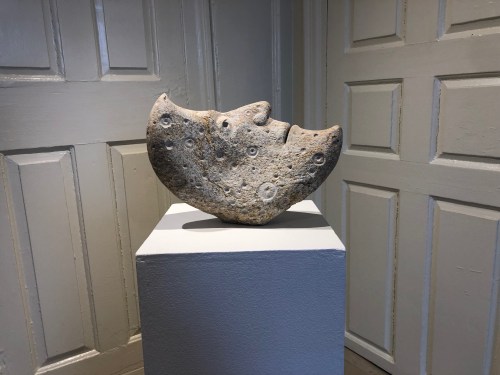
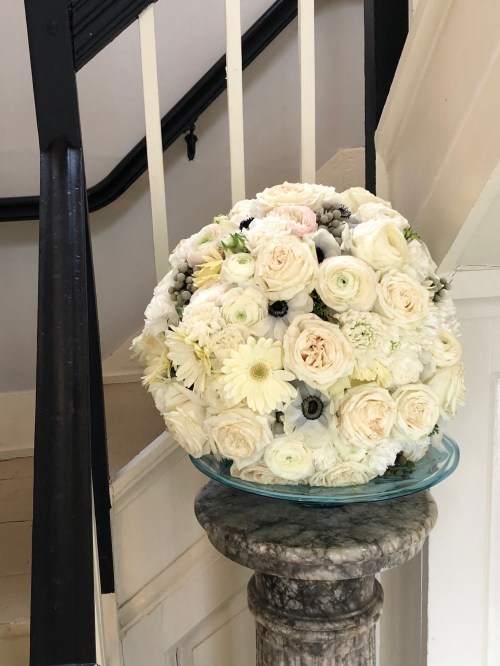
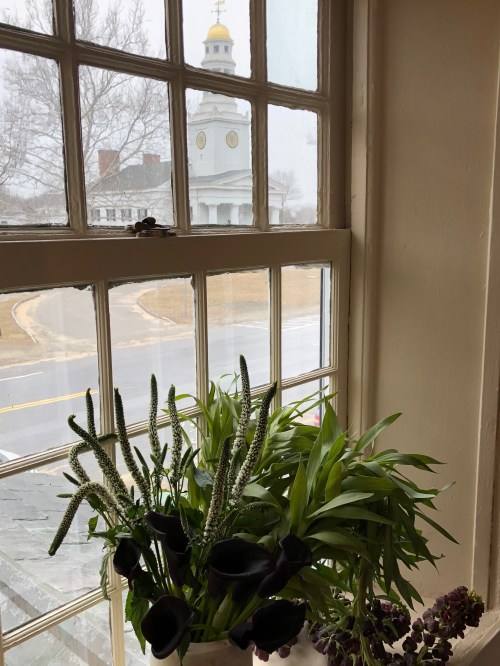
The first is from an art exhibit called “The Moon: Eternal Pearl.”  I particularly liked this Joseph Wheelright sculpture. The gallery itself (once a stop on the underground railroad) is always pleasant to visit, especially right after an opening reception when there are flowers everywhere. I liked how the gold dome of the UU church shows up beyond one flower arrangement.

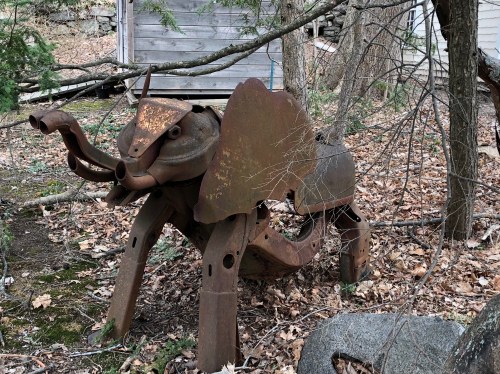
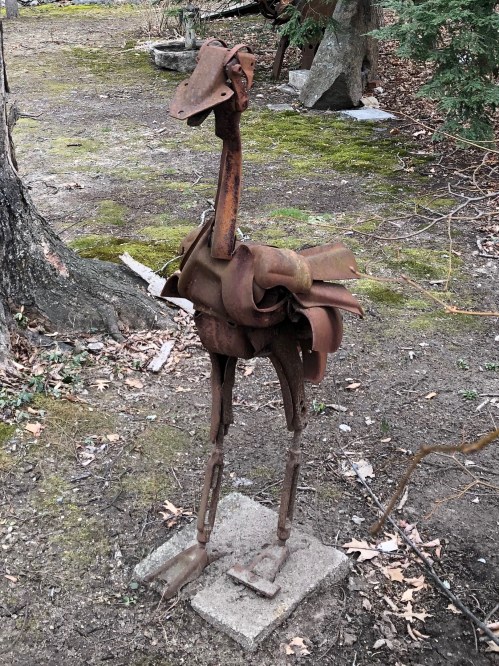
When the gallery isn’t open, you can still enjoy the curious outdoor sculptures, like this elephant and ostrich.

The blue photo is from a blues concert I attended recently. The musicians are actually just doing a sound check here. The next three pictures are from my walks around town, including my walk on a new piece of the Bruce Freeman bike trail on a former railroad bed, which technically isn’t open yet but is so enticing that lots of people are using it. The trail has been taking decades to complete because of lawsuits by abutters. They will soon find out it is an asset, in my opinion.

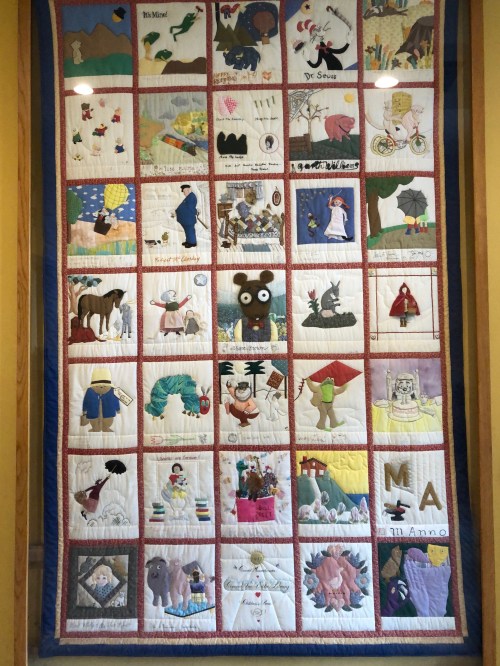
I’m not sure if I posted the library’s children’s-book quilt already, but I want to be sure that quilting friends see it.

032919-art-opening-bouquet

032919-First-Parish-Church-Concord

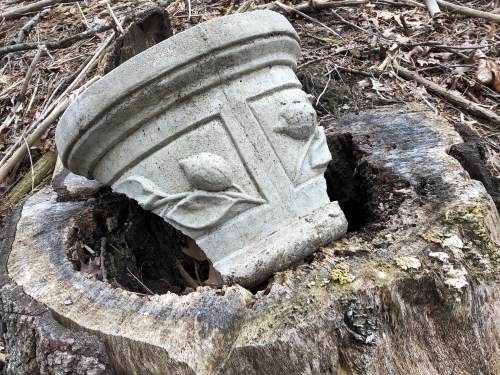
033019-elephant-in-the-yard

033019-ostrich-at-Concord-Art

033119-sound-check-for-blues-concert

040319-leaves-and-shadows

032919-treehouse-next-door

032919-detritus-on-the-trail

040319-child-book-quilt-Concord-MA

Read Full Post »

Photo: Aventura Mall
Louise Bourgeois’s Eye Benches are among the impressive works of art at Miami’s Aventura Mall.

When Suzanne was a toddler, I loved going to the mall, Eastview Mall in Victor, New York, so she could run around. Even today, I may go to a mall for my walk when the weather is bad. But on the whole, I avoid the typically oppressive atmosphere of malls. This one in Miami would have to be an exception. It’s a real art gallery.

Alexandra Peers writes at Architectural Digest, “About a dozen years ago, [real-estate developer Jackie Soffer] began buying artworks for the 2.8-million square-foot Aventura Mall, one of the largest in America. …

“A few malls have art, a very few have good art, but almost none have the button-pushers and immersive installations that the Aventura Mall features. Artists on view include pioneers or buzzy contemporary players like Louise Bourgeois, Wendell Castle, Lawrence Weiner, Julian Opie, and Daniel Arsham. There’s a 93-foot-long slide by artist Carsten Höller, who had another one in London’s Tate Modern museum.

“At first glance, it all seems highly unlikely, but — much like Steve Wynn’s groundbreaking Bellagio Hotel, which signaled to a certain set that the luxury property in Las Vegas had Picassos — the art immediately and wordlessly brands the shopping center.

” ‘Mall has slightly negative connotations,’ Soffer notes, but in Aventura, given its size, longevity (it opened in 1983 and has expanded repeatedly since), and events program, it means to be ‘a real community center.’ Plus, the art is an audience attraction — and great selfie bait.

“[Soffer] concedes that there’s also a popular and much-photographed ‘Love’ sculpture on New York’s Sixth Avenue, near the Museum of Modern Art. But she brags happily, ‘That’s red and blue. Ours is a red, blue, and green artist’s proof!’

“Not all the mall’s retail-art mash-ups go smoothly, of course. One October, sculptures by Ugo Rondinone, a series of Easter Island–style heads atop a plinth of weathered wood, were installed in a gloomy corridor. A few weeks later, a store tenant asked when the Halloween decorations were being taken down. He found them ‘scary,’ given their tucked-away locale. It was a classic case of bad placement, laughs Soffer, who adds that the works have been moved to a wide-open area and are quite popular now. …

“Perhaps the biggest surprise of having the art collection in the mall, says Soffer, has been the unexpected number of adults, rather than kids, who want to take pictures with the pieces. An outdoor fountain of spouting bronze gorillas and animals by The Haas Brothers is, if anything, even more popular when bad weather forces the mall to turn off the water—because fans can get much closer to the figures.”

See more of the art here.

Photo: Leo Diaz/ Aventura Mall
Carsten Höller’s Aventura Slide Tower.

Read Full Post »

Photo: Annie Tritt for the New York Times
Muriel Miguel, a founder of the feminist Native American collective Spiderwoman Theater, is considered a grandmother of the Indigenous theater movement in the United States and Canada.

I’ve been interested to read how indigenous peoples around the world are reaching out to one another and starting to benefit from the strength of numbers. One result has been the emergence of international festivals staking out a place for native people in the arts world. I’m late with this story, but I wanted you to know about one such festival. It took place in January in New York City.

Siobhan Burke at the New York Times noted in particular that a grandmother of the Indigenous theater movement in the United States and Canada, Brooklyn-born playwright Muriel Miguel, was scheduled to be “among the 30 or so artists participating in this year’s First Nations Dialogues New York/Lenapehoking. (Lenapehoking is the homeland of the Lenape, the original inhabitants of the area encompassing New York City.) Taking place at multiple downtown theaters, the Dialogues bring together Indigenous performing artists from Australia, Canada and the United States for a week of performances, discussions and other gatherings, beginning Jan. 5. …

“In drawing attention to the breadth of contemporary Indigenous performance — with works spanning dance, theater, performance art and genres in between — the Dialogues are something rare for New York, if not unprecedented. Describing what to expect is not easy and not intended to be. In deciding what to program, the chief organizers — [Merindah Donnelly, an organizer of the series and the executive producer of BlakDance in Australia], the choreographer Emily Johnson, and Vallejo Gantner, the former director of Performance Space — set out to challenge a notion they often come across, that Indigenous performance fits any single description. …

“Ms. Donnelly said. ‘The people making it are Indigenous, but Indigenous is not a genre.’ …

The offerings here — many of which deal with themes of trauma, grief and healing — include Ms. Miguel’s Pulling Threads Fabric Workshop, in which storytelling and quilting serve as tools for mending old wounds. …

“While the tone may be somber at times, there is also much to celebrate. SJ Norman, an Australian artist of Wiradjuri and Wonnaruah heritage, said in an email that the opportunity to gather in New York ‘feels like an honoring of the continued existence of our peoples in the big city, as well as the dynamism and globalism of our peoples, which is absolutely vast.’ …

“A Native Alaskan artist of Yupik ancestry, Ms. Johnson has been working tirelessly to counter what she calls ‘the perceived invisibility’ of Indigenous performing artists, particularly in the United States. …

“One approach to bringing the United States up to speed is an ambitious pilot program, the Global First Nations Performance Network, which will be in development during this year’s Dialogues. … The network also requires, of each presenter, a commitment to undergoing what Mr. Gantner calls ‘a kind of decolonization process.’ …

“Ms. Johnson sees this year’s Dialogues as a microcosm of what the network may eventually accomplish, including opening up international exchange. For the Australian choreographer Mariaa Randall, whose ‘Footwork/Technique,’ [explores] the footwork of Aboriginal dances, a highlight of the Dialogues is the chance to simply talk and listen with peers from around the world.

“ ‘In our countries we can become kind of siloed,’ she said. ‘I want to be able to sit with and see and hear from other First Nations females: what their struggles are, their achievements, and how they continue to keep their culture and their practice together, to keep moving forward, because sometimes it is really hard.’ ”

More at the New York Times, here.

Read Full Post »

This has been an amazing winter for sunshine amid cold temperatures and I fully expected to have lots of light-and-shadow photos to show you. But when I am outside, I seem to be mainly ogling the light and shadows and muttering to myself how glad I am to have seen that.

So today’s collection has additional photos from friends and family, who have been sharing more regularly.

My sister caught the moon on New York’s Upper West Side in February, and I tried to catch the Super Moon in Massachusetts.

I already blogged about my winter visit to New York (see the post on the Rubin museum’s Himalayan collection), but I wanted to add the port-a-potty for Asakiyume’s funny-potty-name collection — and also the pharmacist photo highlighting New York’s amazing diversity.

Next is a picture of my younger grandson on a ski trip to Vermont. He is climbing the walls, literally. I do it it only figuratively. Suzanne took the picture.

John’s photo shows a marine-themed lantern created by my older grandson yesterday at Arlington’s Art Beat, a shop where kids can buy art supplies or do a project — or both. His sister did a charming sand painting of a snowman.

Two pictures from Verrill Farm in winter show the scarecrow bean toss against a dormant field and a bench carved with horses’ heads.

The last photo is one that my artist-boss from community-newspaper days sent to a few former colleagues. It’s a still life that Bill Finucane painted for her out of the blue. Meredith writes, ” I had completely forgotten the wonderful gift of my assignment to help get Bill back on his feet and his job after a stroke and three years out of the world of work (four years not driving).” His painting is a gift of gratitude for her friendship.

I am grateful for yours.

Read Full Post »

Photo: Katherine Anne Rose
On the south side of Glasgow every year the residents of Strathbungo decorate their windows with weird and wonderful displays for other locals to enjoy.

Here’s a grand idea to light up winter in a city. It reminds me a little of the mega jack o’lantern displays that Providence’s Roger Williams Park puts on at Halloween. Any city could do this.

Peter Ross writes at the Guardian, “Window Wanderland is a festival of lights that sees people transform their neighbourhood into a colourful playground using paper cutouts in their windows. In the streets of Strathbungo, Glasgow, the result is a night-time explosion of pop culture: Mary Poppins, the Moomins, Peter Pan, Paddington.

“The festival was founded in Bristol in 2015 by Lucy Reeves Khan, a set designer who had developed mobility problems, chronic pain and feelings of isolation following a car accident. As part of her rehabilitation, she took short walks in the streets around her home – at night, so few would see her struggling. Lonely, she glanced in lit windows at the people inside, and one evening the idea struck.

“Khan set about trying to articulate her concept to her neighbours. That wasn’t easy. ‘Nobody could understand what I was on about,’ she recalls. It wasn’t quite like Halloween, it wasn’t quite like Christmas. So she created a number of displays in her own windows as examples – and it took off from there, and has now spread to around 20 UK locations. …

“One home in Strathbungo is an angry lament for the Glasgow School of Art, which burned down recently for the second time; the windows of the home are bright with painted flame. On nearby Queen Square, Bernie Hunter, who is 24 and has cerebral palsy, has created a fond tribute to Still Game, the beloved Scottish sitcom, on the eve of its farewell series. …

“The politics of the event tend instead towards the environmental. On Regent Park Square, Emily Munro has decorated an upstairs window with the hourglass logo of Extinction Rebellion, the direct action campaigners. Her other windows show cutouts of insects, which Munro removes as the night wears on, symbolising their catastrophic decline, leaving just one – a bee.

“One home has been tricked out like a giant jukebox, with a real seven-piece band playing on the upper floor through an open window. …

“ ‘It’s beautiful, unplanned, chaotic,’ says Sarah Reid, who started this Scottish leg of the event. ‘Such a simple idea, but when people come together it creates something beautiful and powerful.’ ”

More here.

Read Full Post »

Image: Green Tara Protectress from Eight Fears; Tibet; 19th century; Pigments on Cloth; Rubin Museum of Art; Gift of Shelley and Donald Rubin. The Eight Fears are 1) water, (2) lions, (3) fire, (4) snakes, (5) elephants, (6) thieves, (7) false imprisonment and (8) ghosts.

When I was in New York this week visiting my sister, she suggested we go to the Rubin Museum on West 17th St. She told me that the museum, which opened in 2004, was notable not only for the founders’ Himalayan art collection but for its peaceful aura.

It really was a treat. Here’s what the website says about the current exhibit. “Gateway to Himalayan Art introduces visitors to the main forms, concepts, and meanings of Himalayan art represented in our collection. A large multimedia map orients the visitors and highlights cultural regions of a diverse Himalayan cultural sphere that includes parts of present day India, China, Nepal, Bhutan, and Mongolia. …

“In addition to sculptures and paintings, objects such as a stupa, prayer wheel, and ritual implements demonstrate that their patrons sought the accumulation of merit and hoped for wealth, long life, and spiritual gains, all to be fulfilled through the ritual use of these objects and commissioning works of art.

“Among the featured installations are a display that explains the process of Nepalese lost-wax metal casting and a presentation of the stages of Tibetan hanging scroll painting (thangka).”

At the base of the museum’s circular stair we encountered male and female lions with fire (I think) flaming from their mouths.

There was also an interactive table on which we were bidden to type our “intentions” (for the visit or perhaps for our lives). When we hit “enter,” our phrases whooshed up toward the ceiling, joining the flow of little star-like lights and other visitors’ “intentions” on the underside of the spiraling stairs. I typed “find light in shadow,” and my sister typed “experience peace.”

From the impressive collection we learned about the interconnection of Buddhist and Hindu culture and imagery. Among the highlights was a recreated Tibetan shrine where butter lamps were burning and visitors were enveloped in the deep, deep voices of monks chanting.

There were also two excellent art recreations, one showing how artisans make a sculpture (the museum hired contemporary artists in Nepal to create the different stages of the process to be displayed in a glass cabinet) and the other demonstrating the steps for making a painted cloth hanging, a thangka. At first my sister was puzzled by the hanging’s label because it said “2014,” and all the other labels had ancient dates!

She, in turn, showed me an amazing thing that I had passed right by. It was a kind of virtual-reality video of what the houses of the Buddhist gods might look like, but the most amazing part came when the video swooped in on an aerial view. By George, a mandala! A mandala can be an aerial view of the houses of the gods. Probably other people know that, but I didn’t.

Here is a mandala that Melita showed me in process at MIT a few years ago. Colored sand was painstakingly dripped on a floor space by a visiting monk.

mg_8348sm

Read Full Post »

Photo: Simon Buckley
Grandad, an artist who has experienced homelessness, is one of 33 people behind the “Doodle on Ducie Street” mural, part of the International Arts and Homelessness Festival and Summit in Manchester, UK. The event used art as part of a holistic approach to tackling homelessness.

So many initiatives to address the world’s problems feel like a drop in the bucket, but I have to believe that the bucket can be filled — even if it’s only one drop at a time, even if some drops spill out along the way and have to be replaced. Little things mean a lot if they hit a person just at the moment of receptivity.

In England, a homelessness summit last fall tested the potential of art to spark conversations between haves and have-nots and also to give homeless people a reason to get up in the morning. Helen Lock has the story at the Guardian.

“Two armchairs are facing each other in the Whitworth art gallery in Manchester. Denise Harrison, a mental health blogger with past experience of homelessness, is sitting in one of them, waiting for questions.

“A member of the public sits down opposite her, and tentatively asks if she thinks it’s OK to give money to people on the street, as charities discourage it. ‘It’s down to personal choice – you shouldn’t feel bad if you do or if don’t,’ replies Harrison. ‘Some worry it’s enabling addictions, but it’s also providing someone with the option to pay for shelter. On the street, someone can end up with several free McDonald’s burgers but nowhere to sleep that night.’ …

“Dialogues are part of a performance artwork called Are You Sitting Comfortably? by the artist Emma Turner, who felt the public were becoming inured to homelessness in Manchester. The official number of rough sleepers was 278 in 2017, a 41% increase on the previous year, but the true number of its homeless people – counting those in temporary accommodation – is likely to be much higher.

“As Harrison says of her time suffering with alcohol addiction and sofa surfing after the breakdown of her marriage: ‘It’s scary how quickly a situation that was so abnormal became normal, my new normal. It can happen to anyone.’

”The work was part of the inaugural International Arts and Homelessness Festival and Summit, running 12-18 November [2018], which explored a potentially contentious idea: the role of arts and culture in tackling homelessness.

“Manchester was chosen for the event because the city council’s homelessness strategy for the next five years explicitly includes a commitment to increasing access to arts, and because of how the city’s cultural sector has stepped forward to provide support for the council’s plan. …

“Third sector organisations began working together to approach the council, consulting businesses, universities, cultural organisations and the faith sector, as well as people with experience of homelessness. Their findings underpinned the new Manchester Homelessness Charter. … Officials will now work towards what is described as a jigsaw of homelessness support approaches, rather than focusing exclusively on immediate needs such as shelter and healthcare. This includes the chance to meet people, build skills and have fun. …

“But how would this approach work in practice when the crisis is so severe? Beth Knowles, an adviser on homelessness for the mayor’s office, reiterated that the call for a more holistic approach came from homelessness services themselves – even frontline providers such as the night shelters.

“ ‘I’ve spoken to some about trialling the jigsaw approach,’ she said, ‘and while it might not seem the most immediate thing when you’re trying to find beds, some see the value in maybe having some singing or photography sessions on site, because it’s worked well.

‘Of course, not every council officer is going to see this as a priority. But to do something, it doesn’t have to be a priority. It’s part of a whole package. It’s about what that individual needs and offering it.’

“[According to Amanda Croome, chief executive of the Booth Centre, a day facility for people who are homeless or at risk,] ‘We find that if you put someone into a flat and they have no support network, no interests and nothing to do, then very often in six months they’ll be back on the street. What the arts do is give people a new perspective.’

“Lawrence McGill has become an avid gardener since first becoming a regular visitor to the Booth Centre, filling salvaged containers with soil and seeds. He has also written poetry, and a song, ‘Spinning Plates,’ about juggling life’s hardships. ‘My life started the day I stepped into this place.’ ”

Read about other aspects of the festival, including a description of the “immersive opera” Man on a Bench, here.

Read Full Post »

welling-court1

Photo: Welling Court Mural Project
New York City recently sought proposals from qualified nonprofit organizations to install artwork on an ugly sidewalk shed or fence.

There’s a lot of construction and renovation going on in New York City these days, and many otherwise interesting buildings are obscured by scaffolding and green plywood fences. Fortunately, the city is always looking for ways to bring culture to unlikely places and to engage artists.

Michelle Cohen writes at the website 6sqft, “On September 12, the New York City Department of Cultural Affairs announced a search for applicants for a new pilot program called City Canvas, Archpaper reports. The program was designed to beautify New York City’s visual landscape by installing large-scale–and temporary artwork on its endless construction fences and 270 miles of sidewalk sheds. The protective construction structures are an everyday eyesore for New Yorkers, but current building codes prohibit altering them. The City Canvas program circumvents that ban by allowing select artists and cultural institutions to add visual art to the visual affronts.

“There are two main objectives for the new initiative. First, to improve the experience of strolling through the city’s streets for residents and tourists alike by turning the ubiquitous fences into beautiful works of art, and second, to increase opportunities for artists and cultural institutions to get recognized for their work and to create art that represents the surrounding community. …

“During the pilot period, which will run for the next 24 months, the city is seeking proposals from at least one qualified nonprofit organization to install artwork on at least one ugly sidewalk shed/fence.” More.

The winning applications were announced November 28 at the New York City Department of Cultural Affairs (DCLA) website: “DCLA, in partnership with the NYC Department of Buildings and the NYC Mayor’s Office, is excited to announce two cultural organizations selected for the City Canvas pilot. ArtBridge and Studio Museum in Harlem will each work with local communities to transform protective construction structures into spaces for temporary art installations. First installations are anticipated in Spring 2019.”

Well, it’s a drop in the bucket, but I can’t wait to see what emerges.

Read Full Post »

111118-Art-Ramble-Concord-MA

I finally got to this year’s Art Ramble in Concord’s Hapgood Wright Town Forest — site-specific creations from the Umbrella artists planted among fallen logs and leaves.

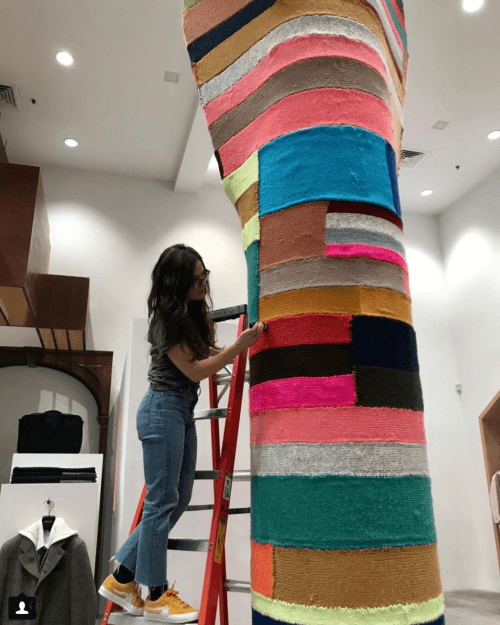
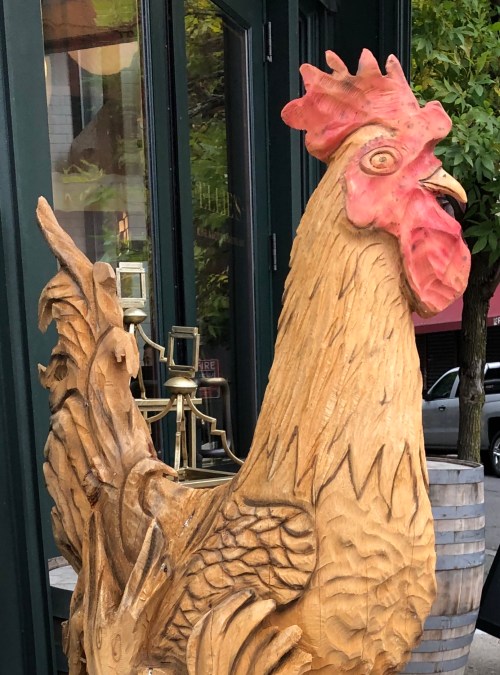
There were quite a few other visitors on the cold, sunny day. One couple shared a laugh about their madly yapping dog, who had been spooked by the recumbent figure of Thoreau in the woods. Another couple discussed with me the best way to avoid a shadow on the chicken-and-egg-sculpture. And a friendly woman who was a United Church of Christ minister and artist herself joined me for half the walk. We helped each other spot pieces that blended in so much with the surroundings that at first, when you saw a descriptive sign but no art, you would think the work had already been removed.

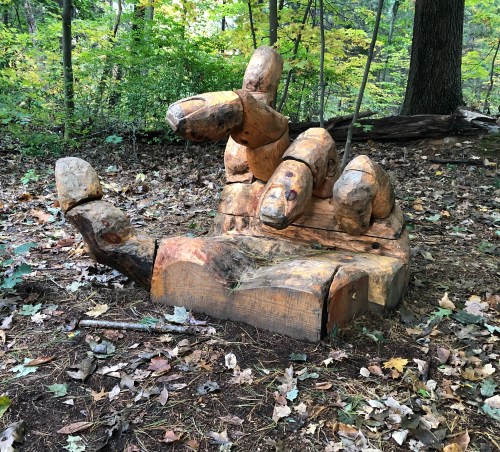
I particularly liked the tiny people — one hermit in contemplation under a root, others peeking out of the bark or cavorting on a dead log.

A man with a top hat and frog face was standing next to the pond — a Slavic water spirit and trickster that I am happy to know about.

My favorite this year was the spirit emerging from the earth at the base of a tree. At first I thought, Caliban, but then looked at his gentle face.

My report on the 2016 Art Ramble is here, and the one on the 2017 Art Ramble is here.

If you live in Massachusetts or are visiting Walden Pond, which is nearby, the Art Ramble is up until Nov. 30 this year. It will make you feel like creating some art yourself — especially with leaves and sticks and mud.

111118-Thoreau-sculpture-in-woods

111118-chicken-egg-sculpture

111118-Slavic-spirit-caled-Vodnik

111118-cruel-shoes-Slavic-legend

111118-artist-plaque-town-forest

111118-contemplative-hermit-under-a-root

111118-tiny-persons-on-a-log

111118-earth-spirit-emerges


Read Full Post »

An Artist of Pies

43wx4hiph47t7f5fygl42o2sla

Photos: Lauren Ko
Blueberry ombre spoke pie. Lauren Ko creates amazing pies with geometric designs and photographs them both before and after baking.

Cooking is an art. Or it can be. My daughter-in-law and her mother have proved that to me. Their art is expressed in the blending of subtle flavors. A baker I just learned about expresses her own art in pies that feature geometric designs.

Annaliese Nurnberg at the Washington Post displays an array of pie photos that are hard to believe.

“Lauren Ko came from a family of ‘phenomenal eaters,’ ” writes Nurnberg. “She grew up watching her mother and grandmother make cakes and cookies, but to her recollection, nobody in her family ever made a pie. …

“It was two years ago that she decided to make her first pie. Instead of sticking with the current trends, she wanted to create pies with geometric patterns, straight lines and contrasting colors. She started baking more and posted photos of her creations to … a public Instragram account, @lokokitchen.  …

“With a background in social work and nonprofit administration, Ko had been working as an executive assistant before she quit her job to focus full time on creating pies and tarts. She now teaches workshops and classes throughout Seattle, flies to food events in other cities, and even got the opportunity to bake with Martha Stewart on her show ‘Martha Bakes.’ …

“She says she has always loved art but has no professional training. She finds inspiration everywhere, from bathroom tile and textiles, to lawn chairs and bamboo purses, and saves images to give her ideas for future pies.

“Ko has no plans to sell her pies because her designs are so labor-intensive that they would be impossible to mass-produce. But, more important, she enjoys the freedom of being able to create something new every time she steps into the kitchen to bake and wants to hold on to that freedom while she continues her art.

“ ‘I’m going to ride the wave as long as it takes me. You know, the nature of social media is that it changes so quickly, and you never know what’s going to happen with it,’ Ko said. ‘I mean, all of this could go away tomorrow, but as long as I’m able and have more ideas for designs and flavor combinations, I’m going to continue baking and posting.’ ”

A Martha Stewart article has more: “Her inspiration ranges from architecture and string art to wicker purses and bathroom tiles. ‘I’ll see someone walking down the street with a cool shirt and file that away in my memory bank,’ says Ko. ‘Anything with geometric shapes and straight lines catches my eye because they’re easiest for me to replicate with dough and fruit.’

“She recreates one of her most popular pies on [a September episode of “Martha Bakes,”] her signature blueberry spoke, which has strips of dough fanning out in a swirled wheel pattern.”

Great pictures at the Washington Post, here, and at Lauren Ko’s own website. Since Ko makes only one pie at a time, I do wonder who gets to eat it. I’m getting hungry.

Blueberry tart with kiwi diamonds.

k4ko4hjvyazvjkr6zar45hiftu

Read Full Post »

6Photo: Fondazione Manifesto
Poggioreale, Sicily, one of the towns destroyed by a 1968 earthquake. A public art project has helped to heal the region’s survivors, many of whom were still suffering from depression decades later.

I’ve blogged a lot about the healing power of various arts in various contexts, but I think this is the first post about what art can do for a traumatized region after a natural disaster. The story takes place in Sicily, where a 1968 earthquake flattened an already impoverished region.

Patricia Zohn writes at artnet news, “On a recent day this summer, I [descended] into the rural, arid Belice Valley. I was accompanied by Zeno Franchini of the Fondazione Manifesto, an advocacy group that leads tours of the region, which was devastated by the 1968 earthquake in Sicily. …

“More than the number of people who died (approximately 400), or the number rendered homeless (approximately 100,000), the earthquake exposed grave fissures in the socioeconomic and political fabric of one of Italy’s poorest regions — disparities that linger to this day.

“While thousands of earthquake victims lived outside Gibellina, an isolated agricultural community, in two shanty towns with barebones infrastructure, in 1970, the National Institute of Social Housing in Rome, determined, after numerous plans for reconstruction were abandoned, to build an entirely new city, a Gibellina ‘Nuova’ for the victims at a site 11 miles from the ruins. …

“By 1979, scant progress had been made due to government corruption, the Mafia influence, and red tape, and victims were still living in dire conditions. That’s when Gibellina’s flamboyant, powerful gay Mayor, Ludovico Corrao, invited a number of leading Italian and German artists and architects to participate in a rescue mission. …

“Though there was no budget for art or culture, Corrao had already begged and borrowed to found the Orestiadi performance festival, just outside the ruins of Gibellina, with the help of performers like John Cage and Philip Glass. Emilio Isgrò, an artist and dramatist, described a wind-chilled night of 1983

‘where artisans, sheep farmers, housewives, anti-Mafia judges and theater directors and personalities from all over Europe sat together to watch’ his performance in the festival. …

“The concrete Utopian city of Gibellina Nuova [became] an open-air laboratory for assessing the healing capabilities of public art. Today, 50 years since the earthquake struck, many look back on Corrao’s radical experiment in civic engagement, rehabilitation, and unification as a cautionary tale. But new efforts are now underway to realize a more pragmatic version of [his] utopian dream.

“ ‘The city needs to really become an Art Town,’ says Alessandro La Grassa, president of the Center for Social and Economic Research of Southern Italy, the organizational heir to the early activist efforts. He envisions it as a place ‘where artists live or stay and where empty buildings and spaces start to find a new function.’ …

“Today the region is a symbol of hope. A newly revitalized combination of social activists, municipal agencies, educational institutions, and private support is finally bringing the unique art interventions of more than five decades in the Belice Valley — and especially the city of Gibellina — to the attention of a wider public. …

“Tours of Poggioreale, Burri’s Cretto, and Gibellina Nuova are available until November 14 through fondazionemanifesto.org.” More here.

I wonder how public art might by employed to rebuild after a hurricane like Michael. Something for art leaders in Florida to think about.

Read Full Post »

« Newer Posts - Older Posts »