Feeds:
Posts
Comments

Posts Tagged ‘art’

savoirbedsxnationalgallery_savoir_felix_with_jan_van_de_cappelle__a_shipping_scene_with_a_dutch_yacht_firing_a_salute__detail__portr-1080x1446

Art: Jan van de Cappelle
Photo: Savoir Beds
Detail from “A Shipping Scene with a Dutch Yacht firing a Salute” (1650) used on a bed’s headboard.

I thought this was an interesting idea, but if I were going to have art that close to my pillow, I would want it to be soothing, wouldn’t you? A yacht firing a salute would surely wake me up.

Monica Uszerowicz reports at Hyperallergic about a new concept in headboards.

“When Gherardo di Giovanni del Fora painted ‘The Combat of Love and Chastity’ sometime between 1475 and 1500, he was likely illustrating two of the poet Petrarch’s ‘Triumphs,’ translating the allegories into a visual battle of love and the thing that quells it. …

“The London’s National Gallery’s website states that the work is part of a series, ‘probably made for a piece of Florentine furniture towards the end of the 15th century.’

“It’s unclear if British bed maker Savoir Beds’ National Gallery Collection, which debuted earlier this year, was an attempt to accomplish the painter’s vision. … Savoir Beds, known for their hefty price tag and their extraordinary contents (think cashmere made from the necks of Mongolian goats), have partnered with home décor specialist Andrew Martin and London’s National Gallery to create custom beds, each upholstered with artwork on the headboard and the base.

“ ‘The Combat of Love and Chastity’ is one choice, but you can make your own: every single artwork owned by the National Gallery can be reproduced onto a selection of handmade beds. … Claude Monet’s ‘Water-Lilies, Setting Sun’ (1907), spread across the Harlech Savoir No. 2, will cost you £29,587 [$38,679]. …

“They’re calling it ‘the fine art of sleeping beautifully.’ But why now — why this sort of patrician indulgence? Alistair Hughes, Savoir Beds’ Managing Director, told Hyperallergic over email that ‘our clients and artisans have always seen our mattresses and designs as works of art.’ ” OK. And?

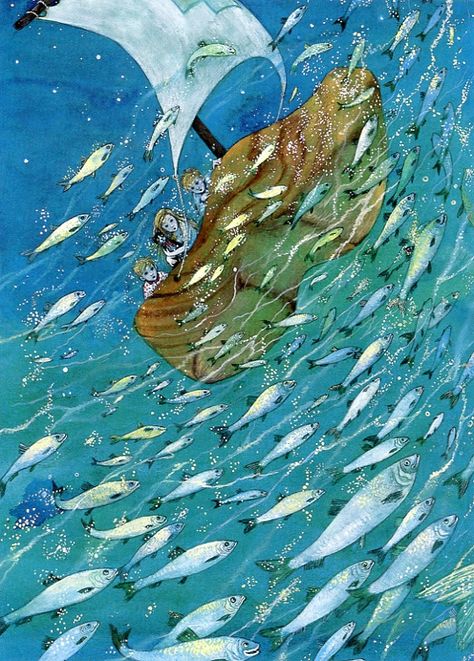
Well, just for fun, what work of art would you want on your headboard if you wanted to go that route instead of giving the money to some worthy cause? I would probably pick something with a moon and stars from a children’s book. Maybe one of the Wynken, Blynken, and Nod illustrations. Someone has collected a glorious array of different artists’ illustrations of that poem, here.

More on the extreme beds at Hyperallergic, here.

632aeccc4e42db4463570117b37b43d7-chloes-closet-wooden-shoe

Read Full Post »

screen-shot-2012-07-15-at-10-09-57-am

Photo: MTA Arts for Transit
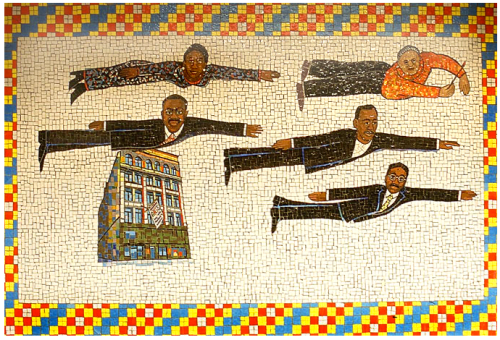
Faith Ringgold’s mosaic “Flying Home: Harlem Heroes and Heroines (Downtown and Uptown),” 1996, is one of the pieces of subway art featured in a PBS documentary.

I’m always amazed by the beauty of the mosaics in the New York subway, even the ones that merely tell you what street you’re at. It makes me happy to see that the city values them, too, and periodically cleans up the oldest ones. They go back as early as 1901.

My sister alerted me to an excellent PBS documentary about recent additions to the art in the subway system. You can read about it at the website Mosaic Art Now.

“For a delightful immersion into the history and current activities of the enormous underground museum that is the New York subway system’s Arts For Transit program, treat yourself to WNET Channel Thirteen’s free one hour video called ‘Treasures of New York: Art Underground.’ …

“Mosaic artist Steven Miotto gets major face time. His decades-long collaboration with artists of all stripes is a fascinating story in itself. When selected by a commissioned artist as a collaborating partner, he gets into their minds and hearts, leading them through the complex process of translating their vision and their graphic designs into mosaic ‘paintings for eternity.’ …

Faith Ringgold, speaks eloquently and nostalgically about the series of paintings – now mosaics – that portray the heroes of her Harlem childhood. Writers and musicians fly across the cityscape in flattened but vivid characterizations. I had the opportunity to interview her when she was in Miami last year, and she spoke about the challenges of trying to ‘make it’ as an African-American artist dealing with political themes at a time when the galleries favored the abstract.  Click here (http://bitly.com/yxGJ3R) to listen to that interview with her.”

See some of the beautiful new mosaics and watch the video here.

If you are up for more on transit-system art, be sure to check out an excellent article by Sarah Hotchkiss at KQED about what’s going on with San Francisco’s Transbay system, here.


Read Full Post »

althomepage

Photo: Canwood Gallery
An art lover in Herefordshire, England, has turned a cow shed and an old tractor barn into an elegant gallery and event locale.

I love reading about something old getting a new lease on life and serving a completely different purpose. On this farm, workaday buildings were creatively adapted for an art gallery.

Vanessa Thrope writes at the Guardian, “A cow shed and an old tractor barn in rural Herefordshire are not where most people would go in search of the avant garde or the latest in abstract painting. But retired farmer Stephen Dale is challenging the assumption that modern art is best appreciated by city dwellers.

“A run of exhibitions staged by the 74-year-old at the free public art gallery he set up two years ago in Checkley, near Hereford, have now drawn big names from the art world and proved the scale of an appetite for the unexpected in the countryside.

“Canwood Gallery and Sculpture Park, built by Dale on arable land he once farmed, is opening a show of previously unseen paintings by the veteran Royal Academician Anthony Whishaw. The exhibition, Experiences of Nature, also features the work of Whishaw’s late wife, the artist Jean Gibson, as well as a sculpture by her famous former pupil, Nicole Farhi.

“Dale’s unusual, charitable plan to create a gallery in an area of outstanding natural beauty was financed by the sale of much of his land. The farmer’s strong feeling for unconventional art emerged more than 40 years ago, while he was undergoing a difficult and long round of experimental treatments for leukaemia in the 1970s.

“Travelling down to London to take part in a series of drug trials at St Bartholomew’s hospital, Dale entertained himself in his free time with visits to art galleries. An early trip to see Carl Andre’s notorious arrangement of bricks, Equivalent VIII, at the Tate changed his life. A passion for modern art was born. ‘It may sound strange, but the hairs on the back of my neck stood up. I guess I fell in love with the bricks,’ Dale said. …

“In Canwood’s first major exhibition last summer, Bricks in the Sticks – A Farmer’s Inspiration, Dale featured a piece made by Carl Andre himself. The American artist’s Isoclast 07 graphite bricks installation, bought by Dale at auction, stood alongside the work of other international artists. A show of Matisse prints followed, and visitors rolled in.

“ ‘Running a farm and running a gallery turn out to be equally stressful,’ said Dale. ‘I did not expect the numbers of people we have coming, nor the standard of artists.’

“While Dale aims at the sort of regional significance enjoyed by the Yorkshire Sculpture Park near Wakefield, he also likes the idea of the example set by former farmer and Glastonbury Festival host Michael Eavis at Worthy Farm in Somerset: ‘A festival like that for visual arts would be something.’ ” Dale gives profits from the gallery to the hospital that saved him.

Read more about the artists here.

Read Full Post »

fogsculpturerenderingoverfranklinparkbostonma

Photo: Emerald Necklace Conservancy
Starting August 11, five “fog sculptures” by artist Fujiko Nakaya will grace the string of Boston parks known as the Emerald Necklace until the end of October. Nakaya uses a system of pumps, pressurized hoses, and ultrafine nozzles to create her sculptures.

You can make art from almost anything, but you need an artist’s imagination to see the possibilities. I notice that in my grandchildren, who take on creative projects that seem impossible to dull adults — like making a necklace with a heavy rock and some paper. In this story, artist Fujika Nakaya saw the possibilities of fog.

As Graham Ambrose reports at the Boston Globe, “The Emerald Necklace, Boston’s 7-mile pendant of parks built in the 19th century, will soon have a new adornment: a string of artworks made from water vapor.

“This summer, artist Fujiko Nakaya will debut ‘fog sculptures’ at five sites along the Necklace. The immersive sculptures — wafting clouds of machine-made mist — will be viewable from dawn to dusk between Aug. 11 and Oct. 31. …

“Mayor Marty Walsh of Boston hailed the project, calling the Emerald Necklace ‘a crown jewel in the City of Boston’ in a statement to the Globe. ‘Similar to the intent of the Emerald Necklace, art has a connecting power, bringing together people from all different backgrounds and all different places.’ …

“Nakaya, born in Japan in 1933, calls fog ‘the most generous of mediums.’ Since 1969 she has built more than 80 fog sculptures across four continents, transforming open spaces into dreamlike landscapes with custom-designed installations. …

Fog is living and dying. It condenses and evaporates simultaneously, with dynamism and vulnerability. It is a positive and negative,” Nakaya told the Globe. …

“To create her sculptures, which emit fog in controlled intervals, Nakaya uses a patented system of pumps, pressurized hoses, and ultrafine nozzles. Computer software receives weather data and alters fog flow to suit wind speeds, dew point, temperature, and humidity.”

Read about the dramatic origins of the sponsoring conservancy at the Boston Globe, here. The Emerald Necklace was the work of landscape visionary Frederick Law Olmsted, who also created designs for New York’s Central Park, the 1893 Chicago World’s Fair, and more.

Read Full Post »

06_minnie-chasing-her-sheep


Photo: Chip Thomas, MD, Indian Health Services
“My interest in documentary photography has helped sensitize me to the living conditions and quality of life of my patient population. … To the extent that they’re comfortable with me taking photos, I use these visits as an opportunity to document their lives.” More at the artist-physician’s website, here.

You probably wouldn’t want your doctor to care more about her artwork than helping patients, but a well-rounded physician is likely to bring more depth to medicine.

Jennifer Sokolowsky writes at the Seattle Times that art is becoming part of doctors’ education at Virginia Mason Medical Center in the state of Washington. The idea is to help physicians build both their observational skills and their empathy.

“One afternoon [in June],”  Sokolowsky reports, “a group of Virginia Mason doctors huddled, discussing a man who seemed to be in pain. Instead of being in a hospital, however, the doctors were at Seattle Art Museum, peering closely at the 1930s painting ‘Morning’ by Pacific Northwest artist Morris Graves.

“The painting, showing a man lying uncomfortably on a wood floor, portrayed pain in a way that was familiar to the group. …

“ ‘I thought, “Wow, this is a man I’ve seen before in our emergency room, suffering and sick,” ‘ said Dr. Laura Saganic, a Virginia Mason resident physician.

“The discussion prompted another in the group to observe that when they see their patients, they often don’t think about the patient’s circumstances before coming to the hospital. ‘Were they lying on a hardwood floor, were they in a tent?’ Saganic said.

“Building such observational skills and empathy — so critical to the physician’s art — is one of the goals of a relatively new program that exposes doctors at Virginia Mason Medical Center to arts education at Seattle Art Museum (SAM). …

“This kind of training helps address the fact that modern medical education often focuses much more on the factual side of healing, rather than balancing that knowledge with the kind of intuition and empathy the best medical practitioners can bring. …

“One artwork on the itinerary was ‘William Forbes M.D. (Professor Forbes, the Anatomist),’ a 1905 painting by Thomas Eakins. … The discussion ranged from how an understanding of human anatomy is important to both art and medicine, to the evolution of patients’ rights. …

“After last year’s pilot program, [rheumatologist Amish Dave, who spearheads the program] said, ‘We got a lot of feedback and learned that the residents wanted to spend more time thinking about emotions.”

Wow, that statement stands out to me. It gives me hope for the world to be reminded how common it is nowadays to acknowledge the importance of emotions. That is one of the “little” things we overlook amid the barrage of headlines tending to show humanity sliding backwards. More at the Seattle Times, here.

Do tell me your stories of medical providers’ outside interests, artistic or otherwise.

Photo: Chip Thomas, MD
Navajo women with a newborn goat.

02_lula-and-minnie-with-a-n

Read Full Post »

Art: Chiura Obata
Upper Lyell Fork, near Lyell Glacier, 1930, color woodblock print. The Japanese-American artist suffered from hostility and interment but was grateful for America’s natural beauty and always gave back.

Maria Popova has an inspiring post at Brain Pickings about a Japanese-American artist who felt grateful for Yosemite and other natural beauty in his adopted country — despite experiencing cruel prejudice, discrimination, and internment.

Popova reports, “Called to art since childhood, Chiura Obata (November 18, 1885–October 6, 1975) was trained in the traditional Japanese ink and brush painting technique sumi-e from the age of seven. When his family readied him for military school at age fourteen, he ran away, left his home prefecture, and traveled four hundred miles north to Tokyo, where he apprenticed himself to a prominent painter for three years.

“Shortly before his eighteen birthday, Obata left for the United States and settled in San Francisco, working as a domestic servant while pursuing an arts education. He was soon supporting himself with illustration work for Japanese-language magazines and newspapers. But the American Dream was not on offer — instead, Obata was met with the era’s prevalent racial animosity toward Japanese immigrants. …

“Perhaps it was this anguishing disappointment with the human world, with its seething cauldron of xenophobia and racism, that made Obata turn his heart and his paintbrush to the natural world. On his first trip to the High Sierra in 1927, watching ‘beautiful flowers bloom in a stream of icy water,’ Obata wrote to his wife, Haruko:

I only feel full of gratitude. …

“By the end of the decade, his paintings had garnered considerable attention. … But neither Obata’s stature in the creative world nor his appointment as an art instructor at U.C. Berkeley protected him from the swarming hostility of the country he had made his home and the recipient of his rare gift. In December of 1941, after the bombing of Pearl Harbor, locals fired shots at the art supply store Obata and his wife owned in Berkeley. …

“By the spring, Obata was detained at one of California’s internment camps for Japanese Americans, where he founded an art school using his own funds and donations from friends at the university. Six hundred of the interned became art students and went on to produce work of such quality that it was being exhibited outside the camp by the summer. ”

More at Brain Pickings, here, where you can see other work by this wonderful artist.

Read Full Post »


Art: Roy Lichtenstein
Masterpiece, 1962, was sold by philanthropist Agnes Gund to launch the Art for Justice Fund. 

There’s a movement in the world of philanthropy to combine the arts with social justice. In some cases, donations to arts organizations specify reaching out to poor communities and new audiences. This particular article focuses on collectors who sell art to fund causes they believe in.

Mike Scutari writes at Inside Philanthropy, “After Agnes Gund launched the $100 million Art for Justice Fund with the proceeds from the sale of Roy Lichtenstein’s ‘Masterpiece,’ I wondered if collectors represented the sleeping giants of arts philanthropy. The prognosis thus far seems promising.

“A number of founding donors to Art for Justice have committed gifts of artwork or contributions, and late last year, the fund allocated $22 million to 30 criminal justice reform groups and education and arts initiatives. Around the same time, the anonymous consignor of Jean-Michel Basquiat’s ‘Red Skull’ announced they would donate the proceeds to a nonprofit that opens new public charter schools. …

“Glenn Fuhrman and his wife Amanda partnered with Suzanne Deal Booth and The Contemporary Austin to transform the existing $100,000 Suzanne Deal Booth Art Prize, which is currently celebrating its inaugural exhibition, into one of the nation’s largest awards presented to an artist.”

Scutari notes that although the prize doesn’t require attention to social causes, sometimes a winner’s work turns out to have been strongly influenced by the issues of the day.

“Collectors have historically deferred to institutional givers to do the heavy lifting when it comes to traditional grantmaking and the red-hot area of activist art in particular. This is why Gund’s Art for Justice Fund is so important. It’s predicated on the idea that by selling their work, collectors can advance social justice. As Ford [Foundation] President Darren Walker noted, ‘art has meaning on a wall, but it also has meaning when it is monetized.’ …

“An open question is the extent to which the Suzanne Deal Booth / FLAG Art Foundation Prize will align with the surging fields of boosting access to the arts and promoting socially focused work. Corroborating evidence suggests it will.

“Regarding access, the Fuhrmans’ FLAG Art Foundation exhibition space has been free and open to the public since its 2008 opening. The Fuhrman family has also underwritten free admission at the Institute of Contemporary Art [in Philadelphia] annually for nearly a decade. The couple is clearly committed to eliminating financial barriers to access.

“Exemplifying its social focus, in the charged aftermath of the 2016 election, the FLAG Art Foundation curated an exhibition that focused on artists who ‘negotiate politics, tragedies, social issues, and their own perspectives’ by using the New York Times as an inspiration for their work. …

“I recently spoke with VIA Art Fund President and collector Bridgitt Evans on the state of arts philanthropy and floated the theory that collectors are the sleeping giants of arts philanthropy. [VIA means Visionary initiatives in Art. It’s located in Boston.] She concurred with this assessment. Collectors, she said, are ‘exposed to a wider variety of artists, practices, ideas, and social commentary,’ and moving forward, they will ‘direct the same passion they have to collecting to philanthropy.’ ”

Read more at Inside Philanthropy, here.

Read Full Post »

Illustration: J.V. Aranda
The website
Vulture has a list of 100 important pages that shaped comics as an art form.

Are you into graphic novels — serious books designed like comics? I haven’t read many, but I thought Stitches: A Memoir, by David Small, was wonderful. It was a dark but insightful retelling of the artist’s childhood. A doctor friend bought copies for patients after I told her about it.

At Vulture, 12 authors came together to choose 100 memorable comic-book pages that shaped the art form. In each case, they explain their reasoning. It’s a pretty fascinating post.

“The origin story of comic books isn’t flashy. No radioactive spider bite, atomic explosion, or shadowy experiment granted the medium the sort of ability that would have allowed it to arrive on early-20th-century drugstore racks as glossy, fully formed vehicles for sophisticated entertainment. Rather, it took a steady progression over the course of more than 75 years for the form to fully understand, and then harness, its powers. When the first comics arrived on newsstands in the early 1930s, they were a cynical attempt to put old wine in new bottles by reprinting popular newspaper comic strips. Cheaply printed and barely edited, those pamphlets were not what a critic at the time would have called high art.

“Yet today, the medium is flourishing in ways its ancestors could never have imagined: … a dizzying array of what the great cartoonist Will Eisner famously termed ‘sequential art.’ And, as evidenced by the sheer number of adaptations in film, television, and even on the Broadway stage, the rest of the entertainment industry has grown wise to what fans have long known: There’s a special alchemy that comes when you tell a story with pictures. …

“We have set out to trace the evolution of American comics by looking at 100 pages that altered the course of the field’s history. We chose to focus on individual pages rather than complete works, single panels, or specific narrative moments because the page is the fundamental unit of a comic book. … When comics have moved in new directions, the pivot points come in a page.

“To assemble our list of 100, we assembled a brain trust of comics professionals, critics, historians, and journalists. Our criteria were as follows: A page had to have either changed the way creators approach making comics, or it had to expertly distill a change that had just begun. In some cases, there were multiple pages that could be used to represent a particular innovation; we’ve noted those instances. We didn’t necessarily pick the 100 best pages. …

“Some pages are notable for their written content — game-changing first appearances, brilliant narrative innovations, and so on. Some are significant because the artwork told a story in ways no one had thought to do before, and ended up being emulated — or, in some cases, outright aped. … You can click on the title of each page to open a window with a full-sized version.”

I liked the first example, the 1929 Lynd Ward spooky guy. I think Asakiyume and I saw it the Fitchburg Art Museum when we met up for the graphics exhibition some years ago.

Vulture explains, “It’s inarguable that one of the leading pioneers of modern longform graphic storytelling was Flemish illustrator Frans Masereel. Right after World War I, he created a series of ‘pictorial narratives’ without words — you may have spotted his most famous, Passionate Journey (1919), in the gift shop at your local art museum.

“Chicago-born art student Lynd Ward discovered Masereel’s work while studying printmaking in Leipzig, Germany, and was inspired to use the oldest print medium — woodblocks pressed into ink — to create something very modern: the first stand-alone graphic narrative by an American, or as he called it, a ‘novel in woodcuts.’

“Gods’ Man (1929) tells the story of a struggling artist who makes a supernatural bargain with a mysterious stranger (pictured here) for a magic brush that comes at a terrible cost. The book, composed of one woodcut illustration on each of the volume’s 139 pages, was a surprise success,”

More.

Art: Lynd Ward
Gods’ Man (1929). Always read the fine print when dealing with spooky strangers.

Read Full Post »

Photo: MFA Boston
The results of a study on school field trips surprised the Brookings Institution researchers.

One of the messages I take from this Brookings report on student field trips is the importance of conducting research with both an open mind and a willingness to follow up on unexpected results. Another takeaway: researchers prefer to study things for which there are a lot of data available; worthwhile questions that don’t have a lot of data to work with often don’t get studied.

Jay P. Greene writes, “Most education research focuses on math and reading outcomes or educational attainment because those are the measures that the state collects and are readily available to us. Less is known about how students are doing in other subjects and whether their progress in those areas has important benefits for them and society. …

“A new experiment … examines long-term effects of students receiving multiple field trips to the Woodruff Arts Center in Atlanta. The Woodruff Arts Center houses the High Art Museum, Alliance Theater, and Atlanta Symphony, all on one campus.

“We randomly assigned 4th and 5th grade school groups to get three field trips per year – one to each of Woodruff’s arts organizations – or to a control condition in which students received a single field trip. …

“The surprising result is that students who received multiple field trips experienced significantly greater gains on their standardized test scores after the first year than did the control students. …

“The reason these results are so surprising is that previous research had suggested that arts instruction tended not to ‘transfer’ into gains in other subjects. …

“When we conducted the analysis on the effects of treatment on test scores, we expected to find no statistically significant effects, just like almost all previous rigorous research. …

“We still do not believe that arts instruction and experiences have a direct effect on math or ELA ability. We think this because the bulk of prior research tells us so, and because it is simply implausible that two extra field trips to an arts organization conveyed a significant amount of math and ELA knowledge.

“Our best guess is that test scores may have risen because the extra arts activities increased student interest and engagement in school. … Maybe arts-focused field trips do not teach math or reading, but they do make students more interested in their school that does teach math and reading. But this is just a guess. …

“The odd thing about trying to write a paper with these results to present at conferences and submit to a journal is that there is strong pressure for us to pretend like we expected our findings all along. Discussants and reviewers generally don’t want to hear that you found something you didn’t expect and don’t really know why. They want to hear a clean story about how your results make sense and follow from your theory and literature review. In short, social science favors the false appearance of confidence.”

Ah, yes. When I was at the Fed, I often wondered about such things, but as a non-economist, I knew I was out of my depth.

Read about how the researchers intend to unpack the meaning of their unexpected results with future studies, here.

Read Full Post »

Photo: Carter Burden Gallery
The Carter Burden Gallery in Chelsea shows works by artists who are at least 60 years old.

I’m always happy to see that older people are still appreciated in some quarters — in this case, at a New York gallery that features only artists over 60. Susan Stamberg has the story at National Public Radio (NPR).

“Some artists in New York may be wishing to get older faster. A gallery there caters to artists age 60 and older. No kids allowed.

“Some 200 artists have exhibited at the Carter Burden Gallery since it opened nine years ago in Chelsea. Business is good, and works sell from $200 to $9,000. It’s a lot like hundreds of other galleries in New York — except for one important thing: The Carter Burden has an age limit. Why?

” ‘Older adults do not stop being who they are because they hit a particular age,’ said gallery director Marlena Vaccaro. ‘Professional artists never stop doing what we do, and in many cases we get better at it as we go along.’

“What does change is the art market. With rare exceptions, artists who were hot when they started out found that galleries, and certainly museums, cooled to them as years passed. They kept making art, but weren’t being shown or bought. Carter Burden’s mission is to give them a wall, ‘because walls are the thing we need,’ Vaccaro said.

“According to Vaccaro, very few galleries represent older professional artists, unless they’re really famous. ‘And I get that,’ she said. “Galleries are a business. They need to show artists that are going to bring in big bucks.’

“Carter Burden is different. It’s a nonprofit, supported by a board, a corporate sponsor and philanthropists. …

“Artist Nieves Saah, 67, originally from Bilbao, Spain, has painted all her life. ‘My first show was in SoHo in ’85,’ she said. ‘And I had like 28 paintings there. I sold a few, and then from that I got many shows. I think that year I was in like 15 shows.’

“Then things slowed down. There wasn’t much interest for 10 years. Saah kept on painting her figures and fantasies in vividly colored, cheerful oils. One day she heard about Carter Burden and decided to apply online. ‘I was in a show one month after I sent the application,’ she recalled. …

“Werner Bargsten, a newbie, had his first show this past October. It consisted of stunning, powerful sculptured wall hangings made with clay and copper tubing, and formed into what look like wrapped packages. …

“At 69, Bargsten is glad to be part of the Carter Burden over-60 crowd. ‘I mean, look, it’s always harder to get out of bed the older you get, but most of the artists that I’ve met here seemed like they missed that memo that they were getting old. Most of them have the brains of a 20-year-old or a 30-year-old or something. So they haven’t really aged in terms of their spirit.’ ”

More at NPR, here.

Photo: Carter Burden Gallery
“Under the Stars,” by Nieves Saah, an 0ver-60 artist who shows her work at the Carter Burden Gallery in New York.

Read Full Post »

Photo: Swem Library
Art on page edges from
The Complete Poetical Works of Henry Wadsworth Longfellow. See 22 other examples at Atlas Obscura.

Have you ever noticed paintings along the page edges of old books? According to a 2016 Atlas Obscura article by Eric Grundhauser, they’re called “fore-page paintings.”

He writes, “While you don’t see them very often these days, fore-edge paintings were once some of the loveliest book illustrations around. … A fore-edge painting refers to an image painted or drawn on the closed leaves of a book. …

“Some ambitious, ‘disappearing’ fore-edge paintings were painted on the inside edges of the pages, so that the hidden scenes could only be seen when the page block was fanned in a certain direction. …

“These secret illustrations could be doubled, with an illustration on either side of the pages, revealing themselves depending on the slant of the page block (known as the ‘two-way double’). Some were painted so that if the book was laid open in the center, naturally splaying the pages to either side, two different illustrations could be seen on either side (known as a ‘split double’). …

“ ‘Sometimes the fore-edge paintings corresponded to the subject of the book, and sometimes not,’ says Jay Gaidmore, Director of Special Collections at the Earl Gregg Swem Library. The library holds the 700-strong Ralph H. Wark Collection, the largest collection of fore-edge painted books in America. …

“ ‘Most of the books are 19th century English fore-edges, but there are a few American scenes.’

“Fore-edge paintings can be found on books dating back to the 11th century, with early examples being decorated with symbolism and heraldry. …

“According to the Boston Public Library’s website for their 250+ collection of fore-edge books, for the most part the paintings were made using watercolors, and went unsigned, often being commissioned by a book-binding firm. …

“The technique has even been printed onto some modern books like Chip Kidd’s 2001 novel, The Cheese Monkeys, which was printed with a two-way double, disappearing fore-edge message. If the pages are shifted in one direction, the phrase ‘GOOD IS DEAD,’ appears, while if they are shifted in the opposite direction, the message, ‘DO YOU SEE?’ can be read.”

Tip of the hat to Fort Point artist Karen McFeaters, who retweeted this lead from @michikokakutani. More here, where you can see 22 additional examples.

Read Full Post »

A Year of Art Discoveries

Photo: Wikimedia Commons
Two Allegory of Justice figures in the Vatican, once attributed to Raphael’s followers, were identified in 2017 as being by the master himself.

This Artsy report on 2017 art discoveries was pretty cool. Curiously, I had already written about one of the finds — here. It was the Rodin sculpture discovered in a New Jersey town hall.

Abigail Cain writes, “Art history is, by definition, primarily a thing of the past — but each year, some small portion of it is rewritten by those in the present.

“In 2017, we gained new insight on the early years of Leonardo da Vinci and the final ones of Andy Warhol; amateur archaeologists were rewarded with major finds; and several masterpieces were discovered, simply hiding in plain sight. From newly mapped Venezuelan petroglyphs to a long-lost Magritte, these are 10 of the most notable art-historical discoveries of the year.”

I especially loved that volunteers made the find that occurred in England. “A team of amateur archaeologists,” writes Cain, “dug up one of the most significant Roman mosaics ever discovered in Britain.

“The discovery was made in a field outside of Boxford, in southern England, by a group of local volunteers supervised by professional archaeologists. Although the project began in 2011, it wasn’t until August of this year — during the final two weeks of the scheduled dig — that organizers realized they’d found something extraordinary.

“As it turned out, they’d uncovered a remarkably well-preserved mosaic, built as part of a Roman villa that dates to roughly 380 A.D. Not only is it a rare find for the country — experts have labeled it the most exciting of its kind unearthed in 50 years — the subject and style of the artwork is highly unusual for the area. The work illustrates the story of Bellerophon, a Greek mythological hero tasked with killing the Chimera.”

Check out Artsy, here, to read about: the discovery that two figures in the Vatican were painted by Raphael and not his assistants; two ancient tombs in Egypt; the likely identity of Leonardo’s mother; a portrait by Peter Paul Rubens found hanging in a historic Glasgow house; a miniscule carving recovered from a Bronze Age tomb with “detailed handiwork centuries ahead of its time”; the last piece of a lost René Magritte painting found in Belgium; and drone technology that helped researchers map “massive, 2,000-year-old petroglyphs in Venezuela for the first time.”

Doesn’t it make you want to go out and discover some long-lost treasure?

Read Full Post »

Source: Biodiversity Heritage Library
A Stanley parakeet, one of 42 plates in Edward Lear’s
Illustrations of the Family of Psittacidae, or Parrots.

Years ago, I read a biography of Edward Lear in which I learned that Lear had distinguished himself at a young age as an illustrator of nature — long before his playful limericks found an audience.

A new biography by Jenny Uglow brings more details to Lear’s story. And Cara Giaimo has a post about him at Atlas Obscura, where she reviews Peter Levi’s Lear biography.

“Edward Lear was a man unafraid of his own imagination,” writes Giaimo. “In his best-known nonsense poems and limericks, he wrote of things the world has never seen: green-headed Jumblies; toeless Pobbles; oceanic romances between birds and cats.

“But before he began bringing these impossibilities to life, Lear had a different focus: he drew parrots. When he was young, Lear was employed as an ornithological illustrator, and he spent years learning to draw birds, favoring live models in an era when most worked from taxidermy. Before he turned 20, he’d published Illustrations of the Family of Psittacidae, or Parrots, a critical success, and the first monograph produced in England to focus on a single family of birds.

“Lear was born in London in 1812. One of the youngest of a gaggle of kids. … He was raised mostly by his oldest sister, Ann. According to biographer Peter Levi, it was Ann who taught Lear to draw. …

“Early on in Lear’s childhood, his father went into debt, and his family fell on hard times. When he turned 15, he decided to put his talents to work professionally, and began taking commissions for everything from decorative fans to ‘morbid disease drawings for hospitals,’ as he later wrote a friend. In this way, he explained, he managed to make enough money ‘for bread and cheese.’

“But when he found the time to choose his own subjects, he often made his way to London’s Zoological Gardens. … While many artists of the time relied on taxidermied specimens—which, after all, were better at staying still—Lear preferred drawing live animals, and was known to occasionally enter their cages, so as to get a better look. …

“Lear’s models inspired at least one bit of verse. In December of 1830, he ended a letter to a friend with an account of a parrot-filled day that had left him rather peckish:

‘Now I go to my dinner,
‘For all day I’ve been a-
‘way at the West End,
‘Painting the best end
‘Of some vast Parrots
‘As red as new carrots,—
‘(They are at the museum,—
‘When you come you shall see ‘em,—)
‘I do the head and neck first;
‘—And ever since breakfast,
‘I’ve had one bun merely!
‘So — yours quite sincerely.

“As this poem suggests, the job was rather demanding. … Eventually, though, he boiled the process down to a science. First, Levi writes, ‘A young zookeeper would hold the bird while Lear measured it in various directions.’ Then Lear would make a few pencil drawings of the parrot, in different poses, doing his best to ignore the curious public (although sometimes he drew them, too). …

“By 1831, he and Ann had moved houses to be closer to the Zoo; the next year, he put out what would be his final batch of parrot lithographs, drew up a table of contents, and encouraged his subscribers to bind them into a complete book. He was 19 years old.

“Although he started out expecting to produce 14 sets of illustrations, depicting about 50 species, Lear ended up stopping just short. … He didn’t want to make the same mistakes as his father. ‘To pay colourer and printer monthly I am obstinately prepossessed,’ he explained, ‘[and] I had rather be at the bottom of the River Thames than be one week in debt.’ …

“Levi writes of Lear’s participation in [John] Gould’s Birds of Europe, ‘The queerer the animal the more it arrested him.’ ”

More here.

Lear-inspired plates that my family members have cherished for years.
012518-Edward-Lear-plates


Read Full Post »

Photo: Sven Creutzmann/Mambo photo/Getty Images
A performance at the 2015 Havana Biennial. When the Cuban government postponed this year’s event, artists took matters into their own hands.

The recent hurricanes have stressed official budgets all over the Caribbean, and in Cuba, the government blames Irma recovery costs for its decision to postpone a popular arts biennial.

So artists and art lovers decided to organize an alternative event, as Laurie Rojas reports at the Art Newspaper.

“A crowdfunding campaign was launched [in December] for the #00Bienal (5-15 May 2018), an independent alternative event that is due to take the place of the 13th Havana Biennial, which the Cuban government has postponed until 2019 because of a lack of resources after Hurricane Irma hit the island. …

“ ‘The democratically minded #00Bienal will be ‘the Havana Biennial for everyone,’ says the artist Luis Manuel Otero Alcántara, one of the main organisers of the event.

“The aim is to provide a platform for artists who do not have the visibility or official status to participate in a government-sponsored biennial. Street, Outsider, performance, digital and conceptual artists and photographers are all invited to submit proposals. …

“[Alcántara] says that ‘the government made a grave error’ when it postponed the Havana Biennial, describing it as ‘the most important cultural event in the country.’

“Other artists and curators, including Tania Bruguera, Alvaro Saavedra and Coco Fusco, as well as independent cultural spaces in Havana, have volunteered to help realise the #00Bienal. It will be completely self-funded and will not seek money from the state.”

Check out the Art Newspaper, here, as well as the Havana Times, here. Hyperallergic details here the government hostility Alcántara ran into for organizing the alternative event.

Two couples I know went to Cuba last year and loved it. If you go in May, please let me know if you see the arts event.

Read Full Post »

Photo: Flying Studio / Mary Corse, Kayne Griffin Corcoran
Mary Corse transformed the exterior of her studio into “Untitled (White Light Bands).” The art takes on an otherworldly glow at dusk.

Here is a story about art works that you have to see in person because the light shifts when you move.

Carolina A. Miranda reports at the Los Angeles Times,”If you stand outside of Mary Corse’s studio in Topanga Canyon at just the right hour, you might get to see one of her works come to life. The painter, who is known for playing with the properties of light, last year transformed the exterior of her studio into one of her largest pieces to date. Along the building’s exterior face, she painted a sequence of four simple columns employing one of the materials for which she is best known: white paint mixed with glass microbeads. The material is what gives street signs and lane markings their illuminative properties.

“ ‘They don’t reflect light, they prism,’ Corse says. ‘It makes a triangle between the surface, the viewer and light. So if the viewer moves, then it changes.’

“In broad daylight, the columns on Corse’s studio are barely perceptible. But at dusk, when the light dims, it is a different story. The moment the wall is hit by any stray beam of light, the columns take on an otherworldly glow.

The effect is that of a portal opening into a parallel universe. …

“Since the 1960s, the Los Angeles artist has produced a body of work that toys with light and the emotional states it can induce — using reflective and refractive materials to create pieces that can shift and change in surprising ways as you move before them. …

“As an artist, she has remained somewhat under the radar — known to a circle of art world insiders; less so to the general public.

“That is changing. [Corse had a November show at] Kayne Griffin Corcoran in Los Angeles, with works from various stages in her career — including an immersive environment she first conceived in the 1960s titled ‘The Cold Room,’ a free-standing structure kept at near-freezing temperatures, in which floats a spectral light box. …

“In May, Dia:Beacon, the temple to minimalism in New York’s Hudson Valley, will present a long-term installation of four recently acquired works covering the span of her career. And the following month, the Whitney Museum of American Art will open the doors on Corse’s first solo museum survey.

“ ‘It will be focusing on her critical moments,’ says the exhibition’s curator, Kim Conaty, ‘starting with her early experiments with shaped canvases, when she was beginning to think about how to find light within painting. …

” ‘She has not only used materials in innovative ways to literally capture light,’ Conaty says, “but to also capture the metaphysical qualities of light. And she has done a lot of it through painting.’ …

“Conaty says the work requires some commitment from the viewer.

“ ‘You pass it, you do the double take, you come back, you move along the side of it,’ she says. ‘You can’t just walk through.’ ”

Conaty is a close friend of Suzanne, so if you are in New York City in June, please go see the Mary Corse show she’s curating.

More on Corse at the Los Angeles Times, here.

Read Full Post »

« Newer Posts - Older Posts »