Feeds:
Posts
Comments

Posts Tagged ‘art’

Sandcastle Artist

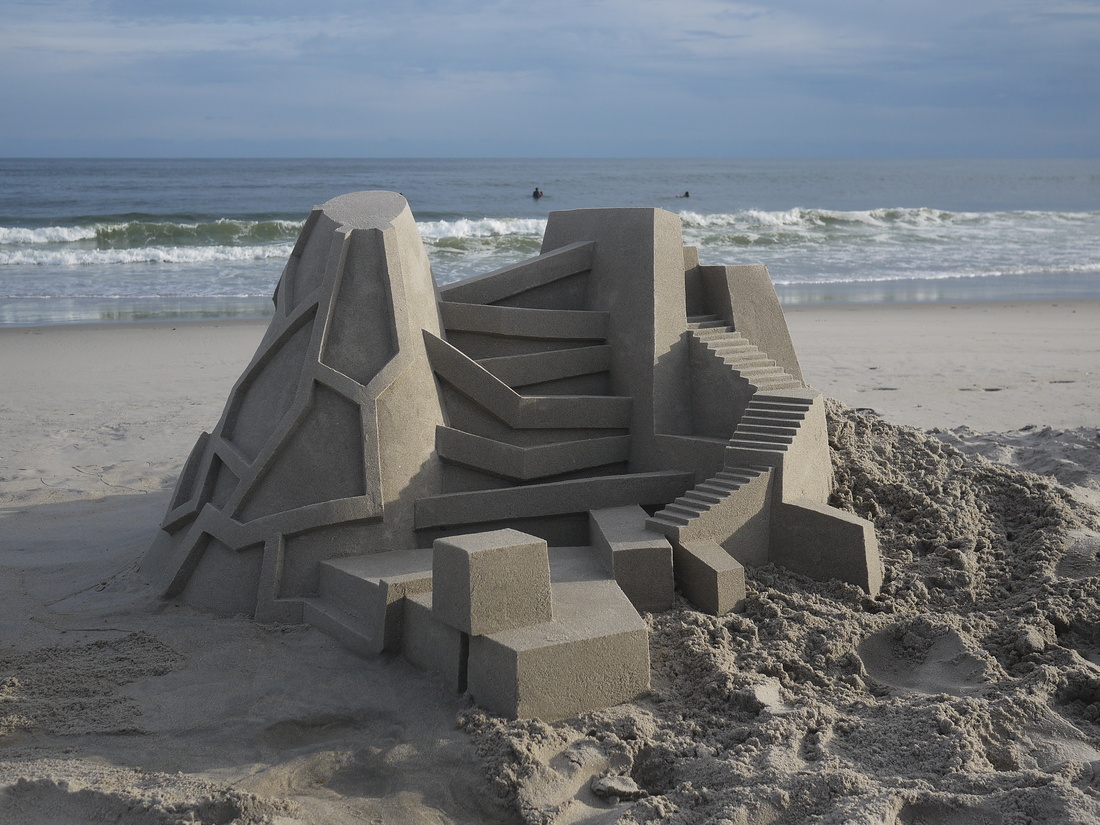
Photo: Calvin Seibert
Artist Calvin Seibert lives frugally in order to make his ephemeral art. He favors New York beaches for his sandcastles.

Here’s something a bit warmer to think about as winter’s cold brings out our heavy coats, boots, gloves, hats, and scarves: sandcastles at the beach.

Alexxa Gotthardt writes at Artsy, “It’s early September on New York’s Rockaway Beach, and the strong winds — aftershocks of Hurricane Harvey — keep most beachgoers away. But not sandcastle artist Calvin Seibert.

“He’s sitting on the shore, midway through sculpting the latest of the many whimsical castles he’s made over the course of the summer. This one — whose angled edges and shadowy nooks resemble a Brutalist temple by way of M.C. Escher — rises from a plot close to the crashing waves. …

“The artist, now 59 years old, has been making sandcastles most of his life. Over the last five years, he’s made the ephemeral structures the focus of his overall art practice, which has also included sculptures forged from cardboard salvaged from the street. ‘I’ve always made things outdoors from the materials I find around me, so this is sort of a long continuation of that,’ Seibert tells me …

“Seibert grew up in Vail, Colorado, in the 1960s, when the resort town was growing fast and mired in construction projects. ‘Everywhere you looked, there were construction and sand piles to play in, and scrap and garbage mounds to pull stuff from,’ he remembers. From these leavings, he built treehouses, fantasy worlds, and models of buildings that he’d glimpsed, like the TWA Flight Center at New York’s JFK Airport. …

“Like most other aspects of Seibert’s life, his process is economical. ‘I do this partly because the main materials I use, sand and water, are free — and there’s a lot of them,’ he explains, smiling. ‘I also live very frugally. No eating out. No movies. No air conditioning. No dog. No car. That’s how I can afford to do this.’ …

“This past winter, Seibert [exhibited] his sandcastles at Ramiken Crucible on New York’s Lower East Side. For several months, he made them on the gallery floor with construction-grade sand trucked in from a local lumberyard. The show marked a rare occasion that Seibert’s castles were for sale (one went to an unnamed private collector).

“Seibert has made money from his sand creations in other ways, too. … Hermès also tapped Seibert’s skills for one of the luxury brand’s photo shoots. The trip to took him first to Paris, where he gathered supplies. ‘On Facebook, I said, “I knocked that off my bucket list … I’m in Paris, shopping for buckets!” ‘ he laughs.”

More great pictures at Artsy, here.
Read Full Post »


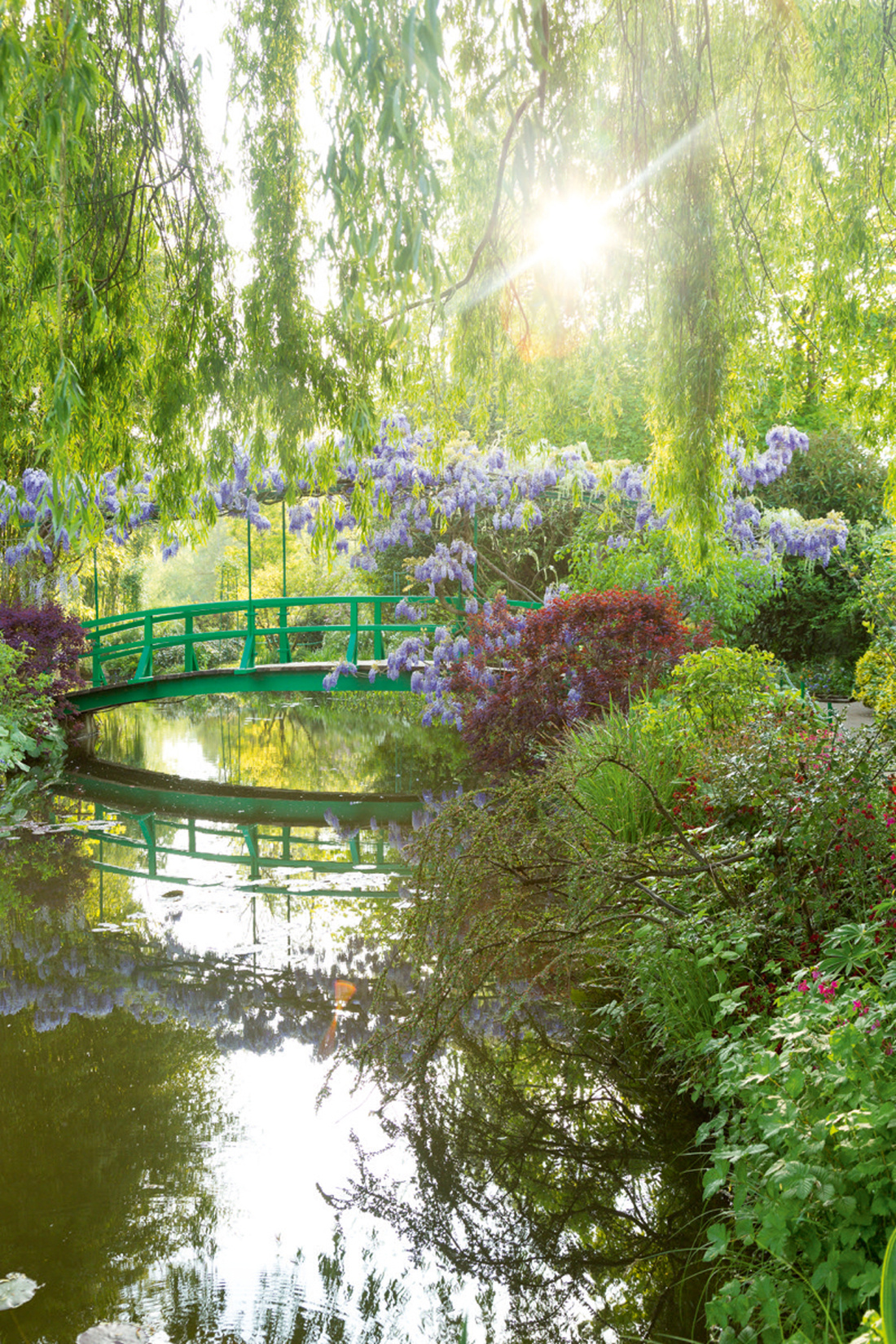
Photo: Eric Sander
Monet’s water garden and the Japanese footbridge in Giverny, France. Gilbert Vahé has been working to maintain the aesthetic of the Impressionist painter’s gardens since 1977.

I’ve always admired historic preservation efforts that save beautiful, old buildings while giving them new, modern purposes. There is a recognition of beauty as both immutable and changeable.

Similarly, ensuring a garden continues to look the same as when an artist painted it is a matter of germinating, blooming, dying, and rebirth. You can’t preserve a garden in amber.

Casey Lesser writes at Artsy about a horticulturist who practices a complicated art that is at the mercy of the seasons.

“Each year, from late March to early November, more than 500,000 people travel to Giverny, France, to visit a place they’ve primarily seen in paintings,” Lesser writes.

“They arrive to find a charming pink farmhouse with emerald-green shutters, set among brilliant flowerbeds that overflow with tulips, lavender, or sunflowers, depending on the season. They follow signs to a tunnel, and are led to an oasis of weeping willows and bamboo shoots, where they can amble along a pond packed with waterlilies, before crossing a familiar Japanese footbridge cloaked in wisteria.

“More than just the idyllic inspiration and open-air studio behind some of the world’s most famous paintings, Claude Monet’s gardens in Giverny have long been understood as a total work of art in their own right. …

“On July 10th, Jean-Yves Le Drian, French Minister for Europe and Foreign Affairs, announced that the site would be a candidate for a UNESCO World Heritage Site designation. That achievement is due in no small part to Gilbert Vahé, Giverny’s head gardener. …

“Vahé’s post at Giverny began with the restoration of the gardens in 1977. While Michel Monet, the artist’s son, had left the property to Paris’s Académie des Beaux-Arts upon his death in 1966, with a view for it to become a museum, it went untouched for a decade.

“An initiative to revive the garden eventually materialized thanks to the French philanthropist and curator Gérald Van der Kemp, who is also known for spearheading the restoration of the Palace of Versailles, and who would go on to become the first director and curator of at Giverny. In 1970, he set up the Versailles Foundation in New York, which was backed by American patrons, and would also fund Giverny. But it was not until an auspicious meeting with Vahé that the gardens really began to take shape. …

“The process of revitalizing the gardens was slow, spanning a long four years. Vahé worked alongside a team of fellow gardeners, including one who had worked alongside Monet himself. …

“Monet had bought the farmhouse and its land in 1883, stumbling upon it while on a walk, and later permanently traded the avenues of Paris for the rolling hills of Normandy. After fitting the house to his needs — painting its walls in hues of blue and yellow, setting up a studio, and hanging it with his collection of Japanese prints — he turned to the gardens.  …

“The plants we see today are not exactly the ones that Monet painted a century ago, and they’re not all placed where they were when the artist lived, but Vahé believes that’s not what’s important. Rather, he works to maintain the original aesthetic — a certain profile of color and light — that corresponds to Monet’s vision.”

More at Artsy, here. The article includes some pictures you’ll like.

Read Full Post »


Photo: Jared Soares for the New York Times
Dupont Underground, a converted trolley station, functions as an experimental art and cultural space in Washington’s Dupont Circle neighborhood.

Kids are pretty literal about things they hear adults say. I knew a girl, a granddaughter of John D. Rockefeller, who when very young was supposed to recite Bible verses with all the students in her school. In her mind, the words “Praise and magnify Him forever” were “Praise the grandfather with a feather.” Someone corrected her.

If I were to tell one of my young granddaughters about underground art, I suspect she’d picture art that was literally under the ground, maybe for the ants that “go marching one by one, down to the ground, to get out of the rain.”

In Washington, DC, she’d be close to the mark. As Avantika Chilkoti wrote recently for the New York Times, an experimental-art space is located under Dupont Circle.

“Roaming the streets of the Dupont Circle neighborhood about 20 years ago, Julian Hunt spotted a grimy staircase leading down from the pavement to a boarded-up door.

“He spent many hours on the phone and in the city’s archives, which led Mr. Hunt to crawl through filthy tunnels with a flashlight to discover an old trolley tunnel inhabited by a small group of homeless people.

“Since the city’s trolley service shut down in 1962, the 75,000-square-foot labyrinth had been the site of a subterranean murder, rumored ’80s rave parties and a Cold War-era bomb shelter. Now, Mr. Hunt, an architect who was a founder of the Hunt Laudi Studio, has turned the tunnels into the Dupont Underground art space, which draws 3,000 visitors every month. …

“The tunnels are now part of a wave of spaces — from small galleries that host artists to sitting rooms that accommodate musicians — where local talent can showcase work in the capital rather than fleeing to New York. …

“ ‘We’re this intermediate opportunity,’ said Noel Kassewitz, director for arts programming at Dupont Underground. ‘We’re a young nonprofit so we have the flexibility to host more experimental works here while at the same time having the space.” …

“The tunnels belong to the District of Columbia government. But after much haggling with the authorities, delayed further by the turmoil of the global financial crisis, Mr. Hunt won a five-year lease in 2014.

“His nonprofit has since spent about $300,000 — raised through crowdfunding and private donations as well as ticket sales — to clean the space and install basic lights and ventilation. Local officials are watching its success closely after an attempt to draw people to the tunnels with a food court on another platform failed in the 1990s.

“For Mr. Hunt, the project is a form of activism in a city where, when people think of beautiful architecture, they think mostly of the preservation of historic buildings.

“ ‘It’s not the kind of activism where you actually do things, new things and where you experiment,’ Mr. Hunt said. ‘That’s not here. This is not an entrepreneurial city.’ ” More here. Check out the pictures.

I do like the concept, but I wish the reporter had told me what happened to the homeless people that Hunt found there 20 years ago.

Read Full Post »

Map: Nations Online Project
Fergus Falls didn’t need much money from the National Endowment for the Arts to create both economic benefits and constructive conversation across the political divide.

As Victoria Stapley-Brown wrote recently at the Art Newspaper, the arts benefit communities in many ways, and in rural America, a little funding can go a long way.

“A grant of $25,000 is not even a drop in the bucket of the US federal government’s spending, around $3.5 trillion per year. But it was able to effect visible change in Fergus Falls, a small rural community in Minnesota with a population of 13,000, which received $25,000 from the National Endowment for the Arts (NEA), the government agency that funds art and culture across every congressional district in the nation, in 2011. …

“With the $25,000 NEA grant, the St Paul, Minnesota-based arts non-profit, Springboard for the Arts, which calls itself ‘an economic and community development organization for artists and by artists,’ opened an office in Fergus Falls and was able to launch a multi-year cultural project. Since 2011, the organisation has been given a total of $145,000 in NEA grants — but has also received over $1.2m in funding from private donors, such as the McKnight Foundation. …

“The project explores ‘how artists can be a part of rural economies and rural communities,’ … to encourage young people to stay in the town and see it as a viable place to make a living and raise their families …

“Artists from other communities working across all media, from the visual arts to music to film-making, have also come to Fergus Falls for the Hinge Arts Residency, a programme that has hosted 45 artists for one to three months. These artists live in apartments on the property of the formerly disused hospital complex, which has spurred a local conversation about preservation and the use of historic buildings in the town, and local politics. …

“The artists-in-residence have carried out their own work during their residencies, which often involve the local community, such as the folk and punk musician Shannon Murray’s research into music and Minnesota working class history. They have also shown work in empty storefronts and organised community art projects, such as casting architectural elements of disused buildings, and giving art classes to local children.” More here.

Hat Tip: Arts Journal.

Photo: Rick Abbott
Kirkbride Art & History Weekend at the former Fergus Falls State Hospital Complex, which is on the National Register of Historic Places.

Read Full Post »

072117-Cynthia-Bloom-Block-Island-art

I went to the deCordova Sculpture Park and Museum in Lincoln Friday to see what New England women had been doing with abstract art since 1950.

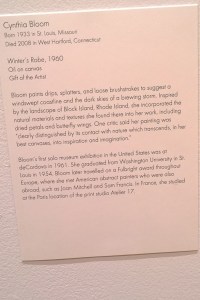
I was drawn to the painting above, and no wonder. It turned out to be Cynthia Bloom’s way of seeing New Shoreham, Rhode Island, my favorite place in the smallest state. The explanatory text says the artist “incorporated the natural materials and textures she found there into her work, including dried petals and butterfly wings.”

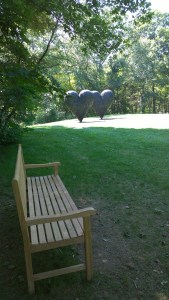
The gigantic heart sculpture looks sweet enough from a safe distance, but when you get close to Jim Dine’s “Two Big Black Hearts” (1985) and see all the broken tools, horseshoes, ladies shoes, etc., smashed roughly into the surface, you may feel a chill.

What’s nice is that on a summer’s day, you can walk in the shady woods on the deCordova grounds and see art along the paths. The serene head is “Humming,” by Jaume Plensa (2011), and the more abstract piece is “Maiden’s Dream,” by Isaac Witkin (1996). That one makes me ask, “Is it a good dream?”

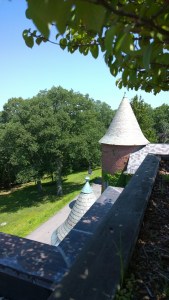
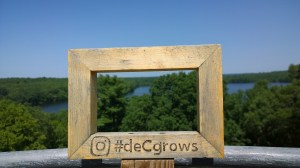
After spending time on the grounds and in the galleries, I took the elevator to the roof deck and photographed the romantic turrets of what was once the home of art collector Julian de Cordova (1851-1945). I don’t think I had ever been on the roof before. The view over Flint’s Pond is amazing.

072117-Cynthis-Bloom-Block-Island-art-at-decordova

072117-Jim-Dine sculpture-decordova

072117-Plensa- sculpture-in-decordova-woods

072117-Witkin-sculpture-in-decordova-woods

072117-decordova-art-museum-turrets

2117-Flints-Pond-deCordova-Lincoln-MA

Read Full Post »


Photo: Ruairi Gray/Twitter
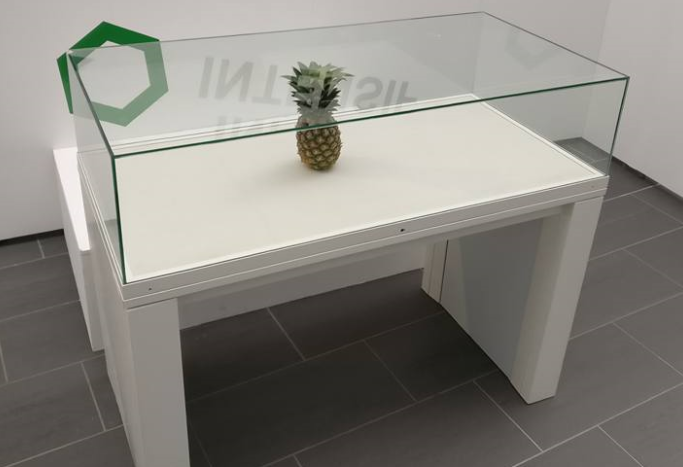
Students tricked a museum into exhibiting an ordinary pineapple as a piece of art.

They used to say of the Walker Art Center in Minneapolis that the janitorial staff had to be careful not to leave a mop and bucket in a gallery even for a moment or they could come back to find a cluster of museum-goers studying it.

Actually, that can happen.

Recently, Roisin O’Connor wrote at the Independent that students left a pineapple in a gallery of a Scottish museum and someone on the staff thought it was the real thing.

“Students claim they managed to pass off a pineapple they bought for £1 at a supermarket as a work of art, after leaving it in the middle of an exhibition at their university,

“Ruairi Gray, a business information technology student at Robert Gordon University in Scotland, and his friend Lloyd Jack, reportedly left the fruit at the Look Again exhibition at RGU’s Sir Ian Wood building, hoping that it might be mistaken for art.

“When they returned four days later he found that the pineapple had been put inside its own glass display case at the event. …

“Natalie Kerr, a cultural assistant for the festival who organised the display, said she wasn’t the one who included the fruit as an artwork because she is allergic to pineapple.

” ‘We were moving the exhibition, and came back after 10 minutes and it was in this glass case,’ she told the Press & Journal. …

“The incident recalls a similar prank last year when a 17-year-old placed a pair of glasses on the floor at the San Francisco Museum of Modern Art.

“Apparently unimpressed with some of the work on display and wanting to test the theory that people will try to interpret any object provided it is in a gallery setting, TJ Khayatan placed the glasses on the floor and walked away.

“Soon after, visitors to the gallery surrounded them and began taking pictures.”

More at the Independent, here, and at the NY Times, here.

Read Full Post »

Art: Simon Roberts
Simon Roberts was the “election artist” for the 2010 general election in the United Kingdom. He chose 24 images — one for each day of the campaign — to reflect the geographical breadth of the trail
. Cornelia Parker is the election artist for 2017.

Not long ago, my husband pointed out a story about official “election artists” in England. That was a new idea for me.

An article in the Economist offers background.

“Many were bemused by the announcement on May 1st that Cornelia Parker was to be the official artist of the 2017 general election. Not as a comment on Ms Parker’s credentials — she is widely considered to be one of Britain’s most exciting contemporary artists — but to discover that such a post exists.”

Parker is the first woman chosen since the post was established in 2001 and the first conceptual artist.

“Jonathan Yeo, the inaugural artist, created a triptych oil painting of the main party leaders where the size of their portrait correlated to their portion of the vote. In 2005, David Godbold produced Hogarthian satirical illustrations on scraps of election ephemera such as manifestos, letters and flyers. In 2010 Simon Roberts photographed the quiet lanes and doorstep conversations of day-to-day campaigning …

“Ms Parker is using an Instagram account (@electionartist2017) to offer an eclectic commentary: so far she has posted pictures of road signs, homeless people and newspaper headlines. One image, captioned ‘The election contenders,’ shows a group of waving garden gnomes.

“Two further stipulations come with the role. First is that the artist must remain politically impartial. … The second is that they must produce a final work — one that can be put on display, or contain elements that can be displayed — which will eventually join the parliamentary art collection.”

I searched the web but couldn’t find Parker’s piece for the permanent collection. Maybe a reader will find it for me. It’s hard to envision what an artist known for “detonated sheds, cut-up shotguns and squashed instruments” would come up with, even if she is currently focused on instagram.

The Economist story is here, the Guardian‘s here and the New Yorker‘s here.

Read Full Post »


Image: The Art Newspaper
Alexander Ponomarev’s underwater art project, “Alchemy of Antarctic Albedo (or Washing Pale Moons)” was said to be for the edification of whales.

Quirky art projects in quirky places call for quirky reporters. Adrian Dannatt writes entertainingly at the Art Newspaper about memorable moments experienced on a trip to cover underwater art — in the Antarctic.

“Typical barren beach; Joaquin Fargas putting reflective silver sheets over the rocks to try and help stop global warming whilst the young architect Gustav Düsing was busy with his white cotton tent, sprayed with water to freeze rock-solid like salt or Greek marble drapes. …

“Rather effective photo exhibition using special plastic display boxes on tripods mounted in the water and along the beach, the horizon line in a photograph next to actual horizon on the sea. …

“At 4 pm it had been a week since we first came up the gangplank and boarded this boat, now our dear old friend. All gather on the back deck for Alexander-the-Great, Pon-Pon lui-même to launch his own underwater art project, ‘Alchemy of Antarctic Albedo (or Washing Pale Moons).’

“These submerged lit globes will be lowered into the sea in order ‘to clean the moon ash.’ He happily admits that he is making this work just for the whales, typically generous, ‘they are a better audience than so many others.’ …

“Much masculine labour, heaving and pushing, to get the moon-balls out to sea, a sweaty, rather laborious form of three-dimensional poetry.

We went out in our Zods but of course could not see anything of the project because it was all underwater, made for the fishes rather than mere humans.

“However the two Argentine underwater divers, fantastic moustachioed veterans straight out of Hemingway, who had been very dismissive and suspicious of the whole thing, were actually impressed, touched, transformed by seeing the reality. Which makes it a successful art work by any definition, and the whales apparently surely adored it also.” More here.

It feels both silly and sacred. Like liturgical clowns.

Read Full Post »

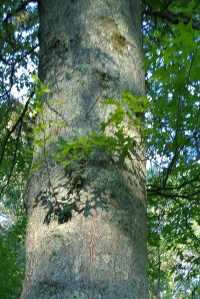
I’m back to taking walks near my home and looking for interesting shadows. The current collection of photos includes leaf shadows on a tree trunk. Only a couple dog walkers were out when I shot this, but I noted an unusual number of cars outside a house flying “2017” balloons. Probably a late-night graduation bash. All was quiet as the grave at 6:30 a.m.

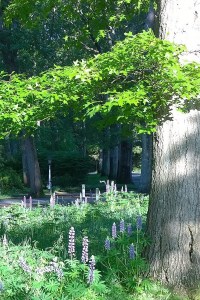
Nearby, blue lupines caught my attention. I admired many lovely ones in Sweden and was happy to see that, while I was gone, a whole batch was blooming along my usual walking route.

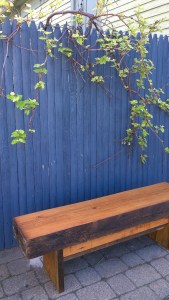
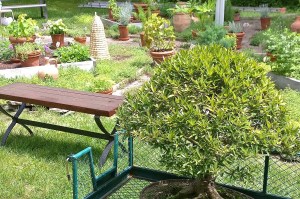
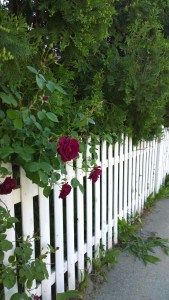
I’m also sharing a grapevine over a bench, a bonsai tree near the church herb garden, and a deep red rose on a white picket fence.

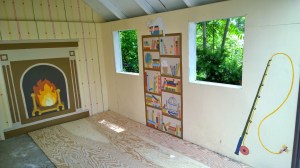
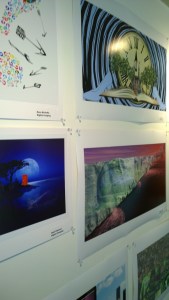
More unusual: the big playhouse at the nursery school and some elaborate digital art by high school students.

061117-leaf-shadows

061117-lupines-ConcordMA


051817-bench-under-grape-arbor

060917-bonsai-and-herb-garden


061117-deep-red-rose-white-picket-fence

060917-playhouse


052117-CCHS-digital-art

Read Full Post »

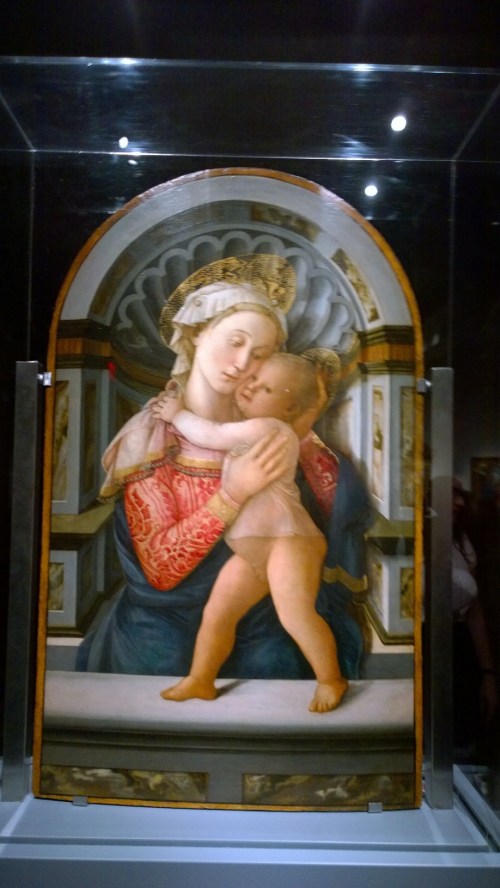
061017-Felippo-Lippi-Madonna-and-Child

I made it to “Botticelli and the Search for the Divine” at the Museum of Fine Arts. By the time I paid for the ticket, the parking garage, lunch, and gas, it was an expensive outing, but I was glad I went. The show closes July 9.

Curiously, I think I loved the tenderness of the mother-and-child by Felippo Lippi (above) the most. That isn’t to say there wasn’t a splendid Botticelli Venus, holding her long tresses in a way that made her look like Eve and the snake. And I was delighted to see the famous Minerva and centaur that I admired so much in Florence when I was 16.

I don’t think I ever knew the centaur story. I ask you, does it look more like the Goddess of War just defeated a warlike centaur or like a tragic couple accepting that they have no future together? The latter version is what I made up, and it still works for me.

But getting back to Botticelli’s teacher: I remembered the name from “Fra Felippo Lippi,” a long, biographical poem by Robert Browning that we were assigned in high school.

So when I got home, I went on Google to have a look. The poem includes a description of the artist’s early years as a street urchin, before being handed over to the friars to be trained as a monk. I wanted to share this section of the poem about how Lippi became a close observer of his world.

“But, mind you, when a boy starves in the streets
“Eight years together, as my fortune was,
“Watching folk’s faces to know who will fling
“The bit of half-stripped grape-bunch he desires,
“And who will curse or kick him for his pains, —
“Which gentleman processional and fine,
“Holding a candle to the Sacrament,
“Will wink and let him lift a plate and catch
“The droppings of the wax to sell again,
“Or holla for the Eight and have him whipped, —
“How say I? — nay, which dog bites, which lets drop
“His bone from the heap of offal in the street, —
“Why, soul and sense of him grow sharp alike,
“He learns the look of things, and none the less
“For admonition from the hunger-pinch.
“I had a store of such remarks, be sure,
“Which, after I found leisure, turned to use.
“I drew men’s faces on my copy-books,
“Scrawled them within the antiphonary’s marge,
“Joined legs and arms to the long music-notes,
“Found eyes and nose and chin for A’s and B’s,
“And made a string of pictures of the world
“Betwixt the ins and outs of verb and noun …”

More on Lippi at Wikipedia, here, and on Botticelli, here.

061017-Minerva-and-centaur-Botticelli.jpg

Read Full Post »

060917-art-and-words-show

Mary Ann alerted me to a local art show co-curated by her artist friend Holly Harrison. I will be visiting this exhibit more than once — it’s a beautiful assemblage of artworks that incorporate words, and there’s a lot to read.

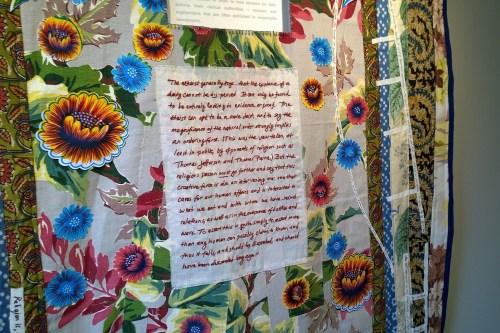
Included in the show “Inhabiting Words” are two needlework pieces by Liz Shepherd that I think will interest blogger KerryCan, given her recent post about a woman who stitched information for her citizenship test into a sampler. (Read it here.)

KerryCan wrote that the citizenship project “was created by artist Aram Han Sifuentes. Sifuentes, from South Korea, prepared for her own US citizenship test by embroidering a sampler of 100 questions and answers typical of the test questions, questions like, ‘What did Susan B. Anthony do?’ ‘Who wrote the Declaration of Independence?’ ‘What is the capital of your state?’ ” I think I should suggest this to a certain Cambodian ESL student who sews.

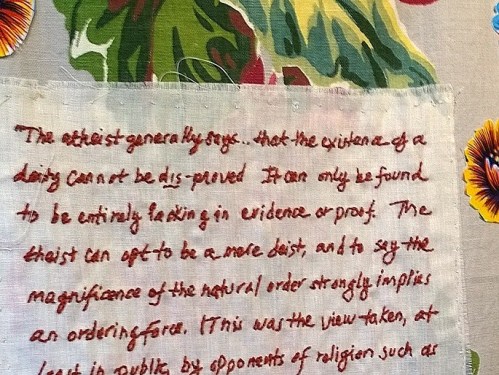
In Liz Shepherd’s creation for the Concord Center for the Visual Arts show, the topic is religion and its sometimes unintended consequences. Here she stitches ruminations by the late Christopher Hitchens.

060917-Liz-Shepherd-philosophy

060917-Liz-Shepherd-sews-Hitchens-words


Read Full Post »

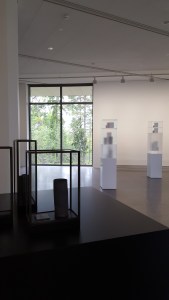
Tuesday we went to Artipelag, a pretty spectacular new museum in the archipelago on the east coast of Sweden. It was built by the founder of Baby Bjorn, with great attention to detail. We liked the wide windows that brought the outdoors in and the way that massive archipelago rocks were kept in place and worked into the design of the rooms.  Below you can see the rock wall in the bathroom, for example, and the rock in the lunchroom with its live candles marching along one edge.

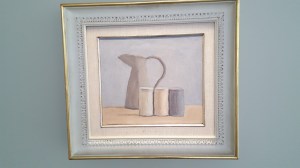
I took some of these pictures, and Stuga 40 took the rest. The current exhibit features the still life paintings of Giorgio Morandi (Italian, 1890-1964) and ceramic pieces made in admiring response by British potter and author Edmund de Waal. (Some people know the latter for the book The Hare with Amber Eyes, a memoir highlighting his family’s netsuke art.) I had not known about Morandi and found his simple, domestic shapes and shadows beautiful.

I should mention that the food at Artipelag was delicious. We had a smörgåsbord buffet, and Stuga 40 made sure we knew how to eat the dishes in the correct Swedish order. I have posted a picture of her friend Anna (in orange) discussing the art with me.

On less wet days, you can have a beautiful walk up and down the Artipelag grounds or tie up your boat at the museum’s dock and climb up for a picnic.

053017-Artipeleg-museum-Sweden

053017-rockc-wall-Artipelag-bathroom


053017-candles-and-native-rock-in-museum

053017-Morandi-at-Artipelag-Sweden


053017-Artipelag-Edmund-de-waal-show

053017-Anna-at-Artipelag-on-her-bday


Read Full Post »

Image: Norah Borges
The artist’s older brother, Jorge Luis Borges, wrote that Norah was the fearless one in the family and “I the slow, timid, submissive one. She climbed to the top of the roof, traipsed through the trees, and I followed along with more fear than enthusiasm.”

How many women in the arts have been overshadowed by the men in their families? Countless. Just the other day I was surprised to hear some work by Fanny Mendelssohn — composer of more than 480 pieces of music — that was pretty impressive.

Maria Popova at Brain Pickings wrote recently of another female artist who was new to me: “Few people know that literary titan Jorge Luis Borges had a sister, and even fewer that Leonor Fanny Borges Acevedo (1901–1998), better-known under the pseudonym Norah Borges, was an acclaimed artist in her own right, who emerged in the 1920s as one of the female pioneers of modern art. …

“During her lifetime, Borges illustrated close to eighty books, including some of her brother’s, in addition to editorial illustrations for a number of avant-garde magazines belonging to ultraísmo — the first major avant-garde movement in Spain, comprising an eclectic group of writers and artists influenced by Italian futurism.

“Her soulful paintings and drawings, the earliest of which is collected in the out-of-print Spanish-language volume Norah Borges: Obra Gráfica, … spans more than seven decades and is nothing short of breathtaking.” See examples of that oeuvre here, at Brain Pickings.

For details on the life of Norah Borges, go to Wikipedia, here.

Photo: Wikipedia
Norah Borges, Argentinian artist, 1901-1998

Read Full Post »

How did we get halfway through May already? It’s time to mention I’ll be taking my first break in six years between May 26 and June 6. We’ll be in Sweden. I’ll try to blog, but you never know.

It sure will feel strange not to post. I have put something up on this site every day since May 2011!

But before I leave, I have other things to share, including today’s photos. The first two are from the giant mural in Dewey Square, Boston — the latest in the Greenway’s ongoing series. The featured artist this time is Mehdi Ghadyanloo from Iran, where he is known for upbeat murals.

The next photo shows a WPA mural in the Arlington, Mass., post office. John pointed me to it after he saw my recent post “Hunting Down WPA Art.”

Then comes another of my shadow photos. Can’t resist shadows. That one is followed by tree-stump mushrooms and dogwood. Can’t resist mushrooms either.

The four Providence photos that follow attest to the fact that the city finally experienced a sunny Tuesday morning (the first since February). Blackstone Park is the location of the Indian shelter and the fallen birch tree with the mysterious yellow plastic strips (art?). Nearby was a wondrous carpet of pink petals and an early rower on the Seekonk River.

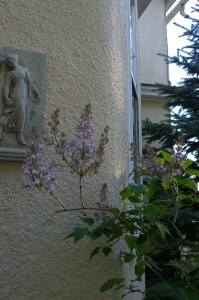
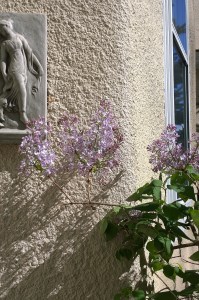
Finally, I wanted to show you my lilac progression. With muse.

042817-Greenway-mural-Boston

042817-Iranian-artist-Mehdi-Ghadyanloo


042917-WPA-mural-in-ArlingtonMA-PO

051117-can't-resist-sun-and-shadow


043017-mushrooms-on-stump

051217-feathery-dogwood-and-garage


051217-feathery-dogwood-and-garage

051617-fallen-birch-art


051617-carpet-of-petals-Providence

051617-sculling-on-the-Seekonk


042617-lilac-and-lady-1

050317-lilac-and-lady-2


050617-lilac-and-lady-


Read Full Post »

screen-shot-2017-04-28-at-153802

Photo: SWG3/Facebook
Y
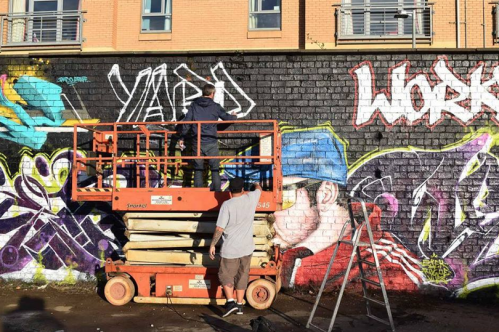
ardworks takes place May 6 and 7
, 2017, in Glasgow, Scotland.

Melita knows I like artistic graffiti. In fact, we are both such fans of Lata_65 (graffiti for old folks) that we intend to try our hand at spray painting if the organization ever comes to the Boston area.

Today Melita shared a link on Facebook about graffiti in Glasgow.

Gregor Kyle wrote at GlasgowLive, “Scotland’s first dedicated graffiti festival will take street art into the heart of the community in Glasgow and open up new opportunities for young people across the city.

“Next weekend (May 6 and 7) in Finnieston, SWG3 will host over 30 of the world’s finest graffiti artists and 50 of Scotland’s street artists at the Yardworks Festival. …

“One of its main aims is to strengthen SWG3’s bond with the local community and the city of Glasgow as a whole.

“School and youth groups have been invited, with the days featuring specialist graffiti workshops and a ‘Creation Station’ for children which will allow everyone the chance to try their hand at painting. …

“ ‘It’s Scotland’s first graffiti festival and the scale of it now, the way it has grown, it’s massive now,’ explained Gaz, who is himself a graffiti artist and part of the management team at SWG3. …

“Most Glaswegians will know SWG3 as a club and concert space but by day it is a thriving hub for artists, filled with studio spaces and workshops. Slowly but steadily it has progressed over the years with the scale and ambitions of its projects growing bigger and bigger.

” ‘The yard is now basically a massive canvas for the artists,’ continued Gaz. ‘We have rendered the walls, wrapped containers in sheet metal – at no small expense – and every surface will be perfect for the artists to paint on. …

” ‘We are trying to build a sense of community in the area, which can be hard sometimes when you have a transient population with some of the students maybe only staying in the flats here for a term and then moving on.

“ ‘Finnieston has this reputation as this hipster area; what people forget is that there is this core population here and in the likes of Partick and Anderston who have lived here a long time. …

“ ‘The Commonwealth Games in Glasgow were fantastic for the city. They drew people together and, through a number of projects, connected me with a lot of other artists and graffiti writers that I didn’t know in the city.

“ ‘We will be looking to run workshops in the summer for young people and will try to play our part in improving the area and bringing the community together.’ ”

More at GlasgowLive, here.

Read Full Post »

« Newer Posts - Older Posts »