Feeds:
Posts
Comments

Posts Tagged ‘Asheville’

Photo: Erin Brethauer.
Marquee hosted more than 300 artists and small business owners in Asheville, North Carolina, before Hurricane Helene, a devastating storm in 2024.

When Hurricane Helene washed through Asheville, North Carolina, last year, my childhood friend Ursula was one of the many who lost out. Her basement washed out, not only forcing her to stay at a neighbor’s but damaging many of her father’s artworks and the materials for her own weaving. At the same time, Asheville lost its whole arts district.

Now Ursula is rebuilding, and so is Asheville.

Jonathan Abrams writes at the new York Times, “Jeffrey Burroughs strolled among crooked trees and clumsily leaning chain-link fences on a recent Thursday afternoon in Asheville’s lower River Arts District. Nearby, heaps of flood-damaged antiques dotted the ground outside gaptoothed buildings that had previously housed hundreds of working artists.

“ ‘It’s nice that at least it’s green,’ Burroughs, president of the River Arts District Artists, said of the bent trees. ‘It was really depressing through the winter and the fall.’

“Burroughs, who uses they/them pronouns, is not joking when they say they have taken just two days off in the more than 10 months since Hurricane Helene, the deadliest hurricane to strike the mainland United States since Katrina in 2005, ravaged wide swaths of the Southeast, leaving at least 250 people dead.

“The storm overwhelmed Asheville’s French Broad River, submerging much of the once robust River Arts District in as much of 24 feet of water, caking it in layers of mud and destroying the life’s work and financial pipeline of hundreds of artists. …

“ ‘People were prepared because this area has flooded’ in the past, Burroughs said. ‘They moved everything up. Nobody anticipated second floors would flood. That’s not something you even conceive.

‘All of a sudden, it was like a lake opened in the middle of our town.’ …

“Over the past few decades, the River Arts District blossomed into that sprawling artistic epicenter as antiquated buildings transformed into bustling studios, classrooms, galleries and showrooms. The district’s recovery is seen as a crucial step in regaining a steadiness of income and the sense of normalcy for the many who lost so much in the storm.

“ ‘The business owners in the River Arts District have been working their tails off to rebuild since Hurricane Helene struck and I am making sure the state works with that same urgency to support their recovery,’ said Gov. Josh [Stein] who recently toured the district on a bike.

“The River Arts District housed nearly 750 artists before the hurricane. ‘You’re just immersed in art,’ said Davis Perrott, a woodworker who recalled waking up from the storm to a sound like someone forcefully slamming themselves against his window. ‘I’m sure there are other areas like it, but I haven’t seen it.’

“The upper portion of the district, which houses Burroughs’s jewelry store, returned fully in January. A few spaces have reopened in the lower portion of the district, which is closer to the river and suffered the most flooding.

“About 350 of the displaced artists are working again in the district. Some are actively involved in the continuing recovery process, waiting to return to the home that welcomed them.

“Others have decided not to return. For them, the risk of another storm outweighed anything else.

“Riverview Station was a major hub in the district, once hosting hundreds of artists, including the 14,000-square-foot ceramics space, the Village Potters Clay Center. That was before ’26 feet of water went through and wiped us out,’ said Sarah Wells Rolland, its founder. …

“The center was home to studios, showrooms, a gallery and classrooms where workshops were held. Wells Rolland said that $500,000 worth of equipment was lost in the flooding.

“ ‘I never even entertained going back,’ she said. … ‘I believe it’ll all wash away again.’

“Instead, Wells Rolland opened a new center near the arts district. While her business has returned, she is still searching for her creative spark.

“ ‘I’ve lost a lot of people. … Just numb is what I felt. I didn’t have any ideas. Still, almost a year out, I’m a highly creative person, but I still don’t feel like I have that creative energy yet.’

“As the district returns in fits and bursts, it could provide a blueprint for how other communities ravaged by increasingly destructive natural disasters can recuperate their livelihoods. Those affected have been depending much more on smaller networks of supporters and volunteers than on any government channels. …

“Marquee, an art gallery that hosted more than 300 artists, [anticipated] a September reopening, with other businesses in the lower district.

“ ‘We’re able to tweak the things that we wished we’d have done the first time before we opened and now we’re getting to get it all right,’ said Robert Nicholas, the building’s owner.

“Despite the devastation it caused, the storm reinforced what had drawn many to the district in the first place, heightening their sense of community.” More at the Times, here.

Read Full Post »

Photo: Kyle Mellott via Heather Divoky.
Catastrophic flooding swallowed up buildings of Asheville’s River Arts District. Despite ongoing floods and fires in the US, government disaster relief is facing big cuts.

My childhood friend Ursula, an artist in Asheville, North Carolina, lost much of her own and her late father’s artwork to Hurricane Helene last year. As I consider the Hyperallergic article below, I can’t help thinking that in addition to individuals who helped victims (like blogger Deb), government disaster relief (like FEMA, now on the chopping block), was indispensable.

Rhea Nayyar wrote, “Southeastern states are reeling from catastrophic loss and damages after Hurricane Helene tore a deadly path of devastation from Florida’s Big Bend region up through inland Georgia, the Carolinas, and Tennessee. In the mountains of western North Carolina, the city of Asheville was particularly hard hit by flooding … obliterating the cherished River Arts District (RAD) — a creative hub home to studios, galleries, community spaces, and other artist-run small businesses.

“ ‘Two-thirds of the district has been destroyed,’ said Jeffrey Burroughs, president of the River Arts District Artists Association, in an interview with Hyperallergic. Hosting over 350 local artists and craftspeople, the RAD complex comprises 27 buildings that span just over a mile of the eastern riverside. The southernmost string of buildings along Foundy Street, including the enormous Marquee warehouse which was once a bustling marketplace for artisans and antique dealers, are ‘gone,’ according to Burroughs. …

“ ‘Marquee is rubble, the nearby winery has washed away … It’s completely apocalyptic,’ Burroughs said. He recalled overseeing artwork, art supplies, and cans of beer being carried off by the [water] itself, saying that it was like ‘watching the spirit of Asheville being washed away.’

“A little further north at Pink Dog Creative on Depot Street, Asheville artist Heather Divoky, a marketing co-chair for RAD, told Hyperallergic … ‘This will absolutely reshape RAD — we’re going to be forever changed,’ Divoky said. ‘We’re all in complete shock right now. I don’t know how many of us can come back.’

“Down the street, Trackside Studios reported that flood waters reached the ceiling of the first floor where about 40 of the 60 studio artists maintain their practice. Co-owners Julie Bell and Michael Campbell were out of state during the storm, and have since become a communications switchboard as they have reliable internet access and power. Bell noted to Hyperallergic that Trackside Studios had recently completed a months-long renovation prior to the storm to restore the building’s historic appearance. …

“ ‘It’s so dangerous to clean up after these types of disasters because the mud is full of debris, mold spores, sharp objects, and dead fish. It’s neither safe nor sanitary,’ she said. …

“Miles east of RAD, artist, tax expert, and Hyperallergic contributor Hannah Cole reported that her studio along the Swannanoa River tributary had been entirely upheaved by floodwaters.

“ ‘The building is totaled,’ Cole told Hyperallergic, noting that 20 years worth of artwork and supplies were ‘effectively put in a blender for hours’ in a mixture of water, mud, heavy furniture and tools, and other debris carried in by the river.

“ ‘Some level of flooding is normal during big storms, but this has never happened before,’ Cole continued, adding that when she paid a risky visit to the studios after Helene, the water lines were up to the ceiling.

“Ruby Lopez Harper, executive director of the Craft Emergency Relief Fund (CERF+), which imparts safeguarding advice for natural disasters and offers emergency relief and preparedness grants to artists across the United States, told Hyperallergic that ‘recovery is going to take years.’

“ ‘We tell artists to store their things in waterproof bins and other such protective measures … None of that is going to help when your home is underwater,’ she said, explaining that no one had predicted this. …

“But on the ground, both Burroughs and Cole expressed that it’s impossible to even think so far ahead while they and their loved ones are still focused on securing potable water. However, Burroughs and the other RAD board members are conceptualizing an action plan to get stipends for artist relief, recovery funds for RAD, and a clean-up effort to remove the dangers and debris onsite.

“ ‘My husband and I moved here in 2020 after I was suffering from long COVID,’ Burroughs said. ‘There is nothing like this area, this community, anywhere else in the country. We will come back stronger.’ ”

More at Hyperallergic, here.

Read Full Post »

grandprize_wide-2fc2c36c86c8cd252a3b1bc853b6437d840515a9-s600-c85

Photo: Kristen Hartke/NPR
For the 2018 grand prize winner in Asheville, the judges were impressed by the intricate, working gingerbread gears of the clock inside Santa’s workshop.

Following up on last week’s post about extreme Christmas cooking, I’ll just say that whether the labor is for love or business, for fun or for cutthroat competition, it’s a treat to see what sorts of edibles our cooks turn out for the winter holidays.

Kristen Hartke reported at National Public Radio (NPR) on Christmas Eve last year, “Nadine Orenstein never expected to judge gingerbread houses. But several years ago, the curator in the Department of Drawings and Prints at New York’s Metropolitan Museum of Art happened to see a program on the Food Network about a competition in Asheville, N.C., and was intrigued. …

“Fourteen years later, Orenstein is still a judge for the National Gingerbread House Competition. … ‘In a way, it’s very similar to what I do as a career and, in some ways, completely different,’ she says.

“The biggest difference, of course, is that each entry must be entirely edible — although it’s fairly rare for the judges to actually eat the sweet creations — and must consist of at least 75 percent gingerbread. …

“The competition didn’t originate as a contest in 1992, but as simply a display of gingerbread houses made by Asheville locals. … This year, there were 195 entries from across the U.S. and Canada, which means that judging this contest is no cakewalk.

“Other than Orenstein, most of the eight judges come with a serious pastry pedigree, like Mark Seaman, master sugar artist for Barry Callebaut chocolate company, one of the world’s largest cocoa producers. Seaman has been judging the competition for over a dozen years.

” ‘It is a long and somewhat complicated process,’ he says. ‘Some people are literally spending hundreds of hours creating their entries, so we want to pay attention to the work they’ve put into it, but we also have to do all the judging in one single day.’ …

“Using specific criteria — creativity, difficulty, overall appearance, consistency of theme, and precision — each judge starts the morning by spending two hours choosing 10 favorites in each category. The competition staff collects the information, plugs it into Excel, and tabulates the first round of results, narrowing it down to a universal top 10 entries. Then the judges really get down to business, parsing the technical difficulty and design elements in half-points — numbers that go back into the spreadsheet for the final result.

“But while the competition relies on numbers to achieve fairness — sometimes the grand prize winner isn’t even selected by all the judges as one of their initial top 10 favorites — it’s ultimately a combination of technique and creativity that determines the winners. …

“For Seaman, craftsmanship is a key element, particularly when he sees something especially innovative, like this year’s

grand prize winner, which depicts Santa’s workshop with a clock made of functional gingerbread gears. The gingerbread was baked by creators Julie and Michael Andreacola, of Indian Trail, N.C., for several hours, then precision-cut with lasers. …

“While Orenstein finds the technical elements impressive, she is also looking for a compelling story, … ‘Sometimes, the lack of perfection is key in art,’ says Orenstein, ‘but what I’ve learned over time is that perfection in these gingerbread houses matters.’ …

“Those details might be the tiny copper Moscow mule mugs that grace a table where a group of reindeer are playing a game of poker, the labels on the cans lining the walls of a general store — all edible, mind you — or realistic-looking candles made of white chocolate that stand next to a gingerbread clock. …

” ‘You don’t enter a competition because you want to win,’ says Seaman. ‘You enter because you want to do the best work you can possibly do. The people who win are attached to the piece in some personal way. Even though the technique is really important, you shouldn’t learn how to do hot sugar just for the purposes of entering this contest.’ ”

More at NPR, here.

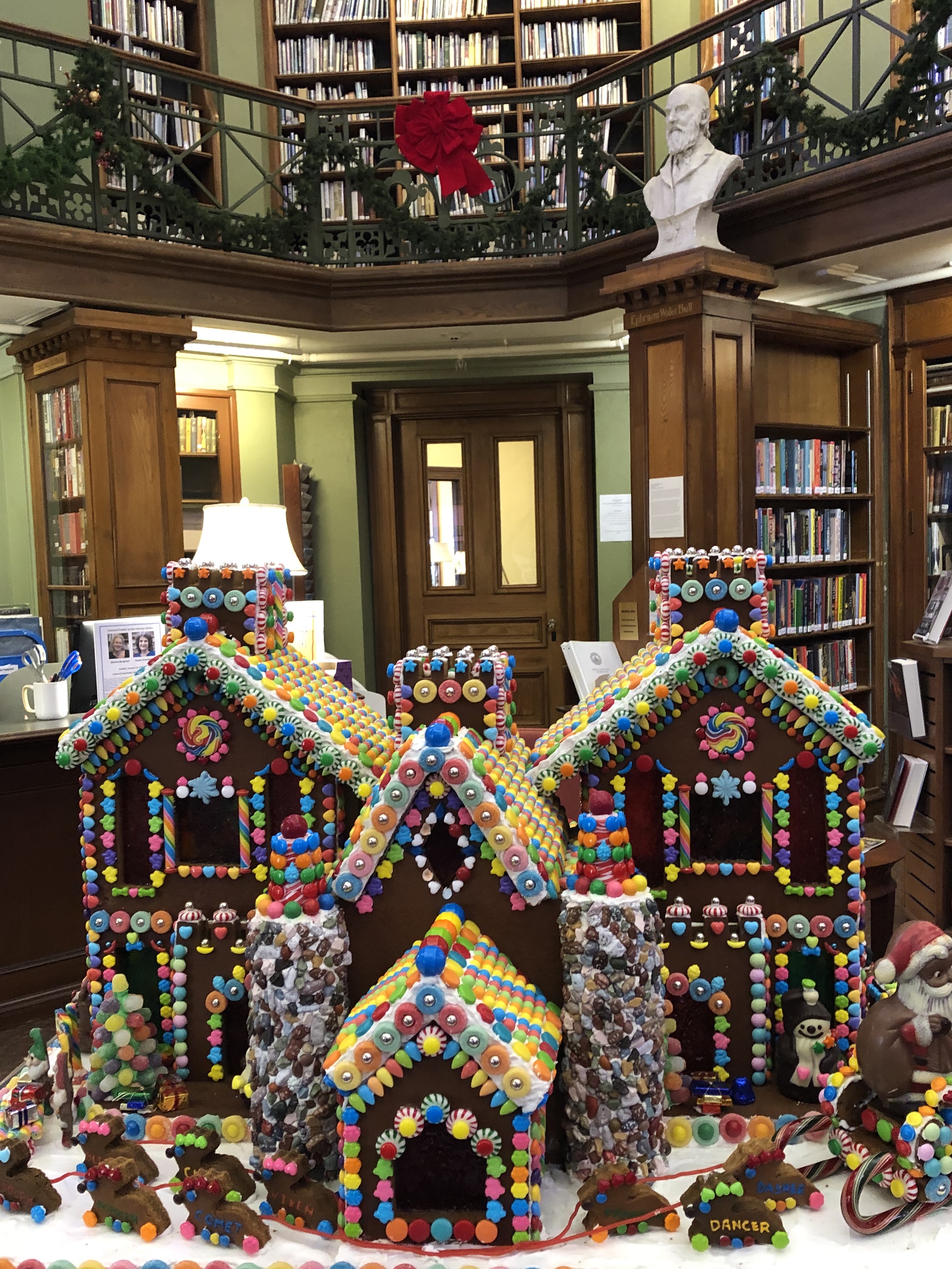
Noncompetitive gingerbread displays involve less pressure and may be more fun. Here are a few local efforts: one at the library, two at the Colonial Inn.

121119-Concord-Library-gingerbread

121219-Frozen-movie-as-Gingerbread

121219-Scouts-do-gingerbread


Read Full Post »

There is a constant drumbeat in the news these days about the cost of college. Of course, it’s not really news. Families have struggled to pay for generations, and there have always been students who worked their way through (Suzanne’s dad, for one). And there have always been a few institutions seeking ways to help them.

Lisa Rathke writes in the Boston Globe about today’s “work colleges,” which believe that working your way through has many advantages, especially if all students are in the same boat.

She writes, “After college, many students spend years working off tens of thousands of dollars in school debt. But at seven ‘Work Colleges’ around the country, students are required to work on campus as part of their studies — doing everything from landscaping and growing and cooking food to public relations and feeding farm animals — to pay off at least some of their tuition before they graduate.

“The arrangement not only makes college more affordable for students who otherwise might not be able to go to school, it also gives them real-life experience while teaching them responsibility and how to work together, officials said. …

“With rising college costs and a national student loan debt reaching more than $1 trillion, ‘earning while learning’ is becoming more appealing for some students. But the work-college program differs from the federal work-study program, which is an optional voluntary program that offers funds for part-time jobs for needy students.

“At the seven Work Colleges — Sterling College, Alice Lloyd College in Pippa Passes, Ky., Berea College in Berea, Ky., Blackburn College in Carlinville, Ill., College of the Ozarks in Lookout, Mo., Ecclesia College in Springdale, Ariz., and Warren Wilson College in Asheville, N.C. — work is required and relied upon for the daily operation of the institution, no matter what the student’s background.” Read more.

Photo: Sterling College via Associated Press
At the seven Work Colleges, it’s not optional: Students must hold jobs during their undergraduate careers and pay off some of their tuition before they graduate.

Read Full Post »