Feeds:
Posts
Comments

Posts Tagged ‘ballroom’

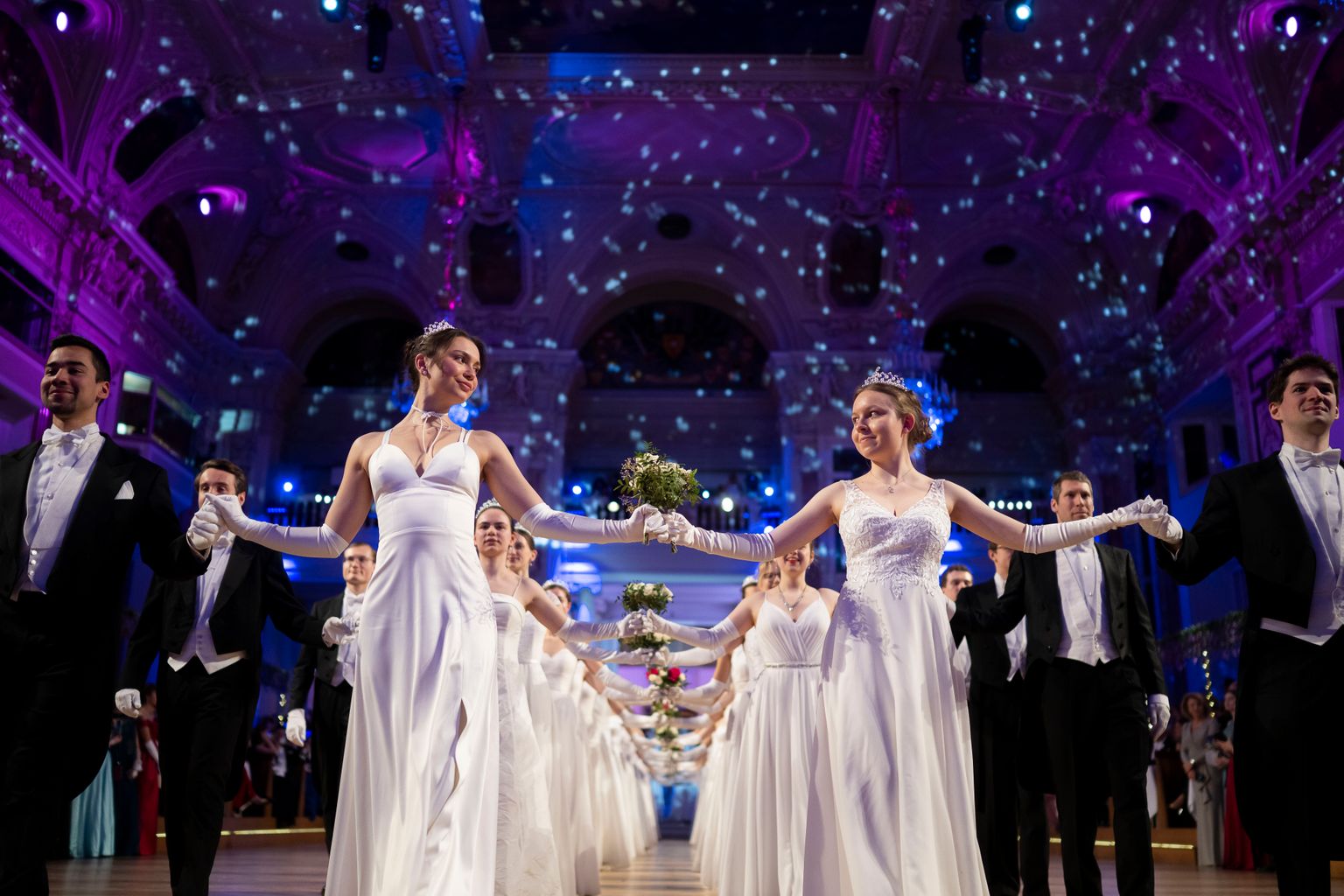
Photo: AP Photo/Denes Erdos.
Young people participate in the opening ceremony of the Lawyers’ Ball in Vienna, Austria, March 1, 2025.

Recently, we had Vienna on our minds because Erik and classmates from his high school in Wales were running a marathon there. Erik is a frequent marathoner and managed the course in under three hours, personal best.

Marathons are a longtime tradition in Vienna, but not as long as the activity in today’s story. It’s about the tradition of elegant balls.

Denes Erdos (along with AP journalist Stefanie Dazio in Berlin) submitted a report to the Associated Press.

“The aristocrats of the Habsburg royal court who danced in the first of Vienna’s famed balls in the 18th century could never have imagined how the hallmark of the Austrian capital’s social and cultural scene would evolve. Today, teenagers learn to waltz by watching YouTube videos while ladies shed their elbow-length gloves to better swipe on smartphones.

“More than 450 balls occur annually in Vienna, starting Nov. 11. … Professional guilds throughout the city host their own events, like the Ball of the Viennese Chimney Sweeps that marks the opening of the season.

“The sparkling balls are deeply rooted in Viennese culture, blending history with modern glamour, and the waltz remains an essential part. While the average ticket costs 395 euros ($427) — though VIP boxes at the Opera Ball can go for 25,500 euros ($27,539) — other events have lowered their prices to 40 euros ($43) to attract a wider audience.

“ ‘To be a part of this for me, as an Austrian person, is like taking part in Viennese culture,’ Leander Selmani, 19, said. ‘I was watching all these ball openings on YouTube and I said, “I want to be part of that.” ‘

“Besides YouTube, teens must learn the carefully choreographed dances for each ball’s opening ceremony from places like the Elmayer Dance School, which has been training dancers since 1919. In order to participate in an opening ceremony, dancers must first qualify through a strict regimen. Then they attend multiple lessons at a dance school and receive a stamped certificate of completion after each session. …

“Only once ‘Alles Walzer!’ (‘Let the waltz begin!’) has been declared can the rest of the crowd join in the dancing. This year, many balls honored the 200th anniversary of the birth of Viennese composer and violinist Johann Strauss II, known as the ‘waltz king.’

“While the waltz, the quadrille and other traditional dances are the heart of the Viennese balls, modern events now offer a diverse range of music and entertainment. Most venues feature multiple halls where guests can dance to various styles, including disco and contemporary beats. …

“Dress codes, however, have remained strictly enforced for centuries: gentlemen are required to wear tailcoats or tuxedos, and ladies must don evening gowns. Many attendees rent their attire from Lambert Hofer, a renowned costume workshop founded in 1862 that rents out hundreds of gowns each year.” More at AP via the Seattle Times, here.

Meanwhile in the US, you can take up ballroom dancing, but be prepared: the competition in the championships is fierce. My friend Ronnie’s sister wins them, but after years of work. About the latest competition, Ronnie tells Facebook, “I was in NY recently for the Fred Astaire Cross Country Dance Championships. My sister competed and is now 2025 Fred Astaire National Champion in American Smooth (tango, waltz, fox trot, Viennese waltz) Senior Division.” She is in her 80s.

Read Full Post »

Photo: Bonfire Visuals/Greenville Journal.
Beautiful gowns are part of the competitive ballroom-dancing experience.

Do you ever watch ballroom competitions on television and wonder where the women get their amazing gowns? At the Washington Post, Cathy Alter provides an answer — for those who can afford it. The gowns are pretty expensive.

“It could be any house in suburban Annandale, Va.,” writes Alter, “among the split-level Colonials with manicured boxwood shrubs — except, around back, past the statue of the red fox and down some steppingstones, there’s a sign on the basement door to greet visitors: ‘You’re about to enter a sparkle splash zone. Twirling encouraged.’

“Inside, Julie Wilson runs a business here in the family home, known by those who need to know as Encore Ballroom Couture. It’s considered the ballroom dance industry’s leading consignment and consignment-rental dress company. Competitive dancers come here from far and wide, as do the frocks. The abiding aesthetic is more is more: feathers, sequins, fringe, crystals. …

” ‘Dancing With the Stars’ is scheduled to return to ABC’s prime-time schedule with its 32nd season this fall (after a sidestep to Disney Plus for a season); Bravo, in its endless hunt for reality-based drama and conflict among ambitious women and certain men, concluded its first season this summer of ‘Dancing Queens.’ …

“Fans of these shows, or just of the scene itself, may wonder where the gowns come from, or where they go after they’ve been worn. A good place to start is here in Wilson’s basement empire.

“Wilson danced competitively for 20 years, which included a decade as an instructor. She was a pageant queen, too. (Ms. Virginia; Ms. Ireland USA.) The years went by, and her closets bulged with the glimmering evidence of moments in the spotlight. There was no place for the family to keep winter coats. Wilson remembers when her mother, Brenda, had enough: ‘She said, “Julie, you need to do something about this.” ‘

“Wilson, 44, says it was hard to part with her girls. (Gowns, in this community, are all female.) ‘I didn’t trust eBay to take care of my dresses,’ she says. Plus, the resale space for competitive ballroom dancing dresses was ‘a black hole.’

“Brenda Wilson, a retired OB/GYN nurse, and Julie, a government contractor, decided to open Encore, transforming the basement of the home they shared with husband and dad Walter into a dance destination. Chandeliers simulate the lighting of competition dance floors, white ostrich feathers are arranged in vases and a small refurbishing station stands ready for dresses that need a bit of first aid. Instead of nails and screws, small drawers contain a color spectrum of crystals.

“At first, Julie sold her own dresses. Then she sold her friends’ dresses. Fourteen years later, Encore has an inventory of around 450 dresses, consigned by dancers who retired, overhauled their image or whose closets needed some breathing room. Consignors get 60 percent of the sale price, which can be quite considerable; dresses here start around $4,000. Dress rentals begin at $300.

“One of the first girls Wilson resold that wasn’t her own belonged to Rose-Ann Lynch, a lieutenant colonel in the U.S. Marine Corps. … When Mike prepared to retire in 2005, Rose-Ann handed him a honey-do list, which included dance lessons. ‘I told him, “I don’t want you to lead if you don’t know where you’re going,” she says.

“The duo competed for the first time that same year and are currently the 23-time USA Dance Senior Amateur national champions, a category for people ages 55-64. Tight as drums, Mike and Rose-Ann make a compelling case that the fountain of youth can be found on the dance floor. A logistician by training, Mike possesses rational, chess-like strategies that come in handy on the dance floor. With multiple couples whirling and twirling at the same time, avoiding a collision is vital when the judges determine their final scores.

“Today, the Lynches have come to Encore Ballroom Couture in search of an American Smooth dress for Rose-Ann. A primer, for those who need one: Competitive ballroom dancing includes both American and International categories. American style includes Smooth (waltz, tango, fox trot, Viennese waltz) and Rhythm (cha-cha, rumba, swing, bolero, mambo); International is separated into Standard (waltz, tango, Viennese waltz, slow fox trot, quickstep) and Latin (cha-cha, samba, rumba, paso doble, jive).

“American Smooth and International Standard styles call for dresses with floats (think fluttery silks that move behind the dancer like wisps of steam), and Rhythm and Latin necessitate something shorter and sexier.

“In American Smooth, partners separate and dance side by side, a la Fred and Ginger, so dresses must look good both coming and going. In International Standard, the couples dance closely, so dresses need look amazing only from the back.

“If Rose-Ann finds a dress today, it will appear in one of the most important dance competitions of the year: the Amateur National Championship, next March in Pittsburgh. ‘I always like to be prepared for Nationals,’ she explains.” 

Yesterday I peeked in at a ballroom refresher class for folks in my retirement community. The couples looked pretty sedate. And there certainly weren’t any swirling gowns.

Nice photos and more than you ever wanted to know on this topic at the Post, here.

Read Full Post »

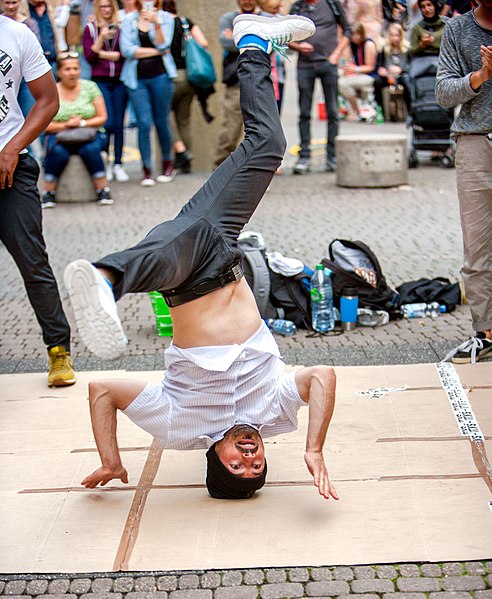
Photo: Wahrmund/ Wikimedia.
Break dancing in Cologne, Germany, 2017.

Back in the 1980s, John was really into break dancing. I think he mainly replicated what he saw other people doing, although he might have taken a class.

Today break dancing is considered athletic enough to be included as a competitive sport in the Olympics. Wow.

Rick Maese has the story at the Washington Post. “When her son had his fill of piano lessons, Ellen Zavian began looking for some other activity to keep him busy. She paid a visit to a dance studio in Washington that specialized in breaking — better known as break dancing to anyone who remembers the 1980s or simply breakin’ to many participants — and it didn’t take long before mother and son were hooked.

“Zavian is a sports law professor at George Washington University. … It didn’t take long before she started brainstorming about what was possible with breaking, an acrobatic urban dance style long associated with oversized boomboxes, hip-hop music, athletic spinning, whirling and ‘freezing.’

“ ‘I just thought: “My kid loves it. I work in sports. I’ve created associations. Why not? This is what I do,” ‘ Zavian said

“That was a full decade ago. The result was the United Breakin’ Association (UBA), an early step in organizing a sprawling, disorganized collection of young dancers, known as b-boys and b-girls, many of whom had no interest in formalizing and codifying their preferred form of self-expression. They were part of an anti-establishment counterculture that feared being co-opted by people who didn’t understand the dance or its dizzying band of denizens.

“The story of breaking’s meteoric rise to the Olympic stage — it’s set to make its debut at the Paris Summer Games in 2024 — involved an unlikely and reluctant partnership between street-savvy breakers and traditional ballroom dancers. …

“’Most of us knew that this could be big one day. We just didn’t really know how it would happen,’ said veteran b-boy Moises Rivas, who dances under the name ‘Moy.’ …. ‘We just had to deal with the misconceptions, negative connotations and people who didn’t always want to give it the credibility it deserves.’

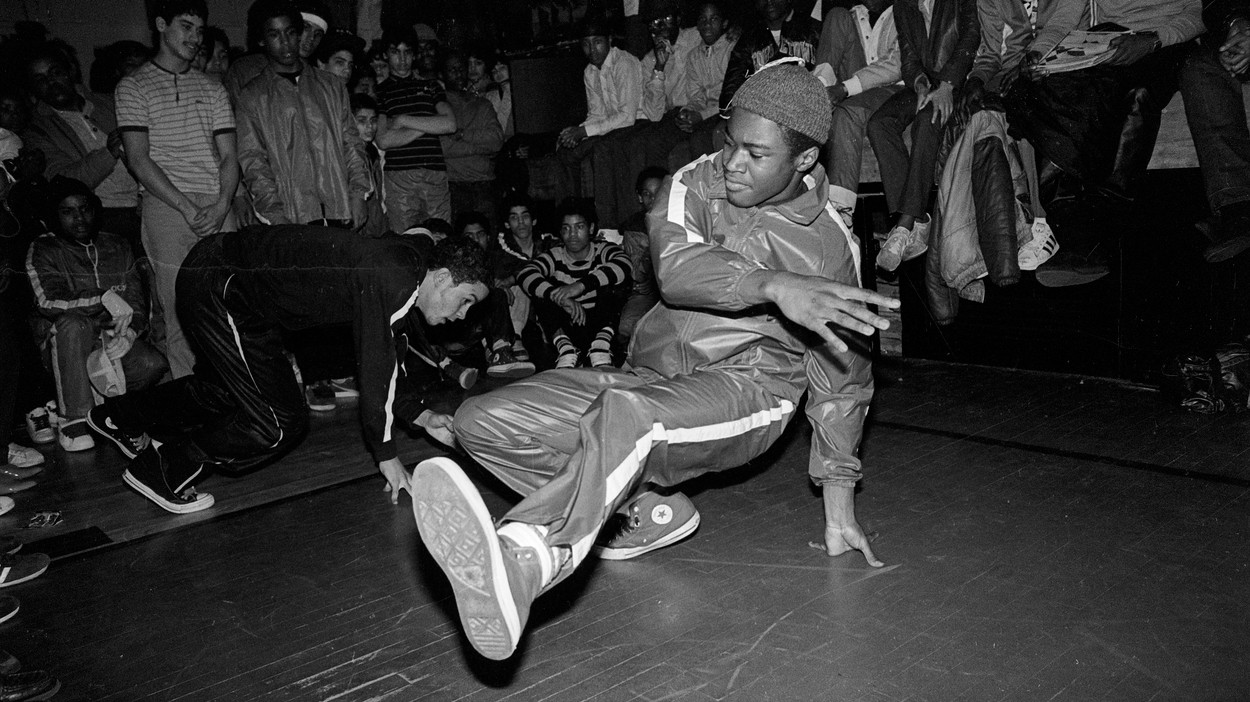
Photo: Ricky Flores.

“Born in the South Bronx nearly 50 years ago, breaking long ago had spread across the world. … From Los Angeles to Miami, there were parallel efforts to grow the sport but little coordination. Steve Graham had dabbled in breaking in college in the early 1980s. He worked on Wall Street and then established a successful private equity firm in Philadelphia. He gravitated back to breaking in his 50s, dancing alongside his children. He saw the potential for growth. The dance wasn’t just a form of expression; competition was baked into it with fierce dance battles between b-boys and b-girls.

“He ran a popular competition in Philadelphia and established a Pro Breaking Tour and a nonprofit membership organization called Urban Dance & Educational Foundation with a vision of drawing together the fragmented breaking world. Many of the competitions were spectacles, drawing large crowds with elaborate lights and window-rattling beats, but the sport was driven by independent event promoters without any movement trained on the Olympics.

“Far removed from booming bass notes and twirling young b-boys, however, serious efforts were afoot to get other forms of dancing on sport’s biggest stage. The global governing body was called International DanceSport, an umbrella organization for all dance disciplines, from Boogie Woogie to salsa. It was formally recognized by the International Olympic Committee in 1997, but officials there failed in their efforts to get ballroom dancing accepted into a Summer Games. Rather than pack up their tap shoes, they rebranded as the World DanceSport Federation (WDSF) and decided to double-down. …

“Breaking was far from the organization’s core when WDSF enlisted the help of Jean-Laurent Bourquin, an IOC veteran, in 2015, asking him for his help in wooing Olympic officials. The WDSF leaders were hopeful they could push specific styles of dance — either Latin or rock-and-roll — but after consulting with his colleagues in the Olympic world, Bourquin surprised them. …

“Dancing would be a viable candidate for the Olympics, he told them, but not the style they were used to.

“The WDSF’s top governing board included no breakers, so the proposition was something of a quandary: The organization could realize its Olympic dream, but only with a rogue, largely unfamiliar discipline.

“ ‘It was a bitter pill that was hard for everyone to swallow,’ recalled Ken Richards, who was on the board at the time and is now president of USA Dance. … ‘We had to come to this understanding and agreement that if dance can get a foot in the door with a style the IOC wants, then maybe the other dances aren’t as far behind as we feared.’

“Bourquin planted a seed with the IOC in 2016 and traveled to the Rio Olympics to chat up IOC members. [He] wanted to see breaking at the 2018 Summer Youth Olympics in Buenos Aires, a more apt platform and a friendly way to introduce the sport to Olympic officials, who skew older. For many in the Olympic world, it was the first time they considered dancing a true sport. And for many in the breaking world, it was the first time they considered the Olympics a realistic goal. …

“ ‘They didn’t view their talent as a sport,’ Zavian recalled, ‘so I had one of the skateboarders come to our meeting and talk about the difference between a sport and art. It was a very heated topic: “You’re going to take our culture away. You’re going to take our art away.” ‘ …

“But the ball was moving. While Graham provided much of the funding, the critical push for the Summer Youth Olympics was spearheaded by the larger dancing community, not the breakers.”

At the Washington Post, here, you can read what happened next.

Read Full Post »

My husband heard that the Kiev subway is a popular place for older Russians and Ukrainians to go dancing. So I Googled around a bit and found stories at Odd Stuff Magazine, here, and the Daily Mail, here. And a video at YouTube. In today’s world, you can’t keep a good story down.

At the Daily Mail (which seems to favor bullet points) Helen Lawson writes, “Saturday night fever: The subway where Kiev’s pensioners dance and find love.

  •     The dancers cannot afford to pay for a venue so they use a metro subway
  •     The group meets every Saturday at 7 pm to socialise and dance
  •     About 20 couples are known to have met thanks to the meet-ups
  •     Reuters photographer Gleb Garanich documented the weekly gatherings

At Odd Stuff, photographer Garanichev Hleb (is that the same Reuters guy?) asks the subjects of his photos about the dance scene. “Milevsky Nicholas was born in 1938 and Natalia Stolyarchuk born in 1955 met at these dances and has since moved in together. This is one of the 20 couples who met at these clubs. ..

“Despite his age, both retired and still work together earn about 4,000 hryvnia per month. …

“These people do not communicate in social networks, but still remember all the holidays of childhood and youth, when put on the table, to visit friends and neighbors come, everywhere sounded cheerful sounds of accordion.” More.

Read Full Post »