Feeds:
Posts
Comments

Posts Tagged ‘baseball’

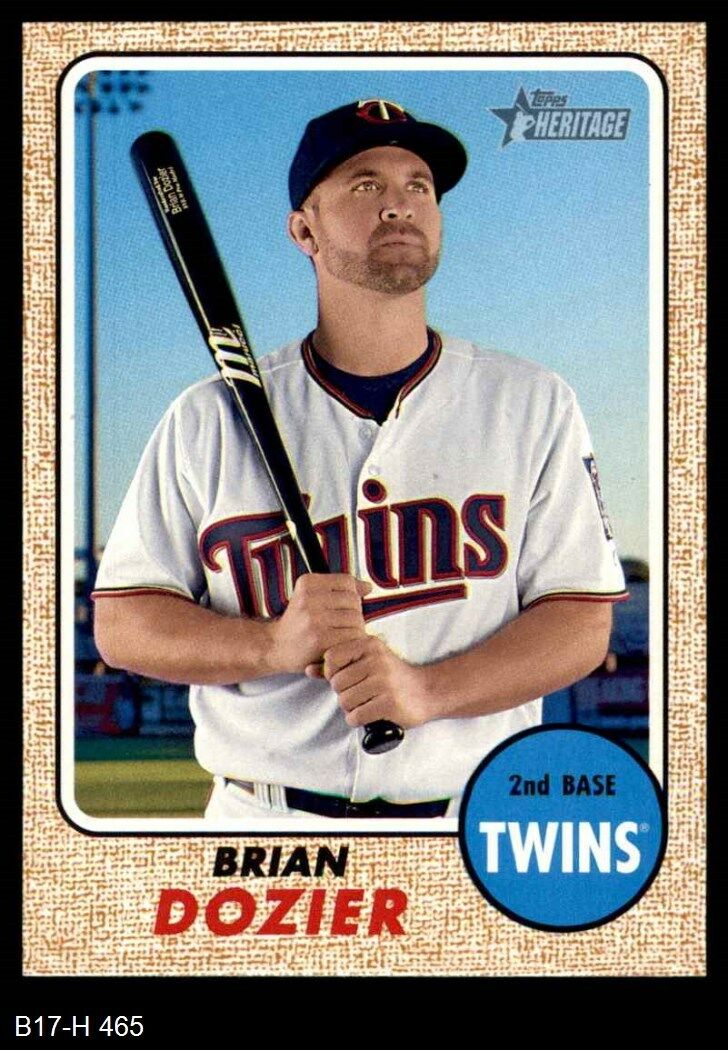
Former Minnesota Twin Brian Dozier’s trading card on eBay.

Both Asakiyume and I work with Spanish-speaking students who are learning English, but she has gone above and beyond in her efforts. She learned Spanish on Duolingo and began listening to Spanish songs in order to connect better with high school students.

I know that Tina, who’s in one of the classes where I volunteer, is getting impatient with me for not doing the same after four years, but if I decide to learn a language, it’s going to be Swedish. So I can understand what Erik is saying to my grandchildren.

Barry Svrluga reports at the Washington Post about a baseball player who was more like Asakiyume in this regard.

“Brian Dozier had 4,900 major league plate appearances, and only 482 of them came with the Washington Nationals. When he retired from baseball last month, he did so as a Minnesota Twin, the team that drafted him, developed him, brought him to the big leagues and made him an all-star.

“And yet in Washington … Dozier is best remembered as the shirtless dude from Mississippi, … crooning reggaeton lyrics in … Spanish? …

‘I think we, as Americans, need to take it upon ourselves to say, “Hey, these guys are going to be playing for a championship just like us, and you need real camaraderie to make that happen, and in order to have that, we need to take it upon ourselves to learn Spanish,” ‘ Dozier said. …

“[Baseball is] a team sport, and in some ways — ways as undeniable as they are difficult to pin down — team dynamics matter deeply. Baseball players spend ungodly amounts of time with one another, from early in the afternoon until late at night, on buses and planes, in hotels and restaurants (at least when there’s not, um, a pandemic), for eight months of the year. They come from backgrounds both affluent and poor. They are Black and White, American and Asian and Latino.

“That last part, it’s important. According to data released by Major League Baseball, nearly one in four players on 2020 Opening Day rosters or injured lists came from a Spanish-speaking country. That would affect any company trying to get its employees to work together, so it has to affect baseball teams.

“ ‘There’s so many times where things have gotten lost in translation,’ Dozier said. ‘Just small stuff, on the field, off the field, in the dugout, in the clubhouse. And all you need — it could be one word. An expression. It could be anything.’ …

“Long ago, when he was in the minor leagues, … he decided to learn Spanish.

“ ‘There were so many great guys that I became friends with, but I really couldn’t break that real true friendship barrier,’ Dozier said by phone last week, ‘because you couldn’t really communicate in the way that you need to communicate in to have that real bond.’

“Dozier had no experience with Spanish, but he took up Rosetta Stone, the language immersion software, and began teaching himself after ballgames and on bus rides. He learned the basics, but there were issues.

” ‘Rosetta Stone kind of taught you the proper way to speak Spanish,’ Dozier said, ‘but not the slang you use in the clubhouse.’

“During one of his offseasons in the minors, he played winter ball in Venezuela. Around that same time, he met Eduardo Escobar, who was new to the Twins organization. They didn’t know they would play seven years together. Still, they made a decision: make each other better.

” ‘I taught him English,’ Dozier said. ‘He taught me a lot of Spanish, just how to communicate day in and day out and stuff like that. I took it upon myself to start reading books on planes and bus rides just to kind of teach myself more. And then obviously the best way to learn it is being around it every day and actually using it.’

“A funny thing then happened for Dozier: He became friends — close friends — with many of his Latin teammates. Go figure. Escobar, now with the Arizona Diamondbacks, missed the beginning of a team meeting last week to call into Dozier’s retirement ceremony. ‘I call him one of my best friends to this day,’ Dozier said.

“[Major League Baseball] has come miles and miles in fostering a more welcoming culture for its Latin players. Most clubs offer some sort of Spanish instruction, and MLB has mandated that each team designate an interpreter so players who aren’t comfortable speaking English can conduct interviews and therefore convey their thoughts and personalities to largely English-speaking fan bases.

“But Dozier’s approach is the right one. Why not meet teammates where they are, making them comfortable rather than demanding they conform — or at least allow them time to develop? …

“Dozier took the time. And now, even though he was in Washington for just one season, his imprint remains here. Not because of much that he did with his bat or glove. But because when the Nationals celebrated their postseason victories, there was Dozier — bare-chested, in the center of a group of Latin players — crooning the song ‘Calma’ by Puerto Rican star Pedro Capó, which became the Nats’ anthem.”

More here.

Read Full Post »

Photo: Evan Petty
Kids enjoying the baseball field at the Allen VR Stanley Secondary School of Math and Science for the Athletically Talented near Kampala, Uganda. 

The inimitable Karen Given at WBUR radio’s Only a Game has found another inspiring story to share with listeners. This one is about a Syracuse University grad who found his calling thanks to a youth baseball team in Uganda.

“Back in the spring of 2014, Evan Petty was a senior at Syracuse University. And he was feeling a little anxious.

” ‘Um … the pressure’s starting to kick in at that point,’ Evan says. “I didn’t really know what it is that I was really going to do. I had always really liked sports. I got a journalism degree, but I didn’t work hard enough to turn it into anything.’ …

“After graduation, Evan flew to Fairbanks to write game reports for the Goldpanners — a collegiate summer team. …

” ‘I guess it bought me time. That’s pretty much all it did,’ he says.

“Evan spent that summer thinking about baseball — he’d always loved the game. He thought he’d like to be a coach. But he didn’t have any training or experience. He figured he’d never find a paid job in this country, so he started looking elsewhere.

” ‘So I think that I looked in places like Japan, even, and places in Europe. Spain, they play some baseball. I took some Spanish in high school, maybe I could make something work with that,’ Evan says. ‘But then Uganda came up.’

“Yep. Uganda. A school was looking for an English teacher/assistant baseball coach.

“The Allen VR Stanley International School of Math and Science for the Athletically Talented was founded by an American businessman who wants to bring baseball to Uganda. Besides teaching kids math and science and English, the school had another well-publicized goal: to send a team to Williamsport.

“Evan had been watching the Little League World Series on TV since he was 13. He loves it.

“The quality of the play is so high, and everything about it is so emotional and real. It’s raw. Like, it’s so raw. It’s just the best,” he says. …

“Evan hopped on an airplane and flew to Kampala. …

“When Evan saw the baseball team he’d be coaching, he was even more excited. It’s not that the players had a lot of experience. In fact, many of them had none at all.

” ‘Put it this way: Balls were being thrown very fast, and bats were being swung very hard, and players were running very fast,’ Evan says. ‘There was a lot of raw talent everywhere.’ …

“In 2011, the team won the qualifying tournament in Poland, but the players were denied visas to come to the United States. Many of the players don’t have birth certificates. ‘Paperwork is hard in Uganda,’ Evan told me. …

” ‘We had to do a whole lot of stuff and satisfy a whole lot of people and pay a whole lot of money [in 2015 to attend the qualifying games in Poland],’ Evan says. ‘And then we had to win the games, and that was the easy part.’ …

“Uganda was headed back to Williamsport, and they had one simple goal.

” ‘Shock the world,’ Evan says.”

That is what they did. Read more.

Interestingly, the Disney flic Queen of Katwe — about a young female chess prodigy from the Katwe, Uganda, slums — also demonstrates that committed adults and international competitions offer Ugandan children one of their best hopes for rising above challenging circumstances.

Read Full Post »

Get ready. National Bobblehead Day is just around the corner.

Bobbleheads? Karen Given at WBUR’s Only a Game can tell you more about the history of sports bobbleheads than you ever imagined.

She says that is 2015, the San Diego Padres were the only Major League Baseball team that didn’t offer fans a game where they handed out bobblehead figures of players. “For years, the Red Sox didn’t give away bobbleheads either.

“ ‘There was a long time actually when we felt like “maybe they’re not into bobbleheads,” ‘ says Red Sox Senior Vice President of Marketing Adam Grossman. ‘But even in Boston we know that the people love them and if they love them then we’ll provide them.’ …

“The Red Sox spend months getting the facial features and tattoos and the stance on their bobbleheads just right. …

“Bobbleheads even have, get this, their own Hall of Fame.

“ ‘We sort of thought of it this way–,’ says Phil Sklar, co-founder and CEO of the National Bobblehead Hall of Fame and Museum in Milwaukee, Wisconsin, ‘if mustard deserves its own museum, bobbleheads definitely deserve their own shrine.’

“The museum doesn’t actually exist yet. Sklar and his partners are busy accumulating thousands of bobbleheads — many from private collections.”

For “the story of a business deal that would change the course of bobblehead history, [Given turns] to Todd Goldenberg of Alexander Global Promotions.  …

” ‘Malcolm Alexander, he’s our founder and former president. He’s retired now, kite skating around the world—’

“So, Alexander was trying to start a business selling promotions, and he got a meeting with the San Francisco Giants, who, you’ll remember, were trying to find a company to manufacture a promotional item that hadn’t really been made for 40 years.

“ ‘He just basically said, “What can I help you with?” and they said, “We need a bobblehead doll,” ‘ says Goldenberg. …

” ‘And Malcolm, being very cocky and very Australian said, “Yeah, sure, I’ll do it. How many do you need?” ‘ says Goldenberg. ‘And then he proceeded to leave the office and find out what a bobblehead doll was. Because even though he had just sold about a quarter of a million dollars worth of bobblehead dolls, he didn’t know what he had sold.’ ”

The rest of the story can be found at WBUR radio, here.

Photo: Karen Given/Only a Game
A Luis Tiant bobblehead doll.

Read Full Post »

Bill Littlefield, at Only a Game on WBUR radio, got a lesson in the subtleties of Finnish baseball when he interviewed the Wall Street Journal’s Brian Costa recently. Costa went to Finland to report on pesäpallo, a game whose players are sometimes scouted by US baseball teams.

“Brian Costa: The biggest difference is the pitcher, instead of throwing the ball from a mound at the batter, stands beside him and throws it up in the air and sort of gets out of the way. But there are base paths, there’s four bases, there’s home plate, players field with gloves. …

“Bill Littlefield: Critics of baseball in the U.S. say the games are too long. It’s too slow. There’s not enough action. Would such critics be happier with pesäpallo?

“Brian: Oh, they would love pesäpallo. There are very, very few strikeouts, very few swings and misses, so pretty much every ball that gets pitched gets put into play. …

“Bill: What’s it like for fans attending a game of pesäpallo? And how many are there? Is this a big popular attraction?

“Brian: This is really not a city sport, so [in] Helsinki, you won’t see that much of it. But it is the sport of the Finnish countryside. You’ll have towns where the local population may be 3,000 people, and they’ll get 3,500 at a game. …

“Bill: You note that a scout from the New York Yankees was in Finland last month for All-Star weekend there. … [But] Finnish players, I gather, do not seem very interested in playing baseball as we know it?

“Brian: No they’re not. It’s very interesting. … None of them seemed to really follow Major League Baseball. The people who I asked about their impressions of it kind of smirked or winced or just said, ‘eh.’ I mean, they feel like they’ve got a better version of it.”

More here.

Video: PattijoenUrheilijat

Read Full Post »