Feeds:
Posts
Comments

Posts Tagged ‘benin’

Photo:  Shereefdeen Ahmad.
“Today you do not play as rivals, but as brothers,” a match organizer tells the men from Nigeria and Benin.

One of the worst things about colonialism is the way it arbitrarily separates ethnic groups and plunks families down in different countries. Today we see how a sport is bringing relatives back together.

Shereefdeen Ahmad writes for the Christian Science Monitor, “It’s game day at the village soccer field, and spectators bunch along the sidelines with banners and drums to support their teams.

“They watch as the captains of the two squads walk to the center of the field for a coin flip to determine who kicks off first. …

“This match is part of a festival celebrating the culture of the Borgu, an ethnic group that straddles the border between Benin and its eastern neighbor, Nigeria. The teams and fans gathered here today have come from both countries, part of an effort to use soccer to bridge the divide imposed by colonial powers more than a century ago.

“ ‘I believe that football can reconnect us beyond those lines,’ says organizer Adam Kabirou, who regularly hosts cross-border matches.

“Mr. Kabirou grew up hearing stories about the Borgu kingdom, a civilization tracing its roots to the late 15th century. He also learned how colonial powers carved up his people’s lands in the late 19th century, splitting the Borgu between present-day Benin and Nigeria.

“Today, the majority of Borgu, approximately 1.4 million, reside in Benin, with a smaller population in Nigeria.

“As a child, Mr. Kabirou saw firsthand how that border created a rift between his community and the Borgu people living just 15 miles away on the other side. For one thing, the two groups often literally didn’t have the words to speak to one another.

Borgu in Nigeria learned English, the colonial language there, while Borgu in Benin spoke French, the language of their former rulers.

“These languages mingled with Batonu, the Borgu language, changing the way it was spoken on each side of the border.

“Meanwhile, Western-style schooling in both countries had pushed the Borgu people away from their shared customs and traditions, says Lafia Hussaini, a Borgu ethnographer and adjunct lecturer at the Centre for Cultural Studies and Creative Arts at the University of Ilorin in Nigeria. [Simultaneously] the border created an administrative division that made close ties practically difficult. …

“Sometimes the division even cut through a single community. For instance, half of the village of Chikanda sits in Benin, the other half in Nigeria. The difference is most clear at night. Electric lights illuminate the houses on the Beninese side of the border, while the Nigerian side, which doesn’t have an electricity connection, is dark.

“Over the years, Mr. Kabirou, a farmer, occasionally attended cross-border soccer matches, and saw how the game shrank the distances between the two communities. So in 2022, he decided to organize a tournament.

“In its most recent edition, in 2024, the Tournoi Brassage Culturel – the Cultural Blend Tournament – drew five teams from Nigeria and 15 from Benin. Mr. Kabirou estimates that more than 4,000 fans attended the final match between Gwanara, Nigeria, and Tchatchou, Benin.

“For the players who participate in these matches, the importance stretches beyond soccer.

“Bashiru Adamu, a Nigerian player, says he barely knew his paternal family in Benin before crossing the border to play a match here in 2023. Now, whenever he comes to play a game, he pays them a visit as well. …

“Today, there are three separate tournaments bringing together Borgu teams from Nigeria and Benin. … They have been important not only for the players, but for spectators as well.

“Watching these matches ‘has really brought us together,’ says Souaibou Seko, a resident of Nikki, Benin. In addition to the soccer itself, he says, he appreciates the cultural performances from Borgu artists that often take place before matches or at halftime.

“These performances ‘stress our newfound cultural unity,’ says Sanni Sika Gounoun, chairman of the organizing committee for the Solidarity Tournament. ‘This camaraderie is growing organically.’ “

This article is published in collaboration with Egab,” which focuses on stories from lesser known areas.

More at the Monitor, here.
Read Full Post »

Photo: British Museum.
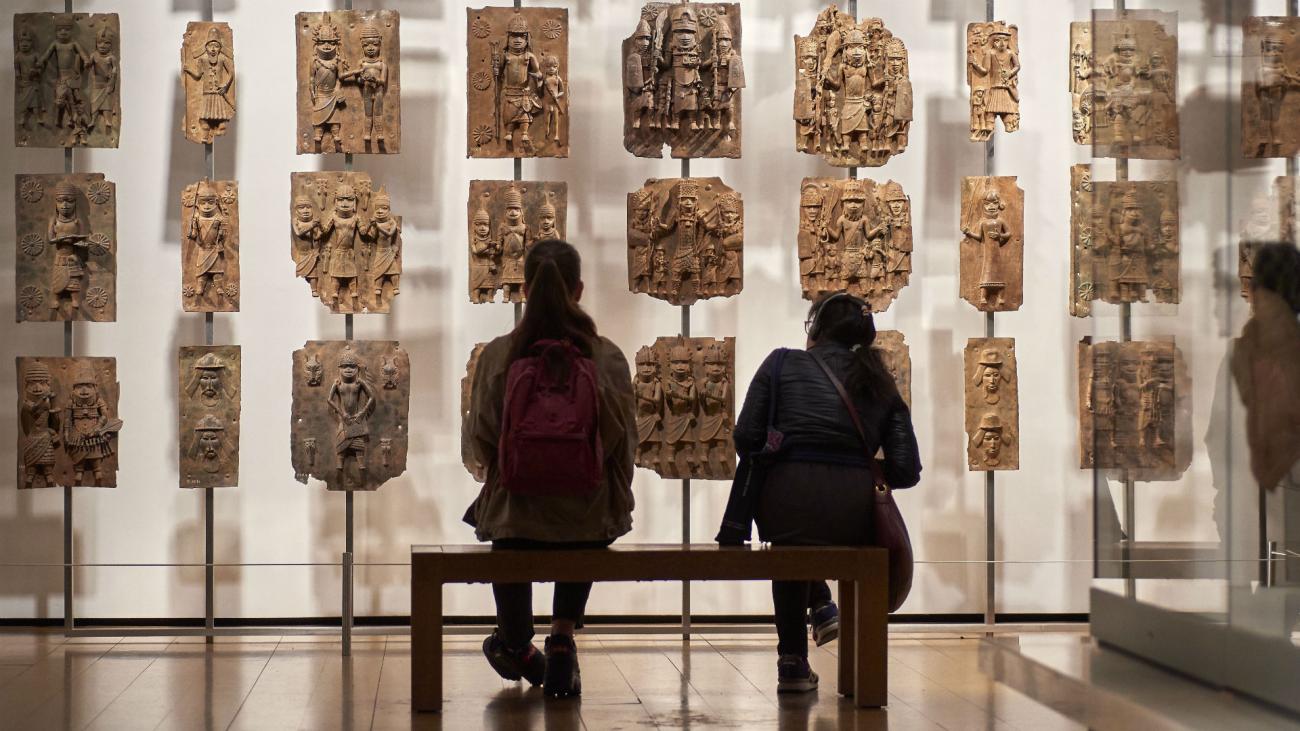
Benin bronzes.

Around the world, looted national treasures are beginning to return home. Among the most famous are the bronze plaques made in Benin, Africa. Now that country is building museums to protect its returning bronzes — and all its art.

Chinma Johnson-Nwosu writes at the Arts Newspaper, “The Republic of Benin, which is making its debut appearance at the Venice Biennale this year, is turning to culture as part of a strategy to spur economic growth. Its government is building four new museums in a range of locations and a cultural quarter in the largest city, Cotonou, in addition to boosting investment in arts education.

“A museum in the coastal city of Ouidah, from where the last recorded shipment of slaves to the US departed in 1860, will explore the history of slavery. It is scheduled to be completed at the end of this year, the first of the four new museums slated to open over the next five years in Benin. Maison de la Mémoire et de l’Esclavage aims to tell the history of slavery from African, American and Caribbean and European perspectives, says Alain Godonou, the director of museums for the national agency of heritage and tourism.

“Between 2016 and 2026, the Benin government plans to invest €250m [more than $5 million], with the goal of making culture the economy’s second pillar after agriculture. In addition to building museums, the government’s focus is on preserving non-material heritage, increasing cultural tourism and offering financial incentives to private investors.

“Promoting the arts goes beyond fostering a sense of national identity, says Babalola Jean-Michel Abimbola, the country’s minister of culture. ‘It’s a fight against poverty, allowing us to create jobs and build a better economy.’

“Construction began last year on a new cultural quarter in the centre of Cotonou [Le Quartier Culturel et Créatif] which is to host a contemporary art museum, a sculpture garden, a Franco-Beninese cultural institute, a concert arena, commercial galleries and a crafts village showing local crafts and heritage. …

“Further plans include the Musée des Rois et des Amazones du Danhomè in Abomey, where visitors will in future be able to explore the 300-year history of the kingdom of Dahomey. Musée International du Vodun, located in the capital, Porto-Novo, aims to rehabilitate the image of a much-maligned and globally poorly understood Indigenous religion, also known as Voodoo.

“The government hopes that the new museums will build on the success of a 2022 exhibition, where 26 recently repatriated royal artefacts went on display in the presidential office. These were shown alongside the contemporary exhibition, Art of Benin From Yesterday and Today: From Restitution to Revelation.

“The show drew more than 230,000 visitors in the three months it ran, 90% of whom were citizens of Benin, Godonou says. … While he concedes it may be too ambitious to expect to replicate the 2022 success annually, he believes a target of 100,000 would be sustainable.

“Last year, the government launched an Agency for the Development of Art and Culture. The ministries of tourism and finance are also seeking to introduce tax relief policies for the cultural industries.

“The kind of publicly funded, government-led major museum projects Benin is undertaking have little precedent in Africa. … The Benin government’s plan does, however, envisage involving the private sector. By showing entrepreneurs that people in the country are interested in art, Abimbola hopes to spark business interest. In some parts of Cotonou that is already happening. Septième Gallery, which already had a space in Paris, launched in Cotonou in 2022. …

“Investment in arts education and professional training is also increasing. Sèmè City, a government-backed development project, has revealed plans for a new Africa Design School campus located in Ouidah. The school launched in Cotonou in 2019 in partnership with L’École de Design Nantes Atlantique and has since added a masters programme and an exchange programme, in which 11 French students participated in 2023. …

“Last year, the École du Patrimoine Africain, which trains heritage professionals, celebrated its 25th anniversary. When it began, only 5% of the people working in Beninese museums were trained in heritage preservation. Now the figure is 80%.”

More at the Art Newspaper, here. Can you guess what country was the colonizer? Consider the names of the museums.

Read Full Post »

Photo: BBC.
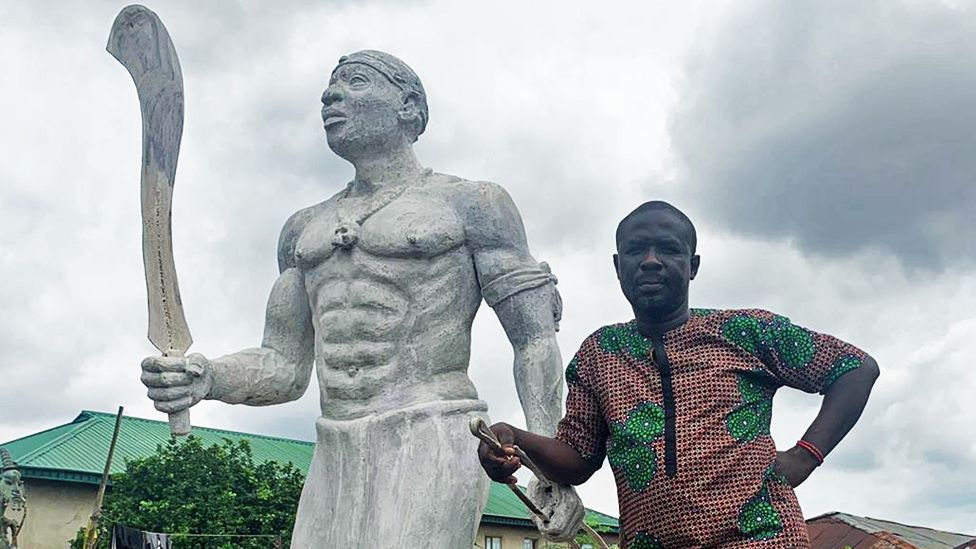
Monday Aigbe standing alongside a statue of his great-grandfather, one of the sculptors of the famous Benin Bronzes.

You have probably heard that art museums around the world have started to return to Africa the bronze sculptures stolen from Benin. In today’s post we learn what the return of the bronzes means to the local people.

Mayeni Jones, the BBC’s Nigeria correspondent, reports, “On the bustling streets of Nigeria’s Benin City, residents cannot wait to get their Bronzes back — for them their return symbolizes reparations for some of the wrongs committed by British troops during the colonial era.

“A statue of a cockerel is one priceless artifact soon to be welcomed home, after Jesus College handed it over to a delegation from Nigeria at a ceremony at Cambridge University on Wednesday.

“It is one of thousands of metal sculptures and ivory carvings made between the 15th and 19th Centuries and looted by British troops in 1897 from the West African kingdom of Benin, in modern day Nigeria’s Edo state.

” ‘I feel happy that the work of my great-grandfather will be coming back to Benin,’ says Monday Aigbe, who, like his ancestor, is a sculptor. He runs a foundry in Benin City, the capital of Edo state, where his craftsmen work quietly on brass statues.

“The skilled workers fashion a myriad of shapes out of metal, including busts of the Oba — the title of the traditional king of Benin — as well as statues of animals and carved doors.

“They have been making bronzes here for six generations. In the middle of the foundry is a large statue of Mr Aigbe’s great-grandfather. He worked for Oba Ovonramwen Nogbaisi when the raid took place on the Royal Palace more than 120 years ago.

‘It makes me upset because they came, they destroyed the palace, they made my great-grandfather run from the city to the village,’ says Mr Aigbe.

“The loot was amongst the most valuable African artworks ever made — and was sold or gifted to private collectors and museums around the world.

“With more and more of the stolen artifacts expected back in Nigeria — [the] University of Aberdeen in Scotland will also be returning one of its Bronzes — Mr Aigbe plans to take his children to see them when they go on display.

“This will be at the Edo Museum of West African Art — a grand initiative by the governor of Edo state to house all the returned Benin Bronzes. The authorities say it will not be completed for at least five years – construction on the building, set to be designed by famous British-Ghanaian architect David Adjaye, has yet to start. …

“The British government has argued that the Benin Bronzes ‘properly reside’ in the British Museum, which has the largest collection of them in the world — with more than 900 pieces. Hosting the ancient objects in London also ensures they are accessible to the world, the UK authorities say.

“But it is an argument that [Theophilus Umogbai, deputy director and curator of the National Museum Benin] takes exception to, saying that most Nigerians will never get to see them there given visa and travel costs. …

” ‘When I saw the Bronzes in the British Museum I was happy at first. Then that thought was replaced by the feeling that these objects were incongruously sitting where they shouldn’t be. They should be back home.’

“Twenty-eight-year-old artist Joe Obamina agrees — as he believes it is the past that inspires the future. In his sunlit studio in Benin City he makes pixellated paintings — inspired by his childhood spent indoors, playing Tetris. …

” ‘Each pixel is a continuous story. Besides the overall image, I tell other stories inside each cube,’ says Mr Obamina. …

“One painting depicts the Idia mask, one of the most famous Benin Bronzes. It is said to be a carving of the face of the mother of an oba from the first half of the 16th Century.

” ‘My painting of the Idia mask was inspired by the ongoing restitution of the Benin Bronzes,’ says Mr Obamina.

” ‘We grew up without seeing the actual mask, just the replicas. Our heritage has been scattered, so I had to paint something to depict that: the scattered heritage that is abroad. But nevertheless we still have our own identity and cultural practices. That’s why when you take a picture of it with your phone you can still see the mask in full.’ …

” ‘These artifacts being returned is going to mean a lot, because it will help me connect with my ancestors.’ “

More at the BBC, here. For another take and some additional pictures, check out a story by Sylvie Corbet and Thomas Adamson at the Associated Press (AP), here.

Read Full Post »

I had to share a delightful report from the radio show Studio 360 in which Khrista Rypl looks at the cultural aspects of African textiles.

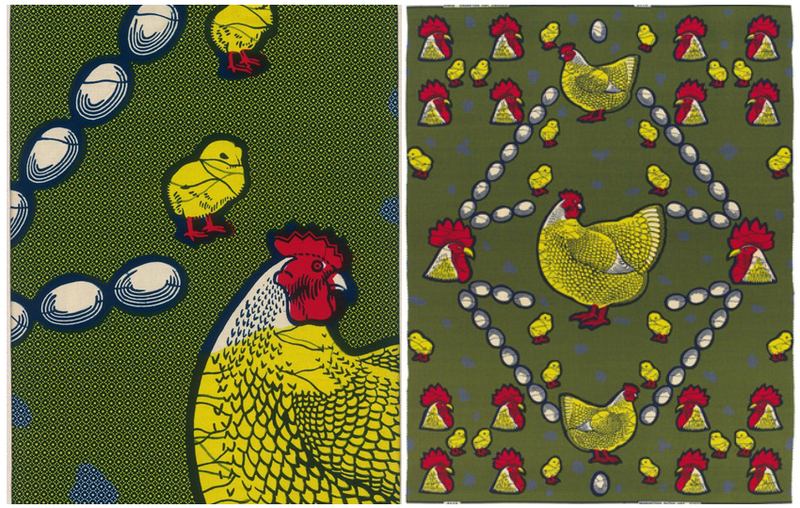
She writes, “African textiles are distinctive for their vibrant colors, bold patterns, and batik dyes that give the fabric a unique crackled texture. But I had no idea that some of the trendiest of these prints are actually designed and produced in the Netherlands by a company called Vlisco.

“Inge Oosterhoff wrote a wonderful deep dive into the history behind the Vlisco textile house, and explained how their designs have remained hugely popular in Africa since the late 1800s. But Vlisco doesn’t just make fabric; they’re known for their printed designs. … Some patterns are designed with different countries in mind, while others are distributed widely around the continent. As the patterns catch on among shopkeepers and consumers, many of them get colorful names like ‘Love Bomb,’ ‘Tree of Obama,’ and ‘Mirror in the Sun.’ …

“Many patterns are sold widely in Africa, and different countries and cultures adopt different meanings and associations. [A swallow] print is a perfect example. The fabric was used for airline uniforms in Togo, so there the pattern is commonly referred to as ‘Air Afrique.’ The pattern also symbolizes asking for a favor, like the hand of a woman in marriage. In Ghana, the swallow refers to the transience of wealth, and the pattern is referred to as ‘Rich Today, Poor Tomorrow.’ It has a similar connotation in Benin, where it’s referred to as ‘L’argent vole,’ where it could either be interpreted as ‘Money Flies’ or ‘Stealing Money.’ ”

More designs and more of Studio 360 report, “Textiles Tell a Cultural History,” here.

Photos: Vlisco

Read Full Post »