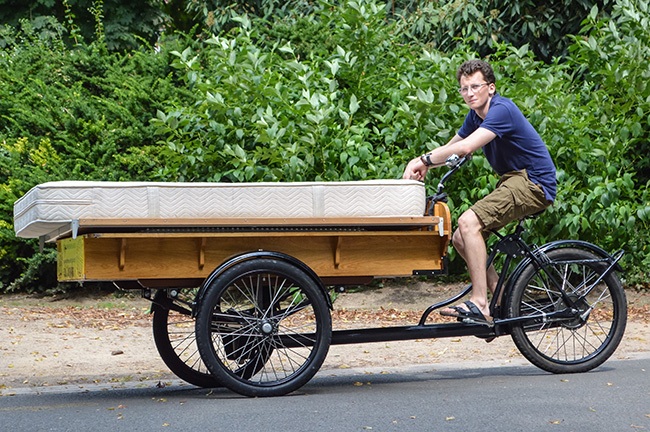
Photo: Modacity.
“To understand how Groningen got to where it is today, one must look back nearly 50 years, to a young, idealistic politician who bravely decided to go against conventional wisdom,” says the Daily Hive.
I haven’t been to Ocean Beach on Fire Island in decades, so I don’t know if it is still entirely free of cars, but it definitely was in my childhood summers, and it’s hard to convey just how radically that changes the quality of life for the better. Car-free in the Netherlands sounds heavenly, too.
Chris and Melissa Bruntlett write at the Daily Hive, “When we initially selected the five Dutch cities we would explore over the course of our #CyclingAbroad adventure, many of our friends had no idea where Groningen was, let alone why we would want to visit there. But among our colleagues in the transportation and urbanism world, a pilgrimage to this once-fortressed college town, 200 km northeast of Utrecht – famously declared ‘The World’s Cycling City’ by Streetfilms’ short documentary – was an absolute must.
“With a population of around 200,000, a quarter of whom are students at the two local universities, Groningen has accomplished a feat many emerging cycling cities could only dream of: a bicycle mode share that eclipses the established powerhouses of Amsterdam and Copenhagen. Recent figures indicate a staggering 61% of trips in the city are made by bicycle. That’s almost nine times larger than Vancouver’s celebrated mode share. …
“To understand how Groningen got to where it is today, one must look back nearly 50 years, to a young, idealistic politician who bravely decided to go against conventional wisdom.
“In the mid-1970s, as cities across the country were scrambling to create the ideal conditions for mass motoring (including, most notably, Amsterdam), a left-leaning Groningen council recognized the inherent flaws in rebuilding their city around the private automobile. Max Van den Berg, then just 24 years old, and the councillor responsible for traffic and urban development, resolved to take his city in the opposite direction. Under Van den Berg’s advice, in 1977, council all but banished motor vehicles from the city centre, making it a far more pleasant place for people on foot and bicycle.
“For Lior Steinberg, an urban planner born and raised in Tel Aviv, the resulting lively cityscape is what drew him to relocate to Groningen, after a study tour while completing his master’s degree. ‘Groningen is a vibrant city, and there is a great cultural life. It’s a real hidden gem,’ he claims. …
“Steinberg credits Van den Berg’s Traffic Circulation Plan as central to Groningen’s successes: ‘The circulation plan divided the city centre to four parts, forbidding cars to cross between those quarters,’ he explains. ‘This made the city centre practically impenetrable with a car, and made cycling and walking the best way to get around.’
“While the plan didn’t completely remove motor vehicles from the equation (public buses and delivery vans still access certain parts of the city centre), we pedalled practically everywhere with our children over the course of a week, feeling completely at ease with our surroundings. Bicycles definitely rule the road in Groningen, with thousands of cyclists rolling along virtually every one of its cobblestone streets, from dawn until long after dusk. …
“Other Dutch cities began replicating their winning formula, and – having discovered that improving cycling conditions serves as an inexpensive and effective way to remain competitive – quickly started catching up.
“At the same time, many of the city’s cycle routes were experiencing problematic congestion, particularly on corridors leading to the university campus. The need to deal with an ever-increasing volume of people on bikes, along with the desire to retain their title of ‘The World’s Cycling City,’ are what provided the impetus for the Groningen Cycling City strategy.
“ ‘Cycling is in our DNA. We are proud of it and definitely aim to keep it that way,’ reads the preface of the 48-page plan. This is as clear of a mission statement as it gets. …
“Many the projects contained in this ‘bicycle first’ strategy are rather ambitious and innovative. Most notably, as a northern city, Groningen’s temperatures often hover around freezing during winter months, creating frosty conditions unsafe for road users, especially those on the narrow wheels of a bike. Within the next decade, officials hope to use geothermal energy (from the earth) and wastewater thermal energy (from the sewers) to heat the cycle tracks, keeping them clear of frost and snow, and allowing for safe, year-round, two-wheeled travel.
“Other measures include a series of ‘smart routes‘: direct, convenient cycle paths designed to get students and staff to school in 15 minutes, without having to make a single stop.
Groningen is also one of the first cities to attempt to ‘solve traffic situations with eye contact,’ first piloting, then expanding, a counterintuitive, but highly effective four-way green light for cyclists at 29 different intersections.
“With as many as 20,000 cyclists traveling certain corridors on a given day, planners are being forced to ‘think outside the lane,’ and experiment with the notion of handing entire streets – known as fietsstraten (Dutch for ‘bike streets’) – over to the bicycle as the dominant mode of transportation.
“The plan also includes a long-overdue expansion of their central train and bus station. Already overflowing from its above and below-ground parking lots – capable of holding 10,000 bikes – the strategy aims to expand that availability by another 5,000 bikes. The City also hopes to improve connectivity from the station to the existing cycling network by building a bicycle tunnel under the bus depot, reducing conflicts between these two popular modes. …
“In every Dutch city we toured, moving by bike was simple and intuitive, even for our seven-year-old son. But traveling on foot was much less desirable, and Groningen was no exception. Sidewalks are narrow, and teeming with bikes parked anywhere their owners could find a space. In fact, shops along the busier routes in Groningen now roll out red carpets to their front doors; not to make their patrons feel like royalty, but to discourage the parking of bicycles, and maintain access for their customers.
“Steinberg feels addressing people on foot is of utmost importance: ‘To be frank, the biggest concern at City Hall today shouldn’t be cycling, but walkability. Many of the city’s sidewalks are not accessible to elderly or physically-challenged people.’ ”
More at the Daily Hive, here. Because the Hive article is from 2016, I recommend that biking enthusiasts check out this update from 2022.



 Suzanne's Mom's Blog