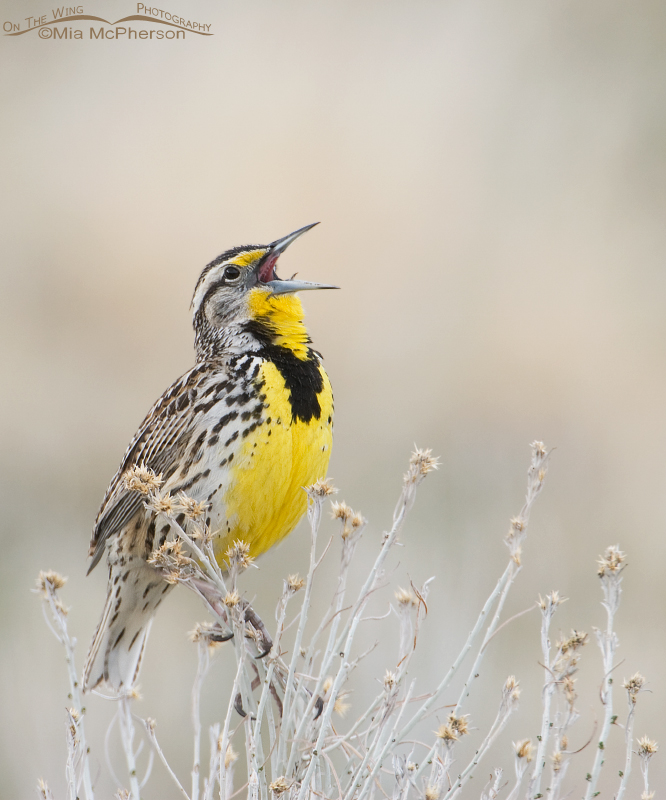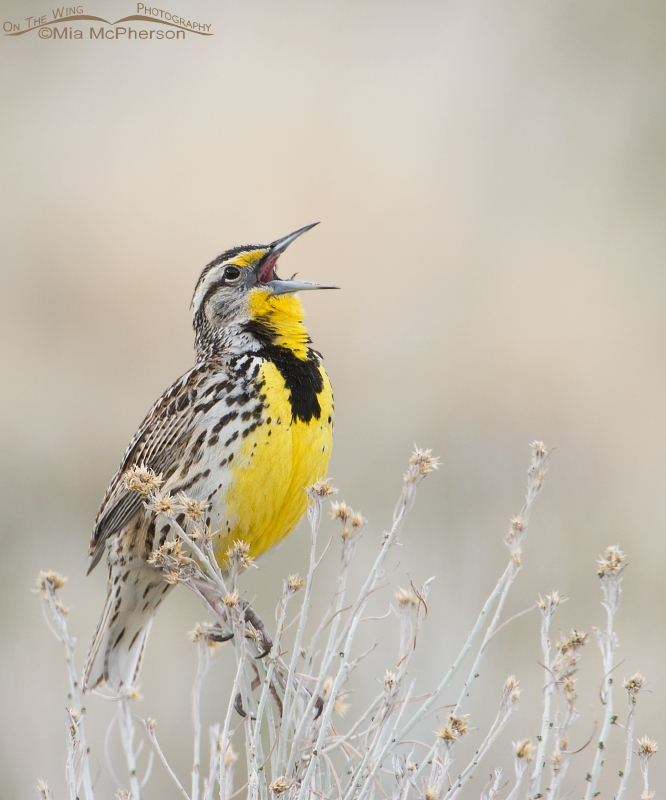
Photo: Mia McPherson/ On the Wing Photography.
Western Meadowlark singing.
Doctors are starting to recommend meditation to lower blood pressure in older people. When meditation was first suggested to me, I scoffed in my usual know-it-all way (what my husband used to call my “stranglehold on the truth”), but as I researched different kinds of meditation on the web, I gradually became a believer.
One of the ways meditation experts get you to focus on the here and now is to have you pay attention to each of your five senses in sequence, as in one five-minute meditation from the Washington Post. Others add that listening specifically to birdcalls can be therapeutic.
At the Post, Richard Sima says, “Looking to improve your mental health? Pay attention to birds. Two studies published last year in Scientific Reports said that seeing or hearing birds could be good for our mental well-being. …
“Research has consistently shown that more contact and interaction with nature are associated with better body and brain health.
“Birds appear to be a specific source of these healing benefits. They are almost everywhere and provide a way to connect us to nature. And even if they are hidden in trees or in the underbrush, we can still revel in their songs.
” ‘The special thing about birdsongs is that even if people live in very urban environments and do not have a lot of contact with nature, they link the songs of birds to vital and intact natural environments,’ said Emil Stobbe, an environmental neuroscience graduate student at the Max Planck Institute for Human Development and author of one of the studies.
“Recent research also suggests that listening to recordings of their songs, even through headphones, can alleviate negative emotions. …
“In one study, researchers asked about 1,300 participants to collect information about their environment and well-being three times a day using a smartphone app called Urban Mind.
“The participants were not explicitly told that the researchers were looking at birds — the app was also collecting data about other vitals such as sleep quality, subjective assessment of air quality, and location details. But the 26,856 assessments offered a rich data set of what is associated with mental well-being in real time in the real world.
“By analyzing the data, the researchers found a significant positive association between seeing or hearing birds and improved mental well-being, even when accounting for other possible explanations such as education, occupation, or the presence of greenery and water, which have themselves been associated with positive mental health.
“The benefits persisted well beyond the bird encounter. If a participant reported seeing or hearing birds at one point, their mental well-being was higher, on average, hours later even if they did not encounter birds at the next check-in.
“Ryan Hammoud, a PhD candidate at the Institute of Psychiatry, Psychology & Neuroscience at King’s College London and an author of the study, called it a ‘time-lasting link.’
“Intriguingly, the birds benefit both healthy participants and those who have been diagnosed with depression. …
“A second study found that listening to short — just six-minute — audio clips of birdsong could reduce feelings of anxiety, depression and paranoia in healthy participants.
“ ‘Listening to birdsong through headphones was able to hit the same pathways that might be beneficial toward mental well-being,’ said Hammoud, who was not involved in the second study. …
“Researchers asked 295 online participants to self-assess their emotional states and to take a cognitive memory test. Then they randomly assigned the participants to listen to birdsongs or traffic noise, of more or less diversity. The researchers then had the subjects remeasure their emotional and cognitive states.
“Participants who listened to more diverse birdsongs (featuring the acoustic acrobatics of eight species) reported a decrease in depressive symptoms in addition to significant decreases in feelings of anxiety and paranoia. And those who listened to less diverse birdsongs (two bird species) also reported a significant decrease in feelings of anxiety and paranoia. …
“By contrast, listening to more or less diverse traffic noise worsened symptoms of depressive states.
“The research shows the ‘healing aspects of nature, or also the not-so-positive effects of urban surroundings,’ said Stobbe, an author of the second study. …
“Birds help us feel more connected with nature and its health effects, Stobbe said, and the more connected we are to nature, the more we can benefit from those effects.
“One hypothesis on nature’s salubrious effects, known as the attention restoration theory, posits that being in nature is good for improving concentration and decreasing the mental fatigue associated with living in stressful urban environments. Natural stimuli, such as birdsong, may allow us to engage in ‘soft fascination,’ which holds our attention but also allows it to replenish.
“Nature — and birdsong — also reduce stress. Previous research has found that time spent in green outdoor spaces can lower blood pressure and cortisol levels, Hammoud said.
“It is not yet understood how birdsong affects our brains, but neuroimaging studies have found brain responses of stress reduction to other forms of nature exposure.”
More at the Post, here.



 Suzanne's Mom's Blog