Feeds:
Posts
Comments

Posts Tagged ‘blue’

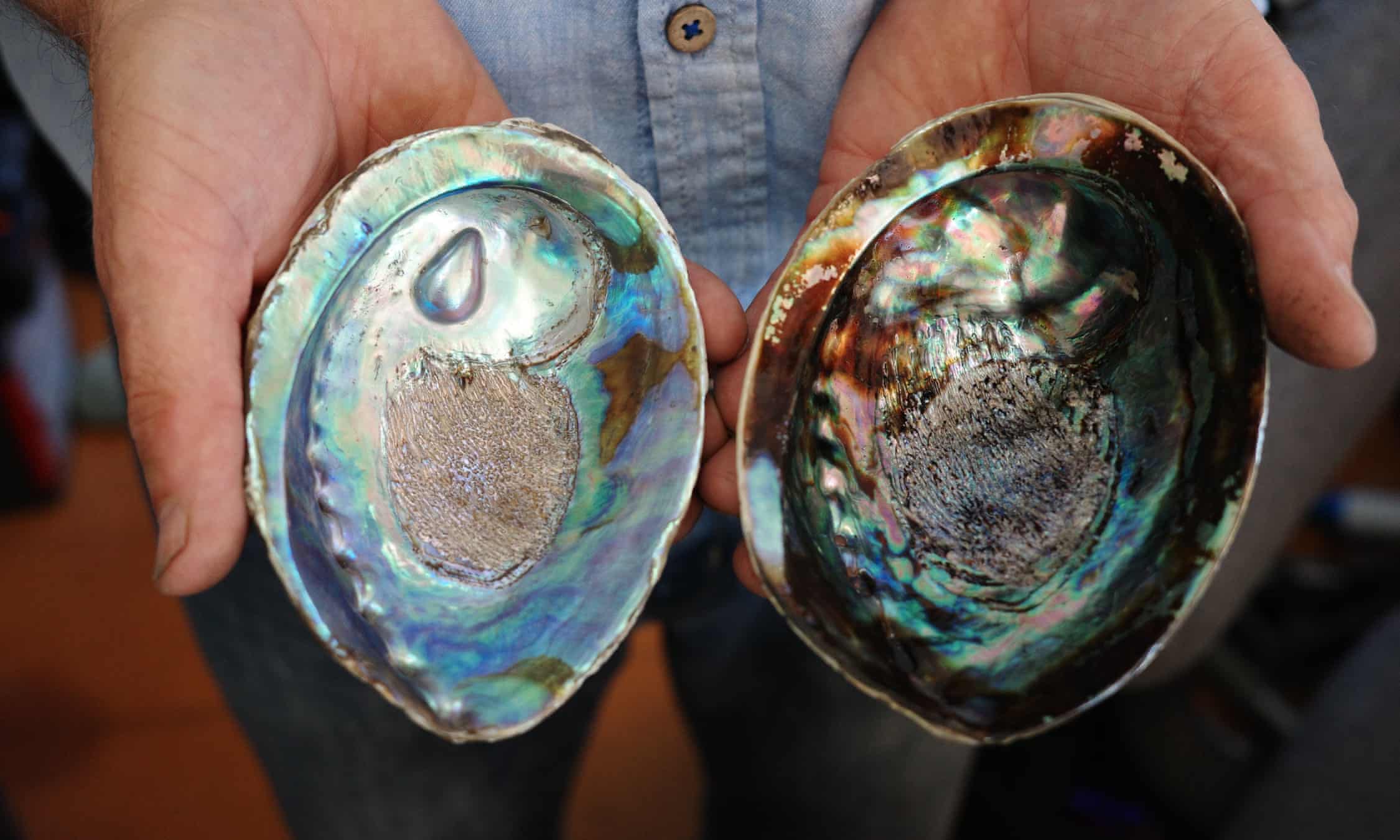
Photo: Shanti Mathias.
A farmed pāua shell with a pearl inside (L) held next to a wild pāua shell in New Zealand.

During the pandemic lockdown, there didn’t seem to be much point in dressing up or wearing jewelry. I certainly got comfortable with being casual all the time, and even now I mostly wear jeans. Except for funerals.

But the other day, I noticed my grandmother’s pearl necklace in a box and felt a little sorry that I hardly ever wear jewelry (unless from Suzanne’s company). I always liked pearls.

In today’s story, we learn about unusual blue pearls and how the reality of global warming suggests we better enjoy them now, while abalone can still make them.

Shanti Mathias writes at the Guardian, “Roger Beattie was diving off the Chatham Islands, about 800km [~500 miles] east of New Zealand, when he saw his first pāua pearl. Beattie was familiar with pāua, the Māori word for abalone, and their iridescent shells of shimmering purples and greens. But the pearl that had formed inside was unlike anything he had ever seen, gleaming with layers of the pāua’s natural colors. …

“That was in the early 1990s, and Beattie soon started experimenting ways of farming pāua, and creating pearls in the shell. A decade later, he began selling the so-called blue pearls commercially.

“Now a small industry exists in New Zealand cultivating the unique gems. They are rare, with only a handful of companies running farms, each producing only a few thousand pāua pearls each year. But the delicate operations are being made more complicated as changing conditions and warming seas alter the environments pāua need to survive.

“ ‘Warm waters cause physiological stress to the pāua,’ says Shawn Gerrity, an ecologist at the University of Canterbury who has studied the pāua.

“There are four species of pāua endemic to New Zealand. The blackfoot pāua is the biggest species, known for its vibrant shell and succulent flesh. All cultivated pāua pearls come from the blackfoot pāua. The pearls appear shades of blue, turquoise, purple and green.

“ ‘Only this abalone, in this water, produces such an unusual color of pearl,’ says Jacek Pawlowski, a jeweler in Akaroa, a seaside town southeast of Christchurch on New Zealand’s South Island. … ‘They have that rainbow, opal shine.’ …

“As juveniles, pāua are taken out of the water, where their flesh is pried up and a small implant placed under their shell for a pearl to form on. If their soft bodies are nicked, the pāua will bleed to death, so the process must be gentle. Only one in five pāua will create a jewelery-grade gem, Beattie says.

“Each mollusk needs to be fed vast quantities of kelp and live in water about 16 degrees for the three to four years it takes for a pearl to form. …

“But rising ocean temperatures pose a threat to their survival. … Marine heatwaves have dramatically increased in frequency around New Zealand, with a particularly severe event in 2017/18 causing thousands of sea creatures to die.

“Increased marine temperatures have caused mass die-offs of abalone species in other areas of the world, like California, where warming water has reduced abalone’s access to food and sped up the transmission of a withering disease. Beattie has had an algal bloom – which is more likely in warm water – kill a harvest of pāua by depriving them of oxygen.

“Gerrity says marine heatwaves ‘destroy habitats.’ …

“Gerrity has researched the recovery of pāua in Kaikōura, on the north-east coast of the South Island, where thousands of pāua died after the sea floor was lifted six metres [~20 feet] in a 2016 earthquake. Nine years later, with careful management, the population is healthy again. …

“Dr Norman Ragg, senior shellfish scientist at science organization Cawthron Institute, says pāua are a ‘really interesting quirk of nature’ that have remained unchanged for millennia. While New Zealand’s populations are still healthy, there is no room for complacency. … Ragg believes cultivating blue pearls could go some way to bolstering appreciation for pāua and securing its future in the face of climate change.”

More at the Guardian, here. With no paywall at the Guardian, donations are vital.

Read Full Post »

Photo: Mark Viales/Al Jazeera.
Luis May Ku, 49, poses with his hands painted in Maya blue outside his home in Dzan, Yucatan, Mexico, on September 9, 2024.

Today’s article is about how the preparation of an ancient paint color was lost to history — and about how a contemporary Mayan’s persistence brought it back.

Mark Viales has the story at Al Jazeera.

“Surrounded by dense jungle and beneath intertwining canopies of towering trees, Luis May Ku, 49, trudges ahead through shoulder-height bushes searching for a rare plant. The oppressive 40-degree Celsius (104 Fahrenheit) heat dulls the senses, and the air, thick with humidity, clings to our skin, causing beads of sweat to form and trickle down.

“After scouring the thickets, May, an Indigenous Maya ceramicist, stumbles upon a shrub similar in shape and texture to others around him, but insists this one is special. He touches the soft, sprawling leaves and tells me it is wild ch’oj (‘indigo plant’ in Mayan, anil in Spanish) – or Indigofera suffruticosa – which is a key ingredient to create the revered Maya blue pigment.

“ ‘It took years before I found it – indigo – and most people from Yucatan believed it to be extinct on the peninsula,’ May says with a pensive look, lifting his sombrero made from interwoven huano palm leaves to wipe his brow with the back of his hand. …

“ ‘The Yucatan Peninsula is going through its worst drought in decades,’ he says. ‘Let’s rest, and I’ll tell you how I recreated Maya blue.’ …

“The bright azure color can still be seen among the ruins at the world-famous archaeological site of Chichen Itza in Yucatan on murals more than 800 years old.

“Only a handful of blue pigments, such as lapis lazuli or Egyptian blue, were created by ancient civilizations. Still, these were predominantly dyes or minerals, while Maya blue required a chemical combination of organic and inorganic substances. Before synthetic versions of blue pigment arrived during the Industrial Revolution, the color was exceedingly rare and often more expensive than gold in Europe. The semiprecious lapis lazuli stone originated in the mountains of Afghanistan and was only accessible to the wealthy. Yet, in the New World, blue pigment was plentiful and thrived.

“When the Spanish arrived in the 15th century, they exploited Maya blue, along with all the treasures they stole from Mesoamerican civilizations. The Spanish controlled the prized colorant until the late 17th to early 18th centuries when synthetic substitutes began to arrive. Common knowledge of Maya blue then disappeared until its rediscovery in the 20th century.

“In 1931, American archaeologist H.E. Merwin first found ‘a new pigment’ on murals within the Temple of The Warriors at Chichen Itza. It was given the name ‘Maya blue’ a few years later (1942) by American archaeologists R.J. Gettens and G.L. Stout. Research paused during World War II, and it was not until the 1950s that powder diffraction analysis revealed the Maya blue pigment had been made by mixing clay, palygorskite (a rare fibrous clay) and indigo. In 1993, Mexican historian and chemist Constantino Reyes-Valerio published a recipe to recreate the color using palygorskite, montmorillonite (a soft clay) and indigo leaves.

“Modern-day scientists value the mysterious paint because its unique resilience to the elements has kept it in near-perfect condition on pre-Columbian murals, artifacts and codices, even a millennium later. …

“It took scientists a long time to understand the formula, and studies are continuing. …

“May was born in Dzan, a village of 6,000 people in the western part of Yucatan about 100 kilometres (62 miles) south of the state capital city, Merida. Most of the peninsula is flat and pocketed with cenotes formed in the aftermath of the cataclysmic meteor that wiped out the dinosaurs. Yet in the municipality of Ticul, which includes Dzan, the land rises somewhat, giving way to the Puuc (‘hills’ in Maya) region, which has been inhabited since around the 7th century BC.

“Several important pre-Columbian Maya cities dot the area, such as the World Heritage Site of Uxmal, an ancient Mayan city with beautiful Puuc-style architecture. The buildings in the ruins have smooth, vertical walls with features such as columns, elaborate friezes, decorated masks and curved snakes, mostly representing the rain god, Chaak, and the feathered serpent deity, Kukulkan, respectively.

“The region remains famous today because of its high-quality pottery and clay sculptures, especially the town of Ticul, nicknamed ‘The Pearl of the South’ [3.1 miles] from Dzan. The area is also a source of palygorskite – found in caves – which some potters use to grind and mix with other clays to make pottery more durable. Here, May cut his teeth in ceramics as a student among some of the most renowned artisans in Mexico and eventually began his journey to recreate Maya blue.

“ ‘I dreamt of working as my ancestors did with clay and natural pigments,’ he says, tapping a finger on his temple. He reminds me that, like most people in his village, his mother tongue is Maya, and emphasizes that he is proud to work like his forefathers in creating Maya blue.

“May was 17 years old when he started sculpting wood while studying Maya Culture at the Autonomous University of Yucatan, taking inspiration from Maya architecture around his region. One of his passions was capturing faces with distinct Maya features. About 20 years later, he followed in the footsteps of ceramicists from Ticul and began sculpting with clay and learned from other ceramicists about adorning pottery with organic pigments such as red and white.

“However, he was also fascinated to learn that they also used synthetic pigments – like blue. On a visit to the Maya ruins in Bonampak, Chiapas, he was captivated by murals painted with a beautiful turquoise colour. May discovered that the sky-blue pigment was held sacred by his ancestors and used during rituals. After questioning his colleagues further, he learned that the knowledge needed to create this color in its traditional form had been lost in Yucatan, leading him towards a path of rediscovery of ancient techniques. …

“On January 9, 2023, May announced on social media that researchers in Italy and Mexico had validated his formula. It was the first time the world had seen Maya blue made with traditional methods in Yucatan for almost two centuries.

“David Buti, a researcher at the Institute of Heritage Science of the National Research Council in Perugia, Italy, and Rodolfo Palomino Merino, a professor of physics and mathematics at the Autonomous University of Puebla, Mexico, sent him PDFs with scientific breakdowns of their analyses. Merino’s work came through first in August 2022, with a 95 percent probability that May’s formula was genuine. In 2023, Buti’s analysis verified that it was 100 percent Maya blue. Both academic institutions confirmed that his samples, which contained palygorskite, calcium carbonate and indigo, caused an ‘intercalation between the indigo molecules’ – a chemical reaction – resulting in an authentic Maya blue.

“ ‘I was ecstatic,’ May says. ‘My ancestors used Maya blue exclusively in ceremonial practices, and even then, it was in limited supply. It was the color of the gods, and only the elite were permitted to use it.’

“ ‘As a child, my father and grandfather taught me that consistent hard work pays off. Never giving up and trying your best, even if you do not succeed, are typical Mayan values.’ “

Lots more at Al Jazeera, here. No firewall.

Read Full Post »

Judith Ross has a beautifully written and photographed WordPress blog she calls Shifting Gears. Recent posts have covered a visit with her younger son, who is a Peace Corps volunteer in Morocco.

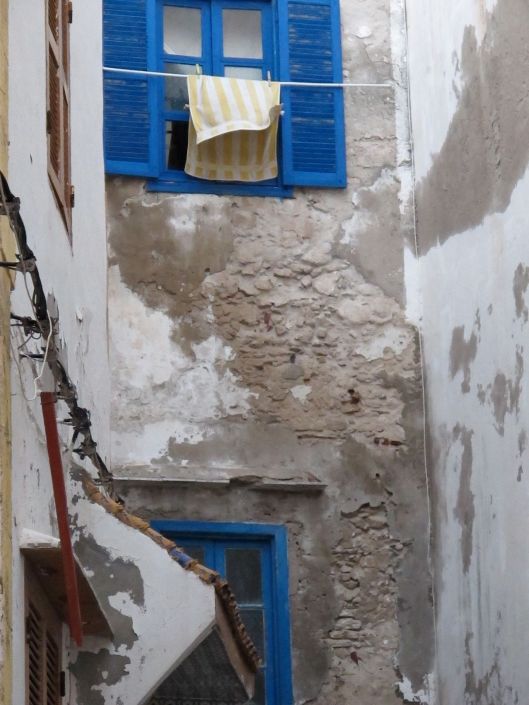
I was particularly taken with an entry in which Judith captures a luscious blue color that is reiterated all over one picturesque town, on everything from fishing boats to bread baskets.

She writes that one morning, she and her husband and son “climbed into our rental car and headed to Essaouira, a beach town. Much less intense than Marrakech, it was a good place to start our journey. [Our son] has friends there, who are also in the Peace Corps.

“The name of the riad where we stayed, Les Matins Bleus, reflected the town’s color scheme. …

“At the docks you can buy fish directly from the fishermen. Then, back in the medina, stop at the market for vegetables, before taking these purchases to a restaurant where they grill your food to perfection and serve it to you with bread – which also functions as your knife, fork, and spoon.” More.

Photo: Judith A. Ross

Read Full Post »