Feeds:
Posts
Comments

Posts Tagged ‘buffalo’

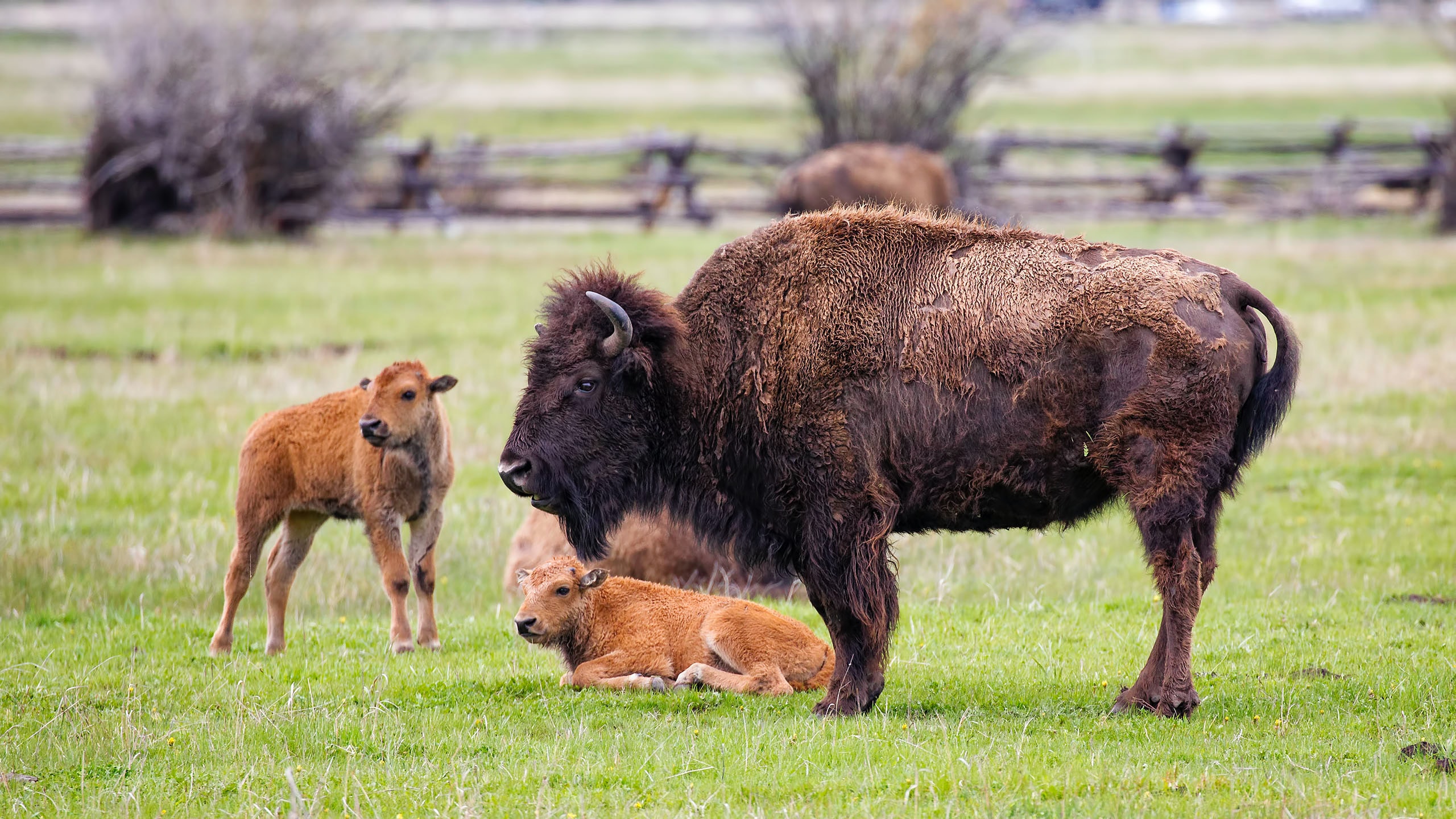
Photo: Philip Brown/Unsplash.
Led by tribes, conservationists are helping bison make a comeback.

Having recently watched an appalling old Annie Get Your Gun film with Betty Hutton (appalling on the subjects of poverty, women, and especially indigenous people), I was relieved to learned from today’s article that attitudes may have evolved into something more promising.

Back in the day, settlers fought natives in underhanded ways. One way was killing bison, a sacred food source. Today European descendants and tribes are actually collaborating to bring the animals back from the edge of extinction.

Jess McHugh reports at the Washington Post, “Miles of prairie stretched out across the Wichita Mountains Wildlife Refuge in southern Oklahoma, acre after acre of brush, grasses and hearty vegetation creeping toward the low-range granite mountains rising in the distance. Like in much of Oklahoma, the road is flat here, but the speed limit remains 30 mph. That’s because of the bison.

“They appeared seemingly out of nowhere: dozens of massive animals lumbering up the shoulder of the road to cross to the fresh vegetation on the other side. The herd moved slowly, their soft, bovine eyes barely registering the stopped cars awaiting their passage. They quickly set to work mowing down the fresh springtime grass.

“The bison’s quiet munching does more than nourish their bodies — it’s one of many things they do to nurture their entire ecosystem, one that is increasingly under threat from climate change. Grazing bison shaving down acres of vegetation leave more than dung behind:

Their aggressive chewing spurs growth of nutritious new plant shoots, and their natural behaviors — the microhabitats they create by rolling in the ground, the many birds that forged symbiotic relationships with them — trickle down the food chain.

“Once bordering on extinction, bison now serve as a great provider for their ecosystems, standing as an example of the ways in which animal conservation and ecological protection can work in tandem.

“ ‘Buffalo is the original climate regulator,’ said Troy Heinert, a member of the Sicangu Lakota (Rosebud Sioux) tribe and executive director of the InterTribal Buffalo Council, a coalition working to restore the animal on tribal lands. ‘Just by how they use the grass, how they graze, how their hoofs are designed, the way they move.’ …

“Tribes are leading the effort to bring back the bison, Heinert says, which in turn allows for the return of other native grasses, animals and insects — all of which will ‘help fight this changing climate.’

“Bison, called buffalo by some Indigenous peoples, are mammoth creatures. Weighing up to 2,000 pounds, they are the largest land mammal in North America. … Two centuries ago, bison dominated much of the continent from Canada to Mexico, when tens of millions roamed North America. They were so numerous that the pounding of their hoofs beating across the land sounded like rolling thunder. For the many tribes of the plains region — the Lakota, the Shoshone, the Arapaho, to name a few — buffalo was a sacred animal that nourished their people and played an important ceremonial role.

“For European colonizers, the bison were both a commodity and a weapon. Americans massacred them by the thousands, selling their pelts and organizing vast sport hunts. As the United States pushed West in the 1800s, bison became a pawn in their quest to wrest Indigenous tribes off their ancestral homes. …

“By the turn-of-the-20th century, millions of bison had been killed. In 1900, fewer than 1,000 — of an estimated 30 to 60 million — remained, many in zoos.

“President Theodore Roosevelt ordered federal bison herds to be put into place (some, such as Custer State Park, were ironically sourced from tribal herds). The bison observed in the Wichita Mountains are descended from 15 animals commandeered from the Bronx Zoo in 1907 and brought to Oklahoma via train car. In the intervening century, federal, tribal and private herds have brought the species back from the brink of extinction. The estimated number of bison nationwide — while far from the millions — now hovers in the low hundreds of thousands.

“Indigenous peoples have been integral to this effort from the start, both by managing herds and by introducing legislation to protect and expand bison territory. In the past few decades, tribal herd numbers have soared: The InterTribal Buffalo Council, which began as a modest coalition of fewer than 10 tribes in the early 1990s, will soon count 76 tribes across 20 states from New York to Hawaii among its members, managing a total of more than 20,000 animals across 32 million acres.

“The return of the bison is a victory not only for the sake of biodiversity but for the entire ecosystem in which they live. As a keystone species, the bison sustain their environment from the top down.

“ ‘They move through, graze everything down. It’s a type of disturbance — like fire would be,’ said Dan McDonald, lead wildlife biologist at the Wichita Mountains Wildlife Refuge. ‘The fresh green [draws] other animals that would feed on it: elk and deer and whatever other type of grazers that would consume some of that new forage.’

“The herd in Oklahoma is approximately 625 animals, but when large herds move synchronously across the land, they create what scientists have dubbed a ‘green wave.’ The bison’s vigorous grazing stimulates plant growth, creating a flood of new vegetation that follows in the bison’s wake to be ‘surfed’ by animals large and small. Green waves can be so dramatic that some — such as the one created by Yellowstone’s bison herd — can be seen from space.”

Read about the extraordinary side benefits of herd restoration at the Post, here.

Read Full Post »

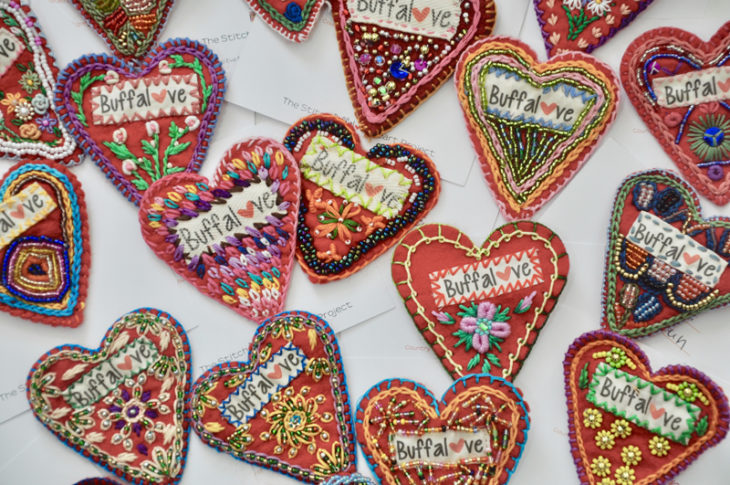
buffalo-stitch-buffalo-ny-4-730x485

Photo: Stitch Buffalo
Stitch Buffalo says it’s “advancing social justice for refugee women in Buffalo, NY, by creating opportunities for cross-cultural exchange and economic empowerment through the textile arts.”

Every individual and every community has its own way of responding to newcomers from other countries.

You would never know it from the headlines, but there are a lot of people who, being curious about foreign cultures or perhaps knowing what it was like for their forebears to be immigrants, feel friendly toward the latest arrivals. Maybe they just smile. Or maybe they work on some integrating initiative, like this charming one in Buffalo, New York.

Maura Christie reports at Spectrum News, “At first glance, it may not seem like much, ‘Embroidery floss, beads, scissors, fabrics, solid colored fabrics,’ said Dawne Hoeg, Stitch Buffalo’s executive director. But these common household items have quite literally bonded refugee women to [the city of Buffalo].

“Stitch Buffalo started as a project back in 2014 as a way to give those women a space of their own to learn and share ideas at different textile workshops.

“Now, five years and a storefront later, workshops are open to anyone in the community and many of the refugees have gone from being students to standing in front of workshops as teachers.

” ‘It’s an exciting opportunity for Buffalo people to come and have an authentic experience learning from a woman from Thailand or a woman from Burma, where she has learned this skill and is willing to share it with us,’ Hoeg said.

‘Some of their stitches are very different from the ones we do and it’s just a beautiful opportunity for a cross-cultural exchange.’

“Women also sell their one-of-a-kind, handmade items in the retail space, anything from pins to bracelets and ornaments. But every two months, that space gets transformed for Second Stitch. The nonprofit uses mainly donated materials, and anything they’re not able to use is sold to the community.

” ‘What we decided to do is to take those materials, sort them, measure them, organize them and turn them back over to the community at a reduced rate,’ Hoeg said. …

“No matter what project the women make next, or how much they sell it for, the love and support they receive from their adopted hometown is priceless.

” ‘It’s the making, but it’s also the selling,’ Hoeg said. ‘When you create something and you see that somebody else finds value in it enough to purchase it, that empowers you, that builds a confidence. That’s what I see happening with the women here is that they are empowered through the skill and the support they receive from the community.’ ”

Find some wonderful pictures at the Stitch Buffalo website, here, and at Spectrum, here.

Hat tip: Beautiful Day. Beautiful Day is a Providence-based welcoming initiative that teaches refugees and other immigrants basic job skills in the process of making a range of fantastic granola products. If you follow them, you will be alerted to new varieties you can buy, and you can read stories from around the country like the Stitch Buffalo story. I like to send their beautiful gift baskets to family members at holidays.

Read Full Post »

Photo: Luke Spencer
Inside the main concourse of the abandoned art deco Buffalo, New York, train station. 

It seems everyone loves old art deco buildings, but no one knows how to preserve them. At least that is the feeling I get listening to the endless discussions of the future of Providence’s Superman Building, so-called because it looks like the Daily Planet building from the 1950s television series.

Meanwhile, as Luke Spencer writes at Atlas Obscura, preservationists in Buffalo, New York, are holding out hope for an art deco “train station, lying forlorn and mostly forgotten … the old Buffalo Central Terminal.

“Opened in 1929 for the New York Central Railroad, the Buffalo Central Terminal was every bit as grand and opulent as Manhattan’s Grand Central Terminal, Philadelphia’s 30th Street station and Washington DC’s Union Station.

“These were the days when Buffalo was known as the Queen City, built on the strength of automobiles, livestock, steel, and other heavy industries prospering along the seam of the Erie Canal, connecting New York to the Great Lakes. Buffalo thrived to such an extent it was chosen to host the prestigious 1901 Pan American World’s Fair. At this point, Buffalo was the eighth-largest city in the United States. … In its heyday, Buffalo Central Terminal was servicing 200 trains a day.

“But the decline in Buffalo’s economic fortunes, and the rise of domestic airlines and automobiles, spelled the end of the grand Terminal. In the early hours of the morning of October 28, 1979, the last Lake Shore Limited train service heading west left Buffalo. The grand old Terminal was never used again.

“For decades, the building was left abandoned, silently falling apart, while the surrounding neighborhood similarly declined. But the spirit of the Nickel City is strong. No more so than in the recent efforts of the non-profit, Central Terminal Restoration Corporation (CTRC), which has been fighting to not only preserve the Terminal, but restore it to its original magnificence. …

“The building itself would need extensive repairs. Forty years of neglect have seen much of the original fixtures either stolen or stripped, particularly in the mid 1980s, when the Terminal was sold off in a foreclosure sale. …

“Perhaps the best chance for the Terminal’s rejuvenation lies with Canadian property developer Harry Stinson, who was named as the designated developer of the site by the City of Buffalo and the CTRC in 2016.” More at Atlas Obscura, here.

It’s a treat to see historic buildings saved and turned to new and profitable uses. Let’s keep tabs on this one.

Photo: Luke Spencer
Is this the prison staircase in the opening scene of Little Dorrit, by Charles Dickens? Oh, guess not.

Read Full Post »

At work we have partnered with an urban high school for 35 years. Tomorrow a group of 15-year-olds from the school will come into the office for Job Shadow Day.

The students fill out a form in advance to let their assigned mentor know something about them — favorite subject, least favorite, hobbies, career ambitions.

My student has an unusual ambition for a 15-year-old. She wants to be a philanthropist.

Perhaps I will tell her what I read recently about how many of today’s top philanthropists are active in their causes. They don’t just give money.

“The global face of philanthropy is changing,” writes the Christian Science Monitor. “Donors no longer just open their wallets. They’re actively involved in causes, use savvy business practices, and leverage what they give to achieve more good.”

One such philanthropist is F.K. Day. Read how his work has benefited people in Zambia and beyond.

“Life in rural Zambia has improved dramatically for dairy farmer Cecil Hankambe. He has doubled his milk sales, purchased a farm, and earned enough money to send his children to school. He still milks the same cow and travels the same rugged roads to the local dairy co-op. The only difference now: Instead of lugging a heavy jug on foot, he pedals a bicycle.

“Mr. Hankambe rides a Buffalo, a bike so sturdy and basic that its steel frame can carry up to 220 pounds and be repaired with a rock. Instead of delivering only seven to 10 liters of milk a day, Hankambe can now transport 15 to 20 liters to a chilling station before it spoils, boosting his profit.

” ‘A reliable bike can create reliability in a dairy farmer’s income,’ says F.K. Day, founder of World Bicycle Relief, a foundation based in Chicago that produces the Buffalo and provides two-wheeled aid to people in developing nations. ‘You forget how important transportation is.’ ”

Day started young, as young as the girl who will visit me at work tomorrow.

“As a teenager, he flew – on his own initiative – from Chicago to Brazil to knock on the door of Irish priests who were building schools in São Paulo‘s poorest neighborhoods. They hadn’t responded to his letters. But when he showed up on their doorstep, they had no choice but to put him to work.

“That experience laid the groundwork for what followed three decades later. On Dec. 26, 2004, horrific images of tsunami-swept Southeast Asia flickered on TV screens in the United States. Day, now a successful cofounder of SRAM, an elite bicycle-parts manufacturer, wanted to do more than just fund relief efforts. …

“So he and his wife, Leah, boarded a plane to Sri Lanka. Within weeks, Day had partnered with World Vision; he eventually oversaw the distribution of 24,000 bicycles that gave thousands of people affected by the tsunami the ability to reach their jobs, schools, and health-care centers.” His bikes are now in many countries were transportation needs are great.

” ‘If you can enter something new, open and honestly with beginner’s eyes, something good is bound to happen,’ says Day.”

How does one come by that core impulse to help? Probably it shows itself at a very young age. Even at 15.

Read about seven additional innovative philanthropists in the Monitor.

Photograph: Leah Missbach Day
F.K. Day, President of World Bicycle Relief & Executive Vice President of SRAM Corporation, pictured in downtown Chicago.

other innovative philanthropists

Read Full Post »

The blue-collar city of Buffalo, New York, has struggled in recent decades with unemployment and economic decline. A few years ago, it had a big idea for redeveloping its waterfront — a big idea that went up in smoke.

But when residents and local organizations starting thinking small instead of big, good things began to happen.

“In 2004, it was decided that the region would invest large sums of public money [at the site of the old Memorial Auditorium] to draw a new outlet for Bass Pro Shops, a national purveyor of sporting goods and fishing equipment. Local leaders scraped together $65 million in promised tax breaks, infrastructure improvements and other public subsidies to speed its arrival and to catalyze a new era of growth and commerce on the waterfront. It was all for nothing.

Since the Bass Pro deal collapsed, the harbor development corporation has shifted its focus on some comparatively tiny, piecemeal projects, such as the multicolored Adirondack chairs that dot the waterfront park, a new small restaurant that dispenses ice cream and veggie burgers, Jason Mendola’s fledgling kayak rental business and the relocation of the free Thursday at the Square concerts to Canalside’s Central Wharf.

None of those improvements required huge investments. None were heralded as keystone projects for future growth. But together, they have begun to transform the phrase ‘waterfront development’ from an oxymoron into a reality.”

Read the thoughtful article by Colin Dabkowski in the Buffalo News. I found the lead at ArtsJournal.com.
*
*
By the way, when my mother met my father, he was an editorial writer for the Buffalo Evening News, the forerunner of the Buffalo News. She was attending law school.

Read Full Post »