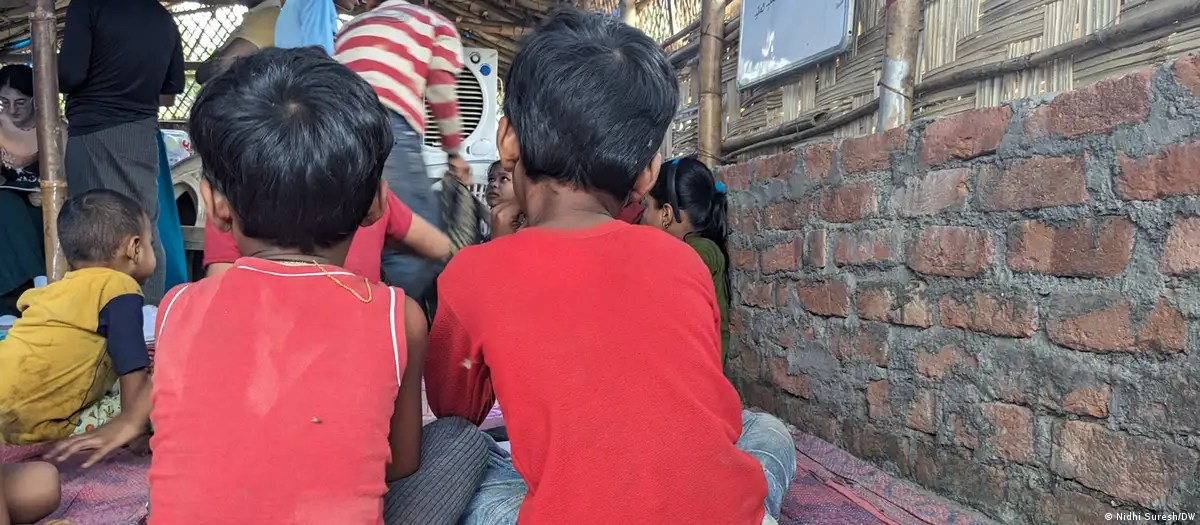
Photo: Nidhi Suresh/DW.
In May, a small classroom made of woven bamboo walls and a cardboard roof was set up in a refugee camp where around 30 children between the ages of 5 and 15 could be taught how to read and write the Rohingya language.
Did you ever feel a need to invent a written form of a language? The Karen language of Burma had no written system until the 1830s, and Somali got Latin characters in 1973. Meanwhile, the Rohingya are barely getting started.
Nidhi Suresh writes for DW, “Ayesha Siddique, an 11-year-old Rohingya girl, rushed into her classroom. She picked up a broom, swept the floor and laid out a plastic mat in front of the small white board.
“Siddique’s family fled Myanmar soon after she was born to escape the widespread discrimination and persecution of the Rohingya, a Muslim minority group in the Southeast Asian nation. They spent a few years in Bangladesh‘s Cox’s Bazar refugee camp before moving to India in 2019.
“The young girl currently lives in a refugee camp in Faridabad, on the outskirts of the Indian capital, Delhi.
” ‘My grandparents often describe Burma as a beautiful land with mountains,’ Siddique said, referring to the country now known as Myanmar. ‘They told me about the trees behind our house, too. One day, I want to write a song about this in my own language.’
“For the past month, Maulvi Mohammad Ismail, himself a Rohingya asylum seeker, began teaching children like Siddique how to read and write in their mother tongue.
“In 2013, Ismail’s family also fled to Bangladesh’s Cox’s Bazar, which is currently home to at least 1 million Rohingya Muslims from Myanmar. After five years, he and his family made their way to India.
“They settled in the Faridabad camp, along with 50 other Rohingya families. The camp is located inside a garbage dump and most of the men work as ragpickers.
“The people in the camp speak to each other in Rohingya. They’re also fluent in Bengali and Hindi. However, most of them do not know how to read or write the script known as the Hanifi Rohingya. …
Rohingya living in Saudi Arabia and Bangladesh started a WhatsApp group called the Rohingya Zubaan Online Academy.
“Ismail joined the group, downloaded the script, and spent a month learning the alphabet. Last month, he set up a small classroom made of woven bamboo walls and a cardboard roof where he started teaching around 30 children between the ages of five and 15 how to read and write the language. …
“Sabber Kyaw Min, founder and director of the Rohingya Human Rights Initiative in India, explained why it was so important that children learn the language.
” ‘We as a community do not have much documentation. Our children must learn to write our language and then our stories, which will become our history. … Through these stories we can hopefully demand justice some day.’
“The Rohingya language remained an oral tradition until the 1980s when Mohammad Hanif, an Islamic scholar, developed a script based on Arabic letters and a set of decimal numbers. [However,] due to a military crackdown, violence and an internet shutdown, most of the population could not access it.
” ‘What happens in any genocide is the systematic erasure of a cultural identity which had to be preserved,’ said Shehzar Doja, founder and editor of the Luxembourg Review. … The erasure of Rohingya culture began in 1964, when Myanmar’s then military dictator, Aye Ne Win, excluded the Rohingya language from Burmese Broadcasting Service.
“In 1982, the military government enacted the Citizenship Law, which excluded the Rohingya people from the list of recognized ethnic groups in the country. …
“In 2017, Myanmar unleashed a violent military crackdown in what many describe as a genocide against the Rohingya Muslims in the country. This led to a mass exodus, with more than a million Rohingya fleeing to Bangladesh and other countries.
“Mayyu Ali, currently residing in Canada, is a Rohingya poet and author of Exodus: Between Genocide and Me. Ali himself learned the language in 2013 while working at a research center in Myanmar which had access to the internet. …
“Ali was among the thousands of Rohingyas who fled to Bangladesh. While living in Cox’s Bazar, he began the ‘Art Garden Rohingya,’ a website which now brings together hundreds of Rohingya writers, poets and artists.
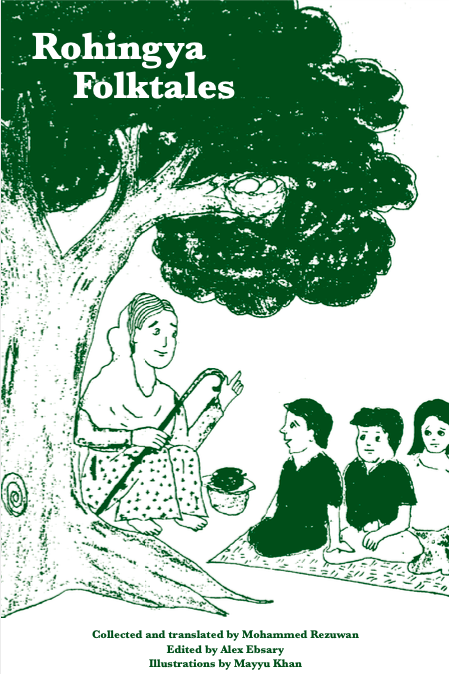
“The platform, launched in 2019, also documents and preserves ancient Rohingya folktales, proverbs and riddles. They’re published in Rohingya, Burmese and English.
“Ali also explained that another factor contributing to the slow erasure of the language is that after fleeing, most of the Rohingya focus on quick assimilation into their host countries. …
“Reefa Akhtar, 10, and Abdul Shukur, 12, are two children studying Rohingya language in Ismail’s class. When asked if they ever want to go home, both siblings immediately said, ‘yes.’
“However, Akhtar was quick to add, ‘but I also don’t want to go back to a place which makes my father sad even if he thinks about it for a minute.’ “
More at DW, here. No firewall.


 Suzanne's Mom's Blog