Feeds:
Posts
Comments

Posts Tagged ‘cinema’

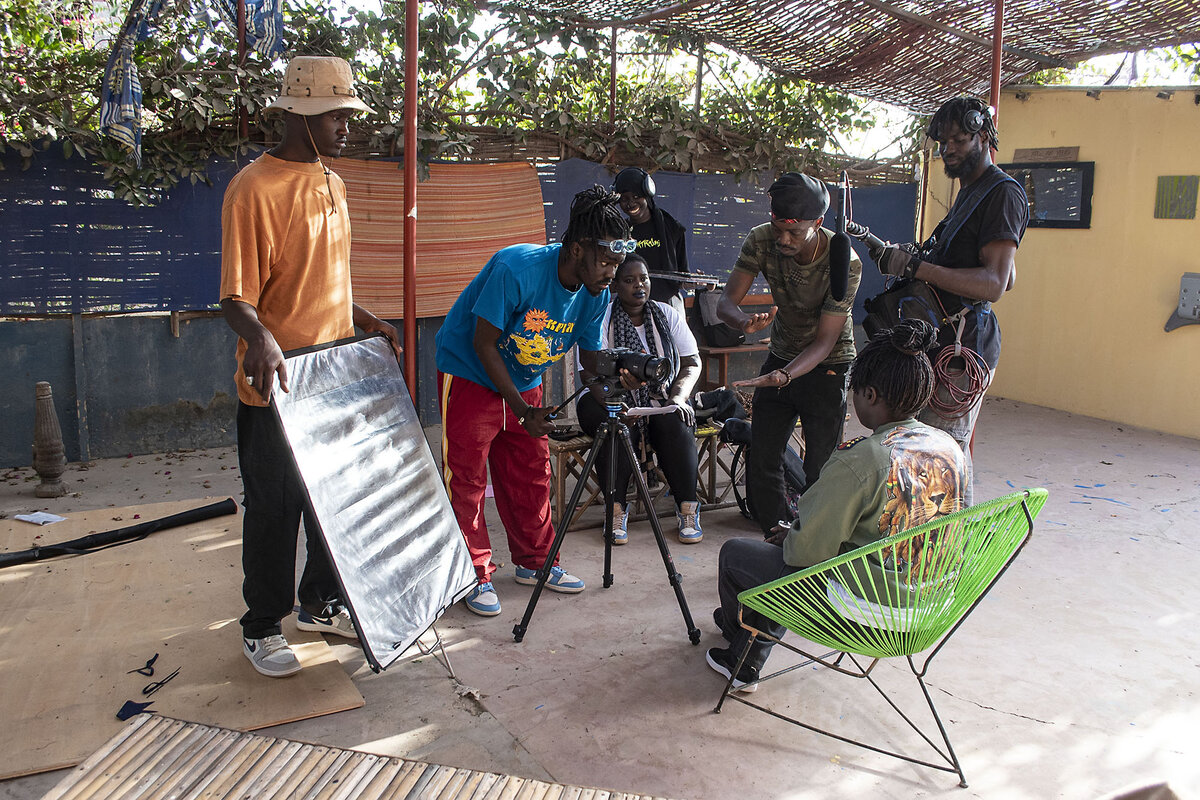
Photo: Ayen Deng Bior.
“Assistant director Pape Samba Tine (second from right) yells, ‘Action!’ on the set of a new Senegalese documentary about women’s lives,” the Christian Science Monitor reports.

For generations, films about Africa were written by non-Africans — in effect by the descendants of the colonizers. But over time, Africans have begun to tell their own stories in their own way.

Ayen Deng Bior, reporting from Senegal for the Christian Science Monitor, writes, “On a dusty Monday afternoon, the hallways of the Kourtrajmé film school buzz with nervous chatter and excitement. It is pitch day, and soon everyone files into a classroom to listen to the students present their screenplay ideas.

“The topics cover a wide sweep of Senegalese life, from the story of a 19th-century slave insurrection to a supernatural drama about a woman who can read people’s thoughts.

“When Leida Ndiaye’s turn comes, she is sweating. … But soon, she finds her rhythm, describing her idea for a rom-com about a woman in her early 30s who uses her job in human resources to ‘interview’ prospective dates to her birthday party. Ms. Ndiaye explains that she wants to provoke new conversations about dating and marriage.

“ ‘A lot of financially independent women are living the same situation here in Senegal,’ she says. ‘The tension between her professional life and her chaotic emotional life leads her to a deep introspection on her true desires and the nature of love.’

“Ms. Ndiaye and her classmates at Kourtrajmé are part of a new generation of Senegalese filmmakers who are setting out to tell their own stories on their own terms. With a film about Senegalese migrants, Io Capitano, up for best foreign film at the Oscars [2024], they know the world is eager to hear about their lives. 

“But Io Capitano’s success also highlights the challenges they face. The movie was made by Italian filmmakers, igniting conversation about what types of stories get told about Africa and by whom. 

“ ‘The Italian film is amazing, but it’s another story about migration,’ says Emma Sangaré, an American producer and screenwriter, and Kourtrajmé’s co-founder. For her students, she adds, there is so much more to say.

“Kourtrajmé’s popularity is a testament to hunger of young Africans to showcase a different kind of story. The school, which opened in 2022, gets hundreds of applications from all over the continent for about two dozen spots in its screenwriting and directing courses. Both six-month programs are fully funded.  

“The Dakar school is the third branch of Kourtrajmé, which French director Ladj Ly started in 2018 in a disadvantaged suburb of Paris in order to bring new and different voices into the film industry. Senegal’s Kourtrajmé was founded by Mr. Ly, Ms. Sangaré, and her husband, French Malian director Toumani Sangaré. …

“Last year, Banel & Adama, a magical realist romantic drama by French Senegalese director Ramata-Toulaye Sy, premiered to positive reviews at the Cannes film festival. But for many Senegalese filmmakers, a lack of resources and connections still makes the global film circuit hard to break into.

Io Capitano, for instance, had budget of more than $8 million. … But getting funding like that often means turning to American or European producers. In these situations, Ms. Sangaré says the power dynamic makes it hard for young Senegalese filmmakers to assert their authority about the kinds of stories they want to tell. …

“Mariama Niang is in director mode, supervising her team as it prepares to shoot an interview for her documentary, Elle, on a recent afternoon. …

“For Ms. Niang, an alumnus of Kourtrajmé who has wanted to be a filmmaker since she was a child, this moment has been a long time coming.

“ ‘Cinema is the world,’ she says. ‘In cinema, you can see everything. You can see one movie, and you see all your life in that movie.’

Elle, whose title means ‘she,’ follows five Senegalese women who have made names for themselves in their respective industries – from photography to financial consulting – while challenging the common narrative here that women are ‘just’ homemakers and childbearers. It’s a contentious topic that Ms. Niang has wanted to tackle for years, but she couldn’t figure out how to pay for it.

“Kourtrajmé changed that. The film school funded half the production, and Ms. Niang used the pitch skills she honed there to convince a private investor to pay for the rest.

“Back at Kourtrajmé, Ms. Ndiaye [says] ‘It’s better to tell our own story because if you don’t do it, people won’t know what exactly African people are living. … Westerners are doing it; they share their history; they share their culture. Why not us?’ ”

More at the Monitor, here. No paywall.
Read Full Post »

Photo: Adrian Susec/Unsplash.

Film buffs, it turns out, are not only creative about making movies, they’re creative about ways to screen movies. That’s because a different locale can lend a whole new feeling to the movie-going experience.

Bryn Stole writes at the New York Times, “Some of international cinema’s biggest names gathered on [a Tuesday in February] at the Berlin International Film Festival as the event honored Martin Scorsese with a lifetime achievement award. Before accepting his trophy, Scorsese listened as the German director Wim Wenders gave a laudatory speech to an audience including celebrities and local dignitaries.

“Just around the corner, parked in the middle of a busy thoroughfare, a group of Berlin’s taxi drivers crammed into the back of a worn-out taxi van to watch a double-feature capped by Scorsese’s 1976 movie Taxi Driver.

“Klaus Meier, who has been driving a cab in Berlin since 1985, handed out bottles of soda and beer, popping the caps with the blade of a pocketknife. Irene Jaxtheimer, who runs a taxi company, passed around homemade popcorn. A generator outside the cab powered a modest television, a DVD player and a small electric heater.

“The unconventional screening, just outside a centerpiece event for one of Europe’s most prestigious film festivals, was part of the makeshift TaxiFilmFest. Running through Sunday, it is partly a protest over the miserable state of the taxi industry these days and partly a counterfestival to celebrate the taxi cab’s iconic place in the urban cultural landscape.

“It’s also in objection to an exclusive partnership deal between the festival, known locally as the Berlinale, and the ride-hailing giant Uber to ferry filmmakers between the city’s movie theaters during the event. … Beeping horns from the busy street outside — some of them coming from sleek black Uber vehicles emblazoned with the Berlinale logo — blended with the street scenes from Taxi Driver playing on the tinny television speakers. ‘Ah, I really miss those mechanical fare boxes!’ Meier said as the fares ticked away in the onscreen cab of the movie’s unhinged antihero, Travis Bickle, who drives around mid-’70s New York with growing hatred and menace.

“The back-seat festival is showing only taxi-themed flicks, and the potential repertoire is deep. Meier polled friends and fellow taxi drivers about which films to show, and said he had received dozens of suggestions about movies in which a cab plays a starring role.

“The early feature on Tuesday was Barry Greenwald’s 1982 quirky slice-of-life documentary Taxi! about some odd characters driving cabs in Toronto. The previous evening, a small rotating crowd beat the rain to catch portions of the 1998 French action-comedy Taxi, a lighthearted flick from the director Gérard Pirès about sinister, Mercedes-driving German gangsters, hapless Marseilles cops and a lead-footed rookie cabdriver who turns out to be the only person fast enough to catch the criminals.

“An early hit at the TaxiFilmFestival, which kicked off last Thursday, was Under the Bombs, a Lebanese drama set during the 2006 conflict between Hezbollah and Israel. In the movie, a Beirut taxi driver is hired to drive a woman into the war-torn south of Lebanon in hopes of finding her sister and son. Meier described it as ‘Shakespearean’ and ‘a masterpiece,’ and Berndt said it was clearly the ‘most moving taxi film’ he’d ever seen.

“But the clear favorite among attendees was Jim Jarmusch’s Night on Earth, a quirky, episodic 1991 film about taxi drivers and passengers in five cities around the world. The selection for TaxiFilmFest’s Sunday night finale had yet to be chosen, and Meier said he remained open to suggestions. …

“The festival attendees, squeezed into the back of the van on Tuesday, also reminisced about better days for taxi driving, such as ferrying around American and British soldiers from the occupying Allies stationed in West Berlin. (The French troops, the small crowd agreed, had less cash and rarely hailed cabs.) …

“The days before the fall of the Berlin Wall were ‘blissful times, hard to even imagine anymore,’ said Stephan Berndt.” More at the Times, here.

See also my 2014 post about a theatrical production in a taxi in Iran, here.

By the way, I hated the movie Taxi Driver when I saw it around 1976 — and walked out. Still don’t get what’s to like. You?

Read Full Post »

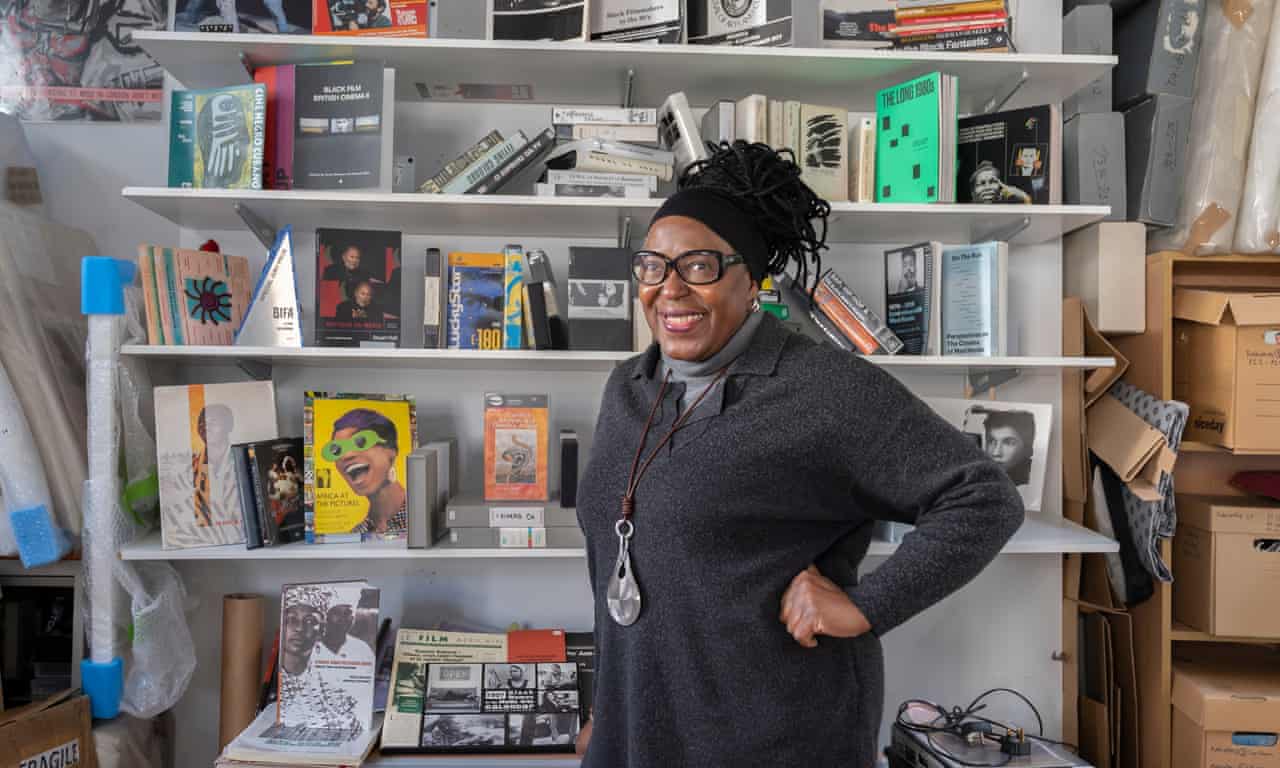
Photo: Amaal Said/JGPACA [June Givanni Pan African Cinema Archive].
From a Mogadishu film week
poster to VHS videos of pioneering art movies, June Givanni has collected a range of Black film artifacts and is now ready to share.

Sometimes people whose childhood struggles involve race-based discrimination grow up to embrace and trumpet the beauty of their heritage. I enjoy stories like that.

At the Guardian, Leila Latif interviews one such person, the founder of June Givanni Pan African Cinema Archive.

Discussing her recent exhibition, “PerAnkh: The June Givanni Pan African Cinema Archive,” Givanni played down the show’s title. Says Latif, “The Black British film curator, activist and archivist who created it is hesitant about positioning herself front and center.

“ ‘I don’t want it to sound like it’s all me, me, me,’ she worries. ‘My name is part of it because I worked as a curator for many years and collected work throughout the non-digital era, which developed into this archive.’

“Though she wants the films, documents, artworks and objects she has preserved to be the focus of people’s attention – from an installation of the earliest audiovisual works by the Black Audio Film Collective to new works by the Chimurenga collective from South Africa – Givanni is more than worthy of the spotlight. When she received the British independent film awards’ grand jury prize in 2021, the organizers said that she had ‘made an extraordinary, selfless and lifelong contribution to documenting a pivotal period of film history.’

Born in British Guiana 72 years ago, Givanni moved to the UK aged seven and was immediately underestimated.

“ ‘They put me with the five-year-olds because I was Black and I’d come from the Caribbean,’ she remembers. ‘My mum went to the school twice before they moved me up to my age range.’

“As an adult, Givanni collaborated with some of the most significant figures and institutions in pan-African cinema and across ‘different territories, different continents.’ She kept adding elements to her collection, she says, ‘because I needed to use them for subsequent programs and as part of building a body of knowledge and a whole series of resources that can be shared with others.’

“Lack of preservation has meant many of pan-African cinema’s masterworks have disappeared. In America alone, it is estimated more than 80% of Black films from the silent era are lost, and technological advances endanger film further. While physical film has a potential shelf life of hundreds of years, digital preservation requires constant migration to keep up with changing technology. …

“Givanni has faced changes in technology, politics and culture since she began in the early 80s. The first film festival she worked on was called Third Eye, inspired by the Latin American Third Cinema movement which set out to challenge Europe and North America’s dominance in film. For Givanni, the festival provided ‘an area to develop our own ideas about representation and taking charge. Pan-African cinema has always been a cinema of resistance. I can’t tell you how inspiring it was that there were all these people out there doing things that really chimed with what I thought should be happening.’ …

“She programmed festivals on five continents; worked for Greater London Council’s ethnic minorities unit and the Independent Television Commission; ran the BFI’s African Caribbean film unit and co-edited Black Film Bulletin, which relaunched in 2021 as a quarterly collaboration with Sight and Sound magazine, and has celebrated the under-sung work of film-makers. …

“The spirit of pan-Africanism was a guiding light, connecting all cultures that originated on the continent without treating them as a monolith. Givanni explains, ‘When I say pan-African, it’s not just the African continent; it’s the entire diaspora. All those significant histories are interconnected and cinema is very much part of that.’

“Choosing how to represent that history at Raven Row, with selections from an archive that now surpasses 10,000 items, was a gargantuan task. But Givanni immediately knew she wanted to include ‘a poster of the Mogadishu film week, given to me at my first attendance at the Fespaco film festival in 1985 by a Somali film-maker. Now people mention Somalia and they don’t picture these vibrant and strategic cultural events taking place there. …

“ ‘At the Havana film festival I bought a collection of silkscreen posters that will be exhibited. Lots of art can be seen digitally, but to see a silkscreen poster, the texture and the color of it – there’s an experience of culture and artifacts that goes beyond digital representation.’

“Beyond allowing the public to admire key objects from Givanni’s collection, the exhibition is structured around a program of films from the likes of Sarah Maldoror and Ousmane Sembène (the mother and father of African cinema). There is also an archive studio and reading room in the spirit of the exhibition’s title, PerAnkh – an Egyptian term for ‘a place of learning and memory.’ “

More at the Guardian, here. No firewall.

Read Full Post »

Photo: Kerry Jones.
Artist Kerry Jones turned her old trailer into one of the smallest cinemas in the UK.

Today we have another idea on taking what you have and turning it into something that can delight others.

“Until fairly recently,” writes the BBC, “Kerry Jones’s caravan lay rotting and forgotten about in her garden in Galashiels in the Scottish Borders — a home for discarded bric-a-brac.

“But during the Covid-19 lockdown, the artist and filmmaker saw new potential in the 1980s Swift Pirouette, and resolved to turn it into a tiny, traveling cinema. With a maximum of eight seats, it could be one of the smallest cinemas in the UK.

” ‘It isn’t the first cinema caravan to exist,’ said Kerry. ‘There was one over in Dumfries and Galloway that a friend of mine made at the beginning of the 2000s, that was really inspiring. I’m really interested in projects that involve people out in your community.’ …

“Over the pandemic, Kerry secured a bursary [grant] from the Alchemy Film and Arts charity based in nearby Hawick as part of a local arts program running between July 2021 and December 2023. She used it to renovate the caravan inside and out, swapping the retro mint paneling for a bright red that could be seen for miles. … Inside, she plans to install between six and eight seats, again in a plush, cinematic red fabric.

“Speaking to Mornings with Stephen Jardine, she said: ‘[I’ve] had it for 12 years — it’s been out and about, it’s been used for people to stay, it’s been a spare room. But over the last few years, but it’s just been one of those spaces that you put things in and forget about.’

“Kerry’s caravan cinema project — named Moving Images — [made] its debut at Hawick’s Alchemy Film Festival on 28 April, screening nine short films all made by people in the south of Scotland.

“It comes at a time when Scotland has lost one of its smallest cinemas — the Schoolhouse Cinema in Shetland. This 20-seat cinema, run by local magician Chris Harris, was put up for auction in 2020 after he decided to leave the islands.

“Around the same time another tiny theater opened in the Highland village of Cromarty — a 35-seat facility that took two years to come to fruition.

“Kerry aims to cater for an even more intimate experience, and will be using a small portable projector to save on power without sacrificing picture quality.

“The caravan itself is solar powered, but Kerry said she will borrow a high-quality battery as back-up until she can crowdfund her own.

“Any spare cash will then be put towards taking the caravan on the road — possibly for a tour of free screenings and running filmmaking workshops at local primary schools.

“Kerry added: ‘It’s going to be really adaptable. Selkirk’s market square have said they’d be quite interested in having the caravan there. I’d love to take it out to some of the more rural areas like Duns and Gordon.

” ‘We’re also going to work with a group called Connecting Threads and they’re doing lots of projects along the Tweed [river] — I’d love to see it there, that would be quite magical.’ “

There’s more to read at the artist’s website. “As part of The Teviot, the Flag and the Rich, Rich Soil, our programme exploring the pasts, presents and futures of Hawick and the Scottish Borders and investigating the town and wider region’s cultural identities in relation to land, water, industry, territory, place and environment, Alchemy is offering a number of bursaries to Borders-based artists. These bursaries will support a range of community-oriented projects between July 2021 and December 2023.”

More at the BBC, here, and Jones’s website, Alchemy Film and Arts, here.

Read Full Post »