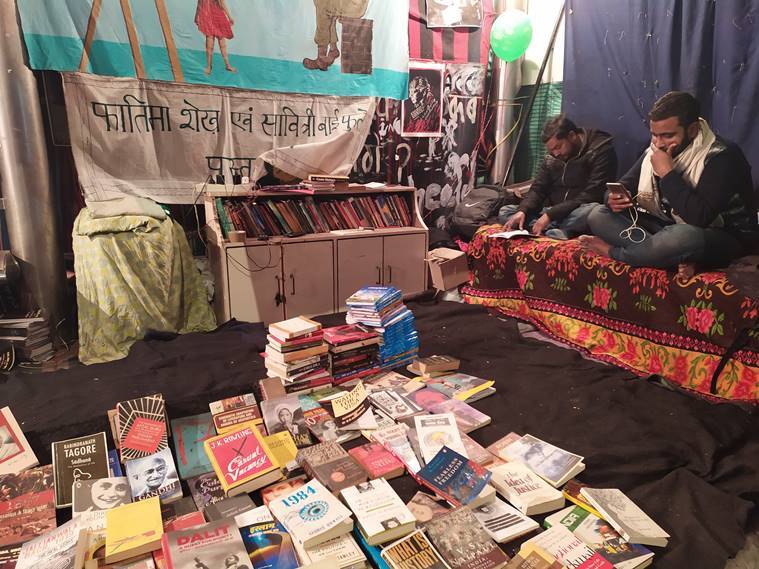
One aspect of the 2019 Shaheen Bagh protest organized by Muslim women against India’s Citizenship Amendment Act was the emergence of free libraries.
Most Americans don’t keep track of politics in India, but it was hard to miss the news back in 2019 when the Modi government decided to change the rules about who could be counted as a citizen. Muslim women organized a protest that spread across the country from the original site in Shaheen Bagh. One aspect has remained.
As Harshvardhan reported at India’s National Herald in January, “The Shaheen Bagh protest site is gone, but its legacy continues to inspire those who dream of a more egalitarian and democratic India. Led mostly by Muslim women, the Shaheen Bagh protest site inspired one of the most aesthetically-pleasing and thought-provoking experiments with protest art in recent times. Walls and streets of Jamia Millia Islamia and Shaheen Bagh protest site exploded with creativity as students and artists camped there and experimented with ideas. …
“One of the most distinctive contributions of the Shaheen Bagh movement was the introduction of a ‘protest site library.’ The idea of a ‘protest library’ came up during the Occupy Wall Street protest, one of the largest popular demonstrations in the United States. Occupy protesters erected a tent and established a ‘People’s Library’ in Manhattan’s Zuccotti Park in November 2011. This one of its kind library held over 5000 volumes of books along with magazines and newspapers, and was finally razed down by the police.
“Since then, the concept of a ‘People’s Library’ captured the imagination of protesters all across the world. It travelled to Gezi Park in Istanbul in 2013 when people resisted the commercialisation of public spaces. Make-shift libraries cropped up in different parts of Spain during the anti-austerity 15-M movement (2011-15) and then it travelled to Hong Kong during the pro-democracy movement there.
“At Shaheen Bagh, a group of students decided to convert a bus stand into a makeshift library in the heydays of the anti-CAA protests [CAA stands for the Citizenship Amendment Act of 2019]. The ‘Fatima Sheikh Savitribai Phule Library’ captured the imagination of people and soon the make-shift library started to attract a lot of donors and also inspired similar libraries at different anti-CAA protest sites.
“The year 2020, an otherwise gloomy year dominated by the COVID-19 pandemic … ended on a high note with the farmers’ uprising against the three farm bills, passed by the BJP-controlled Parliament in haste. … By blocking the entry points of nation’s capital, farmers are actually attempting to block the privatization and corporatization of Indian economy. Along with that, the protests are also a powerful assertion of the right to dissent. …
“It is but natural that such a huge protest in terms of both mobilization and concerns will also develop into a rich site for cultural production enriching the protest repertoire of the country. In one of the most innovative moves, protesting farmers launched their own bi-weekly newspaper. … They also set up libraries at the protest sites. [It] clearly carried on the legacy of the Shaheen Bagh protests. Now, we can be sure that protest site libraries are going to feature every time there is a sustained peoples’ movement.
“The first library came up at Tikri Border, Pillar no 783. On December 22 [2020], a group of students began the ‘Shaheed Bhagat Singh Library’ with a single book stand with almost 200 books standing against a yellow tent. Farmers at Tikri border welcomed the idea and people could be seen browsing through the limited books available there. Soon the idea picked up and similar libraries came up at Singhu border as well as Ghazipur border while attempts were being made to establish one at Shahjahanpur border. …
“From the anti-CAA movement to the anti-farm law movement, the protesters have been accused of being ‘uneducated’ and … of ‘not having ‘read the law’ or ‘not knowing what they are protesting against or for.’ …
“The protest-site libraries stand as proof that these people are not ‘uneducated folks’ [but] are mature enough to develop a concrete socio-economic-political understanding and act upon it.”
More at the National Herald, here. Search Suzanne’s Mom’s blog on the word “library” for examples of other unusual libraries around the world.


 Suzanne's Mom's Blog