Feeds:
Posts
Comments

Posts Tagged ‘city of culture’

Photo: Danny Lawson/PA
The Royal Ballet gala is part of the programme celebrating Hull’s year as the UK City of Culture. 

Years ago, I read an article in which some famous theater person opined that, with money for the arts always tight, only major centers should be funded, not small theaters and arts programs out in the boondocks. I believed then and still believe that was the wrong way to go. Everyone deserves arts. And who’s to say where genius can be found?

Which is why I liked this story from the UK about the post-industrial city of Hull, where an impressive ballet school has been training talent for years.

Anita Singh, writes at the Telegraph, “A backstreet in Hull might seem a world away from the bright lights of the Royal Opera House. But one unassuming dance school in a converted church has discovered more ballet stars than any other in the UK.

“The Skelton Hooper School of Dance has sent what is believed to be a record 24 pupils to the Royal Ballet School, including the current head of The Royal Ballet, Kevin O’Hare.

“As a tribute to the city’s dance heritage, O’Hare is taking his company to Hull for the first time in 30 years. He will stage a gala performance starring Xander Parish, star soloist with Russia’s Mariinsky Ballet and another former pupil. …

“ ‘For me, Hull-born, bringing the Royal Ballet up to Hull for this special opening performance is fantastic,’ said O’Hare. … O’Hare and his brother, Michael, who is now senior ballet master with Birmingham Royal Ballet, studied at Skelton Hooper. …

“The school was founded by the late Vera Skelton and is now run by her daughter, Vanessa Hooper. ‘My mother trained most of the teachers we have. She was quite extraordinary — the first person to get someone into the Royal Ballet from the provinces,’ said Hooper, who charges just £3.75 a lesson. …

“Hooper said there is something special about the city. ‘Hull’s a difficult place to get to. You’ve got to go there out of curiosity,’ she said. ‘We’ve had to build our own little world on the periphery.’ ”
More here.

Read Full Post »

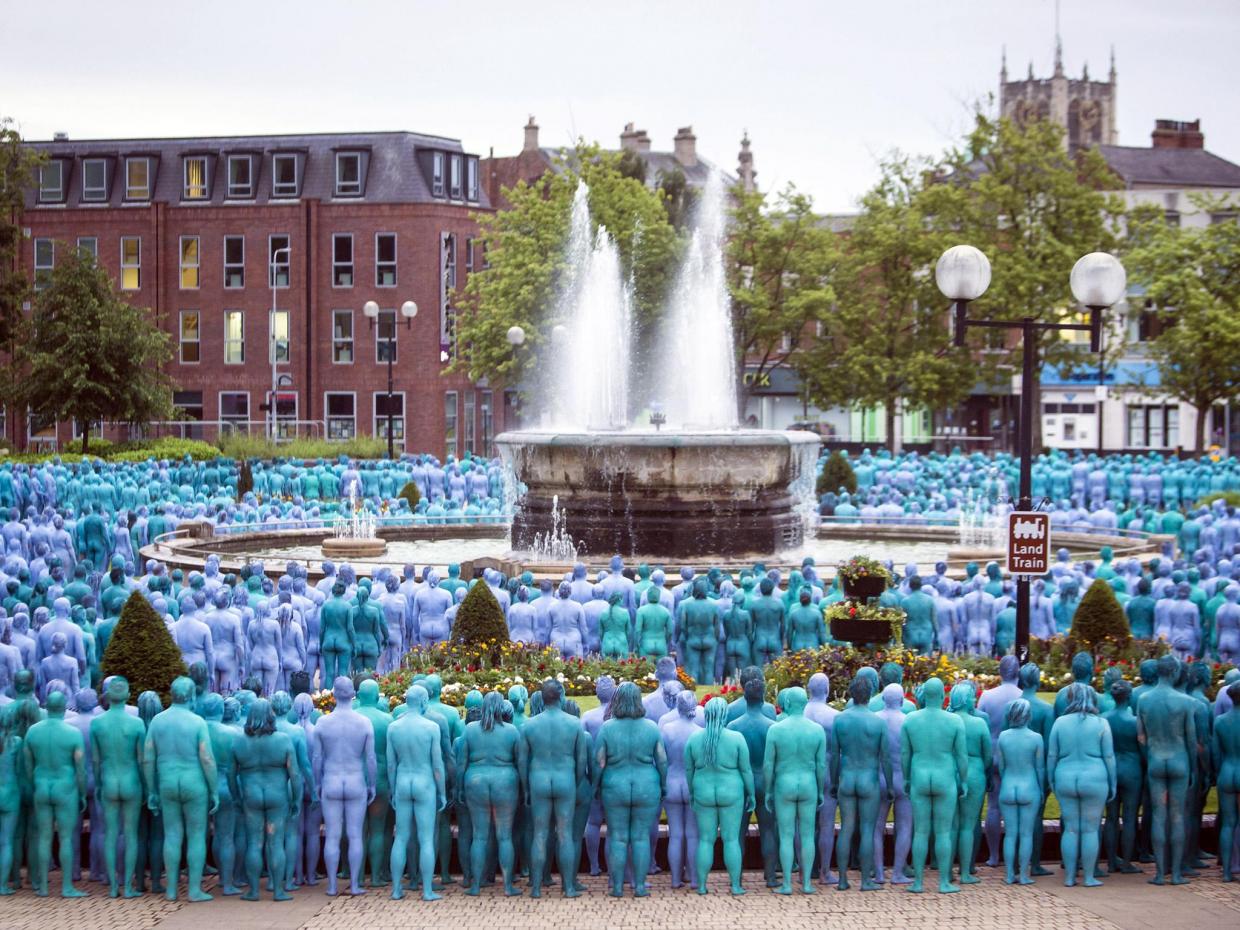
Photo: Getty
People take part in an installation entitled Sea of Hull, by artist Spencer Tunick.

The notion that the arts and related fields like graphic design can boost local economies has been an article of faith for decades, causing disappointment when it frequently fails to lift whole cities above poverty.

Nevertheless, done right and with other stars in alignment, it can be a piece of the economic puzzle in a changing world.

Here is a recent angle from Kingston upon Hull in the UK.

David Barnett reports at the Independent, “On New Year’s Day, a firework display heralded the beginning of Hull’s tenure as the Britain’s City of Culture. Multimedia stories from the city’s maritime and industrial heritage were projected on local buildings in front of a crowd of thousands.

“Over in the Hull City Museum they like a bit of culture and they know Hull’s had it for a long time; exhibits go back to the Paleolithic era. There’s also a recreation of a Roman bath house, featuring mosaics discovered in the 1940s in the Roman settlement of Petuaria, modern-day Brough in East Yorkshire.

“But never mind the Romans … what, the people of Hull might be asking, in true Monty Python’s Life of Brian style, has culture ever done for us? …

“It regularly tops the deprivation rankings for the UK’s 326 local authorities – according to the Kingston upon Hull Data Observatory’s latest figures, Hull ranks as the third most deprived local authority generally, and tops the lists of deprivation for education, skills and training. ..

“Perhaps a typical, post-industrial Northern city. Its traditional industries of whaling and sea-fishing have declined, as elsewhere; Hull still remains a large port, though, and there has been a successful drive to attract chemical and health companies to the area. …

“ ‘There might well be degrees of scepticism about what culture can mean to a place like Hull,’ says Robert Palmer, the director of the team that won and managed Glasgow’s successful bid to be named European City of Culture (as it was then known) in 1990. ‘But being designated a capital of culture can bring long-term effects in terms of the legacy it can offer.’ …

” ‘We employ a very broad definition of culture,’ says Palmer. ‘It’s not just what people might think of as “fine culture.” It’s not just opera. …’

“Which is why Hull’s City of Culture website lists events for the coming year that range from acrobatics to walking tours, by way of cabaret, jazz, literature, parkour and, yes, opera. Which is all very nice, but is it just a distraction from the problems facing Hull?

“ ‘There are tangible economic benefits,’ says Palmer. ‘We’ve seen it before in all cities that get a culture status, it’s well documented. Visitor numbers, job creation, the social impact through participation from social groups who are not normally involved in culture. The benefits are incontestable.’ ”

Lots more here.

Perhaps one year of intense focus on the arts and culture can energize enough residents to keep the momentum going. It certainly seems to have done so for Liverpool, another struggling postindustrial city that was a UK City of Culture in 2008.

One wonders if a designation as, say, a City of Math and Science might have the same kind of long-term ripples.

Read Full Post »

As the New Yorker magazine was wont to label quirky British news items, “There’ll always be an England.”

Today’s tidbit is from the BBC, courtesy of my web-surfing spouse. Will Gompertz writes about the fierce competition to be crowned Cultural City of 2017.

Hull won. There seems to be a bit of bad blood among the losers.

“Hull has been named the UK’s next City of Culture, beating Leicester, Dundee and Swansea Bay to the right to hold the title in 2017. Hull, known for being the home of poet Philip Larkin, the Ferens gallery and the Truck theatre, will follow the 2013 City of Culture, Londonderry.

“The UK government chooses a new destination every four years, with the aim of helping tourism and the economy. Hull council leader Stephen Brady said winning was ‘a real game-changer.’ …

“TV producer Phil Redmond, who chaired the City of Culture panel, said Hull was the unanimous choice because it put forward ‘the most compelling case based on its theme as “a city coming out of the shadows.” ‘ …

“Swansea’s city council said losing to Hull was a ‘bitter disappointment.’ In an apparent swipe at the winners, council leader David Phillips said the residents of Hull ‘had to have something to look forward to.’ He added his team wouldn’t give up, as ‘there were too many good ideas in the bid, we’re not going to let them slip through our fingers.’

“Leicester’s Mayor Peter Soulsby expressed similar sentiments, saying: ‘We don’t need to wait until 2017 to show ourselves off. We are going to do it now.’

“In Dundee, bid director Stuart Murdoch simply said the city was ‘broken-hearted.’

More.

Almost makes you want to visit the losers to make them feel better.

Photo: http://www.bbc.co.uk
The Hull Truck theatre company’s £14.5m new home, 2009.

Read Full Post »