Feeds:
Posts
Comments

Posts Tagged ‘climate change’

061817-new-shoreham-bluffs


On the principle that “one and one and 50 make a million,” a better world relies on everybody pitching in. Ordinary people can help scientists and other leaders of worthy initiatives.

Lisa Mullins and Lynn Jolicoeur report at WBUR on one example.

“It’s a cloudy, cool July morning, and we’ve come to the docks at Fairhaven Shipyard, near New Bedford, to meet Chris Parks. She’s a tall, elegant, retired Boston banker in jeans and a sweatshirt.

“Parks is a volunteer with the Buzzards Bay Coalition. Residents formed the group 30 years ago to help the struggling bay.

“She’s got a plastic bottle attached to a long metal pole. She submerges it and fills it with sea water. Then she pulls out her tool box full of vials and chemicals. She mixes and measures.

“Parks determines the water is pretty cool on this day — 67 degrees. … In addition to temperature and clarity, Parks tests the water for how much salt and oxygen are in it. She’s been coming to this dock, fastidiously, one or two mornings a week for 17 years.

” ‘I’m doing it because it’s one of the few things that I can do that is a tangible task towards helping the environment,’ Parks says. ‘It’s a little bit of science that helps tell us what’s going on in Buzzards Bay.’

“What’s going on is that the water is warming — and that may be contributing to long-lasting pollution problems in the bay.”

Buzzards Bay Coalition science director Rachel Jakuba says, ” ‘If you have too much algae in the water, that’s when you get cloudy, murky water, loss of eel grass, low oxygen levels that make it hard for fish and shellfish to survive … Bay scallops are very rare now because part of their life cycle depends on eel grass blades.’

“The Buzzards Bay Coalition is attacking that pollution aggressively. It’s working with homeowners to upgrade their septic systems with technology that reduces nitrogen. …

“Jakuba says as researchers figure out how global warming fits into the bay pollution picture, citizen scientists will be key.

“Mark Sweitzer, 68, is a citizen scientist and lobsterman based at Point Judith in Galilee, Rhode Island. …

“Six times a month while he’s catching lobster, Sweitzer lowers a device to the bottom of the ocean — about 200 feet. It tracks the temperature and other characteristics of the water at every depth, and it syncs the data to an iPad on board. …

” ‘I’m just happy to do it, because I feel like I’m providing some information — even though it might not have immediate effect on my boat, but in long-term trends in the fishery and how it might influence policy or regulations,’ Sweitzer says. …’

” The settlers — the tiny little ones that are four days old that have reached the bottom — there is a temperature at which they will not survive … and there are temperatures at which we have an influx of fish. Black sea bass used to be primarily a mid-Atlantic fish. And now … the black sea bass are down there gobbling up these little lobsters that don’t have much of a chance to make it in the first place.’ ”

Read how other fishermen are noticing ocean changes before scientists do and reporting back, here.

We have a friend who sets lobster pots off New Shoreham, Rhode Island. His catch has gone down steadily over the past few years, so I know there is a problem.

Photo: Mark Degon/WBUR
Lobsterman Mark Sweitzer works out of Point Judith, Rhode Island.
Read Full Post »


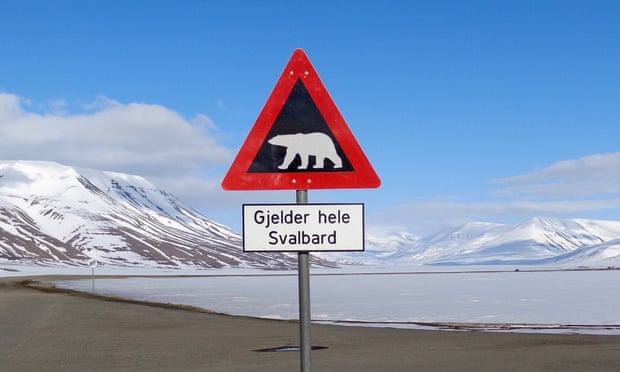
Photo: Balazs Koranyi/Reuters 
A sign warns residents of the arctic Svalbard islands in Norway of the danger from roaming polar bears. Norway is planning to expand its oil operations in the Arctic. 

Norway has a reputation for environmentalism. Unless you are talking about oil. Now some of the country’s leading lights are suing the government because of its plans to start drilling in the Arctic. A Norwegian whose writing I admire is one of them.

David Crouch reports at the Guardian, “Norway’s best-known author has lashed out at ‘the shortsightedness and stupidity’ of plans to expand oil exploration into the Arctic, as campaigners prepare to sue the government for placing future generations at risk from climate change.

“Karl Ove Knausgaard, whose bestselling memoir has been a global literary sensation, is fronting a campaign to mount a legal challenge against moves by Norway to open up the Arctic to oil companies.

“Oil and gas extraction in the Arctic has nothing to do with worthwhile goals such as alleviating poverty, Knausgaard said. ‘Norway is one of the richest countries in the world – it’s all about greed. … I never believed that my government actually would do such a thing. … It just makes me want to cry.’ …

“The campaign aims to make use of a recent change to the constitution which obligates the state to take action to ensure natural resources are managed ‘on the basis of comprehensive long-term considerations,’ including safeguarding the environment for future generations. …

“The campaign by Norwegian environmentalists aims to mirror similar legal challenges in the Netherlands and in the US, where lawsuits have attempted to hold governments to account over climate change. In April, the Dutch Urgenda foundation launched the first case in the world to use human rights and tort law to hold a government responsible for failing to reduce carbon emissions fast enough.

“ ‘Where do we draw the line if not in the Arctic?’ said Åsne Seierstad, the bestselling Norwegian author and another signatory to the petition. ‘No economic policy is more short-term than relying on profits from the very areas that are worst affected from climate change.’ ”

More here.

Read Full Post »

Photo: North Carolina Arboretum
Plant physiologist Joe-Ann McCoy extracts seeds from black cohosh collected in western North Carolina.

A plant physiologist, worried about the future effects of global warming on biodiversity in Appalachia, is not only preserving seeds but working to attract preservation-based economic development. It would be almost like getting a sponsor for one of the plants there, a plant whose roots are used in popular herbal remedies.

At Yale Environment 360, Nancy Averett writes, “When she can spare the time — away from the grant applications, journal articles, and economic reports strewn across her desk — plant physiologist Joe-Ann McCoy laces up her hiking boots and heads to the Pisgah National Forest in western North Carolina.

“Dodging copperheads and black bears, she winds her way deep into the forest, her eyes scanning the lush understory for black cohosh, a native plant whose roots have been used in herbal remedies for centuries, primarily to treat symptoms related to menopause. When she spots her quarry, McCoy gently pulls the plant’s seed pods — tiny brown orbs that rattle when shaken — off the stem and slips them into a paper envelope.

“The seeds inside those pods — which will be cleaned, vacuum-packed, and then stored in a freezer at -20 degrees Fahrenheit — give McCoy hope. As the director of the North Carolina Arboretum’s Germplasm Repository, her job is to preserve native seeds in this highly biodiverse area in southern Appalachia before climate change makes it impossible for some native vegetation to survive there.

“But the black cohosh holds another promise, as well. The plant’s roots are used in top-selling herbal remedies, and, if someone could succeed in growing black cohosh as a crop and manufacturing supplements here [it] could help drive economic development in this job-scarce region. …

“North Carolina [is] special in terms of biodiversity. Studies have documented more than 4,000 species of plants, 2,000 species of fungi, and 500 species of mosses and lichens in the region. Unlike much of the U.S. East Coast, during the last three ice ages the ground in this region did not freeze, which means the plants here have a much longer genetic history and more diversity than in other areas.

‘If I had to pick one place in the entire U.S. for this project,’ McCoy says, ‘it would be here. This is the ultimate spot.’ …

“When she first came to the arboretum, she focused on black cohosh and creating a robust seed collection from the plant’s entire geographic range — she has 22 different strains — and then growing plants from each strain so she would have enough seeds to back up her collection in three different repositories. These include two federal storage sites — in Ames, Iowa and Fort Collins, Colo. — plus the Svalbard Global Seed Vault in Norway.”

After cataloging the seeds, McCoy turns her attention to the economic possibilities. Read here about her work with investors. The Yale article also describes her ginseng efforts and her assistance to Cherokees who value plants used in traditional medicine.

Read Full Post »

What is it about Nordic countries that they seem to find more solutions to global challenges than the rest of us? Do they have fewer challenges to worry them, better education, more ability to focus?

Here are some of their successful and replicable tactics for combating global warming.

Christian Bjørnæs writes at Cicero, “By scaling up just 15 proven Nordic solutions, countries all over the world can save 4 [gigatons] of emissions every year by 2030, which is as much as the EU produces today. The costs for this scale-up equal the amount spent in just 9 days on fossil fuel subsidies.

“These results come from the Nordic Green to Scale study which was launched during the UN Climate Conference in Marrakech. …

“ ‘The main concern decision makers have is that it’s either too difficult or too expensive to rapidly reduce emissions,’ says Senior Advisor Oras Tynkkynen, who led the Nordic Green to Scale analysis on behalf of [the Finnish Innovation Fund Sitra].

“ ‘Our objective with this study is to highlight what different countries have already achieved on climate action and what other countries can learn from their successes.’ …

“Urban Danes cycle on an average almost 3 km every day. If other countries followed the example of Denmark and promoted cycling in cities, it would reduce emissions by almost as much as Slovakia produces in a year.

“In Finland, most of industrial and district heating is provided with energy efficient combined heat and power production (CHP). If other countries used CHP like this, it would reduce emissions by almost as much as Japan produces in a year.

“Iceland produces almost 30% of its electricity and most of its heat with geothermal energy. If countries with significant geothermal potential started using it like Iceland does, it would reduce emissions by more than Denmark produces in a year.

“Last year, almost every fourth new car sold in Norway was an electric or plug-in hybrid vehicle. If other wealthy countries used as many electric vehicles as Norway does, it would reduce emissions by almost as much as Denmark produces in a year.

“Sweden has the world’s highest number of heat pumps per population. Scaling up the solution to selected European countries would cut emissions by as much as Cuba produces every year.

“In addition to direct emission reductions, the 15 solutions also create considerable co-benefits. These include improved air and water quality, higher energy security, more local jobs, lower fuel bills, less traffic jams, and sustained biodiversity.”

More here.

Photo: Cicero
Biking can help reduce global warming.

Read Full Post »

As costs come down, solar and wind energy are being embraced in interesting places. Stereotypes about Texas and Big Oil will have to go.

Matthew Rozsa reports at Salon, “The notion that Texas might become a hub for renewable energy innovation isn’t that new. As Forbes noted earlier this month, Texas — which produces 37 percent of America’s crude oil and 28 percent of its natural gas — has more than 10,000 wind turbines, allowing it to produce more power from wind than the combined power produced by 25 other states from all energy sources.

“Similarly, The Wall Street Journal reported [in 2015] that Texas expects more than 10,000 megawatts of solar-generating capacity to be installed across the state by 2029, which is almost the size of all the operational solar farms in the United States today.”

Rozsa quotes Texans who were interviewed by Voice of America in October:

“ ‘A lot of wind companies have evolved to include solar and wind because solar has become so cheap. It is quite competitive with not only wind, but with fossil [fuel] generation,’ said Andy Bowman, chairman of Pioneer Green Energy.

“This point of view was echoed by Jennifer Ronk, a renewable energy expert at the Houston Advanced Research Center. ‘There is a lot of research being done, a lot of development being done,’ she argued. … ‘I think there is a mix of solutions that are going to be the optimal outcome.’ ”

I’m pretty sure that cost factors will ensure the continuation of renewable-energy research — if only at the state level.

Photo: Getty/Spencer Platt
Turbines at a wind farm in Colorado City, Texas, Jan. 21, 2016.

Read Full Post »

Is the neighborhood of the future going to be on the water? A growing number of architects around the world seem to think so.

Eleanor Ross and Laura Paddison write at the Guardian about some pluses and minuses.

“Architects and city planners across the world are starting to look beyond the traditional confines of the city, towards building on water as one of the answers to reducing inner-city population density and also developing flood-resilient designs. Global damage to cities from flooding could amount to $1tn a year by 2050 if no action is taken, according to a World Bank report. …

“Building on water isn’t straightforward, however. The recent collapse of the Makoko Floating School in Lagos, one of the most famous examples of floating architecture, shows some of the complexities. …

“There are also environmental concerns. The need for foundations of many floating buildings to go deep into the river bed, for example, will have an impact on the environment, says Phillip Mills, director of the Policy Consulting Network, and a specialist in water construction.

“ ‘Foundations or structures within the river could also alter the river bed with silt erosion and deposition elsewhere in the river. The same thing already happens around bridge piers,’ he says. …

“However, Lucy Bullivant, adjunct professor of history and theory of urban design at Syracuse University, thinks there are greater environmental consequences building on land – such as the tendency to be more car focused – than on rivers. ‘Floating designs will create a good anchor point for plants to help foster biodiversity and create habitats for fish and birds.’

“Building on ‘bluefield’ sights can be environmentally friendly, according to Mark Junak, director of Floating Homes. He says floating structures such as those at Noorderhaven in the Netherlands have recently been subject to underwater drone surveys to observe whether their construction has negatively affected the ecosystem.

“According to the research project, the underwater footage ‘revealed the existence of a dynamic and diverse aquatic habitat in the vicinity of these structures, showing that floating structures can have a positive effect on the aquatic environment.’

“For London architect Carl Turner, who has designed a pre-fabricated, open-source amphibious house specifically designed to float on floodwater, called the Floating House, climate change means needing to work with water.

“ ‘You either protect the house or protect the land,’ he says. ‘Creating large-scale flood protection zones is expensive and in itself potentially harmful to the environment. Once breached, homes are left defenceless, as opposed to floating homes that can simply rise with flood waters.’ ”

More.

Photo: Mark Junak 
The Chichester prototype floating home designed by Baca Architects.

Read Full Post »

Small tree farms are now eligible to sell carbon credits, which can supplement or even replace logging income. But to many owners, getting into the market looks pretty daunting. In a recent article in the New York Times, Erica Goode explains how the obstacles can be overcome.

“Lately, [Eve] Lonnquist, 59 and recently retired, has been thinking about the future of her family’s land. Like many small-forest owners, they draw some income from logging and would like to keep doing so. But they would also like to see the forest, with its stands of Douglas fir, alder and cherry, protected from clear-cutting or being sold off to developers.

“ ‘For us, the property is our family’s history,’ she said.

“More than half of the 751 million acres of forestland in the United States are privately owned, most by people like Ms. Lonnquist, with holdings of 1,000 acres or less. These family forests, environmental groups argue, represent a large, untapped resource for combating the effects of climate change.

“Conserving the trees and profiting from them might seem incompatible. But Ms. Lonnquist is hoping to do both by capitalizing on the forest’s ability to clean the air, turning the carbon stored in the forest into credits that can then be sold to polluters who want or need to offset their carbon footprints.

“ ‘Trees are the No. 1 way in which carbon can be removed from the atmosphere and stored in vegetation over the long term,’ said Brian Kittler, the western regional office director for the Pinchot Institute for Conservation, which has a program in Oregon to help the owners of family forests develop potentially profitable carbon projects. …

“The carbon credits from Ms. Lonnquist’s forest could bring an estimated $235,000 over the first six years, and about $6,000 a year after that, said Kyle Holland, the managing director of Ecological Carbon Offset Partners, a California firm that helps small-forest owners enter the carbon markets. …

“Recent developments in forestry may help make the prospect more appealing by lowering the initial costs to landholders. Mr. Holland’s company, for example, has developed a digital tool — a smartphone equipped with a laser to measure distance and an inclinometer to measure height — that he believes will greatly reduce the expense of conducting a forest inventory, which typically costs $40,000 to $100,000 or more, depending about the amount of land.

“With the specialized smartphone, landholders can take an inventory themselves, photographing and measuring the diameters and heights of their trees. The photos and data are sent to the company’s office in California, where an expert forester goes through the images, identifying the species and checking for damage to the branches or crowns, among other things. Probability models are used to calculate the amount of carbon stored in the forest.”

Hmmm. I wonder if this smartphone app could also be used by towns like Arlington, where John and other volunteers are conducting a tree inventory, not for selling carbon credits but for beautification plans.

More at the New York Timeshere.

Photo: American Forest Foundation

Read Full Post »

Photo: The Economist

Reversing desertification in Africa has to be one of the biggest challenges ever attempted. But if we believe that the longest journey starts with a single step, then the continent’s long journey is off to a good start.

According to the Economist, “Building a wall of trees across the width of Africa is a tall order. Solving the twin problems of land degradation and desertification poses a greater challenge still. But more than 60 years after it was first proposed, just such a project is underway at the edge of the Sahara. …

“In 1952 Richard St Barbe Baker, a British environmental scientist, proposed planting a swathe of trees across the southern reaches of the Sahara. The trees would block the wind and sand that move southward from the desert and improve the quality of the soil by binding sediment together and adding nutrients to the mix.

“Although Mr Baker was unable to convince others of his plan during his lifetime, the idea has since taken root. In 2005, Olusegun Obasanjo, then president of Nigeria, revisited Mr Baker’s proposition, seeing in it an answer to some of the social, economic and environmental problems afflicting the Sahel-Sahara region.

“An estimated 83% of rural sub-Saharan Africans are dependent on the region’s land for their livelihoods, but 40% of it is degraded—worn away by soil erosion, human activity and scorching temperatures—leaving much of it unfit for use.

“In 2007, Mr Obasanjo gained the support of the African Union. The Great Green Wall Initiative was launched the same year. Today some 21 African countries are involved in the project, which has grown in scope. Trees have been planted, but building a wall of them is no longer the priority.

“Instead, the wall of trees has become a vehicle for a wider goal: countries in the region working together to tackle climate change, food security and economic growth. Recent projects include abating soil erosion and improving water management in Nigeria, agri-business development in Senegal and forestry management in Mali.”

More at the Economist.

Read Full Post »

Is it possible for a group of people to collaborate effectively enough to make their quaint English village carbon neutral?

Tatiana Schlossberg has an answer at the New York Times: “Ashton Hayes is different in an important way when it comes to one of the world’s most pressing issues: climate change. Hundreds of residents have banded together to cut greenhouse emissions — they use clotheslines instead of dryers, take fewer flights, install solar panels and glaze windows to better insulate their homes.

“The effort, reaching its 10th anniversary this year, has led to a 24 percent cut in emissions, according to surveys by a professor of environmental sustainability who lives here.

“But what makes Ashton Hayes unusual is its approach — the residents have done it themselves, without prodding from government. About 200 towns, cities and counties around the world — including Notteroy, Norway; Upper Saddle River, N.J.; and Changhua County, Taiwan — have reached out to learn how the villagers here did it.

“As climate science has become more accepted, and the effects of a warming planet are becoming increasingly clear, Ashton Hayes is a case study for the next phase of battling climate change: getting people to change their habits.

‘We just think everyone should try to clean up their patch,’ ” said Rosemary Dossett, a resident of the village. ‘And rather than going out and shouting about it, we just do it.’

Oh, ye-es! One and one and 50 make a million.

More here.

Read Full Post »

A friend from my childhood called Caroline has been following this blog, sometimes making comments related to her field, which is architecture.

Today Caroline sent me a link that she knew would be a perfect fit here. The story is about a design competition to address New York City’s rising seawater.

Kayla Devon wrote about it at Builder Online, “In the next 30 years, roughly 30% of Manhattan is expected to sink below sea level, according to a climate study by the NASA Goddard Institute for Space Studies. Instead of trying to stop the inevitable, Brazilian architect Walmir Luz focused on embracing it.

“After studying climate predictions from the United States Landfalling Hurricane Probability Project and the history of Manhattan’s edge, Luz designed a utopian/dystopian future for New York (depending if you’re a glass half-full or half-empty kind of person).

“Luz’s NYC 2050 concept makes flooding a part of city life by taking inspiration from Venice. Luz designed structures as levels that could allow water to move through lower levels as the sea rises. Streets would become permeable so water can wash over the roads instead of flooding them, and more barriers would surround the city’s edges.

“Luz completed the concept as his thesis for his Bachelor of Architecture degree from Cornell University, and won a Silver award in the urban planning and urban design category at the A’Design Award & Competition. He now works as an architect for Gensler.” More at Builder Online.

I love it when people who read the blog come upon topics that they know will fit and then send them along. I like being able to share the cool stuff with a wider audience. Thank you, Caroline.

Design: Walmir Luz
Luz won a design award for a concept making the best of rising sea levels in New York City.

Read Full Post »

It’s interesting to me how artists who believe in a particular cause will use what they know best to advance that cause. Sometimes it takes art to get a wider audience to understand an issue.

At the Greenpeace blog, Elvira Jiménez and Erlend Tellnes wrote in early June about how pianist and composer Ludovico Einaudi is raising awareness of global warming.

“The Greenpeace ship Arctic Sunrise set off from the Netherlands carrying a very special load: the voices of eight million people. Messages from around the globe calling for governments to save the Arctic from threats such as oil drilling and destructive fishing. …

“As the ship stopped in Svalbard, Norway, Europe’s gateway to the Arctic, it welcomed aboard a very special guest: renowned pianist and composer, Ludovico Einaudi. With him a grand piano, to undertake his most challenging performance yet, in the Arctic surrounded by ice. …

“As he performed this piece for the first time — in front of a magnificent surging glacier — the music echoed across the ice, a moment that will remain in our minds forever.” More here.

If one picture is worth a thousand words, maybe this one had an effect: a couple weeks later an international conference voted for protection of the Arctic.

Pilar Marcos followed up at the Greenpeace blog on June 30: “At a meeting held in Ostend, Belgium, last week, the OSPAR Convention agreed to adopt specific measures to protect its Arctic region, including a commitment to secure a marine protected area (MPA) in 2016.

“This means an unprecedented agreement on Arctic protection, which could result in safeguarding the first piece of a future sanctuary in the High Arctic in just a few months’ time. [It’s an] area equivalent in size to half of the surface of Spain, [where] no oil drilling or large industrial fishing will take place, and where the protection of threatened habitats and species will be the priority.”

Photo: Greenpeace
Acclaimed Italian composer and pianist Ludovico Einaudi performs “Elegy for the Arctic” on a floating platform in the Arctic Ocean, the world’s most vulnerable ocean.

Read Full Post »

As I was driving home today, I heard a radio commentator say that the cost of solar has gone way down. John has solar now and can actually sell some of the energy produced back to the utility.

Nevertheless, the typical solar infrastructure is beyond the reach of many low-income people.

In Kenya, however, solar energy is being produced without the intermediary of the panels you may be picturing.

Derek Markham writes at TreeHugger, “Solar energy promises to be one of the backbones of our clean energy future, and its most well-known application is probably solar photovoltaic (PV) arrays, which can produce low-carbon electricity for homes and businesses alike. However, even as solar PV efficiencies rise, and costs drop, solar electricity is still out of reach for many people, as it requires a considerable up-front investment, as well as knowledgeable designers, manufacturers, and installers.

“In the developing world, small-scale solar, which can be used for lighting and charging mobile devices, is one of the solar technologies within reach of low-income residents, and while it can certainly fill some of the energy needs of people (such as a clean light source to replace kerosene, and to keep cell phones charged up), it’s only one piece of the energy puzzle.

“Another larger energy demand is for producing heat, whether it’s for cooking or water sterilization, which is often met by using electricity (at the risk of regular blackouts and high costs) or wood (which contributes to deforestation and indoor air pollution), but there is a viable and sustainable alternative solution in the form of solar thermal technology.

“Using the sun’s rays directly, without the need for expensive and complex components, is a perfect fit for quite a bit of the developing world’s energy needs, as well as being an appropriate technology even in First World countries. …

GoSol is demonstrating what is possible with several pilot projects, including a solar bakery and a peanut butter cooperative in Kenya, and is offering up plans for its solar concentrator at a very reasonable cost. …

“The GoSol Sol4 uses 4 square meters of mirrors to produce an estimated solar thermal output of 2 kW (said to be roughly equal to a standard gas stove) at a construction cost of between $350 and $500 USD (depending on whether recycled or new materials are used), and can pay for itself in the developing world within a year.” More here.

Simple and smart. Makes me think of Boy Scouts learning to start a fire with a magnifying glass that focuses the sun’s rays. GoSol sounds creative.

Photo: GoSol

Read Full Post »

It’s amazing what you can learn from DNA. Recently, scientists have been collecting insights from camel DNA about how camel ancestors were used on ancient trade routes.

Victoria Gill writes at the BBC, “Scientists examined DNA samples from more than 1,000 one-humped camels. Despite populations being hundreds of miles apart, they were genetically very similar. Scientists explained that centuries of cross-continental trade had led to this ‘blurring’ of genetics.

“The findings are published in the Proceedings of the National Academy of Sciences.

“One of the team, Prof Olivier Hanotte, from Nottingham University, explained that what made the dromedary so biologically fascinating was its close link to human history.

” ‘They have moved with people, through trading,’ he told BBC News. ‘So by analysing dromedaries, we can find a signature of our own past. … Our international collaboration meant we were able to get samples from West Africa, Pakistan, Oman and even Syria.’ …

” ‘People would travel hundreds of miles with their camels carrying all their precious goods. And when they reached the Mediterranean, the animals would be exhausted.

” ‘So they would leave those animals to recover and take new animals for their return journey.’

“This caused centuries of genetic ‘shuffling’, making dromedaries that are separated by entire continents remarkably similar.

“Crucially, this has also ensured that the animals maintained their genetic diversity — constantly mixing up the population. This means that dromedaries are likely to be much more adaptable in the face of a changing environment. …

” ‘The dromedary will be our better option for livestock production of meat and milk. It could replace cattle and even sheep and goats that are less well-adapted.’ ”

More at the BBC website, here.

Photo: Mark Payne/Gill/NPL
Ships of the desert: camels provide transport, milk and food in arid, hostile environments

Read Full Post »

I  noticed the Eric Carle picture book Mister Seahorse at Suzanne and Erik’s house today, and it got me thinking about seahorses as fathers.

Did you know seahorse fathers carry the babies from conception to birth, not the mothers?

According to Wikipedia, “The male seahorse is equipped with a pouch on the ventral, or front-facing, side of the tail. When mating, the female seahorse deposits up to 1,500 eggs in the male’s pouch. The male carries the eggs for 9 to 45 days until the seahorses emerge fully developed, but very small. Once the young are released into the water, the male’s role is done and he offers no further care.”

It’s kind of the reverse of today’s devoted fathers. With no direct role in giving birth to babies, they sure do get involved in the daily care and feeding. Grandfathers, too. My husband babysits regularly, and can handle most anything, including diapers.

For more on seahorses, and how to protect them, check out the Sea Horse Trust, here. And if you’re up for a refresher on how increased carbon dioxide in the atmosphere is endangering sea creatures with spines, including the pygmy seahorse, reread my review of the climate-change movie Revolution, here.

Art: Eric Carle

Read Full Post »

A Dutch diplomat started following me on twitter. He’s a Yale World Fellow, so how bad could it be? (Better than, say, Contagious Disease Fellow.)

@Alex_Verbeek is focused on environmental issues, and today he tweeted about the Stockholm Environment Institute, “ is ranked second best think tank worldwide.”

Because of my Swedish relatives, I naturally felt curious about SEI and looked it up. The website doesn’t say which think tank is first — or at least not prominently — but it does say that the US office is in Somerville, Mass., of all things. You learn something every day. I did know that the great environmental radio show Living on Earth is in Somerville, but the city is still a bit under the shadow of its industrial past.

From SEI’s website: “SEI’s vision is a sustainable future for all. Our mission is ‘to support decision-making and induce change towards sustainable development around the world by providing integrative knowledge that bridges science and policy in the field of environment and development’.

“To deliver on our mission, we work across issues like climate change, energy systems, water resources, air quality, land-use, sanitation, food security, and trade, and we approach these issues from a range of perspectives from the natural and social sciences.

“We combine scientific research with policy analysis, connecting our work to decision-makers and civil society in global governance, national public policy, regional cooperation, local planning, and the private sector. We generate and share knowledge that catalyses action, and always take a highly collaborative approach: stakeholder involvement is at the heart of our efforts to build capacity, strengthen institutions, and equip partners for the long term.

“Making scientific knowledge accessible is a priority. We publish our own series of open-access reports and briefs, alongside articles in leading academic journals, and work creatively through a range of media to ensure that our research is available to those that need it. We convene seminars and conferences that bring together decision-makers, academics, and practitioners to debate key issues and share knowledge, and engage in and inform policy processes, development action, and business practice worldwide.”

Whew! Wonky! Wish I could introduce SEI to Somerville neighbor Steve Curwood of Living on Earth. He’s pretty good at using everyday language for listeners.

I hope to learn more about the Stockholm Environment Institute, in any case, and am delighted its US office is so close to home.

Photo: Stockholm Environment Institute
One environmental concern SEI is studying is disaster risk in the Asia-Pacific region.

Read Full Post »

« Newer Posts - Older Posts »