Feeds:
Posts
Comments

Posts Tagged ‘climate change’

Is it possible for a group of people to collaborate effectively enough to make their quaint English village carbon neutral?

Tatiana Schlossberg has an answer at the New York Times: “Ashton Hayes is different in an important way when it comes to one of the world’s most pressing issues: climate change. Hundreds of residents have banded together to cut greenhouse emissions — they use clotheslines instead of dryers, take fewer flights, install solar panels and glaze windows to better insulate their homes.

“The effort, reaching its 10th anniversary this year, has led to a 24 percent cut in emissions, according to surveys by a professor of environmental sustainability who lives here.

“But what makes Ashton Hayes unusual is its approach — the residents have done it themselves, without prodding from government. About 200 towns, cities and counties around the world — including Notteroy, Norway; Upper Saddle River, N.J.; and Changhua County, Taiwan — have reached out to learn how the villagers here did it.

“As climate science has become more accepted, and the effects of a warming planet are becoming increasingly clear, Ashton Hayes is a case study for the next phase of battling climate change: getting people to change their habits.

‘We just think everyone should try to clean up their patch,’ ” said Rosemary Dossett, a resident of the village. ‘And rather than going out and shouting about it, we just do it.’

Oh, ye-es! One and one and 50 make a million.

More here.

Read Full Post »

A friend from my childhood called Caroline has been following this blog, sometimes making comments related to her field, which is architecture.

Today Caroline sent me a link that she knew would be a perfect fit here. The story is about a design competition to address New York City’s rising seawater.

Kayla Devon wrote about it at Builder Online, “In the next 30 years, roughly 30% of Manhattan is expected to sink below sea level, according to a climate study by the NASA Goddard Institute for Space Studies. Instead of trying to stop the inevitable, Brazilian architect Walmir Luz focused on embracing it.

“After studying climate predictions from the United States Landfalling Hurricane Probability Project and the history of Manhattan’s edge, Luz designed a utopian/dystopian future for New York (depending if you’re a glass half-full or half-empty kind of person).

“Luz’s NYC 2050 concept makes flooding a part of city life by taking inspiration from Venice. Luz designed structures as levels that could allow water to move through lower levels as the sea rises. Streets would become permeable so water can wash over the roads instead of flooding them, and more barriers would surround the city’s edges.

“Luz completed the concept as his thesis for his Bachelor of Architecture degree from Cornell University, and won a Silver award in the urban planning and urban design category at the A’Design Award & Competition. He now works as an architect for Gensler.” More at Builder Online.

I love it when people who read the blog come upon topics that they know will fit and then send them along. I like being able to share the cool stuff with a wider audience. Thank you, Caroline.

Design: Walmir Luz
Luz won a design award for a concept making the best of rising sea levels in New York City.

Read Full Post »

It’s interesting to me how artists who believe in a particular cause will use what they know best to advance that cause. Sometimes it takes art to get a wider audience to understand an issue.

At the Greenpeace blog, Elvira Jiménez and Erlend Tellnes wrote in early June about how pianist and composer Ludovico Einaudi is raising awareness of global warming.

“The Greenpeace ship Arctic Sunrise set off from the Netherlands carrying a very special load: the voices of eight million people. Messages from around the globe calling for governments to save the Arctic from threats such as oil drilling and destructive fishing. …

“As the ship stopped in Svalbard, Norway, Europe’s gateway to the Arctic, it welcomed aboard a very special guest: renowned pianist and composer, Ludovico Einaudi. With him a grand piano, to undertake his most challenging performance yet, in the Arctic surrounded by ice. …

“As he performed this piece for the first time — in front of a magnificent surging glacier — the music echoed across the ice, a moment that will remain in our minds forever.” More here.

If one picture is worth a thousand words, maybe this one had an effect: a couple weeks later an international conference voted for protection of the Arctic.

Pilar Marcos followed up at the Greenpeace blog on June 30: “At a meeting held in Ostend, Belgium, last week, the OSPAR Convention agreed to adopt specific measures to protect its Arctic region, including a commitment to secure a marine protected area (MPA) in 2016.

“This means an unprecedented agreement on Arctic protection, which could result in safeguarding the first piece of a future sanctuary in the High Arctic in just a few months’ time. [It’s an] area equivalent in size to half of the surface of Spain, [where] no oil drilling or large industrial fishing will take place, and where the protection of threatened habitats and species will be the priority.”

Photo: Greenpeace
Acclaimed Italian composer and pianist Ludovico Einaudi performs “Elegy for the Arctic” on a floating platform in the Arctic Ocean, the world’s most vulnerable ocean.

Read Full Post »

As I was driving home today, I heard a radio commentator say that the cost of solar has gone way down. John has solar now and can actually sell some of the energy produced back to the utility.

Nevertheless, the typical solar infrastructure is beyond the reach of many low-income people.

In Kenya, however, solar energy is being produced without the intermediary of the panels you may be picturing.

Derek Markham writes at TreeHugger, “Solar energy promises to be one of the backbones of our clean energy future, and its most well-known application is probably solar photovoltaic (PV) arrays, which can produce low-carbon electricity for homes and businesses alike. However, even as solar PV efficiencies rise, and costs drop, solar electricity is still out of reach for many people, as it requires a considerable up-front investment, as well as knowledgeable designers, manufacturers, and installers.

“In the developing world, small-scale solar, which can be used for lighting and charging mobile devices, is one of the solar technologies within reach of low-income residents, and while it can certainly fill some of the energy needs of people (such as a clean light source to replace kerosene, and to keep cell phones charged up), it’s only one piece of the energy puzzle.

“Another larger energy demand is for producing heat, whether it’s for cooking or water sterilization, which is often met by using electricity (at the risk of regular blackouts and high costs) or wood (which contributes to deforestation and indoor air pollution), but there is a viable and sustainable alternative solution in the form of solar thermal technology.

“Using the sun’s rays directly, without the need for expensive and complex components, is a perfect fit for quite a bit of the developing world’s energy needs, as well as being an appropriate technology even in First World countries. …

“GoSol is demonstrating what is possible with several pilot projects, including a solar bakery and a peanut butter cooperative in Kenya, and is offering up plans for its solar concentrator at a very reasonable cost. …

“The GoSol Sol4 uses 4 square meters of mirrors to produce an estimated solar thermal output of 2 kW (said to be roughly equal to a standard gas stove) at a construction cost of between $350 and $500 USD (depending on whether recycled or new materials are used), and can pay for itself in the developing world within a year.” More here.

Simple and smart. Makes me think of Boy Scouts learning to start a fire with a magnifying glass that focuses the sun’s rays. GoSol sounds creative.

Photo: GoSol

Read Full Post »

It’s amazing what you can learn from DNA. Recently, scientists have been collecting insights from camel DNA about how camel ancestors were used on ancient trade routes.

Victoria Gill writes at the BBC, “Scientists examined DNA samples from more than 1,000 one-humped camels. Despite populations being hundreds of miles apart, they were genetically very similar. Scientists explained that centuries of cross-continental trade had led to this ‘blurring’ of genetics.

“The findings are published in the Proceedings of the National Academy of Sciences.

“One of the team, Prof Olivier Hanotte, from Nottingham University, explained that what made the dromedary so biologically fascinating was its close link to human history.

” ‘They have moved with people, through trading,’ he told BBC News. ‘So by analysing dromedaries, we can find a signature of our own past. … Our international collaboration meant we were able to get samples from West Africa, Pakistan, Oman and even Syria.’ …

” ‘People would travel hundreds of miles with their camels carrying all their precious goods. And when they reached the Mediterranean, the animals would be exhausted.

” ‘So they would leave those animals to recover and take new animals for their return journey.’

“This caused centuries of genetic ‘shuffling’, making dromedaries that are separated by entire continents remarkably similar.

“Crucially, this has also ensured that the animals maintained their genetic diversity — constantly mixing up the population. This means that dromedaries are likely to be much more adaptable in the face of a changing environment. …

” ‘The dromedary will be our better option for livestock production of meat and milk. It could replace cattle and even sheep and goats that are less well-adapted.’ ”

More at the BBC website, here.

Photo: Mark Payne/Gill/NPL
Ships of the desert: camels provide transport, milk and food in arid, hostile environments

Read Full Post »

I  noticed the Eric Carle picture book Mister Seahorse at Suzanne and Erik’s house today, and it got me thinking about seahorses as fathers.

Did you know seahorse fathers carry the babies from conception to birth, not the mothers?

According to Wikipedia, “The male seahorse is equipped with a pouch on the ventral, or front-facing, side of the tail. When mating, the female seahorse deposits up to 1,500 eggs in the male’s pouch. The male carries the eggs for 9 to 45 days until the seahorses emerge fully developed, but very small. Once the young are released into the water, the male’s role is done and he offers no further care.”

It’s kind of the reverse of today’s devoted fathers. With no direct role in giving birth to babies, they sure do get involved in the daily care and feeding. Grandfathers, too. My husband babysits regularly, and can handle most anything, including diapers.

For more on seahorses, and how to protect them, check out the Sea Horse Trust, here. And if you’re up for a refresher on how increased carbon dioxide in the atmosphere is endangering sea creatures with spines, including the pygmy seahorse, reread my review of the climate-change movie Revolution, here.

Art: Eric Carle

Read Full Post »

A Dutch diplomat started following me on twitter. He’s a Yale World Fellow, so how bad could it be? (Better than, say, Contagious Disease Fellow.)

@Alex_Verbeek is focused on environmental issues, and today he tweeted about the Stockholm Environment Institute, “ is ranked second best think tank worldwide.”

Because of my Swedish relatives, I naturally felt curious about SEI and looked it up. The website doesn’t say which think tank is first — or at least not prominently — but it does say that the US office is in Somerville, Mass., of all things. You learn something every day. I did know that the great environmental radio show Living on Earth is in Somerville, but the city is still a bit under the shadow of its industrial past.

From SEI’s website: “SEI’s vision is a sustainable future for all. Our mission is ‘to support decision-making and induce change towards sustainable development around the world by providing integrative knowledge that bridges science and policy in the field of environment and development’.

“To deliver on our mission, we work across issues like climate change, energy systems, water resources, air quality, land-use, sanitation, food security, and trade, and we approach these issues from a range of perspectives from the natural and social sciences.

“We combine scientific research with policy analysis, connecting our work to decision-makers and civil society in global governance, national public policy, regional cooperation, local planning, and the private sector. We generate and share knowledge that catalyses action, and always take a highly collaborative approach: stakeholder involvement is at the heart of our efforts to build capacity, strengthen institutions, and equip partners for the long term.

“Making scientific knowledge accessible is a priority. We publish our own series of open-access reports and briefs, alongside articles in leading academic journals, and work creatively through a range of media to ensure that our research is available to those that need it. We convene seminars and conferences that bring together decision-makers, academics, and practitioners to debate key issues and share knowledge, and engage in and inform policy processes, development action, and business practice worldwide.”

Whew! Wonky! Wish I could introduce SEI to Somerville neighbor Steve Curwood of Living on Earth. He’s pretty good at using everyday language for listeners.

I hope to learn more about the Stockholm Environment Institute, in any case, and am delighted its US office is so close to home.

Photo: Stockholm Environment Institute
One environmental concern SEI is studying is disaster risk in the Asia-Pacific region.

Read Full Post »

My friend Kristina is an artist with a long-time interest in shells. At a Harvard-based shell club that she frequents, she meets many interesting artists and scientists — including George Buckley, a Caribbean coral reef researcher who made the video below.

Buckley says, “Little did I know in 1976 that my first visit to Bonaire to study land snails … and dive with Captain Don Stewart would lead to a career interconnected with Bonaire and to some 100 more return trips!

“Bonaire became the focus of case study after case study of marine management and biodiversity in my Harvard University environmental management program. [Dozens] of research and study groups, students, magazine writers and photographers that I brought to the island all fell in love with the landscapes and the emerald sea of Bonaire.

“The early years of the Bonaire Marine Park [BMP] and STINAPA [Dutch acronym for national park] … were a great adventure and while my efforts with the Carco Project and Marecultura were not as successful as hoped, both helped to lay the groundwork for future efforts around the world as to best practices in that field.

“The BMP’s pioneering leadership in education, moorings, gloves policies, banning light sticks and spearfishing, creating the ‘Nature Fee’ and so much more led to Bonaire’s well-deserved world-wide recognition. The efforts to save Klein Bonaire were a testament to international collaboration and stand to this day as the Hallmark of what a committed group of concerned people can accomplish. It is indeed true that Bonaire is to conservation of nature as Greenwich is to time – with credit to Captain Don.”

If you are on Facebook, check out the rest of Buckley’s post.

Photo: Sand Dollar in Bonaire


Read Full Post »

Don’t you love it when something that is extinct turns out not to be extinct at all? Like coelacanths, which, according to Wikipedia, “were thought to have become extinct in the Late Cretaceous, around 66 million years ago, but were rediscovered in 1938 off the coast of South Africa.”

While I’m waiting for someone to prove unequivocally the existence of the Ivory Billed Woodpecker, I will regale myself with Lazarus-like sea snakes in Australia.

I saw this Australian Associated Press story at the Guardian: “A species of sea snake thought to be extinct has been rediscovered off the Western Australian coast. A wildlife officer spotted two courting short-nosed sea snakes while patrolling in Ningaloo marine park on the state’s mid-north coast. …

“The Western Australian environment minister, Albert Jacob, said the discovery was especially important because they had never been seen at Ningaloo reef. …

“A Department of Parks and Wildlife officer photographed the snakes on Ningaloo Reef and James Cook university scientists identified them.”

Maybe marine creatures such as sea snakes and coelacanths are more likely to be preserved than woodpeckers — hidden away in the ocean’s unexplored depths. Still, as a movie I reviewed, Revolution, made clear, the seas are threatened, too.

More on courting sea snakes at the Guardian.

Photo: Grant Giffen/AFP/Getty Images
The discovery of the short-nosed sea snake, previously thought to have been extinct, is significant because the species had never been seen in the Ningaloo marine park in Western Australia before.

Read Full Post »

Last month, Steve Curwood of the radio show Living on Earth covered a special conference on climate change.

“Curwood: A coalition of 80 leading Islamic clerics, scholars and officials meeting in Istanbul has issued a declaration on climate change, ‘calling on all nations and peoples to phase out greenhouse gas emissions as soon as possible.’ …

“Islamic nations, including wealthy oil-producing states, are taking action on global warming, says Wael Hmaidan. He’s director of Climate Action Network International, one of the conference organizers and joins us now from Istanbul. …

“Hmaidan: I was really happily surprised by how rigorous the Koran and the Islamic teachings on the environment and the care for the planet. It’s a core function of Islam to care for the planet. It’s a responsibility. … It talks about the delicate balance that all the creatures have on Earth and it’s the responsibility of humans to protect this balance.

“It also talks actually about how humankind should not think that they are more important than other creatures. It talks about the role of all creatures and the need of respect, this diversity in the planet. So all of these kinds of proverbs from the Koran and the Islamic teachings, as well as stories about Prophet Mohammed’s life and his care for the environment clearly [makes] environmental care and climate change key issue for an Islamic teaching. And hearing strong statements saying that it is forbidden not to phase out greenhouse gas emissions coming from Islamic scholars is something very inspiring, even for climate activists. …

“There’s an agreement to establish an informal group … that will follow up on all the ideas that came out from the conference. And the ideas are varied, some of them are high-level, like I mentioned going to the UN agencies, to governments, but also the representatives of the organizations that attended want to create action plans in their communities of influence, to bring the declaration. … We need to transform all mosques to renewable energy, and so on. So a lot of ideas, and they’ve created this platform Muslims for Climate to continue the dialogue.”

More here.

Photo: Islamic Relief
Mohamed Ashmawey, CEO of Islamic Relief Worldwide and one of the Climate Change Symposium organizers addresses attendees.

Read Full Post »

At Moth Radio Hour, people who can tell stories well are recorded telling theirs before an audience, without notes or prompts. I was driving home one day when I heard a story by Jensi Sartin, who showed fishermen in Bali how to save their livelihoods by “banking” some fish.

A bit of background on Sartin comes from the Aspen Ideas blog: “Jensi Sartin is the director of the Reef Check Foundation Indonesia in Bali, where he devises community-based strategies to protect the coral reefs in Indonesia. [In] his story ‘The Fish Bank,’ [he talks] about how he tried to bring the fish back to Bali.

‘This is not just about 75 percent of the world’s coral reef going extinct, it’s not just about the fish that will just disappear. This is about people, because there are lots of people that depend on this coral reef. There are a lot of people that depend on the fish and this healthy coral to feed their family.’

“Sartin says that his experience growing up in the rainforests of Borneo – where deforestation was already under way – prepared him for his professional career as an advocate for the world’s oceans. ‘All of these things are connected,’says Sartin. … ‘Protected areas are not about managing resources, they are about managing people.’

“Sartin says community-based conservation forms a crucial part of sustainable development, especially in regions of the world that are environmentally stressed.” Here is the Aspen link.

If you missed my review of the climate-change movie Revolution, which shows how coral reefs are sending us a warning, check it out here.

And you can listen to Sartin’s inspiring storytelling at Moth.

Photo: Caroline Lacey
On the Moth Radio Hour, Jensi Sartin talks about creating a fish bank.

Read Full Post »

Some African communities are rediscovering the value of mud for building cool, comfortable homes — and sparing trees.

This story is from the Thomson Reuters Foundation by way of the the Christian Science Monitor feature “Change Agent.”

“Building a house in the poorest villages of southern Mali has for years involved cutting trees for timber frames and struggling to save cash for a corrugated iron roof. Now families are turning to an alternative: Nubian-style domed mud-brick homes that are cheaper, protect fast-vanishing local forests, and make homes cooler in the worsening summer heat, experts say.

“Earthen homes with vaulted brick roofs – a style adopted from Nubia in northern Sudan – are being promoted across the Sahel, including in Burkina Faso, Senegal, and Mauritania, as part of efforts to build resilience to climate change.

” ‘Most people, more than half, don’t have the decent housing they dream of because it costs too much to build. This is going to change with the Nubian vault,’ predicted Chiaka Sidibe, a mason in Massako, one of the Malian communities adopting the new building style.

” ‘You just have to make mud bricks that don’t cost money, and fellow villagers help you to build your house,” he said. …

“The local office of the Association la Voûte Nubienne, the international non-governmental organization that is promoting the Nubian vault building style, has helped train local builders in mud-brick construction techniques. The aim is to build a sustainable, self-supporting market for the homes, said Moussa Diarra, the NGO’s local coordinator.

” ‘It can take much time to reach this goal, but I’m confident the initiative will succeed,’ he said.”

More here.

Photo: UN Climate Change Secretariat

Read Full Post »

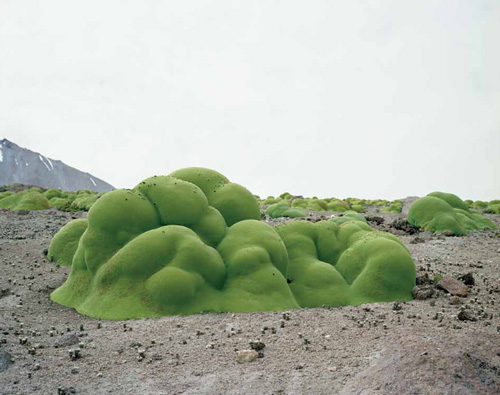
Ever hear of a living thing that has been growing for 3,000 years? Check the picture below. Or how about a 13,000-year-old eucalyptus tree?

At Brain Pickings. Maria Popova writes, “For nearly a decade, Brooklyn-based artist, photographer, and Guggenheim Fellow Rachel Sussman has been traveling the globe to discover and document its oldest organisms — living things over 2,000 years of age.

“Her breathtaking photographs and illuminating essays are now collected in The Oldest Living Things in the World … beautiful and powerful work at the intersection of fine art, science, and philosophy, spanning seven continents and exploring issues of deep time, permanence and impermanence, and the interconnectedness of life.”

Sussman tells Popova in an interview, “I’ve always considered myself an environmentalist, for whatever that term means, and it’s something that I think, as an artist, was an interesting thing — because for a long time, I don’t think it was particularly acceptable in the fine art world to be doing work about nature. …

“The problem of climate change is so pressing and actually is something of a moral imperative for us all, and I think artists do a tremendous job of engaging the public on different levels … . That’s one of the beauties of being able, as a creative person, to create the parameters of what you want to talk about. The science and the climate science are a very important component of the overall project. …

“The question has been this idea of making portraits of these organisms and thinking of them as individuals. I think one of the most important things to do when dealing with climate science and climate change is to create a personal connection, and to create some relationship. That was my way of trying to forge a relationship to these organisms.” More here.

Llareta, 3,000 years old, Atacam desert, Chile

Read Full Post »

I liked this story at TreeHugger on protecting trees and fighting poverty at the same time — especially the part about the importance of women in the effort.

Sami Grover writes, “The old trope that we can either have economic development or environmental protection has been pretty much blown out of the water by this point. …

“Nowhere is this more true than the dry lands of Africa, where desertification, resource depletion, climate disruption and political unrest have all taken their toll on communities’ ability to survive and thrive. There is, however, plenty to be hopeful about too. …

“Tree Aid, a charity which works with villagers living in the drylands of Africa, has long been at the forefront of this fight. By working cooperatively with villagers and on-the-ground non-profit partners in Africa, the charity doesn’t just plant trees, but rather increases villagers’ capacity to protect, nurture and utilize trees to protect their soils, increase agricultural yields, and provide a buffer against the drought, floods and failed crops that are predicted to get ever more common with the advance of climate change.

“A new free report from the charity, entitled Building Resilience to Climate Shocks, the charity is seeking to spread the word about how trees can be used to both alleviate poverty and protect the environment at the same time. …

“Previous tree planting efforts in the drylands have often failed because they’ve either focused on the wrong species of trees, or they have failed to take into account the needs, resources and skills of the local population. …

“Unless short-term needs are met, long-term needs are compromised. … Tree Aid has worked with villagers to develop alternatives to ecologically damaging land management practices:

TREE AID provides training for villagers to plan ways to make money in the short-term as well as the long. For example by producing honey from the bees which live on unburnt land and using fallen trees for fuelwood. This gives them enough income to sustain and invest in their futures and environments, as well as preparing themselves for weather extremes. …

“One of the strategies the charity uses to build climate resilience is to establish ‘Tree Banks’ within a community. These banks are essentially mixed-species tree plantings that can provide for a range of needs from fuel wood to animal fodder to fruit or other products. Each community establishes rules and management practices for when and how a Tree Bank may be used. …

“Any successful strategy for regreening these regions must work within those cultures to empower and educate women as caretakers of the environment: When women take part in decision-making there is a long-term positive impact on trees. They become important forest caretakers.”

More at Tree Aid, here ,and at Treehugger, here.

Photo: Tree Aid


Read Full Post »

Photo: Boston architecture firm IKD.
Designer Timothy Olson, material supplier Fraserwood/Mack Magee. The wood is cypress. “The presence of natural materials such as wood is associated with lower stress and positive feelings.”

There’s a great exhibit about using wood in construction at the Boston Society of Architects on Congress St. in Boston, but only until Tuesday, September 30.

I was surprised to learn that nowadays it is actually possible — and maybe even safer — to use wood for city buildings.

According to the BSA website, the timber “exhibition celebrates wood as the region’s most sensible and abundant choice of material for urban building, highlighting its flexibility and technical qualities, including timber’s potential to combat climate change.

“Yugon Kim, founding partner of IKD, Associate/Director of TSKP Boston, and co-curator of the exhibition explains, ‘We now know that timber is a superior structural building material that should be considered alongside steel and concrete. The carbon offset and sustainability benefits of wood make it an ever-relevant and timely building material in the urban landscape.’

” ‘Urban Timber: From Seed to City’ shows that recent developments — including numerous successful implementations of timber as primary structural for midrise buildings in Europe — point to a different future.

“The exhibition includes a number of case studies, examples of existing wood technology and recent material innovations in the many kinds of engineered timber available to the building industry today.”

Read more about the exhibit here.

Meanwhile, at Andrew Sullivan’s blog (here), we find a quote from James Hamblin about why trees are good for our health: “It is becoming increasingly clear that trees help people live longer, healthier, happier lives—to the tune of $6.8 billion in averted health costs annually in the U.S., according to research published this [year]. And we’re only beginning to understand the nature and magnitude of their tree-benevolence.

“In the current journal Environmental Pollution, forester Dave Nowak and colleagues found that trees prevented 850 human deaths and 670,000 cases of acute respiratory symptoms in 2010 alone. That was related to 17 tonnes of air pollution removed by trees and forests, which physically intercept particulate matter and absorb gasses through their leave.”

More from Hamblin at the Atlantic.

Read Full Post »

« Newer Posts - Older Posts »