Feeds:
Posts
Comments

Posts Tagged ‘climate change’

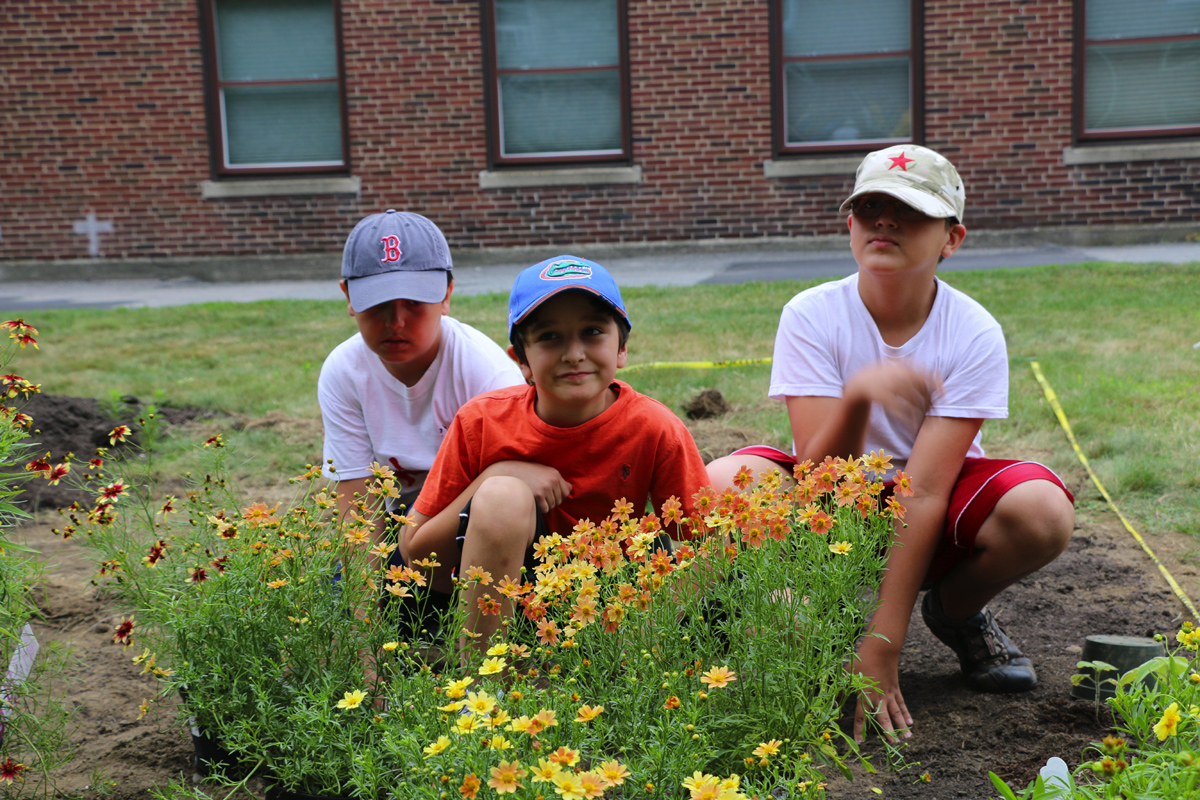
In June I wrote (here) about my friend Jean Devine’s latest venture, “Meadowscaping for Biodiversity.” Jean hoped to get middle-grade kids involved in creating a meadow where once there was lawn juiced with chemicals — and learning how meadows provide habitat for many small creatures. She conducted a pilot program over the summer with her collaborator Barbara Passero and an 8th grade science teacher, Steve Gordon.

Jean e-mails her friends and fans, “We’re delighted to announce that our 8-week summer pilot of “Meadowscaping for Biodiversity” in Waltham, MA, was a great success! The three of us, along with a strong soil turner and a landscape designer, worked with a few boy scouts (and their mothers) to repurpose a 400 square foot plot on the east lawn of Christ Church Episcopal (750 Main St. across from the Waltham Public Library) into a meadow filled with native plants.

“Why did we do this? To engage youth in fun, project-based, outdoor education, while providing native plants as habitat — especially food source — for bees, caterpillars, butterflies, birds, etc.

“The end result? An aesthetically pleasing product and proof that Meadowscaping for Biodiversity, a generative/environmental education program, pays a solution forward to the next generation by inspiring, engaging, and empowering students to be problem solvers and stewards of the Earth. All involved, including the vendors who supplied plants and garden materials, were able to see that this program helps heal the Earth and improve outdoor educational opportunities for youth ‘one meadow at a time.’ Now all we have to do is convince funders, teachers, city planners etc. of the benefits of this program!”

If you fit any of those categories or just want to learn more, contact information is here.
biodiversity-kids

Read Full Post »

My friend Jean Devine is always up to something interesting. A Brown U grad, with an MBA from Simmons, she used to work in investor relations but in recent years has been testing the waters of social entrepreneurship.

Her latest initiative, with Barbara Passero of Sandpiper Creative, is called meadowscaping and is intriguing on many levels.

With access to a Waltham church lawn for a summer youth program, Jean and Barbara will work with kids to convert the yard into a meadow that uses native species from Garden in the Woods and provides a habitat to the bugs and other small creatures that make a healthy environment.

From the Meadowscaping for Biodiversity website: Meadowscaping “is an outdoor, project-based, environmental education program that provides middle school youth with real-world experiences in STEAM learning (Science, Technology, Engineering, Arts and Math), while inspiring and empowering them to address challenges to the environment and our society.

“Today, few children spend time experiencing Nature and the benefits of outdoor recreation, education, and contemplation. Founder and former Director of the Children and Nature Network (C& NN) Richard Louv coined the phrase nature-deficit disorder to describe the negative effects of reduced outdoor time on children’s development. …

“Children who spend little time outdoors may value nature less than children who spend time outdoors in free play. Similarly, children who feel part of something bigger than themselves may … understand their dependence on a clean environment and know that they are responsible for caring for the Earth as their home.” More here.

The idea behind the meadowscaping summer program is that children, both at a young age and as they become adults, can actually do something about the environment.

Remember our post “The Doctor Is In” about the woman who sets up in a Providence park to listen to your worries about global warming (here)? Stop worrying and do something, say the meadowscape entrepreneurs. Give up lawn chemicals, plant a meadow, provide a home for tiny necessary critters, and work to make change.

white-iris-in-morning

Read Full Post »

At the radio show Living on Earth, Steve Curwood recently interviewed Gary Cook of Greenpeace about an effort to get tech companies to be greener.

CURWOOD: “Back in 2012, you criticized Apple for using carbon-intensive energy from coal plants to power its servers. …

COOK: “Just after we spoke, they made a commitment to be 100 percent renewably powered, and as the end of last year, they even made that goal. So, it’s been quite a big shift.

CURWOOD: “100 percent renewable energy. How’s that possible?

COOK: “It requires some effort. Apple has done a lot in North Carolina where they have their largest data center in terms of deploying two different solar farms and an onsite fuel cell that’s powered with biogas energy, so it’s all renewable. They have several other data centers. … In Oregon they’re using wind; in Nevada they’re using solar.

“So they’ve actually shown a commitment from the top, been very aggressive, probably the most aggressive of any of the brands to make sure as they grow, they’re using clean energy.

CURWOOD: “Biogas. Where are they getting that from?’

COOK:” Currently, they’re getting that from landfill and some other renewable sources. The landfill is methane capture in the southeast, and they’re having that piped to where their data center is in North Carolina.”

The radio interview covers several other efforts tech companies are making. It’s a good thing, too, when you consider, as Living on Earth points out, “If the Internet were a country, it would be the sixth largest consumer of electricity in the world.” More here.

Photo: George Nikitin, Greenpeace
The Greenpeace Airship A.E. Bates flies over Facebook headquarters with a banners reading “Building a Greener Internet” and “Who’s The Next To Go Green?” Apple, Facebook and Google have committed to powering their data centers with renewable energy.

Read Full Post »

What’s not to love about Rhode Island? OK, a few shady politicians, high unemployment, low graduation rates — I get it. But Rhode Islanders definitely overdo the “ain’t it awful” schtick.

Architectural Digest has just named Providence the best small city in America for a host of good reasons (thanks for that tip, Suzanne), and if you like “quirky,” Rhode Island has lots of that, too. No one would ever call a big state quirky. For some characteristics, small is better.

Speaking of quirky, this story was passed along by Kate C. It’s about a creative-writing instructor at Brown University who is worried enough about global warming to set up a booth in a public park to commiserate with others about the issue.

Philip Eil writes in the Providence Phoenix,  “It is a crisp Tuesday afternoon in May at Burnside Park in downtown Providence. …

“A few minutes after 2:30 pm, Kate Schapira arrives at the south entrance of the park, pulling a bright red metal hand truck. Over the next few minutes, she unpacks and arranges items from the truck: a small wooden desk; a wooden stool; a rainbow-colored beach umbrella with a white plastic stand; a box containing a stack of homemade cardboard “RI IS MY HOME” cards, each with its own labeled sketch of local flora and fauna (“Eastern Chipmunk/Tamias Striatus,” “House Sparrow/Passer Domesticus”); a glass jar labeled “DONATIONS OF 5¢ FOR ENVIRONMENTAL JUSTICE LEAGUE OF RI”; a pad of poster-sized paper with a hand drawn map of the state of Rhode Island under the words “PUT YOUR WORRIES ON THE MAP”; and two cardboard signs to be affixed to front of the table that read “CLIMATE ANXIETY COUNSELING 5¢” and “THE DOCTOR IS IN.” …

“Today is the first day of Schapira’s Climate Anxiety Counseling. Over the next four weeks, the 35-year-old poet and Brown University creative writing instructor will report to this spot, five days a week, for three hours per shift (two on Saturdays), to talk with passersby about the Earth’s changing climate.” More here.

If you have ever cherished time spent in accommodations overlooking one of Rhode Island’s magnificent beaches, you might like to stop in for a visit with the “doctor” and discuss what might be done to keep the lovely Ocean State from acquiring too much ocean.

Photo: Providence Phoenix

Read Full Post »

Photograph: Devesh Uba
Grocery store in Makoko, Lagos, Nigeria.

A recent manmade-island story in the Guardian made me think of Francesca Forrest’s lovely novel Pen Pal, which involves a girl in a floating community in the U.S. South who corresponds with a political prisoner in Asia.

The Guardian article, however, is about designers and architects building islands for populations threatened by rising seas.

Jessa Gamble writes, “It may seem like science fiction, but as rising sea levels threaten low-lying nations around the world, neighbourhoods like [the Yan Ma Tei breakwater in Hong Kong’s Causeway Bay, where residents live in boats] may become more common.

“Whereas some coastal cities will double down on sea defences, others are beginning to explore a solution that welcomes approaching tides. What if our cities themselves were to take to the seas? …

“The immediate and most numerous victims of climate change are sure to be in the developing world. In Lagos, the sprawling slum of Makoko regularly suffers floods, and its stilted houses are shored up with each new inundation. It’s under threat of razing by authorities.

“The Nigerian-born architect Kunlé Adeyemi proposes a series of A-frame floating houses to replace the existing slum. As proof of concept, his team constructed a floating school for the community. Still, many buildings do not make a city: infrastructure remains a problem here. One solution would be to use docking stations with centralised services, rather like hooking up a caravan to power, water and drainage lines at a campground.” More.

It all sounds like Noah building an ark. But I can’t help thinking it would be better to end global warming in the first place.

Photograph: Seasteading Institute, by way of the Guardian
The Seasteading Institute proposes a series of floating villages.

Read Full Post »

Cate McQuaid, my favorite Boston Globe art critic, who usually covers more esoteric subjects, explains some large artsy globes seen around Boston in recent days.

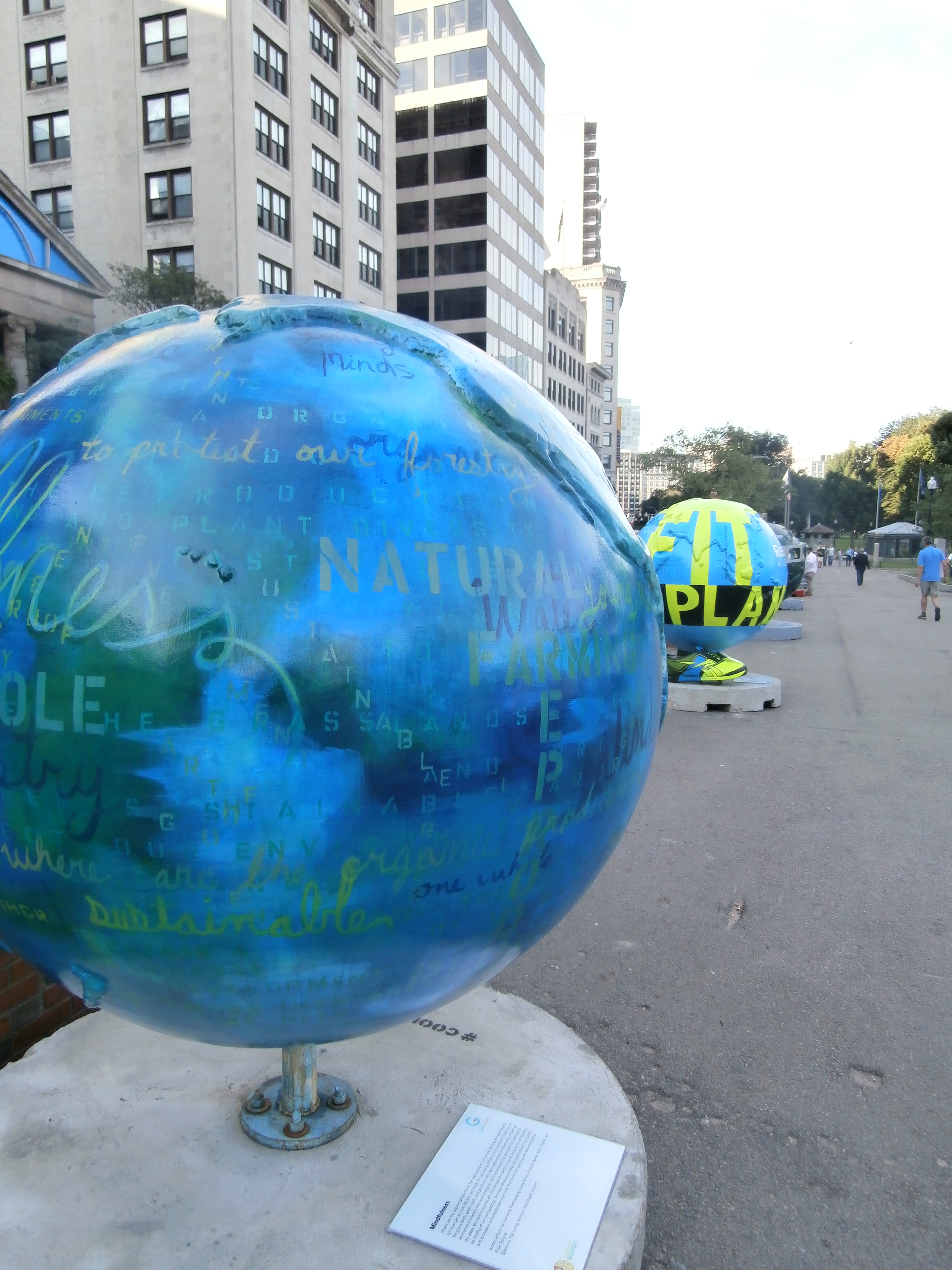
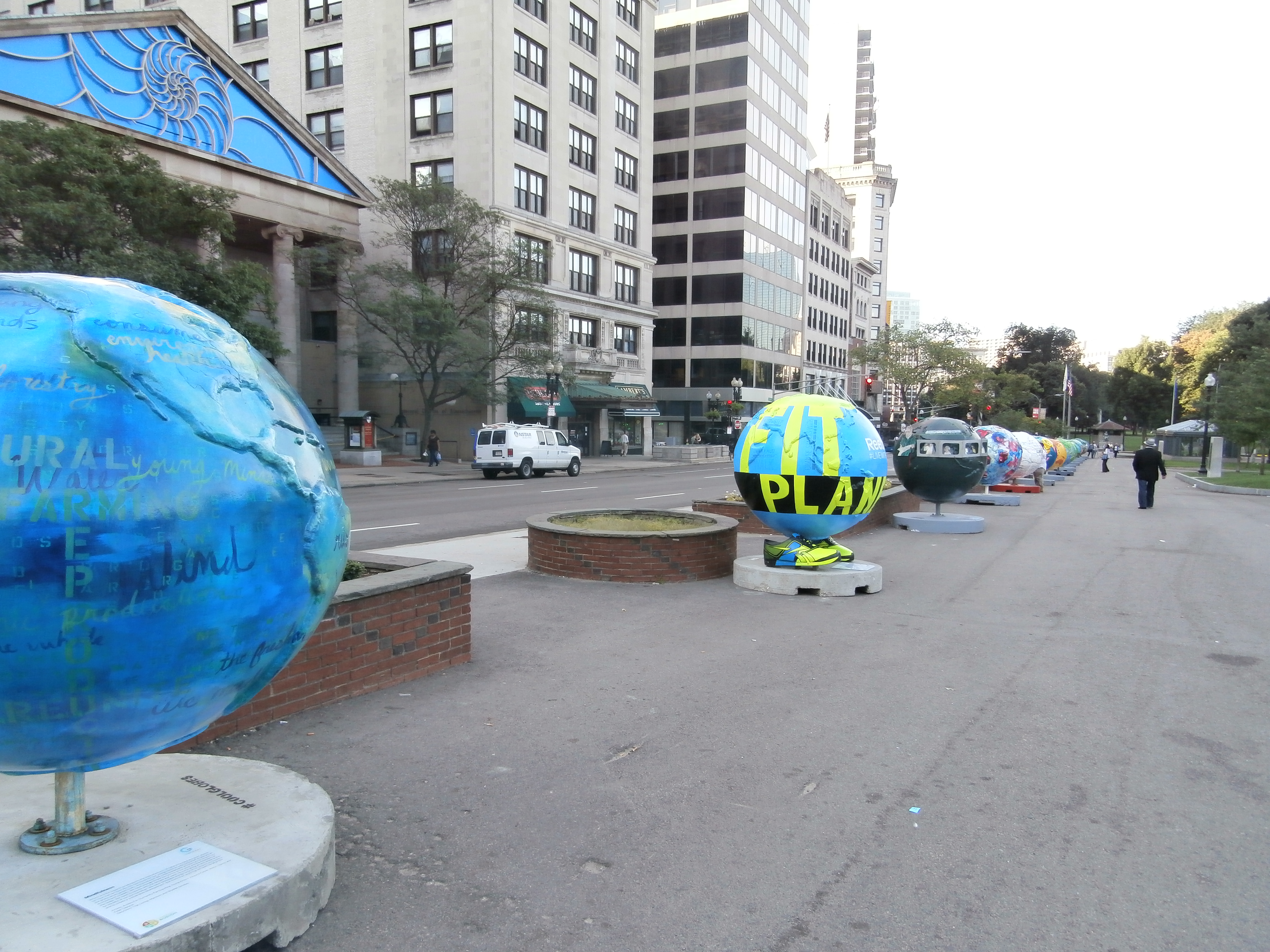
“Huge, colorful orbs line up in a row down the Tremont Street side of Boston Common. It looks like a giant might be marshaling his marbles. Get up close, and you’ll see that the spheres, each 5 feet in diameter, are globes, fancifully decorated and proffering solutions to climate change.

“ ‘Cool Globes: Hot Ideas for a Cooler Planet’ has landed in Boston. The public art project, for which artists designed globes with green strategies to contend with environmental issues, originated in Chicago in 2007 and has traveled the world.”

Environmental activist Wendy Abrams, says McQuaid, is the initiative’s founder.

“Abrams cites two inspirations for the project, the wrecked cars that Mothers Against Drunk Driving pointedly deploy in their Crash Car Program, and the painted cow sculptures that showed up in the streets of Chicago in 1999 — a public art project that prompted Boston to follow suit with painted cod.”

Read about individual artists’ Cool Globe themes, the outreach to students, and more, here.

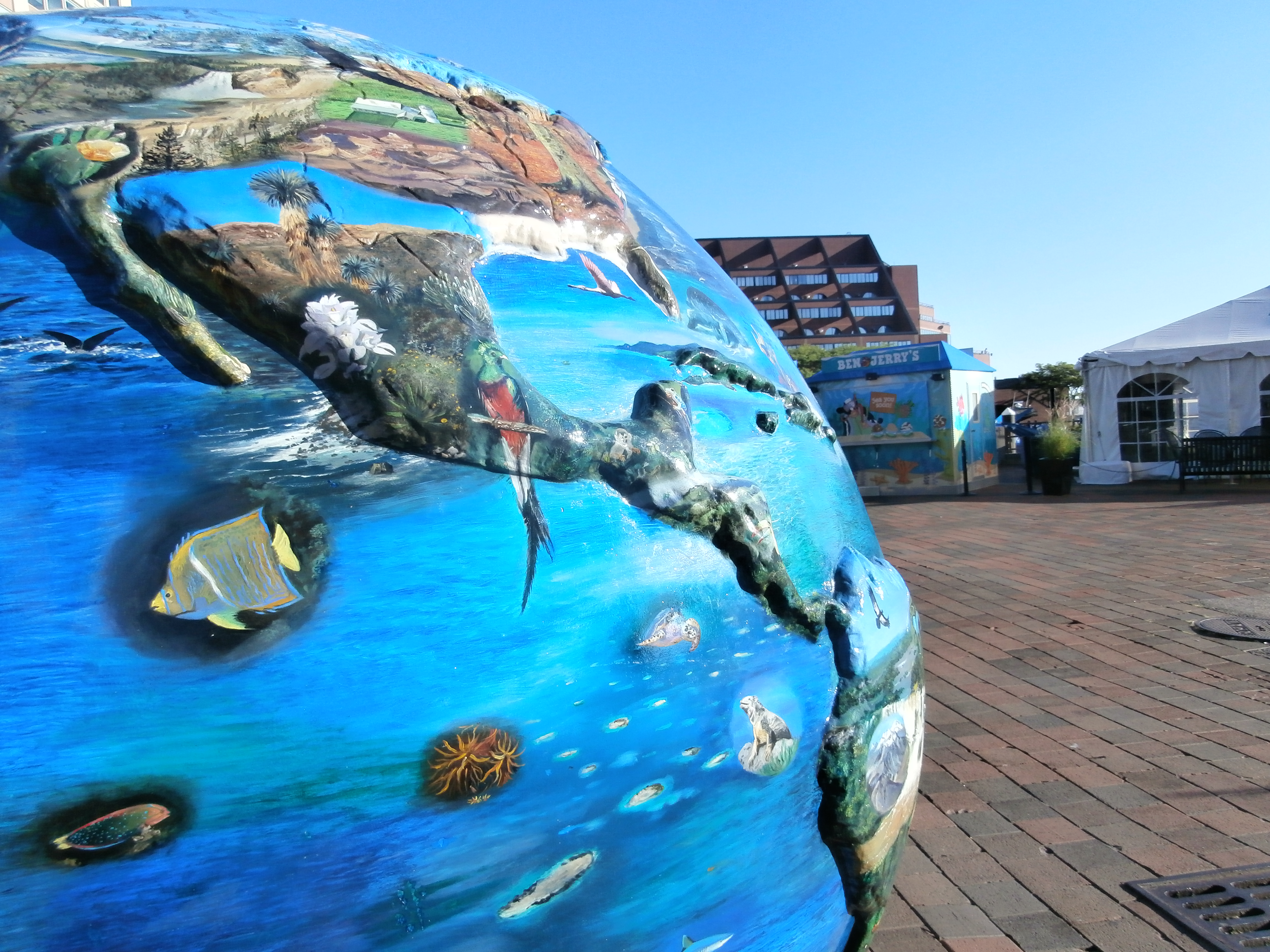
The first two photos below are near the Park Street subway station. The third is in front of the aquarium, and I am not sure if it is part of the traveling series.

cool-globes-boston

globes-for-a-coller-planet

globe-at-aquarium

Read Full Post »

At Public Radio International’s “The World,” David Leveille has a story on research at Ellesmere Island in northern Canada.  There, University of Alberta biologist Catherine La Farge is finding that some frozen plants are able to begin growing again after 400 years on ice.

“Cold as it may be during the winter,” writes Leveille, “it’s a part of the world where glaciers are melting and ice sheets are breaking up due to climate change.

“One glacier there is called the Tear Drop glacier. As it has melted, some interesting plant life was exposed.”

La Farge’s results, published in the Proceedings of the National Academy of Sciences “suggest that bryophytes, representing the earliest lineages of land plants, may be far more resilient than previously thought, and likely contribute to the establishment, colonization, and maintenance of polar ecosystems.” Who knows what else is under the glacier and about to be thawed out.

More.

Photo: Catherine La Farge
In vitro culture of Aulacomnium turgidum regenerated from emergent Little Ice Age plants beneath the Tear Drop Glacier, Sverdrup Pass, Ellesmere Island, Nunavut.


Read Full Post »

Pius Sawa at AlertNet (and the Christian Science Monitor) writes, “Residents of Rusinga Island in Kenya [are experimenting] with renewable energy innovations, environmentally friendly farming, tree planting, and other efforts aimed at improving the island’s environment, creating jobs, and overcoming shortages of food and water.

“For the past 16 years, Ester Evelyn Odhiambo has dedicated herself to improving life on one small island. It’s no small task.

“Rusinga Island, in the northeast corner of Lake Victoria in Kenya, is about 16 km (10 miles) long and 5 km (3 miles) wide. About 30,000 people call it home. But the island over the years has become an increasingly inhospitable environment for them.

“ ‘If you plant something, it just dries out,’ says Ms. Odhiabmo, who runs an organization to help people widowed or orphaned by AIDS [Kisibom, or “come and learn”]. ‘You try to irrigate, and the water is too little because the sun comes and dries everything.’

“The changes have come because of poor management of resources – including forests and fishing grounds – and because of increasing climate impacts.

“But now residents are experimenting with renewable energy innovations, environmentally friendly farming, tree planting, and other efforts aimed at improving the island’s environment, building resilience, creating livelihoods, and overcoming shortages of food and water.”

More.

Photograph: Pius Sawa/AlertNet
Ester Evelyn Odhiambo opens a charcoal refrigerator on Rusinga Island, Kenya. It is lined with charcoal, into which water seeps through a hosepipe fed by a bucket. The wet charcoal absorbs heat and keeps the items inside the fridge cool without needing electricity.


Read Full Post »

When you take pretty much the same walk every day, camera in hand, you may have trouble finding new things to photograph. You may look in vain for something different, puzzling, or mysterious.

But there is something to be said for combing the same territory over and over, as scientists are finding from studying the detailed record keeping of Henry David Thoreau.

“ ‘As far as I know, there is more information about the effect of climate change in Concord than any other place in the United States,’ said Richard Primack, a Boston University biologist who calls Concord a living lab for his research. …

Primack, writes Kathleen Burge at the Boston Globe, “has researched how climate change has affected the flowering times of plants, comparing modern data with the information Thoreau collected between 1852 and 1860. Primack and his lab found that for every 1 degree Celsius increase in mean spring temperature, plants bloom about three days earlier. …

“Primack came to his work about a decade ago, when he decided to change the direction of his research. He had been studying the effects of climate change on plants and animals in southeast Asia and decided, instead, to focus on his home state.

“But when he began searching for older records of plant flowering times in the United States, he came up short. Finally, after six months, someone told him about Thoreau’s journals.

“This was kind of a gold mine of data,” Primack said. “As soon as we saw it, we knew it was amazing.” More from the Globe.

Keep an eye open for the upcoming Thoreau exhibit at the Concord Museum April 12 to September 15, described here.

cross over the bridge

Read Full Post »

Happy President’s Day! Why are you working?

​According to Mother Jones, economist David Rosnick has “found that dialing back the amount of time the average person works by 0.5 percent per year would mean a significant reduction in greenhouse gas emissions. If you work 40 hours a week, that would mean shaving about 12 minutes off the average work week per year. Working one minute less per month seems pretty doable. Basically, we’re using a whole lot more of everything when we’re working – electricity, gasoline, heating, air conditioning, etc. Leisure requires less greenhouse-gas-producing activity.”

I forget were I found this story first, but you can read more at Mother Jones, here.

Photograph: http://yasmincolemanportraits.wordpress.com/
“Lazy Bones, sleeping in the shade. How you ‘spect to get your corn meal made?”
(Hoagy Carmichael)

Read Full Post »

Hurricane Sandy was terrible for many communities in its path, and the devastation has given urgency to climate concerns and innovative solutions.

Henry Fountain writes about one such solution in the NY Times, “With a few dull thuds, the one-ton bag of high-strength fabric tumbled from the wall of the mock subway tunnel and onto the floor. Then it began to grow. As air flowed into it through a hose, the bundle inflated until it was crammed tight inside the 16-foot-diameter tunnel, looking like the filling in a giant concrete-and-steel cannoli.

“The three-minute procedure, conducted on a chilly morning this month in an airport hangar not far from West Virginia University, was the latest test of a device that may someday help guard real tunnels during disasters — whether a terrorist strike or a storm like Hurricane Sandy, whose wind-driven surge of water overwhelmed New York City’s subway system, shutting it down for days.

“ ‘The goal is to provide flooding protection for transportation tunnels,’ said John Fortune, who is managing the project for the federal Department of Homeland Security’s Science and Technology Directorate.

“The idea is a simple one: rather than retrofitting tunnels with metal floodgates or other expensive structures, the project aims to use a relatively cheap inflatable plug to hold back floodwaters.

“In theory, it would be like blowing up a balloon inside a tube. But in practice, developing a plug that is strong, durable, quick to install and foolproof to deploy is a difficult engineering task, one made even more challenging because of the pliable, relatively lightweight materials required.”

More.

Photograph: NY Times

Read Full Post »

« Newer Posts