Feeds:
Posts
Comments

Posts Tagged ‘coexist’

Photo: Silicon Ranch.
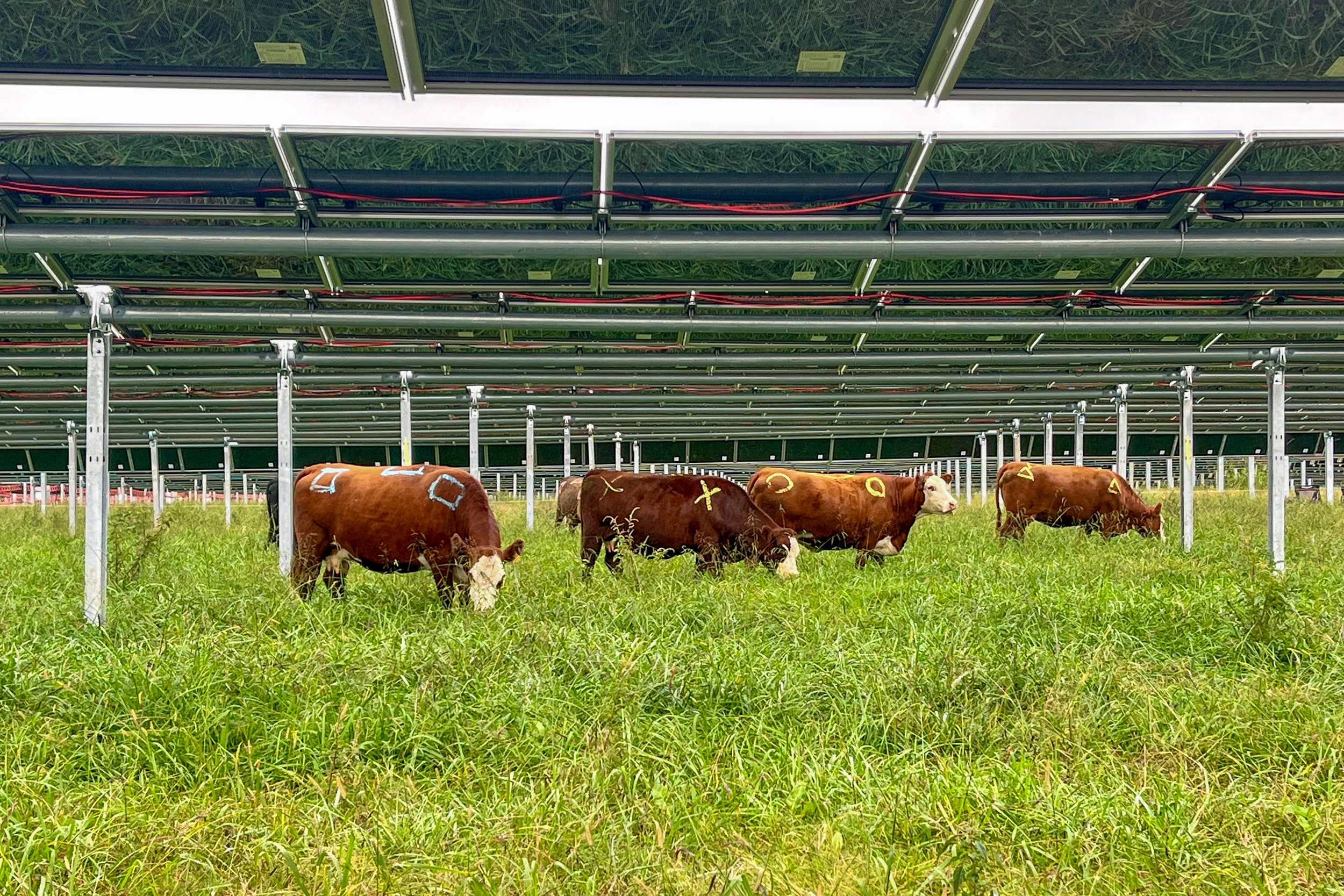
Cattle have been marked for an animal behavior study, showing each cow’s interaction with the solar equipment on Silicon Ranch’s Christiana Solar Farm.

If the cows in the picture above look a little strange, it’s because they are part of a study to see if they can coexist with solar panels, as sheep have already done successfully.

Dan Gearino writes at Inside Climate News, “It is unusual to have a utility-scale solar array in Kentucky, and even more unusual that the grounds crew here is a live-in flock of more than a thousand sheep. …

“The property is a farm and a power plant, and the developer, Silicon Ranch, is using this site to test how to maximize the income from both businesses. The work is part of an effort by solar companies and farmers searching for ways to efficiently utilize the hundreds of millions of acres in the United States used for livestock grazing..

“Nick de Vries, Silicon Ranch’s chief technology officer, walked along a row of panels, explaining that his company and others have largely figured out how to integrate sheep farming and solar. The next step is to replicate the process with cattle, he said. …

“The combination of solar and cattle could transform the renewable energy landscape, opening up vast stretches of land for solar development, contributing to a transition away from climate-warming fossil fuels.

“It also would address concerns about solar encroaching on food production and agribusiness, de Vries said. That’s an important factor in Kentucky, which ranks in the bottom 10 in the country in utility-scale solar installed capacity. …

Inside Climate News visited this farm to discuss [Silicon Ranch’s] CattleTracker and check on the progress of agrivoltaics — the integration of solar and agriculture — at a time when the [federal] administration is eliminating renewable energy subsidies and cutting budgets for research grants.

“Developing solar with cattle presents a major opportunity to expand solar energy, given the vast size of the U.S. beef industry, but it also poses some significant challenges.

“ ‘They’re very large animals,’ de Vries said. ‘They scrape on things. They like to rub.’ …

“He views the challenges with cattle as surmountable. He stepped to a nearby row of panels and pointed out which parts can withstand contact with a cow, and which are vulnerable.

“The main idea behind CattleTracker is that panels are vulnerable when turned at close to vertical angles because they are then low enough for cows to bump into them. The solution is to adjust the tracker system — the machines that tilt the panels throughout the day to capture the sun — so that the panels stay at close to a horizontal angle when cows are present.

“In a typical ranch, workers move the herd to a different part of a property every few days so the animals can have fresh grass and avoid manure pileup. Solar panels can operate with normal tracking most of the time when cows are away, and with limited tracking when cows are present. The system has controls to set the mode. …

“An inevitable part of the conversation is that animal agriculture and Americans’ meat-heavy diets are major contributors to climate change. Solar grazing is an attempt to marry a climate solution to a climate problem, with the expectation that the result is a net positive. …

“Silicon Ranch’s work on CattleTracker includes determining how to manage biodiversity and increase the land’s capacity to store carbon. …

“Solar grazing started with sheep, with some of the earliest U.S. examples coming online in the early 2010s. It’s a natural fit. Sheep are small enough that they’re unlikely to come into contact with panels. The panels provide shade and the animals eat grass, reducing the need for mowing.

“ ‘I just can’t even stress how awesome this opportunity is,’ said Daniel Bell, the farmer whose sheep live at the Silicon Ranch solar array in Lancaster. …

“In at least one way, the timing of Cattletracker’s rollout is not ideal. [The] administration is phasing out and cancelling many of the programs and grants that helped to subsidize renewable energy. …

“Silicon Ranch has benefitted from help in the form of government-funded research at universities and national labs to better understand the effects of solar grazing on soil and other environmental and animal health factors. But de Vries downplayed the harm of having less government support.

“ ‘I don’t think that there should be agrivoltaic subsidies,’ he said. ‘You should strive for a good business solution, and then find what’s going to make it replicable, not limited to grants.’ “

More at Inside Climate News, here.
Read Full Post »

Photo: Connatural Archive.
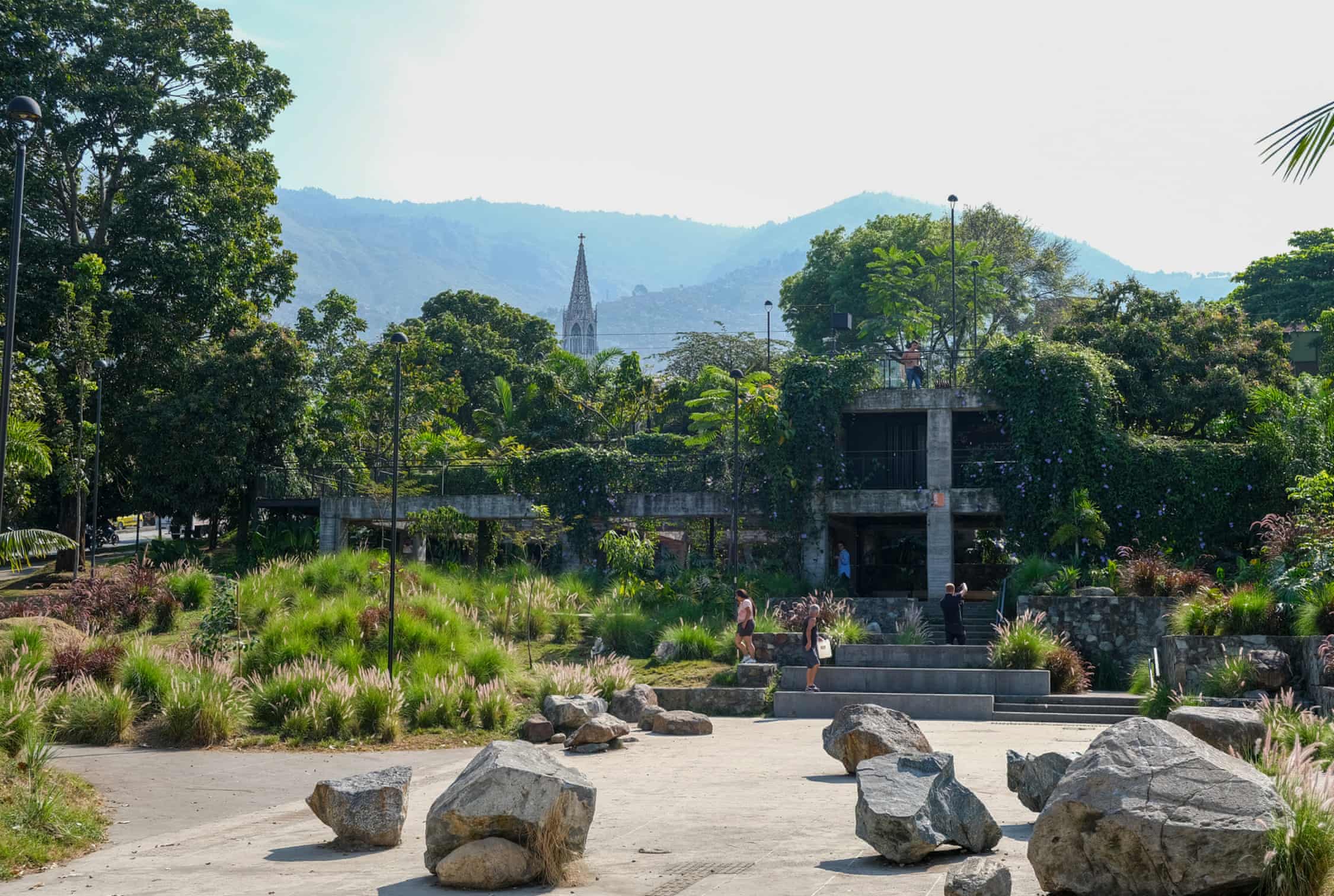
Surrounded by hills: Colombia’s Parque Prado, no longer abandoned to illegal activity.

What is your first reaction to the words Medellín and Colombia? If you have kept up on the news for a few decades, your associations may include both drug wars and change.

Oliver Wainwright at the Guardian focuses on the change.

“Lilac-flowering creepers engulf an abandoned house on a street corner in Medellín, Colombia, spilling from the roof and smothering most of the upstairs windows. A giant fan palm is visible through one opening, while a knotty tangle of aerial roots cascades down to the pavement from another. Step through the doorway of this overgrown ruin, and you find not a scene of desolation and decay but a sleek steel frame holding up the crumbling facade, which forms an unusual entrance to an enchanting new public park.

“ ‘We behaved more like archaeologists than landscape architects,’ says Edgar Mazo of Connatural, the firm behind the Parque Prado, in the working-class neighborhood of Aranjuez. He leads me through a series of planted terraces; fountain grasses and trumpet trees sprout from where a derelict car park and abandoned homes once stood. ‘You dig up the concrete, water gets into the ground, vegetation grows up, and the people come back,’ he adds, speaking through a translator. ‘That’s natural regeneration.’

“In recent decades, Medellín has been widely celebrated for its astonishing urban transformation. In the 2000s, it went from being one of the most dangerous cities on the planet, riven by murderous drug cartels, to a case study in the miraculous peace-bringing powers of architecture and landscape. Sergio Fajardo, the son of an architect who served as Medellín’s charismatic mayor from 2004 to 2008, was hailed for sprinkling the city’s poorest neighborhoods with dazzling new libraries, stadiums and swimming pools.

“These determinedly ‘iconic’ projects were enthusiastically feted on the pages of glossy design magazines, and their stories recounted in keynotes at international conferences. Impoverished hillsides were connected to a new metro system with an elegant web of cable cars and outdoor escalators, while parks dotted with expressive architect-designed canopies sprang up across the city. The dramatic fall in crime during Fajardo’s term was largely credited to this vision of ‘social urbanism,’ and the increase in the amount of public space per citizen.

“But the Medellín miracle has since lost some of its sparkle. Take the Biblioteca España, one of the flagship projects, designed by Colombian star architect Giancarlo Mazzanti. It stands as a striking cluster of chiseled concrete boulders, rising from the hillside in the formerly no-go barrio of Santo Domingo. But it has been shuttered since 2015, due to structural defects. …

“Mazo’s work takes a markedly different approach from the 00s penchant for spectacle. When he was asked to look at the sloping half-hectare site in Aranjuez, which was home to a rundown car park and six boarded-up houses, abandoned for more than a decade, there was an existing plan to raze everything and replace it with a park traversed by a big zigzagging ramp. It looked like a hangover from the earlier lust for shape-making, something that might photograph well from a helicopter.

“Instead, Mazo and his team decided to keep most of what was already there. Almost 70% of the material on-site remains, albeit in a new form. Walls and floor slabs were chiseled from the two-storey parking structure, and the rubble used to fill the basements of the houses, with soil packed on top. The buildings’ roof timbers were reclaimed and used to make benches, while the landscape was shaped in such a way that rainwater is retained, meaning that no artificial irrigation is needed. The team even collected seeds from the plants that had sprung up on the plot, so they could be scattered around the new park after the project’s construction – allowing the natural colonizers back in.

“The project was built during the pandemic for a cost of just [$1.5m] and the lockdowns allowed time for the plants to establish, without the threat of being trampled by visitors. Five years on, the planting has reached a level of maturity that makes this urban oasis seem like it’s always been there. …

“The former car park’s concrete frame makes for an imposing armature at the centre of the park, supporting a raised steel walkway and framing a series of semi-enclosed spaces beneath it. Reclaimed bricks and stacked roof tiles serve as retaining walls, creating a rugged backdrop to lush clumps of grasses and palms. Gabion cages filled with rocks and rubble line water retention ponds, and provide platforms for seating. A sandy clearing down below makes space for ballgames and events, while park-goers can watch the action from the terraced decks above, and enjoy a grandstand view across the sprawling city and its seven hills.

“ ‘When people first colonized this valley,’ says Mazo, ‘they used to climb up to the top of the hills to communicate with each other. The park now becomes part of that system, giving people an elevated view to connect with others.’ …

“Crucially, there’s a space for everyone here – from elevated walkways, to quiet shrub-lined reading areas, to seating tucked away from prying eyes. The sense of fragmentation, as well as the level changes, allow different social groups to coexist.” 

Read more about this and other pilot projects at the Guardian, here. No paywall, but anything you can donate helps to keep factual news accessible to all.

Read Full Post »

Photo: It’s Time.
Jewish Israeli singer Achinoam Nini and Palestinian Israeli singer Mira Awad take the stage at the People’s Peace Summit in Jerusalem, May 9, 2025.

You wouldn’t know it from the headlines, but in Israel there are actually quite a few Jewish and Palestinian individuals who refuse to give up on peaceful coexistence.

Dina Kraft reports at the Christian Science Monitor, “For Israelis and Palestinians, May 28 marked 600 days of the most devastating period either side has known since Israel’s foundation. And yet amid it all, there are people trying to build bridges from one side to the other, attempting – together – to create a different reality.

“Some of them gathered recently for a well-attended two-day People’s Peace Summit in Jerusalem, forged by a coalition of Jewish and Palestinian peace-building and coexistence organizations. They sought to demonstrate that a peace movement is a viable and growing notion, and that joint Jewish-Palestinian activism is withstanding the raging war and shattered trust.

“ ‘The way to peace will not be short, but it is better than endless war,’ Sally Abed, a Palestinian citizen of Israel, called out from the Jerusalem stage to an auditorium packed with over 3,000 people. She is a leader of Standing Together, a fast-growing group uniting Jewish and Palestinian Israeli citizens.

“One outspoken Israeli peace activist is Maoz Inon, whose parents were burned to death in their home near Gaza in Hamas’ Oct. 7, 2023, attack that sparked the war. He and his siblings responded with a vow to seek peace, not revenge.

“ ‘Yes, we are devastated from the horrors that are happening in Gaza and the West Bank, and we acknowledge the ongoing trauma both peoples are enduring,’ he says in an interview. ‘But we know the only way to end the bloodshed and the cycle of violence, revenge, and hate is shaping and creating a new reality. We are learning from spiritual and faith leaders, security leaders, and from other conflict areas that were resolved.’

“In the aftermath of Oct. 7, Mr. Inon paired with a fellow entrepreneur, Aziz Abu-Sarah, a Palestinian from East Jerusalem whose older brother died soon after being imprisoned and beaten in the first intifada. Together they have been advocating reconciliation, equality, and justice.

“They say they can see their growing impact in their growing list of invitations to speak, not only at peace-related events but also in public schools, at universities, and at conferences. Their joint TED Talk has gone viral, and their work caught the attention of the late Pope Francis, leading to a Vatican meeting.

“It can be difficult for Israelis and Palestinians to work together openly. Activists are called naive at best, traitors at worst. But, Mr. Abu-Sarah argues, ‘We are offering the only viable answer to the current reality. As Maoz told me after his parents were killed, “Right now, we are in the desert – no food, no water. We’re lost. And when you’re lost in the desert, you call out for water.”

” ‘We are calling out for peace. … In times like these, we must work with Israelis who oppose the bombardment of Gaza and genuinely support peace. [But] bridge-building must be rooted in clear principles: equality, justice, recognition, healing, and safety for all. It’s not just about dialogue. It must lead to real action and tangible change. We do have strong, principled allies on the Israeli side. … They need us, and we need them, because without each other, we’re weaker – and the killing won’t stop.’

“[Standing Together] sees the recent surge in activism as the sign of an awakening among Israeli Jews who view the war as endangering Palestinian civilians alongside Hamas-held Israeli hostages and soldiers. …

“Illustrating both the challenge and the potential for peace activists, throngs of ultranationalist young Israelis swept through Jerusalem’s Old City on May 26, shouting hateful slogans in a sometimes-violent march marking the day in 1967 when Israel captured East Jerusalem.

“Volunteers from Standing Together and the Free Jerusalem collective, a group of predominantly Jewish Jerusalem residents that works with Palestinians in the city, acted as a ‘humanitarian guard’ to prevent violence. In a scene captured on video, a Jewish Israeli volunteer can be seen rushing into a crowd of far-right marchers surrounding a Palestinian man. …

“ ‘We always have something we can do and a way we can do it,’ wrote Rula Daoud, co-director of Standing Together, herself a Palestinian citizen of Israel.

“Mohammad Darawshe, director of strategy at Givat Haviva, Israel’s oldest and largest organization working for a shared Jewish-Arab society, says bridge-building is challenging for Palestinian Israelis. They face systemic discrimination and are often seen as a fifth column in Israel, he says, and while they have an ethnic and cultural affinity for West Bank and Gaza Palestinians, they have limited political influence.

“ ‘As peacemakers they have a very underutilized role. But if empowered by Israel and by Palestinians on the other side, then they could play a significant role in peacemaking thanks to our bilingualism and dual identity,’ he says. …

“Mika Almog, creative director of the It’s Time movement that organized the peace summit, says that it is hard to counter the general Israeli mindset that there are no Palestinian partners for peace, especially in the wake of the Oct. 7 atrocities. …

“She says Israelis have been told that the conflict could be contained through periodic wars, but not resolved. ‘We have been taught that this is a reasonable price,’ she says. ‘In order for Israelis to be able to sustain and build faith [in the prospects for peace] we need to see Palestinian partners within Israel but also partners in Gaza and the West Bank.’

“At the summit, a view of life in Gaza came in the form of a brief video of a Palestinian woman walking through the rubble. She details the difficulties of her life: living in a tent, subsisting on limited food and water.

“ ‘We are living a tragedy,’ she says. ‘Most people in Gaza are against extremism and terrorism. We want peace.’ ”

More at the Monitor, here. No firewall. Subscription prices are reasonable.

Read Full Post »

110520maghreb20jews20yashiba

Photo: Taylor Luck
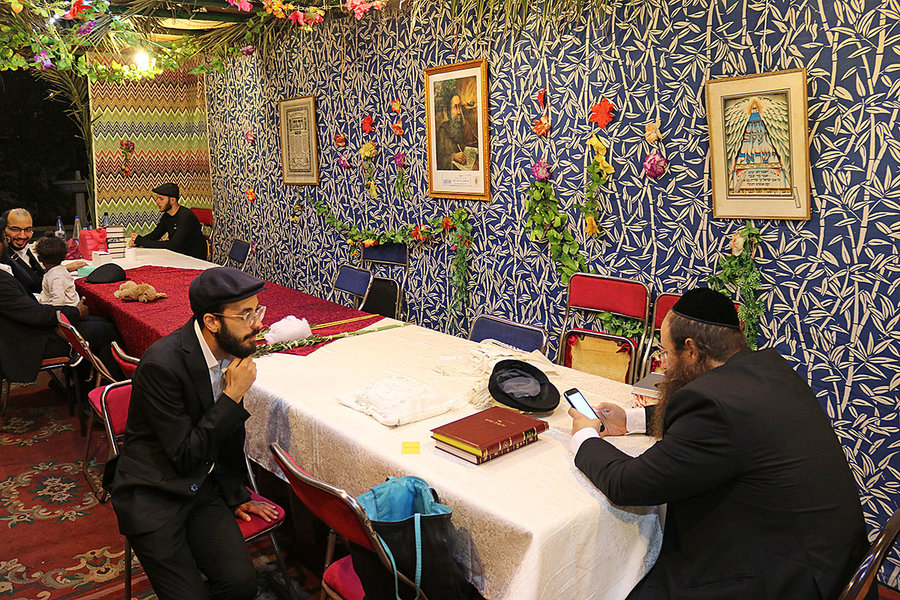
Yeshiva students are seen studying in a Casablanca sukkah hut last October. “Jews and Muslims have a long history of amity in Northern African countries like Morocco and Tunisia,” says the
Christian Science Monitor.

It seems to me that when people want to get along, they do. In the following story, we see how two religions usually depicted at odds have coexisted comfortably in Northern Africa for generations. What isn’t clear to me is how communities can start this kind of positive relationship if they haven’t had it before. There has to be a way.

Taylor Luck reports at the Christian Science Monitor from Morocco, “Even as congregants recite evening prayers at Temple Beth El, the Muslim call to prayer rings out from minarets across the city and into the courtyard, a mix of Arabic and Hebrew filling the dusk sky with praises to God. And as the yeshiva students file out of Beth El (literally, House of God), Mohammed, the gatekeeper, kneels down in Muslim prayer at the synagogue’s entrance.

“This is not a mirage; this is Casablanca. After decades of economic migration and geopolitical tensions that reduced North African Jewish communities from hundreds of thousands to a few thousand people, hope is being rekindled in Morocco and Tunisia that as Jews keep the light of their communities alive, so too does the region’s unique model of Muslims and Jews living side by side.

“For even in a time of global polarization, Moroccans and Tunisians are proving that historical bonds bind, rather than divide, Jews and Muslims, whose shared past they say paves the way for a shared future. …

“In Morocco, a country that is 99% Muslim, whose monarch carries the title ‘commander of the believers,’ a distinct Hebrew culture nevertheless permeates practically every town today. … Moroccans will be quick to tell you that this is not only Jewish heritage, but Moroccan heritage.

“ ‘We have Jewish life from the cradle to the grave in Morocco,’ says Zhor Rehihil, an anthropologist specializing in Moroccan Judaism and curator of Casablanca’s Museum of Moroccan Judaism. …

“King Mohammed VI has promoted the return of the Moroccan Jewish diaspora and Israeli tourism to the country, funding the preservation and renovation of 162 ancient Jewish cemeteries and several synagogues across the country. Under Moroccan law, anyone with Moroccan Jewish ancestry can claim citizenship.

The preamble to Morocco’s 2011 post-Arab Spring constitution enshrines Moroccan Jews as integral to the national fabric, stating that Morocco ‘is a sovereign Muslim state … whose unity is nourished and enriched by its African, Andalusian, Jewish, and Mediterranean constituents.’ …

“ ‘Visiting Arabs and Israelis see the atmosphere in the [Casablanca] streets, signs in Hebrew, Jewish and Muslim families living together in the same apartment building, and they can hardly believe it,’ says Serge Berdugo, secretary-general of the Council of Jewish Communities of Morocco and a community leader. ‘But the fact is, it is not a slogan or some dream, it is daily life for us, and that is a model we need to preserve for the world.’ ”

Meanwhile in Tunisia, “The demand for kosher meat – seen as even more meticulously prepared than by Islamically halal butchers in the capital – is high among Tunisian Muslims as well as Jews.

“On a rainy Friday this October, men and women lined up at the kosher butchery of Amran Fennech, the store name in Hebrew and Arabic, red spicy merguez sausage hanging from the storefront. Ask anyone in central Tunis; hands down, Amran has the best cuts in town. …

“ ‘We are Jews and we are Tunisians – we have specific cuisine, a specific dress, and a specific way of life – you can’t separate one from the other,’ Mr. Fennech says. …

“Historians say the high-water mark of Jewish-Muslim relations may have been over a millenium ago at the time of Al-Andalus, or Islamic Iberia, when the Muslim empire stretched across the Mediterranean to modern-day southern Spain.

“Jews and Muslims had become an intertwined community that was a beacon of science, philosophy, art, and enlightenment while much of Europe was in the Dark Ages. They flourished as the leading scientists and writers: philosopher Moses ben Maimon (Maimonides), diplomat and physician Abu Yusuf ibn Shaprut, poet Moses ibn Izra. …

“For Tunisia’s Jews, communal tensions arose in the second half of the 20th century amid regional crises and the birth of Israel. …

” ‘Every time there was a war in the region, tensions would increase and certain people would direct their anger toward their Jewish neighbors,’ says one 50-year-old Jewish resident, preferring not to speak in the name of the community.

“But in the 21st century, particularly after the 2011 revolution, Jewish Tunisians say they have noticed a marked difference. …

“ ‘At the time of the revolution, there were bigger issues than the Jewish community and the question of Israel; the troublemakers left us alone,’ says Mr. Fennech, the butcher. ‘Now we are all living in a new Tunisia together.’ …

“Officially there are no diplomatic relations between Morocco and Israel, forcing Israeli visitors to receive visas in a third-party country such as Spain. Israeli tourists to Tunisia must fly to the island of Djerba; there are no direct flights to Tunis. But Israeli and European Jewish tourism to Morocco and Tunisia is on the rise; as is the demand for kosher foods and Jewish religious tourism experiences. Locals hope visitors come away with a lesson as well.

“ ‘For the good of the community, for the good of the world, for the good of Morocco, and for the good of Judaism, we must remain to maintain this link between peoples,’ says Mr. Berdugo, the Moroccan community leader.”

More here.

Read Full Post »