Feeds:
Posts
Comments

Posts Tagged ‘colin cotterill’

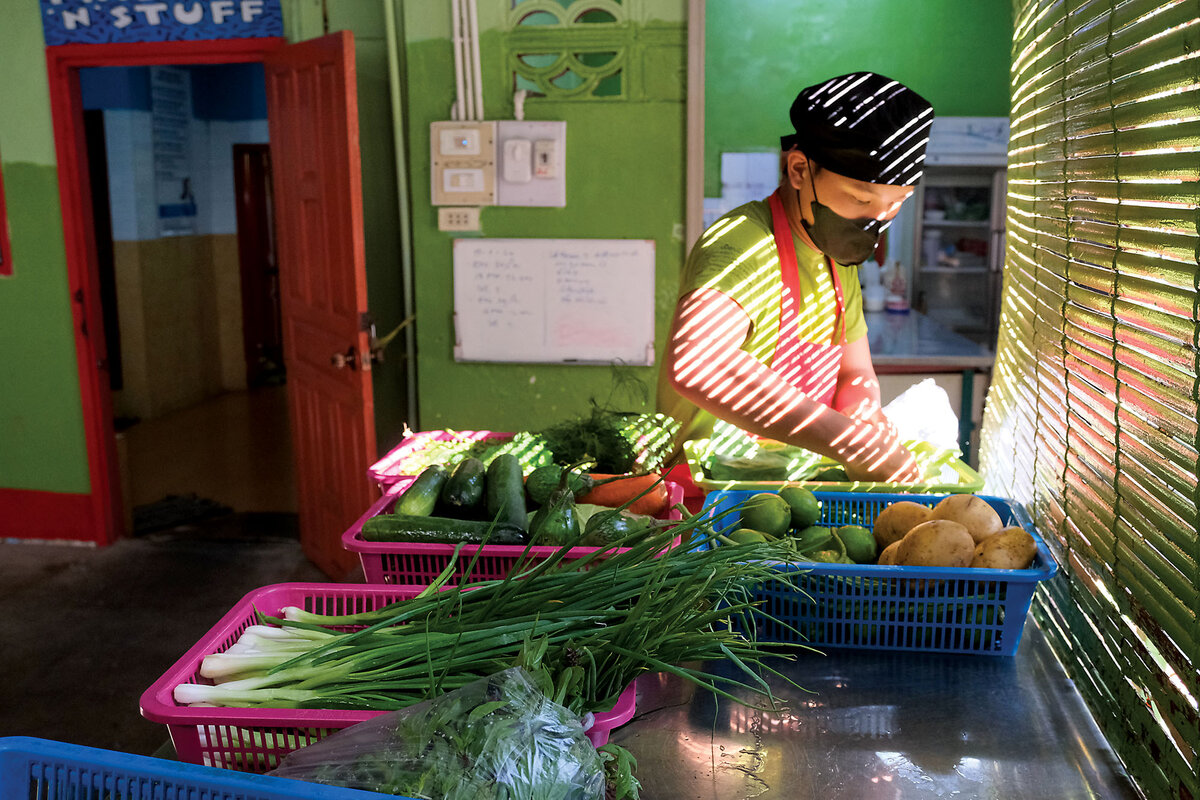
Photo: Zinara Rathnayake.
A student prepares vegetables before lunch begins at Mini-Makphet, a vocational restaurant in Vientiane, Laos.

I can’t read anything about Laos without thinking of the mystery series that Colin Cotterill wrote, which includes a plea for the poor of that country and for removing the explosive mines left by the US. Since today’s article is about training young restaurant workers in Laos, I’m particularly remembering the noodle shop in the mystery series, run by Daeng, the wife of investigator Dr. Siri Paiboun.

Zinara Rathnayake wrote the following story for the internationally focused Christian Science Monitor.

“Until about a year ago, Xue Xiong had never seen a town,” wrote Rathnayake. “She lived in a small village with a dirt road that turns muddy when it rains, making travel difficult. She dropped out of school early to help her parents farm rice and breed cattle to feed her 10-member family. 

“It was at Khaiphaen, a charming restaurant two hours away in Luang Prabang, that Ms. Xiong learned to dream. The Laotian fusion eatery trained her to prepare and serve food for the tourists who flock every day to the bustling city. 

“ ‘I want to save money and open my little Lao food stall, because tourists love Lao food,’ says Ms. Xiong, who is Hmong, one of Laos’ marginalized ethnic minorities. ‘Because I feel like I can do anything now.’

“Khaiphaen was opened by the Cambodia-based organization Friends-International and collaborates with the Lao government and other nonprofits to aid young people interested in culinary education as a path to more prosperous futures.

“Laos is one of Asia’s least-developed countries, and poor education and the lack of economic opportunities often force children and young people there to work in lower-paid, menial jobs under exploitative conditions. Many others are trafficked into factories or prostitution.

“At almost 10 a.m. on a chilly January morning, an hour before Khaiphaen opens for the day with plates of laab (spicy minced-meat salad) and beer-battered Mekong River fish, Ms. Xiong laughs as she watches her friend, another young woman, slice carrots. Ms. Xiong shows off her yellow T-shirt from Le Petit Prince, a nearby Korean cafe where she started working after Khaiphaen. She thinks the cafe’s owner is nice, her English is improving, and soon she will play the piano at the cafe, Ms. Xiong tells her friend.

“ ‘I see children tremble the first time they come to serve,’ says Khaiphaen’s restaurant manager, Anousin Phanthachith, ‘and then in a few years, you see them grow into entrepreneurs.’ He joined the team at Friends-International in 2014 when Khaiphaen was just a concept with a few dining tables, and he has never thought of leaving. ‘You feel fulfilled because you help many young people – especially children who come from remote, underprivileged communities, some of them with traumatic childhoods.’ 

“Nearly a third of Laos’ population lives in poverty, subsisting on less than $4 a day, according to 2022 figures from the World Bank. Children bear the brunt of it. Although Laos has made progress on child mortality, 43 out of every 1,000 children die before reaching age 5 – one of the highest child mortality rates in Southeast Asia (down from 154 in 1990). The government is pushing for primary education for all children, but the number of dropouts is high. 

“More than 130 students have graduated from Khaiphaen. Yet it is not a traditional cooking school, says Friends-International social worker Ae Thongkham. Besides waiting tables, students gain experience making noodle bowls with their teachers from scratch in the kitchen as well as preparing beverages. Mr. Thongkham adds that when students arrive from minority ethnic groups, many of them don’t speak Lao, the country’s official language. So at the social work center upstairs, students learn basic Lao and English, in addition to life skills such as managing their finances. 

“Students aren’t salaried but receive free training, accommodations, meals, transportation, and health care. After graduation, they are placed in hotels, cafes, and restaurants across Luang Prabang’s flourishing tourism industry.

“For Mr. Phanthachith, who left his village at age 18 and studied at a temple before working at the city’s restaurants, looking after his young students has always been the priority. ‘We always talk to our students even after they leave the program to make sure that they are in a safe workplace that benefits them and treats them well,’ he says.

“Khaiphaen is part of a series of vocational restaurants that Friends-International operates across Southeast Asia. Although some of the eateries shuttered during the coronavirus pandemic, Khaiphaen began delivering food to locals to stay afloat. In the capital, Vientiane, Khaiphaen’s sister restaurant Mini-Makphet turned into a soup kitchen, feeding underprivileged children and their mothers. Housed in a tin-roofed space with varnished wooden tables and chairs, Mini-Makphet is much more modest and mainly serves Vientiane residents.

“Ketsone Philaphandet, Friends-International’s country program director for Laos, is quick to highlight that Vientiane receives far fewer tourists compared with Luang Prabang. The quiet, industrial Lao capital serves only as a pit stop for many foreign travelers exploring the country’s far-flung karst mountain towns and vibrant cultural hubs. ‘So we keep our prices lower and food spicier,’ Ms. Philaphandet says, smiling.

“For many young people, Mini-Makphet is a social lifeline. Mala Thoj has worked at the restaurant for only two months but can already pour a latte with a little foam heart on top. ‘I feel happy here, because I have friends who support me,’ she says. She used to live with abusive relatives and was compelled to toil at a rubber estate. …

“Emi Weir, founder of the social enterprise Ma Té Sai, which sells handmade products crafted by Laotian women [notes] that although Khaiphaen lacks marketing to reach tourists who are ‘ready to spend more for a good cause,’ its program has excellent social work, training, and outreach initiatives.”

More at the Monitor, here. No firewall. You can learn a lot more about our world from the Monitor or The World, on radio, than you can from the Washington Post or the New York Times. Check them out.

Read Full Post »

It always seems so limiting to put anything in a category. Some WordPress bloggers are good at categorizing their posts, and I’m sure that helps many readers, but my posts are never about one thing only.

Netflix makes movie recommendations based on categories that pigeonhole movies we’ve rated highly. But the approach seems clunky. Just because we have liked a lot of foreign films (Wadjda, Son of Rambow, Princess Mononoke), that doesn’t mean we like all foreign films. Maybe we like the ones we’ve seen for some other reason than being foreign. Maybe they are less glitzy, more honest, or more entertaining.

He are some funny categories Netflix recommended for my husband and me: “emotional, independent films based on books,” “critically acclaimed foreign movies,” “mind bending movies,” “anime,” “musicals,” “social & cultural documentaries,” “critically acclaimed emotional movies,” and “horror movies.” Horror!? Where did they get that?

At the late, lamented Kate’s Mystery Books in Cambridge, you could get pretty sound advice on books from Kate herself. She would ask you to name some mysteries you liked, and you might say you had read all of Tony Hillerman and Arthur Upfield. Then she would say, “Different cultures.”

Well, ye-es. But what kept me coming back to those authors were detectives who were likable and endings that were positive in some way. no matter how small. Kate did give me some authors I loved, like Eliot Pattison (mysteries about Tibet and, more recently, several about 18th century American Indians), but other books about different cultures might be too noir for me or too fluffhead, like mysteries with animal detectives.

I suppose categories help a bit. I just think they are clunky. Where would I file this post, now? Movies? Books? Retail? Misconceptions? Colin Cotterill, Dr. Siri, Laos?

Colin Cotterill writes a series that is both funny and deadly serious about a 70+ coroner in Laos, Dr. Siri, a likable antihero with an offbeat bunch of equally likable cronies.

Read Full Post »

I am currently reading one of the many delightful Colin Cotterill mysteries about Laos (Slash and Burn). Because the Laotian/American MIA search team seems always to be eating tasteless “astronaut food” provided by the Americans, this story at Andrew Sullivan’s blog the other day caught my attention.

Andrew points to Adam Mann, who writes at Wired, “Several decades from now, an astronaut in a Mars colony might feel a bit hungry. Rather than reach for a vacuum-sealed food packet or cook up some simple greenhouse vegetables in a tiny kitchen, the astronaut would visit a microwave-sized box, punch a few settings, and receive a delicious and nutritious meal tailored to his or her exact tastes. …

“With 3-D printers coming of age, engineers are starting to expand the possible list of materials they might work with. The early work in food has been in making desserts – a Japanese company lets you order your sweetheart a creepy chocolate 3-D model of their head – but some researchers are already thinking of what comes next. The Fab@Home team at Cornell University has developed gel-like substances called hydrocolloids that can be extruded and built up into different shapes. By mixing in flavoring agents, they can produce a range of tastes and textures.”

Don’t you love the word “extrude”? Well, maybe not. But I do because when my husband, my older grandson, and I were waiting for the baby sister to be born a couple weeks ago, we spent an inordinate amount of time extruding Play-Doh snakes from special Play-Doh extruders. (“Don’t be scared, Grandma. It’s not a real snake, Grandma.”)

Come to think of it, I might rather eat a Play-Doh snake than some of this astronaut food.

More from Wired.

More from Andrew Sullivan’s blog.

Photograph: Fab@Home
A deep-fried space shuttle scallop built using Cornell’s Fab@Home 3-D food printer, below.

Photograph: Feb@Home
A 3-D food printer building turkey paste into blocks, below.

Read Full Post »

My husband and I like Colin Cotterill’s quirky mystery books about Dr. Siri Palboun of Laos. The series starts with The Coroner’s Lunch, in case you are interested.

Cotterill has been involved in several worthy causes in Laos, including one addressing the abysmal lack of children’s books in the country. You can read how he got started on his quest for children’s books, here. That work is now handled by Sasha Alyson at Big Brother Mouse, who writes:

“Do you remember the excitement of rushing home to read a book that you hoped would never end? Many Lao children have no such memories, because they’ve never seen a book that was fun or exciting to read. Some have shared textbooks; others have never seen a book at all. We sometimes have to explain how books work: ‘Look, if you turn the page, there’s more!’ ”

Big Brother Mouse is a “Lao-based, Lao-owned project.” More.

Cotterill also works with http://www.copelaos.org to help victims of land mines left over from the CIA’s “secret war.”

And, pointing out that more than 75 percent of children in the far north of Laos have no schools, Cotterill funds efforts to get hill tribe students into teachers colleges. More.

Art: Colin Cotterill at http://www.colincotterill.com

Read Full Post »

We read a lot of mysteries in our house. We especially like stories set in places we don’t know much about, although my husband enjoyed the Qiu Xiaolong books because he had lived in Shanghai himself.

I just finished a mystery by James Church (pseudonym for an author who is a “former Western intelligence officer”). He writes about North Korea. Since hardly anyone ever goes there, I tend to accept Church’s descriptions as better informed than your average Joe’s. And I find that whenever there’s a news story about that isolated country, it seems to mesh with the murder mysteries. The series starts with The Corpse in the Koryo.

Eliot Pattison’s Tibetan series, starting with The Skull Mantra, was a great hit with me — son John, too, until he got tired of exotic locales and started reading business books (snore). Pattison now alternates writing Tibetan mysteries with writing mysteries about pre-Revolution America and Indians. I heard him say at a book reading in Porter Square that he finds similarities in the spiritual beliefs and practices of Tibetan Buddhists and American Indians.

The wacky Colin Cotterill writes a series set in Laos, stating with The Coroner’s Lunch. We love his style and his unique characters. I’m just starting his new series, set in Thailand and featuring a malapropism of George W. Bush at the start of each chapter.

S.J. Rozan’s detective Lydia Chin operates mostly in New York’s Chinatown, but she does get to Hong Kong, and you can pick up a lot of Chinese culture from her. That series starts with China Trade.

Good novelists do a lot of research. You can get the flavor of a culture without going anywhere.

Read Full Post »