Feeds:
Posts
Comments

Posts Tagged ‘collection’

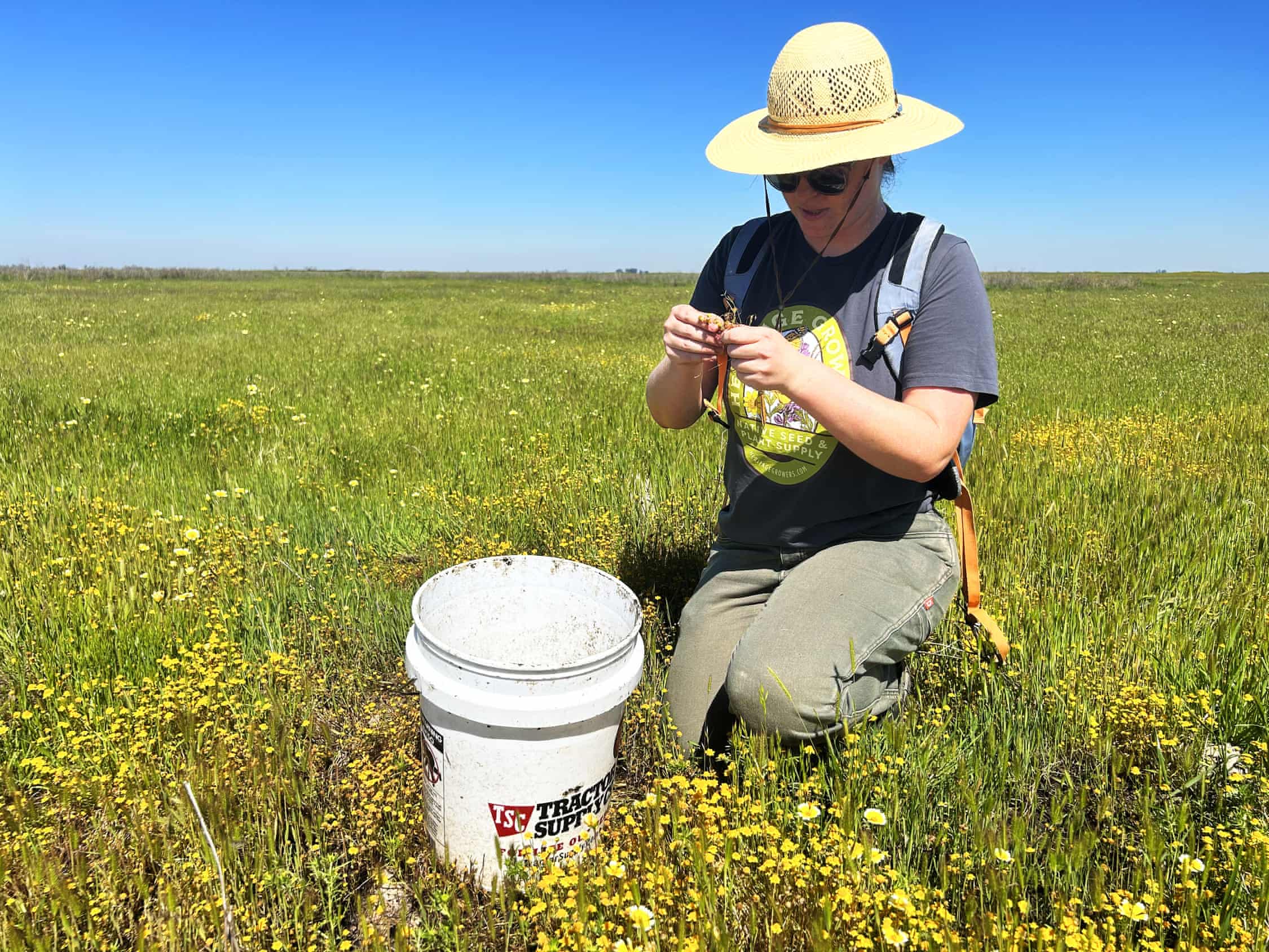
Photo: Dani Anguiano.
Haleigh Holgate, seed collection manager at Heritage Growers, inspects a seed in the San Luis national wildlife refuge complex on March 2025. Only the correct species will do.

I have blogged about seed banks in various countries (search on “seed bank”), and particularly about the global one that will keep seeds safe forever — if it stays frozen.

Today we learn what’s going on in California, where Heritage Growers is focused on local flora.

Dani Anguiano reported at the Guardian, “Deep in California’s agricultural heartland, Haleigh Holgate marched through the expansive wildflower-dotted plains of the San Luis national wildlife refuge complex in search of something precious.

“She surveyed the native grasses and flowering plants that painted the Central valley landscape in almost blinding swaths of yellow. Her objective on that sweltering spring day was to gather materials pivotal to California’s ambitious environmental agenda – seeds. …

“As a seed collection manager with the non-profit Heritage Growers native seed supplier, Holgate is tasked with traveling to the state’s wildlands to collect native seeds crucial for habitat restoration projects.

“The need has become particularly acute as California aims to conserve 30% of its land by 2030, with the governor pledging to restore ‘degraded landscapes’ and expand ‘nature-based solutions’ to fight the climate crisis. …

“But the rising demand for seeds far outpaces the available supply. California faces an ‘urgent and growing need’ to coordinate efforts to increase the availability of native seeds, according to a 2023 report from the California Native Plant Society. There simply isn’t enough wildland seed available to restore the land at the rate the state has set out to, Holgate said.

“Bridging the gap starts with people like Holgate, who spends five days a week, eight months of the year, traveling with colleagues to remote spots across the state collecting seeds – an endeavor that could shape California’s landscape for years.

“That fact is not lost on the 26-year-old. It’s something she tries to remind her team during long, grueling, hot days in the oilfields of Kern county or the San Joaquin valley. …

“Seeds play a vital role in landscape recovery. When fires move through forests, decimating native species and leaving the earth a charred sea of grey ash, or when farmlands come out of production, land managers use native seeds to help return the land to something closer to its original form. They have been an essential part of restoring the Klamath River after the largest dam removal project in US history, covering the banks of the ailing river in milkweeds that attract bees and other pollinators, and Lemmon’s needlegrass, which produces seeds that feed birds and small mammals.

“California has emphasized the importance of increasing native seed production to protect the state’s biodiversity. … Three-quarters of native vegetation in the state has been altered in the last 200 years, including more than 90% of California wetlands, much of them here in the Central valley.

“For the state to implement its plans, it needs a massive quantity of native seeds. … Enter Heritage Growers, the northern California-based non-profit founded by experts with the non-profit River Partners, which works to restore river corridors in the state and create wildlife habitat.

“The organization takes seed that Holgate and others collect and amplifies them at its Colusa farm, a 2,088-acre (845-hectare) property located an hour from the state capital. (The ethical harvesting rules Heritage Growers adhere to mean that they can take no more than 20% of seeds available the day of collection.) …

“Currently, the farm is producing more than 30,000 lbs of seeds each year and has more than 200 native plant varieties.

“The goal, general manager Pat Reynolds said, is to produce source-identified native seed and get as much of it out in the environment as possible to restore habitat at scale. …

“The benefit of restoring California’s wildlands extends far beyond the environment, said Austin Stevenot, a member of the Northern Sierra Mewuk Tribe and the director of tribal engagement for River Partners.

“ ‘It’s more than just work on the landscape, because you’re restoring places where people have been removed and by inviting those people back in these places we can have cultural restoration,’ Stevenot said. ‘Our languages, our cultures, are all tied to the landscape. … It’s giving the space back to people to freely do what we would like for the landscape and for our culture,’ he said. …

“The mission is worthwhile, Holgate said. The seeds she collects are expensive, but if they can be amplified and expanded, native seeds will become more abundant and restoration projects can happen more quickly.

“ ‘We can restore California faster,’ she said. … ‘I know that when I’m dreaming about a certain species, I should go check that population and see what’s happening. And normally there’s something going on where it’s like grasshoppers came in and ate all the seed, or the seed is ripe and ready, and I gotta call in a crew,’ she said. ‘I’ve really put my whole heart into this job.’ “

More at the Guardian, here. No firewall at this outstanding news site, but please support it.

Read Full Post »

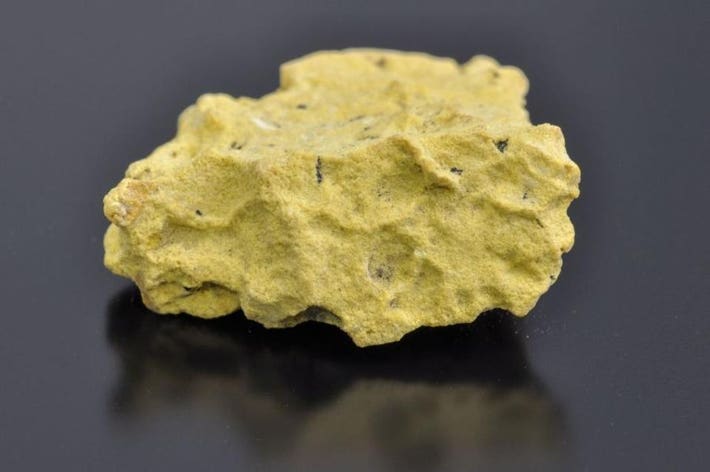
Photo: F.Kemner/LfU Bayern.
The rare mineral Humboldtine is known only from about 30 sites worldwide.
This specimen was found unexpectedly in a mineral collection in Germany.

I’ve often blogged about surprise discoveries of plants or animals thought to be extinct and about the unearthing of long-buried human artifacts. Today’s story by David Bressan at Forbes magazine is on the surprise discovery of a rare mineral that was hiding in plain sight. It makes me think there will be an endless supply of of things to discover in the future because we keep forgetting what we have.

“During a survey of an old mineral collection now hosted at the Bavarian Environment Agency or LfU Bayern in Germany,” Bressan writes, “experts discovered fragments of Humboldtine, one of the rarest minerals found on Earth.

Humboldtine is known from only 30 localities worldwide, including quarries and mines located in Germany, Brazil, the U.K., Canada, the U.S., Hungary, Czech Republic and Italy. It rarely forms tiny crystals and is most commonly found as a yellow, amorphous mass. Humboldtine forms when carbon compounds and iron-oxide react with water and is one of the few ‘organic minerals‘ containing carbon-oxygen-hydrogen groups in their crystalline structure.

“Humboldtine was first discovered by German mineralogist August Breithaupt in a weathered brown coal deposit near the municipality of Korozluky in Okres Most in the Czech Republic. [It was] scientifically described in 1821 by Peruvian geologist Mariano Eduardo de Rivero y Ustariz, who named the mineral after the German 19th-century naturalist and explorer Alexander von Humboldt. …

“In 2023, during the digitization of the archive of the LfU, a letter written by a coal mine owner and sent in 1949 to the agency was found. The letter mentions the presence of Humboldtine in coal seams of the Matthiaszeche near the town of Schwandorf, a town on the river Naab in the Upper Palatinate. The agency asked for some samples for further analysis to confirm the discovery. But no follow-up documentation seems to exist.

“But intrigued by the note, Roland Eichhorn, head of the geological department at the LfU, and colleagues decided to check the vast historic mineral collection — comprising over 130,000 rock and mineral samples — hosted in the agency’s basement. If any samples were ever sent in, they still could be here. In one drawer of the systematic mineral collection, where minerals are ordered according to their chemical composition, they found some fragments of a yellow mineral labeled ‘Oxalit,’ German for organic minerals, still inside an old cardboard box. The label also showed that the samples came from the locality mentioned in the letter.

“Modern chemical analysis confirmed the discovery made 75 years earlier; the six fragments, the largest almost the size of a nut, are indeed Humboldtine. Together with other samples, this doubles the amount of Humboldtine known so far. …

“The Matthiaszeche, a former open-pit mine for brown coal, was closed in 1966 and subsequently flooded. There is no chance of getting any more Humboldtine from this locality.”

More at Forbes, here.

I love that geologist Eichhorn was curious. Bless his heart. That’s how discoveries get made. And I also think curiosity is what keeps us all going.

Read Full Post »

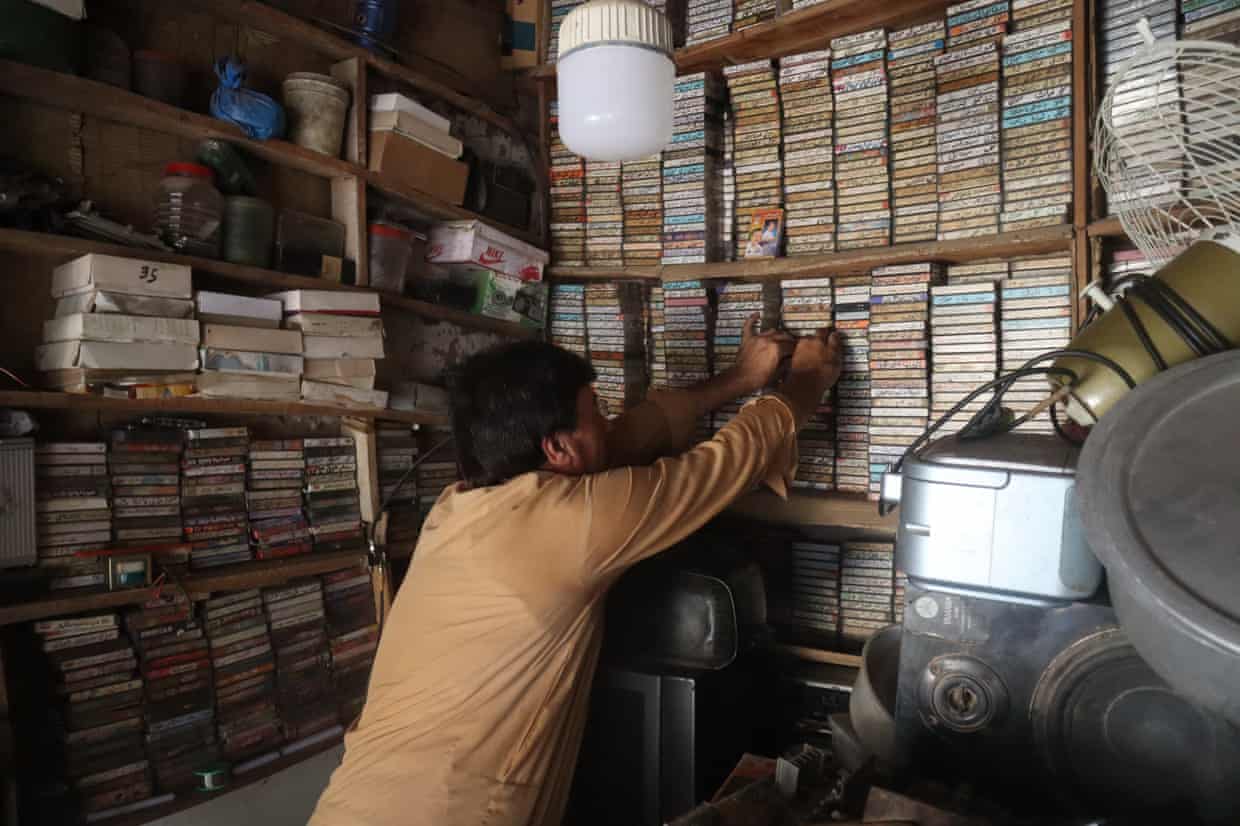
Photo: Shah Meer Baloch.
Afghan refugee Mohammed Hasan Zamri in his shop in Pakistan, where he keeps his collection of rare music cassettes from his homeland.

For the Afghan diaspora, you have to celebrate joy where you find it. In October, for example, Afghan friends lit up social media because of an unexpected triumph in cricket.

“I had a quick shower and was heading towards the office when I learned about Afghanistan’s phenomenal cricket victory against Pakistan, with the news dominating my socials,” Shadi Khan Saif exclaimed in the Guardian. …

“The team’s phenomenal performance has lifted up not just the devastated nation but millions in the Afghan diaspora, including in Australia. At Dandenong Park in Melbourne’s south-east, hundreds joined in on the traditional Attan dance to mark the victory. The scenes in Kabul and other cities in Afghanistan were equally charged with joy and celebration.

“Amid international isolation, Afghanistan’s cricket team has once again proved itself as the only source for the Afghans to connect with the outer world. Afghanistan’s tri-color flag – now replaced with the white Taliban flag – and the Republic-era anthem are still kept alive by the cricketers on the world stage.”

As unusual as was that moment of delight, it is clearly not the only way Afghans seek out joy. Some turn to a collector in Pakistan who is saving Afghan music for posterity.

Shah Meer Baloch reports for the Guardian, “Afghan music fans from Kabul and Jalalabad have crossed the border to the city of Peshawar in Pakistan to offer thousands of rupees to Mohammed Hasan Zamri’s workshop for just one cassette.

“Zamri, an Afghan refugee, refuses them all as he continues his quest to copy and, one day he hopes, digitize his collection of more than 1,000 rare and old Afghan music cassettes of various genres.

“It is his contribution to help preserve a musical culture that existed for centuries before the Taliban existed.

“Since retaking control of the country in 2021, the Taliban have imposed their rigid interpretation of Islam, restricting and even criminalising music and arts. In July, they publicised a bonfire of seized ‘illegal’ musical instruments, reminding Afghans that the sale of instruments was a punishable offense.

“ ‘The Taliban just use religion as an excuse to ban music and say it is haram, prohibited, in Islam. This is not true and it is part of our culture for centuries, but the Taliban have senselessly put a ban on it, says Zamri.

“Zamri fled Afghanistan during the Soviet invasion and went back for a few years after the war had ended and the Taliban had started to consolidate their power. He left again in 1996 and has been running a workshop fixing tape recorders and TVs ever since.

“Most of the space in his small workshop is taken up by stacks of cassettes, neatly arranged on a wall opposite the entrance. His collection includes tapes of renowned Afghan musicians including Munawar, Nashenas, Taj Mohammad and Haikal.

“ ‘I have done recordings of many singers myself who had fled Afghanistan in the 1990s or had come to Peshawar, which has been a thriving hub for Afghan refugees and musicians,’ he says.

“ ‘The love for music is there but the musicians, music and art is banned in the Taliban’s Afghanistan. Today, we have many singers but because of the ban, they cannot perform. They have fled Afghanistan.’

“Listening and copying his cassettes, Zamri reminisces of times when Afghan audiences could enjoy music and culture with freedom – the same freedom afforded to musicians and artists, men and women. … ‘The people who have heard these songs or lived through the era are the ones who come to buy cassettes. …

“ ‘Naseema, Kashan, Benazir and Zarghona were the best female singers who dominated Afghan music three to four decades ago. Now, if they do not allow men to sing or create music, how will they allow women?’

“Until [August], Zamri was unknown to many Pashto-speaking people until local media featured his attempts at saving Afghan music cassettes. He has since received both threats and messages of appreciation.

“ ‘I have been threatened on Facebook from people to stop my work and they would burn down my shop and that this is against Islam. But there were some positive and appreciative comments too. …

” ‘Some people are addicted to smoking, some people love pets and some are fond of many other things. I am addicted to Afghan music. It is my hobby and passion,’ he says.”

More at the Guardian, here.

Read Full Post »

I learned from an article in the NY Times last month that Thomas Edison’s first voice recordings were for talking dolls. And until recently, no contemporary person dared listen to them.

Ron Cowen writes, “Though Robin and Joan Rolfs owned two rare talking dolls manufactured by Thomas Edison’s phonograph company in 1890, they did not dare play the wax cylinder records tucked inside each one.

“The Rolfses, longtime collectors of Edison phonographs, knew that if they turned the cranks on the dolls’ backs, the steel phonograph needle might damage or destroy the grooves of the hollow, ring-shaped cylinder. …

“Sound historians say the cylinders were the first entertainment records ever made, and the young girls hired to recite the rhymes were the world’s first recording artists.

“Year after year, the Rolfses asked experts if there might be a safe way to play the recordings. Then a government laboratory developed a method to play fragile records without touching them.

“The technique relies on a microscope to create images of the grooves in exquisite detail. A computer approximates — with great accuracy — the sounds that would have been created by a needle moving through those grooves.”

Read more here.

Artifacts: Collection of Robin and Joan Rolfs
A government laboratory found a way to listen to recordings on fragile wax cylinders inside dolls made by Thomas Edison in 1890. 

Read Full Post »

Suzanne has always admired Madeleine Albright, an interesting woman before, during, and after her stint as U.S. Secretary of State.

One thing that appeals to me about Albright is her sense of humor, a playfulness seen in the pins she collected for special occasions and to express both diplomatic — and not so diplomatic — thoughts.

The brooches on view through July 20 at her alma mater’s Davis Museum include an eagle pin that she wore to her swearing in, the serpent pin that was a response to a hostile Saddam Hussein observation, and a bee pin with a stinger to warn Yasser Arafat she was losing patience.

Jill Radsken recently toured the collection with Albright and recorded her recollections about her pins, including a pin that went over like a lead balloon.

“She [recalled] her foreign policy pin faux pas when she wore a three-monkey ‘Hear no evil, speak no evil, see no evil’ set to a summer summit with Vladimir Putin. When the Russian leader inquired about the monkeys, Albright forcefully told him: ‘I think your policy in Chechnya is evil.’

“ ‘That was a time when I thought I’d made a mistake with my pin,’ she said.”

Read more here.

Photo: John Bigelow Taylor
Saddam Hussein published a poem calling Madeleine Albright, then ambassador to the United Nations, an “unparalleled serpent.” She decided to have fun with comment and got herself a serpent pin for her next meeting with Hussein’s officials.

Read Full Post »

Barnes-3


Barnes-waterfall

Today I need the Indian goddess with the many arms because I want to say about the Barnes Collection in its new home, “On the one hand, on the other hand, on the third hand …”

After I saw the documentary The Art of the Steal, about how the fabulous art collection that was willed to a historically black college to keep it from art-world experts ended up in the hands of art world experts, I thought a trustee at Lincoln University had sold his patrimony for a mess of pottage. Now I think that receiving untold wealth is a curse and the donor better have a good plan and lots of resources to support the unfortunate recipient. (More about the movie.)

That’s two hands.

On Thursday, having visited the Albert C. Barnes collection in its new Philadelphia Museum of Art building, I needed a few more hands.

On the third hand, the building is gorgeous in its simplicity and displays the art (69 Cezannes, anyone? How about 60 Matisses? 44 Picassos? 178 Renoirs? Do you love Seurat? Van Gogh? Pennsylvania Dutch furniture?) in the quirky layout of the old Merion, Pa., setting and without labels as Barnes did. On the fourth hand, lack of labels is annoying. On the fifth hand, the art experts provide an ipod with lectures on selected works and a booklet to identify all the items exhibited. On the sixth hand, faithful as the layout is, Dr. Barnes, who made his money in pharmaceuticals and wanted ordinary working families to enjoy and study art without the filter of the art establishment — would have had a heart attack about the entry fee and the standard gift shop and coffee shop and other luxurious museum appointments.

The museum is definitely worth seeing, for the building, the art, and the way the roaring controversy was all handled. But it’s the little things I will cherish like finding black and white illustrations that reminded me of Dickens illustrations and turned out to be by the school friend Barnes asked to help form his taste and get him started on collecting (William Glackens).

Giorgio de Chirico, Portrait of Albert C. Barnes, 1926

Read Full Post »

David Guttenfelder seems to get into North Korea and take pictures there more than anyone else, but what are you allowed to take pictures of in North Korea?

When Guttenfelder isn’t attending any official event, he improvises. He may have invented an art form in North Korea — artifact photography. He snaps bunches of plastic flowers in a hotel room, dinner menus, concert programs and labels them as “artifacts,” numbered.

No wonder he is involved with a new artifact museum, mmuseumm, which features the kooky things people collect.

Consider Toothpaste Tubes from Around the World, collected by Tucker Viemeister.  Says Viemeister, “Although I come from a ‘Crest family,’ I got my first tube of foreign toothpaste in Finland in 1985. We were shopping for normal stuff (Marimekko and toiletries). I saw a tube of toothpaste that’s [got a] name as long as the tube! They have long words in Finland.

“As I traveled around, I’d sample the toothpaste around the world. It was fun to buy and fit easily in my bag. Meanwhile it was an easy gift!

“I noticed that toothpaste is a universal media for indigenous people – a veritable blank canvas — both graphics on the generic tube and the flavors of the paste. French brands are more gourmet, Asian is more fruity, while American is very sharp (it this stereotyping?).” More here.

The museum is in Cortlandt Alley between Franklin St. and White St. in Manhattan.

(I wonder if my collection of wooden thread spools is extensive enough for a museum. I am afraid I lost the varied European toilet papers I collected on a trip at age 15.)


Read Full Post »

In case anyone thought that this blog wasn’t eclectic enough, I’m linking today to a story about garbage collection in Taiwan.

“For several years, Taiwan’s garbage trucks have played classical music as they travel through crowded residential areas, drawing forth residents with their garbage. Conceived by Taiwan’s Environmental Protection Administration as a way to decrease pests and odors in outdoor public trash disposal areas, the trucks musically notify residents that they are to bring their garbage directly to the trucks, ensuring that the garbage never sits on the curb attracting vermin and releasing odors.”

I wonder how two-career families who aren’t home to respond to the music deal with this. Read more on Taiwan’s approach at New York’s classical music station, WQXR.

Meanwhile, at Los Alamos, Americans show they can innovate in garbage collection, too. I think my grandson will like this truck.


Read Full Post »