Feeds:
Posts
Comments

Posts Tagged ‘conflict’

Photo: Gianmarco Di Costanzo.
Lek Chailert devoted her life to rescuing abused elephants. Now caring for 120 of them, she fears for their future in Asia.

The stylist at my salon sometimes talks about her love for elephants. She’s the one who opened my eyes to what elephants and other animals suffer from captivity. I had never thought much about it, assuming that zoos were good, helping children to learn about the wild and saving endangered animals from extinction. Those things may be true to some extent, but not always.

Today’s story is about a woman who set up a rescue operation for elephants in her homeland.

Patrick Greenfield writes at the Guardian, “Saengduean Lek Chailert was five years old when she saw an elephant for the first time. It was in chains, lumbering past her home in rural Thailand on its way to help loggers pull trees from the forest. Back then, she saw the giant mammals like everyone else – as animals that served humans. But that changed the day she heard a scream from the forest.

“Chailert was 16 when she heard the terrible noise. She scrambled through the trees until she found the source: a bull elephant scrabbling in the mud as it tried and failed to drag a log out of a ditch. Every failed attempt was met with punishment from the loggers and mahout, the elephant keeper. …

“ ‘The elephant looked at me and I felt the fear and anger. I felt helpless and confused. My heart hurt a lot,” says Chailert. …

“The incident changed the direction of Chailert’s life forever. She was from a poor family – there was no electricity or school in her village – but she vowed to do something for the animals she loved.

“Before a ban on logging in natural forests in Thailand in 1989, elephants were a key part of the industry. In the early 20th century, there were an estimated 100,000 elephants in Thailand. Thousands were worked to death or left with severe injuries. …

“After the ban, many elephants were used by the country’s rapidly growing tourism industry to give performances and rides. …

” ‘Camp owners were competing with each other for tourists,’ she says. ‘They would train their elephants to dance, ride a motorbike, play darts or hula hoop, walk on a rope or play a harmonica. This brought more suffering to elephants.’

“It took Chailert a few attempts to fulfill her dream of finding a way to care for Thailand’s elephants. In 1996, she sold everything she had and borrowed money to set up an elephant sanctuary. She paid $30,000 for four hectares (10 acres) of land to provide a home to nine elephants.

“She insisted that there would be no elephant rides or performances. Her family invested money to help but after disagreements over how to run the park, she left the project, taking the elephants with her.

“Then, Chailert got lucky. National Geographic was filming a documentary with the Hollywood star Meg Ryan about Thailand’s wild elephants, which were estimated to number 4,000 to 4,400 by 2023; Chailert and her newly released elephants featured in it.

“In the US, a Texas couple, Bert and Christine Von Roemer, saw the TV program and contacted Chailert, donating enough money to buy a 20-hectare parcel of land in the Mae Taeng district of northern Thailand, near Chiang Mai. In 2003, Elephant Nature Park was born.

‘Today, about 120 rescue elephants are at the park, which has grown to more than 1,000 hectares, home to a small fraction of the 3,900 or so domesticated elephants in the country. The sanctuary’s work has an enormous social media following on Instagram and Facebook.

“Elephants arrive from all over Thailand. …

” ‘Some arrive with huge mental issues. Some stand like a zombie; some are aggressive, they swing their head back and forth. When they arrive, we do not allow our staff to use any tools or do anything that might make them feel threatened. We are gentle. We have to give them our love to make them trust us. We have to be patient,’ she says.

“New arrivals are almost always put into quarantine and slowly introduced to the herd. Over time, they are accepted. When their ears start to flap and their tails start to whirl, the elephants are happy, says Chailert. …

“Today, the conservation scheme is funded by visitors and volunteers who pay to work on the project. But despite the success of the sanctuary, Chailert fears for the future of Asian elephants, which she believes are decreasing in Thailand, despite official figures showing a steady increase in the population.

“ ‘Throughout Asia, many people are starting to hate elephants. Human-wildlife conflict is a big problem. Many died from being shot and poisoned,’ she says.

“ ‘Many have lost their habitat and water sources so they have to go to golf clubs and rice fields – places that don’t belong to them. So, people get angry and make the elephant into a monster. The future will depend on the government policy to resolve this,’ she says.”

More at the Guardian, here. PS. The Guardian doesn’t have a paywall. Please consider donating to keep their journalism alive.

Read Full Post »

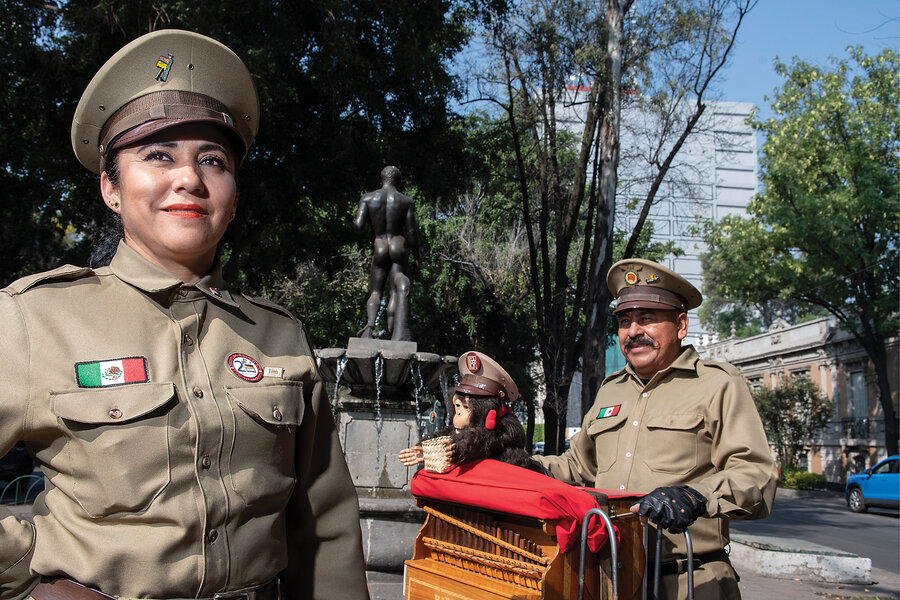
Photo: Alfredo Sosa/CSM Staff.
Elsi Sastre (left) and Cresencio Torres work as a team of organ-grinders in the Roma neighborhood of Mexico City.

Between the two of us, my husband and I can tell our grandchildren about having seen an ice-delivery man, a huckster selling vegetables door-to-door, a traveling knife-sharpening guy. Wouldn’t it be great to show such things in person once in a while, not just in historic villages with costumed interpreters?

Today’s article is about something we will need to hurry up to see before it fades into history: the traditional organ grinder in Mexico.

Whitney Eulich writes at the Christian Science Monitor, “Hunched over a weatherworn hand-crank organ in his repair shop, Roman Dichi explains why the work of Mexico’s organilleros has endured for a century and a half. 

“ ‘This music evokes happiness, tradition, and childhood memories of going out to a plaza with Mom and Dad – or of falling in love,’ says Mr. Dichi, president of the organ-grinders union in Mexico City. …

“Organ-grinders, especially ubiquitous in Mexico City’s historic center, date back to the presidential administration of Gen. Porfirio Díaz in the late 1800s. The dictator’s adoration of all things European inspired Mexico’s elite to import organs into their homes. Eventually, the instruments moved out of private parlors and onto the streets as public entertainment. They were used to draw customers to circuses, with the help of monkeys, and to keep soldiers in good spirits. Over time, the European songs inside the machines were replaced with revolutionary ballads and local classics, such as ‘Las Mañanitas,’ the Mexican birthday song.

“Despite these deep roots, today the tradition is at risk. Not everyone is charmed by the tip-seeking musicians. A crank organ’s sound – akin to the pitchy puff of air from a slide whistle – can be loud. In the wrong hands, an organ can be positively off-key, an assault against the ears. …

“The organs are also expensive, with many organilleros renting them from the small stock available locally. And upkeep gets costlier with each passing year. The heavy instruments can get damaged while being wheeled down crowded city streets or warped by weather and time. 

“Edgar Alberto Méndez Hernández has been slowly turning the crank on his organ in the capital’s historic center for some 15 years. He nets about 250 pesos (a little more than $15) on a good day after paying 250 pesos for his rental. …

“After several hours working along a bustling sidewalk near the Bellas Artes theater, he pushes his black-and-brown antique wooden organ on its dolly and heads several blocks toward the Zócalo square. When he shows up at this even busier – and potentially more lucrative – spot, the two young men already playing organs there take their cue, as if in a dance, and move to a side street. These shifts are imperceptible to the public but tediously negotiated with the union’s help. …

“They ‘live off of tips,’ notes Yuleina Carmona, the Mexico City coordinator for Women in Informal Employment: Globalizing and Organizing, an international nonprofit. Shoeshiners and strolling mariachi bands have fixed rates for their services, but organ-grinders churn out music whether they are paid or not. …

“In March, Mr. Dichi’s union submitted a proposal to Mexico City’s Congress to have organilleros’ work recognized as a cultural heritage. It was the fourth attempt – and this time it was approved.

“The legal recognition is expected to translate to better protection on the street from police harassment and greater support for organ-grinders in their disputes with residents and businesses. Ms. Carmona notes it will also give organ-grinders ‘a seat at the table’ – a say in how Mexico City uses funds for cultural activities in the center.”

More at the Monitor, here. Great pictures. No paywall.

Now, what is the coolest old-timey thing in your memory?

Read Full Post »

Image:Alan Fan Pei via Wikimedia Commons.
China National Expressway G2, Beijing to Shanghai. Who can you trust?

Back when I got my first full-time copyediting job, Wikipedia was new. We were not allowed to reference it for a citation. At the same time, Wikipedia required its own references to be to books and other long-accepted documents — nothing online.

Those days are gone, but the encyclopedia we can’t live without is still evolving, and differing constituencies struggle behind the scenes.

Consider the passionate world of roadmaps.

Stephen Harrison reports at Slate, “When Ben, also known as bmacs001, posted a TikTok video promising to ‘spill the tea’ on how the site treats road and highway articles, the Wikipedia contributor suspected that people would find the topic intriguing: ‘Forty of Wikipedia’s most prolific editors have seceded and made their own wiki, and I’m among them.’

“Ben was part of the contingent of Wikipedia editors who contributed to the site’s pages covering road and highway infrastructure — everything from Interstate 80 and Route 66 to tinier highways on the side of the Jersey Shore. ‘We’ve been chugging along doing our own thing on the ’pedia for the past two decades now, [but] our little corner of the site has come under attack,’ Ben said. … Wikipedia’s highway enthusiasts felt they had no choice but to break away and form a separate project: AARoads Wiki.

“With over 800,000 views and counting, the nearly four-minute TikTok video is a testament to how even extremely niche topics gain visibility on the platform. As the post’s top comment put it, ‘I’m so here for interstate Wikipedia drama.’ But behind this seemingly amusing clash of nerds is a far more pressing issue: how to reconcile 20 years of Wikipedia’s core principles and values with the practical demands of present circumstances. …

“Roadgeeks are drawn toward the immediacy of the subject matter — since many users drive on roads every day — while railfans gravitate toward the historical aspect, since locomotives aren’t nearly as common as they once were. …

One flashpoint that inspired the recent revolt was a strict interpretation of the site’s reliable sourcing policy. …

“Take the example of an article about West Virginia Route 891, a short east–west highway that ends on the Pennsylvania state line. A volunteer editor seeking to contribute content to the page might use information found on the West Virginia Department of Transportation’s website as a reference source. However, policy sticklers are likely to deny this usage because DOT is a primary source for highways (directly involved in the subject matter). According to the site’s policies, Wikipedia should be based mainly on reliable secondary sources, such as newspapers.

“Angry road editors like Ben are up in arms, claiming that this hard-line interpretation of the guideline does not reflect the realities of the situation. With local newspapers going out of business left and right, there are rarely any other sources to draw from for these kinds of articles. Why not allow Wikipedians to cite from DOT, which is responsible for publishing highway routes?

“Then again, it’s worth remembering that most of the time Wikipedia has good reasons for the prohibition against primary sources, especially with government entities. A state’s DOT content might generally be reliable — but allowing Wikipedians to cite from other primary sources, such as China’s Central Propaganda Department, is not a risk worth taking. The question is whether there is some way to recognize an exemption, granting that some types of primary sources may be reliable while still protecting the integrity of the rule.

“Wikipedia’s road editors have also struggled with the site’s prohibition against original research. … The policy has helped stop users from adding pseudoscience about Bigfoot excursions to the site, for example. But road editors are understandably frustrated when ‘no original research’ is applied to exclude maps. Why should someone have to search out a second source to confirm in words what the map communicates in visual form? …

“Finally, there’s the issue of Wikipedia’s notability guideline — the principle that only topics that are truly ‘worthy of notice’ should be included on the encyclopedia. Lack of notability is the reason why the proposed articles about many aspiring influencers get deleted every day. Roadgeeks tend to argue that highways are generally notable. …

“ ‘The people who want to destroy, the only work that they need to do is destroy. Creating involves a lot more work, so we’re trying to fight back against people who have more time for deleting stuff,’ Ben told me.”

More at Slate, here. You’re allowed a few articles for free there.

Read Full Post »

Photo: Atlanta Black Star

CBS News recently had a story on how a Baltimore school and its children are benefiting from meditation.

“During the morning rush,” CBS reports, “Robert W. Coleman Elementary School is as bustling as any other school. But after the buses arrive and the kids pour in, the usual classroom chatter comes to a complete stop.

“The students here learn to seek their inner peace. Every day begins with what the school calls a ‘mindful moment’ – a 15-minute blend of yoga and meditation.

“It’s not what you’d expect from a school in West Baltimore, but it’s the dream of two brothers from right here in the neighborhood, reports CBS News correspondent Tony Dokoupil.

“Twice a day, more than 300 students take part in the ‘Mindful Moments’ program. They learn to breathe, stretch and block out distractions.

“Principal Carillian Thompson said this has made a ‘huge difference.’ … ‘We’ve had zero suspensions,’ Thompson said.

“When students fight or misbehave at Coleman, they aren’t sent to the principal’s office. Instead, they are sent to the ‘mindful me’ room, where they’re taught to resolve conflicts peacefully and teach each other what they’ve learned.

“ ‘When I was breathing, all the things that’s been happening, I passed that on — all the problems, I passed that on and worried about… what’s more important,’ Sierra said.

“The program is the vision of Ali and Atman Smith, who grew up nearby in one of Baltimore’s most volatile neighborhoods.

“ ‘There’s violence going on in the neighborhoods, there’s drug abuse in the neighborhoods, so it’s just, there’s all these things just getting dumped on these kids and they need a way to kind of deal with it,’ said Ali Smith, co-founder of Holistic Life Foundation. …

“ ‘We’re teaching kids at a young age to try to really make a change in our community as far as how conflicts are resolved,’ said Atman Smith.”

More at CBS News, here.

Read Full Post »

Photo: Boston Globe
Al Filipov died on Sept. 11. He was on the plane from Boston.

After September 11, 2001, good works sprouted around the country, launched by people from all walks of life who were determined that goodness should have the last say.  The Huffington Post collected a bunch of these initiatives for one anniversary of the tragedy, here, but you can find examples in nearly every community.

In Concord, Al Filipov, who was on one of the planes, is honored in several ways, including by the Filipov Peace and Justice Forum.

Al’s son, Boston Globe reporter David Filipov, once recalled his father as “engineer, inventor, sailor, deacon, coach, husband, dad, raconteur.” The Filipov forum website adds that he was a painter and a human rights activist, noting,

“He sought out the best in people and cared passionately about the world in its beauty and pain. He earnestly believed in the power of an individual to make a difference in the world.”

The 2016 Al Filipov Peace & Justice Forum will take place on September 25 at the Trinity Congregational Church on Walden Street in Concord. Representatives from the Parents Circle-Families Forum are the featured guests. The Parents Circle is made up of bereaved Palestinian and Israeli families that have come together to support “peace, reconciliation and tolerance.”

As one member says in the video below, people from different sides of a conflict need to get to know one another as individuals and share commonalities in order to let go of “being right” all the time instead of creating peace. Otherwise any future agreement is just a cease fire.

The presentation will be from 4 p.m. to 6 p.m.

Read Full Post »