Feeds:
Posts
Comments

Posts Tagged ‘cooperation’

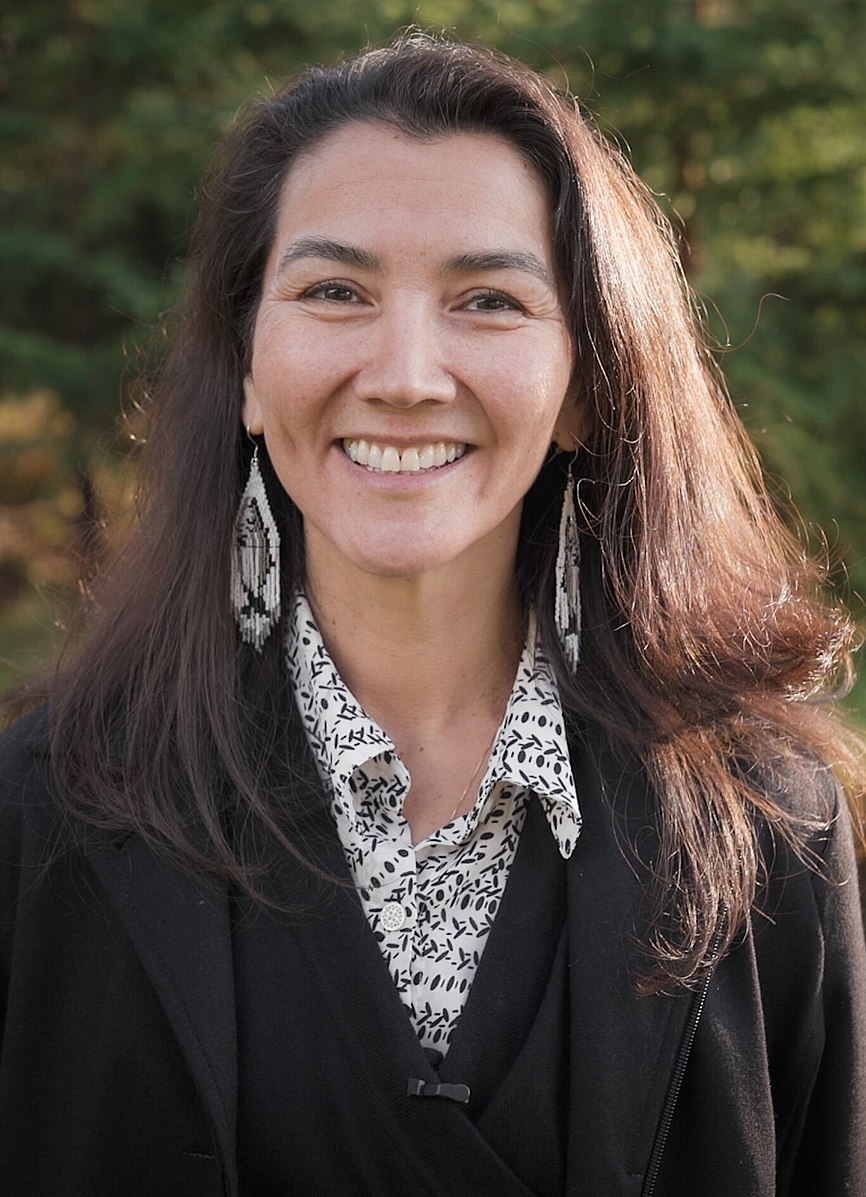
US Rep. Mary Peltola of Alaska.

Is there hope for Americans with different political views to get along? Well, why not? We used to get along. Now it seems that we have to teach ourselves that skill all over again.

Believe it or not, there’s actually a member of the House of Representatives who is showing people how it’s done.

Samantha Laine Perfas and Clayton Collins at the Christian Science Monitor created a podcast about her with West Coast bureau chief Francine Kiefer.

“A race for [Alaska’s] lone House seat had been won in a special election by Mary Peltola, an Alaska Native and a Democrat. … Representative Peltola had hired the chief of staff of her late Republican predecessor, and then hired two other Republican staffers.

“ ‘This just doesn’t happen in Washington,’ Francine says on the Monitor’s ‘Why We Wrote This’ podcast. ‘And I was curious about what kind of person it was that would make sort of a practical decision to hire folks who knew Alaska, who knew Washington, even though they’re not of your own political party.’ (Representative Peltola’s mother’s side of the family is Alaska Native and all Democrats; her father’s side is white Nebraska wheat farmers and all Republicans.)

“What Francine produced [is] a story about the ‘Alaska way’ at the root of such thinking. It’s about interdependence. And while there are many factors at play in Alaska politics – ranked choice voting among them – it’s really about something that might transfer beyond the 49th state. …

Samantha Laine Perfas
“Welcome to ‘Why We Wrote This.’ I’m today’s host, Samantha Laine Perfas. I’m joined by Francine Kiefer, a longtime, award-winning staff writer at the Monitor. … What was it that piqued your interest about Alaska? 

Francine Kiefer
“I have to admit that I’ve just been wanting to get back to Alaska for over 40 years. It was the scene of where I had my first job in journalism, at the Anchorage Daily News. I was just a pipsqueak intern, and I fell in love with the state and I’ve just always wanted to go back. And the political story was a fantastic reason. Here you have a red state. And it just elected two moderates to Congress.

“[Mary Peltola] was the first Alaska Native to be elected ever to Congress. And her whole persona is a bridge builder. One of the things that really got my attention was when I read that Mary Peltola had hired the chief of staff of her Republican predecessor, Don Young. She hired his Republican former chief of staff, his Republican scheduler, and she hired a Republican spokesperson from another office on the Hill. And I was curious about what kind of person it was that would make sort of a practical decision to hire folks who knew Alaska, who knew Washington, even though they’re not of your own political party. …

Laine Perfas
“What was it like talking to her for this story? 

Kiefer
“I’ve talked to many lawmakers over my journalistic career, and she sounded so authentic. She didn’t have her guard up. She wasn’t being measured about what she was saying. She is from an area in western Alaska that depends on fishing for survival. And she’s been fishing since she was six years old. She, as the Alaskans say, ‘She knows how to fill a freezer.’ And she also embraces the spirit of Alaska. It’s a large state. It’s a beautiful state, but it’s also a cold and a dangerous place. And people rely on each other. And there’s a real spirit of cooperation there where people help each other out in tough spots. … Having to help each other out, that is part of the ‘Alaska spirit.’ 

Laine Perfas
“I think it’s interesting to think about how this spirit of Alaska might be different than other parts of the US. How did you see that affecting the political arena? Did it affect the way that candidates interacted with their potential constituents? 

Kiefer
“It definitely did, because of the way that ranked-choice voting works. That allows voters to rank their choices in order of preference such that the one with the broadest appeal emerges from the system. When you’re out there on the campaign trail, you’re not only trying to get people to vote for you as their first choice, but you’re [also] trying to get people to vote for you as their second choice.

“I talked with a local candidate for the state Alaska Senate. And she said this time because of ranked-choice voting instead of knocking only on the doors of the Republican base, she knocked on over 6,000 doors, including many Democrats’, and they would open their door to her and say, ‘You don’t want to talk to me. I’m a Democrat.’ And her answer was, ‘Oh, yes, I do want to talk to you because you can put me as your No. 2 vote. And we may not agree on everything, but here is the stuff that we do agree on.’ And in the end, it was votes from Democrats who had ranked her second, who put her over the line into the majority. 

Laine Perfas
“In the beginning of the conversation, you referred to Peltola as a ‘bridge builder.’ What is the value of having someone like that in office? 

Kiefer
“I think it has two main impacts. One is it can help restore civility to a political dialogue and the other one is it can build understanding and mutual understanding among lawmakers, and hopefully lead to compromise.

“One of my sources for this story was a gentleman named Andrew Halcro. He’s a Republican. He talked to me about the time in which he served as a freshman legislator in the Alaska House at the state Capitol in Juneau. Right off the bat, within a few days of his arriving, he gave a speech where he said, you know, the way to solve Alaska’s fiscal problems is to cut the budget. Cut, cut, cut. And he pointed to rural Alaska, which is where most Alaska Natives live as the place [where the budget] needed to be cut.

“And this speech did not go over well. And within hours, he said, Mary Peltola, who of course, is from this region, knocked on his door and said, ‘You know, I know we’re both new here, but let me explain to you a little bit about what I know about rural Alaska and what their needs are.’ And he said that out of this discussion came a wonderful working relationship with her, as well as understanding and appreciation for the needs of a part of Alaska that he had never set foot in except for sport.

“So you get a sense there of the relationship building, of the understanding that can come about by having bridge builders in a legislature. At the same time, there are limits. And Mary Peltola also said to me, look, she can’t singlehandedly solve the political divide in the United States, but she can do her job of being a model in the way she communicates and the way she reaches out for other political leaders. 

Laine Perfas
“Do you think what we’re seeing in Alaska could be transferable to the rest of the country? 

Kiefer
“Well, definitely the voting system could be. Ranked choice voting has been practiced by Maine in a more limited sense since 2018. And in this very past election in November, Nevadans voted for a system very similar to what Alaska is practicing. So that part of it, I think, could be replicable. The other part of this that we’ve talked about is ‘the Alaska spirit,’ which is that cooperative spirit. I think that is rather specific to Alaska. And in fact, people told me that. But as Peltola said to me, it’s not exclusive to Alaskans, right? And she said, ‘You know, we have been civil before. If we’ve been civil before, we can do it again.’ ” 

Click the podcast arrow at the Christian Science Monitor, here.
Read Full Post »

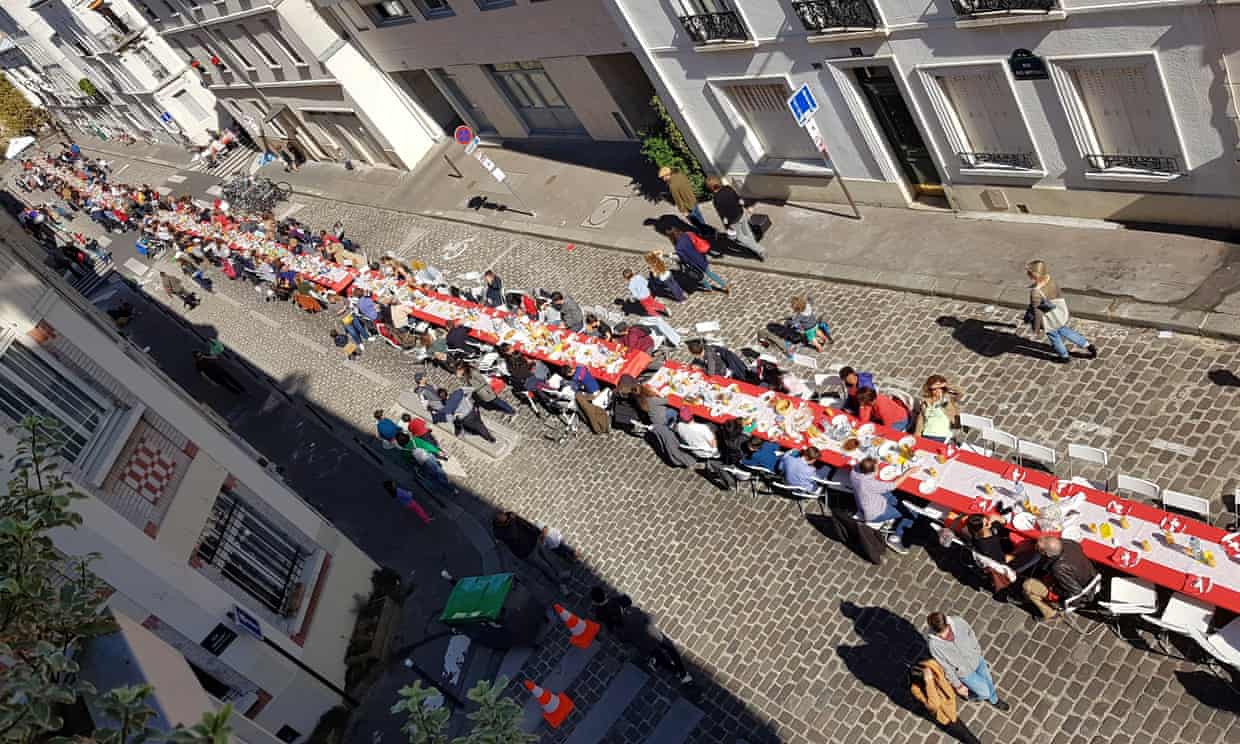
Photo: Hyper Voisins.
A 705-foot banquet table meant to seat 648 people in a Paris neighborhood that’s seeking a more neighborly lifestyle.

It’s that time of year again — time for our valiant but hopeless block party, when we smile and reintroduce ourselves to neighbors that we will look right through when we bump into them in the market in January. If New England can’t make mutual support and cooperation work, how in the world can Paris?

Peter Yeung at the Guardian describes an experiment in France.

“It was a distinctly un-Parisian revolution although it began on an inner city street. No barricades were assembled to block the nearby boulevards and no radical students hurled cobblestones ripped from the pavement. …

“Instead, a 215-meter-long [about 705 feet] banquet table, lined with 648 chairs and laden with a home cooked produce, was set up along the Rue de l’Aude and those in attendance were urged to openly utter the most subversive of words: bonjour.

“For some, that greeting led to the first meaningful exchange between neighbors. ‘I’d never seen anything like it before,’ says Benjamin Zhong who runs a cafe in the area. ‘It felt like the street belonged to me, to all of us.’

“The revolutionaries pledged their allegiance that September day in 2017 to the self-styled République des Hyper Voisins, or Republic of Super Neighbors, a stretch of the 14th arrondissement on the Left Bank, encompassing roughly 50 streets and 15,000 residents. In the five years since, the republic – a ‘laboratory for social experimentation’ – has attempted to address the shortcomings of modern city living, which can be transactional, fast-paced, and lonely.

“The experiment encourages people not just to salute each other more in the street but to interact daily through mutual aid schemes, voluntary skills-sharing and organized meet ups.

“ ‘The stereotype of a Parisian is brusque and unfriendly,’ says Patrick Bernard, the former journalist and local resident who launched the project. ‘But city living doesn’t have to be unpleasant and anonymous. We want to create the atmosphere of a village in an urban space. [Conviviality] can become a powerful asset, an essential economic and social agent in the construction of tomorrow’s cities.’

“Nearly 2,000 people now attend weekly brunches and apéritifs in local restaurants, cultural outings, memory exchanges, children’s activities and more. During the pandemic, residents mobilized to make masks, deliver shopping to vulnerable neighbors and bake cakes to support a local charity. Crucial, too, is the digital aspect: dozens of WhatsApp groups include those dedicated to repairing broken devices, selling second-hand goods, and sharing healthcare resources. …

“Mireille Roberdeau, an 86-year-old widow who moved to the area in 2000, says the scheme has given her a reason to get up in the morning. ‘I was quite timid before,’ she adds. ‘I wouldn’t speak to anyone. I would scowl at people. But now I look forward to going out. It’s good because my doctor says I need to get out.’

“Roberdeau, now a keen user of the WhatsApp groups was hospitalized in March but says neighbors delivered her groceries when she got home. …

“Beyond the ‘eating, drinking and celebrating as social engineering,’ in the words of Bernard, that defined the initial stages of Hyper Voisins, the long-term targets – aimed at transforming the very nature and functioning of an urban neighborhood – come under four pillars: environment, healthcare, public spaces and mobility.

“It has, for example, collaborated with non-profit Les Alchimistes to install organic waste disposal points in former parking spaces and to turn the matter into compost. Perhaps more radically at a time of strained healthcare provision in France, it is launching a health clinic geared towards local needs. [It] will have a staff of 10 and offer extended opening hours, consultations without appointment and home visits. …

“To reduce local car use by residents and traders, Hyper Voisins plans to buy electric bikes with trailers and install a communal electric bike charger. It is also in talks with the mayor to potentially levy a local tax on unwanted businesses such as estate agents, banks and delivery hubs and give residents a vote on whether they can even move in. ‘We want to promote stores that improve our daily life,’ adds Bernard. ‘If not, like a polluter, they should pay.’ …

“A study by sociologist Camille Arnodin found that Hyper Voisins – and two other community volunteer projects in Paris – had reinforced pandemic resilience, transformed weak neighbourly links into strong bonds, improved social mixing and reduced social isolation. …

“[But it] noted issues over inclusion: the scheme could risk leaving out either those who don’t wish to participate in activities or those who ‘don’t feel included or informed.’ ”

What do you think? Several readers are more intimate with Paris than I am, having been there only once, decades ago. So I would love to hear what you think of the experiment. Good idea? Can’t possibly survive?

More at the Guardian, here.

Read Full Post »

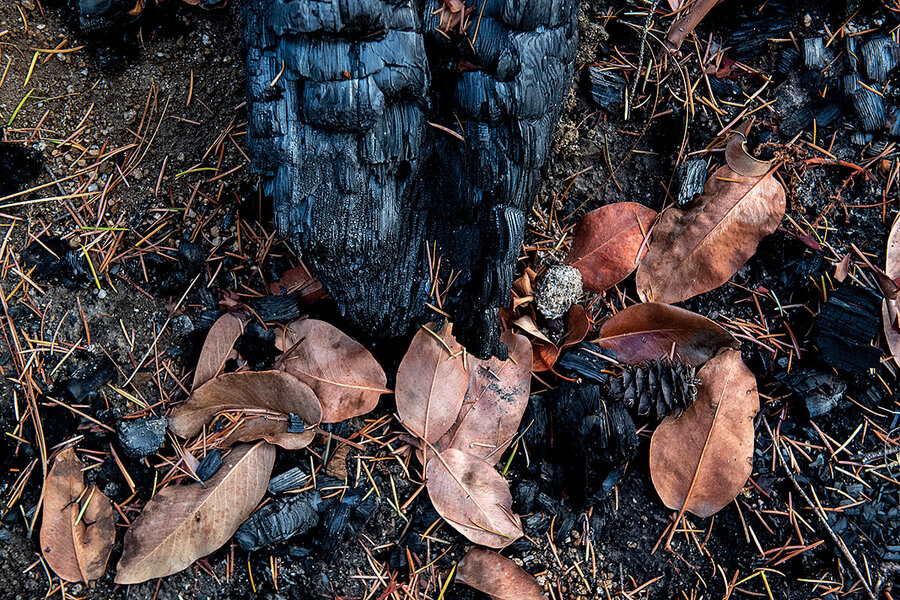
Photo: Andy Nelson/Special to the Christian Science Monitor.
On a hiking trail in Ashland, Oregon, signs of a controlled burn. Says Brian Hendrix, who works for an outreach program that helps homeowners protect their properties from wildfires, “We try to help residents see that their own safety is linked to their neighbor’s safety.”

When Martin Kuz interviewed residents of Ashland, Oregon, for the Christian Science Monitor, he found that the shared determination to prevent wildfires tamped down ideological fires.

He reports, “A municipal water tank built into the forested hills above Ashland offers postcard views of the mountain valley town on clear days. This warm September morning is not, alas, such a day. Wildfires burning elsewhere in Oregon and to the south in California have blurred the blue skies, turning the city into a soup bowl of ash-gray smoke.

“Standing atop the storage tank, Chris Chambers points toward Hald Strawberry Park, visible through the haze about a half-mile away and encircled by homes. Drought has browned its grass and many of its pine and madrone trees. The parched land presents a fire threat to the town’s 21,000 residents – and, he explains, another chance to better protect them from the flames.

“ ‘I want to burn that whole thing. It’s an island of fuel,’ says Mr. Chambers, the wildfire division chief for the city fire department. … ‘There’s a choice: We can burn the land on our terms, or we can let nature burn everything – and we won’t like the effects.’

“The prospects for his plan appear bright in a town that over the past quarter century has emerged as a leading light in the American West for its sustained, communitywide approach to wildfire prevention. Since the late 1990s, acceptance among Ashland’s residents of the need for collective vigilance has grown in tandem with the number, scale, and intensity of infernos across the region. …

“ ‘Calling these huge fires of recent years natural disasters – they’re very much not natural disasters,’ says Mr. Chambers, who joined the fire department in 2002. …

‘We have to think of these fires and climate change as human-made disasters and realize we can unmake them. And, really, we have to if we want to live in the West.’

“This summer delivered more proof of that charred reality. … Propelled by ferocious winds, the Almeda Fire gutted the neighboring towns of Talent and Phoenix, leveling 2,500 homes. The calamity brought into tragic focus the principle of shared responsibility that Mr. Chambers and other fire safety officials promote as they seek to lower wildfire danger and enhance forest health.

“The emphasis on collaboration has drawn together the city, U.S. Forest Service, and conservation groups to restore the town’s watershed, a heavily forested area that slopes down from the 7,500-foot peak of Mount Ashland. The innovative initiative has enabled the partners to treat 13,000 acres of land through prescribed burning, selective logging, and brush clearing.

“Local officials have cultivated broad support in recent years to strengthen homebuilding and landscaping standards to improve wildfire safety. Fire Adapted Ashland, an education and outreach program, works with homeowners to safeguard properties and distributes small grants to individuals and neighborhood groups to replace flammable vegetation and trim trees.

“The culture of solidarity in the former timber town, now best known for hosting the Oregon Shakespeare Festival, has attracted fire safety officials from other Western states and as far away as England and Spain. They learn that an informal policy to persuade rather than dictate guides the city’s strategy. …

“The bitter struggle over clear-cutting and spotted owl habitat in Oregon, Washington, and California resulted in tight logging restrictions on federal lands as popular sentiment shifted toward saving old-growth forest. 

“In the ensuing decades, the ban on most timber operations – along with the enduring practice of extinguishing wildfires as quickly as possible – has deepened the crisis of ailing forests. The added impact of climate change and drought has burdened Western states with an estimated 6.3 billion standing dead trees. The competition for water and sunlight in clogged forests stunts the growth of young trees and diminishes the capacity of older, more fire-resistant trees to withstand flames and disease.

“ ‘The bias for a lot of the public is that any tree is a good tree,’ [Kit] Colbenson says. ‘But what you end up with is a forest that has more fuel and is more susceptible to big fires.’ …

“Forest Service and city officials raised the idea of restoring the 15,000-acre watershed through brush removal, controlled burning, and limited tree thinning to reduce fire danger and preserve the town’s sole water source at the time.

“The initial discussions elicited angry opposition from critics who suspected a Forest Service plot to revert to clear-cutting. Masked protesters stormed the agency’s local office in 1996. …

“Years of meetings followed as federal and city officials sought input from environmental groups and timber interests to forge solutions. A mutual willingness to keep talking dissolved the distrust that prevailed at the outset, and by 2001, the Forest Service and Ashland had agreed to rejuvenate 1,500 acres in the watershed. …

“The collaboration has won praise as a national model and subdued the town’s memories of the timber wars by striking a rare balance between ecology and economics. Environmentalists have come to accept that selective logging and brush thinning can increase the watershed’s resilience to fire while sustaining ample habitat for wildlife, and the funding has benefited timber companies that work under [Lomakatsi Restoration Project] supervision.

“ ‘I won’t ever say we’ve got it all figured out,’ says Mr. Chambers, who envisions expanding the project area and treating portions of the land on a 10-year rotating basis. ‘But there’s been a commitment to finding common ground.’ ”

More at the Monitor, here.

Read Full Post »

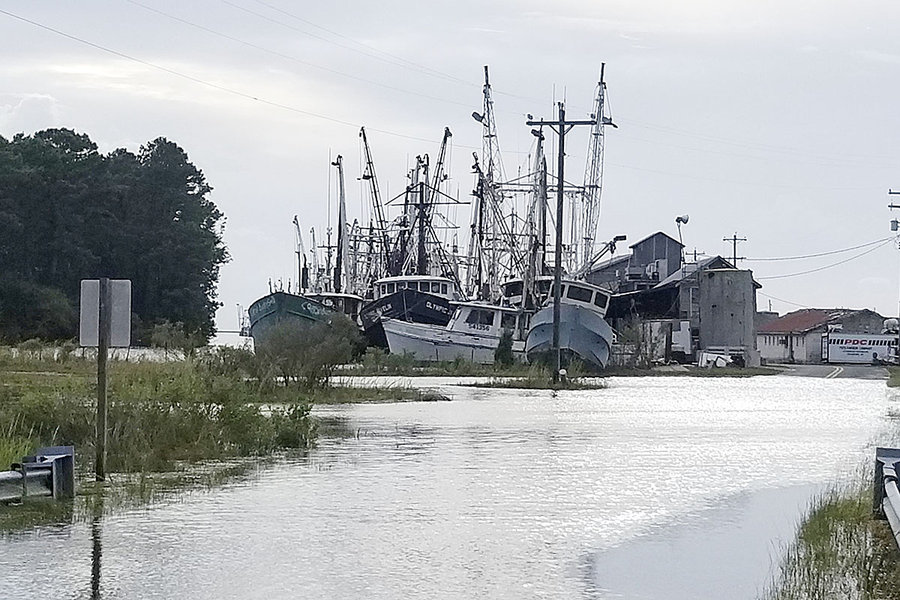
091720nc20boats

Photo: Patrik Jonsson/Christian Science Monitor
At Swan Quarter, North Carolina, shrimp boats cluster on the shore ahead of hurricane Florence in September. The town’s protective dike represents cooperation among practical people, who put aside politics to solve a serious problem.

Even when people believe global warming is only a cyclical blip, they can find common cause with others to solve a problem that affects everyone. Residents of a small town in North Carolina did just that after years of dangerous floods.

From the Christian Science Monitor: “As staff writer Patrik Jonsson began traveling the Carolinas after hurricane Florence, he came across a town that put aside its differences over politics and global warming to find a solution to chronic flooding. …

“Neighbors J.W. Raburn and Henry Williams are political polar opposites. … But the two lifelong friends – along with about 300 or so other North Carolinians who call Swan Quarter home – stood united [in September] against hurricane Florence.

“Nearby Oriental, New Bern, and large parts of central North Carolina were devastated when up to 40 inches of rain fell. … Tens of thousands of residents were displaced, and at least 23 people died.

” ‘There is no doubt that dike has saved us. It gives us a little bit of hope,’ says Raburn. His friend nods.

“The dike, completed in 2010, is a piece of political pragmatism that has gained stature as it held up well against during hurricanes Irene and Matthew, superstorm Sandy. …

“There is also growing evidence that mounting property losses, declines in property values, and threatened historical landmarks are wearing away resistance to preparedness. That common purpose might sometimes be hard to see on the national stage. But locally, people are putting aside politics in favor of practical solutions.

” ‘Working in Swan Quarter, flooding is not an ideological issue there. It is a way of life. Same with sea level rise. People have watched it happen within that lived environment. If you watch forests turn to marshland and the roads flood, the politics fade away,’ says Jason Evans, an environmentalist from Stetson University in DeLand, Fla., who worked on the dike project.

“Raburn and Williams, former bandmates, show the human side of the debate. Raburn believes that finding solutions to manmade climate change is vital. Williams, a farmer and volunteer firefighter, does not believe that humans are altering the temperature of the planet, calling it ‘a phase we are going through.’ But he is the one who cares for and maintains the dike – a job he takes very seriously. …

“In Swan Quarter, local taxes are likely to go up. The county needs to purchase pumps to help clear water that seeps through the dike. Across the sound on Ocracoke Island, county leaders are working on bolstering dunes. …

“At the same time, the dike played a role in the county investing millions in a new courthouse and fire station. The state credit union has felt confident enough in the dike to build a new branch. A critical ferry service runs from the docks to the Ocracoke Island. Inside the local gas station, a line drawn at head level shows the height of Isabel’s surge. Thus far, Florence has left no mark at all.

“The size of the town and the lean budgets mean, ‘the kind of interventions that can be done there and how we think about it is much different than thinking about New York City or Miami,’ says Evans. ‘Hyde County is a hardscrabble place trying to build a dike. Nothing solves anything forever. … But it clearly has helped with certain floods. I wouldn’t want to be in Swan Quarter during a big hurricane event without that dike being there. …

‘Whatever legislators want to do, whatever presidents want to do, it’s in the end not relevant in terms of trying to work through the facts. We have scientific understanding that can apply to all these places,’ says Evans. ‘But I have also seen over and over again – whether in the Florida Keys or in Swan Quarter – that within areas facing substantial problems, all the political stuff that we all get drawn into fades away.’ ”

Speaking of political stuff fading away, I want to do a post sometime on the fact that the divisions among us may make lively and urgent headlines but aren’t always replicated on the ground. Don’t we all interact regularly with people whose politics we know differ from ours? Would love to hear your examples to add to my own.

More at the Christian Science Monitor, here.
Read Full Post »

Love this story by Leigh Vincola at EcoRI News.

“The Harvest Kitchen Project is one of the many arms of Farm Fresh Rhode Island that keeps local food circulating in our communities. The program takes area youth, ages 16-19, who are involved with juvenile corrections, and puts them to work making sauces, pickles and other preserves.

“The teenagers participate in a 20-week job-readiness program that prepares them for employment in the food industry. The program touches not only on kitchen skills but the on the many aspects of work in the culinary industry, from sales and customer service to local farm sourcing to teamwork and cooperation. …

“For the past several years, Harvest Kitchen has operated out of a commercial kitchen space in Pawtucket.”

But when Pawtucket Central Falls Development (PCF) “approached Farm Fresh with its rehabilitation plan for 2 Bayley St., a downtown [Pawtucket] multi-use building that would include affordable housing, retail space and job-training opportunities, the match seemed perfect.” More  at EcoRI, here.

I’ve been buying Harvest Kitchen’s applesauce at the Burnside Farmers Market, and I’m being completely honest when I say it’s the best applesauce I’ve had in years. That’s partly because I love chunks in my applesauce, but also because it’s sweet with no sugar added. If you return the empty jar, you get 25 cents back on the next jar.

Harvest Kitchen offers cranberry and strawberry applesauce, too. Other products include dried apple slices, peach slices in season, whole tomatoes, pickles with veggies, dilly beans and onion relish.

In addition to PCF, organizations that have helped to make this happen include Rhode Island Housing, RI Department of Children Youth and Families (Division of Juvenile Correction), Amgen Foundation, Fresh Sound Foundation, The Rhode Island Foundation and TriMix Foundation.

Find sales locations here.

Photo: FarmFreshRI

Read Full Post »