Feeds:
Posts
Comments

Posts Tagged ‘cost’

Photo: Tracy Nguyen for NPR.
In general, Hollywood cares little for the “circular economy,” but this helicopter at Beachwood Services, originally used in 
Black Hawk Down, has been repurposed in Terminator 4Suicide Squad and The A Team, among other movies and TV shows.

As I was working on a post in which actor Benedict Cumberbatch bemoaned the wastefulness of Hollywood, I ran across a contrary example. Apparently, some folks in that world care about the environment or maybe just see a buck to be made by repurposing sets.

A big part of Hollywood’s problem relates to being in a hurry and taking the easy way out.

First Cumberbatch at the Guardian.

Catherine Shoard writes, “Benedict Cumberbatch has called the Hollywood film industry ‘grossly wasteful,’ taking particular issue with its squandering of resources in the aid of set building, lighting – and bulking up physiques for blockbusters.

“ ‘It’s horrific eating beyond your appetite,’ Cumberbatch told Ruth Rogers on her food-focused podcast, Ruthie’s Table 4, adding that when he was shooting Marvel’s Doctor Strange, he would eat five meals a day. In addition, he would snack on boiled eggs, almonds and cheese, in order to try to ingest enough protein to transform his body.

“ ‘Going back to responsibility and resourcefulness and sustainability, it’s just like, “What am I doing? I could feed a family with the amount I’m eating,” ‘ Cumberbatch said.

“ ‘It’s a grossly wasteful industry,’ he continued. ‘Think about set builds that aren’t recycled, think about transport, think about food, think about housing, but also light and energy. The amount of wattage you need to create daylight and consistent light in a studio environment. It’s a lot of energy.’ “

So there’s that.

On the other hand, according to National Public Radio, “Beachwood Services, owned by Sony Pictures Entertainment, rents out sets and props for reuse that were originally built for its own productions.”

That spark of hope was reported by Chloe Veltman.

“For decades,” she says, “it was standard practice in Hollywood for art departments to build sets for movies and TV shows from scratch, and then break them down at the end of production and haul the pieces off to the landfill.

” ‘The dumpsters just line up at the end of the show,’ said veteran Hollywood art director Karen Steward of many productions she worked on, from the 1988 high school comedy Johnny Be Good, to the 2013 political action thriller Olympus Has Fallen. ‘And there’s no talking about it, because it’s time to get off the soundstage.’

“Steward is part of a group of like-minded Art Directors Guild members who have been pushing for more sustainable practices for years, along with other allies. At first, she said, it was hard at first to get much traction. ‘We’re all about not wasting time, and hurry up, and get it done, and time is money.’

“But Steward said things are becoming easier, as the industry is gradually coming to grips with its impact on human caused climate change. …

” ‘To find a true circular solution, a true zero waste idea, is what we’re working toward,’ she said.

“According to Earth Angel, an agency that helps productions in the U.S. and around the globe reduce their carbon footprints, the average TV show or movie in 2022 created about 240 tons of waste, with an estimated half of that amount coming from the disposal of props and sets.

” ‘There are definitely more innovative, efficient ways of working,’ said Earth Angel founder and CEO Emellie O’Brien. ‘

‘We often just don’t give people the space and the breathing room to uncover those solutions.’

“One such solution is to reuse old sets rather than always building new ones. Beachwood Services, owned by Sony Pictures Entertainment, rents out sets and props for reuse that were originally built for its own productions. Located in Santa Clarita, north of Los Angeles, its warehouses are packed with scenic gems. …

“Art directors sometimes resist the idea of reusing old sets, because they want to realize their own creative vision. But Sondra Garcia, Beachwood’s director of scenic operations, said the service allows them to alter what they rent to suit their needs.

” We tell people, “You’re going to put your own spin on it. You’re going to paint it. You’re going to reconfigure it. And then it is your design,” ‘ said Garcia. ‘The most important thing to remember is to recycle stuff because it’s less wasteful, and producers like it because it saves money.’

“And when those sets get too old to rent out to big-budget productions, they often wind up at places like EcoSet. Productions pay for the Los Angeles-based company to haul away their unwanted sets, props and construction materials. Instead of going to landfills, those treasures are then donated to whoever wants them. …

“But these solutions to Hollywood’s chronic waste problem only go so far.

“Ecoset’s owners don’t know what happens to all of the free stuff the business gives out — whether it’s recycled again or thrown away. Also, many warehouses around the region that used to keep old sets and props in circulation have downsized — Sony’s Beachwood Services formerly had five warehouses and now there are two — or have shuttered in the past couple of years, owing to rising real estate costs. …

” ‘I don’t think anyone in our industry would shy away from really hard challenges or else we wouldn’t be in our industry,’ said Everything Everywhere All at Once producer and sustainability champion Jonathan Wang. ‘But I do think it’s tricky.’

“Wang said despite people’s best intentions, a lot of materials still get thrown out in the rush to meet hectic production deadlines — including on his own sets.

” ‘I think it’s important to just acknowledge that we’re all figuring it out,’ Wang said. ‘We’re trying to do it better.’ “

More at NPR, here, and at the Guardian, here. No firewalls, but both those outlets need our support.

Read Full Post »

Photo: Associated Press.
This image from the National Oceanic and Atmospheric Administration [NOAA], shows a North Atlantic right whale in the waters off New England, May 25, 2024.

Recently a long Inside Climate News essay about NOAA’s efforts to get lobster fishermen to switch to ropeless gear — and save a few whales — appeared in the Boston Globe. The approach is sound but costly for lobster fishermen struggling to make a living.

Kiley Price wrote, “It was a blessedly calm day as Scott Landry’s team set out in their inflatable boat to scan the glistening waters of Great South Channel between Rhode Island and Massachusetts for an endangered whale affectionately known as Wart. They were on a mission to save her life.

“The group, from the nonprofit Center for Coastal Studies located in nearby Provincetown, had spent the better part of three years monitoring Wart after an aerial team spotted the North Atlantic right whale with a large piece of rope lodged in her mouth.

“Instead of coming loose on its own, the fishing rope slowly tangled itself deeper into Wart’s baleens, hindering her ability to eat and reproduce. Finally, Landry’s team decided to take a more hands-on approach — a dangerous but necessary last resort. …

“His team had to rig up a tool that could slice the rope at a distance — essentially a crossbow with an arrow like a throwing star. Eventually, Wart came up for air close enough to Landry’s dinghy for him to get a single clean shot. He took a breath and fired. The whale immediately dove underwater again, leaving the team in suspense. A few minutes later, she popped back up, revealing the knife had cut right through the chunky rope. …

“Wart’s case is a rare bright spot in the pervasive problem of rope entanglements, one of the leading causes of death for whales. …

“The situation is particularly dire for North Atlantic right whales like Wart, with only around 350 left in the wild. Found along the East Coast of North America, the whales’ migratory paths overlap with highly productive lobster fishing areas in Maine and Massachusetts, where scientists say the whales struggle to dodge copious amounts of gear and traps. …

“Scientists and conservationists are scrambling to find a strategy to reduce entanglement risk without threatening the lobster industry, which is facing its own struggles with climate change. In recent years, a seemingly simple approach has taken center stage: getting rid of the rope.

“The traditional lobster traps that sit on the seafloor are connected to the surface by a line of rope attached to a floating buoy. But the National Oceanic and Atmospheric Administration (NOAA) is working with manufacturers and partners to help develop different high-tech traps that they can sink to the seafloor without the rope tethered to the surface — in hopes of giving whales an unobstructed path through fishery waters. Then lobstermen can use a device to call these wireless traps back up to the surface with their catch.

“Officials say this ‘ropeless’ on-demand gear could help people continue to work during seasonal fishing closures. Enacted by the federal government in New England over the past decade, these restrictions limit lobster harvesting at different times of the year during the whales’ migration season. As whale populations struggle to bounce back, more potential closures loom. …

“The problem? Many lobstermen don’t want it.

“Rob Martin’s lobster boat carved through the gray waters off Cape Cod’s Sandwich Marina this May, temporarily transformed into a gear testing laboratory. NOAA scientists and tech experts had squeezed in alongside Martin, a Massachusetts lobsterman, and his crewmate, former lobsterman Marc Palombo.

“Martin brought the boat to a halt once they were far enough out in the bay, and the team dropped on-demand traps into the water, which quickly sank to the seafloor. Several minutes later, Martin activated the gear using a device onboard. … A few yards away, a bright yellow buoy that had been underwater a moment before now bobbed in the water. Martin and Palombo fished the float out of the water, revealing a cage with a string of lobster traps attached to it. …

“This year, fishers from 19 vessels participated in restricted area trials using on-demand equipment borrowed from a NOAA-run ‘gear library’ located in Woods Hole, Massachusetts. Under a special permit, the participants are allowed to keep and sell their catches throughout the winter and spring months. …

“The end goal for these ropeless gear efforts is to give lobstermen an option to get back out on the water during seasonal fishing closures or restrictions. That includes one in place since 2015 across a stretch of Cape Cod Bay every February to April. The federal government is likely to establish new large closures in just a few years to prevent right whales from going extinct. …

“In 2022, the Massachusetts Division of Marine Fisheries published a report to assess the feasibility of ropeless gear throughout the state, produced by the ocean policy consulting company Homarus Strategies. To assess potential economic impacts, Homarus combined the estimated costs of switching to ropeless gear with the potential loss of revenue from the additional time it takes to operate the gear compared to traditional traps — and the findings were stark. If the government mandates a fisheries-wide shift to ropeless gear, the state could lose around $24 million in revenue per year, according to the report.

“There’s a big caveat to that conclusion: The government has no plans to require this type of shift, said Colleen Coogan, branch chief for the Marine Mammal and Sea Turtle Team at NOAA Fisheries Greater Atlantic Region’s Protected Resources Division.

“ ‘We’ll never require fishermen to use ropeless gear, but that means that if they don’t use it, there will be areas that will be closed for fishing,’ she told Inside Climate News. ‘It’s more that the closure is what helps the whales; the ropeless [gear] is what helps the fishermen.’ …

“ ‘Personally, I don’t think there’s anything that they’re going to be able to do to make it viable … to deal with the financial burden,’ said Cape Cod lobsterman Jeff Souza, whose house is the collateral for a loan he took out a few years ago to build a new boat. … ‘I just want to keep being able to fish and not go broke.’ …

“In the fight to pull right whales back from the brink of extinction, there is a bright spot. Last year, NOAA released the annual population estimate for the species using the most up-to-date data, and found that the rate of their decline is slowing down, likely due to the regulations protecting them. Research suggests that ropeless gear could further help. …

“Landry thinks whales can deal with ‘some level of challenge that we throw at them, but, you know, it’s pile upon pile. There’s the changing of the prey, there’s the rope, there’s the boats. You’re asking a lot of a population of 350 animals.’ ”

More at Inside Climate News via the Globe, here.

Read Full Post »

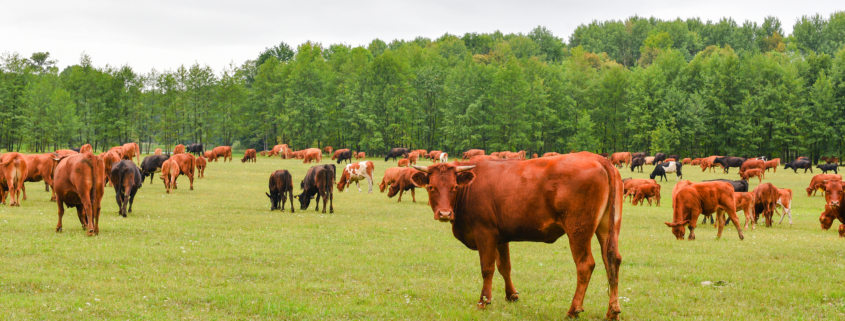
Livestock produces a lot of methane, which is unlikely ever to be balanced out by carbon captured in the soil. The Soil Association Exchange wants you to know about a few positive effects, however. 

It’s an ongoing process to keep up on the latest, especially when it comes to protecting the planet. I myself once thought that massive tree planting had the biggest bang for the charitable buck. Then I learned that, although trees are important, they can’t help much without due consideration given to where and how they are planted, and what varieties of trees they are.

Today I’m trying to bone up on the situation with cows, which we all know (including a young grandson who has cut beef out of his diet) produce too much climate-warming methane gas.

James Tapper reports at the Guardian, “New data shows [cows] may play an important role in renewing farm soil. Research by the Soil Association Exchange shows that farms with a mixture of arable crops and livestock have about a third more carbon stored within their soil than those with only arable crops, thanks to the animals’ manure.

“This also has an effect on biodiversity: mixed arable and livestock farms support about 28 grassland plant species in every field, compared with 25 for arable-only and 22 for dairy-only.

“Joseph Gridley, chief executive of SAE, which was set up by the Soil Association in 2021 to support and measure sustainable farming, said it was unlikely that carbon captured in soil would balance out the enormous amounts of methane created by cattle. Farm livestock around the world creates about 14% of human-induced climate emissions.

“ ‘It’s pretty unequivocal in the data that having livestock on your farm does mean you have more emissions – five or six times more emissions,’ he said. ‘But if you integrate livestock into the system, on every metric on soil health, there’s an improvement, and on a lot of the biodiversity measures as well.’

“Soils are degrading, but by how much exactly is unclear. In 2015, the UN Food and Agriculture Organization claimed that the world had only 60 harvests left, but researchers at Oxford University and Our World In Data said in 2021 that there was a complex picture. …

“Lee Reeves, UK head of agriculture at Lloyds bank, which helps fund SAE … suggested ministers should create a decarbonization strategy, and a standardized carbon calculator, so that farmers and other businesses could use a single tool to calculate their carbon impacts.

“ ‘Moving from traditional to regenerative farming can see a dip in profitability for the first five years, so the government needs to support farmers and banks in that,’ he said.

“[In the UK] the Department for the Environment, Food and Rural Affairs has been investigating so-called methane blockers as a way to reduce emissions. Adding substances such as essential oils, probiotics and even seaweed to cattle feed can reduce the amount of burps and wind they generate.

“Last month the Green Alliance charity said that feeding Bovaer, a methane blocker, to a third of the UK’s dairy cows would cut the country’s emissions by about 1%. Yet this is not happening, the campaign group warned, because farmers were unwilling to pay extra for something they did not benefit from. It said methane blockers should be subsidized, as other green farming schemes were.”

More at the Guardian, here. The Natural Resources Defense Council explains more about regenerative farming here.

Read Full Post »

Photo: Troy Aidan Sambajon/The Christian Science Monitor.
Tyrie Daniel poses in the library at the Charlestown campus of Bunker Hill Community College in Boston, Sept. 10, 2024.

I think most people would agree — maybe even college presidents would agree — that the cost of higher education has gotten out of hand. Two of our grandchildren, being half Swedish, could get educated for free in Sweden, but free higher ed is not an option for most Americans. That’s why Massachusetts is joining the states that have been offering options to students who could use the help.

Troy Aidan Sambajon writes at the Christian Science Monitor, “Cambridge resident Tyrie Daniel was almost at the finish line when he dropped out of Bunker Hill Community College in 2015. He just needed 16 more credits to transfer to a four-year school. But life just came hard. His family was scammed, he says, and their Social Security numbers were stolen.

“ ‘When your stomach keeps growling and you have nothing in your fridge, you can’t even focus on school,’ says Mr. Daniel, who is 33 years old. His family was struggling to pay bills at home and provide for their household of six. … ‘I had to choose between school or food on the table.’

“With five classes to go, he dropped out. He worked as a cleaner, in his family’s spice business, and in real estate. More than thrice, he contemplated returning to school. But he couldn’t reenroll until his overdue fees were paid.

“Now, Mr. Daniel is back at Bunker Hill. This time, he is debt-free and his tuition is covered by MassReconnect. The program, which started in 2023, made community college tuition free for Massachusetts residents over 25 who don’t have a degree. Mr. Daniel says he feels both enormous relief and a new motivation to succeed. …

“Says the cybersecurity major, ‘Now, I’m actually back in school to further my career in something that I really am interested in and passionate about.’

“This fall, Massachusetts is widening the halls of higher education even further. For the first time, all residents with a high school diploma can attend one of its 15 community colleges for free. Since Tennessee first pioneered tuition-free community college for all in 2017, it has spread rapidly in both red and blue states.

“With the launch of MassEducate, the Bay State becomes the 20th to offer tuition-free community college regardless of age, income, or GPA. Another 14 states offer programs targeting specific demographics, such as people over 25, or high-demand majors, such as nursing. …

“Douglas Harris, chair of the economics department at Tulane University and director of the National Center for Research on Education, Access, and Choice [says] promising universal access to community college ‘wipes away that complexity and the risk and uncertainty that goes with it.’

“ ‘Going to college is complicated,’ he says. … ‘When it gets cheaper and simpler, it makes people say yes.’ …

“ ‘This is going to change family trees for generations to come, for the better,’ says Nate Mackinnon, executive director of the Massachusetts Association of Community Colleges. … ‘More families are turning to public higher education and discovering that these institutions offer excellent quality at an affordable price.’

“Why free tuition now? The Bay State needs workers. Massachusetts has 42 available workers for every 100 open jobs, categorizing its workforce shortage as ‘most severe,’ according to the U.S. Chamber of Commerce. Meanwhile, 700,000 residents have some college credits but no degree. …

“In MassReconnect’s first year, 2023-24, some 8,411 students enrolled through MassReconnect. That was a 45% increase in students over 25 from the previous academic year. …

“As of this August, with the launch of MassEducate, total enrollment is up another 20% compared with last year. ‘It’s like the advertising value of free college is giving you a pretty big bang for your buck,’ says David Deming, an economist from the Harvard Kennedy School. … ‘The challenge in the long term is maintaining the quality of education with more students. If local colleges themselves are not getting any extra funding to accommodate the influx, the quality of the service itself might decline.’ …

“For recent high school graduates like Erick Peguero, free tuition means his family can save money while he takes classes in the hopes of transferring to a four-year program. … When he graduated from Brooke High School in June, Mr. Peguero didn’t have plans to go to college this fall. It wasn’t that the resident of the Dorchester neighborhood wasn’t interested, but his family lives in Section 8 low-income housing. When community college became free last month, he jumped at the chance to continue his education.  …

“Some community college leaders say they welcome the challenges that more students in classes bring.

“ ‘I’ve been waiting my entire professional life for this moment,’ says [Pam Eddinger, president of Bunker Hill Community College]. ‘I’ll be damned if I’m going to turn anyone away. Because if I turn somebody away now, where it takes so much for them to come to me, they may not come back.’ ”

More at the Monitor, here.

Read Full Post »

Some initiatives that are costly up front have benefits that far outweigh those costs but don’t show up for years. Even then, people may disagree about what caused the outcomes.

One such initiative sends nurses to new mothers who are young, poor and often friendless to help ensure that their babies get a leg up in life.

At the Washington Post

“A high school senior learns that she’s pregnant — and she’s terrified. But a registered nurse comes to visit her in her home for about an hour each week during pregnancy, and every other week after birth, until the baby turns 2. The nurse advises her what to eat and not to smoke; looks around the house to advise her of any safety concerns; encourages her to read and talk to her baby; and counsels her on nutrition for herself and her baby.

“This kind of support, with trained nurses coaching low-income, first-time mothers, is among the most effective interventions ever studied. Researchers have accumulated decades of evidence from randomized controlled trials — the gold standard in social science research — following participants for up to 15 years. They have consistently found that nurse coaches reduce pregnancy complications, pre-term births, infant deaths, child abuse and injury, violent crimes and substance abuse. What’s more, nurse coaches improve language development, and over the long term, cognitive and educational outcomes.

“Nurse coaching is a vital tool that addresses both the liberal concern about income inequality and the conservative concern about inequality of opportunity. …

“Still, nurse coaching reaches only 2 to 3 percent of eligible families. Which raises the question: if it’s so successful — and people on both sides of the aisle support it — why can’t it be scaled to reach every eligible family?”

There are two stumbling blocks according to the reporters: First, funding must be cobbled together from numerous unpredictable sources; second, the costs are up front, whereas the benefits to government and society appear over time.

“If nurse coaching were fully scaled to reach every eligible family, the costs to state and federal governments would outweigh the savings for the first five years. But then the savings would start to outweigh the costs. Over 10 years, the net savings would be $2.4 billion for state governments and $816 million for the federal government.”

So the question becomes: do we have the patience? More here.

A similar initiative that Suzanne started supporting when she lived in San Francisco focuses on homeless mothers. Read about the great results of the Homeless Prenatal Program here.

Photo: iStock
When nurses coach low-income moms, their babies benefit.

Read Full Post »

In Helsinki, Finland, where young people traditionally leave home at 18 but can no longer afford urban rents, Millennials are applying by the hundreds to live with the elderly.

According to Kae Lani Kennedy at Matador Network, “Retirement homes are serving as more than a community for the elderly. These facilities are providing affordable housing for the city’s growing population of homeless millennials.

“ ‘It’s almost like a dorm, but the people aren’t young. They’re old,’ explains Emil Bostrom, a participant in ‘A Home That Fits,’ a new housing project that allows millennials to move into retirement communities. Bostrom is a 24-year-old kindergarten teacher, and though he has a steady income, it is not enough to compete with 90,000 other renters in a city that has roughly 60,000 affordable rental properties. …

“Bostrom, along with many other young adults, can enjoy discounted rent in exchange for socializing with the seniors in their community. …

“By interacting with a younger generation, the elderly involved with ‘A Home That Fits’ have the opportunity to be engaged in an active and diverse community, instead of being left behind in a forgotten generation.” More here.

And check out a post I wrote about the same phenomenon in Cleveland, here. Both initiatives sound like fun to me.

Video: Seeker Stories

Read Full Post »

There is a constant drumbeat in the news these days about the cost of college. Of course, it’s not really news. Families have struggled to pay for generations, and there have always been students who worked their way through (Suzanne’s dad, for one). And there have always been a few institutions seeking ways to help them.

Lisa Rathke writes in the Boston Globe about today’s “work colleges,” which believe that working your way through has many advantages, especially if all students are in the same boat.

She writes, “After college, many students spend years working off tens of thousands of dollars in school debt. But at seven ‘Work Colleges’ around the country, students are required to work on campus as part of their studies — doing everything from landscaping and growing and cooking food to public relations and feeding farm animals — to pay off at least some of their tuition before they graduate.

“The arrangement not only makes college more affordable for students who otherwise might not be able to go to school, it also gives them real-life experience while teaching them responsibility and how to work together, officials said. …

“With rising college costs and a national student loan debt reaching more than $1 trillion, ‘earning while learning’ is becoming more appealing for some students. But the work-college program differs from the federal work-study program, which is an optional voluntary program that offers funds for part-time jobs for needy students.

“At the seven Work Colleges — Sterling College, Alice Lloyd College in Pippa Passes, Ky., Berea College in Berea, Ky., Blackburn College in Carlinville, Ill., College of the Ozarks in Lookout, Mo., Ecclesia College in Springdale, Ariz., and Warren Wilson College in Asheville, N.C. — work is required and relied upon for the daily operation of the institution, no matter what the student’s background.” Read more.

Photo: Sterling College via Associated Press
At the seven Work Colleges, it’s not optional: Students must hold jobs during their undergraduate careers and pay off some of their tuition before they graduate.

Read Full Post »