Feeds:
Posts
Comments

Posts Tagged ‘crop’

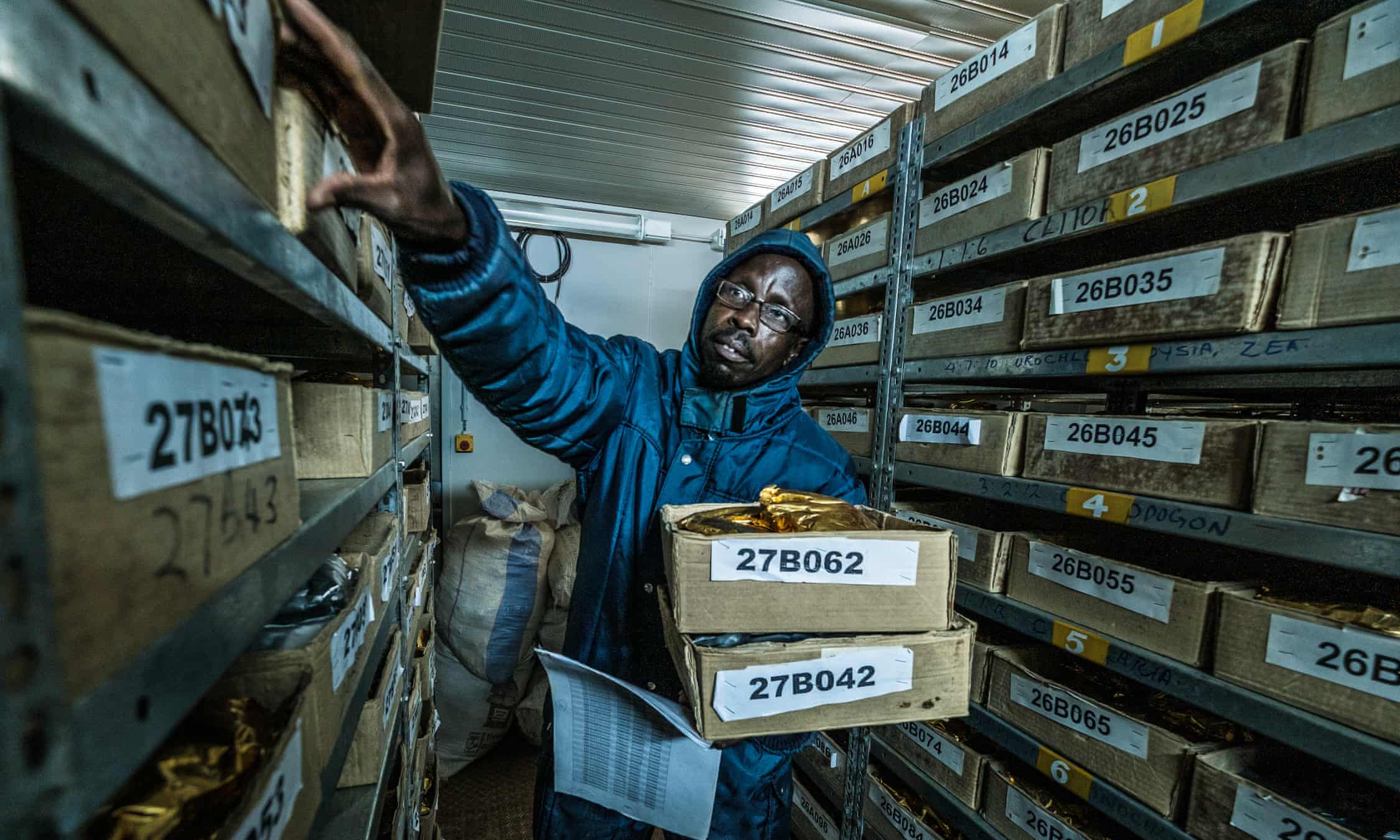
Photo: Brian Otieno/The Guardian.
John Okemer, a seed technician, arranges some of the thousands of seeds stored inside Kenya’s gene bank. 

As our wounded planet hurtles through space, what should we take with us to replicate the better things as needed? Noah took two of each animal, bird, fish. Some of our contemporaries are taking seeds.

Caroline Kimeu writes at the Guardian, “On a winding road in the densely forested Kikuyu highlands of south-central Kenya lies a nondescript government building: the Genetic Resources Research Institute. Opened in 1988, during the country’s ‘green revolution,’ this little-known national gene bank was set up to hold and conserve seeds from the traditional crops that were in danger of disappearing as farmers and agricultural industry moved to higher-yield varieties.

“For decades, it has collaborated with researchers studying crop genetics and others working to develop improved varieties. But as the climate crisis worsens food insecurity, the repository of about 50,000 seed and crop collections could become a lifeline for farmers.

“ ‘We were established as a conservation unit, but these are unusual times with climate change, so we’ve had to diversify our work to respond to needs,’ says Desterio Nyamongo, who runs the institute. ‘Given the erratic weather these days, smallholder farmers need a diverse mix of crops.’

“Through a project with the Crop Trust organization the gene bank is now playing a part in the comeback of indigenous crops that are resistant to drought and pests, but fell from favor and have been neglected for decades.

“It stores backups of its most unique seeds at the Svalbard global seed vault in Norway, where it has been sending collections since 2008. The international repository contains more than a million seed samples from around the world.

“Matthew Heaton, the project manager for Crop Trust’s Seeds for Resilience program, says: ‘National gene banks can be overshadowed by the larger international ones, but they are best positioned to quickly improve local resilience and nutrition because their collections are adapted to local needs and growing conditions.’

“The national gene bank is a small operation, with few staff and limited funding, and its cold rooms, which plant scientists say contain only a third of the country’s plant diversity, are almost full. The Seeds of Resilience project, launched in 2019, has supported national gene banks in Ethiopia, Ghana, Kenya, Nigeria and Zambia with financial and technical support to keep resilient, healthy and nutritious crop collections, and to increase their support for farmers. …

“Farmers from the village of Obucuun in rural Busia county, on the border of Kenya and Uganda, say that before sourcing new sorghum varieties from the gene bank, growing the cereal had become challenging. Attacks by flocks of weaver birds, which can ravage entire cereal fields, increased in frequency after the wild grasses preferred by the birds became more scarce as a result of the climate crisis.

“Ruth Akoropot, a 50-year-old farmer from the area, spends hours each day watching over her crops during peak hours of attack, after studying the birds’ behavior patterns for years.

“ ‘If you don’t do that, your crop will be wiped out,’ says Akoropot, who runs the women’s sorghum farmers association, which sells bales of the grain to Kenya’s national beer brewery. …

“Most of Busia’s population rely on farming for food and to make a living, but … a number remain vulnerable to food insecurityFlooding in April and May [in 2024] swept away farmers’ seeds and yields, exacerbating poor agricultural productivity. Old improved crop varieties sourced from the gene bank, such as Kenya’s red-headed sorghum okoto, which farmers say is less prone to bird attacks, have become community favorites in Busia after decades of disuse. …

“Tobias Okando Recha, an impact researcher for the Seeds of Resilience program, says: ‘These are crops that farmers don’t need to pump a lot of fertilizer on. With just a little fertilizer, the yield is good and they are more [resilient] than hybrid varieties. …

“Plant scientists say that while the divide between farmers and seed conservationists is narrowing, more needs to be done. …

“ ‘The gene banks are not museums, but a resource for the future,’ says Heaton. ‘By linking them with farmers, we can swiftly build local resilience and food security.’ ”

More at the Guardian, here.

Read Full Post »

Sweet potato evangelism has won the World Food Prize. I learned about this at National Public Radio, which has a regular feature on eating and health called the Salt.

Dan Charles reports, “One summer day in 2012, on a long drive through northern Mozambique, I saw groups of men standing beside the road selling buckets filled with sweet potatoes. My translator and I pulled over to take a closer look. Many of the sweet potatoes, as I’d hoped, were orange inside. In fact, the men had cut off the tips of each root to show off that orange color. It was a selling point. …

“In Africa, that’s unusual and new. Traditionally, sweet potatoes grown in Africa have had white flesh. …

“Those orange-fleshed sweet potatoes along the road that day represented the triumph of a public health campaign to promote these varieties — which, unlike their white-fleshed counterparts, are rich in Vitamin A. [In June], that campaign got some high-level recognition at a ceremony at the U.S. State Department. Four of the main people behind it will receive the 2016 World Food Prize. This prize is billed as the foremost international recognition of efforts to promote a sustainable and nutritious food supply.

“This year’s laureates are Maria Andrade, Robert Mwanga, Jan Low and Howarth (Howdy) Bouis. Three of them — Andrade, Mwanga and Low — worked at the International Potato Center, which is based in Peru, but has satellite operations in Africa. Bouis worked at the International Food Policy Research Institute in Washington, D.C. …

“In recent years, researchers have documented health improvements among villagers in Mozambique and Uganda, simply because they chose to eat sweet potatoes with orange flesh.” More at NPR.

Don’t you love the orange truck? I call that multichannel messaging.

Photo: Dan Charles/NPR
Maria Isabel Andrade is one of four researchers honored with the World Food Prize for promoting sweet potatoes that are orange inside to combat malnutrition.

Read Full Post »

Photo: Bob Plain

I do love the inventiveness of entrepreneurs. A friend of Suzanne and Erik’s is an inventive entrepreneur — an oyster entrepreneur, to be specific. Since oysters are a seasonal crop, he looked for something that might become his winter crop.

Bob Plain’s Narragansett Bay Blog has the story on Jules Opton-Himmel, RI’s first kelp farmer.

“Kelp, you may or may not have heard, is the next super food. It’s nutritious, sustainable and ecologically beneficial,” writes Plain.

He continues with a quote from a recent New Yorker article by Dana Goodyear: ” ‘Seaweed, which requires neither fresh water nor fertilizer, is one of the world’s most sustainable and nutritious crops. It absorbs dissolved nitrogen, phosphorous, and carbon dioxide directly from the sea — its footprint is negative — and proliferates at a terrific rate.’ …

“Coincidentally – and quite auspiciously – just as the blockbuster New Yorker article hit the newsstands, Opton-Himmel was gearing up to introduce kelp farming to Rhode Island. …

“Farm-raised kelp is grown on a longline – a submersible thick rope, held in place by anchors and buoys, that is used to hold in place seafood harvesting equipment. A thin string of kelp spores is wrapped around the longline, and the kelp grows toward the bottom. Opton-Himmel, with the help of Scott Lindell and David Bailey from the Marine Biological Laboratory in Woods Hole, Mass, planted 1,000 feet. …

“Unlike oysters, which grow in the warmer months, kelp only grows when it’s cold. That means it could prove an off-season bumper crop for otherwise summertime-only seafood harvesters. Walrus and Carpenter downsizes from 7 to 3 employees in the winter, Opton-Himmel said, and kelp could help him keep the other four on the payroll all year long.

“ ‘I’d love to keep all 6 on year-round,’ Opton-Himmel said.”

More here.

Read Full Post »

A couple years ago I asked someone who organizes gleaners in Vermont to write an article for the place that I work. Gleaning was new to me then, but now I read about it often.

The idea is that volunteers are invited into farms after a harvest to pick the perfectly good remnants that would otherwise be plowed under. The excess produce is then handed over to food banks at peak of freshness.

Kathy Shiels Tully wrote for the Globe today about one gleaning effort.

“Founded in 2004 by Arlington resident Oakes Plimpton, Boston Area Gleaners organizes volunteers, sometimes on only one to two days’ notice.

“Timeliness is important, said Emma Keough, market and food access manager at Brookwood Community Farm.

“ ‘It’s really critical people show up … We’re growing really intensively, so there’s only a small window to pick excess crops in order to give us time to turn over the land and plant a new crop.’ …

“Todd Kaplan of Somerville signed on four years ago after hearing about Boston Area Gleaners ‘through the grapevine.’

“Averaging a dozen gleaning sessions a year, Kaplan, a legal aid attorney at Greater Boston Legal Services, has gleaned mostly on farms west of Boston — Dick’s Market Garden in Lunenburg, where he’s picked kale, tomatoes, and green peppers; Kimball Fruit Farm in Pepperell, which has offered the group first pick of apples; and the Food Project Farm in Lincoln.

“The gleaning nonprofit ‘moves an inordinate amount of food that would otherwise go to waste into the hands of people who really need it,’ Kaplan said.

“Lynn Langton, a North Andover resident, says her immediate reaction to learning about gleaning in a newspaper article three years ago was ‘I want to do that!’ … It’s such a high-quality, fresh product. It’s unbelievable.’ ”

More here.

Photo: John Blanding/Globe Staff
The Boston Area Gleaners program organizes volunteers. to pick excess crops from farms and donate them to food banks for distribution. Matt Crawford is the group’s coordinator.

Read Full Post »

I was pushing the stroller this morning, singing the old Thanksgiving hymns (“Come Ye Thankful People,” “We Gather Together,” “We Plow the Fields and Scatter the Good Seed on the Ground”) and thinking of harvests.

So today might be a good time to blog about harvests and drought-resistant crops.

“Scientists are developing faster-maturing and drought-tolerant varieties of corn and cotton,” writes Madalitso Mwando at AlertNet, “holding out the hope of much-needed relief for thousands of farmers across Zimbabwe.

“As planting season approaches amid concerns about successive poor harvests, research into drought-resistant seeds is gaining momentum …

“Zimbabwean farmers have suffered a succession of poor harvests with yields far below what the country needs, forcing the agriculture ministry repeatedly to revise its projections for harvests.

“Farmers and their unions blame the cyclical uncertainties of their sector not only on a lack of up-to-date farming technology, but also on their inability to obtain seed varieties that can survive the low rainfall caused by climatic shifts.

“The Scientific and Industrial Research and Development Centre (SIRDC), in partnership with the University of Zimbabwe and Biotechnology Research Institute (BRI), has developed a drought-resistant variety of maize (corn) seed called Sirdamaize 113.

“Farmers have had to wait between 150 and 180 days before harvesting their traditional maize crop, but the center says the new seed takes only 136 days to mature.” Read more.

I hope a bountiful harvest was represented at your dinner table today.

With gratitude to blog readers for reading,
Suzanne’s Mom

Photograph: Philimon Bulawayo/Reuters/File
Martha Mafa, a subsistence farmer, stacks her crop of maize (corn) in Chivi, about 378km (235 miles) southeast of the Zimbabwean capital of Harare.


Read Full Post »