Feeds:
Posts
Comments

Posts Tagged ‘customs’

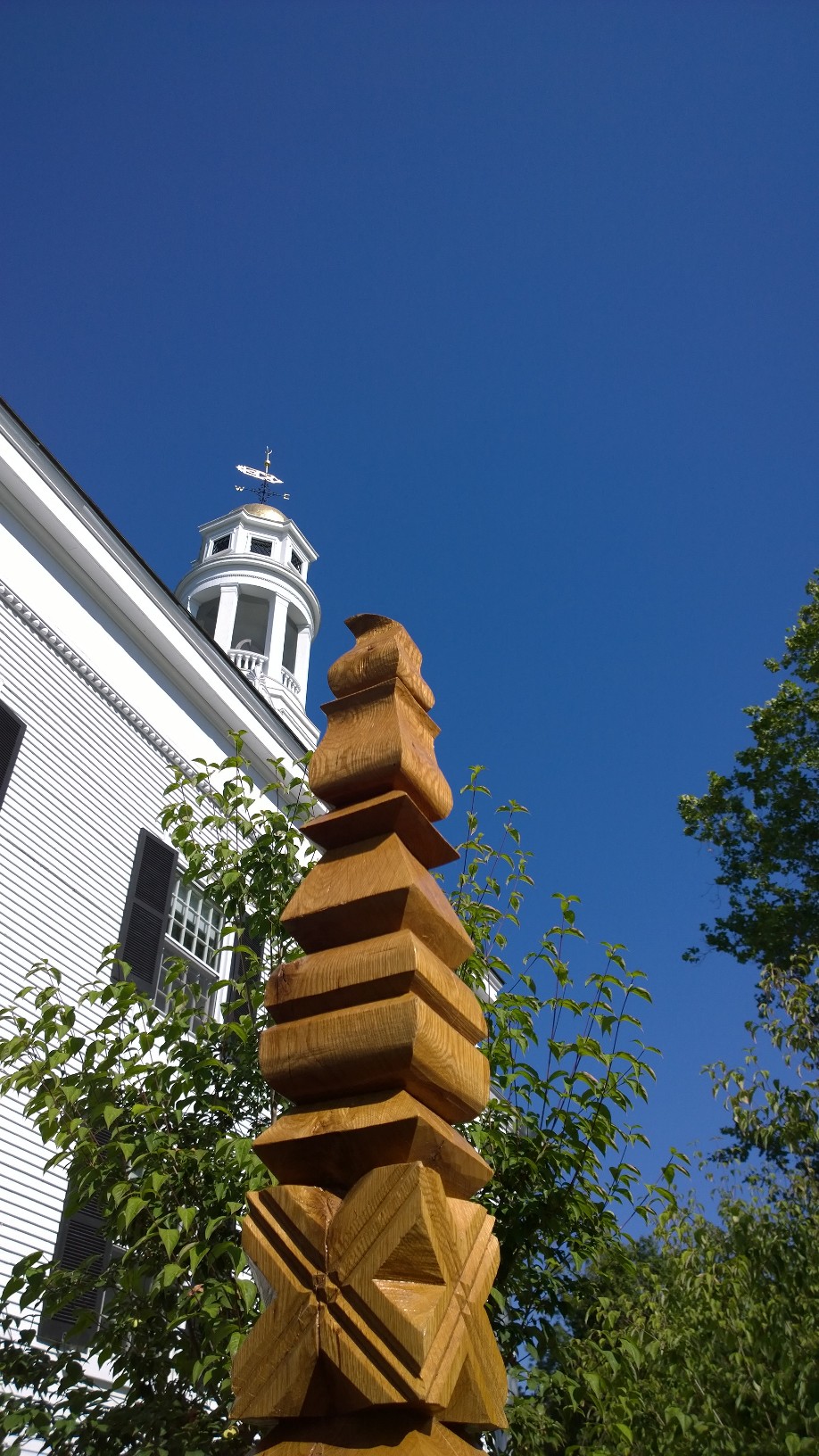
OK, it’s not really a totem pole, but I was afraid the word kopjafa wouldn’t ring any bells with readers.

Today at church we dedicated a wooden pole that was carved by the minister of our sister church in Transylvania when he visited Massachusetts last year.

A translated Wikipedia entry says that, originally, two kopjafa poles were to used to carry a coffin to a cemetery. The poles were then placed at the head and foot of the mound. But according to my minister, nowadays kopjafa poles are set outside churches and, as in our case, sometimes given to a partner church.

The minister read the poem below as he spoke about our church’s connection to Transylvanians of the (almost) same religion. The subject is a little sad for what we do at Suzanne’s Mom’s Blog, but it fits with our previous discussions about the value of preserving language and customs in minority communities. (Hungarian Transylvania was handed over to Romania after World War I, and has had some challenges, starting with language challenges.)

“Leave, if you can …
“Leave, if you think,
“That somewhere, anywhere in the world beyond
“It will be easier to bear your fate.
“Leave …
“Fly like a swallow, to the south,
“Or northward, like a bird of storm,
“And from high above in the wide skies
“Search for the place
“Where you can build a nest,
“Leave, if you can.
“Leave if you hope
“Against hope that homelessness
“Is less bitter abroad than at home.
“Leave, if you think
“That out in the world
“Memory will not carve new crosses from
“Your soul, from that sensitive
“Living tree.”

Read about the poem’s author, Hungarian poet Sandor Remenyik, here.
Transylvania-kopjafa-at-sister-church

Read Full Post »

Erik is in no danger of giving up Sweden. Today he and Suzanne took my grandson to a Santa Lucia celebration in a friend’s house, and Erik helped with the singing and wore a pointy hat that I never knew was part of the deal. (I always thought the Santa Lucia ceremony was just about a girl with candles in her hair.) Swedish customs are living on in Rhode Island.

In Queens, New York, customs from home countries are not only flourishing but being passed to new generations. I liked a story on the topic by Lynnette Chiu at Narratively.

“As soon as the children conclude their routine,” she writes, “the 300-capacity ballroom echoes with the sound of coins hitting the dance floor. The young boys in lederhosen and girls in scarlet dirndl dresses break formation and a scramble ensues to collect the loose change and dollar bills tossed their way by family and friends. The joy is in the gathering rather than the gains; as per tradition, they obediently deposit their loot in the outstretched aprons of the dance group’s older girls.

“While the movements of Die Erste Gottscheer Tanzgruppe—The First Gottscheer Dance Group—are the occasion of the day, it’s the older generation who are doing most of the afternoon’s dancing. …

“Meticulously set tables accommodate pitchers of Hofbrau, wine bottles and cocktail glasses, leaving the family-style platters of chicken cutlet, pork loin and all the trimmings jostling for real estate. …

“What began as a place to preserve and celebrate Gottscheer culture has now become a go-to locale for other communities in [the Ridgewood neighborhood of Queens] to nurture their own traditions. Along with numerous quinceañeras—rite of passage fifteenth birthday parties for Latin American girls—Gottscheer Hall hosts the gatherings of the Ridgewood Nepalese Society, and recently opened its doors to the Ridgewood Market, where artsy vendors hawk vintage wares and DIY baubles.” Read more at Narratively.

Photo: Aaron Adler

Read Full Post »