Feeds:
Posts
Comments

Posts Tagged ‘dancing’

Photo: Colleen Reichmuth, NMFS 23554, via the New York Times.
Ronan, a California sea lion of the Long Marine Laboratory at the University of California, Santa Cruz.

Do you recall reading about the dancing cockatoo Snowball with the head-banger technique? Snowball was a big hit for a while there. I think critter behavior is interesting even when it does not look like human behavior, but it seems that scientists can’t get enough of animals dancing like humans.

Here are two relevant Guardian reports — one on on sea lions and one on rats.

“Ronan the sea lion can still keep a beat after all these years. She can groove to rock and electronica. But the 15-year-old California sea lion’s talent shines most in bobbing to disco hits such as ‘Boogie Wonderland.

“ ‘She just nails that one,’ swaying her head in time to the tempo changes, said Peter Cook, a behavioral neuroscientist at New College of Florida who has spent a decade studying Ronan’s rhythmic abilities.

“Not many animals show a clear ability to identify and move to a beat aside from humans, parrots and some primates. But then there’s Ronan, a bright-eyed sea lion that has scientists rethinking the meaning of music.

“A former rescue sea lion, she burst to fame about a decade ago after scientists reported her musical skills. From age three, she has been a resident at the University of California, Santa Cruz’s Long Marine Laboratory, where researchers including Cook have tested and honed her ability to recognize rhythms. …

“What is particularly notable about Ronan is that she can learn to dance to a beat without learning to sing or talk musically.

“ ‘Scientists once believed that only animals who were vocal learners – like humans and parrots – could learn to find a beat,’ said Hugo Merchant, a researcher at Mexico’s Institute of Neurobiology, who was not involved in the Ronan research.

“But in the years since since Ronan came into the spotlight, questions emerged about whether she still had it. Was her past dancing a fluke? Was Ronan better than people at keeping a beat?

“To answer the challenge, Cook and colleagues devised a new study. … The result: Ronan still has it. She is back and better than ever. This time the researchers focused not on studio music but on percussion beats in a laboratory. They filmed Ronan bobbing her head as the drummer played three different tempos – 112, 120 and 128 beats per minute. Two of those beats Ronan had never been exposed to, allowing scientists to test her flexibility in recognizing new rhythms.

“And the researchers asked 10 college students to do the same, waving their forearm to changing beats. Ronan was the top diva.

“ ‘No human was better than Ronan at all the different ways we test quality of beat-keeping,’ said Cook, adding, ‘she’s much better than when she was a kid.’ “

Meanwhile, at the Guardian, Hannah Devlin writes that rats, too, “instinctively move in time to music. This ability was previously thought to be uniquely human and scientists say the discovery provides insights into the animal mind and the origins of music and dance.

“ ‘Rats displayed innate – that is, without any training or prior exposure to music – beat synchronization,’ said Dr Hirokazu Takahashi of the University of Tokyo.

“ ‘Music exerts a strong appeal to the brain and has profound effects on emotion and cognition,’ he added.

“While there have been previous demonstrations of animals dancing along to music – TikTok has a wealth of examples – the study is one of the first scientific investigations of the phenomenon.

“In the study, published in the journal Science Advances, 10 rats were fitted with wireless, miniature accelerometers to measure the slightest head movements. They were then played one-minute excerpts from Mozart’s Sonata for Two Pianos in D Major, at four different tempos: 75%, 100%, 200% and 400% of the original speed. Twenty human volunteers also participated.

“The scientists thought it possible that rats would prefer faster music as their bodies, including heartbeat, work at a faster pace. By contrast, the time constant of the brain is surprisingly similar across species.

“However, the results showed that both the rat and human participants had optimal beat synchronicity when the music was in the 120-140 beats per minute (bpm) range – close to the Mozart composition’s original 132bpm – suggesting we share a ‘sweet spot’ for hitting the beat. The team also found that rats and humans jerked their heads to the beat in a similar rhythm, and that the level of head jerking decreased the more that the music was sped up. …

“The team now plans to investigate how other musical properties such as melody and harmony relate to the dynamics of the brain.

“ ‘Also, as an engineer, I am interested in the use of music for a happy life,’ said Takahashi.”

Gotta love scientists! More on rats. More on Ronan.

Read Full Post »

lead_720_405

Photo: Irena Schulz
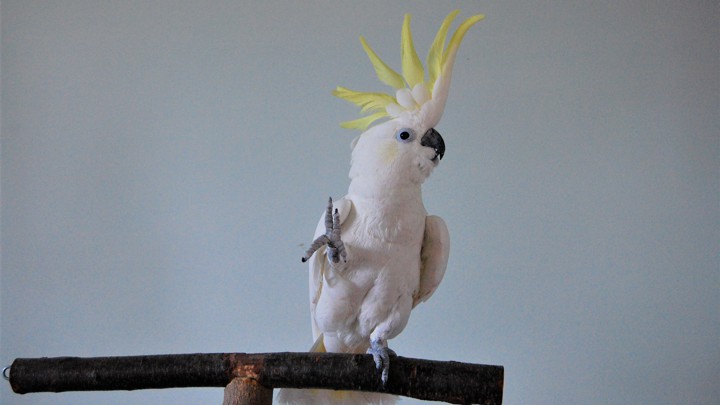
This is YouTube personality Snowball the dancing parrot.

Internet videos of cute animals doing surprising things can sometimes lead to research that expands scientific knowledge. Such was the case with Snowball, better known on YouTube as the dancing parrot.

Ed Yong writes at the Atlantic, “Before he became an internet sensation, before he made scientists reconsider the nature of dancing, before the children’s book and the Taco Bell commercial, Snowball was just a young parrot, looking for a home.

“His owner had realized that he couldn’t care for the sulfur-crested cockatoo any longer. So in August 2007, he dropped Snowball off at the Bird Lovers Only rescue center in Dyer, Indiana — along with a Backstreet Boys CD, and a tip that the bird loved to dance. Sure enough, when the center’s director, Irena Schulz, played ‘Everybody,’ Snowball ‘immediately broke out into his headbanging, bad-boy dance,’ she recalls. She took a grainy video, uploaded it to YouTube, and sent a link to some bird-enthusiast friends. Within a month, Snowball became a celebrity. When a Tonight Show producer called to arrange an interview, Schulz thought it was a prank.

“Among the video’s 6.2 million viewers was Aniruddh Patel, and he was was blown away. Patel, a neuroscientist, had recently published a paper asking why dancing [was rare in animals.] …

“Patel reasoned that dancing requires strong connections between brain regions involved in hearing and movement, and that such mental hardware would only exist in vocal learners — animals that can imitate the sounds they hear. …

“In 2008, he tested Snowball’s ability to keep time with versions of ‘Everybody’ that had been slowed down or sped up. In almost every case, the parrot successfully banged his head and lifted his feet in time. Much like human children, he often went off beat, but his performance was consistent enough to satisfy Patel. …

“Meanwhile, Snowball was going through his own dance dance revolution. Schulz kept exposing him to new music, and learned that he likes Pink, Lady Gaga, Queen, and Bruno Mars. He favored songs with a strong 4/4 beat, but could also cope with the unorthodox 5/4 time signature of Dave Brubeck’s ‘Take Five.’ …

“In 2008, Patel’s undergraduate student R. Joanne Jao Keehn filmed these moves, while Snowball danced to ‘Another One Bites the Dust’ and ‘Girls Just Want to Have Fun.’ And recently [she] she combed through the muted footage and cataloged 14 individual moves (plus two combinations). Snowball strikes poses. He body rolls, and swings his head through half circles, and headbangs with a raised foot. …

“His initial headbangs and foot-lifts are movements that parrots naturally make while walking or courting. But his newer set aren’t based on any standard, innate behaviors. He came up with them himself, and he uses them for different kinds of music. …

“Snowball’s abilities are all the more impressive because they’re so rare. Ronan the sea lion, for example, was recently filmed bobbing her head to music (including, again, the Backstreet Boys), but she was trained. And when [another researcher, Adena Schachner,] combed through thousands of YouTube videos in search of animals that could be charitably described as dancing, she found only 15 species that fit the bill. One was the Asian elephant, which sometimes sways and swings its trunk to music. The other 14 species were parrots.”

Are any of you owners of parrots? I wonder if you have seen dancing behaviors. Read more here. And be sure to note the videos of early and late Snowball moves.

Read Full Post »

Photo: The Daily Mail
At the Ursul festival, Romany gypsies wear bear skins to ward off evil spirits from the year gone by. This scene in Comanesti, north of Bucharest, is replicated across Romania.

Today I saw a photo in the Boston Globe about an unusual custom in Romania. Inspired to do a Google search, I found a surprising amount of information.

Jay Akbar writes for Mailonline, “In a bizarre ritual every December between Christmas and New Year, Roma gypsies living in Comăneşti, 300km north of Bucharest … put on real bear skins and parade through the streets.

“The festival called Ursul — which is replicated across the country — originated from an ancient Indo-European tribe known as the Geto-Dacians, who believed bears were sacred.

“They and other tribes who lived in what is now Romania and Moldova — then known as Dacia — thought bears were the spirit of the forest and ‘the supreme master of cosmic energy’.

“According to Romanian mythology, the bear possesses the power to protect and heal.

“Villagers would long ago cover a newborn baby with bear fat, to give him strength and luck. And today they believe bear skins protect them from the spirits they are chasing out of the village.”

Read more at The Daily Mail, where you will find lots of terrific pictures.

The Ursul experiences of photographer Diana Zeyneb Alhindawi are at CNN. She recounts how her grandmother used to see Gypsies descending “into towns from the forests in which they lived, bringing with them real bears.”

Up until the 1930s, she says, “Townsfolk would pay the Gypsies in exchange for letting the bear cubs walk up and down their backs — seen as a cure for backache.”

No more live bears today — just people in bearskins.

(Even so, I wonder if I should ask a physical therapist about getting a bear cub treatment.)

Read Full Post »


Photo: Bryn Mawr College

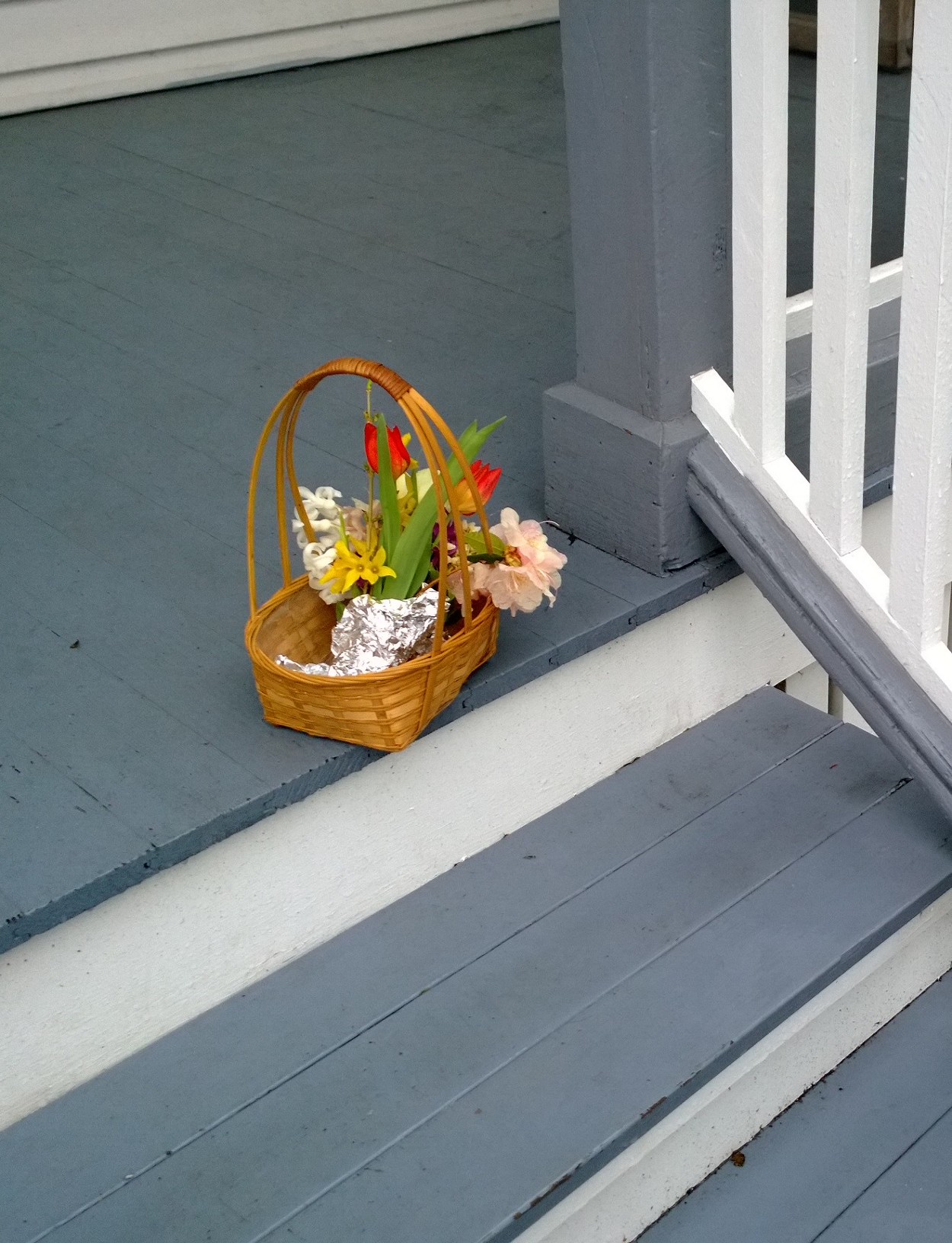
Happy May Day, the old-fashioned kind that involves surprise flowers and dancing around the May Pole.

This year’s came in like a lion, with icy rain, and is going out like a lamb. Spring can’t be stopped now.

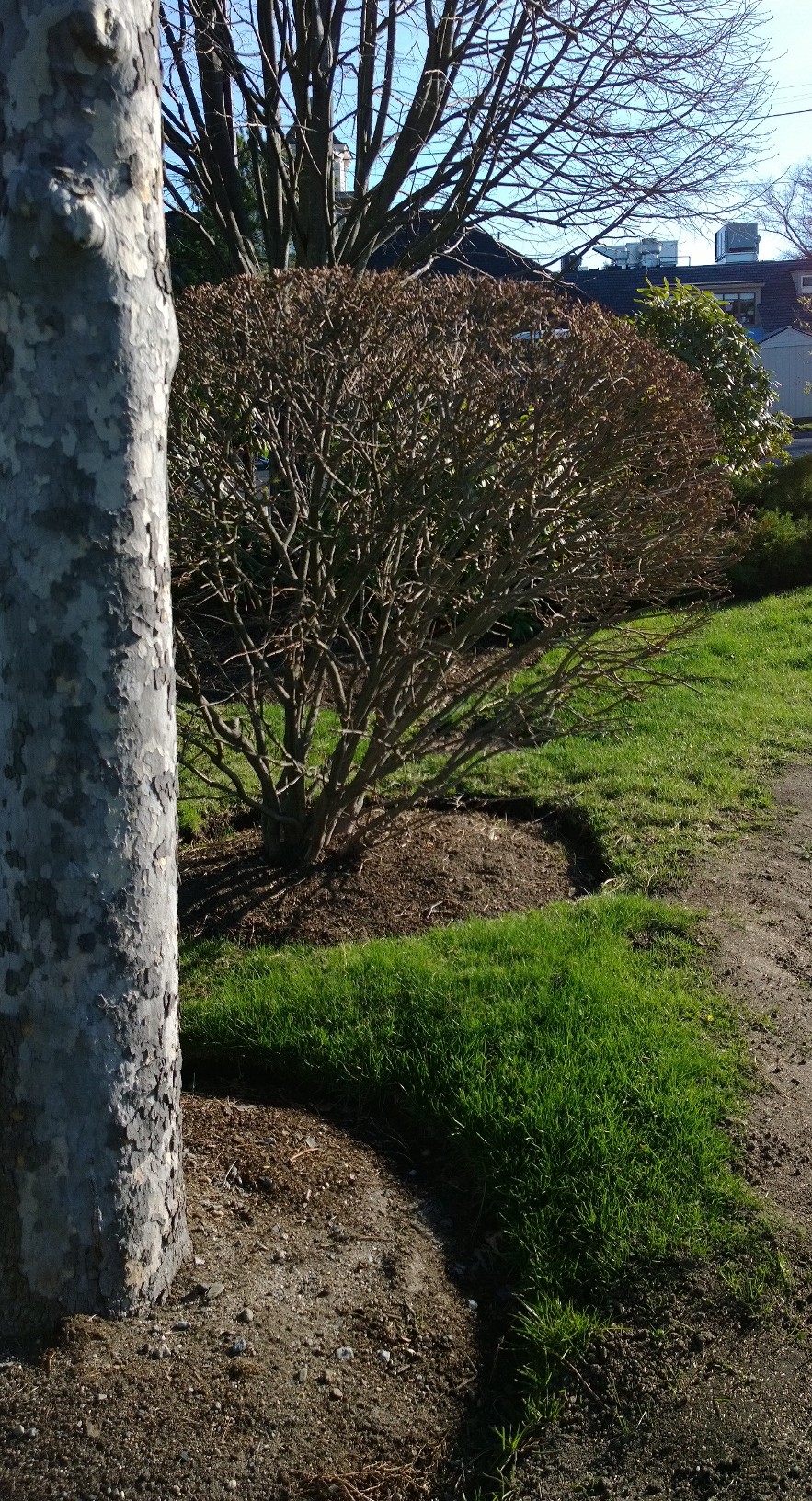
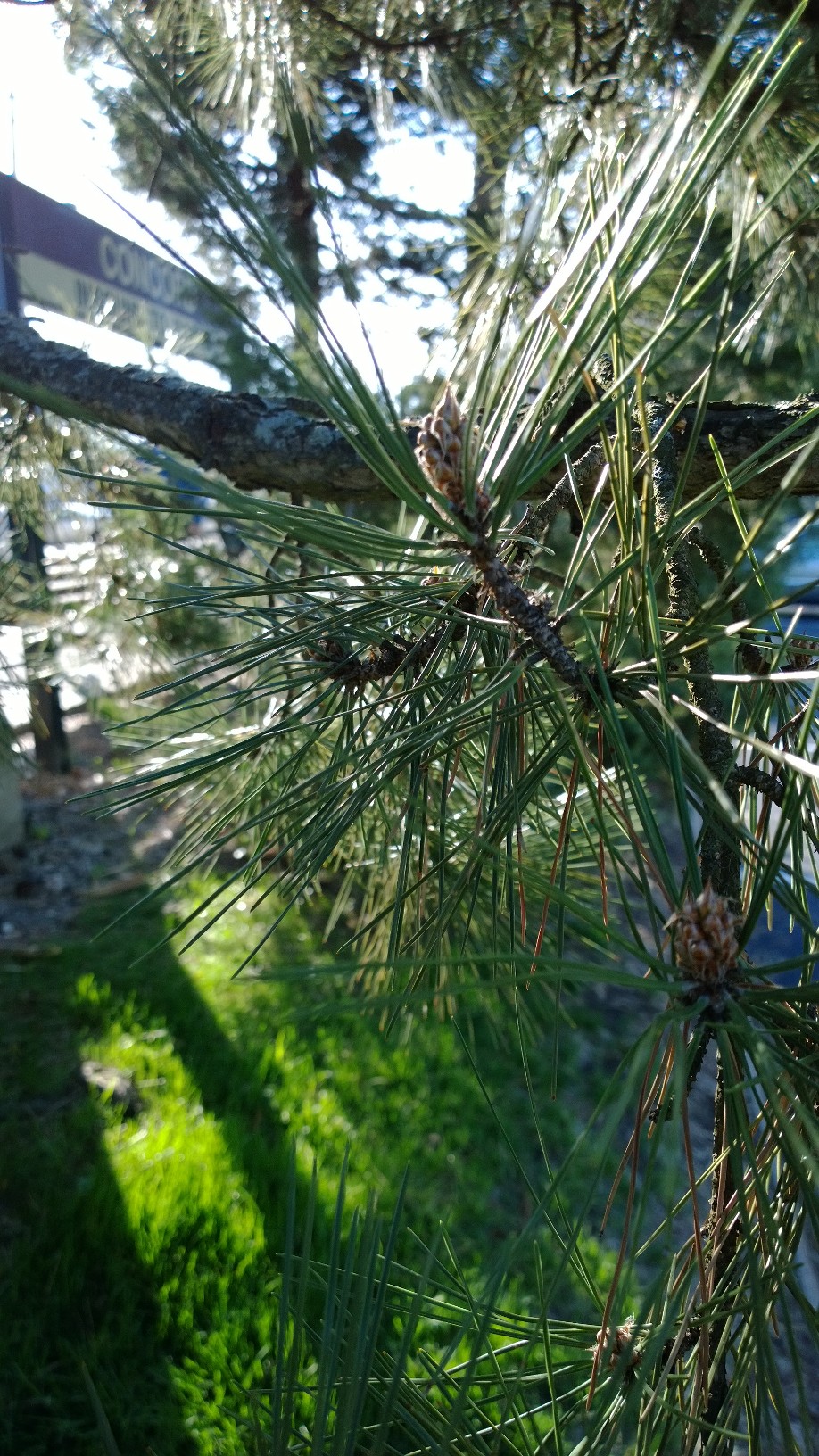
Here are a few photos of the season.

Congress-St-flower-boxes

mottled-tree-by-train-stop


pine-branches

May-Day-basket


Read Full Post »

I read an article by Rebecca Milzoff in the NY Times recently that got me seeing people on the street in a new way.

Milzoff was interviewing a New York City choreographer about his latest work, and something he said stuck with me.

“ ‘I was assured when I came to live in this space on Broadway between Prince and Spring that SoHo would never come this far,’ David Gordon said, looking out the wall-to-wall windows in his second-floor loft. ‘Instead I now live in the Mall of America.’

“ ‘When I set foot out the door, there are so many people going in different directions,’ he said. ‘The choreography of the street is mind boggling.’ ”

Those words came back to me a couple days later as I waited for the morning train. There’s a point when bells start ringing because the gate is going down, and commuters stream across the parking lot with their briefcases and coffee mugs. On this particular day, they looked to me like dancers in a choreography of the everyday. The flow, the spacing between people suggested dance. The commuters had a special aura, partly because they had no consciousness of being in a dance performance.

I hope to be alert to other such happenings in the future.

It sure jazzes up the commute.

Photograph: Julieta Cervantes for The New York Times

Read Full Post »

Had an awesome playdate with my grandson and his parents today.

John and I pushed the stroller to a playground that has lots of climbing things and outgrown toys that families donate. On the way, we passed a neighbor’s yard. Smoke was curling up behind the fence. The three-year-old twins were roasting green coffee beans in an old popcorn maker, their dad watching. The children are apparently quite skillful aficionados and know the difference between “first crack” and “second crack,” a coffee-roasting concept that was news to me. They gave a jar of roasted beans to John to take home, with instructions to let the beans breathe overnight.

At the playground, there were many dads with toddlers. Only two moms. It seems to be a Saturday-morning phenomenon — proof that Suzanne’s high school friend Mike was onto something when he founded Playground Dad.

We also had fun playing in the pup tent that had temporarily taken over John’s dining room. And we danced. My grandson will dance at the drop of a hat. You don’t need to play music — singing a cappella or rattling a jar of freshly roasted coffee beans to a good beat will get him going. His dad took break dancing as a kid. Also tap. And his mom is a super dancer. So there you go.

Read Full Post »