Feeds:
Posts
Comments

Posts Tagged ‘design’

Photograph: Devesh Uba
Grocery store in Makoko, Lagos, Nigeria.

A recent manmade-island story in the Guardian made me think of Francesca Forrest’s lovely novel Pen Pal, which involves a girl in a floating community in the U.S. South who corresponds with a political prisoner in Asia.

The Guardian article, however, is about designers and architects building islands for populations threatened by rising seas.

Jessa Gamble writes, “It may seem like science fiction, but as rising sea levels threaten low-lying nations around the world, neighbourhoods like [the Yan Ma Tei breakwater in Hong Kong’s Causeway Bay, where residents live in boats] may become more common.

“Whereas some coastal cities will double down on sea defences, others are beginning to explore a solution that welcomes approaching tides. What if our cities themselves were to take to the seas? …

“The immediate and most numerous victims of climate change are sure to be in the developing world. In Lagos, the sprawling slum of Makoko regularly suffers floods, and its stilted houses are shored up with each new inundation. It’s under threat of razing by authorities.

“The Nigerian-born architect Kunlé Adeyemi proposes a series of A-frame floating houses to replace the existing slum. As proof of concept, his team constructed a floating school for the community. Still, many buildings do not make a city: infrastructure remains a problem here. One solution would be to use docking stations with centralised services, rather like hooking up a caravan to power, water and drainage lines at a campground.” More.

It all sounds like Noah building an ark. But I can’t help thinking it would be better to end global warming in the first place.

Photograph: Seasteading Institute, by way of the Guardian
The Seasteading Institute proposes a series of floating villages.

Read Full Post »

No reason a recycling facility can’t have an attractive design, right? As long as it isn’t expensive.

Michael Kimmelman wrote for the NY Times last month about a municipal facility that must make the recycling staff there feel good about going to work.

“Recycling in New York is a scrappy business,” Kimmelman writes. “Billions have gone toward building water tunnels, power plants, subways and sewage treatment facilities, but little toward an infrastructure of recycling. …

“But a Sims Municipal Recycling Facility will open shortly at the South Brooklyn Marine Terminal in Sunset Park. The city’s first big, state-of-the-art plant for processing discarded plastic, metals and glass, it promises jobs to nearby residents and, as the cost of exporting garbage out of state rises, some savings for the city. …

“The facility is understated, well proportioned and well planned — elegant, actually, and not just for a garbage site. It is an ensemble of modernist boxes squeezing art, and even a little drama, from a relatively meager design budget. …

“Instead of letting engineers design the plant, as often happens at an industrial site, Sims hired Selldorf Architects, a glamorous New York firm known for doing Chelsea art galleries and cultural institutions. …

“The idea? Partly to game the public review process, but also to build a well-designed plant — welcoming to the public, beckoning from the waterfront.” More here.

Photo: Fred R. Conrad/The New York Times
A look inside the new Sims Municipal Recycling Facility in Brooklyn.

Read Full Post »

People interested in imaginative uses of space to make cities more livable should get over to the Boston Society of Architects on Congress St. before September 29, when an intriguing exhibit closes.

Eight of us visited at lunch today, and the BSA’s marketing director went around the Reprogramming the City exhibit with us pointing out highlights and answering questions.

We saw photos of a lamppost that doubles as an umbrella, a staircase in Hong Kong (below) made into a public lounge, bus stops in Sweden using sun lamps at night, a “low line” community space under a highway (like New York’s high-line concept but under not over), a repurposed parking machine that spits out “tickets” describing how a nearby problem area has been fixed by the city of Boston, street mosaics in Portugal that have a QR code for accessing tourist information, and a Dutch solution to recycling teddy bears and other usable goods curbside for passerby to pick up. The list goes on.

I tried to round up more people to join the excursion, but business meetings at lunch seem to come first. It always surprises me that folks don’t take advantage of cultural activities at lunch: we are surrounded by really nice ones. At least the farmers market is popular. People always have time for that.

More on Reprogramming the City at the BSA website, where you can take an audio tour.

Update 9/18/13 — See some great pictures from the exhibit at the Boston Globe, here.

Photo: Scott Burnham
The Cascade by Edge Design Institute, 2007, Central Hong Kong.
Right, Urban Air by Stephen Glassman, 2010.

Read Full Post »

I’m so glad Kai put this on Facebook. He linked to photos of beautiful places. But at Bored Panda you can also find a bird that looks like Salvador Dali, a dad who illustrates his kids’ lunch bags every day with cute cartoons. and a do-it-yourself Porsche made of plastic pipes and aluminum foil. Or you can watch a video of an astronaut crying in weightless space.

I thought, “What the heck?”

Here’s a bit of explanation from the About page.

Boredpanda.com is a highly visual art and design magazine dedicated to showcasing the world’s most creative artworks, offbeat products and everything that’s really weird or wonderful. …

“We got popular among pandas in a very short time, and now we have an average readership of 1 million unique visitors per month generating ~2 million of page impressions. Most of them come from USA, UK and CANADA .

“So, if you have a story, a product or some weird artworks that are cool enough for pandas – it is a perfect opportunity for you to get noticed. Click here and share it with everyone else!” More.

I myself am going to read up on Thomas Lamadieu. “Every time he looks up, Thomas sees a potential canvas where the building rooftops frame the sky. He photographs it and uses the odd sky shapes to create whimsical line drawings.”

Here are two of those beautiful places I mentioned.

Photo: Allard Schager
Tulip fields, the Netherlands

Photo: Oleg Gordienko
Tunnel of Love, Ukraine

Read Full Post »

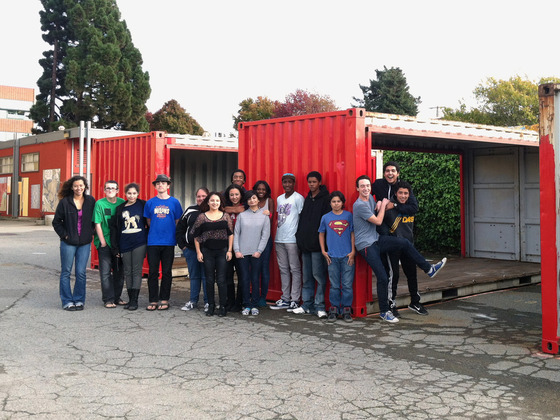
I’m not sure where I first read about Studio H, but I think you will be interested in this high school that engages students in hands-on construction from design to delivery.

The website explains: “Studio H is a public high school design/build curriculum that sparks community development through real-world, built projects. Originally launched in rural Bertie County, North Carolina, Studio H is now based at REALM Charter School in Berkeley, CA.

“By learning through a design sensibility, applied core subjects, and industry-relevant construction skills, students develop the creative capital, critical thinking, and citizenship necessary for their own success and for the future of their communities.

“Over the course of one semester, students earn high school credit and have the opportunity to design, prototype, and build a full-scale community project. Our students have designed and built some crazy chicken coops for families in need, and a 2,000-square-foot farmers market pavilion.”

More here.

Photographs: http://www.studio-h.org

Read Full Post »

For years, I’ve been a fan of Bikes Not Bombs, a local bike repair and training outfit that got its start providing donated bikes to poor people in Central America.

Now I find out that an architecture charity also likes Bikes Not Bombs — enough to donate time to renovate the shop.

The Christian Science Monitor and Cathryn J. Prince have the story.

“Inside the sleek steel and cement workshop of Bikes Not Bombs in Boston’s Jamaica Plain neighborhood, at-risk youths recondition bicycles before sending them on for use in developing countries.

“Halfway across the country at the University of Minnesota Amplatz Children’s Hospital, a ‘showcase suite’ shows how a child’s hospital room can be made less intimidating and more comfortable.

“The ‘1 percent’ built the bike-repair workshop. The ‘1 percent’ also built the hospital room.”

The 1% program of Public Architecture, based in San Francisco, “connects nonprofit groups in need of design assistance with architecture or design firms. The name for the group comes from the idea that if firms across the country donate just 1 percent of their time each year to charitable work it would equal 5 million hours. …

” ‘In a moment of ambitious insanity, I decided to start a nonprofit,’ says John Peterson, the founder and president of The 1%. …

“Most architecture and design firms, he found, were unfamiliar with the idea of doing pro bono work. Initially, holding design competitions was the only way to get firms to participate.

“ ‘But competition [projects] rarely get built,’ says Amy Ress, project manager for The 1% program. ‘We wanted to do projects that would get built.’

“Mr. Peterson launched The 1% in 2001. More than 10 years later, more than 1,000 architecture and design firms (between 3 percent and 5 percent of all American architectural firms) and 600 nonprofit organizations are participating. About 18 new firms join each month, he says.

“One of the earliest design ideas was The Station, which would serve as a gathering point for day laborers. Day laborers normally must hang out at spaces meant for other uses, such as gas stations and parking lots. Today a handful of official Day Labor centers exist across the country.”

More.

Photograph of John Peterson: The 1% program of Public Architecture

Read Full Post »

The 2012 Curry Stone Design Prize winners have been announced. The awards, given to “social design pioneers,” will be presented at the Harvard Graduate School of Design on November 15.

How cool are these winners?

According to the Curry Stone website, New York City’s “Center for Urban Pedagogy (CUP) collaborates with teachers and students, policy experts and community advocates, and artists and designers to visually communicate complex urban-planning processes and policy-making decisions.”

Liter of Light, Manila, Philippines, uses water in bottles to create solar lamps for people living in dark tenements.

“Model of Architecture Serving Society — aka MASS Design — is a Boston-based architecture firm that has created a niche practice in designing healthcare facilities in resource-limited settings, primarily in countries emerging from crisis.”

The Riwaq Center for Architectural Conservation in Ramallah “has spent more than two decades documenting Palestinian heritage and culture through restoration of the built environment.”

“Jeanne van Heeswijk is an artist who facilitates the creation of lively and diversified public spaces, typically from abandoned or derelict sites.”

More here. Be sure to check the pictures here.

Photograph: Jeminah Ferrer
The Liter of Light project uses water  in bottles to create solar lamps for the poor.

Read Full Post »

I’ve been thinking of Lucille Corcos the last couple weeks. I have no idea why, but I hope eventually to reconstruct the train of thought that led to her. She was an artist I knew when I was a child. I rediscovered her art in the 1990s in a Minnesota museum. That was when I realized I love it.

Since Corcos wasn’t in Wikipedia, in spite of having works in museums, I taught myself how to write a Wikipedia contribution and am just waiting for the Wiki experts to let me post it.

As Cipe Pineles Golden and Martha Scotford write in Cipe Pineles: A Life in Design (New York: W.W. Norton & Co., 1999), Corcos and her artist husband, Edgar Levy, moved from New York City to the artsy South Mountain Road in Rockland County, New York, in 1941.

“Corcos was a successful painter and illustrator by this time. In the 1930s, fashion, culture and home magazines published her work and her popularity continued into the 1960s. Cipe Pineles’s close friendship with Corcos had begun when Pineles commissioned Corcos’s work for Seventeen and Charm. Her humor in personal interactions and in her art made her an engaging collaborator. Corcos’s paintings were densely packed with many small stories and commentary. The compositions had detailed multiple subjects; perspective and scale were distorted for practical and expressive purposes. This new modern primitivism was considered part of a native tradition in American art and its ‘unacademic’ nature was celebrated. Corcos’s subjects included rural landscapes and urban scenes, ranging from Christmas Eve, Rockfeller Center to The Oyster Party  to Everybody Meets the Boat. In addition  to doing commissioned illustration, Lucille Corcos built her career as a fine artist and was a steady participant in New York gallery shows from 1936 to 1954. During the same time, she was a part of major exhibitions in Chicago, Pittsburgh, Philadelphia, Washington, D.C., and other institutions in New York.”

I found a few other tidbits about her by Googling around. For example,  I found an article in the July 12, 1954, issue of Life magazine that shows two Corcos paintings, one of her life in winter in Rockland County, another of activities around her Fire Island house in summer. And here is a 1950 painting of her Fire Island house. I remember the house well.

Levy was often spoken of as the great artist in the family, with his numerous Picasso-esque paintings of his wife as mostly feet and eyes, but my mother pointed out that Corcos herself had an art career. Levy is not in Wikipedia either, but I leave it to an admirer of his art to fix that lapse.


Read Full Post »

« Newer Posts