Feeds:
Posts
Comments

Posts Tagged ‘dickens’

Photo: Alex Majoli/Magnum.
“Since at least the time of Greek philosophers, many writers have discovered a deep, intuitive connection between walking, thinking, and writing,” says Ferris Jabr at the New Yorker.

Charles Dickens kept few notes about where his plots were headed. From what I’ve read about him, he kept it all in his head, forming and saving his ideas on long walks wherever he was at the time.

In today’s article, we learn a bit about the science of that.

Ferris Jabr writes, “In Vogues 1969 Christmas issue, Vladimir Nabokov offered some advice for teaching James Joyce’s Ulysses: ‘Instead of perpetuating the pretentious nonsense of Homeric, chromatic, and visceral chapter headings, instructors should prepare maps of Dublin with Bloom’s and Stephen’s intertwining itineraries clearly traced.’ He drew a charming one himself. Several decades later, a Boston College English professor named Joseph Nugent and his colleagues put together an annotated Google map that shadows Stephen Dedalus and Leopold Bloom step by step. The Virginia Woolf Society of Great Britain, as well as students at the Georgia Institute of Technology, have similarly reconstructed the paths of the London amblers in Mrs. Dalloway.

“Such maps clarify how much these novels depend on a curious link between mind and feet. Joyce and Woolf were writers who transformed the quicksilver of consciousness into paper and ink. To accomplish this, they sent characters on walks about town. As Mrs. Dalloway walks, she does not merely perceive the city around her. Rather, she dips in and out of her past, remolding London into a highly textured mental landscape, ‘making it up, building it round one, tumbling it, creating it every moment afresh.’

“Since at least the time of peripatetic Greek philosophers, many other writers have discovered a deep, intuitive connection between walking, thinking, and writing. … ‘How vain it is to sit down to write when you have not stood up to live!’ Henry David Thoreau penned in his journal. ‘Methinks that the moment my legs begin to move, my thoughts begin to flow.’ Thomas DeQuincey has calculated that William Wordsworth — whose poetry is filled with tramps up mountains, through forests, and along public roads — walked as many as a hundred and eighty thousand miles in his lifetime, which comes to an average of six and a half miles a day starting from age five.

“What is it about walking, in particular, that makes it so amenable to thinking and writing? The answer begins with changes to our chemistry. When we go for a walk, the heart pumps faster, circulating more blood and oxygen not just to the muscles but to all the organs — including the brain. Many experiments have shown that after or during exercise, even very mild exertion, people perform better on tests of memory and attention. Walking on a regular basis also promotes new connections between brain cells, staves off the usual withering of brain tissue that comes with age, increases the volume of the hippocampus (a brain region crucial for memory), and elevates levels of molecules that both stimulate the growth of new neurons and transmit messages between them.

“The way we move our bodies further changes the nature of our thoughts, and vice versa. … When we stroll, the pace of our feet naturally vacillates with our moods and the cadence of our inner speech; at the same time, we can actively change the pace of our thoughts by deliberately walking more briskly or by slowing down.

Because we don’t have to devote much conscious effort to the act of walking, our attention is free to wander. …

“This is precisely the kind of mental state that studies have linked to innovative ideas and strokes of insight. Earlier this year, Marily Oppezzo and Daniel Schwartz of Stanford published what is likely the first set of studies that directly measure the way walking changes creativity in the moment. They got the idea for the studies while on a walk. …

“In a series of four experiments, Oppezzo and Schwartz asked a hundred and seventy-six college students to complete different tests of creative thinking while either sitting, walking on a treadmill, or sauntering through Stanford’s campus. In one test, for example, volunteers had to come up with atypical uses for everyday objects, such as a button or a tire. On average, the students thought of between four and six more novel uses for the objects while they were walking than when they were seated. …

“Where we walk matters as well. In a study led by Marc Berman of the University of South Carolina, students who ambled through an arboretum improved their performance on a memory test more than students who walked along city streets. A small but growing collection of studies suggests that spending time in green spaces — gardens, parks, forests — can rejuvenate the mental resources that man-made environments deplete. Psychologists have learned that attention is a limited resource that continually drains throughout the day. A crowded intersection — rife with pedestrians, cars, and billboards — bats our attention around. In contrast, walking past a pond in a park allows our mind to drift casually from one sensory experience to another, from wrinkling water to rustling reeds.”

More at the New Yorker, here.
Read Full Post »

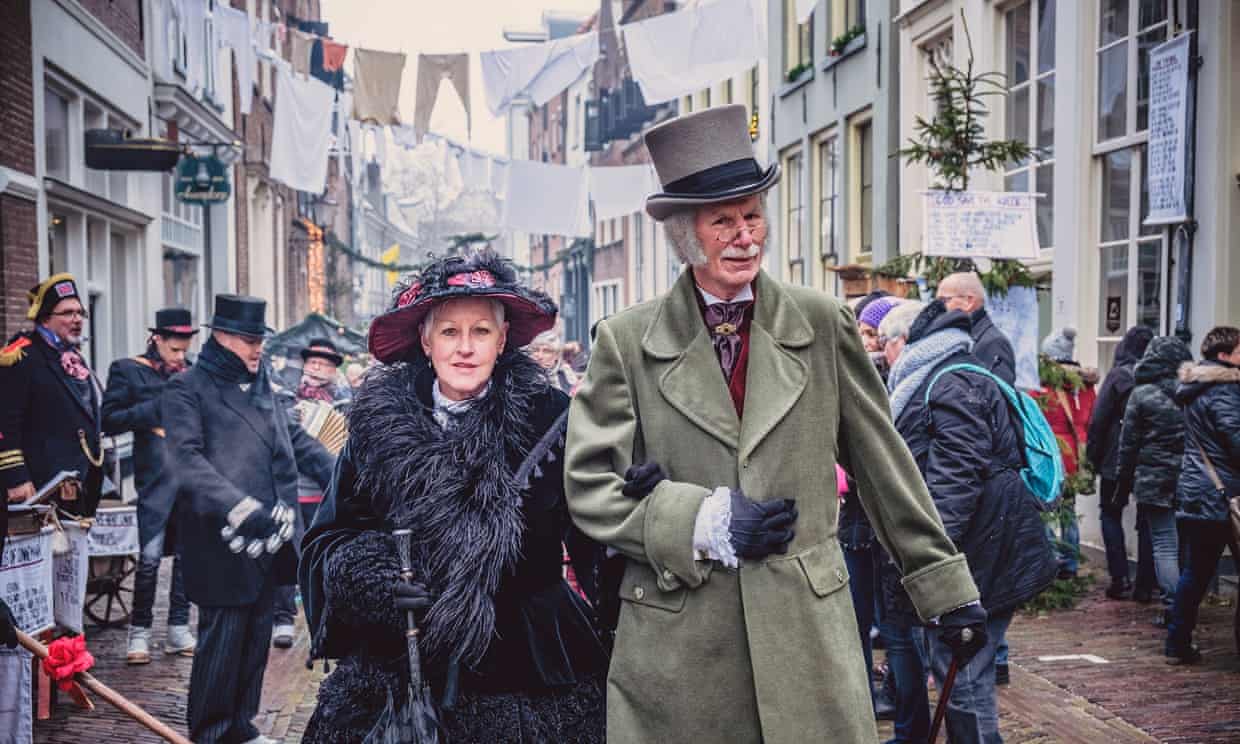
Photo: Sander Korvemaker.
Despite no known historical connection with Charles Dickens, this Dutch town plays host to an annual Dickens festival, the world’s largest.

Today’s story about a town that loves Charles Dickens drew me in because I also love Dickens. That is, I love his novels. With the exception of The Old Curiosity Shop and Barnaby Rudge — neither of which I liked — I have read them all multiple times. But I have also read about the man himself and am pretty sure he was not a very nice guy.

The surprising Dickens festival that Senay Boztas writes about at the Guardian focuses on both the novels and the guy.

Boztas reports, “Soon after limited Sunday trading started in the Netherlands, an anglophile shopkeeper in the small city of Deventer decided it could all be a bit more fun.

“ ‘My 82-year-old mother, Emmy Strik, is England-minded because my grandfather always went to England and read a lot of Dickens,’ said her daughter, Liesbeth Velders, who now runs the Dille & Kamille homeware store. ‘So when we were going to open on Sunday, she decided to make it a fancy-dress party – except the fancy-dress party got a bit out of hand.’

“Decades later, Strik’s experiment in literary frivolity has gone further than she could have imagined. The event she began in 1991 to commemorate Charles Dickens has run for 33 years, with a two-year break during the Covid pandemic.

“Despite no known historical connection with the author, Deventer, in the eastern province of Overijssel, now plays host to what is believed to be the world’s largest Dickens festival. This weekend [in December 2023], 950 volunteers will fill the streets of the ancient Bergkwartier, performing street theatre and selling hot punch and Victorian treats. There are strict rules for actors and traders: no [sneakers], modern watches or mobile phones.

“Among the expected 125,000 visitors will be Ebenezer Scrooge, Tiny Tim, Queen Victoria, Miss Havisham, beggars, thieves and, for the first time, Dickens himself.

“Ojon van Strijland, a bookseller and volunteer at the Dickens Kabinet museum, said he and Strik had learned while on a trip to Kent, where Dickens spent much of his childhood, that authenticity was essential.

“ ‘Years ago, Emmy and I went to [the city of] Rochester’s Dickensian Christmas festival to seek inspiration but there were things there we would not want,’ he said. ‘There were people walking around with Christmas lights on, Santa hats and polyester costumes.’ …

“Strik amassed almost 1,000 authentic costumes, collected enough Dickensian items to fill a museum and grew the Dickens Festijn with commercial sponsorship and support from Events dEVENTer. She has now – largely – handed over the reins to her daughter.

“ ‘We can’t roast chestnuts in big drums any more; there’s a fist-thick book of rules from the fire brigade and the police, but it’s still a real festival,’ said Velders.

“The festival has huge local status. One couple’s 50th wedding anniversary is being incorporated into this year’s edition, while 62-year-old system administrator Wessel Lindeboom is polishing insults in multiple languages for his dream role of Scrooge. …

“At a time when Dutch children’s reading skills are declining, some hope the festival will encourage a wider love of literature. ‘A lot of the visitors have never read a Dickens book but everyone recognizes Scrooge, who walks around calling “humbug!” and insulting people,’ said Velders. ‘There are also storytellers who recount the story of the books.’ …

“The mayor of Deventer, Ron König, hopes visitors will have an enormous amount of fun but also take home a more profound message. ‘The festival beautifully portrays the differences between rich and poor, an issue we are still trying to tackle.’ …

“Peter Jan Margry, professor of European ethnology at Amsterdam University, believes this kind of event provides a welcome break, particularly in dark days. …

“ ‘The festival of Christmas is also about stepping out of your own time into an atmosphere of carols and Christmas trees and a flight from reality,’ he said. ‘But it’s also a form of occupying yourself, a type of tourism, stepping out of your daily life, that you see in all fantasy and live action role-playing. … It’s about stepping into another world.’ “

I hope my blogging friends at Cook and Drink will weigh in on this aspect of life in their beautiful and surprising country.

More at the Guardian, here. No firewall. Subscriptions encouraged.

Read Full Post »

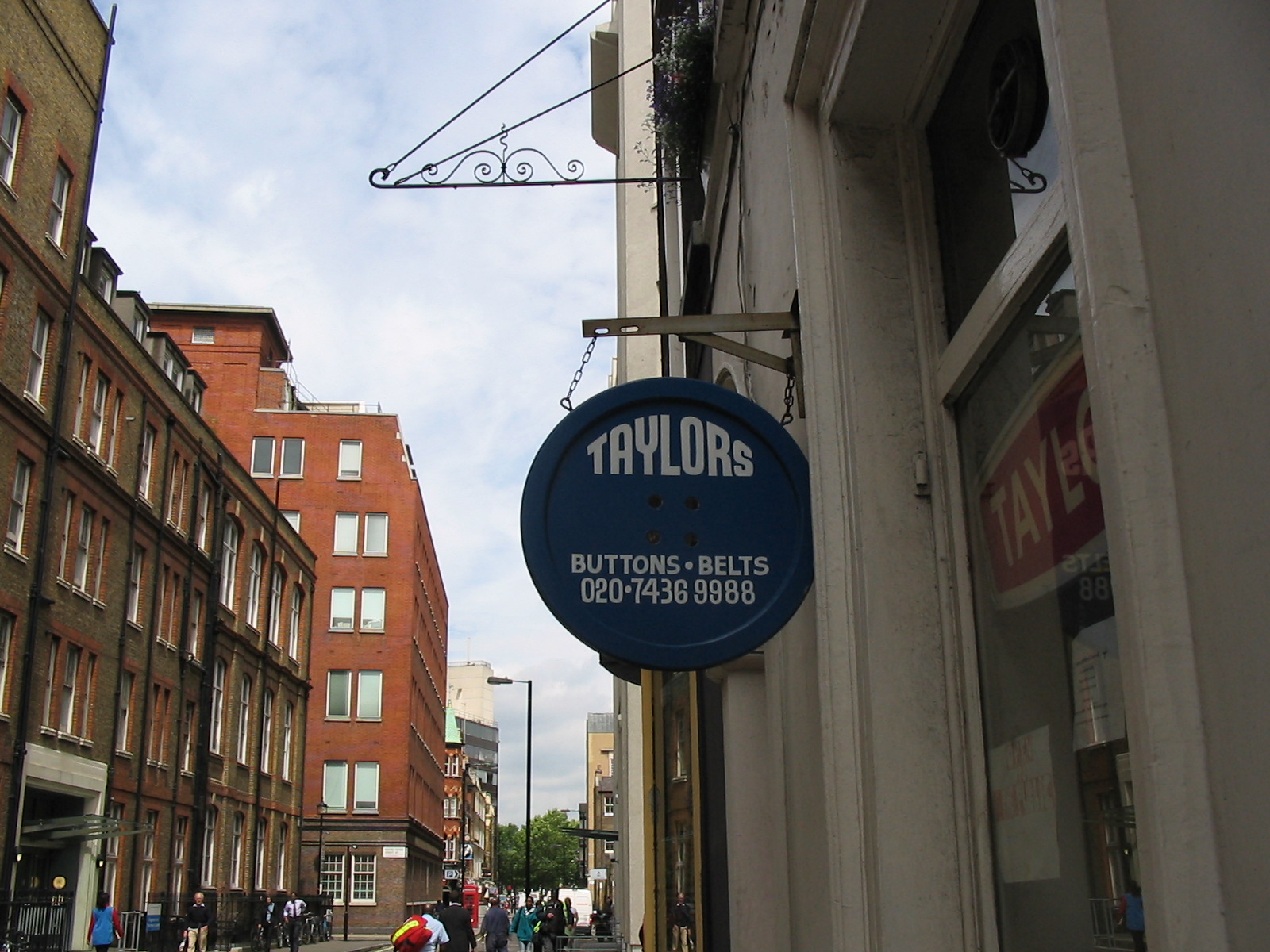
Photo: Taylors Buttons.
The Taylors Button Shop has been established in London over 100 years.

A long time ago, a parent family at the Elwanger-Barry Nursery School in Rochester, New York, closed down their button business and donated a lifetime supply of buttons to the school. Poured into an indoor sandbox, the buttons became one of the two favorite play centers of three-year-old Suzanne. The fuzzy box and the button box.

That’s one reason I’m interested in button stories. And when an editor from last year’s Ukraine social-media project (see this post) wrote on Facebook about a 100-year-old button store in London she visited, I had to learn more.

The Gentle Author at Spitalfields Life interviewed Maureen Rose of Taylors Buttons for a bookshop’s blog:

“Taylors Buttons is the only independent button shop in the West End. It’s more than 100 years old and it’s only been owned by two families in that time. It was founded by the original Mr Taylor; then there was Mr Taylor’s son, who retired in his late eighties when he sold it to my husband,” Maureen Rose said.

“I was a war baby. My mother was from Whitechapel and she opened her own millinery business in Fulham at nineteen. She got married when she was twenty-one and ran her business all through the war. As a child, I used to sit in the corner and watch her make hats, but I didn’t take up millinery – something I regret now, as she was very talented and she could have taught me.

“I helped my mother for a while: I did a lot of buying for her in Great Marlborough Street, where there were many millinery wholesalers. There was a big fashion industry in the West End: I used to go to see the collections from houses like Hardy Amies and Norman Hartnell. It was so glamorous. Now it’s all gone.

“My late husband, Leon Rose, first involved me in this business. He started his career in a button factory learning how to make buttons. Then his uncle, who had a factory in Birmingham, got in touch to say, ‘There’s a gentleman in town who’s retiring and you should think about taking over his business.’ So he did.

“My mother went in to help when he needed someone for a couple of hours a day, and then – of course – there was me! I’ve been working here for more than 40 years now and since my husband died in 2007 it has been a one-woman show.

“Every button tells a story and I have no idea how many there are in the shop. Some are more than 100 years old, but most I make to order. You send me the fabric – velvet, leather or whatever – and I’ll make you whatever you want. We used to do only small orders for tailors: two fronts and eight cuff buttons for a suit. Nowadays I do them by the hundred. I don’t think Leon ever believed that was possible.

“Anybody can walk into my shop and order buttons, but I get a lot of orders for theatre, television, film, fashion houses and weddings. I get gentlemen who buy expensive suits that come with cheap buttons: they come here to buy proper horn buttons to replace them.

“My friends ask me why I have not retired, but I enjoy working here. What would I do at home? I’ve seen what happens to my friends who have retired: they lose the plot. I meet nice people in the shop and it’s interesting. I’ll keep going for as long as I can.”

Interview originally published on the Spitalfields Life blog by The Gentle Author. 

More here. And there’s detailed button information at the Taylors Buttons website, here, where you can also learn that Dickens lived in the building once. Hat tip: Ro.

Read Full Post »

Photo: Carlos Magno/Unsplash.
Remember when we weren’t so hyper about Covid germs? My kids loved this.

I tend to pounce on articles about the importance of creative play for children (in this 2020 post, for example). I have seen the value of play in my own life and in the lives of my former students, my children, and my grandchildren.

Also, I read Dickens, who was a leader in encouraging imagination and who wrote about its value often — not just in his education novel Hard Times, where he calls for “Queen Mab’s chariot among the steam engines.”

Jackie Mader writes at the Hechinger Report about a study on “guided” play, which has the advantages of free play and a bit more.

What happens when you stop teaching young children via direct instruction and instead set up purposeful opportunities to play? They could learn just as much — or more — when it comes to literacy, numeracy and executive function skills critical to early academic success, according to a new review of 17 studies of play.

“Researchers looked at 39 studies of play and included 17 in a meta-analysis that found when children ages three to eight engage in guided play, they can learn just as much in some domains of literacy and executive function as children who receive direct instruction from a teacher or adult. …

“Guided play [means] there is a learning goal set by an adult and children are ‘gently steered’ to explore. The study found children also learned slightly more in some areas of numeracy, like knowledge of shapes, and showed a greater mastery of some behavioral skills, like being able to switch tasks.

“These findings, which were published in the journal Child Development, add to a growing body of research that has found play is not simply a carefree tangent to learning, but rather an effective way to teach important early skills.

“ ‘Children often struggle with mathematical concepts because they are abstract,’ said Elizabeth Byrne, a co-author of the study and a research associate at the University of Cambridge, in a statement. That’s why the hands-on nature of play may be helpful. Those concepts ‘become easier to understand if you are actually using them in an imaginary game or playful context.’ …

“Last year, a report by the LEGO Foundation that looked at 26 studies of play from 18 countries found play is so powerful it can reduce inequality and close achievement gaps between children ages 3 to 6. Those studies, which also looked at free play in addition to guided play, found children progressed in several domains of learning, including language and literacy, math and social-emotional skills.

“While direct instruction gets information across quickly and is effective for certain skills or lessons in a classroom, ‘real learning’ occurs when children are active and engaged, said Kathy Hirsh-Pasek, a professor of psychology at Temple University and a senior fellow at the Brookings Institution. That’s why play can be so effective. … ‘What it’s really about here is can we teach human brains in the way human brains learn,’ Hirsh-Pasek said.

“An added benefit is kids enjoy play more than sitting and listening to an adult talk at them. ‘The kids are happier, the teachers are happier. It’s teaching them more about how to collaborate and communicate,’ she added.

“In the years prior to the pandemic, some states and districts were bringing more play into schools by creating play-based kindergarten classrooms. It was an attempt to move away from the rigorous, academic-focused kindergarten classrooms that emerged in a nation concerned about low reading scores and meeting the Common Core standards.

One top pre-K researcher recently called for more play in pre-K amidst concerns that state-funded pre-K programs involve too much direct instruction and not enough time spent outside. …

“Ideally, guided play involves forethought in setting up play opportunities based on a learning goal, but it doesn’t necessarily require extensive adult interaction. For example, if a climbing structure is painted to show units of measurement, children may take notice and talk about how high they’re climbing. Or if kids are trying to learn addition and subtraction during lesson, throwing a giant number line on the ground and letting children jump forward or backward becomes a guided play activity.

“Teachers or parents ‘become guides on the side,’ Hirsh-Pasek said. ‘When we interact too much and become helicopter parents, the kids check out,’ she added.”

More at the Hechinger Report, here.

Read Full Post »

Image: York Notes.
York Notes, a literature guide, says, “Bob Crachit is Scrooge’s clerk and represents the lower classes. He has to accept poor wages and working conditions because he has a family to support.”

I was thinking about Labor Day and remembering that in many of my favorite novels Dickens wrote with passion about the working conditions of the poor. He had himself worked in a blacking factory as a child when his father was in debt, and few topics were more likely to spark his outrage.

John Broich, an associate professor at Case Western Reserve University, wrote at Time that Dickens decided Scrooge, his hard-working clerk Bob Crachit, and the half-starved Tiny Tim would have more impact on the big issue of the day than the political pamphlet he’d been planning.

“Published 173 years ago this month,” Broich writes, “Charles Dickens’ A Christmas Carol was an instant bestseller, followed by countless print, stage and screen productions. … But A Christmas Carol’s seemingly timeless transcendence hides the fact that it was very much the product of a particular moment in history, its author meaning to weigh in on specific issues of the day.

Dickens first conceived of his project as a pamphlet, which he planned on calling, ‘An Appeal to the People of England on behalf of the Poor Man’s Child.’

“But in less than a week of thinking about it, he decided instead to embody his arguments in a story. … So what might have been a polemic to harangue, instead became a story for which audiences hungered.

“Dickens set out to write his pamphlet-turned-book in spring 1843, having just read a government report on child labor in the United Kingdom. The report took the form of a compilation of interviews with children — compiled by a journalist friend of Dickens — that detailed their crushing labors.

“Dickens read the testimony of girls who sewed dresses for the expanding market of middle class consumers; they regularly worked 16 hours a day, six days a week, rooming — like Martha Cratchit — above the factory floor. He read of 8-year-old children who dragged coal carts through tiny subterranean passages over a standard 11-hour workday. These were not exceptional stories, but ordinary. Dickens wrote to one of the government investigators that the descriptions left him ‘stricken.’

“This new, brutal reality of child labor was the result of revolutionary changes in British society. The population of England had grown 64% between Dickens’ birth in 1812 and the year of the child labor report. Workers were leaving the countryside to crowd into new manufacturing centers and cities. Meanwhile, there was a revolution in the way goods were manufactured: cottage industry was upended by a trend towards workers serving as unskilled cogs laboring in the pre-cursor of the assembly line, hammering the same nail or gluing the same piece — as an 11-year-old Dickens had to do — hour after hour, day after day.

“More and more, employers thought of their workers as tools as interchangeable as any nail or gluepot. Workers were becoming like commodities: not individual humans, but mere resources, their value measured to the ha-penny by how many nails they could hammer in an hour. But in a time of dearth — the 1840s earned the nickname ‘The Hungry ‘40s’ — the poor took what work they could arrange. And who worked for the lowest wages? Children.

“Popular theories about how — or whether — to help the poor often made things worse. The first was the widespread sense that poor people tended to be so because they were lazy and immoral, and that helping them would only encourage their malingering. If they were to be helped, it should be under conditions so awful as to discouraged people from seeking that help. The new workhouses were seen as the perfect solution — where families were split up, food was minimal and work painful. ‘Those who are badly off,’ says the unreformed Scrooge, ‘must go there.’

“Associated with this concept were the ideas of Rev. Thomas Malthus, who cautioned against intervening when people were hungry because it would only lead to an untenable population size. Better that the poor should starve and thus ‘decrease the surplus population.’ …

“Friedrich Engels read the same report on child labor that Dickens did and, with his collaborator Karl Marx, envisioned an eventual revolution. Dickens was very much an anti-revolutionary. In fact, he implied that [revolution] was the fearsome consequence of not solving the problem some other way.

“ ‘This boy is Ignorance. This girl is Want. Beware them both, and all of their degree, but most of all beware this boy, for on his brow I see that written which is Doom, unless the writing be erased.’ …

“Dickens wasn’t a ‘systems’ thinker, nor was he proto-socialist. Yet what Dickens did propose in A Christmas Carol … was that employers are responsible for the well-being of their employees. Their workers are not of value only to the extent to which they contribute to a product for the cheapest possible labor cost. They are of value as ‘fellow-passengers to the grave,’ in the words of Scrooge’s nephew, ‘and not another race of creatures bound on other journeys.’ Employers owe their employees as human beings — no better, but no worse, than themselves.

“And, yes, that might mean ‘a prize Turkey’ at Christmas … but the real salvation that Scrooge gives to the Cratchit family is a raise.

“As Scrooge and the Ghost of Christmas Past watch Tim, his father holding his [hand], the miser pleads, ‘say he will be spared.’ The ghost reminds readers of Scrooge’s Malthusian quote. ‘If he be like to die, he had better do it, and decrease the surplus population.’ ” More at Time.

Today we know that most of the labor benefits we have today, including the Monday holiday in America, were not handed down by benevolent company owners but were wrested from them by workers and unions.

You can read that history at Wikipedia, here. Even so, I do think stories help prepare a population to accept change — to recognize that the way things are is not always the best way.

Read Full Post »

A day that Canadian short story writer Alice Munro wins the Nobel Prize for Literature might be a good day to talk about the power of fiction.

The NY Times took up the subject only last week. I think that reporter Pam Belluck must have been a little psychic. She wrote: “Say you are getting ready for a blind date or a job interview. What should you do? Besides shower and shave, of course, it turns out you should read — but not just anything. Something by Chekhov or Alice Munro will help you navigate new social territory better than a potboiler by Danielle Steel.

“That is the conclusion of a study published [October 3] in the journal Science. It found that after reading literary fiction, as opposed to popular fiction or serious nonfiction, people performed better on tests measuring empathy, social perception and emotional intelligence — skills that come in especially handy when you are trying to read someone’s body language or gauge what they might be thinking.”

Emanuele Castano and David Comer Kidd, researchers in the New School for Social Research’s psychology department. say “the reason is that literary fiction often leaves more to the imagination, encouraging readers to make inferences about characters and be sensitive to emotional nuance and complexity. …

“ ‘It’s a really important result,’ said Nicholas Humphrey, an evolutionary psychologist who has written extensively about human intelligence, and who was not involved in the research. ‘That they would have subjects read for three to five minutes and that they would get these results is astonishing.’ ” More.

My own use of literary fiction is mainly for pleasure, not job interviews. But when things are bleak, Dickens can be the best medicine.

Photo of Charles Dickens from Biography.com

Read Full Post »

You have to have light to have shadows. You have to have shadows to see the possibilities of light.

I took one of these shadow photos in early morning and one in late afternoon. When I went for a walk around noon, I carried my camera in case there might be other shadows that interested me. In the end I concluded that shadows on houses interest me more than shadows on sidewalks. Something to do with knowing that lives are lived inside the houses?

Probably my favorite Dickens novel is Bleak House. I have read it several times. A recurring motif is light and shadow. I am reminded in particular of the young couple walking through light and shadow, shadow and light. They are to experience much that is good, much that is dark. Some people accuse Dickens of writing plots that are too convoluted and bizarre, but what could be more true to life than that?

Read Full Post »

Who wouldn’t love this story? Remember the mime Marcel Marceau? Now try to picture him directing traffic in a crazy intersection.

According to an article in the Canadian Press, by Christopher Toothaker (really his name), “Caracas, Venezuela, is placing over a hundred mimes on its busy streets to admonish reckless drivers and pedestrians. The mimes, dressed in clown-like outfits and wearing white gloves, may frown and gesticulate the command of ‘stop’ to motorcyclists roaring towards crosswalks or wag their fingers at jaywalking pedestrians. Although some reprimanded motorists have predictably hurled insults, mimes have reported that most people have reacted agreeably. Caracas is following the example set by Bogota, Columbia, which has successfully used mimes in a broader effort to increase commuter civility.”

Let’s bring back the Works Progress Administration and employ people as mimes. I can think of lots of intersections that need them, mostly in Boston. (But learning to be a mime is probably not as easy as it seems.)

****

With the increase in vehicle crimes
Caracas has turned to some mimes.
They’ve slowed down the speeding,
Which no one was needing,
And inspired these few awkward rhymes.

Your turn. (If you use the French pronunciation, “meem,” that opens a whole other slate of rhyming options.)

P.S. Isn’t there a literary character — probably in Dickens — who keeps “dropping into poetry”?

Read Full Post »