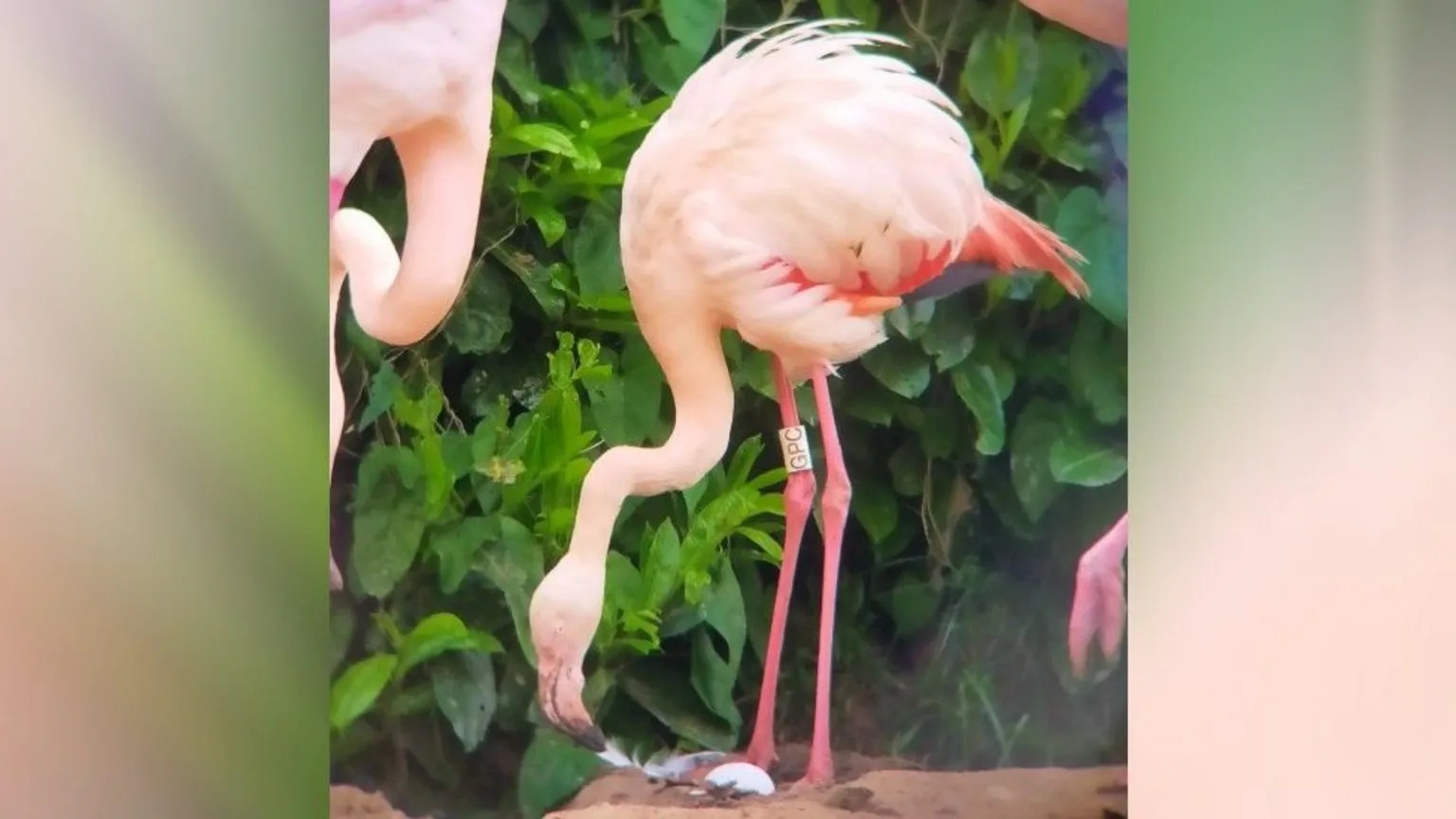
Photo: Claudia Gooch, avicultural warden, Pensthorpe.
Gertrude the flamingo produced her very first egg at age 70.
The miracle baby of a 70-year-old flamingo make me tired just thinking about it.
Cathy Free writes at the Washington Post about Gertrude the flamingo and the surprise she gave the staff at her nature preserve.
“When the greater flamingo reached age 70 last year, it was a safe conclusion that she would spend the rest of her life as a grand-auntie among a flamboyance of 63 other flamingos at the Pensthorpe nature reserve in Norfolk, England.
“ ‘The average flamingo lives for 30 to 40 years in the wild, so Gertrude is quite unique,’ said Ben Marshall, manager of the reserve. ‘She’d just been unlucky in love and had never found a boyfriend.’
“That changed last month to the surprise of Marshall and other bird keepers at Pensthorpe.
“In late April, they noticed that Gertrude — normally shy and not one to cause a kerfuffle in her flock — was suddenly flirting with Gil, 37, a male flamingo about half her age.
” ‘She and Gil were giving each other wing salutes, bowing to each other, and displaying some of the other 136 different courtship and mating dances that flamingos have,’ said Marshall, 31. …
“The next surprise came in early May, when one of the flamingo keepers noticed that Gertrude had made a volcano-shaped nest out of mud and was sitting on an egg — the first one she had ever laid, according to caretakers at Gertrude’s previous bird refuge who advised the Pensthorpe staff, Marshall said.
“ ‘Our entire team was amazed — Gertrude and her egg were the talk of the reserve,’ he said. …
“The greater flamingo can start breeding at about age 5 and does not breed more than once a year. A male and female will bond for mating, then split up after breeding season. …
“It takes 26 to 31 days for an egg to hatch, and Gertrude dutifully sat on her egg for about 10 days, taking breaks only to get food and water. But in mid-May, the septuagenarian bird abandoned her egg, probably because it wasn’t viable, Marshall said.
“ ‘It could also be that at her advanced age, she decided it was just too much for her,’ he said. ‘Although it was a little sad for us, knowing the egg wouldn’t hatch, it was still a remarkable win for Gertrude,’ Marshall added. ‘She made the call herself not to incubate the egg, and she was able to simulate those maternal instincts ingrained in flamingos and experience something completely new.’ …
“It is unusual for a flamingo to have longevity like Gertrude’s, but it isn’t unheard of. Betty, a matriarch flamingo at the National Zoo, was 67 when she died in 2022, and a flamingo named Greater died at age 83 in 2014 at an Australian zoo. She still holds the record as the world’s oldest flamingo.
“Marshall said he wouldn’t be surprised if Gertrude were to break that record someday. ‘She’s quite sprightly and healthy, and she’s very friendly with the other flamingos,’ he said, noting that Gertrude is back to hanging out with younger females while they sit on their nests. …
“The birds are all greater flamingos — among the most widespread varieties of the species, with about 680,000 living in the wild in Africa, India, the Mediterranean and the Middle East, according to World Population Review.
“ ‘We have about 20 eggs at the moment, and one of them hatched a few days ago,’ Marshall said. ‘Every egg isn’t always viable, but we’re hopeful.’
“Even though Gertrude won’t have the experience of hatching her own egg, she will fill in as a protective babysitter for the other hatchlings — something she has done every year for decades, he said.
“ ‘She leads a laid-back life, but she still takes a turn teaching the chicks how to get food and other key skills,’ Marshall said. ‘She always works with the other flamingos for the good of the group.’ ”
More at the Post, here.


 Suzanne's Mom's Blog