Feeds:
Posts
Comments

Posts Tagged ‘el sistema’

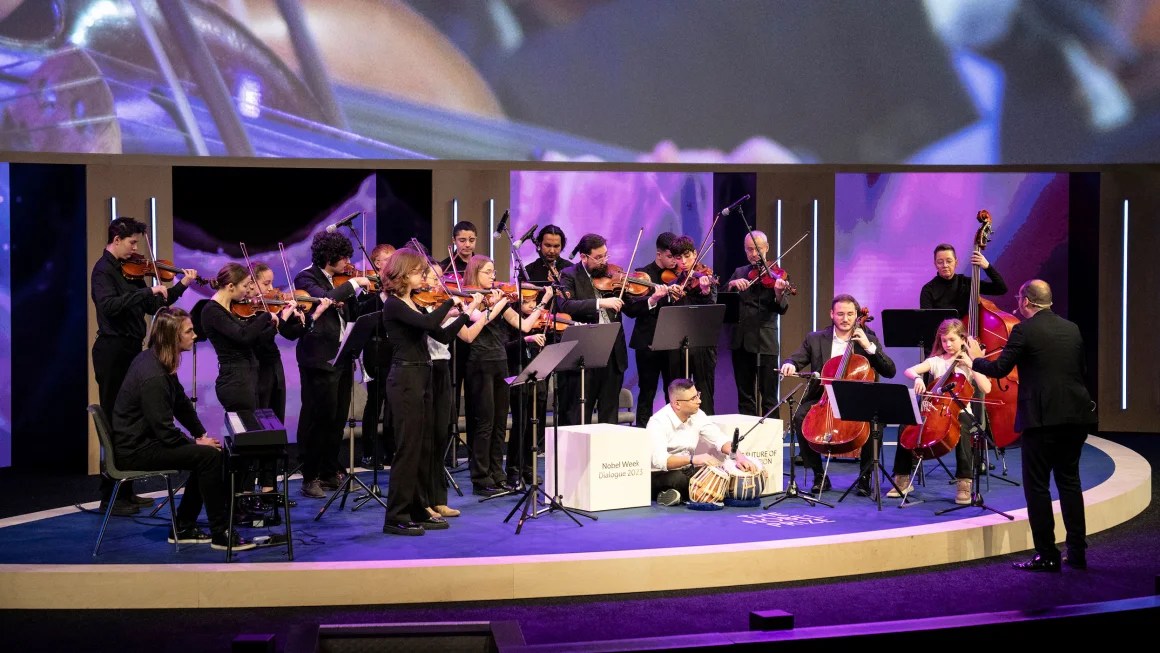
Photo: Anna Svanberg/Nobel Prize Outreach.
The Dream Orchestra started with just 13 members. Now there are more than 400, including this group performing at a Nobel Foundation event in Gothenburg, Sweden, in December 2023. 

Sweden has long been a country that took in refugees, but what I know from family members there is that Sweden doesn’t always do a good job helping immigrants integrate and feel at home. That’s why the orchestra leader in today’s story stands out.

As Mostafa Kazemi, originally from Afghanistan, recalls, the conductor told him that of course he could play an instrument even though he thought he couldn’t. “He’d been in Sweden for a matter of months,” Catherine E. Shoichet at CNN reports. “No one had talked to him like this before.”

The long and interesting article about the Dream Orchestra begins, “Ron Davis Álvarez stood on a train platform in Stockholm, stunned by what he saw. The Venezuelan orchestra conductor was visiting Sweden as part of a university exchange program. … He watched throngs of people getting off trains, their faces drawn and exhausted. Volunteers raced past him to hand out bananas and water to the new arrivals.

“ ‘I was completely in shock, seeing all of these young boys arriving,’ Álvarez recalls. He asked someone what was going on.

“The answer: ‘They are from Syria and Afghanistan. Many of them are unaccompanied. They traveled here alone.’

“ ‘What will happen to them?’ Álvarez asked. No one knew. …

“Álvarez was there watching, and he had an idea. That idea would change his life, and the lives of hundreds of others he hadn’t met yet. …

“It wasn’t long before Álvarez was back in Sweden. He’d been tapped as the artistic director of El Sistema Sweden, based in the coastal city of Gothenburg. … As he began his new role, the memory of what he’d seen months earlier on the train platform remained seared in his mind.

“El Sistema Sweden’s work was focused on younger children enrolled in Swedish schools. The youth he’d seen pouring into the train station were already in their later teenage years. It’s an age when many might assume it’s too late to learn an instrument.

“Álvarez knew it wasn’t. And he knew he had to try to help them. … With a handful of instruments on loan, he visited schools to drum up interest. Eventually, he recruited a group of 13 youth from Afghanistan, Syria, Eritrea and Albania. He dubbed them the Dream Orchestra.

“ ‘I remember coming into the room and there were a lot of girls and boys, and I was nervous,’ Álvarez says in a short film about the orchestra featured on its website. … Many of the Dream Orchestra’s members had never played an instrument before they joined. They came from different countries. They didn’t speak the same languages. …

“Mostafa Kazemi lights up when he recalls the day he met Álvarez in 2016.

“ ‘Which instrument do you play?’ the conductor asked him.

“ ‘I can’t play,’ Kazemi replied.

“Álvarez’s response was confident and unflinching: ‘Yes, you can. Come and pick which one you want.’

“Kazemi, originally from Afghanistan, was 16 years old at the time. He’d been in Sweden for a matter of months. No one had talked to him like this before. So a few weeks after the Dream Orchestra began, Kazemi became one of its first members. He picked the cello. …

“The small ensemble rehearsed on Fridays and Saturdays. Those were Álvarez’s days off, and also a time when he knew it was important to keep young people occupied and off the streets.

“At first, teaching the group wasn’t easy, Álvarez recalls. He was used to instructing younger Spanish-speaking students who came from similar backgrounds. This would require a different approach.

“Álvarez spoke English, and some of the other members of the Dream Orchestra did, too. But still, misunderstandings were frequent, even comical at times. Body language was key to overcoming those obstacles. So was finding a way to connect more deeply with each person – to learn what music they liked and where they came from and who they were.

“Another key part of Álvarez’s approach with these older students: giving them the confidence to make mistakes.

“I tried to build confidence – first the confidence of the sound.’ …

“ ‘Ron was full of energy all the time,’ Kazemi says. ‘And that made us want to do more and more and more. We were practicing at home. I even brought some more students. I told my friends. … And everyone told their friends, and everyone came to orchestra.’ …

“Now, eight years later, the Dream Orchestra has more than 400 members from nearly 20 countries who speak around 20 languages between them. …

“As [Álvarez] sees it, politicians and world leaders could learn a lot from this music ensemble.

“ ‘I see the orchestra like society,’ he says. ‘When you are in an orchestra, you need to learn how to hear each other, how to listen to each other, compassion, how to empathize.’

“That’s not to say there haven’t been challenges over the years. Some students at first struggled with taking direction from female conductors and teachers, Álvarez says, and tensions have boiled over at times between members of the orchestra whose home countries have a history of conflict with each other.

“Some conductors might direct their orchestras simply to play on and ignore these difficulties. Álvarez says he addresses them directly. He wants the orchestra not only to be a safe space, but a place where its members can grow and learn to live together.

“ ‘We are all people that need to respect each other. It’s difficult because you cannot erase this history, but you can rewrite the future,’ he says.”

More at CNN, here. No firewall.

Read Full Post »

Photo: Sarah Matusek/The Christian Science Monitor.
Nixon Garcia, a teaching artist at El Sistema Colorado, conducts students at the music school in Denver.

People sometimes forget that we need more immigrants, not fewer. Their contributions to the economy are well documented. In 2021, for example, they contributed more than $500 billion just in taxes (see Forbes here). Not to mention that they willingly apply for necessary jobs that go begging, sometimes for years.

And there are other contributions getting less attention. Consider what this one musician is doing. Sarah Matusek wrote about his work recently at the Christian Science Monitor.

“A few dozen children in Denver settle into seats, violins and violas in hand. With short cropped hair and a focused gaze, Nixon Garcia observes from off to one side. …

“This is a fall show-and-tell for parents at El Sistema Colorado, a free music school that prioritizes kids from low-income families. The Denver program was inspired by the original El Sistema in Venezuela, which since its founding in 1975 has sparked similar projects around the world. …

“With flutters of his hands and flicks of his wrists, the 22-year-old conjures up simple songs that he learned as a boy in the Venezuelan program. He’s brought that same sheet music to students in the United States, along with hopes for asylum. Working as a teaching artist at the Colorado program, he’s come full circle.

“ ‘El Sistema has been my second home throughout my whole life,’ says Mr. Garcia, who teaches in Spanish and English. 

“The original program’s catchphrase, ‘tocar y luchar‘ – or ‘play and fight’ in English – has evolved into a personal mantra of perseverance for the young conductor who can’t imagine returning home.  By the time he left Venezuela, in 2022, says Mr. Garcia, he’d been kidnapped three times. 

“Backdropped by mountains in northwest Venezuela, the town of La Fría sits near the Colombian border. Mr. Garcia’s family, who ran a poultry farm there, enrolled their son in the popular music program at a young age. …

“At age 5, he began learning the Venezuelan cuatro, which has four strings. Later on came the clarinet. As a teenager, Mr. Garcia began teaching other El Sistema students – a key mentorship feature of the program – and developed a love of conducting. But basic needs were stark; some students he taught sat on the floor, because there weren’t enough chairs. And beyond the solace of class, violence lurked.

“When he was a young teenager, in 2015, a criminal group, called a colectivo, kidnapped him and his family at a gas station. The group held them for several hours, his family says, and demanded thousands of dollars for their release. 

“Venezuela, meanwhile, devolved into further economic, political, and human rights crises under President Nicolás Maduro, causing millions to flee. Mr. Garcia began attending pro-democracy protests. …

‘You can see how everything is terrible. But in the end, you still love your country,’ he says. ‘You don’t want to leave.’ …

“Mr. Garcia was captured again by an insurgent group on his family farm in La Fría. Yet neither was he safe at college in another city, Mérida, where he studied engineering. … Although his family had arranged private security for him in La Fría, they decided that he had to leave. …

“A tourist visa that his family had secured some years prior still hadn’t expired. That became his ticket to the U.S. last year. Yet even as he moved into his cousin’s home in Monument, Colorado, an hour south of Denver, the adjustment was isolating. … A family member suggested he retreat to nature, take a moment to breathe. A prayerful hike in the nearby mountains, Mr. Garcia says, helped right his course. 

“Inspiration struck, tuning-fork clear: Why not return to music?  A Google search for nearby orchestras yielded a name he knew. The young conductor, in awe, reached out to El Sistema Colorado. …

“Mr. Garcia started out as a volunteer at El Sistema Colorado before the federal government issued the asylum-seeker his work authorization. That allows him to work legally while his asylum case moves forward. Now paid, he teaches groups of strings-learning students in an orchestra group called Allegro.

“The teaching artist is a ‘positive light’ at the music school, says Ingrid Larragoity-Martin, executive director of El Sistema Colorado. ‘He’s passionate about kids, and he knows how to work with them.’ …

“Meanwhile, he awaits the outcome of his asylum application, which may take years. Mr. Garcia says he wants to ‘work, make a life, and try to share as many things as we can from our country.’ ” 

More at the Monitor, here.

Read Full Post »

Here is another great music outreach to kids: the Philadelphia Youth Orchestra’s Tune up Philly initiative.

“The mission of Philadelphia Youth Orchestra’s Tune Up Philly program is to nurture urban children in challenging social and economic conditions by keeping them engaged in success through weekday out-of-school hours music instruction.  Through its Tune Up Philly program, Philadelphia Youth Orchestra organization believes that music education is a powerful vehicle for children to master skills that will enable them to acquire valuable tools for cooperative learning, teamwork, academic success and self-esteem.” More.

The Inquirer classical music critic Peter Dobrin wrote at Philly.com that an important goal of the initial program was to show the rest of the city what is possible.

“The brain-child of 24-year-old Curtis Institute of Music graduate Stanford Thompson … and adopted by the Philadelphia Youth Orchestra, Tune Up Philly started at St. Francis de Sales … with the aim of replicating itself at other sites …

“Modeled on the widely praised and emulated El Sistema program that has educated millions of children in Venezuela, Philadelphia’s upstart is already gathering considerable support. Since initial coverage in the Inquirer and subsequent media attention, the program has received donations of cellos, clarinets, double basses, flutes, saxophones, trumpets, trombones, violas, violins and other instruments, plus about $13,000 in cash and $10,000 in in-kind services.” More.

Photograph: First graders exploring xylophones in the 2012 summer program.

Read Full Post »

I’ve been meaning to blog about the wildly successful music-education program out of Venezuela, El Sistema.

Here music critic Mark Swed follows the L.A. Philharmonic to Caracas and writes about El Sistema for the Los Angeles Times.

“Musically, Venezuela is like no other place on Earth. Along with baseball and beauty pageants, classical music is one of the country’s greatest passions.

“In the capital, Caracas, superstar Venezuelan conductor Gustavo Dudamel is mobbed wherever he goes. Classical music teeny-boppers run up to him for autographs when he walks off the podium at concerts. The state-run music education program, which is known as El Sistema and from which Dudamel emerged, is the most extensive, admired and increasingly imitated in the world. One of its nearly 300 music schools for children, or núcleos, is deep in the Venezuelan Amazon, reachable only by boat. …

“The basic tenet of José Antonio Abreu, the revered founder of El Sistema, is the universal aspect of music. He likes to say that music is a human right. That’s an effective, politically expedient slogan. But what he has demonstrated on a greater scale than ever before is that music is not so much a right as a given. El Sistema is not about talent, ingeniously effective system though it may be for discovering and fostering musical talent. The truly revolutionary aspect of El Sistema is its proof that everyone has a capacity for music.”

Read about how El Sistema has spread worldwide in the Los Angeles Times.

Children at La Rinconada in Caracas, Venezuela, Feb. 14, 2012. Gustavo Dudamel, right, among students at a showcase of El Sistema in Caracas, Venezuela, Feb. 15. Photograph: Mark Swed / Los Angeles Times

Read Full Post »