Feeds:
Posts
Comments

Posts Tagged ‘electric’

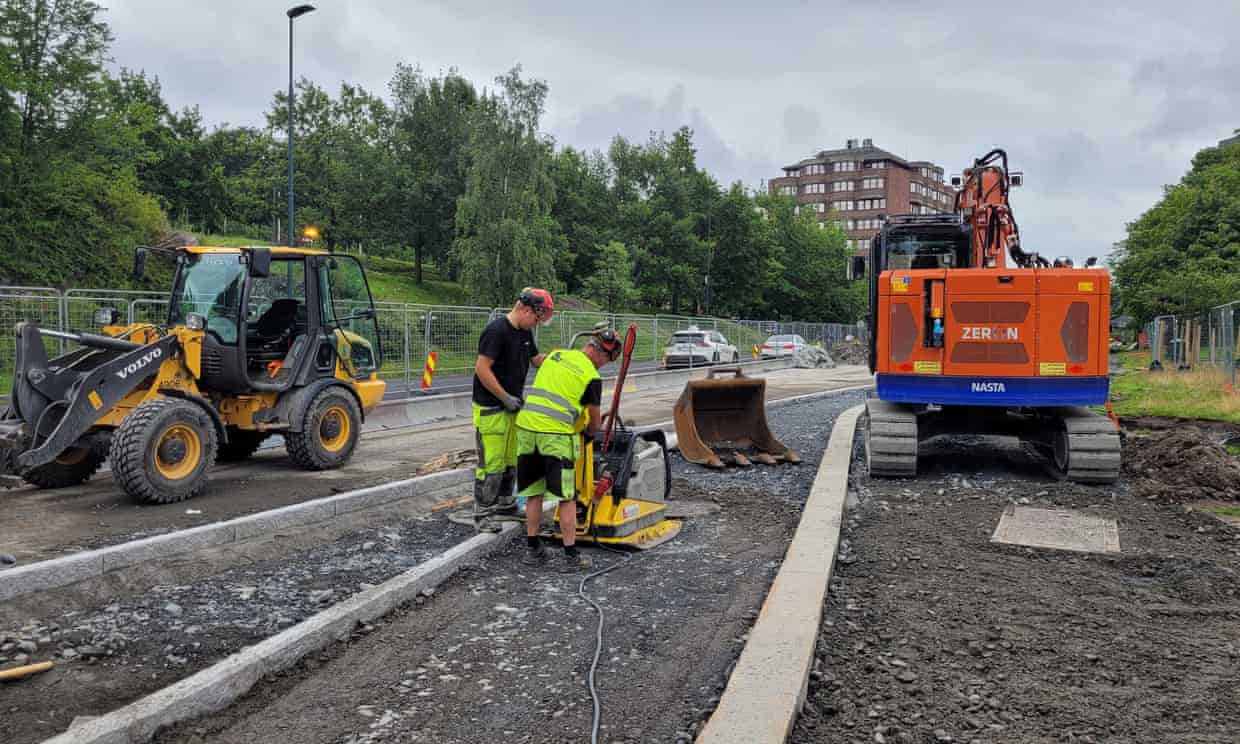
Photo: Ajit Niranjan/The Guardian.
The electric machinery at an emissions-free building site in Oslo, Norway, makes for quieter construction.

Whether we realize it or not, our noisy world is making us a little more jittery than we need to be. It’s not just the clangor and clash of big cities but near airports, hospitals with medivac helicopters, and construction sites.

Despite Norway’s reputation as one of the biggest oil producers, it is leading the way with electric vehicles, even at construction sites.

Ajit Niranjan has the story at the Guardian.

“Tafseer Ali felt no need to raise his voice as the pair of diggers lumbered past him, their treads weighing heavy on the rock and asphalt. Quiet electric machines like these make it easy to work in the city center, the construction manager said – and keep the neighbors happy. …

“The peaceful streets of Oslo are growing even calmer as the city drives noisy machines off municipal building sites. For locals and builders, the drop in decibels is a welcome side-effect of a goal to keep city-managed construction projects free from toxic emissions. The mandate, which is the first of its kind in the world, came into effect on 1 January.

“ ‘I don’t think we’re going to get to 100%, because not all [electric] machines are available on the market,’ said Ingrid Kiær Salmi, an engineer from Oslo’s urban environment agency, speaking to the Guardian at a building site in the city center last year. ‘But I think we’re going to get pretty close.’

“Construction is one of the biggest sources of urban air pollution, but even forward-thinking cities such as Oslo have struggled to clean it up. The Norwegian capital has led the way in replacing the petrol and diesel that powers its construction equipment with biofuels, which do little to heat the planet but still foul the local air. It is now moving to battery-powered machines.

“The latest data shows Oslo’s municipal building sites were 98% free from fossil fuels in 2023; three-quarters were powered by biofuels and less than one-quarter by electricity. For projects run by the urban environment agency, which has more recent data through to October 2024, two-thirds of machine hours were powered by electricity and one-third by biodiesel.

“The proportion of its projects powered by electricity has more than doubled in the past two years as new machines have come on to the market. …

“Electric vehicles are nothing new to Norwegians, who are more likely to drive a car with a big battery than one with a combustion engine, but the market for clean diggers [excavators] and wheel loaders still has a way to go. The building industry has pushed back on Oslo’s pioneering plans for moving too fast. …

“The requirement that all machinery on building sites must be emission-free is ‘at this point, neither effective nor cost-efficient,’ said Stine Marie Haugen, from the Norwegian construction and civil engineering contractors’ association.

“ ‘Currently, very few countries in Europe have a strong focus on emission-free machinery, which means that access to such equipment is somewhat limited,’ she said. ‘Only a few countries bear the development costs of bringing these machines to market.’

“But by taking on these costs, Norway and a handful of other countries are making clean machines cheaper and more attractive for cities around the world. Manufacturers say the early demand from procurement policies like Oslo’s has encouraged them to develop new electric machinery and make existing ones better.

“As the volume of vehicles increases, costs will come down – but ‘like with all new technology, there is a green premium,’ said Tora Leifland, the head of public affairs at Volvo Construction Equipment. A battery-powered machine can cost twice as much as a diesel one, she said, though it will save money on fuel and do little to inflate the overall costs of a construction project.

“There are also benefits that are harder to capture, such as quieter working conditions on-site and reduced disruptions to local communities and businesses.”

More details at the Guardian, here. No firewall. Contributions to support the Guardian‘s reliable journalism are solicited.
Read Full Post »

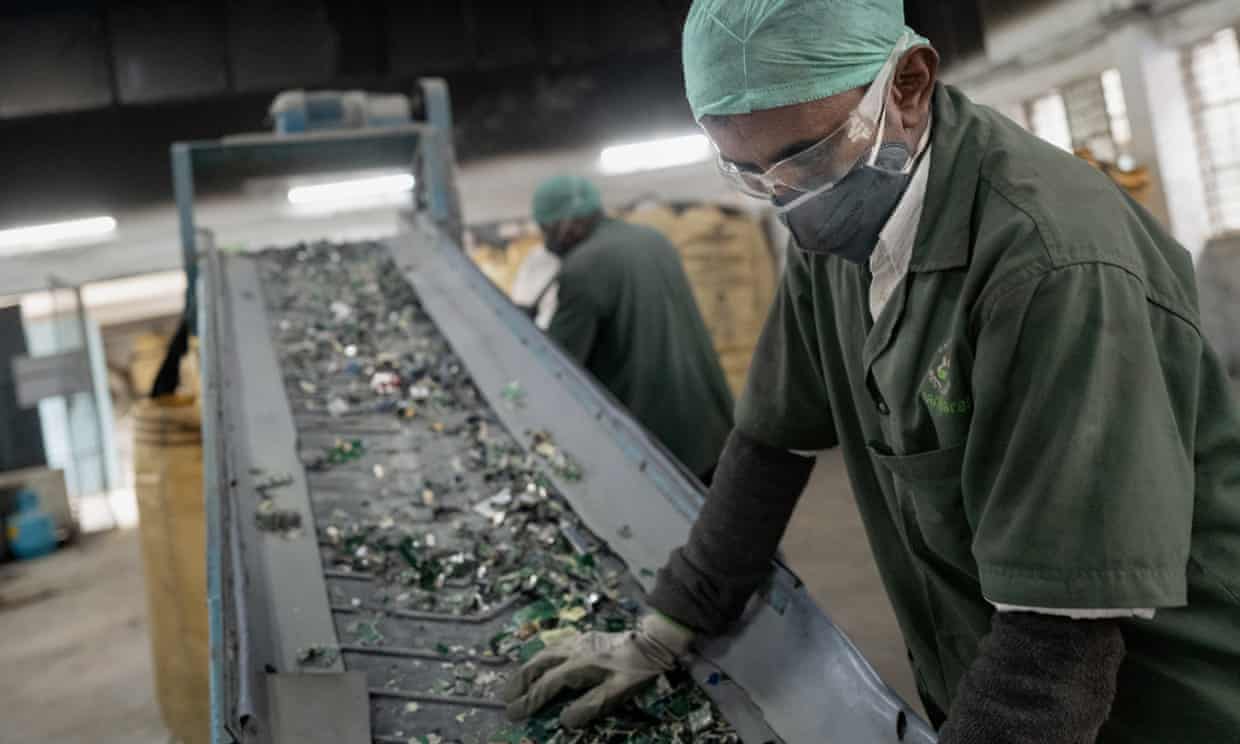
Photo: Elke Scholiers/Getty Images.
Workers sorting electronic waste at a factory in India. A team at University of Edinburgh is using microbes to recycle lithium, cobalt, and other expensive minerals — a greener way to go.

As we know, the downside of going all-electric to reduce the global-warming effects of fossil fuels is the mining of rare minerals for electricity, for batteries. But that mining can be destructive to communities wherever it’s done. Not to mention there’s a finite supply of such minerals on the planet.

Fortunately, human ingenuity even in the darkest times keeps functioning and looking for better ways to do things.

Robin McKie at the Guardian reports on what is potentially a greener way to acquire the rare minerals needed in the batteries we have today.

“Scientists have formed an unusual new alliance in their fight against climate change,” writes McKie. “They are using bacteria to help them extract rare metals vital in the development of green technology. …

“The work is being spearheaded by scientists at the University of Edinburgh and aims to use bacteria that can extract lithium, cobalt, manganese and other minerals from old batteries and discarded electronic equipment. These scarce and expensive metals are vital for making electric cars and other devices upon which green technology devices depend, a point stressed by Professor Louise Horsfall, chair of sustainable biotechnology at Edinburgh. …

“Said Horsfall, ‘All those photovoltaics, drones, 3D printing machines, hydrogen fuel cells, wind turbines and motors for electric cars require metals – many of them rare – that are key to their operations.’

“Politics is also an issue, scientists warn. China controls not only the main supplies of rare earth elements, but dominates the processing of them as well. ‘To get around these problems we need to develop a circular economy where we reuse these minerals wherever possible, otherwise we will run out of materials very quickly,’ said Horsfall. ‘There is only a finite amount of these metals on Earth and we can no longer afford to throw them away as waste as we do now.’ …

“And the key to this recycling was the microbe, said Horsfall. ‘Bacteria are wonderful, little crazy things that can carry out some weird and wonderful processes. Some bacteria can synthesize nanoparticles of metals, for example. We believe they do this as a detoxification process. Basically they latch on metal atoms and then they spit them out as nanoparticles so that they are not poisoned by them.’

“Using such strains of bacteria, Horsfall and her team have now taken waste from electronic batteries and cars, dissolved it and then used bacteria to latch on to specific metals in the waste and deposit these as solid chemicals. ‘First we did it with manganese. Later we did it with nickel and lithium. And then we used a different strain of bacteria and we were able to extract cobalt and nickel.’

“Crucially the strains of bacteria used to extract these metals were naturally occurring ones. In future, Horsfall and her team plan to use gene-edited versions to boost their output of metals. ‘For example, we need to be able to extract cobalt and nickel separately, which we cannot do at present.’

“The next part of the process will be to demonstrate that these metals, once removed from old electronic waste, can then be used as the constituents of new batteries or devices. ‘Then we will know if we are helping to develop a circular economy for dealing with green technologies.’ “

More at the Guardian, here. Remember the detestable partygoer in the Graduate who insisted “there’s a great future in plastics”? We now know what that kind of thinking led to. Sounds to me like the future might actually be in chemistry.

Read Full Post »

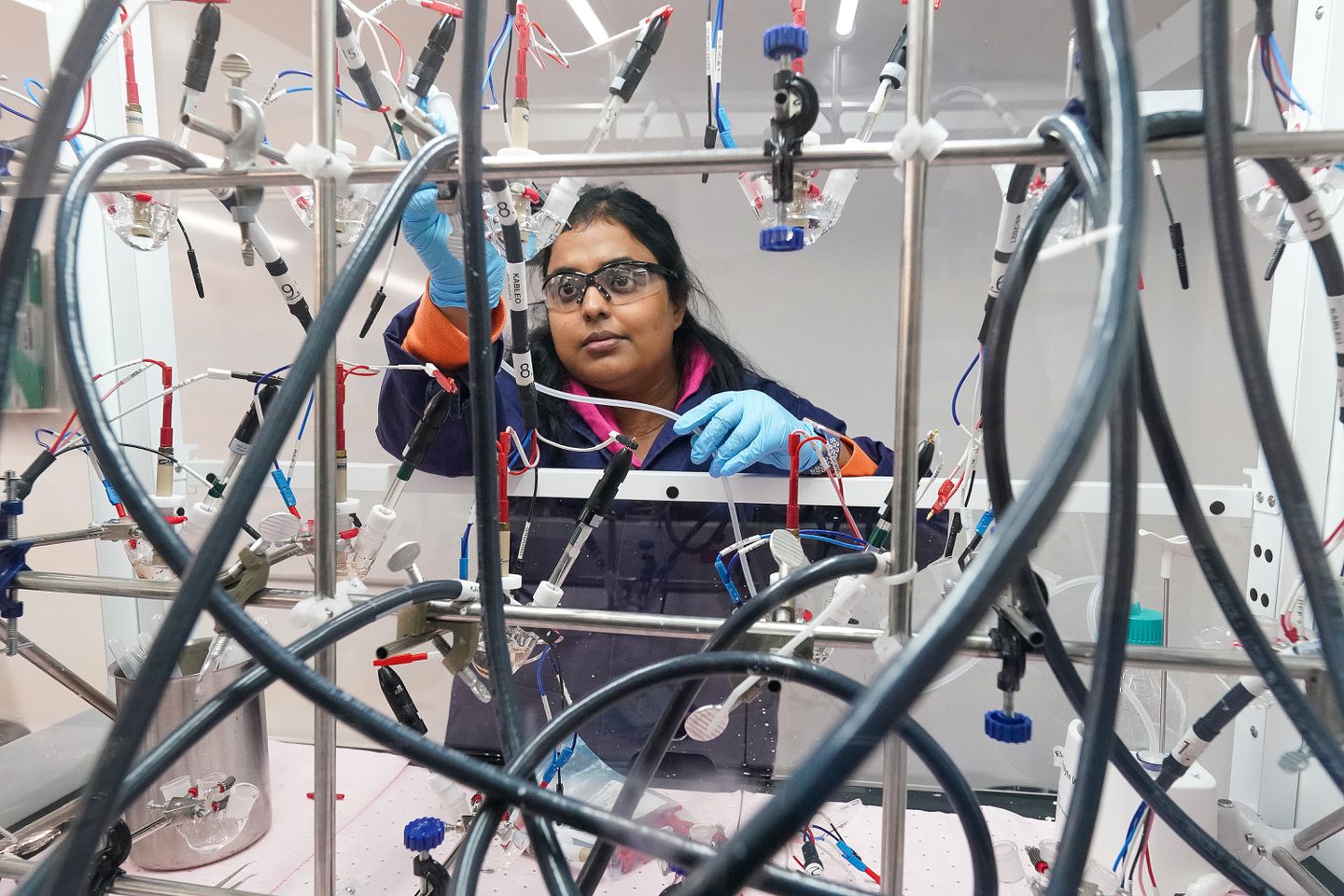
Photo: Barry Chin/Globe.
Alolika Mukhopadhyay, senior research scientist at Alsym Energy, validating a battery reaction in a testing room. “Alsym has developed a new kind of rechargeable battery that doesn’t use lithium. Instead it relies on cheap, plentiful minerals,” reports the Boston Globe.

Oh, I wish so much luck to this startup in Massachusetts! Some of you may remember the 1960s line “If you’re not part of the solution, you’re part of the problem.” Right? Well, I am part of the lithium problem, and this startup is trying to obviate the need for that blood mineral in batteries. As we turn more and more to electric, lithium mines are damaging the environment and the human communities nearby. I feel guilty every time I think about it.

But Hiawatha Bray reports at the Boston Globe that “A small startup in Woburn called Alsym Energy is working on one of the world’s biggest problems — the need for better, cheaper batteries for cars, electric utilities, and even seagoing ships.

“Alsym’s founders, veteran entrepreneur Mukesh Chatter and Massachusetts Institute of Technology professor Kripa Varanasi, say they’ve built a new kind of rechargeable battery that delivers the performance of lithium ion cells at half the cost.

“That’s largely because the batteries don’t contain lithium or cobalt — scarce and expensive metals mostly controlled by China. And Alsym says they will never burst into flame like lithium batteries, because none of the ingredients are flammable.

“Now, the 47-person startup is striking deals with shipping companies and an automaker to prove its claims in real-world use. The company is just one of many worldwide that are scrambling to find practical alternatives to lithium ion batteries. …

“Alsym has been in stealth mode since its founding in 2015. In some ways, it still is. The front door of the company’s offices displays the name of a dance academy. And Chatter is extremely secretive about the chemistry that makes his battery work. He hasn’t even tried to patent it, because that would require revealing the formula. Instead, it’s a trade secret, like the recipe for Coca-Cola.

“But Chatter did offer a few hints. The electrolyte — the material that carries energy between the two electrodes — is water mixed with some solvents that Chatter won’t identify. One of the electrodes is mostly made of manganese oxide, but Chatter wouldn’t say anything about the composition of the other — just that there’s no lithium or cobalt involved, and that all the materials are nonflammable, non-toxic and inexpensive.

“The company has gained the trust of investors, who’ve poured $32 million into the project, with Helios Climate Ventures leading the way.

Chatter, who previously founded a pair of networking hardware companies, began Alsym as a way to provide reliable electricity in developing countries.

“ ‘About 2 billion people in the world either don’t have electricity or have it only part of the time,’ said Chatter. … Solar cells and windmills can help, but they must be backed up with batteries to provide consistent power. Lithium cells are too expensive and unstable; Chatter claims his company’s batteries are much safer and cheaper.

“Chatter says he’s landed $2 billion in pre-orders for Alsym batteries. A small factory at the Woburn headquarters has begun cranking out prototypes. Alsym batteries can be made using the same equipment found at any lithium ion battery plant; only the materials inside the batteries are different. That means existing battery plants could quickly switch over if and when the Alsym batteries prove their worth.

“The first buyers will be Singapore-based cargo ship manager Synergy Marine and Japanese cargo ship owner Nissen Kaiun. The two companies plan to equip up to 100 of their seagoing ships with Alsym batteries as an auxiliary power source.

“Alsym has also signed a deal with one of India’s biggest carmakers to provide electric car batteries, though Chatter won’t say which company. It’s a big test for Alsym, because the typical new car in India costs about $10,000. In US electric cars, the battery alone can cost more than that. …

“Alsym is also in negotiations with a utility that’s interested in using batteries to store power from solar and wind farms, and then release the electricity as needed to the local power grid.

“But Shirley Meng, a materials science professor at the University of Chicago, is very dubious. She said that laboratories worldwide are trying to find alternatives to lithium batteries, so far without much success. ‘Lithium has such great performance,’ Meng said. …

“Alternatives to lithium have been invented, Meng said. But so far, they’ve only worked reasonably well on a small scale. In addition, any new battery chemistry would require the development of a new global supply chain for all the chemicals and components needed to make it work, and that could take years. …

“We should find out in a few years. Synergy Marine and Nissen Kaiun plans to conduct three years of real-world testing starting in 2023. Meanwhile, Alsym plans to begin full-scale production of its batteries in 2025.”

More at the Globe, here.

Read Full Post »

Photo: benedek/Getty Images.
Downtown Ithaca, New York. The city has a plan to lower the climate footprint of thousands of buildings across the city.

My family is trying to disentangle itself from fossil fuels. Too slowly, I fear. I have a hybrid car, and my husband has been working with an electrician to change out the gas stove for an electric one. Suzanne and Erik are looking into electric for cooking, too. John has an all-electric car and solar panels on the roof.

The thing is, I’m sure I would have started this process much sooner if I had realized earlier that gas was bad. I’ve been in my current home nearly 40 years, and I assure you that 40 years ago, I hadn’t a clue.

In Ithaca, New York, there are people who had a clue long before I did, as Mike De Socio reported at the Guardian in August.

“When Fred Schoeps bought a 150-year-old building in downtown Ithaca, New York, a decade ago, he was one of only a handful of building owners dedicated to ending their reliance on fossil fuels and reducing their carbon footprint.

“His three-year renovation of the building, comprising three apartments above a skate store, included installing energy-efficient windows and insulation, plus fully electric appliances, heating and cooling systems.

“But while that was an achievement on its own, said Schoeps, Ithaca cannot address climate change one building at a time. ‘In order to move the needle, you’ve got to think in terms of a thousand [buildings],’ he said.

“Luis Aguirre-Torres, Ithaca’s new director of sustainability, is trying to do exactly that. The upstate New York city of 30,000, home to Cornell University and Ithaca College, adopted a Green New Deal in 2019, a big part of which involves decarbonizing thousands of privately owned commercial and residential buildings across the city.

“Ithaca’s main climate objective is to eliminate or offset all of its carbon emissions ​​by 2030. The focus on retrofitting buildings – installing electric heating systems, solar panels and battery storage as well as reducing energy use and greening the electric grid – promises to tackle an often-overlooked but significant contributor to climate change:

buildings make up nearly 40% of US carbon emissions. …

“Ithaca is exploring a new solution to fund and motivate building owners to decarbonize: private equity.

“Aguirre-Torres has helped Ithaca – which has a total budget of less than $80m – raise $100m by offering investors entry to a large-scale program he pitched as low risk with the potential for lots of cashflow. The goal is to create a lending program providing low- or no-interest loans and quick implementation of sustainable technology. …

“For most homeowners, the program would help them swap out a gas furnace for an electric heat pump, or a gas stove for an electric one – changes that would otherwise involve high upfront costs. Aguirre-Torres says the program will also train a new green workforce in Ithaca. …

“The plan aims to create 1,000 new jobs by 2030, and the city has promised to redirect 50% of the financial benefits of its Green New Deal plan to low-income residents, although there are few specifics on how this will work.

“Conversations with investors started earlier this year. Covid-19 had already battered Ithaca’s finances, said Aguirre-Torres, and it was clear the city would never be able to fund this energy transformation alone.

“These discussions quickly revealed a problem: how do you keep a lending program affordable? ‘What we needed to do was bring down the cost of capital even further,’ Aguirre-Torres said.

“The city is addressing this by trying to reduce risk. It aims to create an economy of scale by sizing the program for 1,000 commercial and residential buildings in the first 1,000 days, which will mean more consistent work for contractors and lower material costs. Ithaca plans to use a $10m loan loss reserve, backed by New York state, that would act as a guarantee for lenders in case any borrower defaults. It will also secure insurance to protect against catastrophic losses,’ such as a massive default due to another pandemic, Aguirre-Torres said. …

“Ithaca’s reliance on private equity may be new, but the cash incentives and on-bill repayment programs have precedent in states around the country, such as New York and California.

” ‘We’ve seen this work,’ said Ethan Elkind, the director of the climate program at UC Berkeley’s Center for Law, Energy & the Environment. Utilities and municipalities have long been offering upfront dollars to ratepayers to encourage them to upgrade lightbulbs or home insulation.

“However, these types of improvements may be an easier sell than swapping out a gas range or fireplace. Consumer preference for natural gas appliances is one of the biggest barriers to home electrification. Cost is another. ‘If you have the money to do something to your house, putting in a new bathroom or kitchen is much more appealing to people than an invisible efficiency upgrade that pays for itself over eight years,’ Elkind said.

“Anne Rhodes has a different view, however. The 76-year-old Ithaca homeowner, who earns about $20,000 a year, is using an existing state incentive program to insulate her home and replace her oil heating system with electric heat pumps. In addition to the climate impact, she said the upgrades will make her home more comfortable to live in.”

More at the Guardian, here.

Read Full Post »

TreeHugger frequently covers biking. And since my four-year-old grandson has mastered all but the braking on his new two-wheeler and expects me to start biking with him, I think I better cover bikes, too.

Here is an article by Derek Markham from the TreeHugger website about a new bike that aims to combine the best of two worlds.

Writes Markham, “When you go from riding a skinny-tired road bike to a mountain bike with fat tires, it opens up a whole new world of cycling, even if you don’t ever leave the pavement. With fat tires (and perhaps some suspension), your bike can float right over bumps and cracks in the road without rattling your teeth, hopping up or down curbs is almost effortless …

“But even with these advantages, there are still riding situations that can bog down a mountain bike, such as sandy and snowy conditions, and if you really want to go where most people don’t, then a fat bike is the next logical step.

“Fat bikes, with their extremely wide (4″) tires, can make a sandy wash or a gravel road as easy to ride as a packed singletrack (well, almost as easy), and riding in and on snow and mud can be something you seek out instead of try to avoid. But those big fat tires also take some extra effort, and if your thighs aren’t quite up to the task of pedaling a fat bike through and over slush, snow, sand, gravel, or mud, a fat bike ride can be grueling. However, when you add the power of a 500W electric motor to a fat bike, such as Biktrix has done, a virtually unstoppable Juggernaut is created.” More here.

Hmmm. An upstoppable Juggernaut might impress my grandson, but I am pretty sure he doesn’t want me to be as impressive as he is. He told his dad Saturday, “You need to be slower than me.”

Besides, the electric part reminds me of mopeds, and I really don’t like mopeds.

Photo: Biktrix

Read Full Post »

A couple weeks ago, I wrote that I was reading Jason Elliot’s book on Iran. That was my post about the rediscovery of the “extinct” Caspian horse.

Elliot slams through millenia of history in that part of the world kind of like the comedy troupe that purports to perform “The Complete Works of Shakespeare” in 90 minutes. He is very good at it, I think. But maybe that’s because I know so little about the endlessly shifting borders of Central Asia and the Middle East.

Among other interesting tidbits in the book is this one on the Baghdad Battery. In Mirrors of the Unseen, Elliot writes that this ancient form of battery was “constructed of an earthenware shell containing an iron rod insulated by an asphalt plug from an outer copper sleeve. A modest electric current is produced when the housing is filled with an electrolytic solution such as lemon juice.”

Wikipedia has more. “The Baghdad Battery, sometimes referred to as the Parthian Battery, is the common name for a number of artifacts created in Mesopotamia, during the dynasties of Parthian or Sassanid period (the early centuries AD), and probably discovered in 1936 in the village of Khuyut Rabbou’a, near Baghdad, Iraq. These artifacts came to wider attention in 1938 when Wilhelm  König, the German director of the National Museum of Iraq, found the
objects in the museum’s collections. In 1940, König published a paper speculating that they may have been galvanic cells, perhaps used for electroplating gold and silver objects … This interpretation continues to be considered as at least a hypothetical possibility. If correct, the artifacts would predate Alessandro Volta’s 1800 invention of the electrochemical cell by more than a millennium.”

Read Full Post »